
外研版高中英语选修六module5readingandvocabulary
In what ways is the monster like a human being?
The monster has a body which is made
of human parts. How did Frankenstein create the
monster ? He used bones from dead bodies to make a creature and gave it life.
going to marry soon?
fiancée
ቤተ መጻሕፍቲ ባይዱ5. Which word means to kill someone?
murder
6. Which word is the noun of the word
beautiful?
beauty
7. Which word describes a part of the human body? bone
Q2: How did Frankenstein create the monster?
He used bones from dead bodies to make a creature and gave it life.
Q3: Why does Frankenstein decide to destroy the monster?
3.When the scientist saw the monster move, he felt _d_is_g_u_s_t_e_d because th_e__c_r_ea_t_u_r_e__w_a_s_u_g_l_y_.
4.When the monster came to Frankenstein’s bed, the scientist ra_n__o_u_t_i_n_t_o_t_h_e_g_a_r_d_e_n__a_n_d__h_id_.
Read Part 2 & Answer the Questions: Q1:Why was the young scientist so
disgusted when he first saw the monster?
Because he had wanted to create something beautiful, but it was very ugly.
Because the monster hates him, and kills his brother, friend and wife.
Q4: What do we learn about the monster’s appearance?
He is very ugly, with wrinkled Yellow skin and black lip.
高中英语课件
(madeofdingshangtuwen)
Read Part 1 & Answer the Questions:
Q1: In what ways is the monster like a human being?
The monster has a body which is made of human parts.
He hid in the garden because he was terrified by the monster and regretted having created him. Why did Frankenstein regret creating the monster?
Because he was terrified by it.
He is very ugly, with wrinkled yellow skin and black lip.
Why was the young scientist so disgusted when he first saws the monster?
Because he had wanted to create something beautiful, but it is very ugly.
5.The scientist regretted _h_a_v_i_n_g_m__a_d_e_t_h_e__m_o_n_s_t_e_r.
1.a terrifying dream
2. your blood moves through these in your body
3. the most northern part of the world 4. the thing that everything is made of 5. very different from
Q5: Why did the monster come to Frankenstein’s bedroom?
Because it wanted to talk to him.
Q5: What did Frankenstein do after running out of the room for the second time?
1.Why do you think Frankenstein refused to create a wife for the monster? 2. Why do you think the scientist dreamt
about his fiancee?
3. What do you think the monster might have wanted to say when he was standing by Frankenstein’s bed?
Why did the monster come to Frankenstein’s bedroom?
Because it wanted to talk to him.
What did Frankenstein do after running out of the room for the second time?
4. Do you think Frankenstein was right to be frightened by the monster when he stood by the scientist’s bed?
5. What do you think the scientist should have done? 6. How do you feel about the monster?
Explain why. 7. What is the lesson of the story, in your opinion?
something?
creation, creator
3. Which word means to quickly
follow someone in order to catch
him/her?
chase
beauty bone chase creation creator disgust
emotion fear fiancélifeless murder (v. n. ) 4. Which word refers to a woman who is
Q2: What had Frankenstein wanted more than anything in the world? To give life to a lifeless body.
Q4: Why did Frankenstein wake shaking with fear?
Because he had terrible dreams.
He hid in the garden because he was terrified by the monster and regretted having created him.
Q6: Why did Frankenstein regret creating the monster?
Because he was terrified by it.
1.The monster terrifies people because _it_i_s_u_n_u__su_a_l_l_y_l_a_rg_e__a_n_d__st_r_o_n_g_a_n__d —ex—tr—em—el—y u—gl—y —.
2.Frankenstein tries to destroy the monster because it__k_il_ls__th_r_e_e__p_e_o_p_le_.
What had Frankenstein wanted more than anything in the world?
To give life to a lifeless body.
Why did Frankenstein wake shaking with fear?
Because he had wanted to talk to him.
Why did Frankenstein decide to destroy the monster?
Because the monster hated him, and killed his brother, friend and wife.
What do we learn about the monster’s appearance ?
beauty bone chase creation creator disgust emotion fear fiancémurder (v.)
1.Which of these words are connected with feelings? disgust, emotion, fear
2. Which words are connected with making
外研版高中英语选修六Module 5CloningListening,Spenking and Writin16张PPT课件ppt
外研版选修六-module5教案
年级:高二科目:授课人:⑥ Words that describe the appearance of the monsterSuggestedAnswers :①Name of the film : Frankenstein .②Type of the film : Science fiction .⑧The author of the novel : Mary Shelley .④ When was the film made?In 1931(9 HOWamous is it? It ' S still the most famous of all the horror films@ Sentences that describe the appearance of the monster :He resembles a huge human being with ugly appearance . He has wrinkled skin , yellow eyes and black lips .He is also strong and big , which can terrify everyone who sees him .Step 2. Blackboard design教后反思备课组长签字:附注:课型填“常规课”或“复习课”或“习题课”或“多媒体课”富县高级中学集体备课教案年级:高二科目:授课人:⑥ refuse ⑦ tiny ⑧ extremely ⑨ intelligent2 . Scanning⑴Read Part 1 carefully , and answer the following questions .① In what ways is the monster like a human being?② How did Frankenstein create the monster?③ Why does Frankenstein decide to destroy the monster?SuggestedAnswers :①ne monster had a body which is made of human parts . It isintelligent and has human emotions .② He used bones from dead bodies to make a creature and gave it life .③ Because the monster hates him and kills his brother , bestfriend and his wife .(2)Read Part 2 carefully , and answer the following questions .①What do we learn about the monster ' S appearance?② Why WaS the young scientist SO disgusted when he first saw the monster?③What had Frankenstein wanted more than anything in the world?④ Why did Frankenstein wake shaking with fear?⑤Why did the monster come to Frankenstein ' S bedroom?⑥ What did Frankenstein do after running out of the room for the second time?⑦ Why did Frankenstein regTet creating the monster?SuggestedAnswers :①It is very ugly , with wrinkled yellow skin and black lips(2) Because he had wanted to create something beautiful , but it ' S very ugly .③ To give life to a lifeless body .@ Because he had terrible dreams .(D Because it wanted to talk to him .⑥ He hid in the garden because he was terrified by the monster and regret having created him .CD Because he was terrified by it .(3)Read P'm't 2 again and choose the best answers .① The first paragraph tells USA . the birth of the monsterB . the terrifying emotion of FrankensteinC . the scene where the monster WaS bernD . the cold night when the monster was bornCD Frankenstein saw this monster moved as a human being , hefelt _____A . happyB . excitedC . worriedD . frightened备课组长签字:年月日富县高级中学集体备课教案年级:高二科目:授课人:备课组长签字:年月日附注:课型填“常规课”或“复习课”或“习题课”或“多媒体课”。
外研版选修六Module5CloningListeningandvocabulary

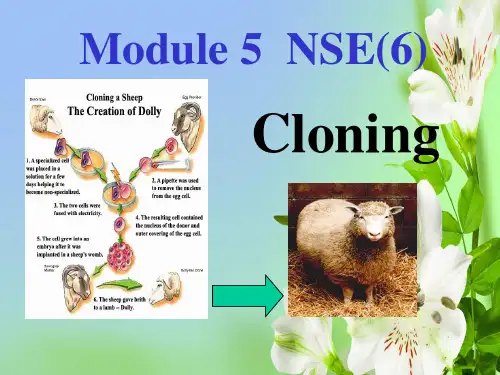
2. A sheep called Dolly was cloned in 11999987. 3. Dolly the sheep died in 2003.
A clone can never be an ________ copy, your genes, ________ and ________ work together create who you are.
We could clone animals that are __________ ___________
3. Cloned animals get ill and die quite young._A__
4. People are afraid that scientists XXX create thousands of copies of the same person._A__
5. Cloning is dangerous because scientists may create monsters by mistake.__A__
√ give them a child.____ √ 3. Cloned animals get ill and die quite young.___ √ 4. People are afraid that scientists XXX create
thousands of copies of the same person.___
6. We could use cloning to cure illness.__F___
外研版高中英语选修六《Module5Cloning》教案
高中英语学习材料madeofjingetiejiI.教学内容分新本模块以“Cloning”为话题,通过一篇科幻小说引入话题,并复习以前学过的描写电影和小说的词汇,旨在让学生初步了解一些关于生命科学方面的知识,并能就自己所了解的相关知识发表自己的看法。
能较明确地表达自己赞成或反对克隆的理由。
Introduction部分通过对Frankenstein这部恐怖电影的介绍,使学生对该电影有初步的了,解,并让学生复习关于描述电影的词汇。
Reading and Vocabulary部分选取了Frankenstein这部恐怖电影的故事大纲和部分片段,并设置了五个相关练习。
第一题要求学生阅读全文并完成句子,该部分内容能很好地训练学生理解文章的能力;第二、三题则通过词义解释和回答问题的方式来考查学生对词汇的认识程度;第四题让学生回答十个与文章相关的问题,促使学生更好地理解文章的细节;第五题让学生在理解文章后,回答几个问题并进行相关的讨论,从而为本模块的Speaking and Writing做好充分的准备。
Function部分通过对阅读文章中5个句子的提问,使学生初步了解如何谈论和表达“对现在和过去的遗憾”,并通过相关的练习使学生较熟练地掌握该功能项目。
Speaking部分要求学生以对话的方式,运用新学的语言功能项目,来说明各自对课文内容的理解,培养学生在学中用、在用中学的能力。
Listen~and Vocabulary部分先是对克隆技术的简单介绍,旨在让学生为接下来的听力内容储备相关的背景知识和词汇。
听力内容是一段对一位从事克隆研究的科学家的采访,要求学生在听的基础上完成判断对错的题目,在之后的练习中纠正错误信息。
Grammar部分介绍了虚拟语气这一高中语法的难点,让学生通过上下文的联系来理解听力材料中的虚拟句,并回答问题,从而加深对虚拟句的理解,同时在具体的语境里,学会使用虚拟语气。
Everyday English部分列出了几个在听力材料里出现过的短语,通过词义搭配和社会对话的练习,使学生在理解短语的基础上能较自然准确地使用所学的内容。
最新外研版高中英语高中英语 Module5 Listening and vocabulary 外研版选修6课件PPT.ppt

Presenter: So cloned animals come from one parent only. Hugh D: Precisely. Presenter: How successful has cloning been so far? Hugh D: Well, as most people know, in 1997 scientists cloned a sheep called Dolly. Since then, scientists have cloned animals such as pigs and cats. Presenter: You make cloning sound easy.
wtGhaiinvtegtsahdet omley?aosut aorngeuereaabsoount?.
Say which of the arguments below are for cloning and which are against cloning.
1. Cloning is against nature.
A gene—the part of a cell that controls how it develops
外研版高中英语选修6-11课本目录(义务教育教科书)
高二英语选修6电子课本目录MODULE 1 Small TalkINTRODUCTIONVOCABULARY AND READINGFUNCTIONREADING AND LISTENINGGRAMMARREADING AND WRITINGREADING AND VOCABULARYEVERYDAY ENGLISHREADING PRACTICECULTURAL CORNERTASKModul e FileMODULE 2 Fantasy LiteratureINTRODUCTIONREADING AND VOCABULARYGRAMMARSPEAKINGLISTENING AND VOCABULARYGRAMMARFUNCTIONSPEAKINGVOCABULARY AND READINGEVERYDAY ENGLISHWRITINGREADING PRACTIONCULTURAL CORNERTASKMODULE 3 Interpersonal Relationships——Friendship INTRODUCTIONREADING AND VOCABULARYGRAMMAR(1)SPEAKINGLISTENING AND VOCABULARYGRAMMAR(2)FUNCTION AND SPEAKINGVOCABULARY AND READINGEVERYDAY ENGLISHWRITINGREADING PRACTIONCULTURAL CORNERTASKModul e FileMODULE 4 MusicINTRODUCTIONREADING AND VOCABULARYGRAMMARVOCABULARY AND LISTENINGVOCABULARY AND READINGFUNCTIONSPEAKINGWRITINGEVERYDAY ENGLISHREADING PARCTICECULTURAL CORNERTASKMODULE 5 Cl oningINTRODUCTIONREADING AND VOCABULARYFUNCTIONSPEAKINGLISTENING AND VOCABULARYGRAMMAREVERYDAY ENGLISHVOCABULARY AND READINGWRITINGREADING PARCTICECULTURAL CORNERTASKModul e FileMODULE 6 War and PeaceINTODUCTIONVOCABULARY AND READINGGRAMMARLISTENI NGFUNCTIONREADING AND WRITINGSPEAKINGREADING AND VOCABULARYEVERYDAY ENGLISHREADING PRACTICECULTURAL CORNERTASKModul e FileMODULE 7 RevisionGRAMMAR AND FUNCTIONVOCABULARYSPEAKINGREADINGLISTENING AND WRITINGWRITINGMODULE 1 Small TalkMODULE 2 Fantasy LiteratureMODULE 3 Interpersonal Relationships——Friendship MODULE 4 MusicMODULE 5 Cl oningMODULE 6 War and PeaceAppendicesNotes to the TaxtsGrammarWords and ExpressionsNames and PlacesVocabulary高二英语选修7电子课本目录Modul e1 BasketballINTRODUCTIONREADING AND VOCABULARYSPEAKINGGRAMMAR 1LISTENING AND VOCABULARYFUNCTIONREADING AND WRITINGGRAMMAR 2READING PRACTICECULTURAL CORNERTASKMODULE FILEModul e2 Highlights of My Senior Year INTRODUCTIONREADING AND VOCABULARY 1GRAMMAR 1SPEAKINGREADING AND VOCABULARY 2LISTENING AND VOCABULARYGRAMMAR 2FUNCTIONREADING AND VOCABULARY 3SPEAKINGEVERYDAY ENGLISHWRITINGREADING PRACTICECULTURAL CORNERTASKMODULE FILEModul e3 LiteratureINTRODUCTIONREADING AND VOCABULARY 1GRAMMAR 1SPEAKING 1VOCABULARY AND LISTENINGGRAMMAR 2 AND FUNCTIONSPEAKING 2EVERYDAY ENGLISHREADING AND VOCABULARY 2WRITINGREADING PRACTICECULTURAL CORNERTASKMODULE FILEModul e4 Music Born in America INTRODUCTIONREADING AND VOCABULARYGRAMMAR 1LISTENINGGRAMMAR 2FUNCTIONEVERYDAY ENGLISHREADING AND WRITINGSPEAKINGREADING PRACTICECULTURAL CORNERTASKMODULE FILEModul e5 Ethnic CultureINTRODUCTIONREADING AND VOCABULARY 1GRAMMAR 1SPEAKINGLISTENING AND VOCABULARYGRAMMAR 2EVERYDAY ENGLISHSPEAKING AND FUNCTIONREADING AND VOCABULARY 2WRITINGREADING PRACTICECULTURAL CORNERTASKMODULE FILEModul e6 The Worl d"s Cultural Heritage INTRODUCTIONVOCABULARY AND READINGGRAMMAR 1LISTENING AND VOCABULARYGRAMMAR 2 AND FUNCTIONREADING AND WRITINGSPEAKINGREADING PRACTICECULTURAL CORNERTASKMODULE FILEModul e7 RevisionGRAMMAR AND FUNCTIONSVOCABULARYVOCABULARY AND READINGLISTENINGSPEAKINGWRITINGWORKBOOKModul e1 BasketballModul e2 Highlights of My Senior YearModul e3 LiteratureModul e4 Music Born in AmericaModul e5 Ethnic CultureModul e6 The Worl d"s Cultural Heritage Appendices 附录Notes to the TextsGrammarWords and ExpressionsNames and PlacesVocabulary封底高二英语选修8电子课本目录Modul e1 Deep SouthINTRODUCTIONREADING AND VOCABULARY 1SPEAKING AND WRITINGGRAMMAR 1READING AND VOCABULARY 2LISTENING AND SPEAKINGEVERYDAY ENGLISHGRAMMAR 2WRITING AND SPEAKINGREADING PRACTICECULTURAL CORNERTASKModul e FileModul e2 The RenaissanceINTRODUCTIONREADING AND VOCABULARY 1GRAMMARLISTENING AND SPEAKINGGRAMMARREADING AND WRITING 2VOCABULARYREADING PRACTICECULTURAL CORNERTASKModul e FileModul e3 Foreign FoodINTRODUCTIONREADING AND VOCABULARY 1GRAMMAR 1VOCABULARY AND LISTENINGSPEAKINGEVERYDAY ENGLISHREADING 2GRAMMAR 2WRITINGREADING PRACTICECULTURAL CORNERTASKModul e FileModul e4 Which English?INTRODUCTIONREADING AND VOCABULARY 1GRAMMAR 1LISTENINGEVERYDAY ENGLISHGRAMMAR 2SPEAKINGREADING AND VOCABULARY 2WRITINGREADING PRACTICECULTURAL CORNERTASKModul e FileModul e5 The Conquest of the Universe INTRODUCTIONREADING AND VOCABULARY 1GRAMMARLISTENING AND SPEAKINGEVERYDAY ENGLISHGRAMMARSPEAKINGREADING AND VOCABULARY 2WRITINGREADING PRACTICECULTURAL CORNERTASKModul e FileModul e6 The Tang PoemsINTRODUCTIONREADING AND VOCABULARY 1GRAMMARLISTENING AND SPEAKINGEVERYDAY ENGLISHGRAMMARREADING AND WRITING 2READING PRACTICECULTURAL CORNERTASKModul e FileModul e7 RevisionGRAMMARVOCABULARYLISTENINGREADINGSPEAKING AND WRITING WORKBOOKModul e1 Deep SouthModul e2 The RenaissanceModul e3 Foreign FoodModul e4 Which English?Modul e5 The Conquest of the UniverseModul e6 The Tang Poems Appendices 附录Notes to the TextsGrammarWords and ExpressionsNames and PlacesVocabulary封底高三英语选修9电子课本目录Modul e1 Bernard Shaw"s PygmalionINTRODUCTIONREADING AND VOCABULARY 1LANGUAGE IN USE 1VOCABULARY AND LISTENINGSPEAKINGLANGUAGE IN USE 2READING AND VOCABULARY 2PRESENTATION SKILLSREADING PRACTICECULTURAL CORNERTASKMODULE FILEModul e2 DNA - the Secret of LifeINTRODUCTIONREADING AND VOCABULARY 1LANGUAGE IN USE 1VOCABULARY AND LISTENINGLANGUAGE IN USE 2READING AND VOCABULARY 2PRESENTATION SKILLSREADING PRACTICECULTURAL CORNERTASKMODULE FILEModul e3 The Qin Tomb and the Terracotta Warriors INTRODUCTIONREADING AND VOCABULARY 1LANGUAGE IN USE 1VOCABULARY AND LISTENINGSPEAKINGLANGUAGE IN USE 2READING AND VOCABULARY 2PRESENTATION SKILLSREADING PRACTICECULTURAL CORNERTASKMODULE FILEModul e4 Languages of the Worl d INTRODUCTIONREADING AND VOCABULARYLANGUAGE IN USE 1LISTENING AND VOCABULARYREADING AND SPEAKINGLANGUAGE IN USE 2PRESENTATION SKILLSREADING PRACTICECULTURAL CORNERTASKMODULE FILEModul e5 The First AmericansINTRODUCTIONREADING AND VOCABULARY 1LANGUAGE IN USE 1LISTENINGLANGUAGE IN USE 2READING AND VOCABULARY 2PRESENTATION SKILLSREADING PRACTICECULTURAL CORNERTASKMODULE FILEModul e6 Why Do We Need Dictionaries?INTRODUCTIONREADING AND VOCABULARY 1SPEAKINGLANGUAGE IN USE 1LISTENING AND VOCABULARY 1LANGUAGE IN USE 2READING AND VOCABULARY 2PRESENTATION SKILLSREADING PRACTICECULTURAL CORNERTASKMODULE FILEModul e7 RevisionVOCABULARYLANGUAGE IN USE 1LISTENINGSPEAKINGLANGUAGE IN USE 2READINGWRITINGWORKBOOKModul e1 Bernard Shaw"s PygmalionModul e2 DNA - the Secret of LifeModul e3 The Qin Tomb and the Terracotta WarriorsModul e4 Languages of the Worl dModul e5 The First AmericansModul e6 Why Do We Need Dictionaries? Appendices 附录Notes to the TextsGrammarWords and ExpressionsNames and PlacesVocabulary封底高三英语选修10电子课本目录Modul e1 Prid e and PrejudiceINTRODUCTIONREADING AND VOCABULARY 1LANGUAGE IN USE 1VOCABULARY AND LISTENINGLANGUAGE IN USE 2READING AND VOCABULARY 2PRESENTATION SKILLSREADING PRACTICECULTURAL CORNERTASKModul e FileModul e2 Australia and New ZealandINTRODUCTIONREADING AND VOCABULARY 1LANGUAGE IN USE 1VOCABULARY AND LISTENINGLANGUAGE IN USE 2READING AND VOCABULARY 2PRESENTATION SKILLSREADING PRACTICECULTURAL CORNERTASKModul e FileModul e3 Slavery and the American Civil War INTRODUCTIONREADING AND VOCABULARY 1LANGUAGE IN USE 1LISTENING AND SPEAKINGLANGUAGE IN USE 2READING AND VOCABULARY 2PRESENTATION SKILLSREADING PRACTICECULTURAL CORNERTASKModul e FileModul e4 The Magic of FilmINTRODUCTIONREADING AND VOCABULARY 1LANGUAGE IN USE 1LISTENING AND VOCABULARYLANGUAGE IN USE 2PRESENTATION SKILLSREADING PRACTICECULTURAL CORNERTASKModul e FileModul e5 High-tech LivingINTRODUCTIONREADING AND VOCABULARY 1LANGUAGE IN USE 1VOCABULARY AND LISTENINGLANGUAGE IN USE 2READING AND VOCABULARY 2PRESENTATION SKILLSREADING PRACTICECULTURAL CORNERTASKModul e FileModul e6 The Mapl e Leaf Country INTRODUCTIONLANGUAGE IN USE 1READING AND VOCABULARY 1LISTENING AND VOCABULARYLANGUAGE IN USE 2READING AND VOCABULARY 2PRESENTATION SKILLSREADING PRACTICECULTURAL CORNERTASKModul e FileModul e7 RevisionVOCABULARYLANGUAGE IN USE 1LISTENINGLANGUAGE IN USE 2READINGSPEAKINGWRITINGWORKBOOKModul e1 Prid e and PrejudiceModul e2 Australia and New ZealandModul e3 Slavery and the American Civil War Modul e4 The Magic of FilmModul e5 High-tech LivingModul e6 The Mapl e Leaf Country Appendices 附录Notes to the TextsGrammarWords and ExpressionsNames and PlacesVocabulary封底高三英语选修11电子课本目录Modul e1 The Boston Tea PartyINTRODUCTIONREADING AND VOCABULARYLANGUAGE IN USE 1LISTENING AND VOCABULARYLANGUAGE IN USE 2READINGPRESENTATION SKILLSREADING PRACTICECULTURAL CORNERTASKModul e FileModul e2 The Long Walk to Freed om INTRODUCTIONREADING AND VOCABULARY 1LANGUAGE IN USE 1LISTENINGLANGUAGE IN USE 2READING AND VOCABULARY 2PRESENTATION SKILLSREADING PRACTICECULTURAL CORNERTASKModul e FileModul e3 Ernest HemingwayINTRODUCTIONREADING AND VOCABULARY 1LANGUAGE IN USE 1VOCABULARY AND LISTENINGLANGUAGE IN USE 2READING AND VOCABULARY 2READING PRACTICECULTURAL CORNERTASKModul e FileModul e4 Sherl ock HolmesINTRODUCTIONREADING AND VOCABULARYLANGUAGE IN USE 1VOCABULARY AND LISTENINGLANGUAGE IN USE 2READINGPRESENTATION SKILLSREADING PRACTICECULTURAL CORNERTASKModul e FileModul e5 The Last LaughINTRODUCTIONREADING AND VOCABULARYLANGUAGE IN USE 1LISTENING AND SPEAKINGLANGUAGE IN USE 2READING AND SPEAKINGPRESENTATION SKILLSREADING PRACTICECULTURAL CORNERTASKModul e FileModul e6 The United NationsINTRODUCTIONREADING AND VOCABULARY 1LANGUAGE IN USE 1LISTENING AND VOCABULARYLANGUAGE IN USE 2READING AND VOCABULARY 2PRESENTATION SKILLS外研版高中英语选修6-11课本目录(义务教育教科书)READING PRACTICECULTURAL CORNERTASKModul e FileModul e7 RevisionVOCABULARYLANGUAGE IN USE 1LISTENINGLANGUAGE IN USE 2READINGSPEAKINGWRITINGWORKBOOKModul e1 The Boston Tea PartyModul e2 The Long Walk to Freed omModul e3 Ernest HemingwayModul e4 Sherl ock HolmesModul e5 The Last LaughModul e6 The United NationsAppendices 附录Notes to the TextsGrammarWords and ExpressionsNames and PlacesVocabulary封底21。
外研版高中英语选修六《Module5Cloning》Period3ListeningandVocabulary,EverydayEnglish
高中英语学习材料(灿若寒星*制作整理)Teaching Goals:1.To review what Ss learnt last period.2.To get Ss to master some new words.3.To enable Ss to know some skills of listening.4.To enable Ss to learn more about cloning.and help Ss learn how to know more about genetics.Teaching Procedures:Step I.RevisionCheck the answers to the Reading exercises in the Workbook.Then give Ss some instructions.Step 2.Vocabulary studyPurpose:To enable Ss to learn more about cloning and genetics.1.Group workLet Ss look at the pictures on 1)45 and answer the questions in Activity 1.Suggested Answers:(1)Our parents.(2)One.(3)In a laboratory.(4)They have identical genes,and SO are identical in every way.2.Individual workFill in the blanks with the following words.]argument,be for,be [against,beneficial,laboratory,cell,clone,create,gene,identical,nature,scientist]As most people know,in 1997 scientists ________ a sheep called Dolly inthe________by using the_________of another sheep .Since then ,there ale many__________about cloning .Some people __________it ,because they think cloning is_________to human beings .It is a way of helping ___________ .For example ,we couldclone animals that are becoming extinct .But some people _____________it .They thinkit ’s a terrible idea to create a(n)____________copy .Suggested Answers :(1)cloned (2)laboratory (3)genes (4)arguments (5)are for(6)beneficial(7)nature (8)are against(9)identicalStep 3.ListeningPurpose :To develop Ss ’listening ability .1.Pre-listeningAsk Ss to read the sentences in Activity 3 on P45,and say which of the argumentsare for cloning and which are against cloning .Write F(for)or A(against).Suggested Answers : 。
外研版高中英语选修6Module5_Listening_and_Vocabulary_公开课教学设计
Unit5 Listening, Speaking and vocabulary 名师教学设计Listening and V ocabularyTeaching goals1. Target languageHelp the students to master the expressions about being for or against sth .2. Ability goalsEnable Ss to know some skills of listening.3. Learning ability goalsHelp the students to learn how to debate .Teaching important pointsTrain the students’ listening and speaking ability.How to help the students to master the useful expression.Teaching difficult pointsHow to help the students finish the task of listening and speaking. How to debate in a proper way .Teaching methodsListening and discussion Teaching aids :A computer and a projector . Teaching procedures :Step 1.Lead in :Help the students know more about cloning. What is clone ?1. Who do we get our genes from?2. Who do cloned animals get their genes from?3. Are the parents in two sentences the same? Why?4. What’s the relationship between the cloned animal and its parent?Step 2.Pre-listening:Say which of the arguments below are the advantages and which are disadvantages and why and then underline the key words .Step 3:while listeningListen to the tape and check which of them are mentionedTip: While listening ,pay attention to the underlined key words .1.Cloning is against nature._______.2.Cloning will be beneficial to humans. For example, if a couple can’t have children, cloning could help give them a child.____3.Cloned animals get ill and die quite young.___4.People are afraid that scientists will create thousands of copies of the same person.___5.Cloning is dangerous because scientists may create monsters by mistake.____6. We could use cloning to cure illness._____Listen again and correct the wrong information .Skill: Before listening ,don’t forget to read and predict the key words that you should pay attention to .1. Dr Hugh Donaville works for a company that has already cloned a number of people.2. A sheep called Dolly was cloned in 1998.3. Dolly the sheep died in 2003.4. Donaville thinks scientists treated Dolly the sheep as a product.5. Donaville says that if a child is very ill, scientists could clone it.6. Donaville thinks is a good idea to have thousands of copies of the sameperson.7. Donaville says that we could clone animals that have become extinct.Step4:after learning : conclusion :1. Skill:Before listening :Read the sentences , predict the key words and then underline them . While listening :focus on the key words .2. Knowledge:What is cloning ?The advantages and disadvantages . The scientist’s idea on cloning .Step 5:activity :English Debate Competition Steps of the English debate1.Say your opinionOne group member of each group to state your opinion in 3 sentences .2.Debate the topic freelyA. For side state his opinion and then against side should point out what do you disagree with . Then against side states his opinion and for side ….B. Each side could ask a question to the other side. If you can’t answer it ,the other group will get marks. Rules of the English debatee as many expressions learned in module 5 as possible.2.Make yourself understood by others ,and if not understood, you can’t get marks .e polite and proper words to debate.Homework:Write a composition about “To clone or not clone?”1.The advantages of cloning2.The disadvantages of cloning3.Your view on cloning .。
外研版高中英语选修六Module 5Cloningintroduction,reading and voca413张PPT6课件ppt
monster.
False
5. Frankenstein has never regretted creating the
monster.
False
Find a sentence in the passage to replace the sentence below
Match the correct definition in Column A
with words or phrases in Column B
1.extremely frightening 2.be similar to 3.disappear suddenly 4.strong dislike for sth 5.never having had life 6.run after in order to seize it
destroy him. In the end, both of them die in the snow.
Imagine you are the scientist Frankenstein, who is interviewed by a reporter about the creation of the monster.
create a wife for him
Frankenstein’s feeling It is too frightening and ugly; he about the monster regrets for what he did.
The ending of both Frankenstein dies in the chase of the
高中英语 M5 Listening and vocabulary课件 外研版选修6
Say which of the arguments below are for cloning and which are against cloning.
1. Cloning is against nature.
Hugh D: I agree, if that happened, it would be terrible. We need laws to prevent that. Presenter: I’m glad you agree about that. But why do scientists want to clone humans? I can’t see any good reasons for this. Hugh D: On the contrary, there are very good reasons. For example, if a couple can’t have children, then cloning can give them a child. And if a child dies, we could clone it. Presenter: Create an identical copy, you mean? I think that’s a terrible idea.
4. People are afraid that scientists will create thousands of copies of the same person.
5. Cloning is dangerous because scientists may create monsters by mistake.