
外研版七年级英语上册同步练习题:Module 9 Unit1
[见学生用书B62] Ⅰ.语法填空 阅读下面短文,按照句子结构的语法性和上下文连贯的要求,在空白处填入一个适当的词或使用括号中词语的正确形式填空。 Today is Saturday.It's nine o'clock.The Smiths __1__(be)all at home.Mrs Smith is watching a TV shopping programme(节目).She wants to buy a bike(自行车)__2__ TV,__3__ she wants to ride one to work.Mr Smith's __4__(read)a newspaper about some news.Their son,Jim,is talking on the phone.He is calling one of his __5__(friend).He wants to go to the zoo __6__(see)animals with his friend.Their daughter,Lily,is playing __7__ her small dog.She is only four years old.Look,she's eating a banana.This is __8__(she)favourite fruit.__9__ is that over there?Oh,it's a cat.It's sleeping.“Jim,please keep quiet.__10__(not)wake it up(弄醒)!” 1.__are__ 2.__on__ 3.__because__ 4.__reading__ 5.__friends__ 6.__to__see__ 7.__with__ 8.__her__ 9.__What__ 10.__Don't__ Ⅱ.阅读理解 A When I'm sitting at the table,father comes into the room and says to us with a smile,“I forget(忘记)to tell you the good news.There is a letter(信)from Aunt Amy.She's coming to see us with her little son Tony this afternoon.I'm going to meet them at the station.” I'm so happy to hear the news,because I really like playing with Tony.Mother is happy,too.She misses(想念)Aunt Amy a lot. After lunch,mother and I go to the supermarket(超市).We buy lots of food.Then we go back home and begin to clean the house.We are both busy but very happy.At four o'clock we finish all the things and we sit around the table to wait for them. ( A )1.What makes father happy? A.There is a letter from Aunt Amy. B.There is a letter to Aunt Amy. C.There is a letter from Tony. D.There is a letter to Tony. ( C )2.Who will go to the station to meet Aunt Amy and Tony? A.My mother. B.I. C.My father. D.Nobody. ( B )3.I like ______. A.playing with Aunt Amy B.playing with Tony C.meeting Aunt Amy at the station D.going to the station ( A )4.What do I do after lunch? A.Go to the supermarket to buy something. B.Go to the station. C.Go to meet Tony. D.Play with Tony. ( A )5.What do I do at 4 o'clock? A.Wait for Aunt Amy and Tony. B.Clean the house. C.Go back home. D.Have dinner. B I'm Jiang Ling from Hangzhou and I'm in Class 2.There are forty-five students in my class— twenty boys and twenty-five girls.I have got two good friends.One is Hu Ning.He is on my left.He is good at maths.The other is Tu Guo.He is on my right.IT is his favourite.After school,we usually read in the library or work on the computer.Now we are having a history lesson. I'm Paul from London and I'm in Class 4.There are twenty-two students in my class—twelve girls and ten boys.Tim is my good friend.He is behind me.He is tall and he is good at PE.We usually play basketball on Friday afternoon.Now it's cool.We're playing basketball in the playground. ( C )6.There are ______ boys in Jiang Ling's class. A.10 B.12 C.20 D.25 ( A )7.Where does Hu Ning sit? A.On Jiang Ling's left. B.Behind Tu Guo. C.On Jiang Ling's right. D.In front of Tu Guo. ( D )8.What are Jiang Ling and his friends doing now? A.Playing in the playground. B.Reading in the library. C.Working on the computer. D.Having a history lesson. ( B )9.What's Paul's good friend good at? A.Maths. B.PE. C.IT. D.History. ( B )10.When do Paul and his friend usually play basketball? A.On Wednesday afternoon. B.On Friday afternoon. C.On Saturday morning. D.On Sunday morning. Ⅲ.任务型阅读 This is a picture of a park.There are many people in the park.They are having a good time.Some boys are playing games.Some girls are singing and dancing under a big tree.Two old men are playing chess near the tree.Some young men are swimming in the lake.Others are boating on the lake.Where is Jim?Can you find him?Yes,he is fishing by the lake(湖).Where is Kate?She is over there.She is running after a white cat.She wants to catch it.In the park all the people are very happy. 根据短文内容,完成表格。 People What are they doing?
Some boys andsome girls Some boys are __1__.Some girls are __2__ under a big tree. Some young men and two old men Some young men are __3__ in the lake.Two old men are playing chess near the tree.
Jim and Kate Jim is fishing by the lake and Kate is running after __4__. __5__ They are boating on the lake. 1.__playing__games__ 2.__singing__and__dancing__ 3.__swimming__ 4.__a__white__cat__ 5.__Others__
外研版七年级英语上册Unit 1 综合素质评价含答案
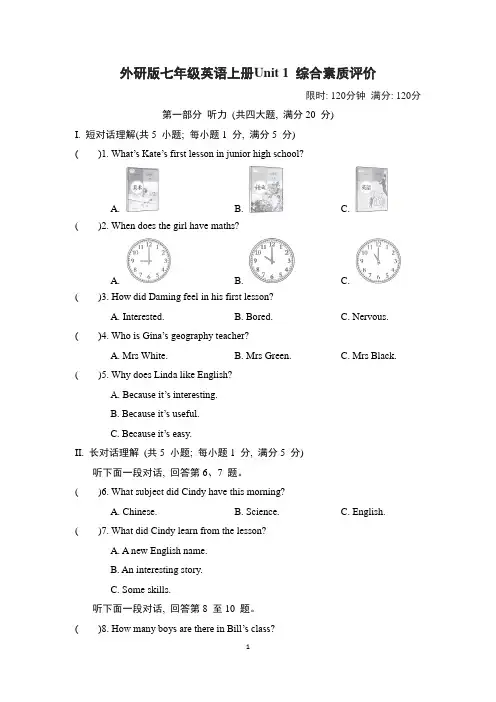
外研版七年级英语上册Unit 1 综合素质评价限时: 120分钟满分: 120分第一部分听力(共四大题, 满分20 分)I. 短对话理解(共5 小题; 每小题1 分, 满分5 分)( )1. What’s Kate’s first lesson in junior high school?A. B. C.( )2. When does the girl have maths?A. B. C.( )3. How did Daming feel in his first lesson?A. Interested.B. Bored.C. Nervous. ( )4. Who is Gina’s geography teacher?A. Mrs White.B. Mrs Green.C. Mrs Black. ( )5. Why does Linda like English?A. Because it’s interesting.B. Because it’s useful.C. Bec ause it’s easy.II. 长对话理解(共5 小题; 每小题1 分, 满分5 分)听下面一段对话, 回答第6、7 题。
( )6. What subject did Cindy have this morning?A. Chinese.B. Science.C. English. ( )7. What did Cindy learn from the lesson?A. A new English name.B. An interesting story.C. Some skills.听下面一段对话, 回答第8 至10 题。
( )8. How many boys are there in Bill’s class?A. Forty.B.Twenty-two.C. Eighteen. ( )9. When does Bill’s first lesson start?A. At 7:30.B. At 8:00.C. At 8:20. ( )10. What problem does Bill have at school?A. Maths is difficult for him.B. The teacher can’t help him.C. He doesn’t have any friends.III. 短文理解(共5 小题; 每小题1 分, 满分5 分)( )11. Where does Betty come from?A. America.B. France.C. England. ( )12. How did Betty feel when she got to her middle school?A. Nervous but happy.B. Sad and nervous.C. Happy and excited.( )13. What was Betty afraid of at first?A. Making friends with others.B. Taking part in after-school activities.C. Speaking in front of the class.( )14. Who helped Betty?A. Her Chinese teacher.B. Her English teacher.C. Her math teacher.( )15. What does Betty often do with her classmates on weekends?A. Go to swim.B. Study Chinese.C. Help some poor students.IV. 信息转换(共5 小题; 每小题1 分, 满分5 分)第二部分语言知识运用(共三大题,满分30 分)V. 单项选择(共10 小题;每小题1 分,满分10 分)( )21. —I don’t know how to do better at school. Can you give me some ______?—Sure. You should find a better way to learn.A. timeB. adviceC. informationD. news ( )22. Jim is so rich that he often shows off (炫耀), but I think it is ______.A. happyB. cruelC. sillyD. proud ( )23. —Why does our chemistry teacher often ______ her?—Because she gets full marks in chemistry every time.A. forgetB. praiseC. controlD. hurt( )24. —Hey, Tom! It’s not ______ to shout in the library.—Sorry, Mrs. King. I won’t do that again.A. rudeB. carefulC. politeD. difficult ( )25. —Did you get red packets (红包) ______ the Spring Festival?—Yes. It’s the most popular way of sending traditional holiday presents now.A. withB. toC. duringD. after ( )26. Miss Guo ______ my mistakes and asks me to correct them at once.A. deals withB. points outC. puts awayD. waits for ( )27. —Hi, Sara. Is this ______ English book?—No. ______ is on the desk.A. your; MineB. your; MyC. yours; MineD. yours; My ( )28. In China, people often joke that there’s no ______ that hot pot can’t solve.A. problemB. programmeC. projectD. exercise ( )29. —Look, there is a cute bird, Mom.—It flew into our kitchen ______ the window just now, Alex.A. aboveB. underC. acrossD. through ( )30. —Could you clean the dining room after dinner?—______ . I’ll do that soon.A. Yes, pleaseB. Yes, of courseC. No, I’m notD. No, I couldn’tVI. 完形填空(共10 小题; 每小题1 分, 满分10 分)Mr. Wu wants his students to bring a personal item (个人物品) from home on the first day of school. Jessica isn’t sure 31 to bring because she has to show it in class and tell others a little about herself. She goes to her room and 32 . There is Teddy, but her classmates may think she is a baby if they know she still 33 with her bear at night. She has a shelf full of 34 , but she seldom spends time reading them. The tennis racket (球拍) under her bed catches her eye. She has tennis lessons in the summer holiday, and she likes 35 .“What about talking about my love of tennis?” Jessica 36 her mom. “It is 37 , but these postcards from Aunt Mary may tell the class more about you.” Mom takes out some postcards 38 a box. “But I have never been to these places,” Jessica says. “No, but you want to visit39 . You want to travel around the world. Showing your classmates these postcards may be a great way for everyone to 40 you better.” “Mom, will Mr. Wu let me talk all day? It takes hours to talk about all of them.”Mom laughs, “Maybe not all day, but he must be happy that you’re so willing to share.”( )31. A. what B. when C. where D. how ( )32. A. looks up B. looks downC. looks outD. looks around( )33. A. eats B. walks C. sleeps D. dances ( )34. A. shoes B. toys C. books D. clothes ( )35. A. music B. films C. snacks D. sports( )36. A. asksB. helpsC. teachesD. wishes ( )37. A. badB. fineC. oldD. difficult ( )38. A. intoB. onC. fromD. to ( )39. A. itB. themC. thatD. there ( )40. A. meet B. know C. help D. find VII. 补全对话,其中有一项多余 (共5 小题; 每小题2 分, 满分10 分) Anna goes home from school. It’s her first day to go to the middle school.Mom: Dear, how’s your first day of school?Anna: Great, Mom! 41. ________Mom: Do you see your friends?Anna: 42. ________ Bella and I are in the same class.Mom: 43. ________Anna: It’s good. We have a school trip this month.Mom: Sounds cool. 44. ________Anna: It’s on September 25th.Mom: 45. ________Anna: Sure, Mom.第三部分 阅读 (共两节,满分40 分)VIII. 阅读理解 (共20 小题; 每小题2 分, 满分40 分)第一节 阅读下列短文, 从每小题所给的A 、B 、C 、 D 四个选项中选出最佳选项。
新外研版七年级英语上册M1同步练习、模块检测及答案
七年级上册Module1 My classmatesUnit1 Nice to meet you(第一课时)一、知识点梳理1.. —Where are you from? 你来自哪里?—I’m from… 我来自……1)be from … 来自……=come from如:I’m from China. =I come from China.2) Where +be +主语+from? ……来自哪儿?如:Where is your friend from?你朋友来自哪里?2.Hello, what about you? 你好,你呢?1) what about…,意为“…怎么样?”=How about … 如:What about your teacher?= How about your teacher?2)What about + doing sth? 做某事怎么样?如:What about going swimming?去游泳怎么样?3. I’m Chinese. 我是中国人。
Chinese,中国人,首位字母要大写,复数是它本身。
如:We are Chinese.二、自学测I.互译下列单词短语或句子:(26分)1.Chinese ___________2. from___ _______3. 中国_____4.美国__________5. American________6. 首都__ _____7.where _ ________ 8. he _____ ____ 9. about ___ _________ 10.What’s your name? _ _ 11. Where are you from? _ __________12.Nice to meet you too._ 13.我十三岁了II.单项选择(24分)( ) 1. ---Excuse me, Wang Wei. _______?---I’m twelve.A. How old are youB. Are you twelveC. How are you ( ) 2. --- _______? ---I’m Chinese.A. What are youB. Where are you fromC. Are you Chinese() 3. “Hello, Xiao Ming. This is Wang Hong.”“________.”“Nice to meet you, too.”A. How are youB. Nice to meet youC. Are you Wang HongD. You are welcome三、当堂练I.根据句意及首字母提示完成单词.1. Nice to m________ you.2. That’s my E________ name.3. Welcome to Class 4 G_______ 7.4. W________ is you from?5. What a_________ you?II.单项选择:1. -Nice to meet you. -__________________. .A.Good morning B. You are welcome C. Nice to meet you, too2. He _____from Beijing,and I ______from Shanghai.A. is, isB. am, amC. is, am3. — ________is Mary from?—She is from_________ .A. When, AmericanB. Where, AmericaC. What, French4. My sister is_____________ .A. twelve year oldB. twelve years oldC. twelve-years old5. —What about _______a rest?—OK. Let’s go out and have a walk.A. to takeB. takesC. taking四、过关考I.用be动词的适当形式完成句子。
外研版(三起)三年级下册《Module 9 Unit 1》 同步练习卷(4)
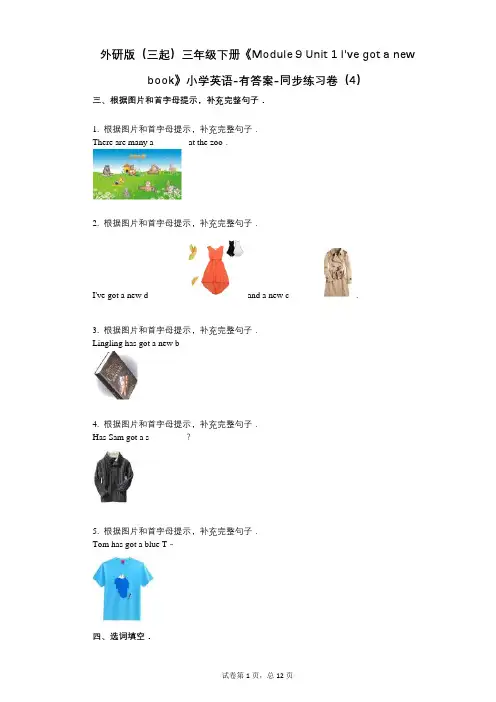
外研版(三起)三年级下册《Module 9 Unit 1 I've got a new book》小学英语-有答案-同步练习卷(4)三、根据图片和首字母提示,补充完整句子.1. 根据图片和首字母提示,补充完整句子.There are many a________at the zoo.2. 根据图片和首字母提示,补充完整句子.I've got a new d________ and a new c________.3. 根据图片和首字母提示,补充完整句子.Lingling has got a new b________4. 根据图片和首字母提示,补充完整句子.Has Sam got a s________?5. 根据图片和首字母提示,补充完整句子.Tom has got a blue T﹣________四、选词填空.(16).I________got a new book,it's about animals.(17).Lingling________got a new bike.It's yellow.(18).﹣﹣________you got a new bag?﹣﹣No,I________.(19).﹣﹣________Tom got a sweater too?﹣﹣No, he________.(20).We________got a TV They________got a TV too.五、连词成句.a has sweater Tom got.________T﹣shirt I've a got new.________you dress Have got a ?________bike Sam got Has a ?________a Daming animals about has got book.________六、根据汉语提示,补全英语句子,每空一词.我的玩具在哪里?它不在书包里.它不在床上.它不在椅子下面.噢!它在晾衣绳上.﹣﹣________my________?﹣﹣________the bag.﹣﹣________the bed.﹣﹣________the chair.﹣﹣Oh,________.根据汉语提示,补全英语句子,每空一词.我有一本新书.它是关于动物的.________a________. It's________.根据汉语提示,补全英语句子,每空一词.大明,你也有本好书吗?是的.看,它是关于运动的.﹣﹣________you________,________?﹣﹣________,I________.________,埃米,你有一本新书吗?不,我没有.我有一条新连衣裙和一件新外套.﹣﹣________you________,________?﹣﹣________,I________.________and a new coat.根据汉语提示,补全英语句子,每空一词.汤姆,你也有一件新毛线衫吗?不,我没有.我有一件蓝色的T恤衫.﹣﹣________you________,________?﹣﹣________,I________.________.七、根据汉语选择适当的英语.根据汉语选择适当的英语.My sweater is ________.(对画线部分提问)________It's under the chair.(变成否定句)________I've got a new book.(改为否定句)________I've got a new sweater.(变成一般疑问句,并作肯、否回答)________________got,a , a ,I've, new, new, and, dress, coat(.)(连词成句)________I've got a blue T﹣shirt.(将主语I改为she,重新改写句子)________The boy has got a nice book.(改为一般疑问句,并作肯、否回答)________________It's on the bed.(改为一般疑问句)________have,Tom,a ,too,new, you,got,sweater(?)(连词成句)________It's about ________.(对画线部分提问)________参考答案与试题解析外研版(三起)三年级下册《Module 9 Unit 1 I've got a new book》小学英语-有答案-同步练习卷(4)三、根据图片和首字母提示,补充完整句子.1.【答案】nimals【考点】看图完成句子【解析】在动物园里有许多动物.【解答】考查看图完成句子.图片中是许多动物,动物的英语是:animal,许多动物用复数animals.故答案为:animals.2.【答案】ress,oat【考点】看图完成句子【解析】我有一件新的连衣裙和一件新大衣.【解答】考查看图完成句子.左边图片中是连衣裙,连衣裙的英语是:dress;右边图片中是一件大衣,大衣的英语是:coat.故答案为:dress;coat.3.【答案】ook【考点】看图完成句子【解析】略【解答】book4.【答案】weater【考点】看图完成句子【解析】略【解答】sweater5.【答案】shirt【考点】看图完成句子【解析】Tom有一件蓝色的体恤衫.【解答】考查看图完成句子.图片中是一件蓝色的T恤衫,T恤衫的英语是:T﹣shirt.故答案为:T﹣shirt.四、选词填空.【答案】have,has,Have,haven't,Has,hasn't,have,have【考点】选词填空【解析】(16)我有一本新书,是关于动物的.(17)玲玲有一辆新自行车,它是黄色的.(18)你有一个新书包吗?不,我没有.(19)汤姆也有毛衣吗?不,他没有.(20)我们有一台电视机.他们也有一台电视机.【解答】本题考查have got与has got的用法.在口语中,常用have got代替have.have got表示"有,拥有".此动词常用于一般现在时中.(16)have.由于主语是第一人称I,一般现在时中,谓语动词用原形have.故填:have.(17)has.由于主语是Lingling,是第三人称单数,一般现在时中,谓语动词用单数形式has.故填:has.(18)Have;haven't.由于主语是you,因此一般疑问句中,用Have开头.否定回答是:No,I haven't.故填:Have;haven't.(19)Has;hasn't.由于主语是Tom,是第三人称单数,因此一般疑问句用Has开头.其否定回答是:No,he hasn't.故填:Has;hasn't.(20)have;have.主语是we,是第一人称复数,一般现在时中,谓语动词用原形have.主语是第三人称复数they时,谓语动词用原形have.故填:have;have.五、连词成句.【答案】Tom has got a sweater.【考点】连词成句【解析】Tom has got a sweater.汤姆有一件毛衣.【解答】该题考查连词成句.首先结合提示词明确所要组合的句子是一个陈述句,组合成的句子的句意是:汤姆有一件毛衣.句子中has got表示有,后面跟名词sweater.故答案为:Tom has got a sweater.【答案】I've got a new T﹣shirt.【考点】连词成句【解析】I've got a new T﹣shirt.我有一件新的T恤衫.【解答】该题考查连词成句.首先结合提示词明确所要组合的句子是一个陈述句,组合成的句子的句意是:我有一件新的T恤衫.句子中have got表示有,a new T﹣shirt表示一件新的T恤衫.故答案为:I've got a new T﹣shirt.【答案】Have you got a dress?【考点】连词成句【解析】你有裙子吗?【解答】考查连词成句.句子表示"你有裙子吗";问号表示疑问句,句子是现在完成时,助动词"have"放在句首,引导一般疑问句,"a dress"表示"一件裙子".故填:Have you got a dress?【答案】Has Tom got a bike?【考点】连词成句【解析】汤姆有一辆自行车吗?【解答】该题考查连词成句,句子表示"汤姆有一辆自行车吗";问号表示疑问句,句子是现在完成时,助动词"has"放在句首,引导一般疑问句,"a bike"表示"自行车".组成句子是Has Tom got a bike?故填:Has Tom got a bike?【答案】Daminghasgotabookaboutanimals【考点】连词成句【解析】Daming has got a book about animals.大明有一本关于动物的书.【解答】该题考查连词成句.主谓宾结构,主语Daming, "has got"表示有,"a book"表示一本书,"about animals"表示关于动物,故填:Daming has got a book about animals.六、根据汉语提示,补全英语句子,每空一词.【答案】Where's,toy,It's not in,It's not on,It's not under,it's on the clothesline【考点】汉译英【解析】Where's my toy?It's not in the bag.It's not on the bed.It's not under the chair.Oh, it's on the clothesline.【解答】本题考查含有介词的日常用语英语表达.由句子意思问和表述东西在哪里可得知为一般现在时,从文中it它可以得知玩具为单数,be动词选is,问东西在哪里用特殊疑问词where,故"我的玩具在哪里?"译为Where's my toy?it 代词它,be动词用is,否定形式 is not,在包里 in the bag,故"它不在书包里."译为:It's not in the bag.同样, on 在…上面,"它不在床上."译为:It's not on the bed.under 在…下方,"它不在椅子下面."为:It's not under the chair.on the clothesline 在晾衣绳子上"噢!它在晾衣绳上."译为:Oh, it's on the clothesline.【答案】I have,new book,about animals【考点】汉译英【解析】I have a new book.It's about animals.【解答】本题考查汉语词汇的英语表达.我有I have,新书new book,关于动物 about animals.将题干进行英汉对比,"我有一本新书"与"_________a________"."关于与动物与"It's____________".可知空格处填"我有""新书""关于动物"的英文表达.我有一本新书.它是关于动物的.是一个一般现在时的肯定句,基本结构为:主语+谓语动词+其他或者主语+be+其他,结合整句与中文的表达习惯,故答案为:I have a new book.It's about animals.【答案】Do,also have a good book,Daming,Yes,do,Look,it is about sports【考点】汉译英【解析】Do you also have a good book,Daming?Yes,I do.Look,it is about sports.【解答】本题主要考查汉译英.题干可知句子是一般现在时,句式为一般疑问句以及问答."大明"翻译为:Daming;"一本好书"翻译为:a good book;"你也有吗"翻译为:do also you have?"是的"翻译为:Yes,I do,是一般疑问句的肯定答语."看"翻译为:look;"它是关于运动的"翻译为:it is about sports.题干中给出了you和I,结合题干要求以及英文的表达习惯作答.注意句号后面的句子首字母需要大写.故答案为:Do;also have a good book;Daming;Yes;do;Look,it is about sports.【答案】Do,have a new book,Amy,No,don't,Ihave a new dress【考点】汉译英【解析】﹣﹣Do you have a new book, Amy?﹣﹣No, I don't. I have a new dress and a new coat.【解答】考查汉译英,根据句子意思,可知句子时态是一般现在时,主语是"you",助动词"do"放在句首引导一般疑问句,后面跟动词原形,"有一本新书"翻译成"have a new book";否定回答用"No, I don't";"我有一条新裙子"翻译成"I have a new dress".结合要求,组织句子.故填:Do,have a new book,Amy;No,don't.I have a new dress.【答案】Do,also have a new sweater,Tom,No,don't,I have a blue T﹣shirt【考点】汉译英【解析】Do you also have a new sweater,Tom?No,I don't.I have a blue T﹣shirt.【解答】本题主要考查汉译英.题干可知句子时态是一般现在时,句式为一般疑问句以及答语."汤姆"翻译为:Tom;"一件新的毛线衫"翻译为:a new sweater;"你也有吗"翻译为:do you also have?"不,我没有"翻译为:No,I don't."我有一件蓝色的T恤衫"翻译为:I have a blue T﹣shirt.题干中给出了you和I.结合题干要求以及英文的表达习惯作答.故答案为:Do;also have a new sweater,Tom;No;don't;I have a blue T﹣shirt.七、根据汉语选择适当的英语.【答案】J,I,F,A,B,G,C,H,D,E【考点】翻译能力【解析】(1)在书包里in the bag.(2)在床上on the bed.(3)在椅子下under the chair.(4)在晾衣绳上on the line.(5)一本新书a good book.(6)关于动物的about animals.(7)一本好书a good book.(8)关于运动的about sport.(9)一本漂亮的书a nice book.(10)一件蓝T恤衫a blue T﹣shirt.【解答】考查短语翻译.(1)J."在书包里"译为:in the bag.故选:J.(2)I."在床上"译为:on the bed.故选:I.(3)F."在椅子下"译为:under the chair.故选:F.(4)A."在晾衣绳上"译为:on the line.故选:A.(5)B."一本新书"译为:a good book.故选:B.(6)G."关于动物的"译为:about animals.故选:G.(7)C."一本好书"译为:a good book.故选:C.(8)H."关于运动的"译为:about sport.故选:H.(9)D."一本漂亮的书"译为:a nice book.故选:D.(10)E."一件蓝T恤衫"译为:a blue T﹣shirt.故选:E.八、根据要求完成各题.【答案】on the line,Where is your sweater?【考点】就划线部分提问【解析】我的毛衣在晾衣绳上.【解答】考查特殊疑问句.划线部分是on the line.是地点.用where来提问.故填:Where is your sweater?【答案】It isn't under the chair.【考点】肯定句转否定句【解析】它在椅子下面.它不在椅子下面.【解答】本题考查肯定句转为否定句.It's=It is.肯定句中有be动词is,转为否定句时,在is 后面加not即可,其它部分不变.is not缩写为isn't.故为:It isn't under the chair.【答案】I haven't got a new book.【考点】改写句子【解析】我有一本新书.我没有一本新书.【解答】本题考查改写句子.肯定句中I've got=I have got,表示:我有.改为否定句时,在have后面加not即可.其它部分不变.故为:I haven't got a new book.【答案】Have you got a new sweater?,Yes,I have.\No,I haven't.【考点】一般疑问句【解析】我有一件新毛衣.你有一件新毛衣吗?是的,我有.\不,我没有.【解答】本题考查转一般疑问句.陈述句中have got表示:有.转为一般疑问句时,把have提到句首.第一人称I变为第二人称you.其它部分不变.句尾用问号.转为一般疑问句是:Have you got a new sweater?回答时,用have回答,主语用I.则肯定回答是:Yes,I have.否定回答是:No,I haven't.故为:Have you got a new sweater?Yes,I have.\No,I haven't.【答案】I've got a new dress and a new coat.【考点】连词成句【解析】I've got a new dress and a new coat.我有一件新裙子和一件新外套.【解答】该题考查连词成句,句号表示陈述句式,主谓宾结构,"a new dress"表示"一件新裙子";"a new coat"表示"一件新外套";'I've got"表示我有…,"and"连词,表示和,组成句子是I've got a new dress and a new coat.故填:I've got a new dress and a new coat.【答案】She has got a blue T﹣shirt.【考点】改写句子【解析】我有一件蓝色的T恤衫.她有一件蓝色的T恤衫.【解答】本题考查改写句子.I've got =I have got,我有.将主语改为she时,由于she是第三人称单数,谓语动词要用第三人称单数,因此have got要改写为has got.其它部分不变.故为:She has got a blue T﹣shirt.【答案】Has the boy got a nice book?,Yes,he has.\No,he hasn't.【考点】一般疑问句【解析】这个男孩有一本好书.这个男孩有一本好书吗?是的,他有.\不,他没有.【解答】本题考查句子转换.has got表示:有,拥有.转为一般疑问句时,把Has放在句首,其它部分不变,句尾用问号.转为一般疑问句是:Has the boy got a nice book?回答用has回答,主语用he代替the boy.肯定回答是:Yes,he has.否定回答是:No,he hasn't.故为:Has the boy got a nice book?Yes,he has.\No,he hasn't.【答案】Is it on the bed?【考点】一般疑问句【解析】它在床上.它在床上吗?【解答】本题考查转一般疑问句.本句中有be动词,改为一般疑问句时,将be动词提到句首即可.其它部分不变.故改为的一般疑问句是:Is it on the bed?【答案】Tom, have you got a new sweater, too?【考点】连词成句【解析】汤姆,你也有一件新的毛衣吗?【解答】考查连词成句,句子表示"汤姆,你也有一件新的毛衣吗";问号表示疑问句,"have got"表示句子是现在完成时,助动词"have"提到句首引导一般疑问句;"Tom"表示人名;"a new sweater"表示"一件新的毛衣";"too"表示"也",放在句末;结合句式,完成题目.故填:Tom, have you got a new sweater, too?【答案】animals,What is it about ?【考点】就划线部分提问【解析】它是关于动物的.它是关于什么的?【解答】本题考查就划线部分提问.划线部分是animals,是物.对物提问常用疑问词what.提问时,用What代替划线部分并放在句首,把句子It's about变为一般疑问句is it about跟在疑问词后面.句尾用问号.故为:What is it about ?。
外研版七年级英语上册课后训练试题Module1Unit1
Unit 1A 组一、英汉互译1.my name我的名字2.nice to meet you很快乐见到你3.I’m Chinese.我是中国人。
4.how old几岁5.thank you感谢你6.你的老师your_teacher7.13 岁thirteen_years_old8.来自北京be_from_Beijing9.我的学生my_student (s)10.你呢?What_about_you?二、用 be 动词的合适形式填空1.My name is Betty.2.Are you from America?3.I am from Beijing.4.Is Lingling from Shanghai?5.Tom and Jim are students from China. 6.He is my friend.三、写出缩略词的完满形式(1)I_am (I ’m)a student. My (2)name_is(name ’ s)Daming.(3)What_is (What ’s)your name? This is my friend Li Lei. (4) He_is(He’s) 14. (5)We_are(We’re) in No.1 Middle School. (6) It_is (It’s) not bigutb very nice.四、依照句意给字母排序,组合成单词1.Nice to meet you. (t e m e)2.My name is Kate Wall. (m e a n )3.Tom is twelve years old. (e a y r s)4.He’s from Beijing. (r f m o)5.Daming is my friend .(r e i f n d)五、依照汉语提示完成句子1.我的名字叫玲玲。
我来自北京。
My_ name is Lingling. I from’mBeijing.2.你几岁了?How_ old_ are_ you?3.——你从哪里来?——我来自中国。
外研版七年级英语上册教学设计 Module 9 Unit 1 We are enjoying the

七年级英语上册Module 9 Unit 1 We’re enjoying the school trip a lot.P1同学们,大家好。
我是来自的老师。
今天我们将一起完成七年级上册Module 9 Unit 1的学习任务。
请大家准备好教材、文具和笔记本。
(点)P2 (Step 1:Analysis of the material)首先来看看本节课我们将会学到什么内容。
(点)P3本模块以世界不同地区的人们在同一个时间做某事为主题, 为语言学习创造积极的环境,从而达到促进语言学习的目的。
通过学习同学们能体验到不同的地域文化,增强自己的跨文化交际意识。
第一单元介绍的是贝蒂游长城的事情。
通过各种活动的操练,同学们能识别对话中谈论的正在发生的事情,并能描述自己或他人正在做的事情。
(点)P4 Leading-in (点)Then I’ll show you some pictures. Please tell me what you can see in the pictures. Are you ready? Let’s go.P5 what can you see?Yes, it is the Great Wall! The Great Wall is one of the greatest wonders in the world. Every year, thousands of visitors walk along the Great Wall. We Chinese are all proud of it.(点)P6How about this picture? What’re these? Yes! They are presents. (点)When you are on a trip, you may buy some special presents for your parents and friends. I’m sure they will be very happy.P7Look at this picture. What’s this? It is a postcard.(点)When you are on a trip, you can send postcards to your friends. Many people like collecting postcards from different places or countries.Do you like them?好,以上图片中的词汇我们都将在本课中用到,请你记住它们,并注意这些词的拼写和发音。
外研版初中英语七年级上册(WY)教案 Module 9 Unit 1
Module 9 People and places一、教学内容:Unit 1 We’re enjoying the school trip a lot.二、课型:Listening and speaking三、教学目标:1、能掌握本单元的词汇及短语:call, lie, lie in the sun, take photos,wait, walk, a few, enjoy, go back2、能掌握现在进行时态be (am /is /are) +doing的用法和结构。
3、能听懂含有现在进行时态的简短对话.4、能转述正在做或发生的事情;能根据图片、视频、真实行为等描述正在发生的事情。
四、教学重难点:掌握现在进行时态句子的肯定,疑问与否定形式,并能用现在进行时态叙述正在发生的事情。
五、教学准备:本课指导学生通过听力获取信息,培养学生听力技能。
教师在教学时尽量用游戏,图片或flash动画的多种媒体来引起学生的学习兴趣,引导学生在交际中动态生成,学生有话可说,乐于合作分享。
这样就有利于他们更好的运用课本知识,达到提高综合运用语言能力的目的。
同时培养学生的合作精神,发展其思维和想象等能力。
在教学过程中,采用多媒体手段辅助教学,利用各种图片和习题任务贯穿整个教学过程。
因此,本节课需准备:PPT课件、挂图、录音机、课堂练习表格、奖品。
六、预习要求:1、根据音标自学本课新单词;2、查找相关资料,找出你认为本课较重要的语言点和短语。
Lead in1.Free talk:(1).Show some pictures and ask Ss like these: What is he/ she doing now?Where are they ? What are they doing now?(2).Show more pictures and let Ss talk about them, try to use the sentences with “be doing .”Task1:Check the newwords.1. Show some pictures and thing s to get the students to say out the new words and phrases.anize the students to read the new words together.3.Ask the Ss to describe 1.Look at the pictures and things to say out the new words and phrases.2. Read the new words and phrases together.3. To describe the picture and try toTask2:listening1.Play the tape, ask thestudents to listen andnumber the pictures.(Activity 2)2.Ask the students toListen to the conversation carefullyand match the people 1-5with the actions a-g.T: “Now, we are goingto listen to a dialoguebetween Betty and hermum. Betty is in Chinaand her mum is at home inAmerica. Let’s listenand match.”1.Betty a. eat an iceg. buy presentsstudents to check their answers. students the the work to read the conversation. 3. Have a competition: in the the anize students to come to the blackboard some language points that they found. 2.Help the students to difficult 3.Check theanswers.1.Read the conversation with the video.2. Read the conversation ingroups.3. Read the dialogue in groups and choose the best group.1. Students come tothe blackboard to show out somelanguage points,the other students listen to them carefully and note .2.Solve the difficult points.with the teacher ’s help.thethecomplete the table.(Activity 3)the students to underlinecorrect3. Ask the students towhattheusing3. 1.Students complete the table.(Activity 3)2.Students underline the correct words. (Activity 4)3.Students work in pairs .Say what people are doing in the conversation, using the form in Activity 3.Task 6:Do some speaking 1.Work in pairs. Ask students to talk about the photos wh ich they brought and say what people are doing in the photos at the moment . A: This is a photo of my familyI’m sitting on thegrass andreading. My father /mother /brother /sisteris …... We are having a good time. B: In this photo, we are enjoy ing the schooltrip. Li Ming is …Tony is …2. Have some students to come to the blackboard to talk about the ir photos.3.Play a guessing game. Have some Ss to do the actions in front of the class. The other Ss guess what is he doing.4.Ask students to do someExercises and then check. game. Some Ss do the actions in front of the class. The other Ss guess what is he doing.4.Do the exercises , then check.达标训练题一、单项选择()1.At the moment,everyone dumplings.A. are eatingB. eatingC. is eatingD. eat()2.Listen! She in the classroom.A. is singingB. singC. to singD. is sing()3.Americans like the sun.A. lie inB. lying inC. to lie unde rD. lying on ()4.My father enjoys piano.A. to playB. playingC. play theD. playing the()5.This is not easy work.A. aB. /C. oneD. an二、用所给动词的适当形式填空。
外研版七年级英语上册(课件):Module 9
2. 贝蒂正在给她妈妈打电话。她想和妈妈说话。 calling her mother. She wants is Betty ________ ________ to _______ ________ talk to/with her. 3. 你能送给我一张你的照片作为礼物吗? Could you ________ a photo of you ________ me give to ________ a present? as 4. ——你现在在做什么? ——我正在等我的朋友们。 —What ________ you ________ now? are doing —I'm ________ ________ my friends. waiting for 5. 商店中有许多衣服在廉价销售。 There are ________ ________ clothes ________ of on lots ________ at the shop. sale
【2】wait的用法 【教材例句】wait for the bus 等公交车(教材第54页) 【要点思维导图】
【举例】Hurry up! Everyone is waiting. 快点!大家 都在等着。 Lucy is waiting for her mother to bring her some photos. 露西正等着她妈妈给她带些照片来。
【2】a lot与a lot of的区别 【教材例句】We're enjoying the school trip a lot. 我们很喜欢学校的这次郊游活动。(教材第54页) 【要点思维导图】
【举例】He likes playing football a lot. 他非常喜 欢踢足球。 My brother is feeling a lot better today. 今天 我弟弟感觉好多了。 I have a lot of things to do. 我们有许多事情要
外研版英语七年级上册-Module-5-Unit1-同步练习
外研版英语七年级上册 Module 5 Unit1 同步练习全国初一课时练习2019-12-2482次一、其他1.根据图示用英语写出时间【小题1】【小题2】【小题3】【小题4】【小题5】_____________________ ____________________ _____________________ _____________________ ______________________二、根据句意填空2.用介词at,in,t.或on填空【小题1】It's five _________ ten now.【小题2】I watch TV________ eight o'clock.【小题3】I have a PE class ________the afternoon of Monday.【小题4】Children go to school ______ the morning. 【小题5】He doesn't have classes _________Sunday.三、根据中/英文提示填空3.根据句意及汉语提示完成单词【小题1】Maths is very ____________(困难的)for me. 【小题2】My favourite _________(科目)is English. 【小题3】Lily doesn't have __________(历史)this Friday. 【小题4】Boys and girls,now let's __________(开始)our class. 【小题5】Th.boo.i.___________(有趣的).Yo.ca.rea.it.【小题6】Students can't __________(交谈)with their classmates in class. 【小题7】I like my English teacher __________(因为)she is very nice. 【小题8】Damin.like.____________(科学).Ho.abou.you.Lingling? 9】—___________ (什么时候)do you eat breakfast? —About 6: 30.【小题10】—Do you have ____________(课)on Children's Day? —No, I don't.四、用所给单词的正确形式填空4.用括号中所给单词的适当形式填空【小题1】I like _____________(talk)with my friends in my free time.【小题2】We usually have four ______________(lesson)in the morning on weekdays. 【小题3】My father____________(love)me and I love him a lot too. 【小题4】My brother is really good at ___________(swim).【小题5】English and maths are Tony's favourite_____________(subject).五、句型转换5.按要求完成句子【小题1】.hav.lunc.at_twelv.o'clock.(对画线部分提问)______ _________do you__________lunch?【小题2】We do our homework in_the_evening.(对画线部分提问) _______ _______ _______ do your homework?【小题3】I have history in the morning.(改为一般疑问句) _______ _______ ________history in the morning?【小题4】W.g.shoppin.o.Sundays.W.pla.basketbal.o.Sundays.too.(合并为一句)We go shopping______ ________basketball on Sundays.六、完型填空6..a.Tim..a.a(n)____ually____.a.hal.pas.six.A.seve.o'clock,.hav.breakfas.wit.my_____.After that,they go to work and I go to(a)_____.Classe.begi.a.eight.W.hav.fou.____.i.th.morning..lik.____.classe.ver.muc.an.m.Englis.i.good..hav.____.a.schoo.a.twelve.A fte.schoo..don'.g.hom.but____o.th.playgroun.wit.m.classmates..ge.hom.a.fiv.thirt.an.hav.suppe.a.____.o'clock..d.m.homewor.ateight.Afte.tha..watc.T.fo.twent.minutes.._____.a.ten.I.i..bus.day. 【小题1】A. teacher 【小题2】A. get up【小题3】A. students【小题4】A. school【小题5】A. meals【小题6】A. English【小题7】A. breakfast【小题8】A. wash hands【小题9】A. six B. student B. stand upB. friendsB. shopC. doctorC. look upC. parents C. parkD. postmanD. stay upD. cousinsD. hospital D. jobs B. classesB. mathsC. apples C. musicD. artB. lunchC. supperC. play games C. elevenC. go to bedD. dinnerB. read a bookB. nineD. play the pianoD. twelveD. go to work【小题10】A. go shopping B. go swimming七、阅读单选7.Thi.i.Ann'.timetable(课程表)fo.th.mornin.o.Wednesda.an.Thursday.WednesdaThursda Class Time yyThe first class The second class The break8: 00 am to8: 45 am8: 55 am to9: 40 amChinese ArtPhysics Music10: 20 am to11: 05 a11: 15 am to12: 00 aThe third classThe fourth classEnglish PE MathsmmScience【小题1】Ann has ______ from 8: 00 am to 8: 45 am on Thursday.A. ChineseB. mathsC. musicD. physics【小题2】When does Ann have art on Wednesday? A. From 11:15 am to 12:00 am.B. From 10:20 am to 11:05 am.D. From 8:00 am to 8:45 am.C. From 8:55 am to 9:40 am.【小题3】Ann has English in the ______ class of Wednesday. A. first B. second C. thirdC .15 D. fourthD .10【小题4】The break is ______ minutes. A .40B .30【小题5】Which of the following is TRUE? A. The first class of Wednesday is art.B. The fourth class of Thursday is PC .D. Ann has four subjects on Wednesday morning.E. Ann has maths from 10: 10 am to 11: 05 am on Thursday.8.Don.Yif.i.i.Beijin.an.h.i.thirtee.year.old.Her.h.tell.u.abou.hi.day.A.6:st.4.minutes.H.ha.lunc.a.11.0.o.clock.Fo.lunch.h.ofte.eat.hamburgers.vegetable.an.egg..I.th.afternoon.classe.star.a.1.30.H.ha.tw.classes.A.4.1.p.m.hi.fathe.take.hi.home.H.doe.hi.homewor.first.The.h.learn.t.dra.pict ures..H.goe.t.be.a.9.00.【小题1】When does Dong Yifu get to school? A .A.abou.6.5.a.m. B .A.abou.7.0.a.m. D. At around 7:40 a.mC. At around 7:30 a.m 【小题2】文中画线单词“ lasts”的中文意思是A. 最后的B. 上一次 C .持续 D. 够……之用 【小题3】What does Dong Yifu eat for lunch? A. Hamburgers, vegetables and eggsB. Hamburgers, vegetables and apples.C. Tomatoes, carrots and hamburgers.D. eggs, bread and vegetables.【小题4】What does Dong Yifu do in the evening. A. He does his homework and plays chess.B. He plays chess and watches TV .C. He learns math and plays chess.D. He plays the piano and watches TV.【小题5】下面哪项陈述是正确的? A. Dong Yifu likes to play basketballafter classB. Dong Yifu learns English in the morning.C. Dong yifu's afternoon classes start at1:30.D. Dong Yifu takes the bus to school.八、填空uall.get.u.a.6.3.a.an.the.read.Englis.o.Chinese.H.ha.breakfas.a.7.0.am.An.the.h.goe.t.schoo.b.bus.t.fo.school.Classe.begi.a.8.0.am.H.ha.fou.classe.i.th.mornin.an.tw.classe.i.th.afternoon.H.ha.lunc.a.12.2.p.at hom.wit.hi.parents.Afte.school.sometime.h.play.basketbal.wit.hi.classmates.an.sometime.h.read.book.i.th.schoo.library. H.goe.bac.hom.a.4.4.pm.Afte.supper.h.alway.studie.Chinese.H.goe.t.be.a.abou.9.0.pm.H.like.Chin.an.Chines.peopl.ver.m uch.根据短文内容,完成以下表格。
外研版七年级英语上册同步习题课件:Module 9 People and places Unit2
课前预习
二、常用短语(请在课文中画出下列短语)
1. 此时此刻
at the moment
2. 在不同的地方 in different places
3. 做不同的事情 do different things
4. 下班
leave work
5. 等待,等候
wait for
课前预习
6. 下(飞机、火车 、公共汽车等) get off
【学以致用】 (7)Here’s the bus. Let’s __A___. A. get on B. get off C. get to D. get in (8)We are near the cinema. Please __B___ the bus and go to the movie. A. get up B. get off C. get on D. get to
课堂导学
3. They’re waiting for buses or trains. 他们正在等公共汽车或火车。 ◆wait意为“等候,等待”,是不及物动词,后面 加宾语时,需加介词for; wait for sb./ sth. 意为“等待某人 / 某物”。
课堂导学
如: (5)Your mother _i_s_w__a_it_in_g__f_o_r_y_o_u_ near the school. 你妈妈正在学校附近等你。 (6)I _a_m__w__a_it_in_g__f_o_r_t_h_e_b_u_s__. 我正在等公共汽车。
课文理解
( D ) 2. When people in New York are having lunch, people in _____ are having dinner. A. Beijing B. Los Angeles C. London D. Moscow
外研版七年级上册Module 9 unit1 We're enjoying the sch
外研版七年级上册Module 9 unit1We're enjoying the school trip a lot.教案Module 9 People and PlacesUnit 1 We’re enjoying the school trip a lot.教学内容:外研版英语七年级上册班级:课型:听说课To get to know the key words, phrases and sentences.(1)key words and phrasespostcards, call, lie, sun, line, take photos, wait for, walk, trip, a few, on sale, enjoy, anyway, go back(2)key structures:We’re enjoying the school trip a lot.I’m standing on the Great Wall of China and talking to you.Tony is eating a delicious ice cream.Daming is having lunch.1. To understand the things told by others with given clues.2. To describe what is happening.Step 1 Warm up &Lead in1. Show some pictures and review the words.2. Act smiling out and ask what is the teacher doing.Step 2 Presentation1. Show some pictures with a question-What is/are she/he/they doing2. Present the present continuous sentences and key phrases to students.3. Ask students what’s the difference between V and V-ing.4. Write the verbs on the blackboard and then pick one student up to finish the present continuous tense.Step 3 Guessing Activity1. Summarize key phrases and lead students to translate them both in Chinese and in English.2. Present key phrases with body language and let students guess what phrase it is.Step 4 Listening practice1. Look at the pictures in Activity 1 and talk about them with the words.2. Ask the students to listen to the recording.3. Ask the students to number the pictures.4. Check the answers.Step 5 Listen and read1. Look at the dialogue in Activity 3.2. Play the recording and ask the students to listen.3. Ask the students to read the dialogue together and answer the questions.a. Where is Bettyb. What does Betty's mum wantc. What are they doing on the Great Wall4. Complete the table in Activity 3.People Things he / she is doingBettyTonyWang HuiLinglingDaming5. Check the answers.6. Make a conclusion of the sentences in the table and deduce the structure of present continuous tense---主+be+V-ing+其它.Step 6 Underline the correct words.1. Ask the students to read through the passage.The children are on a school (1) trip / holiday to the Great Wall. They’re walking on it, taking photos and buying (2) a few / a lot of presents, ice creams and postcards on (3) sale / line at the shop. They (4) are enjoying / aren’t enjoying the trip a lot.2. Underline the correct words.3. Check the answers.4. Explain the usage of “enjoy”. They are enjoying the trip a lot.Step 6 Work in pairsAsk the students to say what people are doing in the dialogue.Work in pairs. One asks “What is Betty/Tony doing ”. The other answers “She/He is doing .......”Betty buy presents and postcardsTony have lunch and lie in the sunWang Hui talk to her motherLingling take photosDaming eat ice creamStep 7 ActivityGuessing game1. Divide students into four groups.2. Describe the actions with present continuous sentences.Describe “family”1. Show some pictures of students in Class2.2. Pick some students to say what are they doing.Step 8 Homework1. Describe what the people are doing at the moment in daily life.2. Finish the exercise book on from page 127 to page 131.。