
人教PEP版四年级英语上册Unit 4 My home 第三课时教案
人教PEP版英语 1 第三课时 课时内容 A. Let’s spell 课时分析 本部分分为语音学习和单词书写两部分内容。通过听一听,读一读,唱一唱的活动,让学生通过听、读、拆音等练习体会并掌握字母u在单词中的发音,本课时主要学习其在开音节里发的双元音/ ju: /。本活动中呈现的韵句为:One cute cat uses two, two balls. Two cute cats use three, three balls. Three cute cats use four four balls. Four cute cats use five, five balls. Five cute cats use six, six balls. One, two, three, four, five, six, Five cute cats playing tricks. 韵句中呈现含有u的开音节词汇:cute, use。同时在教材中以图片形式呈现语音例词use, cute, excuse。学生通过这些语音例词以及韵句的诵读,来感受并掌握字母u在开音节里的发音。之后的听一听,圈一圈,说一说的活动,让学生区分开音节与闭音节,将单词的读音与字形结合起来,进一步训练学生的听音辨音能力。听一听,圈一圈,写一写的活动学生需要判断字母u在本单词中的发音是属于闭音节类还是开音节类,圈出相应的代表字母,并写出单词。这个活动帮助学生进一步掌握拼读规则,并根据拼读规则拼写出单词。 在教学过程中,需要通过多种活动,使学生自己发现、感悟字母的发音规律。 课时目标 1. 能够感知并归纳字母u在开音节(u-e结构)中的发音规则 2. 能够读出符合u-e发音规则的单词 3. 能够根据单词的读音拼写出符合u-e发音规则的单词 课时重难点 1.重点: 能够感知并归纳字母u在开音节(u-e结构)中的发音规则 能够读出符合u-e发音规则的单词 2. 难点: 能够根据单词的读音拼写出符合u-e发音规则的单词 人教PEP版英语 2
教学准备 1. 多媒体课件、录音机、磁带 2. 语音例词单词卡 教学过程 Step 1 Warm up 1. 呈现韵句:Where is my book? 教师先示范,学生倾听后跟读,之后一起表演说。 Teacher:Boys and girls, let’s chant. First, please listen to me. Where is it? Where is it? Where is my book? Is it on the desk? Is it on the desk? No, it isn’t. It isn’t on the desk. Is it in the desk? Is it in the desk? No, it isn’t. It isn’t in the desk. Is it under the desk? Is it under the desk? No, it isn’t. It isn’t under the desk. Where is it? Where is it? Where is my book? It’s in my schoolbag. It’s in my schoolbag. Teacher:Now please chant with me. Teacher: Say the chant together, please. 设计意图:以学习过的文具作为韵句的支撑词汇,由上一课时与本课的重点句式作为韵句的主要结构来进行热身,帮助唤醒学生的已有知识,并为下一环节的学习做好准备。 Step 2 Lead in 1. 与学生自由交流,引出语音例词。 Teacher: Thank you, I find my book. Where is it? Yes, it’s in the schoolbag. Oh, I don’t have my pen. Excuse me, can I use your pen? Thank you. Excuse me, can I use your pencil? Excuse me, can I use your ruler? ... 设计意图:通过向学生借东西,使学生熟悉excuse,use两个语音例词的读音及其含义。 人教PEP版英语 3
2. 请被借了东西的学生使用句式,要回自己的东西。 Teacher:Whose ruler is this? Please come here and say the sentence: Excuse me, can I use the ruler? And the pen, the pencil. Come here please. (板书单词:excuse, use)Please read the words after me, first. 设计意图:衔接上一环节,让学生有机会来通过说句子练习本课的语音例词。 Step 3 Presentation 1. 播放语音韵句。学生先认真倾听。然后再跟读。 Teacher:Now, let’s listen to a chant about these words. Listen carefully. Teacher: We have many cute cats in the chant, isn’t it? (板书cute)Read it please. Teacher: Listen to the chant again. Now, let’s say the chant after it. 2. 学生自由说韵句,以自己的方式来打节奏。 Teacher: Now, say the chant freely. You can say it with your partner. And you can clap your hands to say it. 3. 表演韵句。 Teacher:Now let’s act the chant together. 设计意图:学生先倾听韵句,初步感受韵句内容。然后跟读,获取正确的语音。自由读可以使学生以自己喜欢的方式操练韵句,以达到熟练说韵句的目的。 4. 引导学生发现字母的发音规则。 Teacher:Look at these words on the blackboard. What can you find? Yes, there is an u in each words. What is the sound of the u? Let’s read and find. (和学生一起慢慢读每一个语音例词)What is the sound? Yes, it’s / ju: /. Look at my mouth and say with me. 设计意图:通过拼读,让学生自己发现字母的发音规则,再模仿口型,获得发音的正确方式。 Step 4 Practice 1. 看口型,猜单词。教师说出语音例词中的一个,但不出声,学生通过观察老师的口型,猜出单词,并大声读出来。 Teacher: Boys and girls, let’s play a game. I will say a word. Look at my mouth carefully. Guess what word it is. And try to say it loudly. 人教PEP版英语 4
设计意图:通过观察教师口型来猜单词,有助于学生感受字母在单词的发音,以及字母u的发音方法。 2.听一听,举一举。学生听教师说出的语音例词,举起相应的单词卡片。 Teacher: Look at these word cards. What’s this? What’s this? What about this? You are right. Get the card, please. Teacher: The students who got the word card please come to the front. I will say the word. Please put up the correct card. 设计意图:这个活动锻炼学生能否正确听懂所学的语音例词。提高学生的听音辨音能力。 3. 读一读,听一听,圈出正确的单词。播放录音,学生根据听到的内容在字母串中圈出相应的单词。 Teacher: Look at these letters. There are many words in it. Listen and find the word. Circle it. Listen, please. Cute, cut, use, fun, tube, excuse, bus, mum, mule. Teacher:Show me your answer, please. Teacher:Now let’s read these words together. 设计意图:此活动让学生将单词的字音与字形结合起来,同时帮助学生区分字母u在开音节与闭音节里的发音的区别。 4. 听一听,圈一圈,写一写,根据听到的内容,判断单词是闭音节(u)还是开音节(u-e),圈出相应的规则字母,然后写一写听到的单词。 Teacher:Now, please listen, circle and write. Write the word that you heard. Duck is it for u or u-e? It’s for u. So circle the letter u, then write the word duck. Now, listen carefully and write the words. Duck, cute, up, use. Teacher: Show me your answer, please. Teacher: Read these words together, please. 设计意图:学生先根据听到单词的发音判断其属于闭音节还是开音节,圈出相应的代表符号,再在四线三格上写一写单词。一方面体会单词在四线三格中的书法方式,另一方面也在书写中进一步体会字母在单词里的发音。 5. 编写语音小韵句,学生学唱。 Teacher: It’s chant time. Listen first, then say it. U, u, u; u, u, u; u is in use, /ju: /,./ju: /, /ju: /.
PEP人教版小学四年级上册英语Unit4教案
PEP人教版小学四年级上册英语Unit4教案第一篇:PEP人教版小学四年级上册英语Unit4教案PEP人教版小学四年级上册英语Unit4教案Unit 4单元分析一、教学内容studybathroombedroomliving roomkitchenphonebedsofashelffridgetableit’s=it isaren’t=are notthey’re=they areheytheyopen the dooron the tablenear the phonein the door3、帮助学生在掌握单词的基础上造出句子,编出对话,学以致用。
4、培养学生用英语交流的能力,为学生的进一步学习奠定基础。
二、教学要求1、能听懂、会说,会用每一课会话。
2、掌握本单元出现的生词,词组和字母。
3、会唱本单元的歌曲。
三、教学重点和难点1、对于较长的单词如bathroom ,bedroom ,living room, kitchen的掌握以及对于第一次出现的介词短语如open the dooron the tablenear the phonein the door的掌握。
2、对于礼貌用语“Thank you , Excuse me, After you”的掌握与应用。
3、描述卧室中所有物件,并能据此编出对话。
四、教学时间本单元共6课时,每周3课时,2周完成。
Lesson191.Teaching aimsTo act quickly after listening to the T.Master the sentences: This is my home.You can see a bedroom...New words: study bathroom bedroom living roomkitchenPractice: This is my home.You can see a bedroom, a living room…2.Teaching aidsA tape-recorderA pictureSeveral word cards3.Important pointsThe pronunciation of the new words4.Teaching steps1)GreetingsDo some oral work and sing a song.2)New contentsAt first, the teacher shows Amy’s house using the computer.“What can you see in thepicture?”“I can see a study.”“I can see a bedroom.”…….5.Homework WorkTo say the sentences smoothlyListen to the tape and recite the new words.1.Teaching notes Lesson201.Teaching content1)Learn the dialogue and act it out.2)Let them master the sentences1.Teaching aimsMaster the phrases: in the living room, in the study, in your desk, in your hand…Use the dialogue smoothly.3.Important pointsThe pronunciation of the new words4.Teaching aidsA tape-recorderA pictureSeveral word cards5.Teaching steps1.GreetingSing an English song.Ask the students to introduce their homes.2.RevisionLearn the drills and practice the drills.T: What’s this?Ss: An eraser.T: yes, what does it like?S: It looks like a fish.T: Where is my eraser? Is she in the…?Ss: Yes, she is.(No, she isn’t.)Show them several pictures.T: Oh, how beautiful!Where is it?S: This is my bedroom.(This is myLiving-room.This is my bathroom.)T: Is this your..?S: Yes, it is.(No, isn’t.)Game.-Where is my pen?-Is it in the …?-No, isn’t.-Is it in the …?-Yes, it is.Tell them the difference between “Is it…?” and “Is she…?”Listen to the tape and imitate.Practice in groups and act it out.6.HomeworkTo say the sentences smoothlyRecite the dialogue and listen to tape.2.Teaching notesLesson 211.Teaching AimsLet them master the words :homeroomschoolclassroom(listeningspeakingreadingand writing)And the sentencesWelcome to my ……home ……This is my ……room ……When they see the pictures, they can recognize and say their English names..2.Teaching Aidsa tape recordercardspictures3.Important points4-skill words:homeroomschoolclassroom4.Teaching steps1).Greeting and organizationSing an English song and do oral work.2).RevisionA:Act the dialogue of lesson 21B: Review these words:Homeroomschoolclassroom3).PresentationRead the words and spell them.Ask a student come to the front to read all the words, and the others after him or her.4).PracticeListen to the tape, imitate and practice the sentences.Read and spell the words.5.HomeworkSpell the words , then write them:Homeroomschoolclassroom1.Teaching notesLesson221.Teaching AimsLet the students master the words and phrase :phonebedshelffridgetablesofaLet the students listen and read these drill:Sit on …Make …Watch TV.Answer…Open…Set…2.Teaching Aidsa tape recordercardspictures3.Important pointsLearn to say the words: phoneshelffridgetablesofaWhen they see the subject, they can recognize and say their English names..4.Teaching steps1).Greeting and organizationSing a song and do a oral work.2).RevisionReview these words:Homeroomschoolclassroom3).PresentationThe teacher shows the phone of the room and points at somethingone by one, and the students say it in English.In this way, learn to say the new words:phoneshelffridgetablebedsofaAsk a student come to the front to read all the words, and the others read after him.4).Play a game:Passing the eight words between eight groups, and then checking which group did quickly and right.5).Practice Listen to the tape, imitate and practice the words:phone…Read and spell the words.6).Let’s doSit on the sofa.Make the bed.Watch TV.Answer the phone.Open the fridge.Set the table.5.Homework1.Listen and read the new words and drill.2.Recite “Let’s do”.2.Teaching NotesLesson231.Teaching content1)DrillsA: Are they on the …?A: Are they near…?B: Yes, they are.(No, they aren’t.)2)Learn the dialogue and act it out.3).Let’s chant.2.TeachingaimsLet them master the short sentences:Open the dooron the tablenear the phoneLearn the new e the dialogue smoothly.3.important points1).The pronunciation of the new words2).A: Are they on the …? B: Yes, they are.(No, the arearen’t)4.Teaching aidsA tape-recorderA pictureSeveral word cards5.Teaching steps1).Greeting and organizationSing an English song and do oral work.Ask the students to introduce their home.2).At first, the teacher talk to the students.T: Where are the key(book…)?S: It’s on the table(in the desk, near the phone…)T: Where are the keys(books…)?S: They are on the table(in the desk, near the phone…)T: Are they on the table?S: Yes, th ey are.(No, they aren’t.)Then learn to say the drills.And practise the drill with the Ss.From “the T asks, theS answers” to “the S asks, the S answers.”3)Then practise these drills smoothly.Play a game.S1:Where are the keys? S2:Are they in he …?S3: No, they aren’t.S2: Are they in the …?S3: Yes, they are.Tell them the different of “Is it…?” or“Are they…?”Listen to the recorder and imitate.Work in groups and act it out.6.HomeworkRecite the dialogue.To say the sentences smoothly3.Teaching notesLesson 24.Teaching Aims1)Let the students master the four-skill words :Windowdeskdoorchairbed2)Let the students read these sentences:What can you see in my room? I can see…When they see the objects, they can recognize and read them and do the action about them.2.Teaching Aidsa tape recorder.3.Difficult words and emphasis:4-skill letters and words:Windowdeskdoorchairbed4.Teaching steps1)OrganizationChant together and do a oral work.2).RevisionSpell the word: WindowdeskdoorchairbedPhrase: w_nd_wd_ _rd_skch___b_d3).PresentationWhen the teacher point at the subject, the students say the word and spell it.Then write thesewords.Read the drills smoothly:What can you see in my room?I can see…Read and choose: Listen to the T and choose A,B,C or4).Listen to the tape, imitate and read..5).GameThe teacher asks a student come to the front of the class, and tell him/her a word, then asks other students guess the word.5.HomeworkSpell and write the four-skill words :第二篇:pep版小学英语四年级上册unit4教案Unit 4 My home第一课时教学目标:知识与技能:1、能听懂、会说:Welcome to my home!并能描述自己的房间。
小学英语_Unit4Myhome教学设计学情分析教材分析课后反思
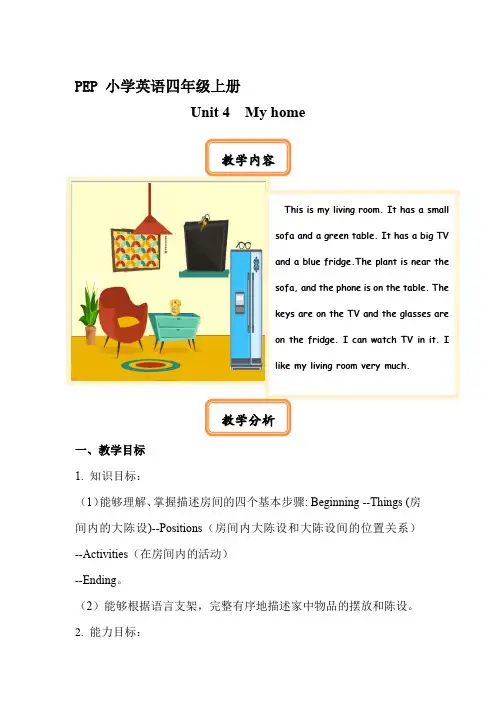
PEP 小学英语四年级上册Unit 4 My home教学内容This is my living room. It has a smallsofa and a green table. It has a big TVand a blue fridge.The plant is near thesofa, and the phone is on the table. Thekeys are on the TV and the glasses areon the fridge. I can watch TV in it. Ilike my living room very much.教学分析一、教学目标1.知识目标:(1)能够理解、掌握描述房间的四个基本步骤: Beginning --Things (房间内的大陈设)--Positions(房间内大陈设和大陈设间的位置关系)--Activities(在房间内的活动)--Ending。
(2)能够根据语言支架,完整有序地描述家中物品的摆放和陈设。
2. 能力目标:(1)能够对如何描述房间有了比较清晰、全面的认识。
(2)能够根据教师的引导,进行完整、有序地口语表达,并在表达时关注语言的逻辑顺序和句式结构。
3. 情感态度、学习策略目标:(1)通过本课的学习,培养和保持学生的英语学习兴趣。
(2)引导学生注重合作学习,培养合作、沟通、交流的意识和能力。
(3)培养学生爱自己的家、爱自己的家人的情感。
二、教学重难点分析1. 教学重点为根据描述房间的步骤,有序地、完整地描述房间中物品的摆放和陈设。
2. 难点为关于房间大陈设与小陈设之间位置关系的描述,即The...is/are..., and the...is/are...是本节课的难点。
三、课前准备CAI,Word cards教学过程What room is it? What’s in the rooms?扣,不仅复习了本单元的重点单词、句型,还激发了学生的学习兴趣,创建和谐快乐的课堂氛围。
人教版(PEP)英语四年级上册《Unit4Myhome》单元教学设计1
人教版(PEP)英语四年级上册《Unit 4 My home》单元教学设计 1一. 教材分析人教版(PEP)英语四年级上册《Unit 4 My home》单元主题是关于家庭,主要学习与家庭相关的词汇和句型。
通过本单元的学习,学生可以掌握一些基本的日常用语,描述自己和家人的外貌特征、喜好以及家庭物品的名称和位置。
教材通过图片和情景对话的形式,让学生在真实的生活场景中学习英语,提高他们的语言运用能力。
二. 学情分析四年级的学生已经具备了一定的英语基础,能够听懂并简单运用日常用语进行交流。
但部分学生在发音和词汇方面还存在困难,需要教师的耐心指导。
此外,学生的学习兴趣和积极性对英语学习成效有很大影响,因此在教学过程中,教师需要注重激发学生的学习兴趣,提高他们的参与度。
三. 教学目标1.知识目标:学生能够听懂、会说、会读本单元的主题词汇和句型,如家庭成员的称呼、外貌特征、喜好等。
2.能力目标:学生能够在真实的生活场景中运用所学知识进行简单交流,提高他们的语言运用能力。
3.情感目标:学生能够培养对家庭和亲人的关爱之情,增强家庭观念。
四. 教学重难点1.重点:本单元的主题词汇和句型。
2.难点:家庭成员的称呼、外貌特征、喜好的表达。
五. 教学方法1.情境教学法:通过设置生活情境,让学生在真实的环境中学习英语,提高他们的语言运用能力。
2.游戏教学法:通过趣味游戏,激发学生的学习兴趣,提高他们的参与度。
3.任务型教学法:通过完成任务,培养学生运用英语进行交流的能力。
六. 教学准备1.教材、课件和教学资源。
2.图片、卡片、实物等教具。
3.录音机、投影仪等教学设备。
七. 教学过程1.导入(5分钟)利用歌曲《Old MacDonald Had a Farm》引导学生进入农场主题,激发学生的学习兴趣。
2.呈现(10分钟)展示农场图片,引导学生说出图片中的动物和颜色。
如:Look! This is a farm. What animals do you see? What colors are they?3.操练(10分钟)分组进行角色扮演,让学生模拟农场场景,运用本节课所学词汇和句型进行交流。
四年级英语上册第四单元教案 -人教版
Unit4 My home单元整体分析本单元是义务教育灵通版(pep)小学英语教科书四年级上册第四单元。
单元主题为My home(我的家)。
主情景图展示了几个学生以及Zoom和Zip的家居生活,从而揭示本单元的主题:描述家里的居室及物品设施。
A部分共三页,分三课时。
第一课时为情景对话和练习部分。
Let’s talk部分Amy向Sarah介绍自己的小猫,然后两个人在家里的房间找来找去,终于找到了它。
以此介绍了询问物品或人物位置的句子:Is she in the ...? 以及表示房间名称的词汇:living room, study, kitchen。
之后的Let’s play是个猜东西位置的游戏。
以此来练习重点句式。
第二课时为词汇学习课时,Let’s learn中介绍了房间名称词汇:bedroom, study, living room, kitchen, bathroom以及询问物品或人物位置的句子:Where is ...? Is she in the ...?之后的Let’s do通过指令活动来练习房间名称以及在这个房间里能做的活动。
第三课时为语音与字母学习课时,通过读一读,听一听,唱一唱;听一听、圈一圈;听一听,圈一圈,写一写三个活动,让学生学习元音字母u在开音节中的发音/ju:/。
B部分共四页,分两课时。
第一课时仍然呈现情景对话和练习。
Let’s talk中John和妈妈到处找门钥匙,最后发现它在门上。
以此来引出询问物品和人物位置的句子Where are...? Are they ...? 以及词汇:table, phone。
之后的Ask, answer and write活动来练习重点句式与单词。
第二课时以John和Mike的对话来学习新的词汇:sofa, phone, table, fridge之后通过一个活动Let’s play来练习句子。
进一步熟悉新授词汇。
之后的读写练习、听音判断、看一看并判断的练习以及歌曲都用来巩固练习本课的重点词汇及句型,与C部分合为一个课时。
PEP人教版小学英语四年级上册Unit4单元教案
Unit 4 My home第一课时教学内容:A Let's learn Let's do C Let's sing教学目标:1.能听懂,会说句子This is my home y home并能简单描述自己的房间2.听、说、认读单词:study, bathroom, living room, bedroom, kitchen。
3.能听懂一些简单的指示语,并能按指令做出相应的动作4.会唱歌曲My Bedroom教学重点:听、说、认读单词:study, bathroom, living room, bedroom, kitchen。
学习表示指令的词组。
教学难点:单词study, bathroom, bedroom的发音。
教具准备:1. 教材相配套的教学挂图[Unit 4 Let’s learn/A]2. 教材相配套的教学录音带3. 教师自制的单词卡4. 教师使用的study, bathroom, bedroom, living room, kitchen 图片。
5. 教师使用的课文挂图P46页Let’s learn部分。
教学过程:一、热身、复习(Warm-up / Revision)A. Learn these sentencesWhere is the doll? It is in the box.Where is the doll? It is on the box.Where is the doll? It is under the box.Where is the box? It is on the table.B. Ask and answerWhere is the farmer? He is in the van.Where is the monkey? It is under the taxi.Where is the elephant? It is in the car.Where is the boy? He is on the train.Where is the nurse? She is on the bus.Where is the girl? She is in the truck.Where is the bird? It is on the bridge.二、呈现新课(Presentation)1. 教师出示study的图片,手指着书房里的书问学生:What are they? 学生回答:They are books. 教师接着自问自答:Where are the books? They are in the study. 教读单词study, 并板书,让学生认读。
Unit4MyhomePartAtalk(教案)人教PEP版英语四年级上册
教案:Unit4 My home PartA talk教学内容:本节课的教学内容为人教PEP版英语四年级上册Unit4 My home PartA talk。
通过本节课的学习,学生能够理解并运用关于家的基本词汇和表达,如“bedroom”、“living room”、“kitchen”等,并能用英语进行简单的介绍和描述。
教学目标:1. 学生能够听懂、会说、会读本节课的重点词汇和句型。
2. 学生能够运用所学词汇和句型进行简单的介绍和描述。
3. 学生能够通过本节课的学习,提高英语听说能力和语言运用能力。
教学难点:1. 学生对于新的词汇和句型的掌握程度。
2. 学生在介绍和描述时,能够正确运用所学知识。
教具学具准备:1. 教师准备与本节课内容相关的图片、卡片等教具。
2. 学生准备课本、笔记本、文具等学习用品。
教学过程:1. 导入教师与学生进行简单的英语交流,引导学生进入英语学习状态。
教师出示与家相关的图片,引导学生猜测并说出图片中的内容。
2. 新课内容学习教师引导学生学习本节课的重点词汇和句型,如“bedroom”、“living room”、“kitchen”等。
学生通过听录音、跟读等方式,学习和掌握新知识。
3. 练习与互动教师组织学生进行小组活动,让学生运用所学词汇和句型进行介绍和描述。
学生通过角色扮演、对话练习等方式,巩固所学知识。
学生通过展示,展示自己的学习成果,提高自信心。
板书设计:1. 教师在黑板上列出本节课的重点词汇和句型,方便学生进行学习和复习。
2. 教师在黑板上展示相关的图片或卡片,帮助学生理解和记忆所学内容。
作业设计:1. 学生完成课本上的练习题,巩固所学知识。
2. 学生进行家庭作业,用英语介绍自己的家,提高语言运用能力。
课后反思:通过本节课的教学,我发现学生在学习新的词汇和句型时,存在一定的困难。
因此,我会在下节课的教学中,更加注重学生的口语练习和语言运用能力的培养,帮助他们更好地掌握所学知识。
小学英语四年级上册Unit4《My home》教案
小学英语四年级上册Unit4《My home》教案小学英语四年级上册Unit4《My home》教案一、教材分析本节课是小学英语PEP四年级上册第四单元单元第一课Let’s learn和Let’s do的内容,在语言的学习和活动中听、说、认读五个生词以及简单的句型,为下节课学习打好基础。
本课时主要是通过展示家庭居室结构,让学生学习各个房间英文名称study,babedroom,living家是每个学生最熟悉地方,学生要学会运用本课所学知识来简单描述自己的家,结合学过语言描述各个房间。
在教学中,教师可通过复习What's this? It's a... What a? They're... W? It's in/on/under...等句型来导入新单词学习。
“Let's do”部分教学是结合“Let's learn”中所学过单词来进行扩展,让学生知道一些相关单词指示用语。
让学生在听懂这些用语基础上,进行模仿和听、做活动,和老师一起互动。
教师还可设计多种课堂游戏活动,使学生掌握这一部分内容,同时激发学生学习英语兴趣。
二、学生情况分析本班学生已经有了一年的英语学习基础,能够熟练的掌握基本的单词拼读、拼写以及给出话题,进行简单的情景对话。
这些孩子性格活泼好动,喜欢直观形象思维,对游戏、竞赛等特别感兴趣。
大多数学生能在老师的引导下完成简单的日常会话,对学习英语有了一定的兴趣,个别学生没有足够的兴趣,在课堂上参与度不高,有的学生缺乏自信心,上课回答文图不是很积极。
所以课堂上主要以激发学生学习兴趣为主,鼓励学生大胆说、积极做,敢于展示自己,提升自己。
三、教学目标知识目标:1.能听懂、会说:Wel!T能简单描述自己房间。
2.能听、说、认读本课主要单词:study, babedroom, living,并能在日常生活中运用。
能力目标:1.能听懂Let's do中指示语,并按照指令作出相应动作。
小学英语四年级上册-人教PEP版《Unit4Myhome》说课稿-
小学英语四年级上册-人教PEP版《Unit 4 My home》说课稿-一. 教材分析人教PEP版小学英语四年级上册《Unit 4 My home》主要围绕家居环境进行展开,通过学习本单元,学生能够掌握关于家居场所的词汇,如bedroom, kitchen, living room等,以及描述家居场所的句型,如Where is the bedroom? It’s next to the bathroom. 同时,本单元还培养学生运用英语进行日常交流的能力,如询问和回答家居场所的位置。
二. 学情分析四年级的学生已经具备了一定的英语基础,能够听懂并模仿简单的英语句型。
但是,部分学生对于家居场所的词汇和描述句型可能还比较陌生,需要通过图片和实物等直观教具进行辅助教学。
此外,学生们的口语表达能力参差不齐,需要在课堂上给予充分的练习和鼓励。
三. 说教学目标1.知识目标:学生能够掌握关于家居场所的词汇,如bedroom, kitchen,living room等,以及描述家居场所的句型,如Where is the bedroom? It’snext to the bathroom.2.能力目标:学生能够运用英语询问和回答家居场所的位置,提高日常英语交流能力。
3.情感目标:通过学习本单元,学生能够培养对家庭和家居环境的热爱,增进亲子关系。
四. 说教学重难点1.重点:学生能够掌握关于家居场所的词汇和描述句型。
2.难点:学生能够灵活运用英语询问和回答家居场所的位置,提高日常英语交流能力。
五. 说教学方法与手段1.直观教学法:通过展示家居场所的图片和实物,帮助学生直观地理解和记忆词汇和句型。
2.情景教学法:创设真实的家居环境情景,让学生在实践中运用英语进行交流。
3.任务型教学法:设计各种任务活动,让学生在完成任务的过程中提高英语交流能力。
六. 说教学过程1.热身(5分钟):通过播放英语歌曲《Old MacDonald Had a Farm》,调动学生的学习积极性,为课堂氛围的营造做好铺垫。
新人教版PEP四年级英语上册《Unit 4 My home》精品教案.doc
《Unit 4 My home》精品教案教学目标:1、能听懂、会说:Welcome to my home! 并能简单描述自己的房间。
2、能听、说、认读study, bathroom, bedroom, living room, kitchen等单词并能在日常生活中运用。
3、能听懂Let’s do中的指示语,并按照指令做出相应的动作。
教学重点:听、说、认读单词:study, bathroom, living room, bedroom, kitchen。
学习表示指令的词组。
教学难点:单词study, bathroom, bedroom的发音。
教具准备:1. 教学课件2.教师自制的单词卡3. 教师使用的study, bathroom, bedroom, living room, kitchen图片。
教学过程:一、热身、复习 (Warm-up / Revision)1、师生问好。
2、演唱歌曲:In the classroom二、呈现新课(Presentation)1. T:We are in the classroom, but Amy is not here. Where is Amy? Let’s look for her. Let’s s ay hello to Amy. Now , follow me: Hello, Amy! Whe re are you?(点击课件出示Amy,配音:Hello!Boys and girls. Welcome to my home.)T: Look!She is here, at her home. This is Amy’s home. Let’s go and have a look.2、播放课件,听Amy 介绍自己的home,教师相机教学新单词study, bathroom, bedroom, living room, kitchen.a. 点击课件出示书房,同时出现配音:Look,this is my study. 教师教读study,指名读,师正音。
人教版(PEP)英语四年级上册《Unit 4 My home》教学设计1
人教版(PEP)英语四年级上册《Unit 4 My home》教学设计1一. 教材分析《PEP英语》四年级上册Unit 4 “My home” 主要围绕家庭环境和家庭成员展开。
教材通过图片和对话展示不同的家庭场景,让学生学会描述自己的家和家庭成员。
本课的主要语言功能是让学生能够用英语简单描述自己的家和家庭成员,提高他们的语言表达能力。
二. 学情分析四年级的学生已经掌握了基本的英语语法和词汇,具备一定的听说读写能力。
他们在日常生活中也经常会谈到自己的家庭,因此对本课内容会有亲切感,容易产生兴趣。
但部分学生可能在发音和词汇运用上还存在困难,需要教师的耐心引导和反复练习。
三. 教学目标1.知识目标:学生能够听懂、会说、会读本课的生词和句子,能够用英语简单描述自己的家和家庭成员。
2.能力目标:学生能够在日常生活中运用所学英语进行简单的交流。
3.情感目标:学生能够感受到家庭的温暖,增强对家庭的热爱。
四. 教学重难点1.重点:学生能够听懂、会说、会读本课的生词和句子。
2.难点:学生能够运用所学英语描述自己的家和家庭成员。
五. 教学方法采用任务型教学法,通过情境设定、小组合作、角色扮演等活动,激发学生的学习兴趣,提高他们的语言表达能力。
六. 教学准备1.教师准备:准备好本课的教学PPT,准备相关家庭环境的图片和物品。
2.学生准备:预习本课的生词和句子,熟悉家庭环境和家庭成员。
七. 教学过程1.导入(5分钟)教师通过提问方式引导学生谈论自己的家庭,如:“What’s your family? Whatdo they do?”等,激发学生的学习兴趣。
2.呈现(10分钟)教师展示教材中的图片,引导学生看图说话,如:“Look at the picture. What’s this? What’s that?”等,帮助学生理解教材内容。
3.操练(10分钟)学生分组进行角色扮演,模拟教材中的对话,练习描述自己的家和家庭成员。