
2015中考英语总复习 动词的时态和语态
中考英语动词时态、语态、(课件)

6. The teacher told us that the earth
__t_r_a_v_el_s__(travel) round the sun.
7. ---Do you know if we _w__il_l _g_o__(go)
-
3
一般现在时的用法:
1.经常发生,反复进行的动作或状态。
2.客观事实或普遍真理。
3.If ; as soon as;not …until 等引导的状
语从句。
4.当主句是祈使句或含有情态动词时
的从句。
常与下列时间状语连用:often, usually ,
always, sometimes everyday / week /
★Don’t go out ! It’s raining hard
outside.
-
9
有些动词如come, go, leave, begin, 等的现在进行时可以表示 预定的或即将发生的动作,句中 常有表示将来的状语:
I’m leaving on Sunday morning.
Jim is coming here this evening.
-
6
9. Jim has lunch at home everyday.
(否定句)
Jim _d_o_e_sn_’_t __h_a_v_e_ lunch at home
everyday.
10. He does his homework every day.
(一般疑问句)
_D_o_e_s__he __d_o_ his homework every
中考英语语法专项复习:动词时态和语态

I didn’t understand the problem until he (had) explained it.
3)有时过去的时间隐含在情景里 I hardly recognized you, Marry. I didn’t know you were coming . Why didn’t you think of that ?
I didn’t notice it. I forgot to tell you that I had been with my brother before. I didn’t recognize him.
4) 表现在的状态、能力、性格、个性。 I don't want so much. 。 Ann writes good English but does not speak well. I like singing. He believes he can achieve his goal one day.
4) 用在一些句型里: It is time you went to bed. I wish I were a bird. I'd rather you came tomorrow.
The more he studies hard, the more progress he will make. 有时为了强调动作的完成,有些动词也可用现在完成时。 Don’t get off the bus until it has stopped. When you have finished your homework, you can play for a while.
(人教版)中考英语总复习语法:专题8-动词的时态、语态(101页)

(2)过去完成时与现在完成时的主要区别是时间参 照点不同: 过去完成时的时间参照点是某个“过去的” 时间;现在完成时的时间参照点是“现在”。因此现在 完成时中的很多规则,也适用于过去完成时。 When I got to the cinema, the film had been on. 当我到达电影院时,电影已经开始了。
以辅音字母+y结尾的动词, 把y变为i再加-ed
以一个元音字母加一个辅音 字母结尾的重读闭音节词, 双写结尾字母再加-ed
study→studied carry→carried stop→stopped drop→dropped prefer→preferred
3.一般将来时 (1)表示将来某个时间要发生的动作或存在的状 态,其构成形式:“will/shall+动词原形”。常与表 示将来的时间状语tomorrow,next week,in+一段时 间等连用。 当主语是第一人称I或we时,问句中一般用shall。
③表单纯性的将来,与人的主观愿望和判断无关 时。 If it's made of wood, it will float on water. 这要是木材做的,它能浮在水面上。 (4)当主句为一般将来时态时,在if,as soon as, until, when等引导的状语从句中用一般现在时代替一 般将来时。 I will call you as soon as I get there. 我一到那儿就给你打电话。
特殊情况:have→has,am/are→is 考查热点:如果主句为一般将来时,if,unless等 引导的条件状语从句和when,until,as soon as等引导 的时间状语从句常用一般现在时表示将来。 What about going climbing if it doesn't rain tomorrow? 如果明天不下雨,去爬山怎么样?
2015中考英语--动词的时态

点拨:It takes sb. some time to do sth.意为“花费某人多
长时间做某事”;由“last term” 可知描述的是过去的时 间,应用过去时。
【例3】 —What________the noise,Bill? —Sorry,I broke my glass.(2013,河南) A.is B.was C.has been D.will be
时不一定正在做) 如:
They are picking apples on a farm these days.这些天他 们一直在农场摘苹果。
③go,come,leave,arrive等表示位置移动的词通常 用现在进行时表示将来。如:
He is leaving for Japan tomorrow.他明天要前往日本。
washing your hands.(2014,临沂)
A.were brushing B.brush C.are brushing D.Brushed C
5.—Can Peter play games with us,Mrs Hawking? —Wait a minute.He ____ a shower.(2013,绍兴) A.is taking B.takes C.took D.was taking 6.— You look very nice in your new dress today. —Oh,really?I ____ it when it was on sale.(2013,广州) A.buy B.bought C.have bought D.will buy 7.Look,so many passengers ____ with their smart phones on the underground.(2013,上海) A.played B.will play C.are playing D.have played 8.—How long has Robert __D__? —Since 2004.(2013,济南)
中考复习之动词和时态语态
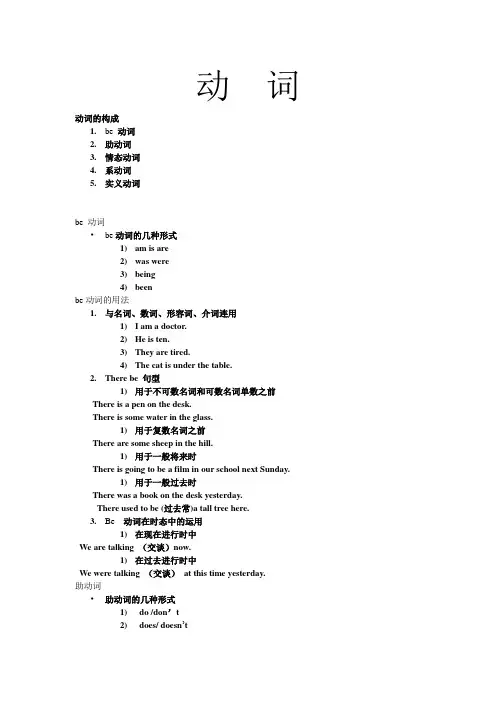
动词动词的构成1.be 动词2.助动词3.情态动词4.系动词5.实义动词be 动词•be动词的几种形式1)am is are2)was were3)being4)beenbe动词的用法1.与名词、数词、形容词、介词连用1)I am a doctor.2)He is ten.3)They are tired.4)The cat is under the table.2.There be 句型1)用于不可数名词和可数名词单数之前There is a pen on the desk.There is some water in the glass.1)用于复数名词之前There are some sheep in the hill.1)用于一般将来时There is going to be a film in our school next Sunday.1)用于一般过去时There was a book on the desk yesterday.There used to be (过去常)a tall tree here.3.Be 动词在时态中的运用1)在现在进行时中We are talking (交谈)now.1)在过去进行时中We were talking (交谈)at this time yesterday.助动词•助动词的几种形式1)do /don’t2)does/ doesn’t3)did/ didn’t4)will /won’t5)have, haven’t /has, hasn’t/had hadn’t助动词的用法1.对句子进行否定和疑问1)Do you get up early every day?2)I didn’t (没)have lunch yesterday.3)Will you be back soon?4)He hasn’t (没)finished the work yet.2.在反意疑问句中1)He works in a school, doesn’t he?2)She has never been there,has she?3.在倒装句中1)They helped the farmers , so did we.2)I won’t visit the famous singer,neither will he.情态动词1.共同特点1)情态动词后面跟动词原型2)无论否定、疑问、倒装句、或反意疑问句都用情态动词3)只有时态变化,没有人称变化情态动词2.解释1)can / could在表示请求允许的时候两者和互换,could比can语气更委婉。