
三起外研版五年级英语上册期末知识点梳理
Module 10
句子: 3、Let’s go. Let’s+动词原形. 我们... ...吧。 4、Don’t walk on the grass. 5、Don’t climb the tree. Don’t+动词原形. 不要... ... 6、You can watch TV. You can+动词原形。“你可以做.....”
Module 7
语法: 代词宾格:表示某人,作宾语用。
Module 8
短语: 1、what time 几点钟 2、go to bed 上床睡觉 3、be late for school 上学迟到 4、in the morning 在早上 5、at half past seven 在七点半 at+时间点 在......点 half past+数字 ......点半 at+时间
Module 9
短语: 1、feel bored(无聊)/angry(生气)/sad(难过) /happy(高兴)/tired(疲倦)/hungry(饥饿) 2、feel cool(凉快)/warm(暖和)/cold(寒冷) /hot(热) 3、of course 当然 of course not 当然不 4、be ill in hospital 生病住院 5、call somebody =phone somebody 给某人打电话 6、win a chess game 赢了围棋比赛 7、on the farm 在农场 8、all day 整天 9、动词过去式:win---won lose---lost
Module 8
短语: 6、do exercise 做操 do morning exercises 做早操 7、in the playground 在操场上 8、want to do … 想要做… 9、play with somebody 和某人玩 10.like+名词 如I like football like+动词ing 如 I like playing football
Module 8
句子: 1--What time is it now? --It’s half past 数字. --What time is it now? --It’s +数字+o’clock 2、I don’t want to be late for school tomorrow. 3、--What time do you get up? --I get up at half past seven. --What time does your school start? --My school starts at nine o’clock in the morning. 5、She always wants to walk.
Module 6
语法:can(can问can答) can “能,能够,可以,会”,后面跟动词原形 1、肯定句:某人+can+动词原形。 2、否定句:某人+can’t+动词原形。 (can后加not,其余不变) 3、一般疑问句:Can+sb+动词原形? (can提前,其余不变) 一般疑问句答语(can问can答) Yes,某人can. / No,某人can’t.
Module 2
句子: 1、--What did you buy? --We bought some apples. 2、--How many bananas did you buy? --We didn’t buy any bananas.
Module 2
句子:
1.How many +可数名词复数+…?答语为数字 如-How many apples did you buy? -Six apples. 2.How much +不可数名词+…?答语为half a kilo / 数词+kilo(s) / 数词+bottle(s) 如-How much cheese did you buy? -Half a kilo.
Module 10
句子: 1、--Where is Sam? --He is in the bedroom. somebody+be(am/is/are/was/were)+地点。 某人在某地 2、--Where did you find John? --I found John in the kitchen. I found+某人/某物+地点。 我在某地发现某人/某物。
Module 6
句子: 1、--Can you pass the ball well? --Not very well. 2、You are very good at basketball. be good at…擅长… 3、You can play football well(句尾). 4、In the past,he ran very fast. very非常,很 The black horse ran really fast. really 真的,确实
Module 2
短语 1、buy some fruit 买一些水果 2、make a shopping list 制定一个购物 清单 3、also也,放句中 too也,放句末 4、 half a kilo 半公斤 two kilos两公斤 5、 a lot of=lots of 许多 接可数名词 复数或不可数名词
Module 9
5、I won a chess game last week. 6、--How does he feel? --He feels hungry, 表达感受: 某人+be(am/is/are)+feeling+表感受的词。 某人+be(am/is/are)+表感受的词。 某人+feel/feels+表感受的词。
Module 9
句子: 1、What’s the matter? What’s the matter with sb? (答语:①lost丢失 ②took拿走、取走 ③ill 生病) 2、--Are you feeling bored? --No…./Yes….. 3、--Is she feeling sad? --Yes,she is./No,she isn’t 4、He is happy./He feels happy.
Module 2
语法:特殊疑问句 特殊疑问句 构成:特殊疑问词+一般疑问句?回答时, 根据具体情况回答。 特殊疑问词: what 什么 问事情 who 谁 问人物 why 为什么 问原因(because) how 怎样 问交通方式或病情 where 哪里 问地点 when 什么时候 问时间
Module 3
句子: --Where did you go? --We went to the British Museum. --How did you go to these places? --We went by bus. 3、-What did you do at the weekend? -We visited lots of places 4、They arrived there at ten o’clock. 5、Daming took a photo of his、some“一些”,接可数名词复数或 不可数名词,用在肯定句中 any“一些”,接可数名词复数或不 可数名词,用在否定句或疑问句中 I have some apples. I don’t have any apples. Do you have any apples? 7、over there 那边 8、动词过去式:buy---bought eat---ate drink---drank
Module 8
语法:一般现在时 一般现在时:表示经常发生的动作或目 前的状况。 第三人称单数做主语,动词词尾加“s” 动词词尾加“s”规则: 1)直接加 2)以o、s、x、sh、ch结尾,加es 3)“辅音字母+y结尾”,变y为i加es
Module 8
1、肯定句:Sb(三单)+动词s+其它。 否定句:Sb(三单)+doesn’t+动词原形+其它。 (句中加doesn’t,动词还原,其余不变) 一般疑问句:Does+某人+动词原形+其它? (句首加does,动词还原,其余不变) Yes, Sb(三单) does./ No, Sb(三单) doesn’t. 其它人称做主语,动词用原形 2、肯定句:Sb+动词+其它。 否定句:Sb+don’t+动词原形+其它。 (句中加don’t,其余不变) 一般疑问句:Do+某人+动词原形+其它? (句首加do,其余不变) Yes,sb do./ No,sb don’t.
小学五年级英语上册知识点梳理
Module 1 • 语法:一般过去时
一般过去时(动词+ed) 动词过去式(动词+ed)规则: 1)、直接加-ed helped 2)、去e 加-ed 3)、变y为i 加-ed 4)、双写加-ed dropped 5)、不规则变化
Module 1
• 肯定句:某人 +动词ed. 如Amy played football. • 否定句:某人+didn’t+动词原形. 如Amy didn’t play football. • 一般疑问句: Did+某人+动词原形? Yes, 某人did./No, 某人didn’t. 如Did Amy play football? Yes,she did./No,she didn’t.
Module 10
短语: 1、in the kitchen 在厨房里 2、in the bedroom 在卧室里 3、in the toilet 在厕所里 4、in the living room 在客厅里 5、play hide-and-seek 玩捉迷藏游戏 6、on the grass 在草地上 7、in the zoo 在动物园里 8、climb the tree 爬树
外研版三起英语五年级上册:全册知识归纳【精品】
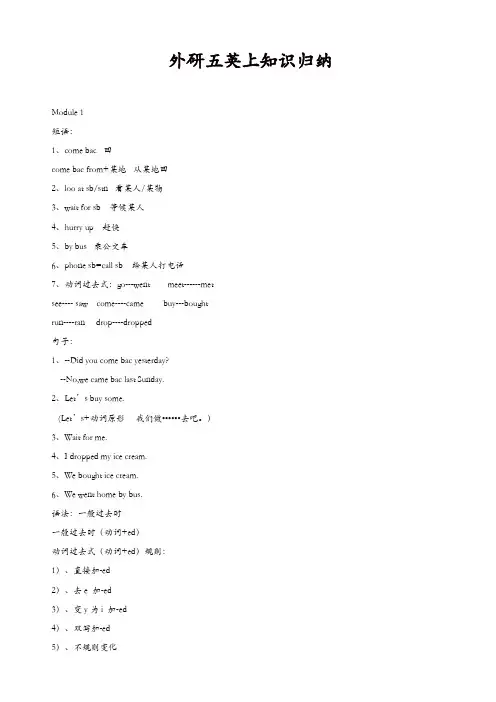
外研五英上知识归纳Module 1短语:1、come bac 回come bac from+某地从某地回2、loo at sb/stn 看某人/某物3、wait for sb 等候某人4、hurry up 赶快5、by bus 乘公交车6、phone sb=call sb 给某人打电话7、动词过去式:go---went meet------metsee---- saw come----came buy---boughtrun----ran drop----dropped句子:1、--Did you come bac yesterday?--No,we came bac last Sunday.2、Let’s buy some.(Let’s+动词原形我们做••••••去吧。
)3、Wait for me.4、I dropped my ice cream.5、We bought ice cream.6、We went home by bus.语法:一般过去时一般过去时(动词+ed)动词过去式(动词+ed)规则:1)、直接加-ed2)、去e 加-ed3)、变y为i 加-ed4)、双写加-ed5)、不规则变化肯定句:Sb +动词ed.否定句:Sb +didn’t+动词原形.一般疑问句:Did+sb +动词原形?Yes,sb did./No,sb didn’t.Module 2短语:1、buy some fruit 买一些水果2、mae a shopping list 制定一个购物清单3、also也,放句中too也,放句末4、some“一些”,接可数名词复数或不可数名词,用在肯定句中any“一些”,接可数名词复数或不可数名词,用在否定句中I have apples.I don’t have apples.Do you have apples?5、half a ilo 半公斤6、a lot of=lots of 许多接可数名词复数或不可数名词7、over there 那边8、动词过去式:buy---bought eat---atedrin---dran句子:1、--What did you buy?---I bought some apples.2、--How many bananas did you buy?--We didn’t buy any bananas.注:How many +可数名词复数+一般疑问句?3、--How much cheese did you buy?--Half a ilo.注:How much +不可数名词+一般疑问句?回答用half a ilo / 数词+ilo(s) / 数词+bottle(s)语法:特殊疑问句特殊疑问句构成:特殊疑问词+一般疑问句?回答时,根据具体情况回答。
外研版(三起点)五年级上册英语期末复习汇总

外研版(三起)五年级Module 1知识汇总一、词汇其他:above(介词)(在…上方,在.之上)those(代词)(那些)us(代词)(宾格)(我们)love(爱你的)常考动词过去式:三、习惯搭配come back 回来hurry up 赶紧,赶快live in 住在go to the park 去公园go home 回家by bus 乘公共汽车wait for 等待last Sunday 上星期日四、常用表达1. How are you? 你好吗?2.I'm fine, thank you. 我很好,谢谢你。
e with us. 跟我一起来吧。
4. Wait for me! 等等我!5.Thank you! 谢谢你!五、重点句型1.询问对方过去是否做过某事:-- Did you + 动词原形+其他?-- Yes, I/ we did./No.I/we didn't.eg: 1.-- Did you come back yesterday?-- Yes, I did.2.-- Did you see a film last night?-- No. we didn't.2.描述某人过去做过某事:主语+ 动词过去式+其他eg: 1.I met my English teacher yesterday.2. Bob lost his pet dog last Friday.重点常考句子:1、--Did you come back yesterday?--No,we came back last Sunday.2、Look at those ice creams!Let’s buy some.(Let’s+动词原形让我们做······去吧。
)3、Wait for me.4、Yesterday I went to the park with Sam and Amy.5、We met John in the park.6、I dropped my ice cream.7、We bought ice creams.8、We went home by bus.9、I ran to the bus.外研(三起)五年级Module 2 知识汇总一、词汇其他:list(清单)er(哦,嗯,呃)can(可以)cheese(奶酪)first(首先,第一;最先的,第一(次)的)half(一半)any(一些,一点,若干)bottle(瓶子;一瓶的容量)kilo(千克)常考动词过去式:动词过去式:buy---bought eat---ate drink---drank三、习惯搭配how many 多少 a shopping list 一份购物清单at the supermarket 在超市 a lot of 许多的how much 多少over there 在那边四、常用表达I don't know. 我不知道。
三起外研版五年级英语上册期末知识点梳理

单击此处添加正文,文字是您思想的提炼,为了演示发布的良好效果,请言简意赅地阐述您的观点。您的内容已经简明扼 要,字字珠玑,但信息却千丝万缕、错综复杂,需要用更多的文字来表述;但请您尽可能提炼思想的精髓,否则容易造成 观者的阅读压力,适得其反。正如我们都希望改变世界,希望给别人带去光明,但更多时候我们只需要播下一颗种子,自 然有微风吹拂,雨露滋养。恰如其分地表达观点,往往事半功倍。当您的内容到达这个限度时,或许已经不纯粹作用于演 示,极大可能运用于阅读领域;无论是传播观点、知识分享还是汇报工作,内容的详尽固然重要,但请一定注意信息框架 的清晰,这样才能使内容层次分明,页面简洁易读。如果您的内容确实非常重要又难以精简,也请使用分段处理,对内容 进行简单的梳理和提炼,这样会使逻辑框架相对清晰。
-We visited lots of places 4、They arrived there at ten o’clock. 5、Daming took a photo of his father.
Module 4
语法:物主代词
物主代词:表示“某人的”,后面跟名词。
Module 5
语法:There be句型 ○ There be句型:
run really/very fast 跑得真快,
跑得很快
2、pass the ball well 传球传得好
3、catch the ball well 接球接得好
4、play football well 踢球踢得好
5、 high 跳高
jump really/very high 跳得真高,跳
--I get up at half past seven. --What time does your school start? --My school starts at nine o’clock
最全外研版(三起)小学英语五年级上册知识点归纳汇总
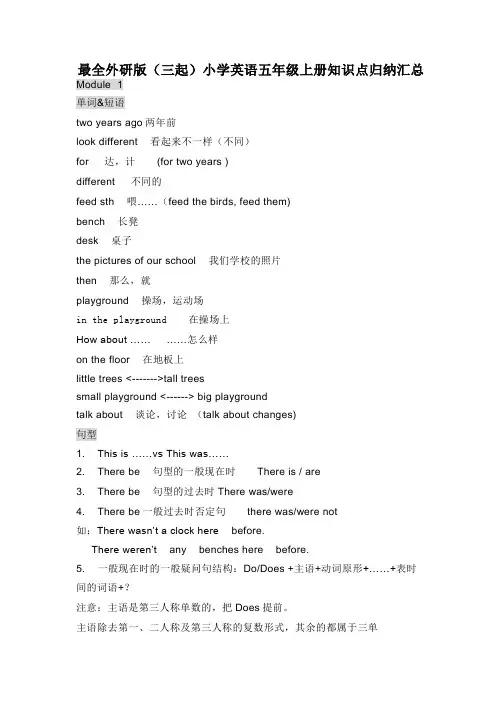
最全外研版(三起)小学英语五年级上册知识点归纳汇总Module 1单词&短语two years ago两年前look different 看起来不一样(不同)for 达,计(for two years )different 不同的feed sth 喂……(feed the birds, feed them)bench 长凳desk 桌子the pictures of our school 我们学校的照片then 那么,就playground 操场,运动场in the playground 在操场上How about …… ……怎么样on the floor 在地板上little trees <------->tall treessmall playground <------> big playgroundtalk about 谈论,讨论(talk about changes)句型1. This is ……vs This was……2. There be 句型的一般现在时There is / are3. There be 句型的过去时There was/were4. There be一般过去时否定句there was/were not如:There wasn’t a clock here before.There weren’t any benches here before.5. 一般现在时的一般疑问句结构:Do/Does +主语+动词原形+……+表时间的词语+?注意:主语是第三人称单数的,把Does提前。
主语除去第一、二人称及第三人称的复数形式,其余的都属于三单例句:Does London look different now ?回答: Yes, it does (主语+ do/does) / No, it doesn’t. (主语+do/does+not )例句:Do you like the park now ?回答:Yes, I do. (一般疑问句中的主语是第二人称的,回答要变为第一人称I或we)No, I don’t.-------------------------------------------------------------------------------------------------------Module 2单词和短语heavy 重的let 允许,让come on 快点sell 卖,销售sometimes 有时over there 在那边put ……in ……把……放在……里put the bags in the carcarry 运送,搬运helpful 有帮助的,乐于助人的a lot of = lots of 后跟可数名词复数或不可数名词goody 复数:goodies 好吃的东西句型:1. Let’s=Let us +动词原形让我们……吧。
外研版(三起)小学五年级英语上册知识点梳理

外研版(三起)小学五年级英语上册知识点梳理Module 1Phrases:e back - to returnCome back from + a place - to return from a place2.Look at sb/sth - to XXX3.Wait for sb - to stay in one place until someone arrives4.Hurry up - to move quickly5.By bus - using a bus for XXX6.Phone sb = call sb - to make a phone call to someone7.Past XXX:go - wentmeet - metsee - sawcome - camebuy - boughtrun - randrop - droppedXXX:1.Did you come back yesterday?2.No。
we came back last Sunday.3.Let's buy some。
(Let's + verb - Let's do something together)4.Wait for me.5.I dropped my ice cream.6.XXX cream.7.We went home by bus.Grammar: Simple Past XXXSimple past tense (verb + ed)Rules for forming past XXX:1.Add -ed to the end of the verb (e.g。
looked。
played。
visited)2.For verbs that end in e。
add -d (e.g。
lived)3.For verbs that end in y。
change the y to i and add -ed (e.g。
外研版(三起)英语五年级上册全册知识点汇总复习
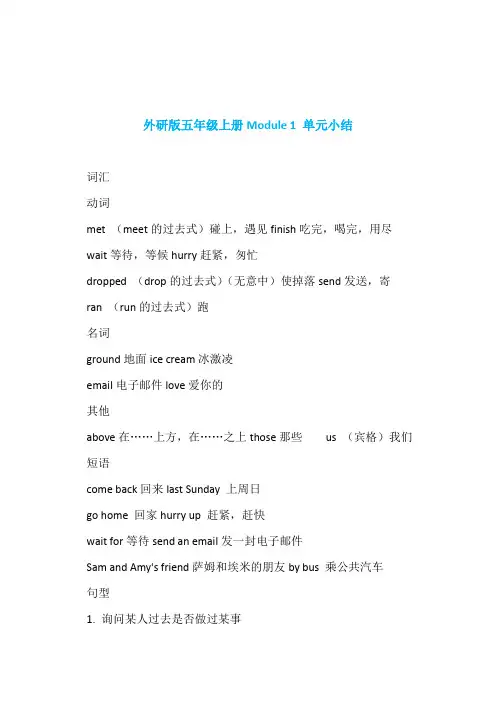
外研版五年级上册Module 1 单元小结词汇动词met (meet的过去式)碰上,遇见finish吃完,喝完,用尽wait等待,等候hurry赶紧,匆忙dropped (drop的过去式)(无意中)使掉落send发送,寄ran (run的过去式)跑名词ground地面ice cream冰激凌email电子邮件love爱你的其他above在……上方,在……之上those那些us (宾格)我们短语come back回来last Sunday 上周日go home 回家hurry up 赶紧,赶快wait for等待send an email发一封电子邮件Sam and Amy's friend萨姆和埃米的朋友by bus 乘公共汽车句型1. 询问某人过去是否做过某事—Did+主语+动词(短语)原形+表示过去的时间?—Yes, 主语+did./No, 主语+didn't.·—Did you come back yesterday? 你们昨天回来的吗?—No, we didn't. 不,我们不是昨天回来的。
2. 描述某人过去的动作主语+动词(短语)过去式+其他.·We came back last Sunday. 我们上周日回来的。
3. 描述某人过去的状态主语+was/were+描述状态的词+其他.·I was very sorry. 我非常抱歉。
外研版五年级上册Module 2 单元小结词汇名词list清单cheese 奶酪bottle 瓶子;一瓶的容量kilo千克动词need需要can 可以lost (lose的过去式)丢失use使用其他er哦,嗯,呃first首先,第一;最先的,第一(次)的any一些,一点,若干half 一半短语make a shopping list 列一份购物清单half a kilo半千克a lot of许多的over there 在那边at the supermarket 在超市how much 多少句型1. 询问他人买了什么东西的句型及其答语—What did+主语+buy?—主语+bought+物品.·—What did you buy? 你们买了什么?—We bought some apples. 我们买了一些苹果。
外研版(三起)五年级英语上册全册知识点汇总复习
Module 1一、核心词汇1. 名词: ground 地面hurry赶紧,匆忙email 电子邮件ice cream 冰激凌love爱你的2. 动词: met (meet的过去式)碰上,遇见finish 吃完,喝完,用尽wait 等待,等候dropped (drop的过去式)(无意中)使掉落send 发送,寄ran (run的过去式)跑3. 代词: those 那些4. 宾语: us (宾格)我们5. 介词: above 在……上方,在……之上二、拓展词汇动词的过去式: came (come的过去式)回来went (go的过去式)去bought (buy的过去式)买did (do/does的过去式)做was (is/am的过去式)是were (are的过去式)是lived (live的过去式)居住waited (wait的过去式)等visited (visit的过去式)参观finished (finish的过去式)吃完三、核心句型1. —Did you come back yesterday? 你们昨天回来的吗?—No, we came back last Sunday. 不是,我们上周日回来的。
解读:此句是由did引导的一般过去时的一般疑问句,询问对方过去是否做过某事。
回答时要用“Yes”或“No”。
举一反三:—Did she meet John in the park? 她在公园里遇到约翰了吗?—Yes, she met John in the park. 是的,她在公园里遇到约翰了。
—Did she come back to China? 她回到中国了吗?—No, she came back to Canada. 不,她回加拿大了。
2. We bought ice creams. 我们买了冰激凌。
解读:此句用的是一般过去时态,表示过去某一时刻或某一段时间所发生了的事情或存在的状态。
常与过去时间yesterday (昨天), this morning (今天早上), just now (刚才), a moment ago (刚才), in May (在五月), last night (昨天晚上)/year(去年)/week(上周), once upon a time (从前), the other day (前几天), in the past (在过去)等连用。
新外研版小学英语(三起)五年级英语上册知识点归纳
短语:1、come back 回来come back from+某地从某地回来2、look at sb/stn 看某人/某物3、wait for sb 等候某人4、hurry up 赶快 5.by bus 乘公交车6、phone sb=call sb 给某人打电话7、动词过去式:go---went meet------met see---- saw come----camebuy---bought run----ran drop----dropped句子:1、--Did you come back yesterday?2、--No,we came back last Sunday.动词原形我们做······去吧。
)3、Let’s buy some. (Let’s+3、Wait for me.4、I dropped my ice cream.5、We bought ice cream.6、We went home by bus.语法:一般过去时一般过去时的动词要改为过去式。
(动词+ed)动词过去式变化规则:1)、一般情况下直接加-ed 比如:looked, played,2)、以不发音字母 e 结尾的单词,去 e 加-ed 比如:taked, rided(骑) 3)、以辅音字母加y结尾的单词,变y为i 加-ed 比如:carry-carried,4)、末尾三个字母为辅音字母+元音字母+辅音字母结构,且重读闭音节结尾,双写最后一个字母,再加-ed ,比如:drop-dropped planned5)、不规则变化比如:run-ran , swim-swam go-went buy-bought肯定句:Sb +动词过去式.否定句:Sb +didn’t(did n ot)+动词原形.一般疑问句:Did+sb +动词原形? Yes,sb did./No,sb didn’t.短语:1、buy some fruit 买一些水果2、make a shopping list 制定一个购物清单3、also也,放句中;too也,放句末4、some“一些”,接可数名词复数或不可数名词,用在肯定句中any“一些”,接可数名词复数或不可数名词,用在否定句中I have apples.I don’t have apples.Do you have apples?5、half a kilo 半公斤6、a lot of=lots of 许多接可数名词复数或不可数名词7、over there 那边8、动词过去式:buy---bought eat---ate drink---drank句子:1、--What did you buy?---I bought some apples.2、--How many bananas did you buy?--We didn’t buy any bananas.注:How many +可数名词复数+一般疑问句?3、--How much cheese did you buy?--Half a kilo.注:How much +不可数名词+一般疑问句?回答用half a kilo / 数词+kilo(s) / 数词+bottle(s)语法:特殊疑问句特殊疑问句构成:特殊疑问词+一般疑问句?回答时,根据具体情况回答。
Module9(复习课件)-2023-2024学年五年级英语上册期末核心考点集训(外研版三起)
C. feeling C. grandma C. happy C. what C. Australia
真题强化-单词过关
二、选词填空,补全句子。
bored
sad
angry
happy
1. I lost my schoolbag. I feel ___s_a_d_____.
2. Mum buys a gift for me. I feel ____h_a_p_p_y__.
How + be 动词(is/are)十主语? 4.一般过去时表示在过去某个时间发生的动作或存在的状态。
02
重难精讲
重难精讲
一、 “询问他人此刻是否具有某种感受的句型”。
课文例句:
Are you feeling bored? 你感到无聊吗? No,I am not.不,我没有。
重难精讲
一、 “询问他人此刻是否具有某种感受的句型”。
-Are you ____B____bored? -Yes,I am. A. feels B. feel C. feeling
重难精讲
二、 “表达自己感受的句型”。
课文例句:
I feel tired. 我感到疲倦。 She feels angry. 她很生气。 Now I feel tired. 现在我感觉很累。 he feels hungry. 他很饿。
知识解读-短语
重点 短语
hungry and thirsty又俄又渴 call my mum给我妈妈打电话 help my grandpa帮助我的祖父 be ill in hospital 生病住院 win a chess game赢得国际象棋比赛 miss your friends 想念你的朋友们
外研版(三起)五年级英语上册全册知识点汇总复习
外研版(三起)五年级英语上册全册知识点汇总复习一、核心词汇1.名词:ground地面hurry赶紧,匆忙email电子邮件ice cream冰激凌love爱你的2.动词:met(meet的过去式)碰上,遇见finish吃完,喝完,用尽wait等待,等候dropped(drop的过去式)(无意中)使掉落send发送,寄ran(run的过去式)跑3.代词:those那些4.宾语:us(宾格)我们5.介词:above在……上方,在……之上二、拓展词汇动词的过去式:came(come的过去式)回来went(go的过去式)去bought(buy的过去式)买did(do/does的过去式)做was(is/am的过去式)是were(are的过去式)是lived(live的过去式)居住waited(wait的过去式)等visited(visit的过去式)参观finished(finish的过去式)吃完三、核心句型1.—Did you come back XXX?你们昨天回来的吗?No。
we came back last Sunday.不是,我们上XXX回来的。
解读:此句是由did引导的一般过去时的一般疑问句,询问对方过去是否做过某事。
回答时要用“Yes”或“No”。
闻一知十:—Did she meet John in the park?她在公园里遇到XXX了吗?Yes。
she met John in the park.是的,她在公园里遇到XXX 了。
Did she come back to China?她回到中国了吗?No。
she came back to Canada.不,她回加拿大了。
2.XXX creams.我们买了冰激凌。
解读:此句用的是一般过去时态,表示过去某一时刻或某一段时间所发生了的事情或存在的状态。
常与过去时间yesterday (昨天)。
this morning (今天早上),just now (刚才)。