
牛津译林版英语七年级下册Unit2 单元短语句型归纳
Unit2 单元短语句型归纳
【短语集萃】
be afraid 恐怕
help each other 互相帮助
most of them他们中的大多数
at the community centre在社区活动中心
help sb. with sth.帮助某人解决某种困难
all kinds of各种各样的
ask sb. to do sth.请某人做某事
be broken 坏了
college students 大学生
be ready to do sth准备/乐意做某事
do some shopping 买东西
be lucky to do sth.做某事真幸运
in the future 在将来
this afternoon 今天下午
check sth. for sb.为某人检测某物
wait for sb. to do sth.等候某人做某事
call back回电话
decide to do sth.决定做某事
watch the film 看电影
next Friday 下星期五
plan a day out 计划一日游
the day after tomorrow 后天
make a fire 生火
office worker 办公室职员,上班族
police station 警察局
post office 邮局
at night 晚上,在夜里
far away from 离(某地)远
be sure 相信,确信 be good at 擅长
sound like 听起来像
sick people 病人
by train/bus/ship/bike 乘火车/公交车/轮船/自行车
in an hour —小时后
turn on 打开
more or less 或多或少
keep quiet 保持安静
on the afternoon of 在……的下午
make you feel better让某人感到好些
worry about 为……担心
what to wear 穿什么
group members小组成员
know a lot非常了解
【典句必背】
1. I’m going to visit our new neighbours.我要去拜访我的新邻居。
2. I’m afraid they won’t welcome visitors like you.恐怕他们不会欢迎像你这样的拜访者。
3. Most of them have 14 floors.它们中的大多数都有十四层。
4. It’s good to live in a neighbourhood like that.生活在像那样的一个街区里真好。
5. They’re kind and helpful.他们善良而且乐于助人。
6. They help us with all kinds of problems.他们帮助我们解决各种各样的问题。
7. There’s something wrong with my computer.我的电脑坏了。
8. Some college students are ready to help.—些大学生正准备帮忙。
9. You’re lucky to live in a neighbourhood like that, Simon.
西蒙,你很幸运,生活在像那样的一个街区。
10. Do you need any help? 你需要帮助吗?
11. How about your uncle? 你的叔叔呢?
12. What are you going to do in the future?你将来打算做什么?
13. I’m sure you’ll be good at it.我确信你会擅长它。
14. That sounds like a good idea.这听起来不错。
15. We are going to have a “helping hands” meeting at the community centre on the afternoon of 5
(完整版)译林牛津七年级下学期英语语法总结
(完整版)译林牛津七年级下学期英语语法总结
译林牛津七年级下学期英语语法总结
Unit 1: Present tenses
- Simple Present tense: 一般现在时用于描述现在的常态、惯或真理
- Present Continuous tense: 现在进行时用于描述当前正在发生的动作
- Present Simple vs Present Continuous: 一般现在时和现在进行时的区别
Unit 2: Past tenses
- Simple Past tense: 一般过去时用于描述过去某个时间发生的动作或状态
- Past Continuous tense: 过去进行时用于描述过去某个时间正在进行的动作
- Simple Past vs Past Continuous: 一般过去时和过去进行时的区别
Unit 3: Future tenses
- Will + verb: 表示将来的决定、打算或预测
- Be going to + verb: 表示计划、意图或预测
- Future Continuous tense: 将来进行时用于描述将来某个时间正在进行的动作
- Future Simple vs Be going to: 将来时的两种表达方式的区别
Unit 4: Passive voice
- Active voice vs Passive voice: 主动语态和被动语态的区别
- How to form the passive voice: 构成被动语态的方法
- Passive voice with different tenses: 不同时态的被动语态形式
Unit 5: Modal verbs
- Can, could, may, might: 表示能力、允许或可能性
- Must, have to: 表示必须、责任或推测
- Should, ought to: 表示应该、建议或期望
牛津译林版七年级英语下册7B U2 重点语法知识整理
7B Unit 2
1. meet sb. 和某人见面/见某人
. meet --- meeting n. have a (class/ parents’) meeting 开班会/开家长会
2. welcome sb. 欢迎某人
. welcome to sp. 欢迎到某地
. You are welcome. 没关系/ 不用谢。
3. like 像
. visitors like you 像你这样的拜访者
. a new neighbourhood like that 一个像那样的新街区
. a bike like yours 像你的一样的一辆自行车
4. be afraid of sth.
. eg. I am afraid of ghosts. 我害怕鬼。
. be afraid to do …
. eg. I am afraid to go out at night. 我害怕在晚上出去。
. be afraid that 从句
. I am afraid (that) he won’t come tomorrow afternoon. 我恐怕他明天下午不会来。
. I am afraid not. 我恐怕不是(能)。 / I am afraid so. 我恐怕是这样。
5. cook 厨师 ---- cooker 厨具
. eg. a rice cooker 电饭煲
6. Where do you live? 比较 Which place do you live in? 你住在哪儿?
Where are you going? 比较 Which place are you going to? 你要去哪儿?
7. in Ninth Street 在第九大街
译林版英语七年级下册Unit1-8动词短语
译林版英语七年级下册Unit1-8动词短语
本文档旨在总结译林版英语七年级下册Unit1-8中涉及的动词短语。以下是各个单元的动词短语列表:
Unit 1: Getting to Know You
- get up
- have breakfast
- go to school
- have lunch
- do homework
- go to bed
Unit 2: Family Matters
- live in
- have dinner
- visit grandparents
- get along
Unit 3: School Life - study English
- play sports
- do chores
- take a shower
- watch TV
Unit 4: Hobbies
- play chess
- take photos
- listen to music
- read books
Unit 5: Food and Drink
- eat out
- have a picnic
- drink milk
- cook dinner
Unit 6: Around Town
- go shopping - visit a museum
- ride a bike
- take a bus
Unit 7: Health and Fitness
- do exercises
- go swimming
- play basketball
- learn karate
Unit 8: Holidays
- celebrate birthdays
- buy gifts
- decorate the house
- have a party
以上是译林版英语七年级下册Unit1-8动词短语的列表。这些动词短语可以帮助学生更好地理解每个单元中的相关话题。学生可以通过运用这些动词短语来描述自己的日常生活、爱好和活动,提高英语表达能力。
译林版牛津英语七年级下册全册Unites1-8单元知识点及语法归纳
译林版牛津英语七年级下册全册Unites1-8单元知识点及语法归纳
以下是译林版牛津英语七年级下册全册Unites1-8单元的知识点及语法归纳。
Unit 1 Knowing about yourself 知识点:
1. 询问和介绍自己的姓名、年龄、国籍以及所在地等。
2. 描述自己的外貌特征、爱好和能力。
3. 学习使用形容词、副词、名词、动词等词汇来构造自己的句子。
4. 学会听、说、读、写26个字母。
语法归纳:
1. 人称代词:I, you, he, she, it, we, they.
2. 动词be的各种形式(am, is, are)。
3. 形容词的比较级和最高级形式。
4. 副词和形容词的用法。
5. 一般现在时的肯定句、否定句及一般疑问句。
Unit 2 Disaster zone 知识点:
1. 描述自然灾害的发生和后果。
2. 学习句式\
牛津译林版七年级下册英语Unit1-Unit8各单元语法知识点复习提纲详细版(全面,实用!)

第 1 页 共 69 页 牛津译林版七年级下册英语Unit1-Unit8各单元语法知识点复习提纲详细版
Unit1 Dream homes
【重点词汇】
1. share
share作及物动词,意为“分享”。常用结构:share sth. with sb.意为“和某人合用某物;和某人分享某物”。如:
I'm afraid you have to share a table with others.
我恐怕你得和别人合用一张桌子。
I often share my snacks with my classmates.
我经常和同学分享零食。
2. dream
dream作名词时,意为“梦,梦想”;作形容词时,意为“理想的,不切实际的”;作动词时,意为“做梦”,常用于结构:dream of/about...(梦到……)或dream of/ about doing sth.梦想做某事。如:
Millie has a dream to have a big house
米莉梦想拥有一幢大房子
My dream house is a house with a big garden.
我梦寐以求的房子是一幢带有大花园的房子。
I dreamed of my English teacher last night.
我昨晚梦到了我的英语老师
Amy dreams of being a singer when she grows up.
埃米梦想长大后成为一名歌手。
3. own
第 2 页 共 69 页 own作形容词.意为“自己的,属于自己的”,常和形容词性物主代词连用,构成短语of one's
own,表示“属于某人自己的”,on one's own = alone,意为“独自地”。own作动词时,表示“拥有”。如:
I have my own computer
江苏省永丰初级中学七年级英语下册 Unit 2 Neighbours知识点复习(无答案)(新版)牛津版
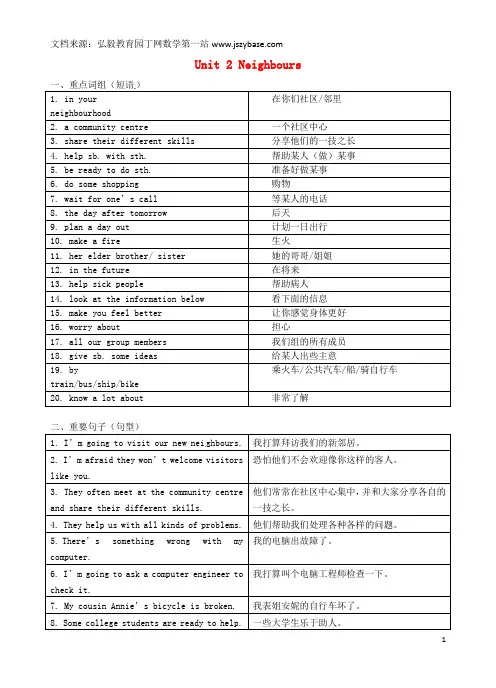
文档来源:弘毅教育园丁网数学第一站
1 Unit 2 Neighbours
一、重点词组(短语)
1. in your
neighbourhood 在你们社区/邻里
2. a community centre 一个社区中心
3. share their different skills 分享他们的一技之长
4. help sb. with sth. 帮助某人(做)某事
5. be ready to do sth. 准备好做某事
6. do some shopping 购物
7. wait for one’s call 等某人的电话
8. the day after tomorrow 后天
9. plan a day out 计划一日出行
10. make a fire 生火
11. her elder brother/ sister 她的哥哥/姐姐
12. in the future 在将来
13. help sick people 帮助病人
14. look at the information below 看下面的信息
15. make you feel better 让你感觉身体更好
16. worry about 担心
17. all our group members 我们组的所有成员
18. give sb. some ideas 给某人出些主意
19. by
train/bus/ship/bike 乘火车/公共汽车/船/骑自行车
20. know a lot about 非常了解
二、重要句子(句型)
1. I’m going to visit our new neighbours. 我打算拜访我们的新邻居。
2. I’m afraid they won’t welcome visitors
like you. 恐怕他们不会欢迎像你这样的客人。
3. They often meet at the community centre
最新最新译林版牛津英语7Bunit2-neighbours知识点讲解
学习-----好资料
更多精品文档 Unit2 Neighbours
词汇/句型
1.
neighbour n.邻居
拼写:
居民区,社区
2. meet
(1) vt.遇见,碰见 I met him in the street.
(2) vt.迎接 Will you meet her at the station?
[拓展]Meet with
偶然遇见
On my way home, I met with an old friend.
3. afraid adj.害怕,畏惧
(1)be afraid to do sth害怕做某事
I’m afraid to go out alone at night.
(2)be afraid of doing sth害怕……
I’m afraid of falling into the river.
(3 )be afraid that从句,表示恐怕……
I’m afraid that I can’t help you.
4.
like prep.
(1)像,类似
Lily makes a kite like a butterfly.
Don’t do it like that.
(2)像…一样,常用词组look like
My brother looks like my father.
5. It’s good to live in a neighbourhood like that.
It是形式主语,to live in a neighbourhood是真正的主语。
句式:It is+adj+(for/of sb) to do sth
6. help sb. with sth
翻译:他经常帮我复习英语。
help sb (to) do sth
翻译:他经常帮妈妈打扫房间。
7. 翻译:我的电脑出毛病了
学习-----好资料
2020牛津译林版七年级英语下册Unit 2 重点单词、短语、句子专练(带答案)
七年级下Unit 2
重点单词、短语、句子专练
一、根据句意及所给的汉语提示,用合适的单词填空。
1. With the help of Dr Johnson, I am feeling __________ (更好)now.
2. We can get much__________ (信息) from the microblog (微博).
3. The panda is sick. He doesn't want to eat __________ (任何东西).
4. Working in__________ (组)is a good idea.
5. Look at the blackboard! There is a new__________ (通知).
二、从方框中选择合适的短语并用其适当形式填空,使句子完整、通顺。
all kinds of, do some shopping, have a meeting, at the weekend,be ready to
1. My mother is very busy. I often help her do housework ___________.
2. The college students ___________help the old people when they have problems.
3. My aunt is good at making kites. She can make ___________kites.
4. The teachers in our school often ____________on Mondays at the school hall.
5. There is little food at home. We have to ___________.
三、单项选择
七年级英语下册 Unit 2 Neighbours知识归纳与拓展 (新版)牛津版
Unit 2 Neighbours知识归纳与拓展
【词汇解析】
1. visitor
visitor是可数名词,意为“游客,参观者”,其复数形式是visitors。visitor的动词形式是visit,意为“参观,访问”; visit也可用作名词,常构成短语pay a visit to,相当于动词visit。如:
Visitors often do some shopping in local shops.
游客们常在当地商店购物。
We will visit the Palace Museum next week.
下周我们将参观故宫。
Some American students will pay a visit to our school next month.
下个月,一些美国学生将访问我们学校。
2. like
like作介词时,意思是“像,类似”,不可作句子的谓动词,常与“be”动词一起使用,或构成短语look like,意为“看起来像”;like作动词时,意为“喜欢”。如:
They don’t welcome a visitor like you.
他们不欢迎像你这样的来访者。
The boy looks like his father.
这个男孩看起来像他爸爸。
Everyone in my class like learning English very much.
我班上的每个人都非常喜欢学英语。
【拓展】like的反义词有两个:dislike是动词,意为“不喜欢”,相当于hate;unlike是介词,意为“不像”。
3. lucky
lucky是形容词,意为“幸运的”,可以作表语或作定语修饰名词,常用结构有:be lucky
to do sth.意为“做某事是幸运的”;It is lucky of sb. to do sth.意为“某人做某事真幸运”。如:
He is really a lucky boy.他真是个幸运儿。
2022-2023学年牛津译林版英语七年级下册全册知识点整理
Unit1Dream homes 1、Would you like to live in a palace, Eddie艾迪,你想住在宫殿里吗
这里 would like是“想,想要”的意思,后面可以加名词或动词或动词不定式。
如:I’d like to go to the USA next year. 明年我想去美国。
2、I’d like to live next to a restaurant. 我想住在餐馆附近。
这里 next to 是“附近,靠近的”的意思,相当于 near。 如:The table is next to the window.
这张桌子在窗户旁。
3、Which country is this photo from, Amy艾米,这幅照片来自哪个国家
这里 be from 相当于 come from, 是“来自……”的意思。 如:Where is Mr Black from
布莱克先生来自于哪儿
4、Is Tokyo the capital of Japan东京是日本的首都吗
句型结构为:The capital of +国家is +首都。如:The capital of the UK is London. 英国首都是伦敦。
[拓展]
(1)capital n.省会 The capital of Jiangsu is Nanjing. 江苏省会是南京。
(2)capital n.大写字母
We should write in a capital at the beginning of a sentence. 句子的开头我们应该用大写字母。
(3)capital n.资本,资金,资产 personal capital 个人资产
(4)capital adj.顶好的,一流的
He came up with a capital idea. 他想好一个绝妙的主意。 5、I like the kitchen best. 我最喜欢厨房。 Like…best 意为“最喜欢……”,相当于like…most。如:The girl likes playing the piano best/most.