
秦始皇兵马俑旅游景点英语介绍
秦始皇兵马俑旅游景点英语介绍Emperor Qin Shihuang’s Mausoleum and the Terra-cotta Warriors and Horses MuseumEmperor Qin Shihuang (259-210B.C.) had Ying as his surname and Zheng as his given name.He name to the throne of the Qin at age 13, and took the helm of the state at age of 22. By 221 B.C., he had annexed the six rival principalities of Qi, Chu, Yan, Han, Zhao and Wei, and established the first feudal empire in China’s history.In the year 221 B.C., when he unified the whole country, Ying Zheng styled himself emperor. He named himself Shihuang Di, the first emperor in the hope that his later generations be the second, the third even the one hundredth and thousandth emperors in proper order to carry on the hereditary system. Since then, the supreme feudal rulers o f China’s dynasties had continued to call themselves Huang Di, the emperor.After he had annexed the other six states, Emperor Qin Shihuang abolished the enfeoffment system and adopted the prefecture and county system. He standardized legal codes, written language, track, currencies, weights and measures. To protect against harassment by the Hun aristocrats. Emperor Qin Shihuang ordered the Great Wall be built. All these measures played an active role in eliminating the cause of the state of separation and division and strengthening the unification of the whole country as well as promotion the development of economy and culture. They had a great and deep influence upon China’s 2,000 year old feudal society.Emperor Qin Shihuang ordered the books of various schools burned except those of the Qin dynasty’s history and culture, divination and medicines in an attempt to push his feudal autocracy in the ideological field. As a result, China’s ancient classics ha d been devastated and destroy. Moreover, he once ordered 460 scholars be buried alive. Those events were later called in history“the burning of books and the burying of Confucian scholars.”Emperor Qin Shihuang,for his own pleasure, conscribed several hundred thousand convicts and went in for large-scale construction and had over seven hundred palaces built in the Guanzhong Plain. These palaces stretched several hundred li and he sought pleasure from one palace to the other. Often nobody knew where he ran ging treasures inside the tomb, were enclosed alive.Emperor Qin Shihuang’s Mausoleum has not yet been excavated. What looks like inside could noly be known when it is opened. However, the three pits of the terra-cotta warriot excavated outside the east gate of the outer enclosure of the necropolis can make one imagine how magnificent and luxurious the structure of Emperor Qin Shihuang’s Mausoleum was.No.1 Pit was stumbled upon in March 1974 when villagers of Xiyang Village of Yanzhai township, Lintong County, sank a well 1.5km east of the mausoleum. In 1976, No.2 and 3 Pits were found 20m north of No.1 Pit respectively after the drilling survey. The terra-cotta warriors and horses are arrayed according to the Qin dynasty battle formation, symbolizing the troops keeping vigil beside the mausoleum. This discovery aroused much interest both at home and abroad. In 1975, a museum, housing the site of No.1 and covering an area of 16,300 square meters was built with the permission of the State Council. The museum was formally opened to public on Oct.1, the National Day, 1979.No.1 Pit is 230 meters long from east to west, 62m wide from north to south and 5m deep , covering a total area of 14,260 square meters. It is an earth-and-wood structure in the shape of a tunnel. There are five sloping entrances on the eastern and western sides of the pit respectively. The pit is divided into eleven corridors by ten earthen partition walls, and the floors are paved with bricks. Thick rafters were placed onto the walls (but now one can only see their remains), which were covered with mats and then fine soil and earth. The battle formation of the Qin dynasty, facing east. In the east end are arrayed three lines of terra-cotta warriors, 70 pieces in each, totaling 210 pieces. They are supposed to be the van of the formation. Immediately behind them are 38 columns of infantrymen alternating with war chariots in the corridors, each being 180m long. They are probably the main body of the formation. There is one line of warriors in the left, right and west ends respectively, facing outwards. They are probably the flanks and the rear. There are altogether 27 trial trench, it is assumed that more than 6,000 clay warriors and horses could be unearthed from No.1 Pit.No.2 Pit sis about half the size of No.1 Pit, covering about 6,000 square meters Trail diggings show this is a composite formation of infantry, cavalry and chariot soldiers, from which roughly over 1,000 clay warriors, and 500 chariots and saddled horses could be unearthed. The 2,000-year-old wooden chariots are already rotten. But theirshafts, cross yokes, and wheels, etc. left clear impressions on the earth bed. The copper parts of the chariots still remain. Each chariot is pulled by four horses which are one and half meters high and two metres long. According to textual research, these clay horses were sculptures after the breed in the area of Hexi Corridor. The horses for the cavalrymen were already saddled, but with no stirups.No.3 Pit covers an area of 520m2 with only four horses, one chariot and 68 warriors, supposed to be the command post of the battle formation. Now, No.2 and 3 Pits have been refilled, but visitors can see some clay figures and weapons displayed in the exhibition halls in the museum that had been unearthed from these two pits. The floors of both No.1 and 2 Pits were covered with a layer of silt of 15 to 20cm thick. In these pits, one can see traces of burnt beams everywhere, some relics which were mostly broken. Analysis shows that the pits were burned down by Xiang Yu, leader of a peasant army. All of the clay warriors in the three pits held real weapons in their hands and face east, showing Emperor Qin Shihuang’s strong determination of wiping out the six states and unifying the whole country. 来源:The height of the terra-cotta warriors varies from 1.78m, the shortest, to 1.97m, the tallest. They look healthy and strong and have different facial expressions. Probably they were sculpted by craftsmen according to real soldiers of the Qin dynasy. They organically combined the skills of round engraving, bas-relief and linear engraving, and utilized the six traditional folk crafts of sculpturing, such as hand-moulding, sticking, cutting, painting and so on. The clay models were then put in kilns, baked and colour-painted. As the terra-cotta figures have beeb burnt and have gone through the natural process of decay, we can’t see their original gorgeous colours. However, most of the terra-cotta figures bear the trace of the original colours, and few of them are still as bright as new. They are found to be painted by mineral dyestuffs of vermilion, bright red, pink dark green, powder green, purple, blue, orange, black and white colours.Thousands of real weapons were unearthed from these terra-cotta army pits, including broad knives, swords, spears, dagger-axes, halberds, bows, crossbows and arrowheads. These weapons were exquisitely made. Some of theme are still very sharp, analyses show that they are made of alloys of copper and tin, containing more than ten kinds of other metals. Since their surfaces were treated with chromium, they are as bright as new, though buried underground for more than 2,000 years. This indicates that Qin dynasty’s metallurgi cal technology and weapon-manufacturing technique already reached quite a high level.In December 1980, two teams of large painted bronze chariots and horses were unearthed 20 metres west of the mound of Emperor Qin Shihuang’s Mausoleum. These single shaft four-horse chariots each comprises 3,462 spare parts, and has a body with two compartments, one behind the other, and an elliptical umbrella like canopy. The four horses harnessed to the chariot are 65-67 centimeters tall. The restored bronze chariots and horses are exact imitations of true chariot, horse and driver in half life-size.The chariots and horses are decorated with coloured drawings against white background. They have been fitted with more than 1,500 piecese of gold and silvers and decorations, looking luxurious, splendid and graceful. Probably they were meant for the use of Emperor Qin Shihuang’s soul to go on inspection. The bronze chariots and horses were made by lost wax casting, which shows a high level of technology. For instance, the tor toise-shell-like canopy is about 4mm thick, and the window is only 1mm thick on which are many small holes for ventilation. According to a preliminary study, the technology of manufacturing the bronze chariots and horses has involved casting, welding, reveting, inlaying embedding and chiseling. The excavation of the bronze chariots and horses provides extremely valuable material and data for the textual research of the metallurgical technique, the mechanism of the chariot and technological modeling of the Qin dynasty.No.2 bronze chariot and horses now on display were found broken into 1,555 pieces when excavated. After two-and-half years’ careful and painstaking restoration by archaeologists and various specialists, they were formally exhibited in the museum on October 1, 1983. No.1 bronze chariot hand horses are on display from 1988。
兵马俑的英语作文(精选26篇)
兵马俑的英语作文在平平淡淡的学习、工作、生活中,大家都经常接触到作文吧,借助作文可以提高我们的语言组织能力。
相信许多人会觉得作文很难写吧,以下是小编为大家整理的兵马俑的英语作文,欢迎阅读,希望大家能够喜欢。
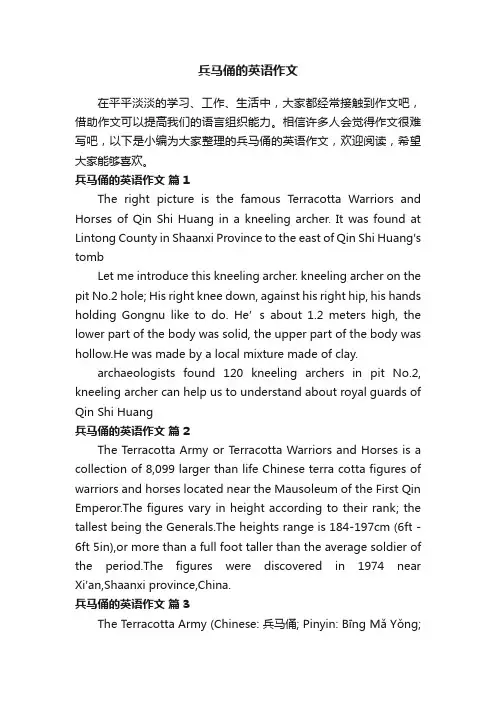
兵马俑的英语作文篇1The right picture is the famous Terracotta Warriors and Horses of Qin Shi Huang in a kneeling archer. It was found at Lintong County in Shaanxi Province to the east of Qin Shi Huang's tombLet me introduce this kneeling archer. kneeling archer on the pit No.2 hole; His right knee down, against his right hip, his hands ho lding Gongnu like to do. He’s about 1.2 meters high, the lower part of the body was solid, the upper part of the body was hollow.He was made by a local mixture made of clay.archaeologists found 120 kneeling archers in pit No.2, kneeling archer can help us to understand about royal guards of Qin Shi Huang兵马俑的英语作文篇2The Terracotta Army or T erracotta Warriors and Horses is a collection of 8,099 larger than life Chinese terra cotta figures of warriors and horses located near the Mausoleum of the First Qin Emperor.The figures vary in height according to their rank; the tallest being the Generals.The heights range is 184-197cm (6ft - 6ft 5in),or more than a full foot taller than the average soldier of the period.The figures were discovered in 1974 near Xi'an,Shaanxi province,China.兵马俑的英语作文篇3The Terracotta Army (Chinese: 兵马俑; Pinyin: Bīng Mǎ Yǒng;literally "military servants") or Terra-cotta Warriors and Horses is a collection of 8,099 life-size terra cotta figures of warriors and horses located in the Mausoleum of the First Qin Emperor (秦始皇陵; Qín Shǐ Huáng Líng). The figures were discovered in 1974 near Xi'an, Shaanxi province,The terracotta figures were buried with the first Emperor of Qin (Qin Shi Huang) in 210-209 BC. Consequently, they are also sometimes referred to as "Qin's Army."The Terracotta Army of China was discovered in March 1974 by local farmers drilling a well to the east of Mount Li. Mount Li is the name of the man-made necropolis and tomb of the First Emperor of Qin; Qin Shi Huang. Construction of this mausoleum began in 246 B.C. and is believed to have taken 700,000 workers and craftsmen 36 years to complete. Qin Shi Huang was interred inside the tomb complex upon his death in 210 B.C. According to the Grand Historian Sima Qian, The First Emperor was buried alongside great amounts of treasure and objects of craftsmanship, as well as a scale replica of the universe complete with gemmed ceilings representing the cosmos, and flowing mercury. representing the great earthly bodies of water. Recent scientific work at the site has shown high levels of mercury in the soil of Mount Li, tentatively indicating an accurate description of the site’s contents by Sima Qian.The tomb of Qin Shi Huang is near an earthen pyramid 76 meters tall and nearly 350 meters square. The tomb presently remains unopened. There are plans to seal-off the area around the tomb with a special tent-type structure to prevent corrosion from exposure to outside air. However, there is at present only one company in the world that makes these tents, and their largest model will not cover the site as needed.Qin Shi Huang’s necropolis complex was constructed to serve as an imperial compound or palace. It is comprised of several offices, halls and other structures and is surrounded by a wall with gateway entrances. The remains of the craftsmen working in the tomb may also be found within its confines, as it is believed they were sealed inside alive to keep them from divulging any secrets about its riches or entrance. It was only fitting, therefore, to have this compound protected by the massive terra cotta army interred nearby.兵马俑的英语作文篇4Friend plays important role in our lives. Everyone needs his or her own friends. Some people make friends easily but some do not. And “friend” means dif ferently to people. Some people think friends should stay together all the time, but some others think that share and support is the real meaning of friend.From my point of view, friend is the person who will always be with you no matter what happens. It’s the person who can share your happiness as well as sorrows.兵马俑的英语作文篇5I have a good friend. She is a beautiful girl and very kind. She has long black hair, a red mouth and two big black eyes , her voice is better. She is good at singing and drawing.She is a clever girl. She likes reading books , playing computer games and climbing mountains. She is also nice. She often helps us. Our classmates like her very much.兵马俑的英语作文篇6liu ying is my best friend. she has been iii for three days. in the afternoon, i went to see her. she told me she was sent to the hospital by her parents this morning. the doctor looked her overcarefully, gave her some medicine and asked her to stay inbed for a few days.she thought she wouldnt go to school until net week. i asked her to have a good rest at home and not to worry about her lessons. i would help her with her lessons.she looked much better after hearing that.兵马俑的英语作文篇7I have a good friend. She is a beautiful girl. She has long black hair, two big black eyes and a red mouth. Her voice was much better. She is good at singing.She is a clever girl. She likes reading books, playing computer games and chess. She’s fine, too. She often helps us. All my classmates like her very much.兵马俑的英语作文篇8hi everybody this is my best friend lily, she is a talented and goodlooking girl ,her pet phrase is industry is a substitute for genius . i like her because not only she is an acute girl but also for her diligent, i think you will be like her sooner or latter when you know her, that's all thank you兵马俑的英语作文篇9I have a good friend,her name is is an England is tall and she is twelve years has brown eyes are big and face is round and her mouth is small,her nose is small, favourite color is she usually wears blue are in the same grade,but in different classes.I m in Class Eleven and Amy is in Class One.Many students in our class are good at English , but I am my English is Amy English is vear s Chinese very much,but her Chinese is not vear we often help each other.I love my friend!兵马俑的英语作文篇10My best friend is very beautiful。
西安兵马俑英文简短介绍
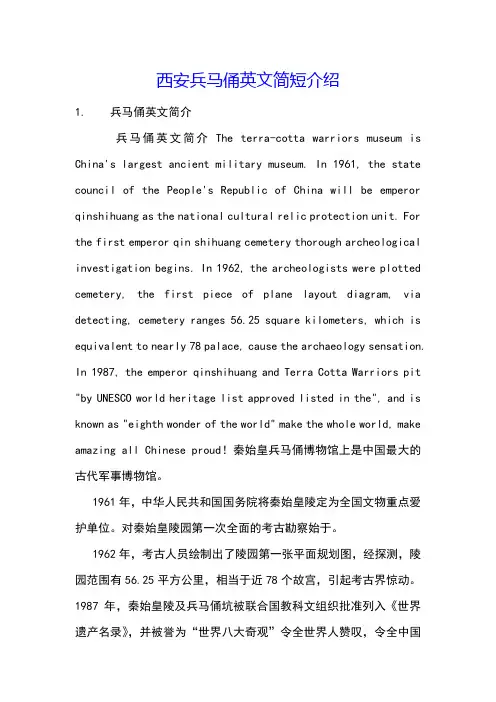
西安兵马俑英文简短介绍1. 兵马俑英文简介兵马俑英文简介The terra-cotta warriors museum is China's largest ancient military museum. In 1961, the state council of the People's Republic of China will be emperor qinshihuang as the national cultural relic protection unit. For the first emperor qin shihuang cemetery thorough archeological investigation begins. In 1962, the archeologists were plotted cemetery, the first piece of plane layout diagram, via detecting, cemetery ranges 56.25 square kilometers, which is equivalent to nearly 78 palace, cause the archaeology sensation. In 1987, the emperor qinshihuang and Terra Cotta Warriors pit "by UNESCO world heritage list approved listed in the", and is known as "eighth wonder of the world" make the whole world, make amazing all Chinese proud!秦始皇兵马俑博物馆上是中国最大的古代军事博物馆。
兵马俑英文作文4篇2023
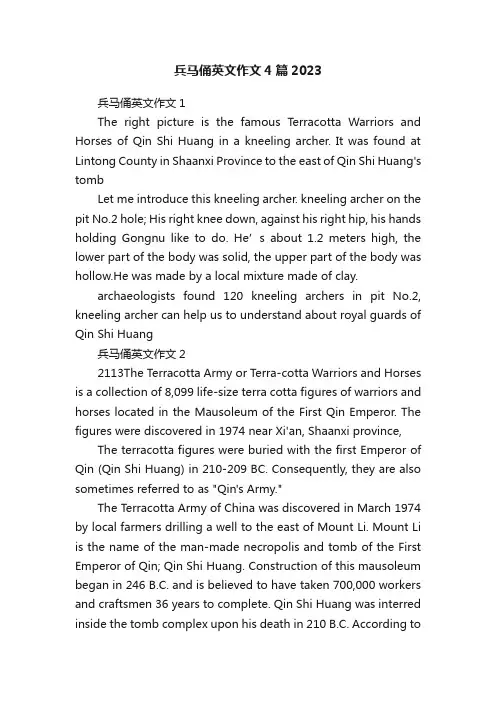
兵马俑英文作文4篇2023兵马俑英文作文1The right picture is the famous Terracotta Warriors and Horses of Qin Shi Huang in a kneeling archer. It was found at Lintong County in Shaanxi Province to the east of Qin Shi Huang's tombLet me introduce this kneeling archer. kneeling archer on the pit No.2 hole; His right knee down, against his right hip, his hands holding Gongnu like to do. He’s about 1.2 meters high, the lower part of the body was solid, the upper part of the body was hollow.He was made by a local mixture made of clay.archaeologists found 120 kneeling archers in pit No.2, kneeling archer can help us to understand about royal guards of Qin Shi Huang兵马俑英文作文22113The Terracotta Army or Terra-cotta Warriors and Horses is a collection of 8,099 life-size terra cotta figures of warriors and horses located in the Mausoleum of the First Qin Emperor. The figures were discovered in 1974 near Xi'an, Shaanxi province, The terracotta figures were buried with the first Emperor of Qin (Qin Shi Huang) in 210-209 BC. Consequently, they are also sometimes referred to as "Qin's Army."The Terracotta Army of China was discovered in March 1974 by local farmers drilling a well to the east of Mount Li. Mount Li is the name of the man-made necropolis and tomb of the First Emperor of Qin; Qin Shi Huang. Construction of this mausoleum began in 246 B.C. and is believed to have taken 700,000 workers and craftsmen 36 years to complete. Qin Shi Huang was interred inside the tomb complex upon his death in 210 B.C. According tothe Grand Historian Sima Qian, The First Emperor was buried alongside great amounts of treasure and objects of craftsmanship, as well as a scale replica of the universe complete with gemmed ceilings representing the cosmos, and flowing mercury. representing the great earthly bodies of water. Recent scientific work at the site has shown high levels of mercury in the soil of Mount Li, tentatively indicating an accurate description of the site’1653s content s by Sima Qian.The tomb of Qin Shi Huang is near an earthen pyramid 76 meters tall and nearly 350 meters square. The tomb presently remains unopened. There are plans to seal-off the area around the tomb with a special tent-type structure to prevent corrosion from exposure to outside air. However, there is at present only one company in the world that makes these tents, and their largest model will not cover the site as needed.Qin Shi Huang’s necropolis complex was constructed to serve as an imperial compound or palace. It is comprised of several offices, halls and other structures and is surrounded by a wall with gateway entrances. The remains of the craftsmen working in the tomb may also be found within its confines, as it is believed they were sealed inside alive to keep them from divulging any secrets about its riches or entrance. It was only fitting, therefore, to have this compound protected by the massive terra cotta army interred nearby.兵马俑英文作文3The Terracotta Army or T erracotta Warriors and Horses is a collection of 8099 larger than life Chinese terra cotta figures of warriors and horses located near the Mausoleum of the First Qin Emperor. The figures vary in height according to their rank; the tallest being the Generals. The heights range is 184-197cm (6ft -6ft 5in) or more than a full foot taller than the average soldier of the period. The figures were discovered in 1974 near Xi'an Shaanxi province China.兵马俑英文作文4With a happy step, my father and I came to xi 'an and once again ascended the steps of history -- the terracotta warriors museum.More than once, such a pause, so that the land linger. Where there is history, there is a glory from the feet.On the northern foot of the lishan mountain, the vast plain of the weishui waterfront, the qinshihuang diling seal is towering and magnificent, majestic and magnificent. The famous Terra Cotta Warriors museum is located in the east of the tomb. 5 kilometers of dense, dense trees of the deep trees. It covers an area of 470000 square meters, a place with chic modelling, the library building of of primitive simplicity, strewn at random have send, scattered, tall trees, low shrubs, flowers, the beauty of the carpet lawn around the meantime, the environment elegant, is enormous, is currently China's largest museum of the project site.The terracotta warriors, as the powerful army of the cemetery, were placed in three pits. The size and shape of the three pits are different. One of the largest pits is a combination of chariots and infantry. The second pit is a square matrix of mixed marshals, infantry, cavalry, and crossbows. The no. 3 pit area is the smallest, it is the number one pit, the number two is the headquarters of the pit. The three pits constitute a huge military base, the east side of the tomb, symbolizing the garrison of the qin shihuang lingyuan.Look from the overall structure, he created a huge army marshal, soldiers on the battlefield is neither model to the fightscenes, also does not have carved the marching hard, but a military staging, selected the battle ahead of the moment, moving in static, giving people not only intuitively meet, and more is left to the imagination.This is the view of the terracotta warriors, which was a sign of the brutality of qin shi huang's rule. But I think this is the paradise of art, the masterpiece of the world, the treasure of history, and it is called "the eighth wonder of the world". There is no denying that when the tomb of qin shi huang was built, not only did Lao Lao work to kill the wounded, but more and more skilled craftsman's living life died here. On the other hand, it is their hard work, the wisdom of sweat that leaves a splendid civilization for future generations. You see, the clay is made of clay, and the exquisite and exquisite clay figures are vivid, and it has conquered the modern people in the new century with the artistic features of "big, many, fine and beautiful".Visiting qin terracotta warriors and horses, I see from the blade of the sword and shadow of the mud people's bitterness; From the colorful terracotta warriors, we see the progress of science and technology. From the huge lineup, the realization of the glorious history!。
兵马俑博物馆英文导游词ThemuseumofTerracottaWarriorsandHorses
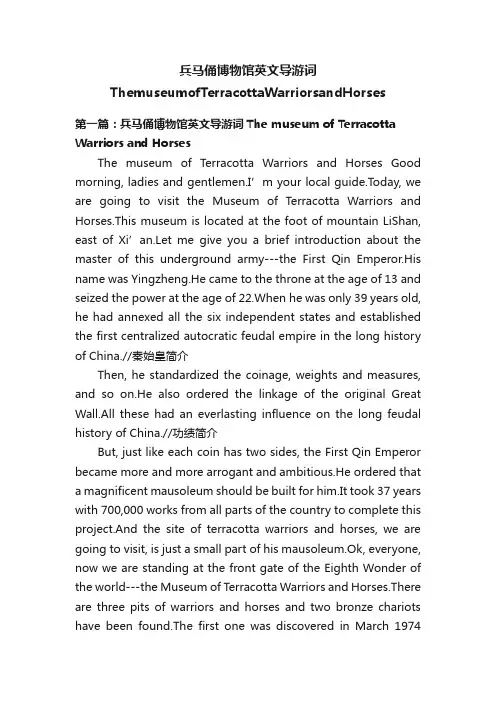
兵马俑博物馆英文导游词ThemuseumofTerracottaWarriorsandHorses第一篇:兵马俑博物馆英文导游词The museum of Terracotta Warriors and HorsesThe museum of Terracotta Warriors and Horses Good morning, ladies and gentlemen.I’m your local guide.T oday, we are going to visit the Museum of Terracotta Warriors and Horses.This museum is located at the foot of mountain LiShan, east of Xi’an.Let me give you a brief introduction about the master of this underground army---the First Qin Emperor.His name was Yingzheng.He came to the throne at the age of 13 and seized the power at the age of 22.When he was only 39 years old, he had annexed all the six independent states and established the first centralized autocratic feudal empire in the long history of China.//秦始皇简介Then, he standardized the coinage, weights and measures, and so on.He also ordered the linkage of the original Great Wall.All these had an everlasting influence on the long feudal history of China.//功绩简介But, just like each coin has two sides, the First Qin Emperor became more and more arrogant and ambitious.He ordered that a magnificent mausoleum should be built for him.It took 37 years with 700,000 works from all parts of the country to complete this project.And the site of terracotta warriors and horses, we are going to visit, is just a small part of his mausoleum.Ok, everyone, now we are standing at the front gate of the Eighth Wonder of the world---the Museum of Terracotta Warriors and Horses.There are three pits of warriors and horses and two bronze chariots have been found.The first one was discovered in March 1974when several farmers were sinking a well.Then another 2 pits and the bronze chariots were also uncovered.As one of the top ten places of historical interest in China, it was also listed as a world heritage site.//兵马俑及铜车马的出土So next, let’s go to uncover the veil of them one by one.Now we are standing at the front of pit 1.The terracotta armies in pit 1 were arranged in battle formation.In the front of this formation, there are warriors in 3 lines facing forward.Armed with bows and arrows, they are the vanguard.There is one row of warriors on each of the borders of this pit, facing outward, holding long-distance shooting weapons---they are the flanks to defend the whole army.There are 28 columns of warriors with horse-drawn chariots in the center.They represent the principal military force of this battle formation.According to the density, there are over 6000 terracotta warriors and horses, and most of them are infantry men.With all of these, no wonder the Qin Emperor could annex all the six independent states and unify China!//一号坑军阵特点Ok, let’s move on.Here now we arrived at Pit 2.We ca n see that pit 2 is under cover, it is because we want to preserve them.You know, the warriors originally were painted in color, but today’s technology is not advanced enough to protect it very well after excavation.According to research, pit 2 consists of 4 different mixed military forces in four arrays.There are infantrymen, cavalrymen, archers and charioteers.They can be divided to act independently, capable of attacking, and defending with a quick response.//二号坑及军阵特点Look at those clay warriors carefully, we can find that their feet, legs, bodies, necks, hands, all is different.And their hair style, shoes are also quite different by their role in the army.The indenton the sole(鞋底的纹路)was clear and meticulous.We may find they are all vivid and true to life.Here is pit 3.The warriors were arranged opposite to each other in two rows, and only one kind of weapon called “shū”(殳)had been discovered.This kind of weapon has no blade, and is believed to be used by the guards of honor.We have found many animal bones in the north side, and it is supposed to be “Prayer Hall”, and “Commander’s office” is on the south side.And in the center, there used to be a chariot, which seems to be ready to send orders.This suggests pit 3 is the headquarters directing the whole underground army.//3号坑Now we have arrived at the exhibition hall of Bronze Chariots and Horses.In 1980, two sets of large painted bronze chariots and horses were found.They broke into thousands of pieces when we found them and after 8 years’ careful restorat ion, they were rebuilt and open to the public.The first one was named “High Chariot” and the second one was called “Security Chariot”.Both of them were made in half life-size.Chariot NO.2 has a front room and a back room, and the windows and doors can close and open easily.The two bronze chariots and horses are decorated with many gold and silver ornaments.The umbrella-like canopy on the top is only four millimeter thick, and the window is one millimeter thick, with many ventilation holes.The horse tassels were made of bronze thread as thin as hair, whose diameter is only 0.1 millimeter.It is incredible that the Chinese people could make such exquisite and intricate items over 2000 years ago.Ok, everyone!So much for this today!We still have some free time.So next, you may look around and take some pictures.We’ll leave at 2 o’clock, so please do not be late.You know, I will miss you.And I’ll stay here, if you have any question,pleak ask me.By the way, watch your step please!So next, it’s your turn.Thank you for listening.第二篇:兵马俑英文导游词The museum of Terracotta Warriors and HorsesLadies and gentlemen, good morning, Today, we are going to visit the Museum of Terracotta Warriors and Horses.This museum is located at the foot of mountain Li Shan, about 35 kilometer s east of Xi’an.First, I will give you a brief introduction about the master of this underground army---the First Qin Emperor, Yingzheng.He came to the throne at the age of 13 and seized the power at the age of 22.By 221BC, he had annexed all the six independent states and established the first centralized autocratic feudal empire in the long history of China.After the unification of the whole country, he styled himself the First Emperor and standardized the coinage, weights and measures, the legal codes, the written scripts and so on.He also ordered the linkage of the original Great Wall.All these exerted an everlasting influence on the long feudal history of China.But the First Qin Emperor was very ambitious.As soon as he came to the throne, he ordered that a magnificent mausoleum should be built for him.It took 37 years to complete this great project.Actually, the site of those terracotta warriors and horses we now see is just a small part of his mausoleum.Ok, everyone, now we are standing at the front gate of the Eighth Wonder of the world---the Museum of Terracotta Warriors and Horses.As one of the top ten places of historical interest in China, it was also listed as a world heritage site.So next, let’s go to uncover the veil of this miraculous work.In March 1974,when several farmers were sinking a well about 1.5km east of the First Qin Emperor’s Maosolem, they came upon many fragments of the terracottafigures.The results of archaeological excavation showed that is two more pits were discovered respectively.They were then named pit1,pit2, and pit3 by the order of discovery.The new discovery stirred up a sensation all over the world.In order to provide the historical artifacts with adequate protection, a musem was set up on the site of Pit 1 in 1975 upon the approval of the state council.Pit 1,covers an area of 16,300 square meters, is an earth-and-wood structure in the shape of a tunnel.The terra cotta armies in pit 1 were arranged in battle formation.In the front of this formation, there are 210warriors in 3 lines facing forward.Armed with bows and arrows, they constitute the so-called vanguard.Meanwhile, there is one row of warriors on each of the borders of this pit, facing outward---they are the flanks and the rear guard.Holding long-distance shooting weapons, they took up the job of defending the whole army.Then, this way please.We may find ten partition wallswhich divided this pit into 11 corridors.The warriors standing inside them with horse-drawn chariots represent the principal military force of this battle formation.According to the density, there are over 6000 terracotta warriors and horses, and most of them are infantrymen.Ok, Here now we arrived at Pit 2.we can see that Pit 2 is still under cover, that’s because we want to preserve them.Pit 2 consists of 4 different mixed military forces in four arrays, they are infantrymen, cavalrymen, archers and charioteers.And pit 2 also include many chariots and horses.They can be divided to act independently, capable of attacking, and defending with a quick response.As you see, those worriors, their feet, legs, bodies, necks, hands and heads, all with different faces, were all made separately and joined together.we may find they are all vivid and true to life.And also as we can see, here are someactual weapons unearthed in those pits.The most attractive one is a bronze sword.Although it was buried over thousands of years, it is still very sharp.It can cat through 20 pieces of paper put together.Now we come to pit 3.Pit 3 covers an area of about 520 square meters.There are only 68 warriors and 4 clay horses.The warriors were arranged opposite to each other in two rows, and only one kind of weapon called “SHU” had been discovered.This kind of weapon has no blade, and is believed to be used by the guards of honor.We have found many animal bones in the north side, and it is supposed to be “Prayer Hall”, and “Commander’s office” is on the south side.This suggests pit 3 is the headquarters directing the whole underground army.Then we have arrived at the exhibition hall of Bronze Chariots and Horses.In 1980, two sets of large painted bronze chariots and horses were found.They broke into thousands of pieces when we found them and after 8 years’ careful restoration;they were rebuilt and open to the public.The first one w as named “High Chariot” and the second one was called “Security Chariot”.They were the eariliest and most exquisitely and intricately made bronze valuables,and also the largest bronze wares discovered in the history of world archaeology.It provides extremlyvaluable material and data for the research of the metallurgical technique and technological modeling og the Qin Dynasty.So now we will finish our journey in the museum today, I believe that you must be very astonished at this world wonder.So it’s your ti me,you can work around and take some pictures.thank you for listening~第三篇:秦始皇兵马俑博物馆导游词秦始皇兵马俑博物馆导游词(陕西)尊敬的女士们、先生们:今天,我们将参观秦兵马俑博物馆。
兵马俑景点介绍中英文
兵马俑景点介绍中英文The Terracotta Army, also known as the "Terracotta Warriors and Horses of the Qin Shi Huang," is a collection of terracotta sculptures depicting the armies of Qin Shi Huang, the first Emperor of China. It is a form of funerary art buried with the emperor in 210–209 BCE with the purpose of protecting him in his afterlife.Located in the Lintong District, Xi'an, Shaanxi province, the Terracotta Army is part of the Mausoleum of the First Qin Emperor, a UNESCO World Heritage site. The site is approximately 1.5 kilometers east of the emperor's tomb mound at Mount Li and was discovered by local farmers in 1974.The figures, dating from approximately the late third century BCE, were discovered in three pits, with the largest being Pit 1, which measures 230 meters in length and 62 meters in width, and contains a large military formation of soldiers and officers of various ranks. Pit 2 is composed of cavalry, chariots, and infantry, while Pit 3 is thought to represent the command post of the army.Each figure is unique, with detailed facial features and expressions, and they are dressed in armor and robes that reflect the fashion of the Qin dynasty. The craftsmanship is incredibly detailed, with the figures equipped with weapons such as swords, spears, and crossbows.The Terracotta Army is a testament to the military might of the Qin dynasty and the ingenuity of its artisans. It has become a major tourist attraction, drawing visitors from around the world to marvel at the ancient craftsmanship and the historical significance of this archaeological treasure.Visiting the Terracotta Army is a journey back in time, offering a glimpse into the grandeur of ancient China and the legacy of its first emperor. It is a must-see for anyone interested in history and archaeology, and it stands as one of the most remarkable archaeological finds of the 20th century.。
关于兵马俑的英语作文
关于兵马俑的英语作文(composition)是经过人的思想考虑和语言组织,通过文字来表达一个主题意义的记叙方法。
作文分为小学作文、中学作文、大学作文(论文)。
作文体裁包括:记叙文、说明文、应用文、议论文。
下面是关于兵马俑的英语作文,请参考!关于兵马俑的英语作文1The right picture is the famous Terracotta Warriors and Horses of Qin Shi Huang in a kneeling archer.It was found at Lintong County in Shaanxi Province to the east of Qin Shi Huang's tombLet me introduce this kneeling archer.kneeling archer on the pit No.2 hole; His right knee down,against his right hip,his hands holding Gongnu like to do.He’s about 1.2 meters high,the lower part of the body was solid,the upper part of the body was hollow.He was made by a local mixture made of clay.archaeologists found 120 kneeling archers in pit No.2,kneeling archer can help us to understand about royal guards of Qin Shi Huang关于兵马俑的英语作文2The Terracotta Army (Chinese: 兵马俑; Pinyin: Bīng Mǎ Yǒng; literally "military servants") or Terra-cotta Warriors and Horses is a collection of 8,099 life-size terra cotta figures of warriors and horses located in the Mausoleum of the First Qin Emperor (秦始皇陵; Qín Shǐ Huáng Líng). The figures were discovered in 1974 near Xi'an, Shaanxi province,The terracotta figures were buried with the first Emperor of Qin (Qin Shi Huang) in 210-209 BC. Consequently, they are also sometimes referred to as "Qin's Army."The Terracotta Army of China was discovered in March 1974by local farmers drilling a well to the east of Mount Li. Mount Li is the name of the man-made necropolis and tomb of the First Emperor of Qin; Qin Shi Huang. Construction of this mausoleum began in 246 B.C. and is believed to have taken 700,000 workers and craftsmen 36 years to complete. Qin Shi Huang was interred inside the tomb complex upon his death in 210 B.C. According to the Grand Historian Sima Qian, The First Emperor was buried alongside great amounts of treasure and objects of craftsmanship, as well as a scale replica of the universe complete with gemmed ceilings representing the cosmos, and flowing mercury. representing the great earthly bodies of water. Recent scientific work at the site has shown high levels of mercury in the soil of Mount Li, tentatively indicating an accurate description of the site’s contents by Sima Qian.The tomb of Qin Shi Huang is near an earthen pyramid 76 meters tall and nearly 350 meters square. The tomb presently remains unopened. There are plans to seal-off the area around the tomb with a special tent-type structure to prevent corrosion from exposure to outside air. However, there is at present only one company in the world that makes these tents, and their largest model will not cover the site as needed.Qin Shi Huang’s necropolis complex was constructed to serve as an imperial compound or palace. It is comprised of several offices, halls and other structures and is surrounded by a wall with gateway entrances. The remains of the craftsmen working in the tomb may also be found within its confines, as it is believed they were sealed inside alive to keep them from divulging any secrets about its riches or entrance. It was only fitting, therefore, to have this compound protected by the massive terra cotta army interred nearby.。
秦始皇兵马俑英文导游词
秦始皇兵马俑英文导游词秦始皇兵马俑英文导游词秦始皇陵兵马俑是稀世的文化瑰宝,其风化状况评估是秦俑保护的重要依据。
下面是关于秦始皇兵马俑英文导游词的内容,欢迎阅读!秦始皇兵马俑英文导游词Everybody is good! my name is lu, I'm go to the guide of qin Terra Cotta Warriors. I'm very honored to serve you, hope we have a nice day today.Now we're going to set off to the world-famous qin Terra Cotta Warriors.You see, this great historical sites show in front of our eyes! Our xi 'an lintong has three qin Terra Cotta Warriors pit, a total of 3 20000 square meters, nearly 50 basketball courts, a pit of the Terra Cotta Warriors to nearly eight thousand. In three pits at the pit is the largest, 230 meters long, north and south 62 meters wide, with a total area of 14260 square meters; The pit of the Terra Cotta Warriors, of course, also the most, there are more than six thousand! Above the no. 1 pit has a huge vaulted hall. Into the hall, standing on high bird's eye view, will see the Terra Cotta Warriors pit, line by line, the process is very neat, formed a huge army of rectangle like qin shihuang had command of an army of fighting, invincible.You look, the general burly, wearing a brown, wearing armor, sword in hand, with pride. Know it's the look on his poses battle-hardened, accountable.The average height of the warriors, 1. 8 meters, trim. They dressed in a shirt to wear armor, feet front end up the cock combat boots, and armed with weapons, ready to go.Look, the horse figurines in short armour, on foot mouth waswearing tight pants, boots right hand holding the REINS, left hand with bows and arrows, as if ready to mount a horse to kill.Now we use one hour to watch slowly. Please take good care of cultural relics, don't litter. Thank you for your cooperation.Well, today was the end of run. Welcome to have the opportunity to visit again later.秦始皇兵马俑英文导游词Everybody is good! I am your tour guide, guide. Today by I lead you to visit xi 'an lintong unearthed qin Terra Cotta Warriors.Qin Terra Cotta Warriors, is on the sculpture of ancient and modern, Chinese and foreign is unique, it perfectly simulate the ranks, the vivid emersion qin soldier millions, thousand chariots magnificent momentum.Has now been unearthed three pits, each pit has the Terra Cotta Warriors, a total of more than eight thousand. Up to the no.1 pit, the Terra Cotta Warriors nearly more than six thousand.Now on the no. 1 pit has built up a huge vaulted hall. Please look forward, this is what I call the vaulted hall. Everyone please follow me to the hall. Please look down, these terracotta warriors line by line, the process is very neat, formed a huge rectangular ranks.We now see the Terra Cotta Warriors seem to be "the same", but, if look carefully, you will find they look different. Let me introduce several kinds of the Terra Cotta Warriors:This is general, his burly, wearing armor, sword in hand, chin, a see be battle-hardened; This is the terracotta warriors, their height is 1.8 meters, well-built, armed with weapons, ready to go; Cavalry is cavalry figures aside, the warriors wear short armour on commission, was wearing tight pants, right hand holding the REINS, left hand with bows and arrows, as if ready to mount ahorse to kill.Below, your own play, I offer some requirements: 1. You don't scribble on the T erra Cotta Warriors. 2. Debris-brick don't litter. 3. The kids don't ride on the TaoMa.Wish everyone have a happy travel!。
介绍秦始皇陵兵马俑英语作文
介绍秦始皇陵兵马俑英语作文The Terracotta Army of Qin Shi Huang's MausoleumThe Terracotta Army, also known as the Terra Cotta Warriors and Horses, is a collection of life-size, sculpted clay figures discovered in 1974 near the city of Xi'an in Shaanxi province, China. These figures were created over 2,000 years ago as part of the mausoleum of Qin Shi Huang, the first emperor of a unified China. This remarkable archaeological find has captured the imagination of people around the world and has become one of the most significant cultural heritage sites in China.The Terracotta Army was discovered by local farmers who were digging a well in the area. They stumbled upon the first of the thousands of clay figures that make up this vast underground army. Subsequent excavations have revealed three major pits, each containing thousands of soldiers, horses, and chariots, all arranged in a military formation. The figures are remarkably detailed, with each one having a unique facial expression and individual features. The soldiers are depicted in various poses, some standing, some kneeling, and some even appear to be in the midst of combat.The Terracotta Army was created as part of the elaborate funerary complex built for Qin Shi Huang, who ruled over a unified China from 221 to 210 BCE. The emperor was known for his ambitious and often ruthless policies, which included the construction of the Great Wall of China and the standardization of the Chinese writing system, currency, and measurement units. His mausoleum was intended to be a miniature version of his earthly palace, complete with all the necessary accoutrements for the afterlife.The figures in the Terracotta Army were created using a highly sophisticated manufacturing process. Each soldier was molded from terracotta clay and then individually painted and equipped with unique armor, weapons, and accessories. The figures were then assembled and placed in the underground pits, which were designed to protect the army from the elements and potential tomb robbers.The level of detail and craftsmanship displayed in the Terracotta Army is truly remarkable. Each figure is unique, with no two soldiers or horses exactly alike. The weapons, armor, and accessories are also highly detailed, with intricate designs and patterns. This level of individualization suggests that the artisans who created the figures were highly skilled and dedicated to their work.The Terracotta Army is not just a remarkable archaeological find, but also a testament to the ingenuity and engineering prowess of theancient Chinese. The pits in which the figures were discovered are massive, measuring over 200 meters in length and 60 meters in width. The construction of these pits, which were designed to protect the army from the elements and potential tomb robbers, is a testament to the advanced engineering and construction techniques of the time.The Terracotta Army has become a symbol of China's rich cultural heritage and has become one of the most popular tourist attractions in the country. Millions of people from around the world visit the site each year to marvel at the incredible craftsmanship and to learn more about the history and culture of ancient China.In recent years, the Terracotta Army has also become the subject of extensive research and study. Archaeologists and historians have been working to uncover more about the lives of the soldiers and the artisans who created them. Through this research, we have learned more about the social and political structure of the Qin dynasty, as well as the technological and artistic advancements of the time.Overall, the Terracotta Army is a truly remarkable and awe-inspiring archaeological treasure. Its discovery has captured the imagination of people around the world and has become a symbol of China's rich cultural heritage. As we continue to study and explore this incrediblefind, we can only imagine what other secrets it may hold about the ancient world of Qin Shi Huang and the people who lived during his reign.。
兵马俑英文导游词
( 陕西导游词)姓名:____________________单位:____________________日期:____________________编号:YB-BH-030816兵马俑英文导游词English tour guide for terra cotta warriors and horses兵马俑英文导游词秦始皇陵兵马俑是稀世的文化瑰宝,其风化状况评估是秦俑保护的重要依据。
下面是为大家带来的兵马俑英文导游词,希望可以帮助大家。
兵马俑英文导游词范文1:Ha! Hi, I'm happy "tour" of the tour guide. T oday, I take you to xi 'an east 30 kilometers. In February 1974, the local farmers in the east of emperor qinshihuang 1.5 zone at the foot of the mount li qin Terra Cotta Warriors.In that year, the emperor after he began to reign, and he began to build cemetery, hosted by prime minister lisi planning and design, general ZhangHan supervisors, build time for 38 years, engineering of vast, magnificent verve, the successive feudal rulers luxury lights of precedent. At that time, the qing dynasty a total population of about 20 million, and built ling labor was more than 720xx0. Xiu ling home soil, from 20xx meters south of this cemetery three between liu village to the county quarry department, there are 5 ~ 25 meters high multistage loess cliff. Fix cemetery used a large amount of stone from nutrient-ladenhebei usagi nakayama, asan, depends on human to lintong, engineering is very difficult. Predictably large quantities, usagi nakayama, the corpse and under strict asan side shows the cruelty of the whole project. It is also known as one of "the eight wonders of the world"!Qin Terra Cotta Warriors is divided into three pits, with a total area of 000 square meters. The Terra Cotta Warriors are robust, forms and more thoughtful! Figures are divided into general figurines, the side horse figurines, kneeling position figurines, figurines of cavalry, terracotta warriors... Among them, the no. 1 pit is the largest, 230 meters long, north and south 62 meters wide, about five meters deep. About 500, the warriors six chariots, driving, horse 24, and bronze sword, wugou, spears and arrows, crossbows, machine, copper halberd combat with weapons of bronze and iron, etc. They all facial expression, ' ', and action each are not identical: some thoughtfully, as if considering how to cooperate, defeat the enemy; Have a deep breath, as if in thought, as the people of qin, must help the emperor beat all places; Some look in the distance, seemed to be missing loved ones far away... Said so much warrior figures, the said the horse figurines: TaoMa ears erect, some mouths scream, some still shut up. All these of the qinshihuang terracotta warriors and touching artistic charm. If you hold your breath gaze of looking at it, you will find it muscle fullness, realistic than a real horse!兵马俑英文导游词范文2:Hi, I'm lee, take you to visit the Terra Cotta Warriors today?Behind me is a vaulted hall, this is a famous scenic spots and historical sites. What places of interest you guess what it is? It is known as "the eighth wonder of the world" terracotta warriors.The Terra Cotta Warriors in mount li, lintong county, shaanxi province in China under the north river near the village. Now explore three pit. We have come to is one of the biggest, the Terra Cotta Warriors pit pit no. 1. You can put these down. Oh, you are alone, I'll help you take pictures with the Terra Cotta Warriors in the background. To come. One, two, three eggplant!Let's visit the qin shihuang's mausoleum. Adults, please take your children. At the same time, also please mind your own hand, do not litter. Move down inside, we see this is the qin shihuang's mausoleum, it is imitation built the palace of the emperor used to live. The qinshihuang in north and south long, the width of a rectangle. The whole cemetery, surrounded with two walls in "back to" glyph. The magical thing about this is it.We have come to is about the position of the underground. Because buried deep underground, and plus there are crossbow authority, so we can't go to visit. According to "historical records" records, however, the underground to depict the sun, the moon and the stars on the ceiling, and artificial earth, the earth has a mountain, flowers and plants, andrivers. The river is made of mercury, glittering, extremely beautiful.Everybody, the tour is over. You must be very happy, right? Everyone had so happy, hope you can remember me.兵马俑英文导游词范文3:How do you do! Welcome to the ancient city of xi 'an, I am your tour guide in xian this time. My name is xu, everyone call me xu guide. Today visited the first scenic spot is one of the world heritage, the qin Terra Cotta Warriors. Scenic spot is located in xi 'an lintong, we take car is lintong county, about 40 minutes. I'd like to mention of xi 'an, you will certainly think of unique chi toilet.Ok, we have come to qin shihuang mausoleum, in order to get off, please. Do you know the history of the qin Terra Cotta Warriors? Originally previous dynasty, the emperor's death is looking for some buried alive, then in the qin dynasty, a minister of emperor qin shi huang said: "previous dynasties but with buried the living. I think it is not very appropriate to you, let craftsmen create a made of dirt that you have conquered, invincible army How" Qin shi huang think this idea is very good, agreed. In fact, if it weren't for the time of qin shi huang, a nod today just see this vision spectacular terracotta army. Large scale of the Terra Cotta Warriors. Has discovered three pit, with a total area of nearly 20xx0 square meters, nearly 50 of the basketball court at ordinary times, about 8000 pit with the warriors.可以在这输入你的名字You Can Enter Your Name Here.。
西安秦始皇兵马俑英文导游词
西安秦始皇兵马俑英文导游词西安秦始皇兵马俑英文导游词范文导语:兵马俑是古代墓葬雕塑的一个类别。
古代实行人殉,奴隶是奴隶主生前的`附属品,奴隶主死后奴隶要作为殉葬品为奴隶主陪葬。
兵马俑即制成兵马形状的殉葬品。
以下的是店铺为大家搜集的秦始皇兵马俑英文导游词范文,希望你会喜欢。
Emperor Qin Shihuang’s Mausoleum and the Terra-cotta Warriors and Horses MuseumEmperor Qin Shihuang (259-210B.C.) had Ying as his surname and Zheng as his given name. He name to the throne of the Qin at age 13, and took the helm of the state at age of 22. By 221 B.C., he had annexed the six rival principalities of Qi, Chu, Yan, Han, Zhao and Wei, and established the first feudal empire in China’s history.In the year 221 B.C., when he unified the whole country, Ying Zheng styled himself emperor. He named himself Shihuang Di, the first emperor in the hope that his later generations be the second, the third even the one hundredth and thousandth emperors in proper order to carry on the hereditary system. Since then, the supreme feudal rulers of China’s dynasties had continued to call themselves Huang Di, the emperor.After he had annexed the other six states, Emperor Qin Shihuang abolished the enfeoffment system and adopted the prefecture and county system. He standardized legal codes, written language, track, currencies, weights and measures. To protect against harassment by the Hun aristocrats. Emperor Qin Shihuang ordered the Great Wall be built. All these measures played an active role in eliminating the cause of the state of separation and division and strengthening the unification of thewhole country as well as promotion the development of economy and culture. They had a great and deep influence upon China’s 2,000 year old feudal society.Emperor Qin Shihuang ordered the books of various schools burned except those of the Qin dynasty’s history an d culture, divination and medicines in an attempt to push his feudal autocracy in the ideological field. As a result, China’s ancient classics had been devastated and destroy. Moreover, he once ordered 460 scholars be buried alive. Those events were later called in history“the burning of books and the burying of Confucian scholars.”Emperor Qin Shihuang,for his own pleasure, conscribed several hundred thousand convicts and went in for large-scale construction and had over seven hundred palaces built in the Guanzhong Plain. These palaces stretched several hundred li and he sought pleasure from one palace to the other. Often nobody knew where he ranging treasures inside the tomb, were enclosed alive.Emperor Qin Shihuang’s Mausoleum has not yet been excavated. What looks like inside could noly be known when it is opened. However, the three pits of the terra-cotta warriot excavated outside the east gate of the outer enclosure of the necropolis can make one imagine how magnificent and luxurious the structure of E mperor Qin Shihuang’s Mausoleum was.No.1 Pit was stumbled upon in March 1974 when villagers of Xiyang Village of Yanzhai township, Lintong County, sank a well 1.5km east of the mausoleum. In 1976, No.2 and 3 Pits were found 20m north of No.1 Pit respectively after the drilling survey. The terra-cotta warriors and horses are arrayed according to the Qin dynasty battle formation, symbolizing the troops keepingvigil beside the mausoleum. This discovery aroused much interest both at home and abroad. In 1975, a museum, housing the site of No.1 and covering an area of 16,300 square meters was built with the permission of the State Council. The museum was formally opened to public on Oct.1, the National Day, 1979.No.1 Pit is 230 meters long from east to west, 62m wide from north to south and 5m deep , covering a total area of 14,260 square meters. It is an earth-and-wood structure in the shape of a tunnel. There are five sloping entrances on the eastern and western sides of the pit respectively. The pit is divided into eleven corridors by ten earthen partition walls, and the floors are paved with bricks. Thick rafters were placed onto the walls (but now one can only see their remains), which were covered with mats and then fine soil and earth. The battle formation of the Qin dynasty, facing east. In the east end are arrayed three lines of terra-cotta warriors, 70 pieces in each, totaling 210 pieces. They are supposed to be the van of the formation. Immediately behind them are 38 columns of infantrymen alternating with war chariots in the corridors, each being 180m long. They are probably the main body of the formation. There is one line of warriors in the left, right and west ends respectively, facing outwards. They are probably the flanks and the rear. There are altogether 27 trial trench, it is assumed that more than 6,000 clay warriors and horses could be unearthed from No.1 Pit.No.2 Pit sis about half the size of No.1 Pit, covering about 6,000 square meters Trail diggings show this is a composite formation of infantry, cavalry and chariot soldiers, from which roughly over 1,000 clay warriors, and 500 chariots and saddled horses could be unearthed. The 2,000-year-old wooden chariots are already rotten. But their shafts, cross yokes, and wheels, etc.left clear impressions on the earth bed. The copper parts of the chariots still remain. Each chariot is pulled by four horses which are one and half meters high and two metres long. According to textual research, these clay horses were sculptures after the breed in the area of Hexi Corridor. The horses for the cavalrymen were already saddled, but with no stirups.No.3 Pit covers an area of 520m2 with only four horses, one chariot and 68 warriors, supposed to be the command post of the battle formation. Now, No.2 and 3 Pits have been refilled, but visitors can see some clay figures and weapons displayed in the exhibition halls in the museum that had been unearthed from these two pits. The floors of both No.1 and 2 Pits were covered with a layer of silt of 15 to 20cm thick. In these pits, one can see traces of burnt beams everywhere, some relics which were mostly broken. Analysis shows that the pits were burned down by Xiang Yu, leader of a peasant army. All of the clay warriors in the three pits held real weapons in their hands and face east, showing Emperor Qin Shihuang’s strong determination of wiping out the six states and unifying the whole country.The height of the terra-cotta warriors varies from 1.78m, the shortest, to 1.97m, the tallest. They look healthy and strong and have different facial expressions. Probably they were sculpted by craftsmen according to real soldiers of the Qin dynasy. They organically combined the skills of round engraving, bas-relief and linear engraving, and utilized the six traditional folk crafts of sculpturing, such as hand-moulding, sticking, cutting, painting and so on. The clay models were then put in kilns, baked and colour-painted. As the terra-cotta figures have beeb burnt and have gone through the natural process of decay, we can’t se e their original gorgeous colours. However, most of the terra-cottafigures bear the trace of the original colours, and few of them are still as bright as new. They are found to be painted by mineral dyestuffs of vermilion, bright red, pink dark green, powder green, purple, blue, orange, black and white colours.Thousands of real weapons were unearthed from these terra-cotta army pits, including broad knives, swords, spears, dagger-axes, halberds, bows, crossbows and arrowheads. These weapons were exquisitely made. Some of theme are still very sharp, analyses show that they are made of alloys of copper and tin, containing more than ten kinds of other metals. Since their surfaces were treated with chromium, they are as bright as new, though buried underground for more than 2,000 years. This indicates that Qin dynasty’s metallurgical technology and weapon-manufacturing technique already reached quite a high level.In December 1980, two teams of large painted bronze chariots and horses were unearthed 20 metres west of the mound of Emperor Qin Shihuang’s Mausoleum. These single shaft four-horse chariots each comprises 3,462 spare parts, and has a body with two compartments, one behind the other, and an elliptical umbrella like canopy. The four horses harnessed to the chariot are 65-67 centimeters tall. The restored bronze chariots and horses are exact imitations of true chariot, horse and driver in half life-size.The chariots and horses are decorated with coloured drawings against white background. They have been fitted with more than 1,500 piecese of gold and silvers and decorations, looking luxurious, splendid and graceful. Probably they were meant for the use of Emperor Qin Shihuang’s soul to go on inspection. The bronze chariots and horses were made by lostwax casting, which shows a high level of technology. For instance, the tortoise-shell-like canopy is about 4mm thick, and the window is only 1mm thick on which are many small holes for ventilation. According to a preliminary study, the technology of manufacturing the bronze chariots and horses has involved casting, welding, reveting, inlaying embedding and chiseling. The excavation of the bronze chariots and horses provides extremely valuable material and data for the textual research of the metallurgical technique, the mechanism of the chariot and technological modeling of the Qin dynasty.No.2 bronze chariot and horses now on display were found broken into 1,555 pieces when excavated. After two-and-half years’ careful and painstaking restoration by archaeologists and various specialists, they were formally exhibited in the museum on October 1, 1983. No.1 bronze chariot hand horses are on display from 1988.下载全文。