
Unit 5 SectionA(grammar focus-3c)(课件)七年级英语下册(人教版)
because, they’re, do, don’t cool, like, why, where B: Really? _W__h_y_do you like giraffes? A: Well, b_e_c_a_u_s_ethey're kind of interesting. Do you like pandas? B: Yes, I do. But I like tigers a lot. A: Tigers? Why _d_o__you like tigers? B: They're really _c_o_o_l__!
Yes, it is.
Yes, you’re right!
Is the animal smart? Where is the animal from? Is it big and fat?
It’s an elephant.
Yes, it is.
It’s from India.
Yes, it is.
why引导的特殊疑问句的基本结构是: “Why + 一般疑问句(肯定 / 否定一般疑问句)?”,其 答语一般用because引导的句子来回答。 —Why are you late for class? —Because the bus is late.
where引导的特殊疑问句
◆ where疑问副词,用于询问地点,意为“哪里; 什么地方” Where are lions from? Where is she from?
Guess!
other’s animal.
What’s your favorite
animal, Ann?
Is the animal big?
Where is the animal from? Is it black and white?
It’s a panda.
Yes, it is.
It’s from China.
• why引导的O特b殊se疑rv问e 句an,d Learn
询问原因 • 回答:用because引导的
句子来陈述理由或原因
• where引导的特殊疑 问句,询问地点
• 回答:用be from, 意为“来自于……”
why引导的特殊疑问句
why是疑问副词,常用来询问具体的、直接的原因,意 为“为什么” Why do you like dogs?
◆ 回答:用be from回答,意为“来自于……” They are from South Africa. She is from China.
形容词在句子中的用法。 1. 形容词在句子中作表语。置于 __系__动__词_ 之后。 如: 大象有点聪明。_E_l_ep__h_a_n_ts__a_r_e_k_i_n_d_o_f__sm__a_r_t_.
—Because it's really difficult.
A.not
B.aren't C.do
3.—Where __B__ lions ________ from?
D.don’t
—They are from South Africa.
3b Write names of animals in the blanks to make sentences that are true for you.
1. I like _____ because they’re cute. 2. I like _____ because they’re smart. 3. I like _____ because they’re interesting. 4. I don’t like _____ because they’re lazy.
Where are they from?
North Pole Europe
North America
Asia
South America
Africa
Australia
South Pole
Oceania
Fill in the chart. Where are these animals from?
8. —__H_o_w__ _m__u_c_h_ is the backpack?
—It’s ¥20.
二、单项选择。
1. —__B__ she so happy?
—Because she sees her old friend.
A.Why does
B.Why is
C.Why do
D.Why
2. —Why __D_I like _p_a_n_d_a_s_ because they’re cute. 2. I like _e_l_ep_h_a_n_t_s because they’re smart. 3. I like _g_i_r_af_f_es__ because they’re interesting. 4. I don’t like _c_a_t_s because they’re lazy.
5. 为什么你不喜欢老虎? _W_h_y__d_o_n_’t_y_o_u_l_ik_e__ti_g_e_rs_?_____
6. 因为它们真的很吓人。 __B_e_ca_u_s_e_t_h_e_y’_r_e_r_e_a_ll_y_s_ca_r_y_. ___
7. 狮子来自哪里? W__h_e_r_e__a_re__li_o_n_s_f_r_o_m_?_______
Yes, you’re right.
Language points
why特殊疑问句“闯三关”
要想挑战why引导的特殊疑问句,我们必须闯过以下 “三道关”: 第一关:疑问词关 疑问副词why意为“为什么”, 用来询问原因。如: Why does he want to see the tigers?
第二关:结构关 其基本结构是:疑问词why+一般疑问句?如: Why is Nancy late (迟到的) for class? 第三关:答语关连词because意为“因为”,引导表示原 因的句子,常用来回答why引导的特殊疑问句。如: — Why doesn’t Mike come to school? — Because he is ill (生病的) in bed.
中物理
新人教版英语七年级下册
Unit 5 Why do you like pandas?
Section A (Grammar Focus-3c)
Lead in Watch a video and answer what kind of
animals do you like?
1. To learn to use Why, Where questions: Why do you like pandas? Why don’t you like tigers? Where are lions from?
如: There are many kinds of tigers in China. There are many kinds of scary animals in Africa.
A: Why do you like pandas? B: Because they’re kind of interesting. A: Why does John like koalas? B: Because they’re very cute. A: Why don’t you like tigers? B: Because they’re really scary. A: Where are lions from? B: They’re from South Africa.
_B_e_c_a_u_s_e_t_h_e_y_’r_e_k__in_d__o_f_i_n_te_r_e_s_ti_n_g_.__ 3. 约翰为什么喜欢考拉?
_W__h_y_d_o_e_s_J_o_h__n_l_ik_e__k_o_a_la_s_?_
4. 因为它们很可爱。 _B_e_c_au_s_e_t_h_e_y_’r_e_v_e_r_y_c_u_t_e._____
Pictures Name
Country
koala
Australia
panda
China
lion
South Africa
elephant
Africa
Pair work
3c Think of an animal. Ask and answer
questions with your partner to guess each
—Because there is a football match in the afternoon.
4. —_W__h__a_t __t_i_m__e do you usually get up?
—At 6 o’clock in the morning.
5. —__H_o_w__ do the students go to school?
—They go to school by bike.
6. —__W__h_i_c_h__ boy is your brother?
—The one in a blue T-shirt.
7. —_H__o_w__ _m__a_n_y_ pen pals do you have?
—I have five pen pals.
because, they’re, do, don’t cool, like, why, where A: W__h_e_r_e_ are lions from? B: T__h_e_y_’r_e_ from South Africa. Do you _li_k_e_lions? A: No, I don't. B: Why _d_o_n_’_t _ you like lions? A: Because they're really scary. But I like giraffes.
合集下载
2020七年级上册英语unit5单元全套优质课件(人教版)

volleyball basketball
hey let us let’s=let us go we late has get
n.排球 n.篮球 interj.嘿;喂 v.允许;让 pron.(we 的宾格)我们 让我们(一起) v.去;走 pron.我们 adj.迟到 v.(have 的第三人称单数形式)有 v.去取(或带来);得到
短语连线。 1. 网球 2. 乒乓球拍 3. 足球 4. 棒球拍 5. 听起来不错
A. soccer ball B. sound good C. tennis ball D. ping-pong bat Ech the words with the things in the picture.
balls.
3
2
4
Tapescripts
Conversation 1: Bob: Do you have a soccer ball, Paul? Paul: No, I don’t. Bob: Does your brother Alan have one? Paul: Yes, he does.
Conversation 2
John: Hi, Mike. Mike: Hi, John. John: I want to play basketball. Do you have
a basketball? Mike: Yes, I do. John: Great!
Conversation 3
Jane: Hi, Sally. Sally: Hi, Jane. Jane: Sally, this is my friend, Anna. Sally: Hi, Anna. Nice to meet you. Anna: Nice to meet you, Sally. Sally: Let’s play tennis. Do you have a tennis ball,
Unit5SectionA(GrammarFocus3c)课件初中英语人教版新目标七年级下册

◎用法总结:why为特殊疑问词,常见的特殊疑问词总结如 下:
what who
什么 谁
对物、人或事提问 对人物进行提问
how
如何,怎么样 对感受、状况和方式等提问
when
什么时候
对时间提问
what time 几点几分
对时刻提问
how old
几岁
对年龄提问
how many how much
how far how long
(2)I like pandas.(改为否定句) __I__d_o_n_’__t__l_i_k_e__p_a_n_d_a_s_._______
(3)Why do you like pandas?(将主语换成Mike) _W_h_y__d_o_e_s__M_i_k_e__l_i_k_e__p_a_n_d_a_s_?___
把主语I换成he,然后造句。
合作探究
句型学习 ◎学法指导:特殊疑问词就是对句中的某一部分进行提问, 问什么答什么,不可答非所问。
1.仔细阅读教材上Grammar Focus中的句子,然后按照要求 完成下列各题。
(1)请将very、kind of、really按程度从轻到重的顺序排 序。
_k_i_n_d__o_f_,__v_e_r_y_,__r_e_a_l_l_y___
2.以Where开头的特殊疑问句对什么进行提问?用什么回 答? ____对__地__点__、__位__置__进__行__提__问__,_用__表__示__位__置__的__短__语__或__句__子__回__答__。__
3.在谈论一类动物时,要用 _复__数___ 形式表示种类,在回 答中,要注意主语和谓语在 __单__复__数__ 形式上保持一致。
what who
什么 谁
对物、人或事提问 对人物进行提问
how
如何,怎么样 对感受、状况和方式等提问
when
什么时候
对时间提问
what time 几点几分
对时刻提问
how old
几岁
对年龄提问
how many how much
how far how long
(2)I like pandas.(改为否定句) __I__d_o_n_’__t__l_i_k_e__p_a_n_d_a_s_._______
(3)Why do you like pandas?(将主语换成Mike) _W_h_y__d_o_e_s__M_i_k_e__l_i_k_e__p_a_n_d_a_s_?___
把主语I换成he,然后造句。
合作探究
句型学习 ◎学法指导:特殊疑问词就是对句中的某一部分进行提问, 问什么答什么,不可答非所问。
1.仔细阅读教材上Grammar Focus中的句子,然后按照要求 完成下列各题。
(1)请将very、kind of、really按程度从轻到重的顺序排 序。
_k_i_n_d__o_f_,__v_e_r_y_,__r_e_a_l_l_y___
2.以Where开头的特殊疑问句对什么进行提问?用什么回 答? ____对__地__点__、__位__置__进__行__提__问__,_用__表__示__位__置__的__短__语__或__句__子__回__答__。__
3.在谈论一类动物时,要用 _复__数___ 形式表示种类,在回 答中,要注意主语和谓语在 __单__复__数__ 形式上保持一致。
Unit5SectionA(GrammarFocus-3c)课件人教版八年级英语上册

PresentationFill in the blanks according to grammar focus.
watch the news
What
plan to
plan to
expect to learn
learn
jokes
watching the news
hope to find out
stand
动词不定式作宾语
3.常见接动词不定式作宾语的动词(短语)
want、agree、choose、decide、 fail、hope、plan、would like 等 动词后接动词不定式作宾语。
We’d like to go to Hong Kong
tomorrow. 我们想明天去香港。
ask、learn、show、teach、know Can you teach me how to play
love watching
talk shows
mind
can’t
Grammar Focus
Read and discuss:
Do you want to watch the news? Yes, I do. / No, I don’t.
What do you plan to watch tonight? I plan to watch Days of Our Past.
What can you expect to learn from sitcoms?You can learn some great jokes.
Why do you like watching the news?
Because I hope to find out what’s going on around the world.
人教版 英语七上 Unit 5 第二课时 Section A(Grammar Focus-3c)课件
肯定回答: Yes, 主语+ do/ 有。
does.
—Does she have a dictionary? 她有一本词典吗?
否定回答; No, 主语+
—Yes, she does./ No, she doesn’t. 是的,她有。/ 不, 她没有。
don’t/ doesn’t.
3 Practice 3a Write each word in the correct place in the chart.
Look and say. Using the structure “Do you have…..” “Does he/she have….”
Do you have a soccer ball?
Yes, I do.
Look and say. Using the structure “Do you have…..” “Does he/she have….”
其他.
She doesn’t have a football. 她没有足球。
Do/ Does + 主语+ have + —Do they have an English class today? 他们今天有英语课吗?
其他?
—Yes, they do./ No, they don’t. 是的, 他们有。/ 不, 他们没
don’t 相当于 do not, doesn’t 相当于 does not。在口语中 常用这类缩略形式。
行为动词have的一般现在时
语法概述
行为动词也叫实义动词,是表示动作或状态的词。行为动词have 意为“有”,表示所属关系,其主语一般是人,强调某人拥有某物 ,有时也可以用物作主语。在一般现在时中有两种形式:have和 has,当主语是第三人称单数时用has,其他人称用have。
新人教版七年级上册英语Unit5课时3 Section A Grammar Focus(3a-3d)
3. —Can they play chess? —Yes, they can./No, they can’t.
4. I can run fast, but I can’t swim. 5. Emma can sing well, but she can’t play any musical instruments.
UNIT 5 Fun Clubs
学科素养
1. 语言能力: 能够理解情态动词的特殊用法,及其在句型中的功能作用,并且用情 态动词表达自己及他人的能力点。
2. 思维品质: 培养多元兴趣爱好,习得多样能力,丰富自己的学习生活。
3. 学习能力: 能够正确使用情态动词描述能力点,并且运用于不同的场景。 尝试在特殊句型中理解情态动词的特殊用法。
What can he/she do?
3c Complete the passage with the words in the box.
is likes to play can play can speak can’t speak can even make
My best friend is Linda. She ___is_______good at so many things! She_c_a_n__s_p_e_a_k__English, French and some Chinese. I c_a_n_’_t_s_p_e_a_k__French, but I’d like to learn. Linda ___li_k_e_s_t_o_p_l_a_y_the guitar and the violin, too. I like to watch her play. And she can do so much more. She__c_a_n_p_l_a_y_ ping-pong and tennis. She _c_a_n__e_v_e_n_m__a_k_e___delicious cakes. Everyone in our class likes her.
4. I can run fast, but I can’t swim. 5. Emma can sing well, but she can’t play any musical instruments.
UNIT 5 Fun Clubs
学科素养
1. 语言能力: 能够理解情态动词的特殊用法,及其在句型中的功能作用,并且用情 态动词表达自己及他人的能力点。
2. 思维品质: 培养多元兴趣爱好,习得多样能力,丰富自己的学习生活。
3. 学习能力: 能够正确使用情态动词描述能力点,并且运用于不同的场景。 尝试在特殊句型中理解情态动词的特殊用法。
What can he/she do?
3c Complete the passage with the words in the box.
is likes to play can play can speak can’t speak can even make
My best friend is Linda. She ___is_______good at so many things! She_c_a_n__s_p_e_a_k__English, French and some Chinese. I c_a_n_’_t_s_p_e_a_k__French, but I’d like to learn. Linda ___li_k_e_s_t_o_p_l_a_y_the guitar and the violin, too. I like to watch her play. And she can do so much more. She__c_a_n_p_l_a_y_ ping-pong and tennis. She _c_a_n__e_v_e_n_m__a_k_e___delicious cakes. Everyone in our class likes her.
英语人教版七年级上册 Unit5_SectionA(Grammar_Focus-3c)优质课课件
basketball
tennis ball
badminton racket ping-pong bat
Challenge your eyes
What is missing?
Lead in
Let’s chant:
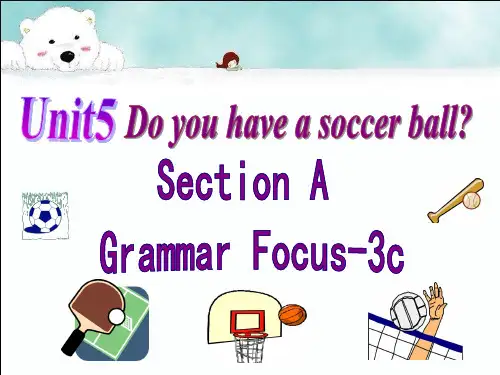
Volleyball, volleyball. I have a volleyball. Soccer ball, soccer ball. Do you have a soccer ball? Baseball, baseball. She has a baseball. Basketball, basketball. Does he have a basketball? We all have ping-pong bats and baseball bats.
Review
basketball soccer ball volleyball baseball bat
tennis racket
ping-pong pingபைடு நூலகம்pong bat table tennis
Do you know them?
soccer ball
volleyball
baseball
baseball bat
_t_h_e_y_d_o_n_’_t_.
— _D_o__th_e_y_h_a_v_e_a__b_as_k_e_t_b_al_l_____? 他们有一个篮球吗?
— Yes, __th_e_y_d_o_____. 是的,他们有。
— No, __t_h_ey__d_o_n_'t____. 不,他们没有。
5 . 他们有一个篮球吗? _D_o_ they _h_a_v_e_ a basketball? 是的,他们有。 Yes, _t_h_e_y_ __d_o__./不,他们没 有。他们有一个排球。_N_o__, they d_o_n_’_t_. They _h_a_v_e_ a _v_o_l_le_y_b_a_l_l.
Unit5 SectionA+Grammar+Focus~3c课件-2024学年人教版七年级英语下册
本课须掌握的形容词
ugly friendly small / little 难看的 友好的 小的
quiet smart 安静的 精明的
fun 乐趣
shy 害羞的 interesting 有趣的
clever beautiful cute 聪明的 美丽的 小巧玲珑的
scary 令人恐慌的
Can you describe(描述)the pandas?
Learn to walk before you run
聪明的
友好的
1.smart ______ 2. friendly _____
Do you like pandas? B: Yes, I do. But I like tigers a lot. A: Tigers? Why d__o you like tigers? B: They’re really _c_o_o_l !
Grammar Focus
2.Cooperation inquiry. Why do you like pandas?
“They are + from…”来回答。
➢ 句子结构 Where + a_r_e_ + 名词 + _fr_o_m__?
Learn to walk before you run
e.g. —Where are koalas from?考拉来自哪里?
—They are from Australia.他们来自澳大利亚。
二、where 引导的特殊疑问句询问来 自哪里。 ➢ 句子结构
Where + _a_re_ + 名词 + _f_r_o_m_?
Learn to walk before you run
ugly friendly small / little 难看的 友好的 小的
quiet smart 安静的 精明的
fun 乐趣
shy 害羞的 interesting 有趣的
clever beautiful cute 聪明的 美丽的 小巧玲珑的
scary 令人恐慌的
Can you describe(描述)the pandas?
Learn to walk before you run
聪明的
友好的
1.smart ______ 2. friendly _____
Do you like pandas? B: Yes, I do. But I like tigers a lot. A: Tigers? Why d__o you like tigers? B: They’re really _c_o_o_l !
Grammar Focus
2.Cooperation inquiry. Why do you like pandas?
“They are + from…”来回答。
➢ 句子结构 Where + a_r_e_ + 名词 + _fr_o_m__?
Learn to walk before you run
e.g. —Where are koalas from?考拉来自哪里?
—They are from Australia.他们来自澳大利亚。
二、where 引导的特殊疑问句询问来 自哪里。 ➢ 句子结构
Where + _a_re_ + 名词 + _f_r_o_m_?
Learn to walk before you run
人教版七年级上册英语unit 5 Section A(Grammar Focus-3c)
人教版七年级
Unit5Doyouhaveasoccerball?
Period2SectionA (GrammarFocus-3c)
1 play 2 Let 3 nice 4 us 5 has
先练后背
提示:点击 进入习题
答案呈现
6 Does; have; hedoesn't; has
7 baseballbat; play
A. aB. anC. /D. the
2.—Doyouandyoursisterhaveanybasketballs?
—No, ________don't. D
A. IB. heC. theyD. we
3.—____C____theyhaveWeChatnumbers? —No, they________. A. Are; aren'tB. Do; do C. Do; don'tD. Are; are
5. Let'splay_____D___basketballafterschool. 【2019•贺州】 A. aB. anC. theD. /
【点拨】语法判定法。句意为“让我们放学后 打篮球吧”。play与球类名词搭配时,球类名 词前不加冠词。故选D。
6. Lilypracticesplaying______D__piano (钢琴) afterschooleveryday. 【2019•武威、白银】
4. Ms.
B
Brownalways________volleyballinthea
fternoon.
A. playB. plays
C. goD. goes
【点拨】主语Ms.Brown 是第三人称单数,谓语 动词play用第三人称单数。故选B。
Unit5Doyouhaveasoccerball?
Period2SectionA (GrammarFocus-3c)
1 play 2 Let 3 nice 4 us 5 has
先练后背
提示:点击 进入习题
答案呈现
6 Does; have; hedoesn't; has
7 baseballbat; play
A. aB. anC. /D. the
2.—Doyouandyoursisterhaveanybasketballs?
—No, ________don't. D
A. IB. heC. theyD. we
3.—____C____theyhaveWeChatnumbers? —No, they________. A. Are; aren'tB. Do; do C. Do; don'tD. Are; are
5. Let'splay_____D___basketballafterschool. 【2019•贺州】 A. aB. anC. theD. /
【点拨】语法判定法。句意为“让我们放学后 打篮球吧”。play与球类名词搭配时,球类名 词前不加冠词。故选D。
6. Lilypracticesplaying______D__piano (钢琴) afterschooleveryday. 【2019•武威、白银】
4. Ms.
B
Brownalways________volleyballinthea
fternoon.
A. playB. plays
C. goD. goes
【点拨】主语Ms.Brown 是第三人称单数,谓语 动词play用第三人称单数。故选B。
Unit5_SectionA(Grammar_Focus-3c)精品课件
Why do you like pandas?
Because they’re kind of interesting.
3b Write names of animals in the blanks to make sentences that are true for you. elephants I like __________, because they’re smart.
Why do you like pandas? 问) __________________________________
3. My dog can walk on two legs. (对划线部分提问) What can your dog do? __________________________________
3a Fill in the blanks with the words from the box. Then practice the conversation. because they’re
do
cool why
don’t
like where
Where are lions from? A: _________
线部分提问)
Why doesn’t Eric like cats? ___________________________
Homework:
1. Remember the sentences in the Grammar Focus. 2. Write five sentences about yourபைடு நூலகம்favorite animals.
A: Is the animal big? B: Yes, it is.
人教版七年级英语上册课件Unit5第2课时SectionAGrammarFocus3c共36张
? 【拓展】系动词除sound外,还有:be是; feel感到;become变得;get变得;taste 尝起来;turn变得;smell闻起来;look 看起来等等。如:
? Lucy looks happy实义动词have的一般现在时 ? ⑴含义:当表示“某人有……”时,可以用
have来表示所属关系。
? ⑵用法:
? ①have还有“吃;喝”的意思。如: ? have breakfast/lunch/supper 吃早饭/午
饭/晚饭
? have a cup of coffee 喝一杯咖啡
? ②have与许多名词搭配组成短语:
? have a look 瞧一瞧 have a walk 散步
a dictionary.She
? C( )7.—Does your brother have a soccer ball?
?
—Yes,he .
? A.do
? B.don't
? C.does
? D.doesn't
? A( )8.—Does Judy have a tennis bat?
?
—
.
? A.Yes,she does
? have a rest 休息 have a good time 玩得高兴have a talk 说说话 have fun 玩 得高兴
? ③have/has句型与there be句型的比较: 两者都表示“有”,但用法不同。前者表 示所属关系,即“某人或某物有什么”, 而后者表示存在,表示“某地有什么”。 如:
? Ⅳ.单项选择。
?B( )1.画线部分发音与所给音标/ 的一项是
?
。
? A.chair