
人教新目标版英语七年级下册 Unit2 写作课件
curly hair
straight hair
Hair 头发
长短+卷直+颜色
long straight black hair
hair build
height
short /long 长短 straight/curly 直卷 black /blonde… 颜色
thin
heavy
medium build
Hair
long straight black hair
short curly blonde hair
summery
He/She have/has长有,留有
has short hair has long hair has straight hair has curly hair has black hair has blonde hair
要求: 1. 80词左右; 2. 语言规范、意思连贯、表达完整。
_______M___y__b__e_s__t_f_r__i_e_n__d_____________
______________________________________
______________________________________
Ready? Go
Step1:
words
how to discribe the appearance外貌
hair
build
height
…
Height
tall medium height short
Build
thin
heavy
medium build
Hair short hair
long hair
要点1:你好朋友的基本信息 (2分)
内容 要点2:你好朋友的长相、穿着 (2分) (8分)
要点3:你喜欢他/她的原因 (2分)
拓展合理 (2分) 语言 词汇丰富 (1分) (3分) 句法正确 ,语言优美( 2分) 卷面
书写工整( 1分)
乐在交流,乐 在分享
优秀作文分享:
开门见山,道出好朋友的
My best friend名字。
_______________________________________
While writing
Step1 Think and Fill(想一想,填一填)
审题
体裁:____记__叙__文_______________ 人称:____第__三_人__称______________ 时态:_一__般__现__在__时_态_____________
B: He/She is… Height
short tall
of medium height
A: What does he/she look like? B: He/She is...
Build
thin of medium build heavy
A: What does he/she look like? B: He/She has...
He is
Congratulations to pass Step 3! 祝贺你通过第3关!
Ready to Step 4?
Step4:
Ready? Go
Have a try by yourselves! 自己试一试!
Writing
每个人都有自己的好朋友。你心目中最好的 朋友是谁,长什么样?请你以“My best friend” 为题,写一篇80词左右的短文来描述你的好朋 友。
My best friend
写作话题: Friends (朋友)
the steps of writing
Step 1(first :words) Step 2(second :make up 组织sentences Step 3(third:make up article) Step 4(forth:practice)
眼睛大/小 have big/small eyes
is tall is short is of medium height is thin is heavy is of medium build
Congratulations to pass Step 2! 祝贺你通过第2关
Ready to Step 3?
tall medium height short
Congratulations to pass Step1! 祝贺你通过第一关!
Ready to Steps 2 ?
Ready ? go
Step 2:
make up sentence 连词成句
A: What does he/she look like?
Ready? Go
Steps 3:
make up article
lead-in
Guessing Game
Some clues(线索):
He is a famous actor and host(主持人) He is a humorous(幽默的) man He is of medium height. He is heavy. He has short straight hair and a big nose. He is good at talking about cross talk(相声).
glasses. He usually wears jea从n他s的,外a貌、T穿-s着h等i方r面t 描and
述自己的好朋友,逻辑清晰,
sports shoes.
ቤተ መጻሕፍቲ ባይዱ
层次感强。
I like him because he is really cool and fun,
My name is Jim, Jack is my best friend.
Let me tell you what he looks like. First of
all, he is very tall and handsome. He has
straight brown hair but he doesn’t wear
Step2 Structurize (列一列 )
以“My best friend ”为题 1. 我好朋友的基本信息 2. 他/她的长相、穿着 3. 你喜欢的原因
beginning Body Ending
评分表
项目
标准
自我评价 同伴评价 教师评价
结构 段落合理 (2 分) (3分) 衔接自然 (1分)
新目标(人教)七年级下册英语教学课件 Unit 9 Section A(2a-2d)

little 表示否定含义, 修饰不可 I have little free time. 我几乎没有空 “几乎没有” 数名词 闲时间。
a little 表示肯定含义, “一点;少量”
I know a little French. 我懂一点儿 法语。
2. He has brown hair and wears glasses. 他有着棕色的头发而且戴着眼镜。 wear 动词, 可表示“戴着眼镜”, “蓄着……样的头发”, “穿着……样的衣服”等。 wear的宾语是“衣服、鞋子、眼镜、首饰”等。 wear 表示经常性的状态。 put on表示穿的动作。
David
Sally
Peter
is heavy of medium height, short tall thin
has curly hair long straight hair short hair
is后多接形容词,用于描述身高、体格等;has后一般接名词短语, 用于描述头发等。
Listen and read. Conversation 1 A: Is that your brother David? B: No, it isn’t. A: What does David look like? Is he tall or short? B: He’s tall. He’s heavy. And he has curly hair.
You ask and I answer
Pre-listening
Look at the picture and I circled one person. Then you can guess which one I circled using these sentences:
人教版新目标七年级英语下册unit2教案(表格式)
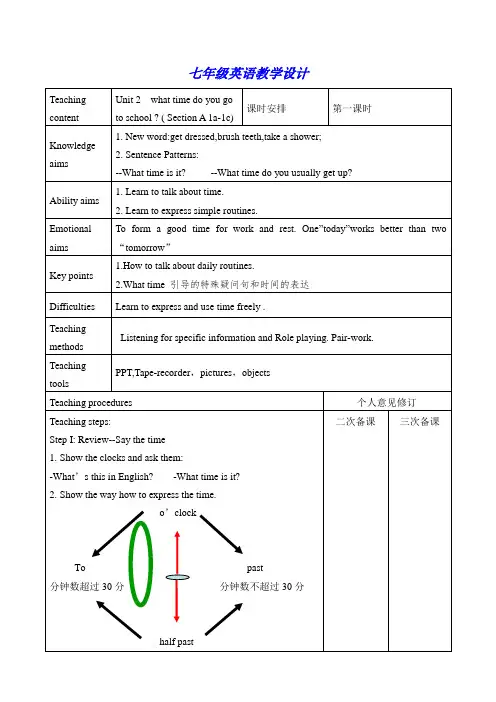
七年级英语教学设计Teaching content Unit 2 what time do you goto school ? ( Section A 1a-1c)课时安排第一课时Knowledge aims 1. New word:get dressed,brush teeth,take a shower;2. Sentence Patterns:--What time is it? --What time do you usually get up?Ability aims 1. Learn to talk about time.2. Learn to express simple routines.Emotional aims To form a good time for work and rest. One”today”works better than two “tomorrow”Key points 1.How to talk about daily routines.2.What time 引导的特殊疑问句和时间的表达Difficulties Learn to express and use time freely .TeachingmethodsListening for specific information and Role playing. Pair-work.TeachingtoolsPPT,Tape-recorder,pictures,objectsTeaching procedures 个人意见修订Teaching steps:Step I: Review--Say the time1.Show the clocks and ask them:-What’s this in English? -What time is it?2.Show the way how to express the time.o’clockTo past分钟数超过30分分钟数不超过30分half past二次备课三次备课(1). 点钟数+分钟数6: 10 six ten7: 25 seven twenty-five(2). 分钟数+past +点钟数(分钟数不超过30分)7: 20 twenty past seven8: 30 half past eight(3). 差分钟数+ to +下一点钟数(分钟数超过30分)8:45 fifteen to nine9: 50 ten to tenStep II : New lessonI. Presentation:1.Show a clock, ask them to say the time2.Show the picture and let them to say: What does he do?If they cannot say, let them say in Chinese. Show the English of the action: get up,3.Ask him: What time do you usually get up?To the class: What time does he get up?To show the sentences and read.4.Do the others one by one in the same way.5.Teach ‘take a shower’and lead them to guess the time that Rick takes a shower.Step 3 look and say1.Finish 1a,match words with pictures.2.Read words and ask them to recite in 2 minutes.3.Ask them to talk about the shower schedule for Rick’s family. 4.Choose some pairs to say.Step 4 Look, listen and match1. Listen and match the time.2.Show the pictures and let them to say again.Step 5 Interview1.Let them to say the actions they do everyday.2.Show some pictures they may do, and let them try to say inEnglish.3.Show the tablet and let them discuss in groups of4.4.Report what they get.Step III: Practice:达标测评,反思提高1、上午七点整2、中午十二点3、早上五点半4、下午五点一刻5、差十分六点6、五点过两分7、三点二十五8、四点三十八分9、十二点差一刻10、五点零五分11、九点十分12、十一点零六分Step IV: Summary:Summarize the key phrases and drills in this part; Summarize how to express time.Step V: Homework:Write a short passage about the tablet they interviewed.Bb design:Unit 2 What time do you go to school?What time is it? /What’s the time? It’s 2 o’clock./11:05. Take a shower get up get dressed go to school教后感悟成功之处:不足之处:改进措施:七年级英语教学设计Teaching content Unit 2 What time do you goto school? Section A (2a–3c)课时安排共五课时第二课时Knowledgeaims 1.New word:brush teeth, do homework, go to bed, wash face,play computer game.2.2. Sentence Patterns:--What time does she usually get up?-- She usually gets up at five o’clock.Ability aims Train ss’ speaking skill, and train them to communicate with others fluently. Emotionalaims培养良好的作息习惯和守时习惯。
人教版新目标英语七年级下册unit2全单元教案
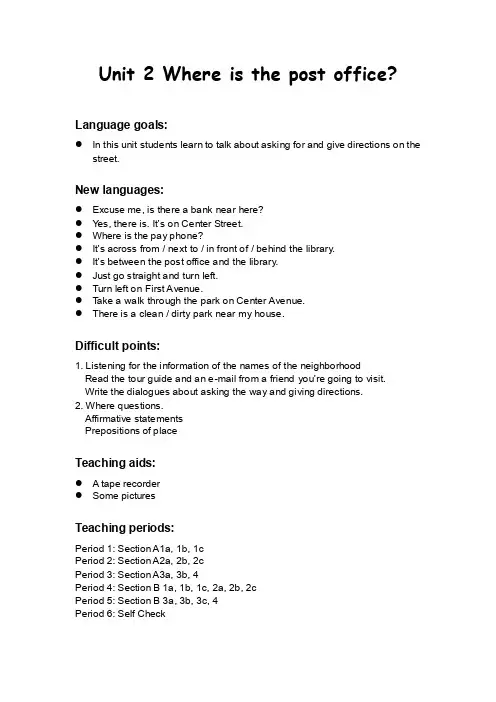
Unit 2 Where is the post office?Language goals:●In this unit students learn to talk about asking for and give directions on thestreet.New languages:●Excuse me, is there a bank near here?●Y es, there is. It’s on Center Street.●Where is the pay phone?●It’s across from / next to / in front of / behind the library.●It’s between the post office and the library.●Just go straight and turn left.●Turn left on First Avenue.●T ake a walk through the park on Center Avenue.●There is a clean / dirty park near my house.Difficult points:1. Listening for the information of the names of the neighborhoodRead the tour guide and an e-mail from a friend you’re going to visit.Write the dialogues about asking the way and giving directions.2. Where questions.Affirmative statementsPrepositions of placeTeaching aids:● A tape recorder●Some picturesTeaching periods:Period 1: Section A1a, 1b, 1cPeriod 2: Section A2a, 2b, 2cPeriod 3: Section A3a, 3b, 4Period 4: Section B 1a, 1b, 1c, 2a, 2b, 2cPeriod 5: Section B 3a, 3b, 3c, 4Period 6: Self CheckTeaching aims:1. T each vocabulary words.2. T arget languages: Is there a bank near here? Y es, there is. It’s on CenterStreet.3. Enable the students to ask for and give directions on the street.4. Help the students to ask for and give directions on the street.Teaching procedures:Step 1. Warming upShow three pictures prepared before class to the students. There is acat in a box in picture 1. There is a cat on a box in picture 2. There is acat under the box in picture 3.Then ask some students to ask and answer these questions.Step 2.Match work (2a)Ask the students to read the picture and the words in the numbered list.Ask the students to match each word or phrase on the list with one of the pictures.Then check the answers.Present the new sentence patterns.Then ask the students to read the dialogue in the picture.Step 3. Listening (1b)Ask the students to listen to the conversations and circle the places in 1a.Change the roles and do the same again.Then students ask and answer without the help of the recording.Step 4. PracticePoint to the different locations shown in the picture. Ask different students to name each one.Then point to more locations and let the students to practice more.Homework1. Practice the conversation in the picture on page 7.2. Learn the new words and phrases in this period by heart.Teaching aims:1. Learn the vocabulary words and useful expressions.2. T arget languages:The pay phone is across from the library.The pay phone is next to the library.The pay phone is between the post office and the library.The pay phone is on Greet Street.The pay phone is in front of the library.The pay phone is behind the library.3. Enable the students to talk about the position of a place.4. Help the students to talk about the position of a place.Teaching procedures:Step 1. Revision and warming upCheck the homework by talking about the pictures on page 7 with thestudents or prepare some other pictures with different buildings in itand let the students practice asking and answering questions aboutthe places.Ask the students to practice more.Step 2. Presentation (2a)Introduce the items across from, next to, between, in front of, behindand on.Draw the following picture on the blackboard.Park 3 Centre StreetEncourage or help the students to answer: It’s across from the library.The same way goes with next to, on and in front of.Ask the students to match each sentence with one of the pictures.Then ask the students to read the six sentences and match thesentences the pictures.Check the answers.Step 3. Listening(2b)Review the buildings and street names in Activity 1a and the sixsentences in 2a.The read the six sentences in 2b to the class.Ask the students to listen to the recording and fill in the blanks.Play the tape. Check the answers.Step 4. Practice (2c)Ask the students to repeat the conversations after the recording.Ask the students to do the Pair work asking and answering questionsabout the places in 1a.Step 5.Grammar FocusAsk the students to read the sentences in the grammar box aloud. Theask them to answer the following questions. Explain some languagepoints if t he students can’t understand.HomeworkAsk the students to practice talking about their neighborhood in pairs.Period 3T eaching aims:1. T each vocabulary words.2. T arget languages:Just go straight and turn left.It’s down Bridge Street on the right.It’s next to a supermarket.3. Enable the students to talk about the neighborhood.4. Help the students to talk about the neighborhood.Teaching procedures:Step 1. RevisionLet the students look at the picture in activity 1a. And ask somestudents to answer some questions in order to check the homework.Say, Is there a library near here? Where is it? Is there a bank near here?Where is it?Put up the picture of activity 2a on the blackboard and ask them tomake conversations.Step 2. Presentation (3a)Guide the students to guess the meanings of the three traffic signs.Show the pictures and ask some questions about the pictures.Then ask the students to hold up their left hands and then their righthands to practice “left” and “right”.Point to the picture and let the students read the conversation.Ask the students to read the conversations. Then ask them to find Pauland Nancy in the picture.Ask the students to role play the conversation then point out the placethat Paul wants to get to.Step 3. Complete the conversations (3b)Ask the students to make conversations and answer the questionsbelow each picture.The students point out the place in the picture. And write down theanswers on the line in the pictures. Or ask a pair of students to say theconversation, the others point to the speakers’ place.Step 4. GameAsk the students to look at the picture in Activity 1a and name all the buildings.Ask some students to read the conversation in the picture in Activity 4.And then explain the instruction to the student.Then ask some groups to present their work.HomeworkAsk the students to make a similar conversation to that in Activity 3a. Period 4Teaching aims:1. T each vocabulary words.2. T arget languages:Is there a big supermarket near your house?Y es, there is.There is a big supermarket.No! There is a small supermarket.3. Enable the students to describe the neighborhood.4. Help the students to describe the neighborhood.Teaching procedures:Step 1. RevisionCheck the homework by asking the following questions.Say, Look at the picture in activity 3a. Suppose you are standing nearthe building on the side of New Street. Please answer my questions.Excuse me. Is there a pay phone in the neighborhood?Ask another student to answer questions.Give more students chances to practice this dialogue.Step 2.Match work (1a)Bring in some objects or pictures to the students. (Two rulers, one is old,the other is new. Two boxes, one is big and the other is small. Two bottles, one is clean and the other is dirty. Two pictures of a street, one is busy and the other is quiet.)Say, Look at the rulers, please. Can you find the difference between them? Y es. This one is old. (Show the old ruler.) And this one is new.(Show the new ruler.) Do you understand old and new?Ask the students to talk about the picture.Point to each half of each picture and ask about the difference between the halves.Go on with the other pictures to teach the language items.Ask the students to match the words with the pictures.Step 3. Pair workCall attention to the conversation in the picture.Then ask the students to work in pairs and take turns asking each other questions about the things on the list of phrases in activity 1a on page 7. Step 4. Listening (2a, 2b)Ask the students to listen to the tape and circle the places in 1a.Say: Now please listen to the tape again. Listen to it and draw the places in Michael’s neighborhood on the street map. Just listen.Play the recording.Play the recording again.Then have some students show their completed drawing to the class. Step 5. Pair workAsk the students to work in pairs talking about drawings to the class.Then ask some pairs to present their dialogues to the class.Ask the students to work in pairs, draw a map of their own neighborhood and practice asking and answering questions about the places they live in.HomeworkAsk the students to make similar conversations to that in Activity 1b.Period 5Teaching aims:1. T each vocabulary words.2. T arget languages:Turn left on First Avenue and enjoy the city’s quiet streets and small parks.T ake a walk through the park on Center Avenue.This is the beginning of the garden tour.Bridge is a good place to have fun.3. Enable the students to write a tour guide and draw the rout to somewhere.4. How to write a tour guide and draw the rout to somewhere.Teaching procedures:Step 1. RevisionCheck the homework by asking about the student’s neighborhood.Ask the students to work in pairs.Ask the students to work in pairs.Then ask some pairs to present their conversations to the whole class.Step 2. Reading (3a, 3b)Ask the students to read the tour guide.Divide the whole class into four groups to have a quiz.T ell the students to keep these words down and make at least two sentences with each word after class.After that ask the students to look at the pictures and fill in the blanks for this tour guide.Step 3.WritingAsk the students to write a tour guide with the students.Names of buildings and locations.Description wordsWords that talk about positions.Words that talk about directions.Step 4. Pair work (4b)Learn to draw a picture of neighborhood. First ask the students toanswer the questions according to the pictures.Then ask the students to draw a picture according to the followingconversation.Then ask students to present their drawings to the whole class.Homework1. Ask the students to talk about the street and buildings in their ownneighborhood.2. Ask the students to make sentences with the description words they keptdown in the class.Period 6Teaching aims1. T each vocabulary words.2. T arget languages:I know you are arriving next Sunday.Let me tell you the way to my house.I hope you have a good trip.3. Enable the students to write about the neighborhood.4. Help the students to learn how to write about the neighborhood.Teaching procedures:Step 1. RevisionCheck the homework by asking and answering some questions.Give more students chances to practice.Step 2.Key word check(1)Ask the students to check the words they know.Then ask the students to do the some exercises.Step 3.Vocab-Builders (2)Expand the students’ vocabulary.After that ask the students to share their list with other students.Step 4. ReadingAsk the students to read the letter and draw the rout on the map.Ask the students to change the letter into a telephone conversation.Let the students pay attention to the pictures.Say, Look at the picture of Sally. How old do you think she is? Where do you think she is from? What language do you think she speaks? What do you think she likes?What do you think she dislikes?The same step goes with Jim and Julie.After a few minutes, ask some students to read their descriptions to the class.Step 5. Just for Fun!Call attention to the conversation in the cartoons.Ask the students to read the conversation and then answer the questions.HomeworkAsk the students to do the following:1. Suppose your friend is going to visit you. He doesn’t know the way toyour house. Write a letter to him to tell him the route from the bus stop to your house.2. Review the next unit.。
新目标(人教)七年级下册英语教学课件 Unit 3 Section A(2a-2e)
Jane: About 15 minutes by bike. It’s good exercise.
/baɪ/ prep. (表示方式)乘(交通工具)
Lisa: Yeah. Well, have a good day at school.
Jane: You, too.
by bike member.
walks
about 20 minutes
takes the bus about one hour and 30 minutes
How far? (kilometers)
about 2 kilometers
about 60 kilometers
2c Listen again. Check your answers in 2b.
Work in groups of four and do a research about others’ transportation, the amount of time and distance to school.
Who How How long
How far
Lily on foot ten minutes one kilometer
这里用作名词, 意为“旅程”。
Lisa: I’m not sure ... about 10 kilometers? The bus ride
takes about 20 minutes. How long does it take you
to get to school?
动词, 意为“花费 (时间)”。
Conversation 1 Mary: How do you get home from school, Tom? Tom: I walk. Mary: How long does it take? Tom: It takes about 20 minutes. Mary: Wow! That’s quick! How far is it from the school to your home? Tom: Only about two kilometers.
人教版新目标七年级英语下册Unit2说课稿
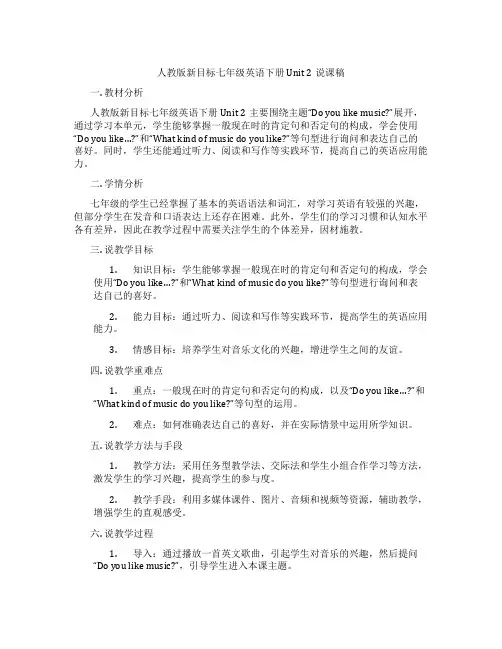
人教版新目标七年级英语下册 Unit 2说课稿一. 教材分析人教版新目标七年级英语下册Unit 2主要围绕主题“Do you like music?”展开,通过学习本单元,学生能够掌握一般现在时的肯定句和否定句的构成,学会使用“Do you like…?”和“What kind of music do you like?”等句型进行询问和表达自己的喜好。
同时,学生还能通过听力、阅读和写作等实践环节,提高自己的英语应用能力。
二. 学情分析七年级的学生已经掌握了基本的英语语法和词汇,对学习英语有较强的兴趣,但部分学生在发音和口语表达上还存在困难。
此外,学生们的学习习惯和认知水平各有差异,因此在教学过程中需要关注学生的个体差异,因材施教。
三. 说教学目标1.知识目标:学生能够掌握一般现在时的肯定句和否定句的构成,学会使用“Do you like…?”和“What kind of music do you like?”等句型进行询问和表达自己的喜好。
2.能力目标:通过听力、阅读和写作等实践环节,提高学生的英语应用能力。
3.情感目标:培养学生对音乐文化的兴趣,增进学生之间的友谊。
四. 说教学重难点1.重点:一般现在时的肯定句和否定句的构成,以及“Do you like…?”和“What kind of music do you like?”等句型的运用。
2.难点:如何准确表达自己的喜好,并在实际情景中运用所学知识。
五. 说教学方法与手段1.教学方法:采用任务型教学法、交际法和学生小组合作学习等方法,激发学生的学习兴趣,提高学生的参与度。
2.教学手段:利用多媒体课件、图片、音频和视频等资源,辅助教学,增强学生的直观感受。
六. 说教学过程1.导入:通过播放一首英文歌曲,引起学生对音乐的兴趣,然后提问“Do you like music?”,引导学生进入本课主题。
2.新课呈现:讲解一般现在时的肯定句和否定句的构成,示范使用“Doyou like…?”和“What kind of music do you like?”等句型进行询问和表达喜好。
新目标(人教)七年级下册英语教学课件 Unit 12 Section A(2a-2d)
/ˈbʌtə(r)flaɪ/ n. 蝴蝶
Lisa: Yeah, it was fun. They have a butterfly house with over 200
visitor /ˈvɪzɪtə(r)/ n. 游客;参观者
kinds of butterflies! I told the visitors about them and their
A: Hi, Mike. What did you do last weekend? B: I watched TV, and then I went fishing
with my father. A: How was your last weekend? B: It was boring.
Names
【用法详解】 sheep是可数名词,意为“羊;绵羊”,其复数形式仍然是sheep。 ➢Sheep are eating grass in the fields. 羊在田野里吃草。
单复数同形的可数名词: 中日鱼羊鹿,是单也是复。
(注:中 — Chinese 日—Japanese 鱼—fish 羊—sheep 鹿—deer)
Listen again and fill in the chart.
Who Becky Carol Jack
Weekend activities visited her grandma, did her homework stayed at home, studied for the English test
Read the sentences in 2a and say the original forms of verbs.
1. ___ I visited my (aunt/ grandma). visit 2. ___ I did (my homework/ sports). do 3. ___ I studied for the (English/ math) test. study 4. ___ I went to a (farm/ beach). go 5. ___ I fed some (sheep/cows). feed
英语人教新目标七年级下册Unit2Section B (2a – 2c)
Advice(建议):
get up early/on time have breakfast slowly eat fruit and vegetables
Mary eat ice-cream after dinner
Don’t eat ice-cream after dinner
精致卓越 大气开放 品质绵外 担当未来
(4)eats hamburgers for lunch
(5)plays basketballfor half an hour
does homework
(6)
first
(7)either watches o games
(8)at 10:30 _b_ru_s_h_e_s_t_e_et_h_ (9)then__g_o_e_s_t_o_b_e_d______
Teaching aims
Preparation
1.Master key words and Text book Page 11
phrases.
Notebook
2.Talk about healthy and Pen
unhealthy habits.
3. Improve reading skills.
Retell
Tony's Daily Routine
at 8:00
goes _t_o___s__c_h__o__o__l_____
at noon
plays basketball for half an___h__o_u__r______
in the brushes teeth and goesevening to bed________________
After school
新目标(人教)七年级下册英语教学课件 Unit 9 Section B (2a-2c)
2b Read the article. Which picture shows the real criminal?
2c Read the article again and write what the words in bold refer to.
1.He=___J_o_e__B_r_o_w_n_____________________________ 2.it=____th_e__p_ic_t_u_re__o_f _th_e__c_ri_m_i_n_a_l_________________
七年级英语下(RJ) 教学课件
Unit 9 What does he look like?
Section B (2a-2c)
➢Key words & phrases:
学习目标
artist; crime; criminal; put; each; way; describe; differently; another;
6.He=___th_e__c_ri_m_i_n_a_l____________________________
Language points
1. He wants to draw a good picture of each criminal. 他想画好每 个罪犯的画像。 each adj. & pron. 每个;各自
“The criminal is of medium height and young. He has long
straight brown hair and big eyes,” says one woman. Another
woman says, “He is tall and thin, and he has curly blonde hair.
人教版新目标七年级英语下册unit2教案(表格式)
矿产资源开发利用方案编写内容要求及审查大纲
矿产资源开发利用方案编写内容要求及《矿产资源开发利用方案》审查大纲一、概述
㈠矿区位置、隶属关系和企业性质。
如为改扩建矿山, 应说明矿山现状、
特点及存在的主要问题。
㈡编制依据
(1简述项目前期工作进展情况及与有关方面对项目的意向性协议情况。
(2 列出开发利用方案编制所依据的主要基础性资料的名称。
如经储量管理部门认定的矿区地质勘探报告、选矿试验报告、加工利用试验报告、工程地质初评资料、矿区水文资料和供水资料等。
对改、扩建矿山应有生产实际资料, 如矿山总平面现状图、矿床开拓系统图、采场现状图和主要采选设备清单等。
二、矿产品需求现状和预测
㈠该矿产在国内需求情况和市场供应情况
1、矿产品现状及加工利用趋向。
2、国内近、远期的需求量及主要销向预测。
㈡产品价格分析
1、国内矿产品价格现状。
2、矿产品价格稳定性及变化趋势。
三、矿产资源概况
㈠矿区总体概况
1、矿区总体规划情况。
2、矿区矿产资源概况。
3、该设计与矿区总体开发的关系。
㈡该设计项目的资源概况
1、矿床地质及构造特征。
2、矿床开采技术条件及水文地质条件。
人教版新目标英语七年级下册Unit 2 写作教学案
七年级下册Unit 2 What time do you go to school?写作教学案(教师使用)【话题】日常作息习惯(Daily routines)【写作目标】能运用本单元所学的语法及语言材料,完成写作简单谈论日常作息习惯。
【课前任务】一、写出下列短语。
1、起床2、穿上衣服3、洗淋浴4、广播电台5、(在)周末6、做作业7、散步 8、要么……要么……参考答案:1. get up 2. get dressed 3. take a shower 4. radio station 5.on weekends 6.do (one’s) homework 7. take a walk 8.either...or...二、根据汉语意思完成下列句子。
1、里克,你通常几点起床?________ ________ do you usually ________ ________, Rick?2、她认为那(冰激凌)对她身体不好,但是它尝起来味道很棒!She ________ it’s not good ________ her, ________ it tastes good!3、要么你错了,要么我错了。
________ you ________ I ________ wrong .4、放学后,迈克经常在教室里做作业。
________ ________, Mike often ________ ________ ________ in the classroom.5、你每天通常什么时候散步?________ ________ you usually ________ ________ ________ every day?参考答案:1.What time; get up 2.thinks;for; but 3. Either; or am 4.After school; does his homework 5.When do; take a walk三、写出与本话题有关的词汇和句型。