
五年级下册英语Unit 5 Robin At The zoo人教PEP版
新PEP小学英语五年级下册《Unit 5 Whose dog is it》
整理课件
Guessing game
What’s the panda doing? It’s… It’s eating.
整理课件
Guessing game
What’s the elephant doing? It’s…
It’s drinking.
整理课件
Guessing game
What are the monkeys doing? They’re…
What animals does Robin see?
整理课件
Listen to the story.
整Hale Waihona Puke 课件Question:What animals does Robin see?
A bear, some rabbits, a tiger, an elephant, a monkey, a bird and some fish.
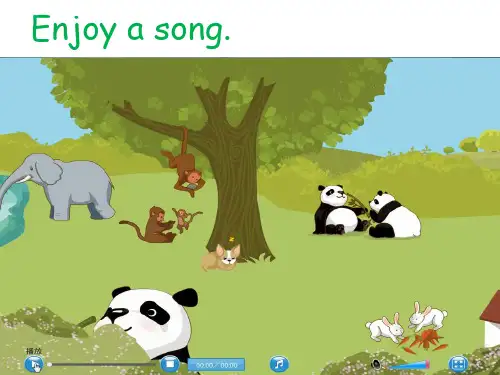
Enjoy a song.
整理课件
Unit5 Whose dog is it?
Robin at the zoo
No.4 Primary School of Linyi Wang Jun 整理课件
At the zoo
整理课件
Let’s chant
Jumping, jumping, I’m jumping. Climbing, climbing, I’m climbing. Eating, eating, I’m eating. Drinking, drinking, I’m drinking. Dancing, dancing, I’m dancing. Playing, playing, we are playing. Going, going, we are going to the zoo.
五年级下册英语书53页read and white翻译
五年级下册英语书53页read and white翻译五年级下册人教版英语第53页翻译:1、Robin at the zoo罗宾在动物园2、Sarah and Robin are at the zoo.Robin is excited!萨拉和罗宾在动物园。
罗宾是兴奋的。
3、Sarah:What are you doing here,Robin?萨拉:罗宾你在这里做什么?4、I'm looking at a bear. I'm dancing like a bear.我在看一只熊。
我跳得像只熊。
5、I'm looking at the rabbits. I'm eating like a rabbit. 我在看兔子,我在像兔子一样吃东西。
6、I'm looking at a tiger. I'm running like a tiger.我在看一只老虎。
我在像老虎一样跑。
7、I'm looking at an elephant. I'm walking like an elephant. 我在看一只大象。
我在像大象一样散步。
8、I'm looking at a monkey.I'm climbing like him.我在看一只猴子。
我在想猴子一样攀爬。
9、I'm looking at a bird.I like flying.I want to be a bird. 我在看一只鸟。
我喜欢飞,我想变成一只鸟。
10、Sarah:Robin,do you want to swim like a fish?萨拉:罗宾,你想像鱼一样游泳吗?11、Robin:No! No! I don't want to be a fish!罗宾:不!不!我不想变成一条鱼。
12、Answer the questions.回答问题13、Where are Sarah and Robin?萨拉和罗宾在哪?14、They are at the zoo.他们在动物园。
人教(PEP)版五年级英语下册《Unit 5 Whose dog is it. C》研讨课教案_11

1、教学内容分析:本课题出自人教2014版PEP(三年级起点)小学英语五年级下册第五单元,本单元内容丰富,以“询问小动物主人”为话题,单元重点是运用重点句型和名词性物主代词谈论物品的归属人,培养学生爱护小动物的意识。B部分主要是对现在进行时的学习。本节课通过设置Robin和Sarah游览动物园等场景,让学生借助图片理解短文,并再次练习使用现在进行时来描述正在发生的事情。
(1)跳读(扫读、寻读)scanning,Read the words quickly and find the key words.快速读文字,找出关键词。
1读然后勾出动物类单词。Circle “○”
T: Please read the words quickly and circle the words about animals.(20秒) If you finish it you may hands up.
T:Now please mark the word“excited”, and write down the means.
2细读第一幅图的内容。
T:Children,please read the wordsin picture one, and answer the question.
What is Robin doing?
2.教学பைடு நூலகம்点:
excited, like的理解。
想象力和创新思维的激发。
说说“Robin为什么不想像鱼一样游泳”的发散性思维讨论。
五、教学准备
电子课件,动词现在分词形态单词卡,动物类单词,like, excited,
六、教学过程设计
Step 1
课前:观看动物类视频或歌曲激趣。
英语人教版五年级下册Unit5 Read and Write Robin at

Unit5 Read and Write一、Teaching aims1、Ss can understand and read the passage.2、Ss can use the sentences in the real situation.二、Key points and difficulties.1、Ss can understand and read the passage.2、Ss can use the sentences in the real situation.3、Ss can read and understand: excited, I want to be a ….三、Teaching Procedure(一)、Warm upStep1. Talk and actT: class begins.Ss: Stand up.T: Good morning,boys and girls!Ss: Good morning,Miss Zhou!T: Boys and girls,look at the picture. I can see a bear. It’s s trong.T: What can you see ?S1: I can see an elephant. It’s strong.T: Do you like elephants?S1 : Yes, I do.T: Now ,act like an elephant.S1 : (Act like an elephant)T: Well done.Sit down ,please.Thank you!What about you ?S2:I can see a tiger,it’s bigT: Do you like tigers?S2:Yes.T: Now ,act like a tiger. Can you?S2:(Act like a tiger)T: Eating like a tiger,Can you?S2:(Do it)T:Wow,big hands.Sit down please.Eating like a mouse,Can you?S1:动作T:Good job,sit down please.Now,Look,…like…. Who want t o have a try?(3位学生)T:Wonderful! Big hands! Excellent!Step2.Let’s chantT: Now, Let’s chant :dancing,dancing,dancing like a mouse.T: Stand up ,please.Dancing,dancing, dancing like a mouse.Running,running,running like a horse.Flying, flying, flying like a bird.Jumping,jumping,jumping like a rabbit.(二)、Lead inT: (chant over) Oh, very good.The animals are so funny,Do you like animals?Ss:Yes.T: Robin likes animals ,too. Now,here’s video about robin.Let’s watch and guess:Where is robin?T: (Look over) Where is Robin?S1:Robin is at the zoo.T:Why?S:Because I can see kangaroo,zebra.T: Good idea.Maybe Robin is at the zoo.Any other ideas?S2: Robin is in the forest.T:Why?S:Because I can see the animals.T:Good try.Now let’s listen.(听完后)Where is Robin?Ss:Robin is at the zoo.T:Oh,Li ,you are right.Very good.(帖板书)Let’s read together:Robin at the zoo.T: So how does Robin feel? Maybe Robin is very frightened,because the tiger is so big.What about you?S1: No,no,no,I think Robin is happy.Because there are so many animals.Robin likes animals.T:Good idea.Sit down,please.Any other ideas?S2:Robin can play with the animals. So I think Robin is very very happy.He is excited. T:Excellent.Robin is excited.Now Let’s listen.T: Follow me,please: excited.T: You try: You two please. You four please.T: Together: Robin is excited.(三)、PresentationStep1 Teach:I’m looking at... .T: Robin is excited in the zoo. What animals does Robin See?T: Look at the picture. You guess like this:Picture1, You can answer like this: He is looking at the ……(板书)S1:Tiger. He is looking at the tiger.T: Maybe,any more?S2:He is look at the bear.T: Good guessing. How about picture 2?生:He is looking at the elephant.T: Maybe, any more?S: Tiger. He is looking at the tiger.T: Good try. What about picture 3?S: He is looking at the tiger.T: Good guessing.This one?S1: Lion. He is looking at the lion.T: Maybe,any more?S2: He is looking at the bird.T: Maybe, picture 5?S1: He is looking at the monkey.T: Good try.Any more?S2: He is looking at the squirrel.T: Maybe,how about this one ?S1: He is looking at the bear.T: Maybe.Any more?S2: He is looking at the elephant.T: Good try. Now let’s listen and check.T&ss: (听完之后跟学生一起说) Now,lets say together. He is looking at the bear.(PPT bear)T&ss: He is looking at the tiger.(出示tiger)T&ss: He is looking at the rabbit.(出示rabbit)T&ss: He is looking at the bird.(出示bird)T&ss: He is looking at the monkey.(出示monkey)T&ss: He is looking at the elephant.(出示elephant)Step2. Read and orderT: I have six pictures. One group one picture. The other two groups are the judge.Now,let’s read the text quickly.Then put the pictures on the blackboard in order.T: Now, read it quickly.T: Are you Ok?Ss: Yes.T: Put the pictures here in order.Ss: (Put the pictures)(贴画有序)T: Wow,you did a good job.Step3. Guess and actT: Now,Look at the picture. The bear is talking. What is the bear saying? Can you guess? I have some suggestions.S1:I’m a bear. I’m dancing.T: Good try. Thank you. Sit down,please.Any more?S2:Hi,Robin. I’m a bear. I’m like dancing.T: Great! Thank you. Sit down,please.T: (戴上头饰)Now. I’m the bear.T: Haha,Robin.I’m a bear.I’m dancing.T: What will Robin say? Can you guess?(出示文本框)Here “like” means……S1: I’m dancing like you.T: Now, I’m the bear.You are Robin.Let’s act it.B: Haha,Robin.I’m a bear.I’m dancing.R: I’m dancing like you.B: You are funny.T: Now,who want to be bear?Robin?T: Well done. Now here are many pictures.Work in four.You can choose 2or 3 pictures you like to act it.Here are the requirements.Look at this paper.If you act well, you can stick a star here. Are you clear? Now.Work in four.T: Ok,stop. Which group want to try?Step4. Read alongT: Excellent ! one star for each.Now,let’s read along.Read with the tape together.Read? Go!T: Now it’s your turn.Four students a group,read the story to your partners. You can read together or one by one. If you read well. You can get a star. Understand? Ss: Yes.T: Now read it. Time’s up. Which group want to have a try?T: Now,open your book,turn to P finish the exercises.T: Ok,now,stop.Let’s check.T: No.1 can you spell it?S: d-a-n-c-i-n-g.Pay attention to this word:here “e” Byebye,then we adding.T: No.2 .S: Eating.T: No.3 . Spell it.S: r-u-n-n-i-n-g.T: Look carefully, we add ning.her e double”n”.T: No.3S1: Walking.Step5. Read and answerT: You all did well. Now, let’s read the story again and answer my question. If you are Robin,which animal do you like best?S1:I like the tiger best.T: Why?S2:Because he can run.T: Great , sit down please.Thank you .Any more?S3:I like the bird best.T: Why?S4:Because I can’t fly. I want to be a bird.T: Good try.Thank you, sit down please.T: In my opion,I’m Robin. I like the bird best.too.Because I can walk,eat,run,climb,dance.But I can’t fly. I want to be a bird.T: Follow me, please. I want to be ……(板书)T: Look , Where is Robin now?S1:He is near the river.T: Good, sit down please. What does Robin see?S2:Some fish.T: Yes, Is he happy?Ss: No.T: Why? Now ,lets go on.T: Look, Sarah is coming . she says:录音.What will Robin say? Can you choose.S1: BT: Why?S1: Because he can’t swim.T: Thank you, sit down ,please.T: Any more?S2:Because he is afraid of water.T: Yes, Robin can’t swim and he is afraid of water. So Let’s listen. What does R obin say?T: No!No! I don’t want to be a fish.(表演教) Who can try?T: Good try. Thank you! Robin doesn’t want to stay here. Help! Help! He want’s to run. Robin’s friend Yifan is not here.(四)、ConsolidationT:Where is Yifan today? Can you guess?S1:He is at home.T: Yes,thank you.He is busy at home. Yifan misses Robin very much.he thinks Robin and Sarah are at the zoo. What are they doing? At that moment. Sarah sends wechant to Yifan. Let’s read.T:读PPT 微信T: Sarah sends many pictures. Look at this picture, what is Robin doing? Can you guess?Say like this: He is ……like……S1:He is slecping like a pig.S2:He is siwing like a bird.T: Now, let’s write.Tabe out this paper. You can choose one or two pictures to tell and write.T: If you write well, you can get one star.and you write this one. You can get two stars. T: Ok?Ss: Ok.T:Write it.T: Let’s share it.(五)、HomeworkT: So much for today . Today’s home work.No.1 Listen and follow the tape 3 times.No.2 Retell the story.Class is over. Goodbye, boys and girls.。
人教版pep五年级英语下册unit5教学设计
人教版pep五年级英语下册unit5教学设计Unit 5 of the People's Education Press Fifth Grade English textbook is focused on the topic of "At the zoo." This unit aims to help students expand their vocabulary related to animals, develop their speaking and listening skills, as well as learn about different habitats and ecosystems in the animal kingdom.Here is a suggested teaching plan for Unit 5:Objectives:1. To introduce and practice new vocabulary related to animals.2. To develop speaking and listening skills through conversations about zoo animals.3. To learn about different habitats and ecosystems in the animal kingdom.Week 1:Day 1-2: Introduction and Vocabulary- Start by introducing the theme of the unit "At the zoo" and brainstorming with students about the different animals they might see at the zoo.- Teach new vocabulary related to animals such as lion, giraffe, elephant, etc. using flashcards, pictures, and gestures.- Practice pronunciation and spelling of the new words with the students.Day 3-4: Speaking and Listening- Use role play activities to help students practice asking and answering questions about animals. For example, "What animal do you like? Why?"- Play listening games where students have to listen to descriptions of animals and guess which animal is being described.Week 2:Day 1-2: Reading and Writing- Introduce reading passages or short stories about zoo animals to the students. Encourage them to read aloud and ask questions about the text.- Have students write short paragraphs about their favorite zoo animal, describing its appearance, habitat, and behavior.Day 3-4: Group Projects- Divide the class into groups and assign each group a different habitat (Jungle, Savannah, Arctic, etc.).- Have students research and create posters about the animals that live in their assigned habitat. Encourage them to present their posters to the class.Week 3:Day 1-2: Review and Assessment- Review the vocabulary, speaking, and listening skills learned in the unit with games and activities.- Have a quiz or assessment to test students' understanding of the unit material.Day 3-4: Field Trip to the Zoo- Organize a field trip to a local zoo to give students a hands-on experience with the animals they have learned about in class.- Encourage students to observe and take notes on the different animals they see at the zoo.Overall, Unit 5 of the People's Education Press Fifth Grade English textbook provides a fun and engaging way for students to learn about animals and their habitats. By incorporating avariety of activities such as vocabulary practice, role plays, reading, writing, and group projects, students can develop their English language skills while also gaining a better understanding of the natural world around them.。