
人教版英语七年级下册unit10-12
新目标七年级下册综合测试题(unit10-12)
☆重点归纳☆
话题 1.Holidays and vacations假期; 2.Popular culture流行文化; 3. Rules规章,规定
功能项目 1.Talk about past events(谈论过去的事情); 2.Give opinion(表达看法)3.Talk
about likes and dislikes(谈论喜欢和不喜欢的事); 4. Talk about rules(谈论规则)
词汇 1.mountain山脉 2.museum博物馆 3.expensive昂贵的 4.delicious可口的,美味的 5.sitcom情景喜剧 6. wallet钱包,皮夹 7.belt皮带,夹子 8.rule规章,规定 9. classroom
教室 10.hallway门厅,走廊 11.outside在外面,向外面 12.gym体育,体操
短语 1. New York City纽约市 2.Central Park中央公园 3.the Great Wall长城4.Tian’an Men Square天安门广场 5.the Palace Museum故宫 6.think of想起,考虑到 7.soap opera肥
皂剧,连续剧 8. hair clip发卡 9.key ring钥匙环10.in class在课上,上课时 11. have to
不得不,必须 12.listen to music
句型 1. How was the weather? Where did you go on vacation? 2. What do you think of…?
3. Don’t eat in class!
语法要点 1. How引导的特殊疑问句 2. be动词的一般过去时
3.Wh-引导的特殊疑问句 4.情态动词can,have to的用法
☆典型试题☆
例1 There_______ any tomatoes left. We need to buy some. A. are B. is C. aren’t D. isn’t 【解题思路】此句考查there be句型的用法。在此句中,there是先行词,be动词位于主语之前,称为倒装句。因be 动词之后的主语tomatoes是复数形式,所以be动词也应用复数形式。 there be句型的另一个考点就是 some 与any的用法。 Some用语肯定句, any 用于否定句和疑问句中,答案应选C。 例2 My uncle can_____ three kinds of languages: Chinese, English and French. A. say B. speak C. talk D. tell 1) 【解题思路】此题考查say, speak, talk, tell的区别用法。say指说话的内容;speak说的是语言; talk主要用于和某人谈话;tell是告诉某人。根据句意选B。 2) 句型sth +cost (me) thirty yuan. 根据上述四种句型的不同用法,选择答案为D。 A. 例3 I_________ someone singing in the next door when I _______ music. A. listen; hear B. listen to; hear C. hear; listen D. hear; listen to 【解题思路】选D。在英语中有很多动词表示动作和结果时要用不同的形式,例 “看” 一词看到用see(结果), “看“ 则用look (动作)。此句中指 “听
“的结果,而指听的动作。我在听音乐时隔壁有人
在唱歌。
例4 Do you enjoy________ books?
A. read B. reads C. reading D. to read
【解题思路】许多英语动词后面要跟动词ing形式,
例can’t help doing sth, Do you mind doing sth等;有
的动词后可跟动词不定式和动名词两种形式,但意
思不一样;有的只能跟动名词。此题中enjoy doing
sth是喜欢做谋事,故选C。
☆单元评价☆
●基础巩固
一、根据首字母及句意补全单词。(10分)
1. I don’t like to go shopping on Sunday because it’s
too c___________.
2. Wash your hands carefully with the s______. They
are too dirty.
3. We had a wonderful dinner at this restaurant. The
food was d_________.
4.The apples in this supermarket were i____________,
they were cheap.
5. We’ll be relaxed when we return from our
人教版新目标七年级英语下册Unit10教案

—1—人教版新目标七年级英语下册Unit10教案Unit 10I’d like some noodles.Period 1 Ⅰ.Teaching Aims and Demands Knowledge Objects Key vocabulary. Ta rget language. 2. Ability Object Train 2. Ability Object Train students’students’students’ listening and speaking skills. listening and speaking skills.3. Moral Object Noodles are popular with people. They are trad itional Chinese food. Ⅱ. Teaching Key Points Key vocabulary, espe cially the names of food. Countable and uncountable nouns. Ⅲ. Teac hing Difficulties Train hing Difficulties Train students’students’students’ listening and speaking skills. listening and speaking skills. Ⅳ. Teac hing Methods Listening and speaking methods. Scene teaching methods Ⅴ. T eaching Aids A tape recorder . Ⅵ. Teaching Procedures Step Ⅰ. Warming-up and lead-in Oral speech.→ I like I like…I’…I’…I’d like some noodles. Step d like some noodles. Step Ⅱ. New words learning Step Ⅲ. Presentation (1a) 1. Write the letter after the name of the food. 2. Have students match the words with the foods on their 初一全科目课件教案习题汇总语文数学英语历史地理own. 3. Go over the answers. StepⅣ. Listening (1b) Listen and put a check before the noodles the m an ordered. StepⅤ. Pairwork(1c) Ask students to practice similar conversation s in pairs. Students take turns to be the customer and the noodles ma ker . StepⅥ. Summary and homework Remember the words and practice the target language.Period 2Ⅰ.Teaching Aims and Demands 1. Knowledge Objects Target language Ability Object Train Ability Object Train students’students’students’ listening and speaking skills. Train stude listening and speaking skills. Train stude nts’nts’ communicative competence. Moral Object Noodles are popular communicative competence. Moral Object Noodles are popular with people. They are traditional Chinese food. Ⅱ. Teaching Key Poi nts T h e t a r g e t l a n g u a g e u s e d f o r a s k f o r a n d g i v e p e r s o n a l information. Order food. Ⅲ. Teaching Difficulties Train Train students’students’students’ listening and speaking skills. Train listening and speaking skills. Train listening and speaking skills. Train students’students’students’ commu commu nicative competence. Ⅳ. Teaching Methods Listening and speaking methods. Scene teaching methods Ⅴ. T eaching Aids A tape recorder Ⅵ. Teaching Procedures Step Ⅰ. Warming-up and revision Oral speech and free talk. StepⅡ. Listening (2a 2b) 1. . Listening (2a 2b) 1. YY o u ’r e t o listen and check the names of the foods you hear on the tape. 2. Play the recording twice. Then che ck the answers. 3. P lay th e s ame record ing ag ain. Lis t en carefully and fill in the blanks. StepⅢ. Pairwork (2c,2d) 1. Work with a partner. One is a customer and t he other is a waiter. 2. Invite several pairs of students to act out the ir conversations in front of the class. 3.Have some students role-p lay the conversations in pairs,then explain it to the class. StepⅣ. Grammar Focus G u i d et h e s t u d e n t s t o m a k e s o m e s e n t e n c e s w i t h I ’d , H e ’d and and They’d.They’d.They’d. Step StepⅤ. Conversation practice (3a ,3b) 1. You are to match each question wi th an answer. 2. Get students to do the task in pairs. 3. Put students i nto pairs. One is working in a noodles h o u s e. T h e o t h e r i s t h e c u s t o m e r. G e t t h e p a i r s t o s t a r t t h e activity . Ste pⅥ. Summary and homework 1. S u m m a r yt h e t a r g e t l a n g u a g e w e ’v e l e a r n e d i n t h i s class. 2. Reread the conversa tion in 3a. try to recite it. 3. Write down the conversation in 3c.Period 3Ⅰ. T . Teaching Aims and Demands Knowledge Objects Key vocabulary eaching Aims and Demands Knowledge Objects Key vocabulary . T . Tar ar get language. 2. Ability Object Train get language. 2. Ability Object Train students’students’ listening and speaking skill s. Train s. Train students’students’students’ communicative competence. 3. Moral Object Every communicative competence. 3. Moral Object Every one should choose foods which are good for h is health. Ⅱ. T eachi ng Key Points Learn how to ask for and give personal information an d write down the information. Ⅲ. Teaching Difficulties Learn howto ask for and give personal information and write down the i nformation. Ⅳ. Teaching Methods Practicing methods. Scene teach ing methods Ⅴ. T eaching A ids A tape recorder Ⅵ. Teaching Procedures StepⅠ.Warming-up and lead-in Oral speech. Describe one .Warming-up and lead-in Oral speech. Describe one’’s preferenc es. StepⅡ. New words learning. Porridge onion fish pancake Step Ⅲ. Presentation (1a 1b) 1. Match the words with the pictures. Write the letter of the food on the blank line before its name.2. Circle the things you like in the picture. And make an “×”“×” nex nex t to the things you t to the things you don’t don’t don’t like. Step like. StepⅣ. Listening (1c,1d) 1. Listen carefully and circle in activity 1a th e words that you hear on the tape. 2. Play the same recording again. W Write down the rite down the rite down the customer’s customer’s customer’s address, telephone number and what he or address, telephone number and what he or ders. 3.Check the answers. StepⅤ. Pairwork (2a) 1. Put students into pairs. Ask questions abo ut what they door eat on their birthdays. 2. Invite more advanced students t o demonstrate how to do the activity o demonstrate how to do the activity. Step . StepⅥ.Summary and homework Remember the key words and target la nguage.Period 4Ⅰ. T . Teaching Aims and Demands Knowledge Objects Learn to read and eaching Aims and Demands Knowledge Objects Learn to read and write an ad for House of Dumplings. 2. Ability Object Train student s’s’ reading and writing skills. Train reading and writing skills. Train reading and writing skills. Train students’students’students’ integrating skills. 3. Moral integrating skills. 3. Moral Object Keep healthy. Ⅱ. Teaching Key Points Learn how to order fo od. Learn to write an ad for House of Dumplings. Ⅲ. T . Teaching Diffic eaching Diffic ulties Learn how to order food. Learn to write an ad for House of D umplings. Ⅳ. Teaching Methods reading and writing methods. Practi cing methods Ⅴ. T eaching A ids A tape recorder Ⅵ. Teaching Procedure s Step I. Warming-up and revision Oral speech and dictation. Step II.R eading and answering(2b,2c) Do 2b:Ask students to read the article and complete the c h a r t ,t h e n c h e c k t h e a n s w e r s.E x p l a i n t h e k e y p o i n t s t o the class. D o 2c :H a v e s t u d e n t s r e a d t h e a r t i c l e a g a i n a n d a n s w e r t h e questions,then check the answers. Step III. Reading (3a) Fill in the blank lines, usi ng words from the box. Get students to complete the paragraph on t heir own. Step IV . Writing (3b,3c) 1. W r i t e y o u r o w n a d. P l e a s e u s e t h e a d i n a c t i v i t y 3a a s a model. 2. Us e the sample version in activity 1c to demonstrate how to order a meal. 3.Have some students to read their ads to the class. Step V . P airwork Let students work in pairs to order meal. Students p ractice both roles. Step VI. Summary and homework Order food.Period 5Ⅰ. T . Teaching Aims and Demands Knowledge Objects Reaching Aims and Demands Knowledge Objects R e v i e w t h e n a me s o f f o o d s a n d d r i n k s , t h e t a rg e t l a n g u a g e used to order food, ask for and give personal information and design an ad.2. Ability Object Train 2. Ability Object Train students’students’students’ communicative competence.3. Moral communicative competence. 3. Moral Object Noodles, a kind of fast food, helps save a lot of time. And it ’s ’s delicious and rich in nutrient, thank the inventor. Ask your family delicious and rich in nutrient, thank the inventor. Ask your family members or classmates what they’d they’d like to eat. In this way, you like to eat. In this way, you will understand each other better. Ⅱ. Teaching Key Points Review all the key words and order food. Review to ask for and give person al information. Ⅲ. Teaching Difficulties Order food, design an ad fo r House of Dumplings. Ⅳ. Teaching Methods Practicing methods. Ⅴ. T eaching A ids Ⅵ. Teaching Procedures Step Ⅰ.W arming-up Step Ⅱ. Review the key vocabulary Give students several minutes to me morize the key vocabulary . Large, medium, noodles, beef, mutton, chic ken, cabbage, potatoes, tomatoes, dumplings, soup, green tea, orang e juice. StepⅢ. Self Checks1, 2 ,3 D oS e l f C h e c k 1. A s k s t u d e n t st o c h e c k a l l t h e w o r d s t h e y know. Write five new word s in their V ocab-builder. Do Self Check2. Ask students to complete th—7—e task,then h a v e s o me s t u d en ts r e a d th e 3 co n v e r s at io n s t o t h e c l as s i n pairs. D o S e l f C h e c k 3. A s k s t u d e n t s t o w r i t e a c o n v e r s a t i o n w i t h the help of the clues in pairs,t hen have some pairs read their conversations to the class. StepⅣ. Review the target language Make a conversation use the target la nguage. What kind of noodles would you like?→I’d I’d like beef noodles. What size bowl of noodles would you like? like beef noodles. What size bowl of noodles would you like?→I’d I’d like a small/medium/large bowl of noodles. like a small/medium/large bowl of noodles. like a small/medium/large bowl of noodles. What’s What’s What’s your address? your address? →My address is My address is ….….…. Get several pairs of students to act out their conv Get several pairs of students to act out their conv ersations. StepⅤ.Summary and homework Summary the language .Summary and homework Summary the language we’ve we’ve we’ve learned learned in this unit. Finish 3c as your homework.。
七年级下册英语书所有单词表
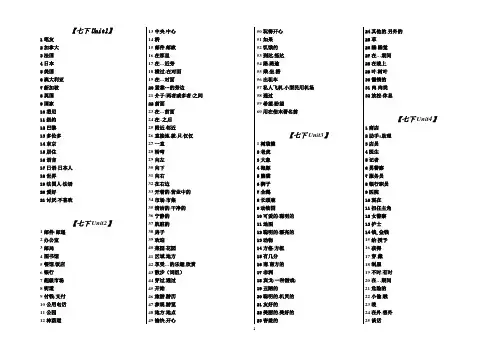
【七下Unit1】1笔友2加拿大3法国4日本5美国6澳大利亚7新加坡8英国9国家10悉尼11纽约12巴黎13多伦多14东京15居住16语言17日语,日本人18世界19法国人,法语20爱好21讨厌,不喜欢【七下Unit2】1邮件;邮递2办公室3邮局4图书馆5餐馆,饭店6银行7超级市场8街道9付钱;支付10公用电话11公园12林荫道13中央,中心14桥15邮件,邮政16在那里17在…近旁18横过;在对面19在…对面20紧靠…的旁边21介于(两者或多者)之间22前面23在…前面24在..之后25附近,邻近26直接地,就,只,仅仅27一直28转弯29向左30向下31向右32在右边33开着的,营业中的34市场,市集35清洁的,干净的36宁静的37肮脏的38房子39欢迎40菜园,花园41区域,地方42享受…的乐趣,欣赏43散步(词组)44穿过,通过45开始46旅游,游历47参观,游览48地方,地点49愉快,开心50玩得开心51如果52饥饿的53到达,抵达54路,路途55乘,坐,搭56出租车57私人飞机,小型民用机场58通过59希望,盼望60用在信末署名前【七下Unit3】1树袋熊2老虎3大象4海豚5熊猫6狮子7企鹅8长颈鹿9动物园10可爱的,聪明的11地图12聪明的,漂亮的13动物14方格,方框15有几分16南,南方的17非洲18宾戈(一种游戏)19丑陋的20聪明的,机灵的21友好的22美丽的,美好的23害羞的24其他的,另外的25草26睡,睡觉27在…期间28在晚上29叶,树叶30懒惰的31肉,肉类32放松,休息【七下Unit4】1商店2助手;助理3店员4医生5记者6男警察7服务员8银行职员9医院10现在11担任主角12女警察13护士14钱,金钱15给,授予16获得17穿,戴18制服19不时,有时20在…期间21危险的22小偷,贼23晚24在外,想外25谈话26车站;局27电视台28警方,警察29警察局30报纸31辛苦地;努力地32作为33按照,根据34夏季,夏天35故事36杂志,期刊37年轻的38戏剧,剧本39新闻,消息40孩子(复数)41国际的42教,讲授43技能;技巧44先生,阁下45女士,夫人【七下Unit5】1打扫2读,阅读3通过,以..方式4公寓5电视节目6当然7等待(词组)8玩具9西方10活动11买东西12购物商场13水池14照相机15鸟【七下Unit6】1下雨2有风的3多云的4阳光充足的5下雪6天气;气候7烹调;煮8学习9 how’s=10坏的;劣质的11很糟的;可怕的12相当;很13热的14寒冷的15凉爽的16温暖的17潮湿的18假期19在度假中20拍照21平卧;躺22海滩23朝…看24团体;组25(口)令人满意的26感到惊讶的27热;热度28放松的29冬季30围巾31每个人32玩得高兴33男人;人;人类【七下Review of units 1-6】1描述,形容2寻找,寻求3谈论,讨论4方向5单元6最(many和much的最高级)7下列的8为了9改进,改善【七下Unit7】1头发2卷曲的3直的,笔直的4高的5中等的6高度7瘦的8重的9体格,体形10像,如同11总是,始终12队长,首领13队,组14受欢迎的15金黄色的16漂亮的17一点儿(词组)18笑话,玩笑19决不,从不20停止21棕色的22人,人物23胡须24眼镜25外表,外貌26牢记,记住27流行歌曲28歌唱家,歌手29说,讲30没有人,没人【七下Unit8】1will的过去式2I’d=3面条(常用复数)4牛肉5羊肉6洋白菜7土豆,马铃薯8特色菜9饮料10大的,宽广11大小,尺寸12碗13 he’d=14果汁15饺子16粥17茶,茶叶18绿茶19米,稻,米饭20汤,羹21洋葱22鱼,鱼肉23电话(缩写)24人民币25星期一(缩写)26星期二(缩写)27星期三(缩写)28星期四(缩写)29星期五(缩写)30原因,理由31菜单【七下Unit9】1 is过去式2 do过去式3go的过去式4 拜访,访问5考试,测验6…怎么样?7停留,留下8在家9做,进行,从事10读,阅读11练习,实践12正常的,有规律的13动词14不规则的,无规律的15现在时态,现在的16过去时态的,以前的17山,山脉18地理学19度过,过20星期,周21编号,号22中等的23中学24大多数的,大部分的25购物26 have的过去式27 see的过去式28访谈节目(词组)29 write 的过去式30歌曲,歌31去散步32 sit 的过去式33向下,在下面,降下34猫35该是…的时候了36 wasn’t=37没有的,极少的38任何事,无论何事39建议,意见【七下Unit10】1纽约市2野营,营地3夏令营4博物馆5向导6中心的7didn’t=8考试,检查9真的,是吗10下雨的11 are的过去式12极好的13不友善的14极坏的15美味的16昂贵的17拥挤的18廉价的,便宜的19思考20水21哭泣22角落23使24 make的过去式25感到26步行27回原处28决定29墙壁30万里长城31宫殿32故宫33广场34天安门广场35胡同36做,制作37同班同学38讨论,议论39报告,汇报40性别【七下Unit11】1肥皂2肥皂剧3情景喜剧4情景,形势5没什么6忍受7介意8国王9…怎么样?10事实11实际上12文化13主持人14同意15赞同16太阳镜17皮带18钱包19钥匙链20由,被21时尚22 say过去式23文章24放25主意26色彩鲜艳的【七下Unit12】1规则2走廊3教室4打架5女士6外面的7进餐8大厅,礼堂9不得不10其他的11运动鞋12体育馆13医生14到(某时)之前,不迟于15洗涤,洗16后来17少年宫18不许讲话19大声地【七下Review of units 6-12】1配件,饰品2雪3预定,点(菜)4意见,看法【Additional material】1定单,定货2.表格。
英语七年级下册Unit10 GF(新人教版)
She/He would like…
She’d like… He’d like… What would they like? They would like… They’d like…
常用的量词shoestrousers一双鞋子一条裤子bread一片面包water一杯玻璃杯水water一杯咖啡杯水people一群人milk一包牛奶juice一瓶果汁coke一罐可乐twopairs其他的以此类推
Unit 10
I’d like some noodles.
Sectns
potatoes
Uncountable nouns
beef mutton
tomatoes
onions
chicken
rice
strawberries
apples
porridge
orange juice
eggs
oranges
green tea
用 a, an或 some填空。
四、可数名词前通常可用具体的数词来修饰。如:three women ten babies 不可数名词表示数量的多少时,必须与表示数量的名词连用,即"数词+表示数量的 名词(可数名词)+of+不可数名词"。如: two glasses of milk 两杯牛奶 five pieces of bread 五片面包 五、可数名词作主语时,谓语动词的单、复数与主语的单、复数须保持一致。不可 数名词作主语时,谓语动词只能用单数形式。如: There is some rice in the bowl.碗里有些米饭。 All the students are in the classroom.所有的学生都在教室里。 [友情提醒]如果不可数名词前有复数名词短语修饰时,谓语动词须用复数形式。如: There are two bags of rice in the room. 房间里有两袋大米。 六、对可数名词的数量提问用how many; 对不可数名词的数量提问要用how much,但对不可数名词前表示数量名词中的修饰语提问时要用how many。如: I can see two pictures on the wall. → How many pictures can you see on the wall? There is a lot of pork in the basket. → How much pork is there in the basket? I want three glasses of water. → How many glasses of water do you want? 七、另外,有些集合名词也是可数名词,但不同的是,它们以单数形式出现,表示 复数概念,如people,police,family等;而有些可数名词 本身就以复数形式出现,如 clothes,glasses(眼镜)等;有的可数名词单、复数形式相同,如Japanese,sheep, Chinese等。如: The Chinese people are hardworking and brave.中国人民勤劳勇敢。 The sports clothes are new. 这些运动服是新的。 I have one sheep. He has two sheep. 我有一只羊,他有三只羊
人教版七年级英语下册Unit 10 教材听力原文及译文

UNIT 10 Section A1b Listen and check (√)the noodles that the person orders.Waitress: What would you like?Boy: I’m not sure yet. Are there any vegetables in the beef noodles?Waitress: Yes, there are some tomatoes.Boy: OK, I’d like the beef nood les, please.2a Listen and check (√)the names of the foods you hear.Waiter: What size would you like?Boy: I’d like a large bowl of noodles.Waiter: And what kind of noodles would you like? Boy: I’d like chicken, potato and cabbage noodles. Waiter: And how about you?Girl: I’d like a medium bowl.Waiter: What kind would you like?Girl: I’d like beef and tomato noodles, please.2b Listen again. Complete the sentences. Waiter: What size would you like?Boy: I’d like a large bowl of noodles.Waiter: And what kind of noodles would you like? Boy: I’d like chicken, potato and cabbage noodles. Waiter: And how about you?Girl: I’d like a medium bowl.Waiter: What kind would you like?Girl: I’d like beef and tomato noodles, please.Section B1c Listen and complete the food order form. A: Hello, House of Dumplings!B: Hello! I want to order some food, please.A: Sure.B: I’d like chicken, fish and cabbage, please.A: Uh-huh.B: And twelve dumplings.A: What kind of dumplings would you like?B: Beef and carrot dumplings, please.A: OK. What else? 听录音,在这个人点的面条前打“√”。
Unit10_语法专项课件(可数名词和不可数名词)

考点大观
易错辨析
通关训练
不可数名词的特点
3) 不能用不定冠词a/an或数词直接修饰。若要表示数量,
则需要借助一定的单位词来表示。
借助表示“张”“片”的单位 a piece of paper 一张纸 词piece 借助表示容量的词 借助表示重量的词 借助表示形状的词 a piece of bread 一片面包
构成方法 词尾加-s 词尾加-es
以“辅音字母+y”结
尾的名词
把y改为i,再加-es 把f或fe变为v,再 加-es 有生命的加-es, 无生命的加-s
以f或fe结尾的名词
life—lives , wife—wives
zoo—zoos , radio—radios tomato—tomatoes, hero—heroes
是第二个名词) 由man和woman构成的复合名 词,二者均变为复数形式
pencil box—pencil boxes
man doctor—men doctors woman teacher—women teachers
考点大观
易错辨析
通关训练
可数名词的特点
1)可数名词有单、复数之分。
例:a bird 一只鸟;many birds 很多只鸟
解析
考查可数名词和不可数名词。根据句中的“they’re”
可知,应选复数名词,而chicken, beef, fish都是不可
数名词。故选D。
考点大观
易错辨析
通关训练
【典例3】 There are a lot of _____ in our school. They work very hard. A. woman teachers B. women teachers
人教版初中英语七年级下册精品教案unit10
Unit 10 I’d like some noodles.Period 1 section A 1a-1cTeaching Aims and Demands1. Knowledge objects(1) Key words: noodles, beef, mutton, chicken, cabbage, potatoes, tomatoes.(2)Target Language: What kind of noodles would you like?I’d like beef and tomato noodles, please.(3)Listening practice and speaking practice(4)To learn the countable and uncountable nouns.2. Ability objectsTo train students’ abil ity of listening and speaking.Teaching Focuses1. To learn the names of food and the countable and uncountable nouns;2. To learn how to order food;3. To make pair work.Teaching ProceduresStep 1 PresentationShow a picture and let the students answer the questions below:1) Can you see three bowls? 2) What are in them? 3) Do you like noodles?4)Can you find the differences among the three bowls of noodles?5)Show the sign ___Special 1, Special 2, Special 3 to understand their meanings. Step 2. Presentation1. Teach the new words of food used in noodles.2. Look at the numbered list of ingredients. Read and repeat.3. Ask students to match each word with the foods in 1a.Step 3. Grammar1. Present the countable and uncountable nouns.2. List many words, and let the students discuss in groups and tell us what kinds of nouns these words are.Step 4. PresentationPresent the target language as following:A: What kind of noodles would you like?B: I’d like beef and tomato noodles, plea se.Step 5. Practice the drill1、Read the conversation above.2、Ask students to work in pairs. One person is the waiter, the other one is the customer. Then let them perform the conversation in front of the classroom.Step 6. Listening1、Show three bowls of noodles in picture. Ask: What ingredients are in these noodles?2、Play the recording the first time .Students only listen.3、Play the recording a second time and correct the answers.Step 7. Homework1. Review the knowledge learned in this period.2. Copy the new words.Period 2 section A 2a-2d. Teaching Aims and Demands1.Knowledge objectsa) To review how to order food;b) Key structures: A: What size bowl of noodles would you like?B: I’d like a large / medium / small bowl of noodles.c) Listening and speaking practice2. Ability objectsTo train students’ ability of listening and communication.Teaching Focuses1. To review how to order food;2. To learn the key structures in this period;3. To do listening practice.Teaching ProceduresStep 1. RevisionReview the new words and conversations learned in last period.Step 2. PresentationPresent the target language as following:A: What size bowl of noodles would you like?B: I’d like a large / medium / small bowl of noodles.Step 3. Role playLet the students perform the conversation as following, imagining they are in a restaurant (Each student can be both the waiter and the customer):A: What kind of noodles would you like?B: I’d like beef and tomato noodles, please.A: What size bowl of noodles would you like?B: I’d like a large / medium / small bowl of noodles.Step 4. Listening1、Listen and check the names of the foods they hear in 2a.2、Listen and fill in the blanks in 2b.Play the recording a second time.Step 5. Pair work1. Ask and answer questions with your partner. Use the information in 2a.2. Show the conversations of 2a on the big screen to the Ss.3. Make a model for the Ss.T: What kind of noodles would you like?S1: I'd like beef noodles, please.…3. Ss work in pairs and practice the conversations.Step 6. Role-play1. Ask Ss to read the conversation in 2d and find the answer to this question:What would they like?(They would like one large bowl of beef soup, one gongbao chicken, and one mapo tofu with rice.)2. Check the answers with the Ss.3. Ss work with their partners and role-play the conversation.Step 7 . Exercises.Step 8 Homework1. Review the words and expressions in this period.2. Role-play the conversation in 2d.3. Write a short conversation to order some noodles you like in a restaurant.Period 3 Section A (Grammar Focus-3c)一、教学目标:1. 语言知识目标:1) 继续练习运用如何订餐或叫外卖等的用语。
人教七下Unit10_语法专项课件(可数名词和不可数名词)
如:a book; two boys
可数名词变复数 2.1 规则变化
类别
构成方法
一般情况
词尾加-s
以s, x, ch, sh等结尾的 词尾加-es
名词
以“辅音字母+y”结 把y改为i,再加-es
尾的名词
以f或fe结尾的名词 以o结尾的名词
把f或fe变为v,再 加-es 有生命的加-es, 无生命的加-s
埃及人 an Egyptian—Egyptians 德国人 a German—Germans
口诀记忆 中日不变英法变,其余s加后面。
可数名词变复数 2.3 复合名词的复数形式
构成方法 一般的复合名词,只用把中心 词变为复数形式(中心词一般
是第二个名词) 由man和woman构成的复合名
词,二者均变为复数形式
much, little, a little只能修饰不可数名词。
易错点3 不可数名词的“量”
不可数名词没有复数形式,表示量的时候需要借助于“数词/ 冠词+量词+of+不可数名词”的结构来表示。 注意:1)量词可以是单数也可以是复数。
2)量词如果是复数形式,谓语动词则用复数。 例: There are two glasses of milk on the table. 桌子上有两杯牛奶。
可数名词变复数 2.2 不规则变化
① 改变名词中的元音字母或其他形式 foot — feet, tooth — teeth, goose — geese
man — men, woman — women, child — children, mouse — mice
②单复数同形词 deer, sheep, fish等 由汉语音译表示度量、币值等单位量词,如:five yuan
七年级下册Unit 10英语短语汇总
七年级下册Unit 10英语短语汇总七年级下册Unit10英语短语汇总Unit10wheredidyougoonvacation?1Newyorkcity纽约城2visitsb./myuncle拜访某人/我的叔叔3gotosummercamp去夏令营gotochurch去教堂gotothemountain/thebeach去爬山/去沙滩4visitthemuseums参观博物馆5belost/missing丢失6walkbackto返回走7studyforEnglishexams为英语考试而学习8becrowded拥挤9allday整天alldayraining整天下雨10decidetodo决定做某事decideonsth.决定某事11inthecorner在拐角12helpsbdosth=helpsbwithsth.帮助某人做某事withthehelpofsb在某人的帮助之下13makesb/sth+adj使sb/sth….makesbdosth使某人做某事14havedinneratone’shome在某人家里享用晚餐15TheGreatwallTian’anmenSquare天安门广场16SummerPalace故宫17centralPark中央公园Unit11whatdoyouthinkofgameshows?1thinkof想起,考虑thinkabout考虑thinkover仔细思考2soupopera肥皂剧4hairclip发夹4keyring钥匙圈5makealist列一张表onthelisting在那张表上6minddoingsth介意做某事keepsthinmind牢牢记住7agreeonsth同意某事agreewithsb同意某人长城agreetodo同意做某事8infashion时尚fashionshow时装秀gameshows娱乐节目talkshow脱口秀sportsshow运动节目EnglishToday今日英语Healthyliving健康生活LawsToday今日说法culturechina中国文化chinesecooking中国厨艺Animalworld动物世界weekendTalk周末访谈cartoonworld卡通世界F4SearchF4大搜索Happyonehundred开心100Happycamp快乐大本营SkyEnglish空中英语9inone’sopinion根据某人的意见10goodidea好主意havesomeideasofdoingsth有某事的主意havenoideas没有主意,不知道11athirteen-year-oldgirl 一个14岁的女孩12welcometo欢迎参加…13schoolmagazine学校杂志14asksbsth询问某人某事asksbtodosth叫某人做某事asksbforsth向某人要某物Unit12Don’teatinclass.1inclass在课上2goldmedal金牌3Notalking禁止讲话4belateforclass/school上课/学迟到5runinthehallway在走廊跑步6eatintheclassroom/cafeteria在教室/食堂吃东西7listentomusicinthemusicroom在音乐室听音乐8fightwithsb与sb打架9quarrelwithsb与sth吵架10wearschooluniform穿校服11cleantheroom打扫房间12breaktherule违反/遵守规则13gooutonschoolnight在上课的晚上出去14gooutwithsbafterclass与某人下课后一起出去15makethebed铺床16meetone’sfriends遇到某人的朋友17takesboutforawalk带某人出去散步18washone’sclothes=dothelaundry洗衣服19beinbed=gotobed=gotosleep上床睡觉20children’sPalace少年宫21Don’ttalkloudly.不要大声说话22Nowetumbrellas.=Don’ttakewetumbrellas.不要把湿雨伞带进来23Don’tletthelightson.不要让灯开着24readwhileeating边吃边看书25wastewater浪费水26showsbsth=showsthtosb向某人展现某物27begoodat=dowellin擅长做某事。
人教版七年级英语下册Unit10I’dlikesomenoodles单元复习
词
些土豆。
would like to do 想要做某事,后跟 I would like to have lunch with you.
sth.
to do
我想要和你一起吃午餐。
would like sb.to 想要某人做某事 I would like you to come to my home.
do sth.
目录 contents
重点短语
重点短语
Work seriously
二、重点短语 would like(表示意愿)愿意;喜欢; take one’s order点菜; one bowl of 一碗…; around the world 世界各地; make a wish许愿; blow out吹灭;
words ☆☆
__ __/10
min
基础复现天天练 Work seriously
Do you know McDonald’s? Yes, it is a famous fast food 1 and it is very popular around the world ①.You can find one near your house even in every city. 2 people like the hamburgers and potato chips there.People know fast food is 3 , but they eat a lot because it is very convenient(方便的).You can eat in the restaurant or 4 the food.
我想要你来我家。
目录 contents
5 基础复现 天天练
人教版七年级下册英语全书单词默写版
33、n.生活;生命
17、adj.奇怪的;滑稽好笑的
人教版七年级下Unit3 How do you get to school?
1、num.七十
16、n.河;江
2、num.八十
17、adv.&.pron.许多
3、num,九十
18、n.村庄;村镇
4、num.一百
19、prep.介于……之间
17、adj.寒冷的;冷的
35、n.雪人
18、adj.热的
36、adj.阴雨的;多雨的
人教版七年级下Unit8 Is there a post office near here?
1、n.邮政
18、v.转向;翻
2、n.办公室
19、adv.向右边n.右边
3、n.警察
20、adv.向左边n.左边
4、n.旅馆;酒店
21、n.十字路口
5、n.餐馆
22、n.街区;街坊
6、n.银行
23、v.花(时间、钱等)
7、n.医院
24、n.猴子
8、n.大街
25、v.爬
9、v.&n.付费
26、n.路
10、prep.在…附近
27、adv.时常;常常
11、adv.&.prep.过;穿过
28、n.空气
12、n.前面
29、n.阳光
13、prep.在……的后面
14、n.(可食用的)肉
30、adj.幸运的
15、n.饺子
31、adj.受欢迎的;普遍的
16、n.粥;面糊
32、n.想法;主意
人教版七年级下Unit11 How was your school trip?
1、v.挤奶