
一般现在时、现在进行时、一般将来时、一般过去时专项练习
1 一般现在时、现在进行时、一般将来时、一般过去时专项练习
一 单项选择题
1. _____ he _____ to the park at 6:30 in the morning? No, he ____.
A. Does; goes; does B. Does; go; doesn’t C. Does; go; does
2. What colour _____ you _____ this bookcase? I _____ it pink.
A. are; going to paint; am going to paint B. do; paint; paint C. did; paint; painted
3. Tim always _____ a picture at home. He _____ a car now. A. draws; is drawing B. draw; draw C. draws; draw
4. She usually _____ her friends. They often _____ tea. A. see; drink B. sees; drinks C. sees; drink
5. He usually _____ the dishes at night, but tonight he _____ clothes.
A. wash; wash B. washes; is going to wash C. is washing; washes
6. Mr. Green usually _____ his newspaper in the evening, but he and his wife _____ television yesterday evening.
A. reads; watches B. reads; is going to watch C. reads; watched
7. Where are the man and the woman? They _____ near the tree. A. sit B. sat C. are sitting
8. _____ your pen pal _____ diving? No, he _____ .He ______ writing stories.
A. Does; like; doesn’t; likes B. Does; likes; doesn’t; like C. Do; like; don’t; likes
9. _____ you _____ fishing yesterday? No, we _____ .A. Does; go; doesn’t B. Did; go; didn’t C. Do; go; don’t
10. Open the window, please. Look! He _____ it A. opens B. is openning C. is opening
11. I usually _____ some milk every day. But I _____ coffee yesterday.
A. drink; drank B. is drinking; drink C. drank; am drinking
12. Mr. Green often _____ his newspapers at night. But he _____ an interesting book tonight.
A. reads; reads B. reads; read C. reads; is going to read
13. The old man _____ playing sports in the park. He _____ morning exercise now.
A. likes; is doing B. likes; does C. like; doing
14. What _____ you usually _____ in the evening? I ______ computer games.
What _____ you _____ last night? I _____ a book.
A. do; do; play B. did; do; played C. does; do; plays
did; do; read do; do; read do; do; am reading
15. Where ______ the boy _____? He _____ across the river now.
A. does; swim; swims B. is; swimming; is swimming C. is; swimming; is swimming
16. _____ you _____ to music now? Yes, we _____. A. Do; listen; do B. Did; listen; did C. Are; listening; are
17. Put on you coat, please. OK. I ______ it on. A. am putting B. am going to put C. put
18. _____ you ______ coffee? Yes, I ______. A. Do; like; do B. Did; like; did C. Are; like; am
19. Look! Two cats ______ across the wall. A. run B. runs C. are running
20. She _____ tea, but he _____. A. likes; doesn’t B; like; don’t C. like; doesn’t
21. If it ________ tomorrow, we’ll go roller-skating. A. isn’t rain B. won’t rain C. doesn’t rain D. doesn’t fine
22. Jenny ____ in an office. Her parents ____in a hospital
A work; works B works; work C work; are working D is working; work
23. ----I don’t know if his uncle _____. ---- I think he _____ if it doesn’t rain.
A will come; comes B will come; will come C comes; comes D comes; will come
24. There _____ a meeting tomorrow afternoon. A. will be going to B. will going to be C. is going to be
二 用动词的正确形式填空
1. He often (have) dinner at home. 2. It is very cold these days. It (snow)soon.
3.Tom and Mary (come) to China last month.
2 4 Mike (not go) to bed until 12 o’clock last night. So I (get) up late.
5. We (not watch) TV last Monday. 6 Mary (read) English yesterday morning.
7. ---- I
(get)you a copy of today’s newspaper? ----Thank you.
8. The girl (teach) us English on Sundays. 9. I can take Li Ming there when he (come) to visit.
10. There (be) some water in the bottle. 11 What time you (get) to Beijing yesterday?
12.What (make) him cry (哭) just now?
13. Last year the teacher (tell) us that the earth (move) around the sun.
14. I (be) ill. I’m staying in bed. 15. I (have) an exciting party last weekend.
16. He (get) up at six o’clock everyday. 17. We (get) to Beijing at 9:00 this evening.
18. There enough milk at home last week, wasn’t there? 19. They (be) on the farm a moment ago.
20. How many lessons your classmate usually (have) on Monday?
21. Jenny (not go) to bed until 11:00 o'clock last night .22. There (be) a telephone call for you just now.
23. Jack (not clean) the room just now.
24. ---- you (be)here tomorrow?----No. I (visit)my teacher.
25. Mike sometimes (go) to the park with his sister. 26. Most of us don’t think their team (win).
一般现在时、一般过去时、现在进行时、一般将来时语法讲练
一般现在时、一般过去时、现在进行时、一般将来时语法讲练
1 / 12
__________________________________________________________________________________
__________________________________________________________________________________
熟练掌握四种时态
一般现在时态
一般现在时: 表示现阶段经常或习惯性发生的动作或存在的状态,或说明主语的特征。
1)常用时间状语:often 经常,usually通常,always 总是,every每个,sometimes 有时,at …在几点钟, once / twice a week 一周一次/两次
They go to the Palace Museum once a year. 他们每年去一次故宫。
They often discuss business in the evening . 他们经常在晚上谈生意。
2)表示客观真理,事实,人得技能或存在的状态。 如:
The earth goes around the sun. 地球绕着太阳转。
3)表示十分确定会发生(或安排好的事情)或按照时间表进行的事情,用一般现在表示将来,句子中可以有表示将来的时间状语。如:
The train for Hankou leaves at 8:00 in the morning.
去往汉口的列车上午8点开。
现在进行时 . 一般现在时、一般过去时、现在进行时、一般将来时语法讲练
2 / 12 现在进行时的定义:现在进行时表示现在或当前一般时间正在进行的动作.可以表示有计划的未来.
现在进行时的基本用法:
A. 表示现在( 指说话人说话时) 正在发生的事情.
例:We are waiting for you.
(完整版)六年级英语时态专项练习题
小学六年级英语时态练习题(一般现在时、现在进行时、一般将来时、一般过去时)
Ⅰ 用适当形式填空.
1. He __________ back a month ago. (come)
2. My mother often tells me __________ in bed. (not read)
3. I must take it back the day after tomorrow. You can only __________ it for 24 hours. (keep)
4. Why have you kept me __________ here for so long a time? (wait)
5. Please come to our meeting if you __________ free tomorrow. (be)
6. She __________ to the Great Wall several times. (go)
7. In his letter, he said that he __________ us very much. (miss)
8. The film __________ for nearly fifteen minutes when I got to the cinema. (be)
9. He said he became __________ in physics. (interest)
10. This film is worth __________. (see)
11. He went to school instead of __________ home. (go)
12. In the old days it was difficult for the poor to __________ a job. ( find)
现在进行时-一般将来时-一般现在时-一般过去式-现在完成时的综合练习
现在进行时-一般将来时-一般现在时-一般过去式-现在完成时的综合练习1(总2页)
--本页仅作为文档封面,使用时请直接删除即可--
--内页可以根据需求调整合适字体及大小-- 时态专项
五种时态的构成:
一. 现在进行时
1. 现在进行时构成:_____________________________________________________________
2. 与此时态常用词:______________________________________________________________
二. 一般将来时
1. 一般将来时时构成:____________________________________________________________
2. 与此时态常用词:______________________________________________________________
三. 一般现在时
1. 一般现在时构成:______________________________________________________________
2. 与此时态常用词:______________________________________________________________
四. 一般过去时
1. 一般过去时时构成:____________________________________________________________
2. 与此时态常用词:______________________________________________________________
五. 现在完成时
1. 现在完成时构成:______________________________________________________________
(牛津版初中时态语态练习)一般现在时一般过去时一般将来时现在进行时混合练习2(附答案)
一般现在时 一般过去时 一般将来时 现在进行时 混合练习- 2
一、根据要求改写下列句子。一、根据要求改写下列句子。
1. This is my pencil. (变为一般疑问句)
Is this your pencil?
2. She is going on a trip to Beijing now. (用I做主语改写句子)
I am going on a trip to Beijing now.
3. He found some meat in the fridge. (改为一般疑问句)
Did he find any meat in the fridge?
4. It is going to be a fine day tomorrow. (改为否定句)
It isn’tgoing to be a fine day tomorrow.
5. I stay at home on Saturdays. (对划线部分提问)
What do you do on Saturdays?
6. That bird is red. (对划线部分提问)
What color is that bird?
7. They are having lunch at school at the moment. (对划线部分提问)
What are they doing at school at the moment?
8. Lucy doesn't have sports every day. (变为肯定句)
Lucy has sports every day.
9. She stayed there for a week. (对划线部分提问)
How long did she stay there?
10. He came back just now. (用in two days改写句子)
He will come back in two days.
一般过去时,一般将来时,现在进行时,一般现在时大题量复习题
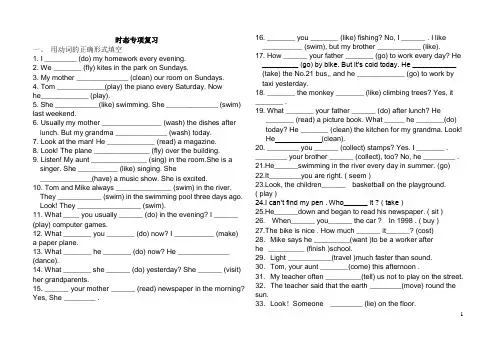
1 时态专项复习
一、 用动词的正确形式填空
1. I ________ (do) my homework every evening.
2. We _______ (fly) kites in the park on Sundays.
3. My mother _____________ (clean) our room on Sundays.
4. Tom ____________(play) the piano every Saturday. Now
he____________ (play).
5. She ___________(like) swimming. She _____________ (swim)
last weekend.
6. Usually my mother _______________ (wash) the dishes after
lunch. But my grandma _____________ (wash) today.
7. Look at the man! He ____________ (read) a magazine.
8. Look! The plane ______________ (fly) over the building.
9. Listen! My aunt ______________ (sing) in the room.She is a
singer. She __________ (like) singing. She
_____________(have) a music show. She is excited.
10. Tom and Mike always ______________ (swim) in the river.
They ___________ (swim) in the swimming pool three days ago.
一般现在时一般过去时一般将来时现在进行时混合练习2附答案
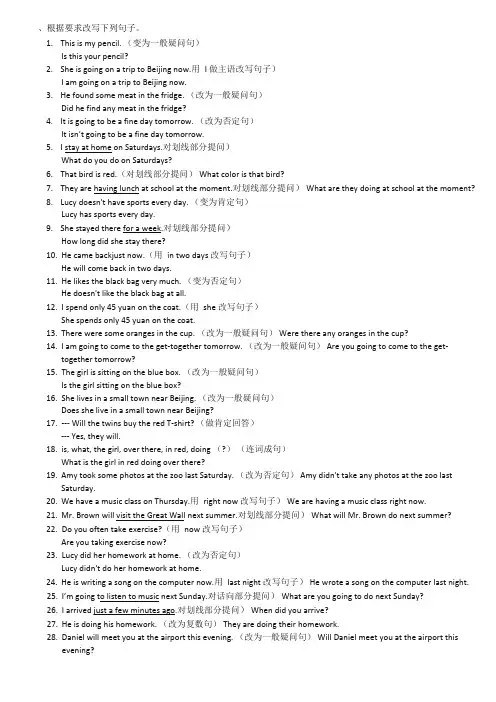
、根据要求改写下列句子。
1. This is my pencil. (变为一般疑问句)
Is this your pencil?
2. She is going on a trip to Beijing now.用 I 做主语改写句子)
I am going on a trip to Beijing now.
3. He found some meat in the fridge. (改为一般疑问句)
Did he find any meat in the fridge?
4. It is going to be a fine day tomorrow. (改为否定句)
It isn’t going to be a fine day tomorrow.
5. I stay at home on Saturdays.对划线部分提问)
What do you do on Saturdays?
6. That bird is red.(对划线部分提问) What color is that bird?
7. They are having lunch at school at the moment.对划线部分提问) What are they doing at school at the moment?
8. Lucy doesn't have sports every day. (变为肯定句)
Lucy has sports every day.
9. She stayed there for a week.对划线部分提问)
How long did she stay there?
10. He came backjust now.(用 in two days 改写句子)
He will come back in two days.
11. He likes the black bag very much. (变为否定句)
人教版小升初英语一般现在时一般过去时现在进行时综合练习题40题【答案解析】
人教版小升初英语一般现在时一般过去时现在进行时综合练习题40题【答案解析】
1. I _____ to school by bus every day.
A.go
B.goes
C.going
D.went
答案解析:A。I 是第一人称单数,在一般现在时中,动词用原形 go。goes
是第三人称单数形式,going 是现在分词,went 是过去式,都不符合题意。
2. My mother often _____ breakfast for us.
A.cook
B.cooks
C.cooking
D.cooked
答案解析:B。my mother 是第三人称单数,在一般现在时中,动词要用第三人称单数形式 cooks。cook 是原形,cooking 是现在分词,cooked 是过去式,都不正确。
3. We _____ English classes on Monday.
A.have
B.has
C.having
D.had
答案解析:A。we 是第一人称复数,在一般现在时中,动词用原形 have。has 是第三人称单数形式,having 是现在分词,had 是过去式,都不合适。
4. Tom _____ football after school.
A.play
B.plays
C.playing
D.played
答案解析:B。Tom 是第三人称单数,在一般现在时中,动词要用第三人称单数形式 plays。play 是原形,playing 是现在分词,played 是过去式,都不符合。
5. My sister _____ books in her free time.
A.read
B.reads
C.reading
D.readed
答案解析:B。my sister 是第三人称单数,在一般现在时中,动词要用第三人称单数形式 reads。read 是原形,reading 是现在分词,read 的过去式和原形一样是 read,不是 readed。
(初中时态语态练习)一般现在时-一般过去时-一般将来时-现在进行时-混合练习2(附答案)
(初中时态语态练习)⼀般现在时-⼀般过去时-⼀般将来
时-现在进⾏时-混合练习2(附答案)
⼀、
根据要求改写下列句⼦。1. Thisismypencil.(变为⼀般疑问句)
2. SheisgoingonatriptoBeijingnow.(⽤I 做主
语改写句⼦)3. Hefoundsomemeatinthefridge.(改为⼀般疑
问句)4. Itisgoingtobeafinedaytomorrow.(改为否定
句)5. IstayathomeonSaturdays.(对划线部分提问)
6. Thatbirdisred.(对划线部分提问)
7.
8. 9. 10. 11. 12. 13. 14. 15. 16. 17. 18. is,what,thegirl,overthere,inred,doing(?
)(连词成句)
19. AmytooksomephotosatthezoolastSaturday.(
改为否定句)20. WehaveamusicclassonThursday.(⽤
rightnow 改写句⼦)
21. Mr.BrownwillvisittheGreatWallnextsummer
.(对划线部分提问)
22. Doyouoftentakeexercise?(⽤now 改写句⼦) 23. Lucydidherhomeworkathome.(改为否定句) 24.Heiswritingasongonthecomputernow.(⽤
lastnight 改写句⼦)
对
)
)
为同义
⽤
对划线
对划线3.---I________theminhalfanhour.
A.washed
B.havewashed
C.willwas h
D.wash
4.Some________intheriverandsome________onthebeachnow.
A.areswimming;arechatting
B.isswimming;ischatting
小升初英语一般将来时、现在进行时与一般现在时混合练习题20题(带答案)
小升初英语一般将来时、现在进行时与一般现在时混合练习题20题(带答案)
1. My mother ______ some cakes for us this afternoon.
A. makes
B. is making
C. will make
答案解析:C。一般将来时表示将来某个时间要发生的动作或存在的状态。句中有this afternoon( 今天下午)这个表示将来的时间状语,所以要用一般将来时,will make符合要求。选项A makes是一般现在时,通常表示经常或习惯性的动作,在这里不符合语境。选项B
is making是现在进行时,强调正在进行的动作,与this afternoon不搭配。
2. Look! The boys ______ football on the playground.
A. play
B. are playing
C. will play
答案解析:B。现在进行时表示正在进行的动作或存在的状态。句中的Look( 看)表明动作正在发生,所以要用现在进行时,are playing符合要求。选项A play是一般现在时,不能体现动作正在进行。选项C will play是一般将来时,与Look所表示的现在正在进行的语境不符。
3. He usually ______ to school by bike, but tomorrow he ______ a
bus.
A. goes; will take
B. go; takes
C. is going; is taking
答案解析:A。第一空,usually( 通常)是一般现在时的标志词,主语He是第三人称单数,所以动词用goes。第二空,tomorrow( 明天)是一般将来时的标志词,所以要用will take。选项B中go形式错误,takes也不符合tomorrow的语境。选项C中is going和is taking都是现在进行时表将来,但在这里一般将来时更合适。
六年级英语时态专项练习题
六年级英语时态专项练习题
小学六年级英语时态练习题(一般现在时、现在进行时、一般将来时、一般过去时)
Ⅰ 用适当形式填空.
1. He __________ back a month ago. (come)
2. My mother often tells me __________ in bed. (not read)
3. I must take it back the day after tomorrow. You can only __________ it for 24 hours. (keep)
4. Why have you kept me __________ here for so long a time? (wait)
5. Please come to our meeting if you __________ free tomorrow. (be)
6. She __________ to the Great Wall several times. (go)
7. In his letter, he said that he __________ us very much. (miss)
8. The film __________ for nearly fifteen minutes when I got to the cinema. (be)
9. He said he became __________ in physics. (interest)
10. This film is worth __________. (see)
11. He went to school instead of __________ home. (go)
12. In the old days it was difficult for
the poor to __________ a job. ( find)