
牛津小学英语六年级上册
六年级上册期末复习1 1 期末复习讲义1 时态1 一般过去时 1.一般过去时概念:一般过去时表示过去某个时间里发生的动作或状态。 2.一般过去时的时间状语(时态提示语、关键词) ______________________________________________________________
______________________________________________________________ 3.一般过去时关键点----- 动词的过去式 动词过去式的变化规律 (1)_______________________________________________________ (2)_______________________________________________________ (3)_______________________________________________________ (4)_______________________________________________________ 不规则变化 am/is__________are__________do/does_________have/has___________ sit___________give___________sing_______________drink____________ buy__________catch____________carry____________go______________ make_________take_____________ write___________get___________ draw_________see_____________come____________spend___________ meet_________ run_____________ fly__________ eat______________ say__________ read____________swim_________study____________ 4.一般过去时的三种句式 (1)称述句与否定句 含有be动词: was/were 构成 例如 I was there last week. 我上周在那里。 否定直接was+not=________ were +not=__________ 例如 I was not there last week. 我上周不在那里。 行为动词: 行为动词过去式构成 例如Jenny bought a skirt yesterday. 詹妮昨天买了一件短裙。 否定需要借助助动词过去式did 形成did+not=__________ 后面动词需要接动词__________ 例如Jenny didn’t buy a skirt yesterday. 詹妮昨天没有买短裙。 (2)一般疑问句 含有be动词: 将be动词过去式放置句首 Was/Were……? 例如 Were you there last week? 你上周在那里吗? 行为动词: 借助于助动词过去式did构成,将did 放置句首 Did……(句中原行为动词用动词_______)+V___……? 例如Did Jenny buy a skirt yesterday? 詹妮昨天买短裙了吗? (3)特殊疑问句 特殊疑问词+did+ V_______+……? 例如What did Jenny buy yesterday? 詹妮昨天买了什么? 六年级上册期末复习1 2
时态2 一般现在时 1. 一般现在时概念:表示通畅性、规律性、习惯性的状态或动作。不是描述具体的一次事件,而是有规律的事件,存在的动作或状态,也可以是永恒的真理。 2. 一般现在时的时间状语(时态提示词,关键词) ____________________________________________________________________________________________________________________________ 3. 句式 (1) 称述句及否定句 肯定时:主语+_____/______+…… 否定时:主语+_____/______+_____+…… 例如: I like drinking tea. 我喜欢喝茶。 I don’t like drinking tea. 我不喜欢喝茶。 注意点:当主语为第三人称单数时,动词用第三人称单数。 第三人称单数构成 _______________________________________ read _______ write_________ say_________ _______________________________________ teach_______ wash_________ do__________ go_________ _______________________________________ try_________ carry_________ study_________ (2) 一般疑问句 ______/______ +主语+______+…… 答句:Yes, …… ____/______. No, …… _______/________. 例如: Do you like drinking tea? 你喜欢喝茶吗? (3) 特殊疑问句 特殊疑问词+_____/_______+_______+…… 例如:What do you like? 你喜欢什么?
时态3 现在进行时 1. 现在进行时概念:表示现在或现在这一阶段正在进行的动作。 2. 时态提示语 ____________________________________________________________________________________________________________________________ 3. 现在进行时结构 (1) 肯定句及否定句 肯定句:主语+______+doing(______)+…… 否定句:主语+______+doing(______)+…… 例如:I am doing my homework. 我正在做我的家庭作业。 I am not doing my homework. 我没在做我的家庭作业。 (2)一般疑问句 _______ +主语 +doing+…… 六年级上册期末复习1 3
例如: Are you doing your homework? 你在做的家庭作业吗? (3)特殊疑问句 特殊疑问词+_______+主语+doing+…… 例如: What are you doing? 你在做什么? 4. 现在分词的构成 (1)__________________________ go_____________ work_____________ sing_____________ (2)__________________________ leave__________ make____________ write_____________ (3)__________________________ sit____________ run______________ swim_____________ shop_____________ stop_____________ 六年级上册期末复习1 4
时态复习作业 一 单选填空 ( ) 1. Does Peter like to watch TV?__________. A. Yes, he like B. No, he doesn’t C. Yes, he’d like D. No, he likes ( ) 2. _____ he ________ a good rest? No, he didn’t. A. Have, had B. Did, have C. Did, had D. Had, had ( ) 3. They _________ on a farm. A. working B. is work C. work D. is worked ( ) 4. When _________ Lee ________ school this morning? A. had, got to B. did, get to C. did, get D. did, got to ( ) 5.What are you______ for ? A.find B. look C. finding D. looking ( ) 6.He went into the room and _______ the door. A. lock B. locking C. locks D. locked ( ) 7. Who _____ over there now? A. singing B. are sing C. is singing D. sing ( ) 8. —_____ he ____ his lunch? — Yes, he did. A. Have ,had B. Had, has C. Did, have D. Did, had ( ) 9. Listen! The baby _____ in the next room. A. crying B. cried C. is crying D. cries ( ) 10. She doesn’t __________ her homework in the afternoon. A. doing B. to do C. does D. do
二 用所给动词的适当形式填空 1.Tom and Mary ___________ (come) to China last month. 2.Mike _________________(not go) to bed at 12 o’clock last night. So he _______ (get ) up late. 3.Mary __________ (read) English yesterday morning. 4.He (like)_________ to __________(go) to school. 5. Mr Zheng____________(read) a book now 6.________ your father ________ ( go ) to work every day last year? 7. Listen! Someone is_____________(come). 8. —What time _______ you _______ (get) to Beijing yesterday? —We __________ (get) to Beijing at 9:00 in the evening. 9.What __________ (make) him cry (哭) just now? 10. The doctors_____________ (get ) off the bus. 11. –When _______ you _________ (come) to China? - Last year. 12.Did she ________ (have) supper at home? 13.There ________ (be) a football match on TV yesterday evening, but I _________ (have) no time to watch it. 14.He ______(eat) some bread and _________ (drink) some milk this morning. 15. Last week I _______ (buy) a new bike.
小学六年级牛津上学期英语期末整理复习易考题
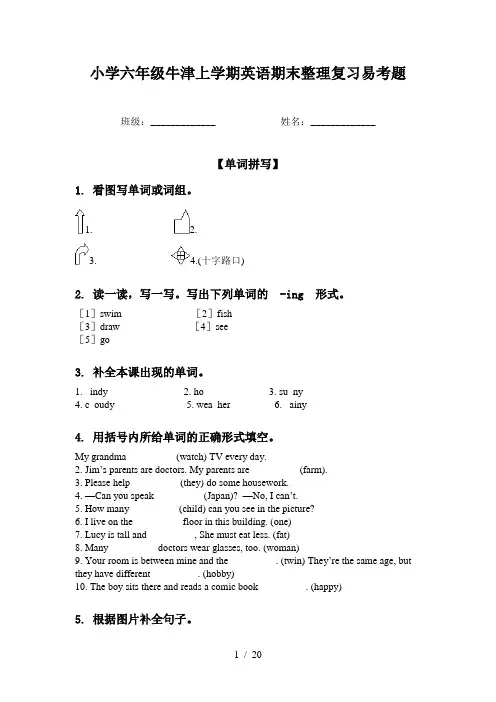
小学六年级牛津上学期英语期末整理复习易考题班级:_____________ 姓名:_____________【单词拼写】1. 看图写单词或词组。
1.________2._________3._________4.(十字路口)__________2. 读一读,写一写。
写出下列单词的-ing 形式。
[1]swim ________ [2]fish ________[3]draw ________ [4]see ________[5]go ________3. 补全本课出现的单词。
1. _indy2. ho_3. su_ny4. c_oudy5. wea_her6. _ainy4. 用括号内所给单词的正确形式填空。
My grandma _________ (watch) TV every day.2. Jim’s parents are doctors. My parents are _________ (farm).3. Please help _________ (they) do some housework.4. —Can you speak _________ (Japan)? —No, I can’t.5. How many _________ (child) can you see in the picture?6. I live on the _________ floor in this building. (one)7. Lucy is tall and _________, She must eat less. (fat)8. Many _________ doctors wear glasses, too. (woman)9. Your room is between mine and the _________. (twin) They’re the same age, but they have different _________. (hobby)10. The boy sits there and reads a comic book _________. (happy)5. 根据图片补全句子。
上海沪教牛津版小学六年级英语上册Unit3 习题及答案
上海沪教牛津版小学六年级英语上册:Unit 3Healthy or unhealthy习题及答案第1课时一、看图写出食物的英文名称。
1.2.3.4.二、选择适当的单词填空。
1.Itwo hamburgers this morning.2.You should some milk.3.Mary,you should some fruit.4.What did he for breakfast?三、单项选择。
()1.Tom can have a little meat,but not .A.too manyB.many tooC.too muchD.too ()2.What did you have lunch yesterday?A.onB.atC.inD.for ()3.I had egg andapple.A.a;anB.an;anC.an;aD.a;a ()4.Breakfast is very to us.A.importantB.easyC.hardD.unimportant四、根据所学知识,判断下列习惯是健康的(H)还是不健康的(U)。
()1.Tom doesn't have breakfast every day.()2.Linda likes to have hamburgers and cola.()3.Miss Li likes to eat fruit.()4.Mike drinks milk every morning.()5.Susan has much meat every day.第2课时一、将下列短语与其对应的汉语意思连线。
1.strong and healthy A.甜食2.sweet food B.胖且不健康3.ice cream C.冰激凌4.fat and unhealthy D.饮食习惯5.eating habit E.强壮且健康二、将下列各组单词连成完整的句子。
牛津上海版小学六年级英语(上)第三单元达标测试卷(一)含答案与解析
牛津上海版小学六年级(上)第三单元达标测试卷(一)英语Unit 3 Spending a day out together学校:___________姓名:___________班级:___________考号:___________ 一、单项选择(共10分)1.Don’t leave your child alone. He is not old enough to take care of ________.A.he B.him C.his D.himself 2.—I will take part in the art festival. I am a little bit nervous.—Believe in ________. You are the best in our club.A.himself B.myself C.yourself D.ourselves 3.—________ is this church?—More than 20. People built it in 1993.A.How old B.How wide C.How tall D.How long 4.—Like so many creative people, he was never ________.—That’s why he has made lots of valuable paintings.A.cheerful B.skillful C.satisfied D.surprised 5.This piece of music ________ very beautiful. It’s my favorite.A.smells B.looks C.tastes D.sounds 6.—The kitchen ________ terrible. What are you cooking?—Stinky toufu, a famous local food from Shaoxing.A.looks B.tastes C.smells D.feels 7.They walked for an hour, and ________ arrived at the small village.A.clearly B.quickly C.finally D.loudly 8.First, open the box. Next, take it out. ________, eat it.A.Three B.Second C.Final D.Finally 9.—Could you buy me a computer like this, Dad ?—Sure. We can buy________ one than this, but _______ this.A.a better, better than B.a worse, as nice asC.a more expensive, so nice as D.a cheaper, as nice as10.The problem was very difficult, but he worked it out ________ .A.last B.end C.final D.finally二、多句选词填空(共5分)(本题5分)cheer strawberry soon Australia nobody11.(1分)Students are happy to know they’ll have a school trip to the zoo _______.12.(1分)Betty went to the market and bought two kilos of _______. Those were her favourite fruit. 13.(1分)I got an email from my _______ friend last night. She told me a lot about her life in a new school in Sydney.14.(1分)This Friday, there is going to be a tennis match in my school. My friend and I _______ for the players.15.(1分)The girl hurt her leg and couldn’t move in the forest. She shouted for help but _______ came.三、用所给单词的正确形式填空(共6分)16.I can’t understand her _________(mean).17.When you are skimming(略读), there is no need for you to know the _________ (mean) of each word. 18.Everything ________(taste)very good. I like it very much.19.I bought nothing for _________(my).I didn’t really see anything I liked.20.I found it difficult to remember the ________ (mean) of some English words.21.The WeChat is ________ used in China. It has millions of users. (wide)四、句型转换(共7分)(本题7分)22.(1分)They decided to go to Australia for their holiday. (改为同义句)They decided ________ _________ _________ a holiday _________ Australia.23.(1分)It took me two hours to see the film. (改为同义句)I _______________two hours_______________ the film.24.(1分)Be quick, or you'll be late for school. (同义句转换)If you ___________quick, you ___________get to school on time.25.(1分)The cost of the book was____23yuan. (对划线部分提问)______________ _____________ the cost of the trip?26.(1分)The cost of the trip for each student is 50 yuan.(改为同义句)Each student____________50 yuan____________ the trip.27.(1分)I don't think the trip is wonderful. (改成反意疑问句)I don't think the trip is wonderful,_____________ _____________?28.(1分)support, forget ,to ,friends, us ,your ,to ,bring ,don’t (____)(连词成句)___________________________________________________________五、阅读单选(共10分)(本题10分) My father was born in a small town in the US. He traveled to many cities in the country, before going on to France, Australia and the Philippines. He took his wife and three daughters with him and went wherever the road took him.It’s easy to feel lonely when you’re on the road. As my mother said repeatedly, “We made lots of new friends on our trip—most of them were mechanics (机械工)”, since we often spent hours in repair shops. But that was better than sitting by the roadside when it was 40 ℃.Getting along sometimes seemed impossible. There were always a lot of arguments, especially among us back—seat passengers about who had to sit in the middle.But even if it was hard, we did learn a lot about forgiveness (原谅).When we were travelling in the Philippines, we drove to Quezon City one day. It should have been a one—hour drive but was nearly three, thanks to bad roads an d worse traffic. “Did you put our suitcases (行李箱) in the car?” my father asked my mother as we arrived. From the back seat, we saw her slowly turn toward my father. “No,” she said. “I thought you did.” That was how a seven—hour car trip turned into a 16—hour car trip, which was mostly spent in silence.In situations like that, we had to learn to let go of our anger because we were stuck in a moving box with the same people for the rest of the journey. Even if I sometimes felt like opening the car door and pushing one of my sisters out, I kept my feelings to myself.This is why road trips were like mobile universities to us. We got our PHDs (博士学位) in how to get along with other people just by travelling in that old car.And if we were somehow given a second chance at life, we would do it all over again. Only this time, I’d put the suitcases in the car myself.29.According to the first paragraph, the writer’s father ________.A.didn’t like his hometown B.enjoyed travelling a lotC.preferred travelling alone D.had never travelled abroad30.During the road trips, ________.A.hot weather made a lot of trouble for the familyB.the writer’s mother was very proud to make friendsC.the family often had to stop to get their car repairedD.they argued about who had to sit in the front31.When the family was travelling in the Philippines, ________.A.they were very surprised at the good traffic conditions on the wayB.the father and mother had a big fight with each otherC.they wasted more time on the road after they forgot to take their suitcasesD.the family had a wonderful time with each other on the road32.In the writer’s opinion, road trips ________.A.are very boring for big families B.are fun only when we travel with others C.help people go to universities D.help people to develop their social skills 33.What does the last sentence of this passage mean?A.The writer has really learned to be more responsible in the future.B.It will waste a lot of time if you forget to carry something during the trips.C.It is common to experience some problems when you travel with someone else.D.The writer thinks a holiday is a chance to understand your family members better.六、完型填空(共20分)(本题20分) Mr. Turner has ten days off, a nd he doesn’t have to go to work. So he wants to go to Paris for a trip. He 34 to his wife, “I will leave for Paris by train and see some of my friends there.” He puts on his favorite hat, takes some books, goes to the 35 and gets on the train. The weather is sunny. Mr. Turner often puts his 36 out of the window and 37 the beautiful scenery(风景). Suddenly the wind blows(吹)his hat off his head.Then Mr. Turner 38 throws(扔)one of his books out of the window, too.One of the passengers(乘客)on the train asks him in surprise(惊讶), “ 39 do you throw yourbook out of the window? Can your book 40 the beautiful hat back? ”“No,” Mr. Turner answers, “I don’t 41 my name and address(地址)on my 42 , but there is my name and address on my book. If somebody 43 either of them, perhaps(也许)he will send me the book and the beautiful hat.”What do you think of Mr. Turner’s idea? Is it a good idea or a bad idea?34.A.talks B.says C.tells D.speaks 35.A.station B.farm C.shop D.work36.A.hat B.hands C.books D.head37.A.goes B.looks C.gets D.enjoys38.A.early B.quickly C.slowly D.quietly39.A.How B.Why C.When D.What40.A.come B.take C.bring D.stop41.A.show B.see C.write D.get42.A.hat B.book C.train D.hand43.A.buys B.wear C.loses D.finds七、短文综合填空(共20分)(本题20分)阅读下面短文,在空白处填入1个适当的单词或括号内单词的正确形式。
Unit 1 Who is younger
Unit 1 Who is younger?一教学背景:1 面向对象:全体学生2 学科:牛津小学英语六年级上册Unit 1 Who is younger? A. Listen, read and say3 教学课时:本课第一课时4 学生课前准备:提前自学课文A部分,初步了解比较级的意义。
5 教师课前准备:准备本课录音和多媒体课件二教学课题:牛津小学英语六年级上册Unit 1 Who is younger?三教材分析:这一课时通过描述Su Hai 在散步过程中遇到Ben和他的表弟Jack,三人之间展开的闲聊这一情景,来引发学生对两种事物的比较这一话题。
Su Hai与Jack原本不相识,所以Jack 并不知道Su Hai还有个孪生姐妹Su Yang。
在他们闲聊这一过程中,出现了本单元的重点:比较级。
在教学中,我们要将重点放在比较级的体会和运用上,而不仅仅放在比较级的构成形式上。
四教学方法:(1)运用多媒体,激发学生学习主动性多媒体的适当运用,可以充分的激发学生的学习主动性,让学生愿意参与到整个教学过程。
在本课教学中,我主要从三个方面运用了多媒体:a 引导学生运用多媒体搜索课文录音;b 在教学中,我设置了一些课文中没有出现的词语,引导大家自己通过网络找出这些词语的比较级,如nice, clever, bad,beautiful等,了解比较级的构成形式的多样性;c 通过课文中相关课件的出示,激发学生做出比较,了解比较级。
(2)采用启发式教学方法,发挥教师主导作用,体现学生的主体作用在整个教学过程中,我努力让学生成组练习比较,相互之间的比较能够让学生更深的体会什么时候运用比较级,而这一方法也从另一方面激发了学生的学习主动性,让学生能够充分发挥自己的主体性。
(3)激发学习兴趣,开展交流活动在教学过程中,设置一些相关的游戏,活动,让学生相互之间多做了交流,让他们能够由老师教,变为自己学,在相互的交流过程中,体会英语的魅力。
沪教版牛津上海小学六年级上册英语阅读理解及答案(1)

沪教版牛津上海小学六年级上册英语阅读理解及答案(1)一、阅读理解1.阅读理解It was National Day last Sunday. And it was also Tom's birthday. He had a party at home. His friends came and they all gave presents to him. They sang and danced. They were very happy. Tom's parents gave him a model ship. After lunch, they went to a park. They played games there. They went home at 4 o'clock. After dinner, they went to the supermarket. Tom bought a VCD of Japanese cartoons. He was very happy.(1)Tom's birthday was on the National Day.(2)Tom had birthday party last Sunday.(3)They played games at the party.(4)The model ship was birthday present from Tom's uncle.(5)Tom likes watching Japanese cartoons.【答案】(1)1(2)1(3)0(4)0(5)1【解析】【分析】文章大意:介绍国庆节汤姆生日的事情。
(1)句意:汤姆的生日在国庆节。
根据It was National Day last Sunday. And it was also Tom's birthday. 可知汤姆的生日在国庆节,故答案为:正确。
牛津译林版六年级上册《单元Protect the Earth》 小学英语-有答案-同步练习卷 (5)
牛津译林版(三起)六年级上册《Unit 7 Protect the Earth》同步练习卷(5)一、英汉互译.1. 翻译.节约能源________2. 汉译英浪费水________3. 翻译.砍伐树木________4. 汉译英保护地球________5. 翻译.收集塑料瓶________6. 汉译英使用纸袋和玻璃杯________7. 翻译.make a poster________8. 翻译.use too many plastic bags________9. 英译汉reuse old textbooks________10. 翻译.at the school gate________二、单项选择.What would you like to ____? I'd like _____ orange juice.()A.drink, drinkingB.drink, to drinkC.drink, drink____, please. My sister is sleeping.()A.No smokingB.No parkingC.Be quietYour pen is on the floor. Please_____.()A.pick up itB.pick them upC.pick it upWe use water _____ clothes every day.()A.washB.to washC.washingCoal is _____ useful energy.()A.aB.anC./Mr Brown ____ from the US.()eesC.is comesThere are too many _____ in the water.()A.rubbishB.fishC.plasticSmoke is bad ______ the air.()A.forB.atC.onThere ____ a lot of ____ on the desk.()A.is, papersB.is, paperC.are, paperYou should not drive ______.()A.so manyB.too manyC.so much三、用括号中的词的适当形式填空.用括号中的词的适当形式填空.We should________ (eat) fruit and vegetables every day.用括号中的词的适当形式填空.Mr Green________ (drink) too much yesterday.用括号中的词的适当形式填空.________ (not waste) water, please.用括号中的词的适当形式填空.He starts________ (draw).用括号中的词的适当形式填空.There are three plastic________ (bottle) on the table.四、根据句意和首字母填空.根据句意和首字母填空.You should not waste paper. You should s________ paper.根据句意和首字母填空.The tap is running. Don't w________ water.根据句意和首字母填空.You are so fat. You shouldn't eat too m________.根据句意和首字母填空.W________ comes from trees.根据句意和首字母填空.Most of our energy c________ from c________ and oil.五、阅读判断正确的写(T)错误的写(F).阅读判断正确的写(T)错误的写(F).Earth Day is on 22nd April. We should protect our Earth. In many places, there is not much water. We should reuse and save water. There is not much energy. We shouldn't drive so much. We can take the bus or the metro to go to school or go to work. We should save trees. Trees can keep the air clean.We shouldn't cut down too many trees. We should plant more trees.(1)Earth Day is on the twenty﹣first of April.________(2)We should not protect our earth.________(3)There is not much water in many places.________(4)We should not drive so much.________(5)We should plant more trees.________参考答案与试题解析牛津译林版(三起)六年级上册《Unit 7 Protect the Earth》同步练习卷(5)一、英汉互译.1.【答案】save energy【考点】翻译能力【解析】save energy【解答】考查短语翻译.节约译为save,能源译为energy,不可数名词,短语译为:save energy.故答案为:save energy.2.【答案】waste water【考点】翻译能力【解析】waste water 浪费水.【解答】考查短语翻译.浪费水译为:waste water.故答案为:waste water.3.【答案】cut down trees【考点】翻译能力【解析】cut down trees【解答】考查短语翻译.砍伐是固定短语cut down,树木用trees复数形式表这一类,故译为:cut down trees.故答案为:cut down trees.4.【答案】protect the earth【考点】翻译能力【解析】protect the earth【解答】该题考查短语翻译.保护地球protect the earth.故答案为:protect the earth.5.【答案】collect plastic bottles【考点】翻译能力【解析】collect plastic bottles【解答】考查短语翻译.根据收集塑料瓶,收集用collect,塑料瓶plastic bottles,可数名词用复数形式,故译为:collect plastic bottles.故答案为:collect plastic bottles.6.【答案】use paper bags and glass cups【考点】翻译能力【解析】use paper bags and glass cups【解答】该题考查短语翻译.使用纸袋use paper bags,和and,玻璃杯glass cups.故答案为:use paper bags and glass cups.7.【答案】制作一张海报【考点】翻译能力【解析】制作一张海报【解答】考查短语翻译.根据make a poster,译为:制作一张海报.make制作,a poster一张海报.故答案为:制作一张海报.8.【答案】用太多的塑料袋【考点】翻译能力【解析】用太多的塑料袋【解答】该题考查短语翻译.use用;too many太多;plastic bags塑料袋.故答案为:用太多的塑料袋.9.【答案】重复使用旧的教科书【考点】翻译能力【解析】重复使用旧的教科书【解答】该题考查短语翻译.reuse重复使用,old textbooks旧的教科书.故答案为:重复使用旧的教科书.10.【答案】在学校门口【考点】翻译能力【解析】在学校门口.【解答】该题考查短语翻译.at在; the school gate学校门口.故答案为:在学校门口.二、单项选择.【答案】B【考点】动词原形动词不定式【解析】你想喝什么?我想喝橙汁.【解答】考查动词原形及不定式.drink"喝"动词原形.drinking动名词/现在分词.to drink不定式.第一个空,不定式to后用动词原形drink.第二个空,would like to do sth想要做某事,用不定式to drink.故选:B.【答案】C【考点】祈使句【解析】请安静.我妹妹正在睡觉.【解答】考查祈使句.A.No smoking禁止吸烟.B.No parking禁止停车.C.Be quiet安静.根据My sister is sleeping."我妹妹正在睡觉."可知,应该是"请安静".故选:C.【答案】A【考点】动词短语【解析】你的钢笔在地上,请捡起来.【解答】该题考查短语.pick up捡起来,pick…up这是"动词+介词"构成的短语,代词放在中间,排除答案A;句子your pen为名词单数,作为宾语时,代词it来代替.故选:C.【答案】B【考点】动词不定式【解析】我们每天用水洗衣服.【解答】考查动词不定式.由题,"用某物做某事"为use sth to do,"to+动词原形"表示目的,"用水洗衣服"即为use water to wash clothes;而A为动词原形,C为动名词.故选:B.【答案】A【考点】不定冠词(a,an)【解析】煤是一种有用的能源.【解答】本题考查不定冠词.根据句意,Coal煤,是一种能源,用不定冠词a或者an,useful是一个以辅音音素开头的形容词,前面用a修饰.故选:A.【答案】B【考点】一般现在时,动词单数第三人称【解析】布朗先生来自美国.【解答】考查动词的第三人称单数.句子描述的是事实性的内容,故为一般现在时态,主语Mr Brown,为第三人称单数,其后的谓语动词也用单数comes.C中be动词is和comes不能同时出现.故选:B.【答案】名词【解析】水里有太多的鱼了.【解答】考查名词.A.rubbish垃圾不可数名词.B.fish鱼,复数名词.C.plastic塑料,不可数名词.too many"大多"修饰可数名词复数.这里用集合名词fish"鱼".故选:B.【答案】A【考点】动词短语【解析】烟对空气有害.【解答】该题考查短语.for为了;at在;on在…上面;be bad for对…有害的,为固定短语.故选:A.【答案】B【考点】不可数名词there be 句型【解析】桌子上有很多纸.【解答】考查there be句型及不可数名词.is是,单数.are是,复数.paper纸,不可数名词.papers不正确.第二个空,paper纸,不可数名词,A不正确.第一个空,there be 句型,"有"的意思,be动词单复数与临近主语单复数一致.paper不可数名词,用is.C不正确.故选:B.【答案】C【考点】动词短语【解析】你不应该开车太多.【解答】考查短语.题干句意为:你不应该开车太多.drive是驾驶的意思,so much表示这么多的.drive so much译为开这么多车,表示开车时间长.many用于修饰可数名词复数形式.故选:C.三、用括号中的词的适当形式填空.【答案】单词、词组【解析】我们应该每天吃水果和蔬菜.【解答】考查动词原形.根据should可知,情态动词后谓语动词用原形eat"吃".故答案为:eat.【答案】drank【考点】单词、词组【解析】格林先生昨天喝得太多了.【解答】考查动词的过去式.根据yesterday"昨天"可知,一般过去时态,谓语动词用drink的过去式drank"喝".故答案为:drank.【答案】Don'twaste【考点】单词、词组【解析】请不要浪费水.【解答】考查祈使句.原句是否定祈使句,通常用Don't开头,后跟动词原形waste"浪费".故答案为:Don't waste.【答案】drawing【考点】单词、词组【解析】他开始画画.【解答】考查动名词.start doing sth"开始做某事"固定搭配.用draw的动名词drawing"画画".故答案为:drawing.【答案】bottles【考点】单词、词组【解析】桌子上有三个塑料瓶.【解答】考查名词复数.根据three"三个"可知,用bottle的复数bottles"瓶子".故答案为:bottles.四、根据句意和首字母填空.【答案】ave【考点】单词、词组【解析】你不应该浪费纸.你应该节约纸.【解答】本题考查单词填空.根据题目推测题意为:你不应该浪费纸.你应该节约纸.节约译为save.should后面用动词原形.故答案为:save.【答案】aste【考点】单词、词组【解析】水龙头正在放水.不要浪费水.【解答】本题考查单词填空.根据题目推测题意为:水龙头正在放水.不要浪费水.浪费译为waste.Don't后面用动词原形.故答案为:waste.【答案】uch【考点】单词、词组【解析】你太胖了.你不应该吃太多.【解答】本题考查单词填空.根据题目推测题意为:你太胖了.你不应该吃太多.太多放在末尾,译为too much.故答案为:much.【答案】ood【考点】单词、词组【解析】木头来源于树.【解答】本题考查单词填空.根据题目推测题意为:木头来源于树.木头译为wood,为不可数名词,符合句子语法.故答案为:Wood.【答案】omes,oal【考点】单词、词组【解析】我们的大多数能源来自煤和油.【解答】本题考查单词填空.根据题目推测题意为:我们的大多数能源来自煤和油.来自译为come from.根据energy为不可数名词,因此谓语动词come要用第三人称单数形式comes.煤译为coal.故答案为:comes;coal.五、阅读判断正确的写(T)错误的写(F).【答案】F,F,T,T,T【考点】判断正误【解析】地球日是4月22号.我们应该保护地球.在许多地方都没有水.我们应该重复使用和节约水.能源也不多.我们不应该开太多车.我们可以坐公交车、坐地铁去上学或工作.我们应该保护树木.树木可以保持空气干净.我们不应该看法那么多树.我们应该多植树.【解答】细节理解题.(1)F.根据Earth Day is on 22nd April可知,地球日在4月22号,twenty﹣first of April4月21日,故答:F.(2)F.根据 We should protect our Earth可知,我们应该保护地球,故答:F.(3)T.根据In many places, there is not much water可知,在许多地方都没有水,故答:T.(4)T.根据We shouldn't drive so much可知,我们不应该开太多车,故答:T.(5)T.根据We should plant more trees可知,我们应该多植树,故答:T.试卷第11页,总11页。
牛津上海版小学英语六年级上册unit 8 visiting museums 第一课时同步练习
牛津上海版小学英语六年级上册unit 8 visiting museums 第一课时同步练习翻译写出下列单词(1)蜜蜂(2)昆虫(3)蚂蚁(4)任何东西【答案】(1)bee(2)insect(3)ant(4)anything【解析】(1)蜜蜂bee。
(2)昆虫insect。
(3)蚂蚁ant。
(4)任何东西anything。
翻译写出下列单词(1)种类(2)手指(3)跳舞者(4)昆虫博物馆【答案】(1)kind(2)finger(3)dancer(4)insect museum【解析】(1)种类kind。
(2)手指finger。
(3)舞蹈着dancer。
(4)昆虫博物馆insect museum。
翻译写出下列单词(1)汽车博物馆(2)汽车模型(3)科学博物馆(4)各种各样的【答案】(1)car museum(2)model car(3)science museum(4)many kinds of【解析】(1)汽车博物馆car museum。
(2)汽车模型model car。
(3)科学博物馆science museum。
(4)各种各样的many kinds of(固定短语)。
翻译上周日,我去了一个昆虫博物馆。
【答案】I went to an insect museum last Sunday.【解析】上周日last Sunday,我I,去go to,一个昆虫博物馆an insect museum,根据last Sunday需要一般过去时,go的过去式是went,所以答案是I went to an insect museum last Sunday.翻译你在博物馆里看到了什么?【答案】What did you see at the museum?【解析】你you,在博物馆里at the museum,看到see,什么what,该句子是一般过去式的特殊疑问句,引导词What ,助动词用个did,所以答案是:What did you see at the museum?翻译我上周日去了一个汽车博物馆。
小学英语译林牛津版六年级上册《Chinese New Year》教案
重
点
1.句型be going to …的用法。
2.介词in、at在节日名称前的用法区别。
难
点
掌握一般将来时的句式结构,能用一般将来时谈论自己的节日安排。
方法手段挂图,卡片,PPT Nhomakorabea教学过程
(包括:主要教学流程、重难点处理过程与方法、亮点/精彩片段)
教师教什么、怎么教
学生学什么、怎么学
Step 1:Revision
1.Say the words and phrases.映示课文插图,说出相应单词及词组。
2.T:What is Su Hai going to do ? Guess!
3.T: Chinese New Year is a popular holiday in China. What are you going to do this Chinese New Year? I’m going to…(板书)
2.能听懂、会说、会读、会写句子:What are you going to do? I’m going to…
(二)能力目标
1.能初步理解并朗读课文。
2.能在理解课文的基础上讲述Anna一家是如何过中国新年的。
第1课时
学
情
分
析
学生
有什么
学生已经对“春节”这个话题有了初步的了解。
学生
缺什么
对不同时态的理解和运用。
4.指名学生提问:What is he/she going to do ? He/She is going to…What are they going to do? They are going to…
Step 2:Grammar time
小学英语沪教牛津版六年级上册Unit-2《My-summer-holiday》(第2课时)教学PPT
3.Did you have_____books?
√ A. some B.any C.a little D.much
4.There are____flowers in the park.
√A. many B.much C.any D.too much
Up and down.
Up and down.
Pronounce
I went to bed at nine o'clock last night.
bed 床
What are they? They are pets.
pet 宠物
I don't want to see her any more. any 任何;无论哪个;若干
Sing a song
Over the bridge, into the town
Over the bridge, into the town, Over the bridge, into the town,
She rode her bicycle.
They rode their bicycles.
She rode her bicycle
They rode their bicycles
Over the bridge,
Over the bridge,
Into the town.
Into the town.
She rode her bicycle,
They rode their bicycles,
What´s this in English? It´s an apple. apple 苹果
牛津深圳版英语六年级上册 Unit 2 My summer holiday 单元测试卷含答案
班级____________ 姓名_____________ 座号_____________ 牛津深圳版小学英语六年级上册单元测试卷Unit 2 My summer holiday听力部分(40%)一、听录音,选出你听到的单词或短语,念两遍。
(8分)()1.A.back B.pick C.plane()2.A.spend B.visited C.played()3.A.during B.family C.holiday()4.A.cinema B.museum C.watched()5.A.famous B.summer C.wonderful()6.A.swimming B.everyone C.homework()7.A.grandparents B.wonderful C.countryside()8.A.Tian’anmen Square B.the Great Wall C.the Palace Museum 二、听录音,用阿拉伯数字给下面句子排列顺序,念两遍。
(8分)()它是伟大的。
()这是北京。
()它是不错的。
()这是长城。
()它是有趣的。
()这是大英博物馆。
()它是美妙的。
()这是故宫博物馆。
三、听录音,根据你所听到的内容,在对应的方框里打“√”,念两遍。
(8分)长城大英博物馆故宫博物馆大本钟1.Ben2.Jill3.Joe4.May5.Tom6.Ann7.Peter8.Kitty四、听录音,选出句子所缺内容,念两遍。
(6分)()1.Lily __________ her friend in Beijing. A.visited B.watched ()2.I went to the beach __________ my family. A.and B.with ()3.Everyone __________ a good time. A.had B.have ()4.They spent their __________ in London. A.holiday B.birthday ()5.I __________ a lot of photos. A.took B.take ()6.She __________ apples with her grandmother. A.pick B.picked 五、听录音,根据录音内容判断对错,用“√”和“×”表示,念两遍。