
人教新目标八年级下册(新)unit 9 Have you ever been to a museum section B 2a-2e
人教新目标英语八年级下册讲义—Unit 9 Have you ever been to a ……

新目标八年级下册Unit 9 Have you ever been to a museum ?讲义一、重点单词1. amusement n. 娱乐; 游戏2. somewhere adv. 在某处; 到某处3. camera n. 照相机; 摄影机; 摄像机4. invention n. 发明物5. invent v. 发明; 创造1. unbelievable adj. 难以置信的; 不真实的2. progress n. 进步; 进展3. rapid adj. 迅速的; 快速的4. unusual adj. 特别的; 不寻常的5. toilet n. 坐便器; 厕所6. encourage v. 鼓励7. social adj. 社会的8. peaceful adj. 和平的; 安宁的9. performance n. 表演; 演出10. perfect adj. 完美的; 完全的11. itself pron.(it的反身代词) 它自己12. collect v. 收集; 采集13. German adj. 德国的; 德语的; 德国人的n. 德语; 德国人14. theme n. 主题15. ride n. 供乘骑的游乐设施; 短途旅程16. province n. 省份17. simply adv. 仅仅; 只; 不过18. fear v. & n. 害怕; 惧怕19. whether conj. 不管......;还是); 或者......(或者); 是否20. Indian adj.印度的 n. 印度人21. Japanese adj.;日本的; 日本人的; 日语的n. 日本人; 日语22. equator n. 赤道23. whenever conj. 在任何......时候; 无论何时24. spring n. 春天25. mostly adv. 主要地; 通常26. location n. 地点; 位置二、短语归纳1.at night在夜晚2.in a more natural environment在一个更加自然的环境中3.all year round 全年4.be far from 离……远5.in the dark 在黑暗中6.in the past 在过去7.have been to sp. 去过某地8.science museum 科学博物馆9.history museum 历史博物馆10.amusement park 游乐园11.go somewhere different 去不同的地方12.go skating 去滑冰13.take the subway 坐地铁14.a great way to spend a Saturday afternoon一个过周六下午的好方法15.all the old movie cameras所有的古老的电影摄影机16.learn about sth.解有关……的情况17.on the weekend 在周末18.camp in the mountains 在大山里露营19.put up a tent搭帐篷20.in such a rapid way 以如此迅猛的方式21.different kinds of各种各样的22.development of toilets 厕所的发展23.social groups 社会团体24.the tea art performances茶艺表演25.make a perfect cup of tea with beautiful tea sets用漂亮的茶具沏一杯完美的茶26.a nice place to enjoy tea 一个品茶的好地方27.thousands of 数以千计的28.International Museum of Toilets国际厕所博物馆29.the Terracotta Army 兵马俑30.Southeast Asia东南亚31.Night Safari 夜间动物园32.three quarters 四分之三33.an English-speaking country一个讲英语的国家34.have problem doing sth. 做某事很困难35.during the daytime在白天36.a couple of times 好几次37.right now 现在;目前38.an amusement park with a special theme一个有特别的主题的游乐园39.walk around the park 在公园里到处走40.hear of 听说41.take a ride兜风42.another province另一个省43.the Bird’s Nest鸟巢44.encourage sb. to do sth.鼓励某人做某事45.on the one hand... on the other hand.一方面,另一方面三、句型集萃1.a great way to do sth一个做某事的好办法2.It’s unbelievable that很难相信……3.watch sb do sth.看某人做了某事4.encourage sb to do sth鼓励某人做某事5.as..as和。
人教版八年级英语下册《Unit 9 Have you ever been to an amusement park.(通用)》教案_1
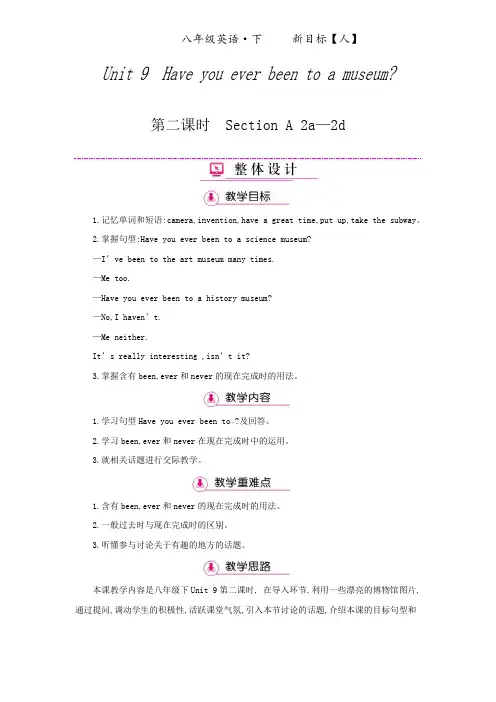
八年级英语·下新目标【人】Unit 9 Have you ever been to a museum?第二课时Section A 2a—2d1.记忆单词和短语:camera,invention,have a great time,put up,take the subway。
2.掌握句型:Have you ever been to a science museum?—I’ve been to the art museum many times.—Me too.—Have you ever been to a history museum?—No,I haven’t.—Me neither.It’s really interesting ,isn’t it?3.掌握含有been,ever和never的现在完成时的用法。
1.学习句型Have you ever been to…?及回答。
2.学习been,ever和never在现在完成时中的运用。
3.就相关话题进行交际教学。
1.含有been,ever和never的现在完成时的用法。
2.一般过去时与现在完成时的区别。
3.听懂参与讨论关于有趣的地方的话题。
本课教学内容是八年级下Unit 9第二课时, 在导入环节,利用一些漂亮的博物馆图片,通过提问,调动学生的积极性,活跃课堂气氛,引入本节讨论的话题,介绍本课的目标句型和单词,在听力环节,注重对学生听力策略的指导,消除学生对听力的“恐惧”心理,让学生能够高效做题。
2d教学是本课综合运用的体现。
通过学习词组、重点句到对话的填空让学生的学习有渐进的过程;抽取学生进行角色扮演,对学生是知识升华的过程。
设计教学PPT,录音机,图片,多媒体。
StepⅠ.Lead in[设计意图]调动学生情感,激活他们头脑中关于过去去过的地方的情感,导入新授。
Leading inT:Boys and girls,do you like traveling?S:Yes.T:Great! Most of you like traveling very much.Me too.Look at the pictures.I went to a lot of places last year.Guess where I went? Use “have/has been to”.S1:You have been to Shanghai.S2:I know you have been to the space museum.S3:You have been to the amusement park.S4:You have been to the zoo.S5:…T:Great! All of you did well.I have been to so many interesting places.Which of these places would you like to visit? Please rank them 1 to 6.space museumhistory museumart museumwater parkzooamusement parkS:…[设计意图]通过情境引入,激发学生情感,便于导入新授内容。
人教版八年级英语下册unit9haveyoueverbeentoamuseumsectiona(1a-2d)(新版)人教新目标版

Conversation 1
Tina went to the space museum
last year.
TF
John has never been to the space
museum.
TF
They are going to take the subway. T F
Conversation 2
Linda has been to the amusement
friends. We put up a tent and cooked outside. Anna: That sounds fun. I've never been
camping. Jill: You should try it!
1. Practice the dialogue. 2. Preview the next part.
way to spend a Saturday afternoon. Jill: Yes, I love all the old movie cameras there. I
learned about the inventions that led to color movies, too.
Anna: So, what did you do on the weekend? Jill: I camped in the mountains with some
Listen. Have these students ever been to these places? Check laudia Science museum
History museum
Art museum
√
Nature museum √
新教材_go_for_it_新目标_八下_第九单元_第一课时_unit_9_have_you_ever_been_to_a_museum

report In my group , Tom has been to a science museum, he saw many interesting inventions. And he learned a lot about science. He will be more interested in science later. She/he thinks it's ..... xxx and xxx have been to ...., they think it's ... .. I ....
art museum
space museum
Talk something about the picture.
Sarah
Claudia
Listening 1 Choose the best answer.
1.When did Sarah visit the National Science Museum? A. Today B. Yesterday C. Last year 2. When did Claudia visit the nature museum? A. Last year B. Last summer C. Last school trip 3. What may the relationship be between the two speakers? A. Friends B. Teacher and student C. Mother and kid.
art museum
science museum
water park
A: Have you ever been to a/an…? B: Yes, I have. I have ever been there. How about you? A: Me, too. /No, I haven’t. I have never been there. A: Have you ever been to a/an…? B: No, I haven’t. I have never been there. How about you? A: Me, neither. /Yes, I have. I have ever been there. an amusement park
人教版八年级下册《Unit 9 Have you ever been to a museum 》教案

4a. Put the correct forms of the verbs in the blanks.
4b.Fill in the blanks with the correct forms of the verbs in brackets.
4c.Answer the survey questions and then ask your partner.
2.. Show the words one by one
quickly and ask students to speak out the
Chinese meaning of the words as soon as
quickly.
Step2:Grammar focus
Make a dialogue according to the text.
Yes, I have. I went there last year./
No, I haven’t.
I’ve been to the art museum many times.
Me, too. And I’ve also visited the nature museum.
二、情感态度与价值观
通过本课的学习,热爱祖国的大好河山,同进也要拥有乐观向上的精神
Play a video and ask students to watch it carefully. Try to understand the meaning of the video.
Step 2:Free talk
Show a picture ofdifferent museum. Ask students to sayHave you ever been to a museum?
人教新目标英语八年级下册Unit 9 单元教案 最新人教版初二英语下册

Unit 9 Have you ever been to a museum ?Period 1 Section A 1a-2cTeaching AimsKey vocabulary: amusement; neitherTarget language:Lets' go somewhere different today.Have you ever been to…? Yes, I have./ No, I haven’t.How about/what about…?How are we going to get there?We can take the subway/…Ability AimsSs can talk about the past experiences with been, ever, never and language chunks.To train students’ listening and speaking skills.Moral AimsImprove the cooperative spirit of the Ss and let the Ss be proud of the interests of the world. Teaching key Points1. Key vocabulary in this period.2. Target language in this period.Teaching Difficult PointsLearn to talk about the past experiences by using “Have you ever been to....?”.Teaching ProceduresStep1 Warming-upWatch a video the interests of the worldStep2 Presentation1. Checking the words .2. Study the new language in group. Get students to work in groups to practice theconversation: “Have you ever been to…”“Yes, I have”/ Not, I haven’t.Step 2 Work on 1a .1. T: OK. Now open your books on Page 65. In Part 1a, 6 places are given. Please read thenames of these places. (Teacher writes the names on the blackboard.) Which of these places would you like to visit? Rank them from 1 to 5.2. Talk about the pictureStep 3 Listening 1b1. Look at the picture and answer.Explain: Me , too . Me, neither.Know the names of the five museums.2. Listen and check.3. Sum up the chart:Claudia has been to.... But she has never been to....Sarah has been to.... But she has never been to....4. Listen again and answer:When did Sarah visit the National Science Museum?A. TodayB. YesterdayC. Last year2. When did Claudia visit the nature museum?Last year B. Last summer C. Last school trip3. What may the relationship be between the two speakers?A. FriendsB. Teacher and studentC. Mother and kid.Listen and repeat.5 .Follow the tape.Step 4 Pair work.1. Example :A: Let’s go somewhere different today.B: OK. Where do you want to go?A: Have you ever been to the spacemuseum?B: No, 1 haven’t. How about you?A: A: Me neither. / Neither have I.2. Students work.Step 5 Listening (2a 2b)1. Talk about the pictures by using “Have you ever been to...?” and “How did you go there?”2. Ss listen and circle the places.3. Check.4. Read and translate the sentences in 2b.5. Listen and circle “T” or “F”.6. Check.7. Read the listening passage and correct the mistakes.Step 6 work on 2c.Look at the map in 2a and make conversations about the places.A: Have you ever been to the space museum?B: Yes, I have. How about you?A: No, I haven’t.B: Oh, it’s fantastic. Let’s go tomorrow.A: OK. How are we going to get there?B: We can take the subway.Step 7 Homework.Period 2 Section A 2d & GrammarTeaching AimsKey vocabulary: camera; invention ;a couple of ; German; theme; ride; provinceTarget language:It’s a great way to spend a Saturday afternoon.I learned about the inventions that led to color movies, too.Have you ever been to a science museum?Yes, I’ve been to a science museum./No, I’ve never been to a science museum.Have you ever visited the space museum?Yes, I have. I went there last year./No, I haven’t.I’ve been to the art museum many times.Me, too. And I’ve also visited the nature museum.Teaching Key PointsThe present perfect tense.How to use the present perfect tense.Teaching DifficultiesTo understand and use the present perfect tense.Teaching procedures:Step 1 : Review.Show the pictures and ask and answer:Have you ever been to .....?Yes I have. /No, I haven’t./No, never.\ Not yet.Step 2 Work on 2d.1. Learn the words.2. Listen and choose: What’s it about?A: About their clothes.B: About the food.C: About their last weekend.3. Scan(寻读) the conversation and answer the following questions.4. Listen and imitate5.Role-play conversationStep 3 Grammar.1.Ask students to read the sentences of Grammar focus aloud.2. Explain. Learn the Present Perfect TenseStep 4 Work on 4a.1. Finish 4a on textbook. Put the correct form of the verbs in the blanks.2. Check the answer.Step 5 Work on 4b.1. Finish 4b on textbook. Fill in the blanks with the correct forms of the verbs in brackets.2. Check the answer.Step 5 Work on 4c.Finish 4c on textbook. Answer the survey questions and then ask your partner.Make a survey:What fun places have your classmates been to ?How did they get there?Write a report according to their charts.Today I asked our classmates about their journey. Here are the results.__________________________________________Step 6 Homework.Period 3 Section A (3a-4c)Teaching AimsKey vocabulary:unbelievable, progress, rapid, unusual, toilet, encourage, social, peaceful, performance, perfect, itself, collectTarget language:I wonder how much more computer will be able to do in the futureWatching them prepare the tea with the beautiful tea sets is just as enjoyable as drinking the tea itselfI’ve also learned that there was a special computer.Ability Aims1.Ss can understand the passage,to train students’reading ability2. To get students know some knowledge about many kinds of museums.Moral AimsTo raise students’interest of learning English.Teaching key Points1. Key vocabulary:2. Target language:Teaching Difficult Points1.How to improve reading skill.2. To understand the passage and the culture.Teaching ProceduresStep1 Warming-upStep 1, Free talkAsk Ss to talk about some places.A: Have you ever been to…?B: Yes, I have. I went there last…/ No, I haven’t. How about you?A: Me too./ So have I. I went there …/ Me neither./Neither have I.Step 2, pre-readingShow Ss a picture about a museum ,ask Ss to guess what kind of mesuem it is.Show Ss pictures for new words .Step 3, While reading1.skimming.Give Ss 1 or 2 minutes to ask them to read the passage quickly and answer the question.Which three museum do you think about ?What do they think of the museums?2. Careful readingA .Read Para. 1 to answer the 2 questionsWhat is Ken interested in in the American Computer Museum?Answer like this: Ken is interested in _________.B . Read Para 2 to answer the 2 questionsWatch video 1 ,what do you think of the museum?Watch video 2, what can you learn from the video?Read paragraph 2, and answer:Why does Amy think the museum is unusual ?What has Amy learned at the International Museum of Toilets?C . Read Para.3 to answer the following questionsWatch the video, and compare, which sentence is better,why ?The tea art performances show how to make a perfect cup of tea with beautiful tea sets.The tea art performances show how to make a cup of tea with tea sets.What does Linlin think of the tea performances and the tea drinking?3. Enjoy reading.What do you think is the most interesting museum ?Read the sentences you like in 3a with your feelings.Step 3 post reading -- Work on 3c.Ask Ss to finish 3c by themselves , then check the answers.Step 4 Homework.1.Level A: Listen and read the passage.2. Level B: Talk about your favorite museum and write it down.Period 4 Section B 1a-1dTeaching AimsKey vocabulary:the Terracotta Army; the Great Wall; the Bird’s Nest;the Palace MuseumTarget language:Have you visited …?Have you been to …?Have you seen …?Have you tried …?Ability AimsTo train students’ listening and speaking skills..Moral AimsTo raise students’interest of learning English.Teaching Key Points1. Key vocabulary in this period.2. Target language in this period.Teaching DifficultiesImprove students’ listening.Teaching ProceduresStep1 Warming-upHave you ever been anywhere interesting in Beijing?Have you ever been anywhere interesting outside Beijing?Learn the phrases: the Terracotta Army; the Great Wall; the Bird’s Nest;the Palace Museum Read these places of interestStep 2 Work on 1a.1.Finish exercise 1a on textbook. Match the pictures with names.2. Check the answers.Step 3 Listening1. work on 1b.Listen to a student interviewing a foreign student. Check (√) the question you hear.Check the answers.2. Work on 1c.Listen again and take notes.Check the answers.3. post listening.Complete the sentences about Peter’s visit in China.Peter has been in China for _____ weeks.Peter went to ___________________ last week.When Peter visited the Great Wall, he saw many ________ there.Peter said that the Terracotta Army was __________.____________ is Peter’s favorite Chinese dish.Step 4 Pair work,1. demonstrate:How long have you been in China?Have you visited the Palace Museum?Have you been to the Great Wall?Have you tried Chinese food?2. Work in pairs to ask your partner where she/he has been to?Have you visited …?Have you b een to …?Have you seen …?Have you tried …?Step 5 self check.1. self check 1.Think about the things below and write an answer for each one.Check the answers.2.self check 2.Check the answers.Step 6 Homework.Teaching Aims:Key vocabulary:quarter; fear; Indian; dark; fox; whenever; equator; island; whether; English-speaking ;take a holiday; three quarters; all year round;Ability AimsTry to develop the st udents’ abilities of reading and writing.Train students’ integrating skills.Train students’ reading comprehension and cooperation spirit.Teaching Key PointsNew words and key phrases.Understand the passage correctly .Teaching DifficultiesHow to describe a place.How to take notes about a passageMoral object:Be interested in knowing about the culture of foreign countries.Teaching ProceduresStep 1 Warm up.1. Play a song before class.2. Greet the class and ask the students if they know the name of the song. (Traveling light).3. Ask the students if they like traveling or not. If they plan to travel to some place, Wheredo they want to go?Step 2 before reading1. Show the symbol (Merlion) of Singapore and ask the students if they know the city, thenshow some pictures of Singapore2. Read the title: From the title , we can infer Singapore is a __________ place.Step 3 while reading .1.Fast reading What four aspects(方面)of Singapore are mentioned?2.Careful reading of each paragraphDiscussion: How many reasons can you find for visiting Singapore.(underline them in each paragraph)3. Task 2. Read the article and use the information to correct the wrong sentences.4. Fill in the conversation about Singapore using the information from the article.Step 4 Post-reading.Make notes about Singapore. Write down anything that you remember. Do not look atthe article.Step 5 HomeworkLevel 1. Introduce Singapore to your parents.Write sth about the hometown or a place the students like.Teaching Aims:Target language.Have you ever tried/seen/been…?If you…, you will/can…You should…One great thing about …is…Ability AimsTo train students speaking and writing abilities.Teaching Key PointsTarget language in this period.Teaching DifficultiesImprove students’ writing ability.Teaching ProceduresStep 1 RevisionWhat do you know about Singapore?Step 2 Work on 3a.Make a list of facts about your hometown or a place you have been to. Think aboutthese topics.1. Pre-writingSize and location:_________________Population:_______________________Weather:________________________History:_______________________Places to visit:___________________Things:___________________________2. example:A: Hainan IslandHave you ever tried/seen/been…?Have you ever been to Hainan Island?I have been there only once before, and I want to go there again.But I know it is thesecond largest island in China. It’s a fantastic place.If you go there, you should walk along the beaches and enjoy the sunshine.The weather in Hainan is very hot, so people like doing many water sports, such as scubadiving (潜水), fishing, swimming, surfing and boating.One great thing about Hainan is that you can try many kinds of sweet fruit in Hainan.If you go to Hainan, I’m sure you will enjoy yourself.Step 3 Work on3b.Write an article to advertise your hometown or a place you have been to.Useful language:Have you ever tried/seen/been …?If you …, you will/can …You should …One great thing about … is …Another example:I have been to Beijing, the capital of China. As the capital of the PRC,Beijing is located in northern China.The city covers an area of more than 16,410 square kilometers and has a population of 14.93 million.If you go to Beijing, you should try Beijing Duck because it is very delicious. If you go to Beijing in winter, you should wear warm clothes because it can get very cold.One great thing about Beijing is that there are a lot of historical places to visit, such as the Great Wall and the Summer Palace.They are all very interesting places!Step 4 Homework .1.Revise the language points.plete your article in 3b.11。
人教版新目标英语八年级下册《Unit9 Have you ever been to a museum》SectionA课件
√ √ √
Sarah
√
√ √
Claudia has ever been to …
1b
Listen and fill in the blanks
I have
I haven’t
Have too. So have I S:I’m bored,Claudia. Let’s do something interesting. C:1.____________________a science museum? S:Yes,2._____I went to the NationalScience Museum last year. Have you ever been to a history museum? C:No,3.________.S: 4.__________.Let’s go to one tomorrow. C: Well, that sounds good, but I’m not interested in history. S: Really? I didn’t know that. How about the art museum? Have You been to the art museum? C: I’ve been to the art museum many times. S:5.________.But I’d like to go again. Hmm. Let’s see…how about the nature museum? I’ve been there a few times. C:6.____________.I went there on our last school trip. S: I know. Let’s go to the space museum. I’ve never been there. C: That’s a good idea. I went there last year, but I’d like to go
八年级英语新目标下 unit 9 Have you ever been to a museum se
Museum
2. What can he see and பைடு நூலகம்earn in the
museum?
She can see some different computers.
Such as old computers and a special computer. She has learned information about different computers and who invented Sthheemha. s also learned that there was a special computer. It could play … .
is the American Computer Museum. They have information ____ different computers and ____ them. The old computers were___ .It’s_____ that technology _____ in _____ way! I’ve also _____ that there was a _____ computer .It ____ play chess even ____ than humans. I wonder ____ computers will ____ do ____.
information about different computers
there.
( T) 2. Ken thinks computers will do more work in
the future.
(T ) 3. International Museum of Toilets is a very
人教新目标英语八年级下册:Unit 9 Have you ever been to a museum
人教新目标英语八年级下册:Unit 9 Have you ever been to a museum? Section A 3a-Grammar Focus 学案设计(含答案)
1 / 5 Name Group Class Title:Unit 9 Have you ever been to a museum? Period 2 (Section A 3a-Grammar Focus) Topic: Fun places
【Get ready before class】 温故知新 一、根据所给首字母,请同学们发挥想象力,写出博物馆的种类(A) 1. museum 2. museum 3. museum 4. museum 5. museum 二、Look at the picture and answer the questions.(B)(看图片,回答问题。) 1. What kind of museum is it in the picture?
2. Have you ever been to the museum? 3. What can we learn at this museum? 新知探究 一、Listen and read the new words from Section A 3a-Grammar Focus. 预习生词,摘抄翻译或造句。 (A) invent: rapid: encourage: collect: 二、阅读3a一遍完成3b,阅读第二遍,在文中划出下列句子并翻译。(A) 1. 我去过的最有趣的博物馆是……
2. They have information about… 3. It’s unbelievable that technology has progressed in such a rapid way! 4. I have also learned that…