
七年级下册英语第四单元知识点汇总
人教版七年级英语下册四单元知识点汇总Unit 4 Don’t eat in class.词汇精讲1. arrive1)arrive意为“到达”。
arrive at+小地点,arrive in +大地点。
例如:I will arrive in Beijing next week.我下周到北京。
I arrived at the small village on a cold morning.在一个寒冷的早晨我到达了那个小村庄。
2)arrive后面跟地点副词here, there, home时,不需要跟介词。
例如:arrive home到家arrive here到这儿注意:arrive late for与be late for是同义短语,都表示“做某事迟到”的意思。
arrive late for强调动作晚,be late for侧重状态晚。
例如:Don’t arrive late for the next test.=Don’t be late for the next test.下一次考试不要再迟到了。
2. listenlisten是不及物动词,意为“听,倾听”,强调听的动作,后面接宾语时要加上介词to。
例如:We should listen to the teacher carefully.我们应该认真听老师讲课。
Listen! Someone is singing in the garden.听!有人在花园里唱歌。
拓展:hear, listen和sound的辨析三个词都有“听”的意思,具体区别如下:hear意思是“听说,听到”,侧重听到的内容。
例如:I heard someone cry in the next room last night.昨晚我听见有人在隔壁哭。
listen意思是“听”,侧重听的动作。
例如:Listen! Someone is crying.听!有人在哭。
sound作动词讲时是连系动词,意为“听起来”,后面跟形容词作表语,构成主系表结构。
例如:It sounds good!听起来不错!3. relaxrelax作及物动词,意为“放松,休息,使轻松”,第三人称单数为relaxes。
例如:You work too hard;you should relax yourself.你工作太努力了,你应该放松一下你自己。
This song relaxes me.这首歌使我心情舒畅。
拓展:1)relaxed形容词,意为“感到轻松的”,常修饰人做表语。
例如:He is relaxed after listening to music.听完音乐后,他感到轻松。
2)relaxing也是形容词,意为“令人轻松的”,常用来修饰物或者事情,可以作表语也可以作定语。
例如:It’s a relaxing trip.这是一次令人轻松的旅行。
The film is very relaxing.这部电影很令人放松。
4. on time&in timeon time意为“按时,准时”,指按照规定的时间或者指定的时间做某事;而in time指“及时”,指不迟到或在规定的时间之前或者接近所规定的时间做某事。
例如:We must arrive there on time.我们必须按时到达那里。
At last, the police arrived there in time.最后警察及时赶到了那里。
5. wear, put on, dress&in1)wear是动词,它的意思是“穿”,它表示状态。
例如:My father wears a T-shirt today.我爸爸今天穿着T恤衫。
2)put on的意思是“穿上、戴上”,它表示动作。
例如: It’s cold outside, put on your coat please.外面非常冷,请穿上你的大衣。
3)dress作动词时,表示“为……穿衣”后接反身代词或人,也可以不接宾语。
例如:Can you dress the baby for me?你能帮我给孩子穿衣服吗?4)in表示穿着的状态,后接颜色或服装。
例如:The girl in red is my sister.穿红衣服的女孩是我姐姐。
The girl in hat is very beautiful.戴帽子的女孩儿很漂亮。
6. strictstrict形容词,意为“严厉的,严格的”,在句子中可以做表语、定语。
常用短语be strict with sb.意为“对某人要求严格”;be strict in sth.意为“对某事要求严格”。
例如:She is a strict teacher.她是一个严格的老师。
She is strict with her students and strict in her work.她对她的学生和工作要求严格。
7. bringbring动词,意为“带来;拿来”。
例如:Bring your English book to my office.把你的英语书带到我办公室里来。
辨析:bring&take1) bring指从别处将某人或者某物带到说话人所在的地方。
例如:Please bring your family photo tomorrow.明天请把你的全家福带过来。
2) take 意为“带走,拿走”时,指把某人或者某物从说话人所在地带走。
例如:His father often takes him to the zoo on weekends.他爸爸周末经常带他去动物园。
8. outside1)outside副词,意为“在外面”,反义词是inside。
例如:Don’t go outside. It’s too cold.不要到外面去,天气太冷了。
2)outside还可以做介词,意为“在……外面”。
例如:There is a new car outside the house. 房子外边有一辆新车。
3) outside 作名词,意为“外部,外表”。
例如:The outside of the house is red. 这个房子的外部是红色的。
out副词意为“外出,出来”,其反义词为in。
outside副词作副词时,意为“在外面,在户外”等,其反义词为inside。
拓展:go out的用法1)外出,或者指“参加社交活动,外出交际或娱乐”。
例如:Mary goes out a lot on Sundays.每逢周日,玛丽的应酬非常多。
2)出去。
例如:Let’s go out for a walk.让我们出去散步吧。
3)出国,移居国外。
例如:He went out to Canada two years ago.他两年前移居加拿大了。
4)过时,不流行。
例如:This kind of shoes went out last year.这款鞋去年就过时了。
9. dish1)dish名词,意为“碟,盘”,做餐具讲时,常用复数形式,其前常加the。
do the dishes相当于wash the dishes,意为“清洗餐具”。
例如:It’s your turn to do the dishes today.今天轮到你洗碗了。
2)dish还可用作可数名词,意为“菜肴,一道菜”。
例如:He likes cold dishes.他喜欢凉菜。
辨析:dish&platedish和plate都是“盘,碟”的意思,它们的区别在于:dish可以泛指就餐时所用的餐具,包括盘、碗、碟、杯、刀、叉等,特指较深的盘子。
例如:Please dry the dishes and put them away.请你把餐具擦干,收拾好。
plate指较平的盘子、碟子,可用来盛汤,也可用来装菜。
例如:Our host was very generous, heaping a plate of food to us.主人十分慷慨,给我们装了一盘食物。
10. practice1)practice作动词时是及物动词,意为“练习,训练”,其后可跟名词、代词或动名词做宾语。
例如:I often practice my English in the morning.我经常在早上练习英语。
He practices playing the piano every day.他每天练习弹钢琴。
2)practice作名词,意为“练习,实践”,是不可数名词。
例如:Playing the piano needs a lot of practice.弹钢琴需要多加练习。
Practice makes perfect.熟能生巧。
11. followfollow动词,意为“遵循,跟随”。
follow the rules意为“遵守规则”。
例如:You must follow the school rules.你必须遵守学校规章制度。
拓展:follow常见的其他用法有:1)跟随,跟着。
例如:Please follow me. I’ll show you the way.请跟我走,我来给你带路。
2)明白,领悟。
例如:You are speaking too fast and we can’t quite follow you.你讲的太快,我们不太懂你的意思。
3)表示“沿……而行”。
例如:follow the road沿路而行12. feel1)feel作行为动词,意为“觉得,认为”。
例如:How do you feel today?今天你感觉怎样?I feel that you will win.我感觉你会赢。
2)feel作连系动词,意为“感觉,摸起来”,其后跟形容词作表语。
例如:I feel happy today.我今天感觉很高兴。
Your hand feels cold.你的手摸起来很凉。
句式精讲1.Don’t arrive late for class.1)这是一个表示否定的祈使句,祈使句表示请求、命令或者建议。
谓语动词用原形,句子的主语you通常省略。
句子结尾用句号,表示强烈语气的时候用感叹号,朗读时要用降调。
可以在句末或者句首加上please,使语气更加的缓和客气。
please放在句首时后面不需要加逗号,放在句末时后面要加逗号。
例如:Listen to your teacher, please.请听你的老师讲话。
Don’t look out of the window.不要向窗外看。
Please come in. = Come in, please.请进。
2)这种祈使句的肯定式是“Do (实义动词) +其他成份”。
例如:Listen to me carefully!认真听我讲!Open the door!打开门!2.…help his mother make breakfast.help sb. (to) do sth.意为“帮助某人做某事”,help后面可以跟带to的不定式(to+动词原形)做宾语补足语,也可以跟不带to的动词不定式(动词原形)做宾语补足语。
英语七年级下册第四单元知识总结

英语七年级下册第四单元知识总结The fourth unit of English textbook for Grade 7 is arich and diverse section that covers a wide range of topics, from school life to hobbies and interests. This unit is designed to enhance students' language skills while introducing them to new vocabulary and grammatical concepts. As students progress through this unit, they will encounter various activities and exercises that are aimed at consolidating their understanding and enabling them toapply their knowledge in real-life situations.**Vocabulary Focus**The vocabulary introduced in this unit is diverse and relevant to the topics covered. Students learn new words related to school subjects, activities, and hobbies, suchas "math," "science," "music," and "art." These words not only expand their vocabulary but also provide them with the language tools to discuss their interests and academic pursuits. Additionally, this unit introduces words relatedto feelings and emotions, such as "happy," "sad," "angry," and "excited," which help students express their emotions effectively.**Grammatical Concepts**The grammatical focus of this unit is on present continuous tense and its usage in different contexts. Students learn to identify and use the present continuous tense to describe actions that are happening at the moment. This tense is often used to talk about ongoing activities, temporary situations, or upcoming events. By mastering this tense, students can more accurately convey their ideas and experiences.**Communication Skills**Communication skills are essential in any language learning journey, and this unit emphasizes the importance of effective communication. Students learn to ask and answer questions related to school subjects, hobbies, and activities. They also learn to express their opinions and feelings using the new vocabulary and grammatical concepts introduced in this unit. Through role-plays, discussions, and other interactive activities, students practice their communication skills and develop their confidence in speaking English.**Cultural Understanding**This unit also includes cultural elements that help students understand different perspectives and backgrounds. By exploring topics like hobbies and interests, students gain insights into the diverse interests and passions that people from different cultures may have. This cultural understanding not only enhances their language skills but also broadens their horizons and promotes tolerance and respect for others.**Conclusion**In conclusion, the fourth unit of English textbook for Grade 7 is a comprehensive and engaging section that covers various aspects of language learning. It focuses on vocabulary expansion, grammatical concepts, communication skills, and cultural understanding, providing students with a well-rounded and immersive learning experience. As students progress through this unit, they will not only improve their language proficiency but also develop their critical thinking and interpersonal skills, preparing them for future academic and social challenges.**探索英语七年级下册第四单元:知识与理解的融合**英语七年级下册的第四单元是一个丰富而多元的部分,涵盖了从学校生活到兴趣爱好等广泛的话题。
七年级下册英语4单元短语15个
七年级下册英语4单元短语15个《七年级下册英语第四单元常见的15个实用短语汇总》。
一、“get up”(起床)。
这个短语在日常生活中超级常用。
比如说,早上妈妈会喊你:“Get up, it's time for school.”(起床啦,到上学的时间啦。
)它很简单,但是特别实用,咱们得牢牢记住。
二、“go to school”(去上学)。
这个就不用我多说啦,每天咱们都要做这件事。
比如你和小伙伴约好一起走,你就可以说:“Let's go to school together.”(咱们一起去上学吧。
)。
三、“take a shower”(洗澡)。
晚上睡觉前,咱们都得洗个舒服的澡。
像这样说:“I usually take a shower before going to bed.”(我通常在睡觉前洗澡。
)。
四、“brush teeth”(刷牙)。
保持口腔卫生很重要,每天都要刷牙哟。
例如:“You should brush your teeth twice a day.”(你应该每天刷两次牙。
)。
五、“have breakfast”(吃早餐)。
早餐是一天中最重要的一餐,可不能不吃呀。
比如妈妈做好早餐后会说:“Come and have breakfast.”(过来吃早餐吧。
)。
六、“get dressed”(穿衣服)。
早上起床后,咱们要做的就是穿衣服啦。
像:“I get dressed quickly and then go to school.”(我快速穿好衣服,然后去上学。
)。
七、“go home”(回家)。
放学啦,当然是开开心心回家咯。
例如:“Let's go home together.”(咱们一起回家吧。
)。
八、“do homework”(做作业)。
回家后,重要的任务就是做作业。
比如说:“I have to do my homework first.”(我得先做作业。
)。
初一英语下册Unit4 知识点归纳
初一英语下册Unit4 知识点归纳初一英语下册Unit4知识点归纳前预习资料学习目标:1知识目标1)词汇:dtr,reprter,plieffier,aiter,banler,salesassistant,d angerus2)句型:—hatdeshed?—Heisaaiter—hatduanttbe?—Ianttbeanatr—heredesher?—Hersataban2能力目标:谈论有关职业的话题为将来踏入社会求职打下基础3情感目标:热爱学习,以便将来在各自不同的岗位上为建设祖国做出贡献。
重点、难点1重点1)--hatdud?--Iaareprter2)--hatdeshed?--Heisastudent3)--hatduanttbe?--Ianttbeanatr4)--hatdesheanttbe?--Heantstbeabanler2难点一般现在时态的概念和用法:当主语用第三人称单数时,谓语动词的相应变化。
后复习资料一短语:1anttdsth想要作某事2givesbsth=givesthtsb给某人某物/把某物给某人3helpsbdsth帮助某人作某事Eg:Iantthelptherdsehuserathe4helpsbithsth帮助某人谋事Eg:Iantthelptherithsehuseratheintheda在白天6atnight在晚上7talith/tsb和----谈话8bebusdingsth忙于做某事Eg:Heisbuslisteningttheteaher9inahspital在医院10r/studhard努力工11EveningNespaper晚报二重点句式及注意事项:1询问职业的特殊疑问词是hat;有三种主要句式①hat+is/are+sb?Eghatisurther?②hat+des/d+sb+d?Eghatdeshisbrtherd?③hat+is/are+名词所有格/形容词性物主代词+b?Eghatisurb?2Peplegiveetheirnergettheirnefre3SetiesIrinthedaandsetiesatnight4IlietalingtpepleIrlateI’verbushenpepleguttdinners6heredesursisterr?7thenehaveabfruasaaiter8Duanttrfraagazine?Theneandrfrusasareprter9Dulietreveningsandeeends?10eareaninternatinalshlfrhildrenf-12三本单元中的名词复数。
七年级下册英语第四单元b知识点
七年级下册英语第四单元b知识点七年级下册英语第四单元B知识点涉及到日常生活中的各种场景和话题,包括谈论饮食、购物、时间、天气、交通和文娱等方面。
以下将分别对这些知识点进行介绍。
1. 谈论饮食在这一部分中,我们将学会如何询问、介绍和点餐。
例如:- What do you usually have for breakfast?你早餐通常吃什么?- Can I have a chicken sandwich and a cola, please?我可以要一份鸡肉三明治和一杯可乐吗?2. 购物在这一部分中,我们将学习如何询问价格和购买物品。
例如:- How much is this T-shirt?这件T恤衫多少钱?- I’d like to buy a pair of shoes.我想买一双鞋。
3. 时间这一部分中,我们将学会如何询问时间、日期和做时间表。
例如:- What time is it now?现在几点钟?- What day is today?今天星期几?- I usually get up at 6:30 in the morning.我通常早上六点半起床。
4. 天气在这一部分中,我们将学习如何描述天气状况和询问天气预报。
例如:- It’s raining heavily today.今天下大雨。
- What’s the weather like tomorrow?明天天气怎么样?5. 交通在这一部分中,我们将学会如何询问和提供交通指示。
例如:- How can I get to the museum?我怎么才能到博物馆?- Go straight and turn left at the first traffic light.一直往前走,在第一个红绿灯处左转。
6. 文娱在这一部分中,我们将学会如何谈论各种文娱活动并提出建议。
例如:- Would you like to watch a movie with me this weekend?你这周末愿意和我一起看电影吗?- I think visiting the zoo is a good idea.我认为去动物园是个好主意。
(完整版)人教版英语七年级下册第四单元短语语法知识点总结及练习
(完整版)人教版英语七年级下册第四单元短语语法知识点总结及练习Unit 4Don’t eat in class【短语归纳】1.on time 准时,按时2. listen to …听……3. in class 在课上4. be late for 做……迟到5. have to 不得不6. be quiet安静7. go out外出8. do the dishes 清洗餐具9. make breakfast 做早饭10. make (one’s) bed 铺床11. be noisy 吵闹12. keep one’s hair short 留短发13. play with sb. 和某人一起玩14. play the piano 弹钢琴15. have fun 玩得高兴16. make rules 制订规则【用法集萃】1.Don’t + 动词原形+其他,不要做某事。
2.help sb. (to) do sth. 帮助某人做某事3.too many + 可数名词复数太多的……4.practice doing sth. 练习做某事5. be strict with sb. 对某人要求严格6. be strict in sth. 对某事要要求严格7. leave sth sp. 把某物忘在某地8. keep + 宾语+形容词使……保持某种状态9. learn to do sth. 学会做某事10. have to do sth. 不得不做某事┃语法探究┃┃.祈使句定义:用于表达命令、请求、劝告、警告、禁止等的句子叫__________句。
时态:使用______________时态。
结构:动词原形+其他成分+please. 否定祈使句在动词原形前面加__________ 。
如:Be quiet in the classroom, please.在教室里请保持安静。
Don't fight. 不要打架┃.情态动词have to 和must1.情态动词have to和must都表示“__________”的意思。
人教版七年级下册英语第四单元知识点整理
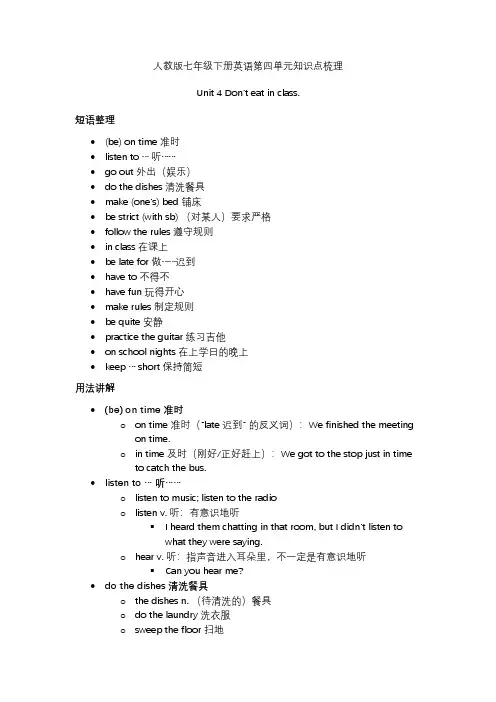
人教版七年级下册英语第四单元知识点梳理Unit 4 Don’t eat in class.短语整理•(be) on time 准时•listen to … 听……•go out 外出(娱乐)•do the dishes 清洗餐具•make (one’s) bed 铺床•be strict (with sb) (对某人)要求严格•follow the rules 遵守规则•in class 在课上•be late for 做……迟到•have to 不得不•have fun 玩得开心•make rules 制定规则•be quite 安静•practice the guitar 练习吉他•on school nights 在上学日的晚上•keep … short 保持简短用法讲解•(be) on time 准时o on time 准时(“late 迟到” 的反义词):We finished the meeting on time.o in time 及时(刚好/正好赶上):We got to the stop just in time to catch the bus.•listen to … 听……o listen to music; listen to the radioo listen v. 听:有意识地听▪I heard them chatting in that room, but I didn’t listen towhat they were saying.o hear v. 听:指声音进入耳朵里,不一定是有意识地听▪Can you hear me?•do the dishes 清洗餐具o the dishes n. (待清洗的)餐具o do the laundry 洗衣服o sweep the floor 扫地o mop the floor 拖地o do the cooking 做饭•make (one’s) bed 铺床o Remember to make your bed!•be strict (with sb) (对某人)要求严格o The teacher is strict with us.•follow the rules 遵守规则o= obey the ruleso= observe the ruleso We must follow the rules in the school.•in class 在课上o You shouldn’t eat in class. 上课时不能吃东西。
人教版英语七年级下册第四单元单词知识点汇总
Uint 4 单词●rule n.规则;规章ruler 尺子●arrive v.到达arrive /be late for 做….迟到arrive at + 小地方arrive in + 大地方get to + 地点到达……..reach + 地点到达……..●(be) on time准时in time 及时●hallway n.走廊;过道in the hallways 在走廊里●hall n.大厅;礼堂●dining hall餐厅●listen v.听;倾听listen to…听……●fight v.&n.打架;战斗fight for 为…..而打架fight with sb 跟某人打架●sorry adj.抱歉的;难过的;惋惜的●have to 必须,不得不●outside adv.&adj.在外面;外面的inside 在室内,在…里面●wear v.穿;戴●important adj.重要的●bring v.带来;取来bring sth/sb to 带某物/人到….●uniform n.校服;制服●quiet adj.安静的be quiet 安静quite adv.相当,完全●out adv.外出●go out外出(娱乐)●practice v.&n.练习practice doing sth 练习做某事●dish n.碟;盘●do the dishes清洗餐具●before prep.&adv.在……以前;以前●make (one's) bed铺床●dirty adj.脏的●kitchen n.厨房●more adj.&pron.更多(的)●noisy adj.吵闹的noise n.喧嚣声,噪音●relax v.放松;休息relaxed/relaxing adj. 轻松的(人用ed,物用ing)●read v.读;阅读●terrible adj.非常讨厌的;可怕的●feel v.感受;觉得●strict adj.严格的;严厉的be strict with sb对某人要求严格be strict in sth对某事要求严格●remember v.记住;记起remember to do 记得要做某事remember doing 记得做过某事●follow v.遵循;跟随●follow the rules遵守规则●luck n.幸运;运气good luck!/good luck to you ! 祝你好运!●keep v.保持;保留keep+宾语+ adj 使….保持…状态keep the classroom cleankeep doing 保持做….●hair n.头发;毛发keep one’s hair short 留短发●learn v.学习;学会learn to do 学习做某事●have fun = have a good time 玩的开心have fun doing 做某事很开心祈使句:1)Do 型:Go and wash your hands.2)Be 型:Be quiet, please.3)Let 型:Let me help you.否定形式:1)Do 型、Be 型在句首加Don’tDon’t forget me.Don’t be late for school.2)Don’t let……或let…not….Don’t let him go. = let him not go.3)No 开头No speaking.。
人教版七年级下册英语Unit 4 知识点语法归纳总结
Unit 4 Don’t eat in class.1.短语归纳2.典句必背3.用法集萃(1)Don’t arrive late for class. 不要上课迟到❖arrive in❖arrive at(2)You must be on time. 你必须准时。
❖on time是固定搭配,意为“按时;准时”。
例:Don’t worry. The train will arrive on time. 别担心。
火车会准时到达的。
❖常见的time短语(3)Don’t listen to music in class. 不要上课时听音乐牛刀小试—Do you like the songs by Taylor?一Yes. Country music ______ nice and full of feelings.A. SoundsB.listensC. hearsD. looks(4)This is very important. 这是很重要的❖important作形容词,意为“重要的”。
如:The first lesson is very important. 第一课是很重要的❖反义词:unimportant adj. 不重要的❖派生词:importance n. 重要;重要性(5)Can we bring music players to school? 我们可以把音乐播放器带到学校里来吗?❖bring作动词,意为“带来;拿来”例:Don’t forget to bring your homework here. 不要忘记把你的家庭作业带过来❖辨析bring, take, carry和get牛刀小试Don’t forget _____ your photos here when you come to school.A.bringingB. to takeC. takingD. to bring(6)Oh, and we also have to be quiet in the library. 哦,我们在图书馆里还必须保持安静❖quiet作形容词,意为“安静的”,可以用来修饰人,也可以用来形容地点或场所等。
七年级下册英语知识点Unit4
七年级下册英语知识点Unit4 Unit 4 is an important unit in the seventh-grade English curriculum, which covers a wide range of knowledge points. In this unit, students will learn about the present perfect tense, the simple past tense, and the present perfect continuous tense, as well as other grammar structures, vocabulary, and reading comprehension skills. By the end of this unit, students will have a solid understanding of these concepts and be able to use them in their daily communication.1. Present Perfect TenseThe present perfect tense is used to describe an action that happened in the past but has a connection to the present. It is formed by using the auxiliary verb "have" or "has" followed by the past participle of the verb. For example, "I have eaten breakfast" or "She has watched the movie." This tense is commonly used when talking about experiences, changes, or events that have occurred up to now.2. Simple Past TenseThe simple past tense is used to describe an action that happened in the past and is now completed. It is formed by adding "-ed" to the verb.For example, "I walked to school" or "He played soccer yesterday." This tense is used to talk about a specific time in the past, and when the time or date is important to the story.3. Present Perfect Continuous TenseThe present perfect continuous tense is used to describe an action that started in the past and continues up to the present. It is formed by using the auxiliary verb "have" or "has" followed by "been" and the present participle of the verb. For example, "I have been learning English for three years" or "She has been studying hard for her exams." This tense is used to emphasize the ongoing nature of the action and its relevance to the present.4. VocabularyIn this unit, students will learn a variety of new vocabulary words related to travel, vacation, and leisure activities. These words include "destination," "backpack," "tourist attraction," "surfing," and "skiing." By mastering these words, students will be able to talk about their interests, plans, and experiences in English more fluently.5. Reading ComprehensionThroughout this unit, students will have the opportunity to practice their reading comprehension skills by reading passages related to travel, vacation, and leisure activities. They will be asked to identify the main idea, make inferences, and summarize the text. These skills are essential for academic success in English and will help students develop critical thinking and analytical abilities.Overall, Unit 4 is a crucial unit in the seventh-grade English curriculum. By mastering the grammar structures, vocabulary, and reading comprehension skills presented in this unit, students will be well-prepared for future academic and professional success in English.。
初中七年级下册英语知识点总结unit4
初中七年级下册英语知识点总结unit4初中七年级下册英语知识点总结unit4Unit 4 主要学习了“能力”和“职业”的表达。
在本单元中,我们将学习如何询问和回答自己和他人的能力以及职业。
同时,我们还将学习一些食物和饮料的名称,以及如何进行点菜。
首先,我们来学习“你能做什么?”这一询问能力的问题。
在回答时,我们可以使用以下结构:I can + 动词原形比如,当我们被问及“你能弹吉他吗?”时,我们可以回答“I can play the guitar.”。
在这里,“play”是动词,表示“弹奏”。
同时,我们还可以使用一些常见的能力词汇来回答这个问题。
比如:Swim - 游泳Dance - 跳舞Speak English - 说英语Draw - 画画Play basketball - 打篮球除了询问和回答个人的能力外,我们也可以询问他人的能力。
我们可以使用以下句型:Can + 主语 + 动词原形?比如,当我们想询问他人是否会游泳时,我们可以问:“Can you swim?”。
对方可以回答“Yes, I can.”(是的,我会)或“No, I can't.”(不,我不会)。
接下来,我们来学习一些职业的表达。
在本单元中,我们将学习一些常见的职业名称,以及描述这些职业所需要的能力。
在英文中,职业类别常常以名词形式出现,比如“doctor”(医生)、“teacher”(老师)和“engineer”(工程师)。
当我们想问某人的职业时,我们可以使用以下句型:What do you do?比如,当我们问某人的职业时,我们可以问:“What do you do?”。
对方可以回答“I'm a teacher.”(我是一名老师)或“I'm a doctor.”(我是一名医生)。
当然,我们也可以使用其他的职业相关词汇来回答这个问题。
比如:Nurse - 护士Musician - 音乐家Engineer - 工程师Pilot - 飞行员除了学习询问和回答能力和职业外,本单元还包括一些食物和饮料的名称的学习。