
2014七年级英语上unit5do-you-have-a-soccer-ball复习课
Unit5.2 Do you have a soccer ball?(Section B)-七年级英语人教版(上册)(解析版)
Unit 5 Do you have a soccer ball?
课时2 Section B
(满分: 100分 时间: 40分钟)
一、根据句意及汉语提示填写单词。(共5小题,每小题2分,共计10分)
1. —Let’s play soccer.
—No. That sounds ________ (无聊的).
2. English is ________ (难的) for me.
3. Dad, can I ________ (观看) TV now?
4. I think playing basketball is ________ (有趣的).
5. Let’s play tennis. It’s ________ (轻松的).
【答案】
1. boring 2. difficult 3. watch
4. interesting/fun 5. relaxing
二、连词成句。(共5小题,每小题2分,共计10分)
1. a, I, tennis, have, ball, don’t
__________________________________________.
2. Bill, a, does, ping-pong, have, bat
_________________________________________?
3. go, basketball, let’s, to, the, watch, game
__________________________________________.
4. so, for, volleyball, boring, is, me
__________________________________________.
5. soccer, bed, Bob’s, the, under, is, ball
七年级英语上册Unit5Doyouhaveasoccerball教案
Unit 5 Do you have a soccer ball?
The Second Period
Section A (Grammar Focus-3c)
Ⅰ.Teaching aims:
1.Knowledge aims:
(1)Key words:great,play,sound
(2)Key phrases:play basketball
(3)Important sentences:
①—Do you have a baseball?
—Yes,I do./No,I don’t.I have a volleyball.
②—Does she have a table tennis ball?
—Yes,she does./No,she doesn’t.She has a baseball.
③—Do they have a basketball?
—Yes,they do./No,they don’t.They have a volleyball.
2.Ability aims:Talk about ownership with “do” or “does”.
3.Emotion aims:Make students fall in love with ball sports.
II.Important points:Learn to ask “do” or “does” questions and short answers.
III.Difficult points:Grasp the correct usage of “do” or “does”.
IV.Teaching process
Step 1 Revision
Choose several pairs to act out 2d.
Step 2 Read and say
Work on Grammar Focus.
七年级英语上册 Unit 5 Do you have a soccer ball学案(无答案)(新版)人教新目标版
Unit 5 Do you have a soccer ball?
第 1 课时 课题名称 Words and expressions
时间 第 周 星期 课型 Vocabulary
目标 学习根据音标拼读单词:do, have, tennis, ball, ping-pong, let, us, let’s=let us等,并根据发音规律熟读并尝试记背单词,然后将单词按照词性进行归类,并对重点单词拓展词性变化。
重点 学会根据音标拼读单词并根据发音规律读熟并尝试记背单词:do, have,
tennis, ball, ping-pong, let, us, let’s=let us等。 我的问题
难点 将单词按照词性进行归类,并对重点单词拓展词性变化。
自
主
学
习 [a:] after class card basketball
[ei] same great late tape
[i:] we me easy teacher
[e] let get bed head
精
讲
互
动 一、将本单元所有的生词按照词性进行分类
1.(n.)
2. (v.)
3. (adj.)
4. (pron.)
5. (phrases)
郑州市七年级英语上册Unit5Doyouhaveasoccerball考点题型与解题方法
1
郑州市七年级英语上册Unit5Doyouhaveasoccerball考点题型与解题方法
单选题
1、Betty is a tidy girl. She keeps everything ________ her room well.
A.withB.overC.inD.on
答案:C
句意:贝蒂是一个整洁的女孩。她把她房间里的所有东西都保持得很好。
考查介词辨析。with“和”;over“在……上面”;in“在……里”;on“在……上”,两者有接触面。根据“her room”可知,此处指房间里,要用in。故选C。
2、The long necks(颈) make giraffes ________ from other animals.
A.importantB.difficultC.interestingD.different
答案:D
句意:长颈鹿的长颈使长颈鹿不同于其他动物。
考查形容词辨析。important重要的;difficult困难的;interesting有趣的;different不同的。根据“make giraffes...from other animals.”可知,长颈鹿的长颈使长颈鹿不同于其他动物,make sth. different from“使某物不同于”。故选D。
3、—What does she look like?
—She ________ of medium height and ________ glasses.
A.is; hasB.is; wearsC.was; hasD.is; wearing
答案:B
句意:——她长什么样?——她中等身材,戴着眼镜。 2
考查动词时态及动词辨析。has有;wear戴。be of medium height“中等身高”,根据“does”可知,本句是一般现在时,主语she是第三人称单数,故用be动词is。wear glasses“戴眼镜”,wear用其单三形式。故选B。
七年级英语上Unit 5 Do you have a soccer ball

新希望教育 七年级英语上册 Unit 5 Do you have a soccer ball
1
Unit 5 Do you have a soccer ball?
词汇精讲
1. interesting&interested
这两个词都是形容词。interesting表示某物本身有趣,强调主动,在句子中可以作定语、表语,多用来修饰物。interested着重于被动意义,其主语一般是人。常做表语,后接介词in,一起构成be interested in…结构,意为“对……感兴趣”。
例如:I am very interested in the interesting story.
我对这个有趣的故事很感兴趣。
2. difficult
difficult“困难的”,相当于hard。在句子中可作定语或者表语。其反义词是easy“容易的”。其名词形式是difficulty。 常用于以下结构:It’s difficult for sb. to do sth. (对某人来说做某事很困难。)
例如:It’s difficult for me to listen to you clearly.
对我来说听清楚你说话很难。
3. great
great 形容词,意为“美妙的,大的,伟大的”。
例如:That’s great! 太好了!
He’s a great man. 他是个伟大的人。
4. watch
watch作动词时,意为“看”。一般指看动态的东西,例如:节目、比赛等。动词短语“看电视”用“watch
TV”。
watch 还可以指认真观察,或者目睹事情的全过程。
例如:I watched my son become from a baby to a boy.
我看到我的儿子从婴儿变成了男孩儿。
Just watch what will happen when I press the button.
七年级英语上册 Unit 5 Do youhave a soccer ball(第4课时)Section B阅读课教案 (新版)人教新目标版
Unit 5 Do you have a soccer ball?
Period Four (Section B)—阅读课
Teaching and learning Goals:
1. Review the Plural form of Nouns
2.The Present Simple Tense of verbs。Pay attention to the rules do→ does
3.To write something by using the drills they have learnt.
4.Reading and writing practice.
Teaching and learning steps :
Step I Review
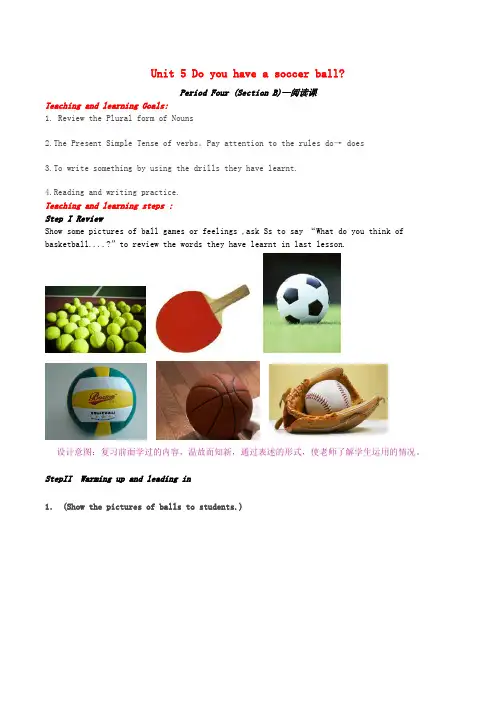
Show some pictures of ball games or feelings ,ask Ss to say “What do you think of
basketball....?”to review the words they have learnt in last lesson.
设计意图:复习前面学过的内容,温故而知新,通过表述的形式,使老师了解学生运用的情况。
StepII Warming up and leading in
1. (Show the pictures of balls to students.) tennis rackets basketballs
ping-pong balls and bats
T: I have two tennis rackets, three basketballs and four ping-pong balls and bats.This is my sports
collection.(Repeat the collection several times and teach the new word.)
人教版七年级Unit5Do-you-have-a-soccer-ball?导学案
====Word行业资料分享--可编辑版本--双击可删====
源-于-网-络-收-集 Unit5 《Do you have a soccer ball?》第一课时(1a-1c)导学案
【学习目标】:1、掌握本节课的9个单词和2个短语
2、学会句型Do you have -----?以及其回答Yes, I do. /No, I don't.
【学习重点】: 学会就有关人与物所属关系进行问答的句子。
【学习难点】:句型Do you have -----?以及其回答Yes, I do. /No, I don't.
【使用说明与学法指导】
依据学习目标充分预习本课,勾画出重点,标记出疑点,在充分预习的基础上,独立认真的研究导学案的内容。
【预习案】将25页1a部分单词与图中物品配对。
【听力风暴】听录音,把1a部分单词按出场顺序标号。
【探究案】
一.①Do you have a/an...? 你有...吗?该句是________引导的一般疑问句,句中的谓语动词____是一个实意动词。在英语中,句子的谓语动词如果是实意动词,常借助于_____来引起疑问,主语是第三人称单数的句子中用_____引起疑问。____或_____在这里没有实际意义,只是用来帮助构成一般疑问句。其基本句式为:Do/Does+主语+动词原形+...?
针对训练:
I have a basketball.(变一般疑问句)
He knows Li Ming。(变一般疑问句)
二.回答这种一般疑问句,首先用___或_____作出肯定或否定回答,肯定回答是“Yes,主语(代词)+do/does.”否定回答是“No,主语(代词)+don’t/doesn’t.”
1.——Do you know Jim?做肯否回答。
2.( )Do they have a volleyball?
A.Yes,they don’t B.No,they do C.Yes,they do D.No,they hasn’t
新目标英语七年级(上)Unit 5 Do you have a soccer ball?难点剖析
新目标英语七年级(上)Unit
you have a soccer ball?难点
重点词汇 tennis网球;ping—pong乒乓球;volleyball排球;basketball篮球;let允许,让;play打球;
sound听起来;many大量的;club俱乐部;more更多的;class班级,课;interesting有趣的;diffi—
cult困难的;boring无聊的;watch观看,注视;every每一;day(白)天
学习重点
1.谈论物主关系 当谈论某物属于某人时,除了第二单元学习的“Is this my/your/his/her/their…?”句型外,我们
还可以用have来表示所属关系。have作动词,意为“有”,其第三人称单数形式是has。例如:
He has a blue bike. 他有一辆蓝色的自行车。
I don’t have many friends. 我没有很多朋友。
Do you have a volleyball? 你有排球吗?
2.提出建议
1)向别人提出建议或请求允许,我们常常可以用Let’s…句型,意为“咱们做……吧”,后接动词
原形。
2)在回答这类句型时,赞同可以用“OK.”、“All right.”、“Yes,let’S…”、“That sound good/inter—
esting/great."或“That’S a good/great idea."等来回答;表示不赞成,可以用“Sorry,…”、“That sound
boring/difficult.”或“No,I don’t have…”等来回答。例如:
一Let’S play tennis. 咱们打网球吧。
一That sounds great. 听上去很棒。
一No,I don’t have a tennis racket. 不,我没有网球拍。
一Let’S have a cup of tea. 我们喝杯茶吧。
海门市第五中学七年级英语上册Unit5DoyouhaveasoccerballPeriod1Sect
1 Unit 5 Do you have a soccer ball?
Period 1 Section A 1a—2c
【课型】听说课
学习目标
1.能掌握本课重点词汇:do,have,ball,tennis,soccer,volleyball,basketball
2.能初步口头运用Do you have...?Does he/she have...?等句型询问物品的所属关系,并能作出相应回答。
3.能基本听懂含有本课重点词汇和目标语言的听力材料。
4.能通过谈论体育运动,增加同学间的了解和对体育运动的热爱。
学习过程
【自主学习】
1.请在课前会拼读下面的单词,并熟记。
do,have,ball,tennis,soccer,volleyball,basketball
2.你熟悉以下球类的英文名字吗?参照课本单词表,写一写吧!
【师生互动】
[新知呈现]
1.Play a game:guess “What is it?”
2.观看幻灯片,说出自己熟悉的球类的英文称谓。
3.Pair work:两人一组,用幻灯片呈现有关球的图片,互问对方:
—Do you have a/an...?
—Yes,I do./No,I don’t.
[新知学习]
Listen to 2a.
● While listening 1.Listen carefully and fill in charts.
Paul
Alan
Mike
Jane
Dale
2.Pair work:两人一组就上面的表格进行问答,以便巩固have的第三人称单数形式。
—Does Paul have a soccer ball?
—No,he doesn’t.
3.Listen carefully and fill in the blanks.
2 Conversation 1
七年级英语上册-Unit-5-Do-you-have-a-soccer-ball综合测试题
Unit 5
班别__________ 姓名 __________ 分数 __________
一、听力理解 (略)
二、单项选择 (每小题1分,共15分)
从A、B、C、D四个选项中,选出可以填入空白处的最佳选项。
( )26. — Do you have ________ tennis ball?
— Yes, it is under the desk.
A. a B. an C. the D. /
( )27. — Do you like ping-pong?
— Yes, I do. It is easy ________ me.
A. with B. after C. for D. on
( )28. — I can not spell his name.
— Let ________ help you.
A. me B. I C. he D. she
( )29. I can not play tennis. I think it’s _______.
A. easy B. interesting C. relaxing D. difficult
( )30. — Does he _______ a soccer ball?
— Yes, he does.
A. has B. have C. to have D. to has
( )31. I love sports. I play _______ after class.
A. them B. this C. they D. these
( )32. — Who’s that girl?
— She’s my __________. We are both (两者都) in Class Five.