
牛津上海版9A More practice-some facts about tea
Task 3 Read and complete Read Para.2 carefully, complete the table.
The history of __b_la_c_k_ tea
When It was invented in China__d_u_r_in_g__th_e_M__i_n_g_D__y_n_a_st_y____.
Part 2
Para. 2 Para. 3-4
Detailed examples
Familiar examples
Special examples
Part 1: para. 1
as popular as tea ?r
1. How many types of tea are mentioned? 2. What are they?
It is not surprising thatw_e_s_t_er_n_e_r_s_ drink mostly black tea.
Westerner=western + er
东方人?北方人?南方人?
easterner, northerner, southerner
Part 2: para. 2
Why Where Who
To keep tea _f_re_s_h_ when it _w_a_s__tr_a_n_sp_o_r_t_e_d____ long distances. To travel a long distance to reach places such as _U_K__, _C_a_n_a_d_a_a_n_d__A_u_s_tr_a_l_ia____.
The majority of + n.[C]+ v.[P]
The majority of + n.[U]+ v.[S]
Part 2: para. 3-4
1. How many types of tea are mentioned?
2. What are they?
3. What are their features?
New words
be transported to Tea is transported to different shops.
New words
caffeine n. /kæˈfiːn/ caffeinated adj. /'kæfɪəneɪtd/ Decaffeinated /diːˈkæfɪneɪtɪd/ Decaffeinated drink is processed to remove the caffeine.
bud
Picking tea/ Tea is picked
from tea plant.
leaf picked
What parts of the tea plant are used to make tea?
Bud and leaf.
New words
be processed into Leaves and buds can be processed into tea.
Task 4 Read and complete Read Para.3-4 carefully, complete the table.
Tea name
Features
Herbal tea
herbs, fruits, spices, etc.
Decaffeinated tea
Organic tea
Task 2 Guess and Match Read the passage quickly, divide the passage into two parts.
oolong tea black tea white tea green tea
Part 2: para. 2
What does Para.2 mainly talk about?
The majority of the damage is easy to repair.
4wb3de0l3sboaa0at%0lcrusma%l%ykdcdoakettogdfooenfteratfteirhstnaiehesdkpenrsa’iintrk.
The majority of + n.[Collective]+ v.[S]
has been processed to remove the caffeine without the use of any chemicals
Some facts about tea
Task 1 Read and Divide Read the passage quickly, divide the passage into two parts.
Paragraphs Main idea
Details
Part 1 Para. 1 General facts
Does the majority of the world drinks black tea?
the majority of…
The majority of the world drinks black tea.
The majority of students like green tea.
6077%00%%ofootffhteshtewuddoearndmtsage dridisnrekinasskgygrteroeenernetpetaeiar.
Unit 2 Tradition skills
More practice: Some facts about tea
What’s your favorite drink? What do you think of it?
Free talk
Some facts about tea
Tea drinks
milk tea
fruit tea
New words
Tea drinks are poopular = be____(enjoy)/(like) by a lot of people.
New words
What are they doing?
2013年新版沪教牛津英语上海版九年级上册单词表(按单元顺序)英英解释版
为什么做全英文版的初中词汇表?答复:打个比方,英汉词汇表就好比是一个人学走路时用的拐杖,在刚开始的时候可能还有点用,但如果要真正学会走路最终还是要扔掉拐杖,去接触英英解释的词汇表,去接触真实的英语环境。
使用英英词汇表还有以下好处:、节省你学词汇表的时间,提高你学词汇的效率,并且能够养成英英思维的良好习惯:你是用旧的英文单词理解新的英文单词,在记忆新的单词时,顺便已经复习了旧的单词;同时没有母语的影响,也就没有思维的转换过程,你的记忆效率非常会非常高。
、更加深刻地理解词汇(中文和英文并非就真能一一对应,很多词非常微妙,细微差别在中文翻译中体察不出来)、更加全面地掌握单词的各种搭配以及切合语境的应用(动词和介词如何搭配?形容词如何用更贴切?常用词一词多义,活学活用等问题都可以在字典里找到答案。
)。
在中考中,你能够非常非常精准的理解为什么要选哪个答案,而其它的答案不能选。
仅通过中文解释是看不出的,只能查英英词典,用英英方式去理解,才能真正找到根源。
本文由美英桥原创。
用英英理解太难了,如何才能更简单一点?答复:如果想过好英语,让初中三年的英语学习变得非常轻松,你一定要学会使用英英思维方式。
对于从来没有使用这种方式的初中生来讲,的确比较难,因为最熟悉的还是我熟悉的还是自己母语。
在第一步时,你可以借助中文去理解,但当有一定的基础后,你可以逐渐学会用英英的方式去记忆和理解单词。
为了能够更好的让你完成这种过渡,我们准备了以下的分享的文档:相关具体细节和相关完整的分享文档怎么没有,我如何获得?相关的文档由于篇幅或者上传限制的原因可能不完整,请发邮件至2487452826@索取(请注意要索取的文档内容)。
词汇表特别说明:由于篇幅所限,没有相关例句,如需要,请发邮件索取Excel有例句的文档。
牛津英语上海版六年级6A Unit 9教案设计(4课时)
Module 3 Food and drink Unit 9 Picnics are funFirst periodTeaching aims:Learning about different foodsMaking suggestions for a picnicCompiling a shopping listLanguage focus:Using modal verbs to make suggestionsUsing modal verbs to indicate preferenceUsing formulaic expressions to make suggestionsTeaching procedures:Pre-task preparation:Do a quiz: Ss work in groups of five. Write as many food names as possible.e.g. Aa apple, Be beef, Cc cabbage…While-task procedure:1. Look and learn: Look at the pictures, and learn some different foods.oranges, bread, pears, cola, spicy sausages, jam, apple juice, chicken wings, nuts, lemon tea, water2. Listen and circle: Listen to the tape, then circle the pictures of the foods. oranges, bread, cola, jam, apple juice, chicken wings, nuts3. Look and read: Look at the picture, read after the tape sentence by sentence. Then Ss read by themselves and read in roles.______ will be a fine day. It’s a good day for _______. So _______ plan to have a picnic. First they will _______ together. Peter would like to buy some _______. He likes ______ very much. Joe would like to have some _______. Alice wants to buy _______ and ______ because bread tastes ______ with ______. Jill would like to buy ______. Kitty would like to have ______.Post-task activity:1. Write a shopping list: Ss work in groups of five, and make a shopping list for thecoming picnic.2. Act it out: Ss talk in groups of five and make a short dialogue about the picnic. Then act it out.You can use these sentences:•Shall we buy some …?•Let’s buy some …•I’d like to have …•I’d like to buy …•… tastes nice with …Optional activity:1. Make a food dictionary:Ss work in groups, make some cards with food names starting with different letters. Then put all these cards in alphabetical order and make a food dictionary.e.g. apple, banana, carrot, …, peach, …, watermelon, …2. Plan a barbecue: Work in groups of five and make a plan and a shopping list. Suppose you are going to have a barbecue at Shanghai Forest Park this Saturday. What will you buy?Consolidation1. Workbook 6A, page 552. Read and recite P.62Second periodTeaching aims:Learning adjectives to describe tasteMaking suggestions for a picnicGiving reasons for choicesLanguage focus:Using formulaic expressions to make suggestionsUsing modal verbs to make suggestionsUsing adjectives to describe tasteAsking Wh-questions to find out the reasonUsing connectives to give a reasonTeaching procedures:Pre-task preparation:Odd one out: Ss look at the slide and odd out the different one from each group.Group 1 oranges pears strawberries lemon tea (lemon tea)Group 2 nuts biscuits cakes bread (nuts)Group 3 cola lemon tea apple juice chicken wings (chicken wings) Group 4 prawns fish chicken crabs (chicken)Group 5 milk ice cream fish balls frozen vegetables (milk) While-task procedure:1. Look and learn:a. Look at the fruits, odd out the different one. Learn adjectives: sweet, sour.b. Read different foods and learn adjectives to describe taste: cakes, sweet, nuts, salty, chillies, spicy, lemons, sour.2. Look and say:a. Look at the pictures, T invites some Ss to read the model dialogues first, then thewhole class read together:1) S1: Do you like vegetable salad?S2: Yes. I like vegetable salad.S1: Why?S2: I like vegetable salad because it is tasty. It’s sour, salty and sweet.2) S1: Do you like vegetable salad?S2: No. I don’t like vegetable salad.S1: Why not?S2: I don’t like vegetable salad because it is too salty.b. Practise the dialogues: Ss work in pairs, and then make dialogues about fourfoods according to the model.Look at the picture, answer the question: How does coffee taste? Learn the adjective: bitter. Then think and answer the other question: Why do we add sugar to coffee? Try to get the answer: To make it sweet.4. Look and read: Look at the pictures, read after the tape sentence by sentence. Then Ss read by themselves and T invites some Ss to read in roles.5. Read and answer: Answer some questions according to the text.•What kind of juice are they going to buy? Apple juice or orange juice?•Why does Peter like apple juice?•What kind of fruit are they going to buy?•Why does Jill like oranges?•Does Joe like eating spicy sausages? Why or why not?•What does Joe think of chicken wings?Post-task activity:1. Act it out: Ss work in pairs and role-play the text.2. Look, read and write: Look at the pictures, fill in the blanks to complete the dialogues, then read them.3. Do a survey: Ss work in groups of five and survey group members what kind of meat / fruit/ drink/ vegetables/ seafood they would like to eat and why they like1. Find out: Ss can walk round the classroom. Try to find what flavour the people indifferent places have. E.g.: Cantonese (sweet), Shanghainese (sweet and salty), Sichuanese (spicy)2. Make comments:Ss look back at the survey form. Use the cues in the box to make comments on group members’ favourite food. Then T invites some Ss.You can use these sentences:•It’s good for ___’s health.•It’s bad for ___’s health.•It’s too sweet.•It’s too sour.•It tastes bitter.•It is tasty/ terrible.Example: Joe likes chicken, cabbage, kiwi, cola and squid best. Chicken is salty and tasty. But too much is bad for our health. Cola is sweet but I think it’s too sweet. Kiwi is sour and sweet. I also like it very much. It’s good for our health …Consolidation1. Workbook 6A, page 572. Read and recite P.63Third periodTeaching aims:Reading a poem about suggestions for a picnicMaking suggestions for a picnicCompiling a shopping listGiving reasons for choicesLanguage focus:Using modal verbs to make suggestionsUsing adjectives to describe tasteAsking Wh-questions to find out a reasonAsking Wh-questions to find out specific informationTeaching procedures:Pre-task preparation:Look and think: Ss look at the pictures and think what they are probably doing. Try to get the answer: They are having a picnic.While-task procedure:1. Read a poem: Play the cassette of the poem, Ss listen and repeat sentence by sentence. Then T invites individual Ss to read a verse each.according to each poem.1) Shall we have a picnic?Shall we have some bread?Let’s buy some bacon to make some sandwiches.Shall we have a picnic?Shall we have some cakes?Let’s buy some butter to put on the cakes.Shall we have a picnic?Picnics are nice.Let’s buy some soft drinks and a big packet of nuts.2) Shall we have a birthday party for Mum?Shall we have a birthday cake?Let’s buy some candles to put on the cake.Shall we have a birthday party?Shall we have some noodles?Let’s buy some sausages to put on the noodles.Shall we have a birthday party?Birthday parties are wonderful.Let’s buy some sweets and a big bag of fruit.3) Shall we have a barbecue?Shall we have some chicken wings?Let’s buy some honey to make the chicken wings nicer.Shall we have a barbecue?Shall we have some potatoes?Let’s buy some tomato sauce to make the potato nicer.Shall we have a barbecue?Barbecues are fun.Let’s buy some cola and a big bag of ice!4. Look, speak and write:a. Ss work in groups of three, make a dialogue to find out what food and drink theyand their classmates like/ dislike. And complete the shopping list.b. T asks groups to say a dialogue and invites individual Ss to read their shoppinglists.Post-task activity:1. Read and learn: Ss look at the slide, read the sentences from the poem to learn “... to do sth.”e.g. Let’s buy some jam to spread on the bread.Let’s buy some jam.We can spread the jam on the bread.Then rewrite some sentences and read together.2. Write a poem: Re-read the poem on page 64. Write a similar one with other food names. Then T invites some Ss to read their poems in class.Optional activity:Write: Suppose your mother’s birthday is coming. You are going to have a birthday party for her. Write 6 to 8 sentences about the preparation.Consolidation1. Workbook 6A, page 562. Read and recite the poemFourth periodTeaching aims:Reading about pricesCompiling shopping lists with quantities and pricesLanguage focus:Asking How questions to find out quantitiesTeaching procedures:Pre-task preparation:1. Think and say: Ss look at the pictures, answer the question: What do we need to have a picnic? (We need a good day / a nice place / some food / some plates and cups / enough money.)2. Discuss and say: Ss have a discuss and answer following questions:• What kind of weather is good for a picnic?• Where can you have a picnic?• What would you like to have at the picnic? Why?• What wouldn’t you like to have at the picnic? Why not?• How much money do you need for your picnic?• Who will give you the money for the picnic?While-task procedure:1. Look and talk: Look at the pictures, T invites some Ss to read the model dialogues first, then the whole class read together:1) S1: How much are the chicken wings?S2: They are fifteen yuan.2) S1: How much does a packet of chicken wings cost?S2: A packet of chicken wings costs fifteen yuan.Practise the dialogues: Ss work in pairs, and then make dialogues according to theSs read by themselves and T invites some Ss to read in roles.3. Answer questions: Look at the picture and questions, then answer them.∝ How much do these food items cost?They cost __________ yuan.∝ How much money have they got?They have got _________ yuan.∝ Have they got enough money?∝ How much money do they need from Mr Li?They need _________ yuan from Mr Li.Post-task activity:1. Choose and write: Ss work in groups, look at the picture and choose five items they want to buy with ¥80 for a picnic. And complete the table.2. Read and write: Ss read a short passage, then fill in the blanks.Paul’s family are going to have a _______ in Century Park this weekend. ¥ Total: ¥ ¥¥ ¥ ¥ Price Item_________ is Paul’s favourite because it’s a little ________ and ________.His father likes bacon best. His mother is going to buy some _________ and ________. She thinks they are ________ for our health.Optional activity:1.Listen and write: Look at the menu and listen to five short conversations. AfterM: I’d like a b aked potato, a steak and a corn soup.W: W ould you like something to drink?M: N o, thank you. (¥ 43)2) W: Are you ready to order?M: Y es, I’ll have the fried fish, please.W: W ould you like anything else?M: I ced tea, please. (¥ 28)3) W: May I take your order?M: I’d like a steak and a chicken salad, please.W: W ould you like some dessert?M: Y es, I’ll have the apple pie.(¥ 40)4) W: Are you ready to order?M: Y es, I’ll have the chicken wings and a steak. I also want a seafood soup.W: W ould you like anything to drink?M: A hot coffee, please. (¥ 56)5) W: May I take your order?M: W hat’s your special today?W: W e have very good steak. It’s very delicious. Would you like to try it?M: O K, I’ll have the steak and I also want a green salad.W: W ould you like anything to drink?M: Y es, orange juice, please. (¥ 45)2. Look and act: Ss read the menu again and role-play the waiter/waitress and the customer. The waiter/waitress should tell the total price at the end of each conversation.You can use these sentences:•May I take your order?•Are you ready to order now?•What’s special for today?•That’s … yuan in all.Then T invites some Ss to act it out.Consolidation1. Workbook 6A, page 602. Read and recite P.65Fifth periodTeaching aims:Giving reasons for choicesWriting reasons for likes and dislikesLanguage focus:Using modal verbs to ask permissionAsking Wh-questions to find out specific informationUsing connectives to give reasonsUsing formulaic expressions to decline an offerTeaching procedures:Pre-task preparation:1. Look and say: Ss read the model patterns first.Then practise in pairs according to the pictures. T invites some pairs.Model: 1) S1: Would you like some nuts?S2: Yes, please.S1: Why do you like to have nuts?S2: Because they are tasty.2) S1: Would you like some chocolate?S2: No, thanks.S1: Why not?S2: Because it’s too sweet.2. Think and act: Ss look at the seven slides, practise the sentence pattern “Would you like…?”While-task procedure:1. Look and say: Look at the pictures, and practise the dialogue.S1: May I have some cola?S2: OK. Here you are.S1: May I have prawns?S2: Sorry, I haven’t got any.2. Act out: Ss work in pairs, make dialogues according to the pictures.3. Listen and say: Listen to the tape, and then read sentence by sentence. Then Ss read by themselves and read in roles.4. Act out the story: With a classmate, choose different food or drink. And act out the1. Read and answer: Ss read one text, then answer questions.Mandy: Today is a good day for our barbecue.Judy: Yes! It’s hot and sunny. There’s no rain and there’s no wind.Kally: This is a good place.Eddie: Let’s make a fire.Danny: It smells good!Eddie: Our meat will be ready soon.Peter: May I have some corn, please?Judy: OK. Here you are. Why do you like corn?Peter: I like it because it’s delicious.Mandy: Would you like some orange juice?Peter: No, thanks. I don’t want any orange juice.Mandy: Why not?Peter: It’s sour.Mandy: I like orange juice. I think it’s sweet.Questions:•What are the children doing?•What’s the weather like today?•What do they do first?•What are Danny and Eddie talking about?•What does Peter want to eat?•Why does he like it?•Does Peter like orange juice? Why or why not?•What does Mandy think of orange juice?2. Write: Ss think and write 6 to 8 sentences on the topic “_______ is/are fun”. Y ou may choose…–Barbecues are fun.–Picnics are fun.–Food festivals are fun.–Our school life is fun.–…Consolidation1. Workbook 6A, page 59 and 612. Read and recite P.66。
沪教牛津版 9AU1-2 Listening and speaking课件
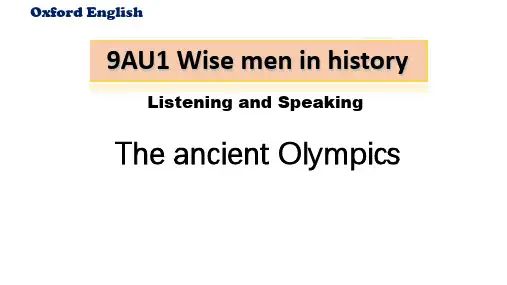
allowed to watch the Olympics. But
Helen wanted to watch her son run.
What
Helen dressed as a soldier to attend the
Olympics and watch her son run, but she
• someone has done an exciting thing
• someone has seen or done something unusual
• an animal or a pet can do unusual things
cyat the pictures below. Can you name the sports?
volleyball
basketball
baseball
Look at the pictures below. Can you name the sports?
tennis
notes: next slide
Who Helen Why
Helen at the Olympics
What
When Where
Who Helen
Why
Helen at the Olympics
In ancient Greece, women were not
allowed to watch the Olympics. But
You may check your answers.
B Listen to the recording again and then complete the notes below. Write one word to each blank. (Page 6)
2014新深圳广州上海牛津版英语九年级上册Unit7 The adventures of Tom Sawyer

2014新深圳广州上海牛津版英语九年级上册课文知识点讲解Unit7 The adventures of Tom SawyerReading部分1.On Saturday morning,every boy in the town was happy,except Tom Sawyer.except在此处用作介词,意为:除......之外,表示同类事物之间的关系,不能放在句首。
其后可接名词、代词、副词、介词短语和动词不定式。
We have classes every day except Sunday.辨析:except,besides,but与except forexcept 除去...,除...之外强调从整体中除去部分,except后面的部分不包括在整体内。
besides 除...之外还有强调除去一部分还有另外一部分,besides后的部分包括在整体内。
but 除了多与on one,nobody,all,who等连用,其余情况下可与except互换。
except for 除去...之外表示对一个人或者事物先进行一个整体评价,再就局部或细节提出看法或修正。
I know nothing about the young lady except that she is from Beijing.All but him have gone to Japan.His article is very good except for a few spelling mistakes.There are three more visitors me.He had considered everything the weather.one old lady, the bus was empty.2.He painted one board and surveyed his progress, and then he sat down to have a rest.1)survey 及物动词,意为:查看,审视The engineers surveyed the building.She turned to survey her daughter’s pale face.【拓展】survey 作动词,还可意为:调查;作名词,意为:调查,测量Business Development Advisers surveyed 211 companies for the report.In a survey from 2000, satisfaction levels in Japan were only half those in America.Please make a survey about your favorite festival and fill out the form.2)progress 不可数名词,意为:进展make progress 取得进展make great progress取得很大进步After some period of practice, you will make great progress.He (make) great progress in English since he came into the college.3)rest 名词,意为:休息have/take a rest 休息一下rest作名词,还意为:剩余部分,余下的人或物the rest of 剩余的....rest也可作动词,意为:休息The workers stopped to have a rest. We rested for an hour after lunch.The rest of the apples have gone bad.3.Tom began to think of the games that he wanted to play.think of 意为:想象到,想出,考虑。
沪教牛津版9BU2-2 Extensive reading课件

seven
public school and private school
two
Chinese, Maths, English, Science, Art, Music, PE
Physics, Chemistry, Biology, History, Geography, etc.
4
Let’s read more about the education in other countries and find out which country would you like to go.
4
Discuss the following questions with your classmates.
If you have the chance to be an exchange student abroad and spread Chinese culture, which
country would you like to study in? Why?
More practice
Education in UK
1
You are going to know the education in the UK.
You can compare the schools in
2 China and the UK.
You can talk about the school you
Selective: Make a PPT about your report and share with the class.
Thank you
Live and learn.
student in…because… First,…Second,…Third,…
牛津上海版七年级上Unit9基础知识练习学案
七年级上U9基础知识练习学案Ⅰ. Choose the best answer. (15分)( )1. The Shanghai Expo 2010 opened ______________ May 1st, 2010.A. untilB. onC. inD. at( )2. --Mum, can you tell me how to cook fish?--_____________.A. Yes, pleaseB. Of courseC. Thank youD. You'rewelcome( )3. There are different kinds of foods _____________ many countries in the world.A. inB. fromC. ofD. for( )4. The SPCA needs some money to take care of _____________ animals.A. homedB. homelessC. missingD. lost( )5. I ____________ that there will be a sports meeting in our school.A. have heardB. hear ofC. hearD. listen( )6. Let's ask the maths teacher _______________ u s.A. to helpB. for helpingC. helpD. helping( )7. The porridge isn't sweet enough, so we need to ______________ some sugar.A. addingB. be addedC. addD. put( )8. _____________ , mix the butter and the flour.A. OneB. First oneC. FirstlyD. The first( )9. The _____________ rice is popular in our school.A. fryB. friedC. fireD. fired( )10. What are we going to do to raise money ____________ them?A. forB. aboutC. toD. in( )11. Chinese people usually eat noodles _____________ chopsticks.A. byB. withC. inD. for( )12. The famous singer is going to hold a concert to somemoney____________the sick children.A. raise; toB. rise; onC. raise; forD. raise; at( )13. Raisin scones are __________ food. Most children in my class like them.A. AmericanB. ChineseC. EnglishD. Thai( )14. I'll take this red coat. ___________ does it cost?A. How manyB. How longC. How muchD. How far( )15. —_______ shall we have our English party?—In the hall.A. WhatB. WhenC. WhyD. Where Ⅱ. Complete the sentences with the given words in their proper forms. (5分)1.You can see different _______________ of fish in the Ocean Park. (kind)2.My sister is ill. I have to take care of _______________ at home. ( she)3.Because of the terrible flood, many people became _______________ . (home)4.Don't eat too much ______________ food. It's bad for health. (fry)5.The English boy likes to eat _____________ food very much. (China)Ⅲ.Rewrite the following sentences as required. (10分)1. I can show you how to make the paper plane. (改为一般疑问句)____________ ____________ ____________ me how to makethe paper plane?2.We are going to have a picnic on the beach tomorrow. (对划线部分提问)_____________________are you going to _____________ on the beach tomorrow?3.Tom would like to buy two moon cakes. (对划线部分提问) ___________________________ ____________ Tom like to buy?4.Can I help you, sir? (保持句意不变) ___________________________ ____________ Ido for you, sir?5.We've sold out the moon cakes. (保持句意不变)We ____________ have ___________ mooncakes left.Ⅳ. Reading comprehension. (30分)A. True or false. (5分)In many English homes people eat four meals a day: breakfast, lunch, tea and dinner. People have breakfast at any time from seven to nine in the morning. They eat porridge, eggs or bread. English people drink tea or coffee at breakfast.Lunch comes at one o'clock. Afternoon tea is from four to five in the afternoon and dinner is about half past seven. First they have soup, and then they have meat or fish with vegetables. After that they eat some other things, like bananas, apples or oranges. But not all English people eat like that. Some of them have their dinner in the middle of the day. Their meals are breakfast, dinner, tea and supper and all these Steals are very simple.( )1. Many English people have four meals a day.( )2. English people may have porridge, eggs, bread, tea or coffee for their breakfast.( )3. English people have lunch at one.( )4. All English people have some soup and meat for their dinner.( )5. In many English homes dinner comes in the middle of the day.B. Choose the best answer. (5分)The customs in different countries are rather different. If I have dinner with a Chinese host, he always puts more food onto my plates as soon as I have emptied them. It often discomforts me greatly. I have to eat the food even if I don't want to, because it is considered bad manners in the West to leave one's food on the plate. I have already noticed that when a Chinese friend sits at an American's dinner party, he often refuses the offer of food or drink though he is in fact still hungry or thirsty. This might be good manners in China, but it isn't in the West at all. In the US it is impolite to keep asking someone again and again or insist on him accepting something.Americans have a direct way of speaking. If they want something, they will ask for it. If not, they will say "No, thanks". When an American is fed with beer by the host, for example, he might say, " No, thanks, I'll take some Diet. Pepsi-Cola if you have it. " That is what an American will do. So when you go to the US, you had better remember the famous saying, " When in Rome, do as the Romans do. "( ) 1. From the passage, we know that the Chinese are usually_______________to the guests.A. eager to give all they haveB. politeC. impoliteD. cold( )2. When a foreigner has dinner with a Chinese host, he often feels _______________ .A. pleasantB. uncomfortableC. satisfiedD. happy( )3. Why does a Chinese friend often refuse the offer of food or drink at a dinner party?Because ______________ .A. he has had enoughB. he is shyC. he is afraid that others will laugh at himD. he thinks it's polite to do that( )4. When an American wants something to eat or drink at dinner, hewill_______________.A. go and take it himselfB. refuse the host'sofferC. ask for it directlyD. ask another to fetch it for him( )5. "When in Rome, do as the Romans do. " means _______________ .A. when you get to Rome, you should act as the Romans doB. when you stay in Rome, you should do as the Romans doC. when you are in a new country, you should do as the natives doD. Romans can be an example for youC. Choose the words or expressions and complete the passage. (10分)A poor traveler arrived 1 a small village. He had no food 2 money, He only had a cooking pot. He made a small cooking fire, placed his pot on it, and poured in some water. When a few villagers asked 3 he was doing, he said that he was making stone soup which was a recipe passed down from his father. He then dropped a round stone into the pot.Then the traveler told the villagers stories of his travels and the 4 things he'd seen. He 5 his soup and said it was nice, but a bit of salt would be better. One villager went home and came back with some 6 for the soup.A few more villagers stopped to see what was going on when they heard the traveler speaking. The traveler told 7 stories and said that some carrots or onions would be nice to the 8 soup. So another villager said he could give a few carrots and brought them from his home.This continued with the traveler 9 onions, 10 meat, celery (芹菜) , potatoes to the soup.Finally, the soup was OK and everyone enjoyed the tasty meal.( )1.A. at B. in C. on D. under ( )2.A. and B. but C. or D. for( )3. A. how B. when C. what D. where( )4. A. exciting B. excited C. interested D. happy( )5. A. tasted B. drink C. smelled D. touched( )6. A. salt B. salty C. salts D. sugar( )7. A. much B. more C. many D. lot( )8. A. beautiful B. delicious C. tasted D. nice( )9. A. ask for B. asked for C. asking for D. asking at( )10. A. a bit of B. a few C a bit little D. manyD. Read the passage and fill in the blanks with proper words. (5分)People eat different things in different parts of the w 1 .In some countries, people eat rice every day. Sometimes they eat it two or three times a day, for breakfast, lunch and supper. They u 2 eat it with meat, fish and vegetables.Some people do not eat some k 3 of meat. Muslims(穆斯林), for example, do not eat pork. In western countries such as Britain, Australia and the U. S. A. , the most p 4 food is bread and potatoes. And people can cook potatoes in d 5 ways. Some people eat only fruit and vegetables. They don't eat meat or fish or anything that comes from animals. Some people say that food from plants is better for us than meat.1. _________2. _________3. _________4. ________5. ________E. Answer the questions. (5分)I have been in England for three months now. I hope you don't think I've forgotten you. There are so many places to see and so many things to do that I've not had much time for writing letters.I shall soon be starting my studies at King's College. So far I've been learning about England and British ways of living. I won't tell you about London. There are plenty of books you can read and lots of pictures you can look at. I'm sure you'll be more interested to know what I think about life here.I find some of the customs new and interesting. People here do not shake hands as much as we do on the European continent. During the first weeks I was often surprised because people did not put out their hands when I met them. Men raise their hats to women but not to each other.1.Who do you think wrote the letter, an American, a British or a French?2.What did the writer of the letter go to London for?3.Why didn't the writer reply soon after he arrived?4.British people don't shake hands as often as European people, do they?5.Are women respected by men in Britain?Ⅴ.Writing. (15分)Write at least 60 words about the topic"My Favourite Food".(以“我最爱的食物”为题写一篇不少于60词的短文,标点符号不占格)参考答案Ⅰ. 1-5 BBBBA 6-10 ACCBA 11-15 BCCCDⅡ. 1. kinds 2. her 3. homeless 4. fried 5. ChineseⅢ. 1. Can you show 2. What; do 3. What would 4. What can 5. don't; anyⅣ.A. 1-5 TTTFTB. 1-5 BBDCCC. 1-5 ACCAA 6-10 ABBCAD. 1. world 2. usually 3. kinds 4. popular 5. differentE. 1. A French.2. To learn England and British ways of living.3. Because there are so many places to see and so many things to do that he has not had much time for writing letters.4. No, they don't.5. Yes, they are.Ⅴ.略。
牛津沪教版九年级下册英语Unit2 课时6 More practice~Culture corner
六、任务型阅读。【2021·太原小店区志达中学一模】
25. Pleasetranslatetheunderlined (画线的) sentenceintoChinese. ____________________________________________
whetheryou'reinanintervieworgivingatalkinfrontoftheclass. 28 Four. /4.
29 Theyusuallyhaveagroupdiscussioninclass.
能力提升练
答案呈现
30 Yes, Ihave. Ithinkit'sawonderful/valuable/excellent/…experience, becauseyoucannotonlypracticeyouroralEnglishbutalsoim proveyourconfidence. /…
A. educationB. invitation
C. informationD. imagination
四、根据汉语意思完成句子。 16. 每个问题都以同样的方式解决了。 Everyproblemisworkedout__________________.
inthesameway
17. 我的好朋友玛丽邀请我参加一些课后活动。 MygoodfriendMaryinvitedmetotakepartinsome __________________.
manage, especial, everyday, whatever, uniform
沪教牛津版八上英语 Unit 3 课时6 More practice~Culture corner
Todayitisused_______33manyways. Itreally______34theworldlargewealth(财富)andhappiness. 33. A. inB. withC. awayD. over 34A. A. takesB. helpsC. getsD. brings
10 busiest
答案呈现
11 A 12 D 13 C 14 A 15 A
基础巩固练
答案呈现
16 on
21 alotof
17 advice
22 Typein
18 health
23 Hereiepopularthan
20 became
25 onhowto
基础巩固练
______40astudentinthetwenty-firstcentury, youmustworkhardatit. 40. A. ForB. BeC. AsD. To
C
八、任务型阅读。
Thespeechtellsfouradvantagesaboutgo ingonline. First, itmThaeksepsoeeucrhlivteelslsinftoeurresatdinvagnatnadgmesaakbeosuut s_______41ourlives. going online. First, it makes our lives enjoy
A. olderB. oldest C. youngerD. youngest
13.【中考·扬州】—Ican’taffordthewhitedress.
—Whatabouttheorangeone? Thepriceisalittle______.
Unit+9+Writing+课件+2023-2024学年牛津上海版英语六年级下册
Action(s) _4__________ Make full use of water.
Look and write
How can we make full use of water?
HWeasishwvaesgheitnagbltehsewviethgethtaebwleastewrituhstehde(w用at过er的u)sefdo(r 用 过cle的an)infogrrciclea. ning rice.
• We can save water by _w_a_s_h_in_g__m_o_p_s_w_i_th_t_h_e_w_a_t_er_u_s_e_d_f_o_r _w_a_s_hi_n_g_v_egetables. • We can save water by _w_a_s_h_in_g__ve_g_e_t_ab_l_e_s_w_it_h_t_h_e_w_a_te_r_u_s_e_d_f_or_c_l_ea_n_ing rice. 2. Change our bad habits of using water. • _W_e_c_a_n_s_a_v_e_w_a_t_e_r b_y__n_ot_u_s_i_ng__th_e_w__as_h_i_n_g_m_a_c_h_in_e_w__he_n__it_is__on_l_y_h_a_lf_-f_u_ll. • _W_e_c_a_n_s_a_v_e_w_a_t_e_r b_y__b_ru_s_h_in_g_o_u_r_t_e_et_h_w_i_th__th_e_t_a_p_o_ff_. ______________ 3. Check the taps regularly(定期地). • _W_e_c_a_n_s_a_v_e_w_a_t_e_r b_y__tu_r_n_in_g_o_f_f _a_d_ri_p_p_in_g_t_a_p._____________________ • _W_e_c_a_n_s_a_v_e_w_a_t_e_r b_y__fi_xi_n_g_a_l_e_ak_y_(__漏_水__的_)__ta_p_. ___________________
沪教牛津版 9AU4-2 Grammar课件
OC
( e)3. She will come at 10 p.m.
( c)4. I had some meat. A
O ( b)5. Learning English is useful.
C ( g)6. My dad bought me a book.
IO DO
( f )7. He put the book on the shelf.
My father bought a watch for me. (3) The man left the woman a letter.
The man left _a_l_e_tt_e_r_f_o_r _th_e__w_o_m__a_n__.
(4) The mother gave her daughter a birthday present. The mother gave __a_b_i_rt_h_d_a_y_p_r_e_s_en_t__to__h_er__d_a_u_g_h_te_r_.
O
A
Grammar—Sentence elements and structures
3. Complete the following sentences with to or for.
(1) Give these papers __to____ my secretary. (2) Could you make some coffee __f_o_r__ me? (3) Book a flight __f_o_r__ me, will you? (4) Can you post this cheque ___to___ the hotel? (5) Don’t show these plans __t_o___ anyone. (6) Fetch the file __f_o_r__ me, will you? (7) Write a memo ___to___ all the managers.