
2019秋人教版九年级英语上册 Unit 4 Grammar Focus
如何变一般 疑问句? 句首加Did, used还原, 句末加问号; 第1人称变 第2人称。
二、新课讲解
You used to be short, _d_i_d_n_’t_ _y_o_u___. (变反意疑问句) Yes, I did. (肯定回答) (是的,我很。) Your mother didn’t use to like bread, _d__id_ _s_h_e__? No, she didn’t. (否定回答) (是的,她不喜欢。)
三、归纳小结
四、强化训练
1. My sister _______ be lazy. But now she’s working really hard.
A. used to
B. is used to
C. was used to
2. There ________ a lot of trees here, but now it has become desert.
A. drive; taking B. driving; taking C. driving; take
四、强化训练
1. There used to be a lot of trees here. (改为反意疑问句) There used to be a lot of trees here, _d_i_d_n_’_t _th_e_r_e__?
二、新课讲解
I used to be short. (变否定句) I _d_i_d_n_’t_ _u_s_e__to be short.
如何变否 定句? used前加 didn’t, used还原。
二、新课讲解
I used to be short. (变一般疑问句) _D_i_d_ you _u_s_e__to be short? Yes, I did. (肯定回答) No, I didn’t. (否定回答)
五、布置作业
1. Write down 3-5 sentences with “used”,“didn’t use”. 2. Preview the new words and expressions in Section B.
2. She used to hang out with her friends. (改为否定句) She _d_id_n_’_t _u_se__ to hang out with her friends.
3. 她过去常和朋友们闲逛 She __u_s_ed_ _t_o_ hang out with her friends.
九年级英语RJ版·上册
Unit 4
Grammar Focus
授课人:XXXX
一、新课引入
He didn’t use to like talking, but now he is humorous.
二、新课讲解
I used to be short.
I didn't use to be popular in school.
A. is
B. have
C. used to be
D. used to being
3. — Did your father use to _______ to work?
—Yes, but now he likes using public transportation. He is used to _______ the bus.
Paula used to be really quiet.
She didn't use to like tests.
You used to be short, didn't you? Yes, I did./No, I didn't.
Did he use to wear glasses?
Yes, he did. / No, he didn't.
英语人教版九年级全册Unit 4 SectionA Grammar Focous

Unit 4 I used to be afraid of the dark.SectionA Grammar Focous【教学目标】1.复习used to的用法;运用used to描述自己的变化;感受自己的变化,努力找出原因,让自己变得更好;完成本课写作任务。
2.掌握生词和短语,并且能运用本课生词和短语造句。
3.提高学生语言运用能力,尤其是写作能力。
.【教学重点】运用used to描述自己的变化1.重点短语:used to do sth .过去常常做某事, adj.+ enough to do sth 足够。
做。
, on the …team在…队里,from time to time时常,有时, I agree我同意, see sb. doing sth看见某人做…. take up开始从事,开始做,学着做,deal with对付,应付, dare to do sth.敢做…, not …anymore 不再, be able to能,会, all the time一直, hang out闲逛, give up(doing)放弃做某事, be prepared to do sth. 做好做…的准备,the road to success成功之路, think about思考, a small number of少数, be absent from.缺席, make a decision决定做某事, send sb. to…把某人带到.., so many如此多, advise sb.(not)to do sth. .建议某人(不)做某事, in person 亲自, even though即使, to one’s surprise令某人惊奇的是, take care of=look after 关心,照顾, take pride in/ be proud of对…感到自豪, try to do sth 尽力做…, such a great idea.如此好的一个主意, in public在公共场所,公开地, be careful about小心,当心, do well in/be good at擅长…, be nervous about对…害怕, worry about担心, make it获得成功, atleast 至少, have problems with sb给某人惹麻烦. change one’s life改变了某人的生活pay attention to 对…多加注意, in the end =at last最后, have a great influence on sb 对某人有很大的影响change a lot有很大的改变, in the last/past few years在过去的几年里2.重点语法:used to do sth.的用法。
人教版英语九年级全册Unit4 Section A(Grammar Focus-4c)精品教案
Unit4 Section A〔Grammar Focus-4c〕一、教学目标:1. 语言知识目标:1) 学习掌握以下词汇:European, African, British, speech, public, in public2〕进展一步复习稳固学习Section A 局部所学的生词和词组。
3〕掌握如何表达过去常常做的事情或状态的句型。
4) 掌握used to的不同句型用法,并通过不同方式的练习,来熟练运用这些句型。
2. 情感态度价值观目标:让学生明白事物是在不断开展、变化的道理,培养学生积极向上的心态。
二、教学重难点1. 教学重点:1) 复习稳固Section A 局部所学的生词和词组,到达熟练运用的目标。
2) 总结used to 的不同句型。
2. 教学难点:1) 学习运用表达过去常常做的事情或状态的句型2) 掌握used to的用法。
三、教学过程Ⅰ. Warming up and revision1. Have a dictation of the new words learned in the last class.2. Review some main phrases we learned in the last class. Check the homework.3. Let some Ss tell something about the Candy Wang.① Candy Wang’s background.② The change of Candy Wang’s life③Candy Wang’s advice to young people who want to succee d.Ⅱ. Grammar Focus.1. 学生阅读Grammar Focus中的句子,然后做填空练习。
①我以前是矮个子。
I ______ ____ be short.②我以前在学校常不受欢送。
人教版初中英语九年级上册GrammarFocus[4]-课件
![人教版初中英语九年级上册GrammarFocus[4]-课件](https://360docs-1393072327.cos.ap-beijing.myqcloud.com/2326ca43a66e58fafab069dc5022aaea988f416a.webp)
在回答由must引起的问题时, 如果是否 定的答复,不能用mustn’t, 而需要用 needn’t或don’t have to, 因为mustn’t是 “一定不要”的意思,表示禁止。
-- Must I hand in my homework now?
(客观上需要做这件事)
He said that they must work hard. (主观上要做这件事)
有时两者都可以用, 意思差别不大。
We must / have to leave now. must在表示说话人对事物的推测时,它
比may肯定得多, 相当于汉语的“一定”或 “准是”。(只有在肯定句中能这样用。)
一. can和could的区别和用法
1. can表示体力和脑力方面的能力, 或根据客 观条件能做某种动作的“能力”。
Can you speak English? can用在否定句和疑问句中时有时表示说 话人的 “猜测”或 “不肯定”。 Can the news be true? (在日常会话中, can可代替may表示“允 许”, may比较正式)
May you have a pleasant journey. 一路平安。
2. might的用法: a. might可以代替may, 表示现在时间的动
作,但语气较为婉转客气或更加不肯定。 Might I offer a suggestion? b. might用来表示现在时间时, 还可表示”
规劝”。
-- No, you needn’t.
情态动词表示推测可以分为以下几种情况: ★情态动词+ do 此结构表示对现在或将来情况的推测和判断
—Do you know where she is now?
Unit4SectionAGrammarFocus3c课件人教版英语九年级全册
A. has to B. need to C. used to D. ought to
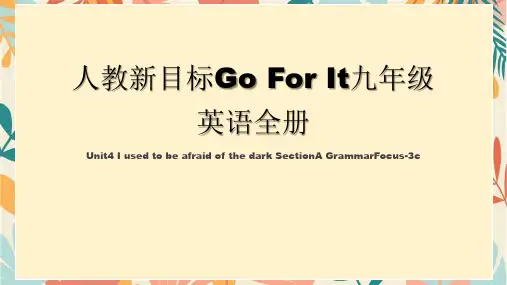
二、按要求改写句子。
If a thing is worth doing it is worth worth doing well
1. Martin used to give his mother a lot of trouble.(改为否
Did he use to wear glasses? Yes, he did./No, he didn’t.
过去常常...
used to be+ adj./adv used to do sth.
只用于一般过去时, 没有 人称和数的变化;to后跟 动词原形。
If a thing is worth doing it is worth worth doing well
定句)didn't use
Martin____ ____to give his mother a lot of trouble
2. They used to do homework after dinner.(改为般疑问 句)
D_o__they _u_s__eto do homework after dinner.
4b Look at the information and write sentences about Emily.
Answers:
If a thing is worth doing it is worth worth doing well
•Emily didn’t use to eat a lot of vegetables, but now she loves carrots and tomatoes.
英语人教版九年级全册Unit4 Grammar Focus

学
反
思
本节课用学生的照片和学生自己拍摄的视频引入并呈现主要句型,学生比较感兴趣,同时也调动了课堂氛围。为后面内容的学习奠定了一定的基础,师生互动环节开展的也不错,本节课学生能积极参与课堂活动,踊跃发言,充分体现了学生在课堂上的主体地位。
(2)Give each group a topic.
Step 6 Practice
(1)Continue to show the pictures of the little boy with“used to...but now...”
(2)Finish 4b. Look at the information and write sentences about Emily.
I used to be short.
She didn’t use to like tests.
You used to be short, didn’t you?
Did he use to wear glasses?
—Yes, he did. / No, he didn’t.
Be afraid of…Be still afraid of
学生继续大量练习句型“used to”和“didn’t use to”.为学生完成下一个环节的4a做好铺垫。
顺利完成4a的任务。
由两岁小孩曾经害怕和依然害怕的两件事情如:怕黑,怕孤单。自然引出本环节的句型“used to be afraid of”and“be still afraid of”并进行训练。
Talk about the pictures.
Practice the sentence structer:“used to...but now...”
初中英语人教版九年级全册《Unit4SectionA(GrammarFocus-4c)》课件

3. 你表妹以前惧怕独自一人,不是吗? Your cousin __u_s_e_d__ __to__ be afraid of _b_e_i_n_g_ alone, _d_i_d_n_’_t_ she?
4. 珍妮以前在学校里并不受欢迎。 Jenny _d_i_d_n_’_t __u_s_e_ _t_o_ be popular in school.
/ju:st/
拓展: “be used to”
be used to + sth./doing sth.
对……已感到习惯,或“习惯于”,
to是介词,后需加名词或动名词。
I
am (not) used to
You /We/They are (not) used to the hot weather. drinking coffee.
1. Emily used to listen to pop music, but now she enjoys country music.
2. Emily used to watch scary movies, but now she hates scary movies.
3. Emily didn’t use to read a lot of books, but now she reads at least six books a year.
Yes, I did./No, I didn’t.
Did he use to wear glasses?
Yes, he did./No, he didn’t.
• used to是一个固定结构,它的意思是“过去常常、以 前常常”,它的后面用动词原形,它表示过去存在某 种状态或者过去的某种常常性、习惯性的行动或者动 作,并意味着这种动作目前已经不存在,所以它只能 用一样过去时,不能用现在时态。
Unit4GrammarFocus课件九年级人教版英语全一册
boarding school and talk with him.The father started to ask him, “Dear,
do you know 4 I'm here today?”
The boy answered back, “To check my grades?”
( C )3.A.travel
B.with B.What a
C.for C.How
( B )6.A.my
B.me
C.mine
Later we had a talk.From the talk, I knew that he was one of the few five-star taxi 7 in the city.I asked him the secret to 8 .He said proudly, “No matter how difficult the situation seems to be, there is always the good and hope in it.No complaining(抱怨), find the good and keep going.And you'll make it.” After hearing this, I suddenly realized 9 I was stuck(陷入) in the bad situation for such a long time.I decided 10 complaining and started to make a change.I believed that a little change would lead to a big difference.
In Shenzhen,Yang worked in a 5._fa_c_t_o_r_y___.About seven years ago, she returned to her hometown and set up her 6 . __f_ir_s_t__ company.Yang has gone from “a village girl” to “a boss”.
2019秋人教版九年级英语上册课件:unit4 Section A(Grammar Focus-4c)单元语法精讲(共13张PPT)
5. Mary used to help the children with English.(改为一般疑问句)
?
B: Sure, of course.
A: By the way, 3. Is this your dog
?
B: Yes, it is. You used to play with my dog. Don't you remember him?
A: Wow! Is it him? He used to be small. But now he's so big. Do you often take
him for a walk? B: 4. Yes, I do
. I walk him every day.
A: That's great. Now I'm a little afraid of him.
B: 5. Don't be afraid
. He's friendly.
A: All right. Let's go.
A. is used to
B. used to
C. uses to
( A )4. (2018·菏泽) During the Spring Festival, the young ________ a
kowtow(磕头) to the elders, but now they only give them best wishes.
人教九年级英语上册Unit 4同步课时教学课件Grammar Focus (共24张PPT)
Venke Knutson - I Wonder
There were times we used to share There were times we used to walk around All the joy that life would bring We could laugh at anything But now I'm all alone ... I wonder where you are I wonder how you feel So tell me what to do To get back close to you Now I need to find a way Or just the word to say I want you here with me Back where we used to be ...
cold water. 3. My pen friend used to __s_p_e_a_k__ (speak)
Japanese, but now he is used to _s_p_e_a_k_in__g (speak) Chinese.
知识链接
比较: be used to do sth.
before
now
She used to get up very late.
before
now
He used to be fat.
Lily used to have short hair. ①变为一般疑问句: _D_i_d_L__ily__u_se__to__h_av_e_s_h_o_r_t_h_a_ir_?_/____. _U_s_e_d_L_i_ly__to__h_a_ve__sh_o_r_t_h_a_ir_?_______. ②进行肯定回答: __Y_es_,_s_h_e_d_id_._/_Y_e_s_, s_h_e_u_s_e_d_t_o_. _____. ③变为否定句: _L_i_ly__d_id_n_’__t_u_se__to__h_av_e__sh_o_r_t_h_a_ir_. _/ _ . _L_i_ly__u_se_d_n_’__t _to__h_a_ve__sh_o_r_t_h_a_ir_. ____.
Unit4SectionAGrammarFocus-4c课件人教版英语九年级全册
Five years ago didn’t eat a lot of vegetables
Now loves carrots and tomatoes
listened to pop music watched scary movies didn’t read a lot of books
enjoys country music hates scary movies reads at least six books a year
Samples
Did you use to be afraid of being alone
No, I didn’t. But I used
to be afraid of giving a speech in public. n. 讲 话,发声
give a speech 演讲 in public 公开地
My partner used to My partner is still
be afraid of…
afraid of…
Samples
Did you use to be afraid of the dark
Yes, I used to be afraid of the dark. I’m still afraid of the dark.
4. 她以前不喜欢小测验。 She __d_id_n_’_t _u_s_e _t_o_ like tests.
反义疑问句:主语+used to do sth, didn’t +主语
5. 你以前很矮, 不是吗? You used to be short, __d_id_n_’_t __yo_u_ 是的, 我是。/ 不, 不是。 Yes, I ___d_id_. / No, I _d_id_n_’_t__.