
译林牛津版八上英语 Unit 8 Natural disasters教案
*初中英语精品资源*
~初中英语精品资源~
Unit8 Natural disasters
教学目标 1. To learn some natural disasters and accidents 2. To talk about some accidents
3. To learn to write an article on natural disasters
教学重点
1.To learn some natural disasters and accidents
2.To talk about some accidents
教学难点 To learn to write an article on natural disasters
教具准备 computer, ppt, pictures, tape recorder
教学过程(教师) 学生活动
Welcome to the unit
Step1 Lead-in
1. T: What natural disasters do you know?
2. Ss work in pairs and have a discussion
学生讨论自己所知道的自然灾害
Step2 Presentation
1. Show Ss some pictures and some words
thunder and lightening flood earthquake
2. T: They’re called disasters.
3. Show Ss some pictures and phrases
The flood washed away the village
mop up the floor thousands of people
a train accident coach
The car crashed into a tree storm catch a
fire
4 Ss read the words and phrases
学生看图片学习单词
学生明吧理解disaster 的含义
学生看图片学习短语
学生读单词和短语
Step3 Practice
1. T: Sandy is reading some newspaper headlines.
Look at them. Which are about natural
disasters? Put a tick (√)in the correct boxes.
2. Check the answers
3. Listen and answer
T: Sandy and Millie are chatting online about
natural disasters and accidents. Listen to
their conversation and answer some questions
(1) What happened to Vivien’s school?
(2)When did it happen?
4. Some language points
hear about = hear of with 的用法 caught
fire
5.Ss work in pairs and make up a new dialogue using
the conversation as a model
6. Play the tape and Ss read after it
学生完成Part A 部分
学生核对答案
学生听对话回答问题
学生学习一些短语
学生听录音跟读,练习语音语调
*初中英语精品资源*
~初中英语精品资源~
Comic strip
Step1 Presentation
1. Listen to the conversation and answer questions
(1) What’s the weather like?
(2) What happened to Hobo?
(3) What was Hobo doing when it started to rain?
(4) Did Hobo hear the rain?
(5) Why doesn’t he want to go home alone?
(6) What do you think of Hobo?
2. Some language points
wake up 醒来
wake sb. up 叫醒某人
mop up 拖干,把......拖干
fall from 从……掉下,落下
学生听对话回答问题
学生学习相关语言点
Step 2 Practice 1. Act the comic strip out 2. Finish some exercises on the ppt 学生表演对话
学生完成ppt上的相关练习
Step3 Homework
1. Write an article about the natural disaster
2. Review the words and phrases and some language points 3. Preview reading
教学反思
牛津译林版英语八年级Unit8 Natural disasters教案(10)
Step6:Class Exercise (一)
根据所给汉语写出复合词(课课练P86一)
Class Exercise (二)
根据句意和首字母写出单词。(课课练P 86二)
板书设计
Unit8 Natural disasters
S:Good morning.
T:How are you?
S:I'm fine,thank you.And you?
T:I'm OK.Thank you.Sit down,please.
Step 2:Show"Learning aim"
T:Today we will learn Unit 8 Study skills.Please look at our"Learning aim"(Then I read it slowly.)
Step5:Show"Guide Three"to the students.
Guide Three
let the students know that we can remember words more easily by separating the compound words into two words.
Step4:Show"Guide Two"to the students.
Guide Two
Look at the words in Part A on page 101 and see how they form new words,then write the correct words in the blanks.
最新译林牛津版初中英语八年级上册Unit 8 Natural disasters Task公开课教学设计(1)

Teaching procedures
The second preparing lessons
STEP 1 Talking about pictures
Show a picture of a Nhomakorabeasnowstorm and get the students to talk about it.
STEP 3 Making a flow chart
Tell the students thatSandy also makes a flow chart to organize her ideas. Divide the students into groups of 4. Invite the students to helpSandycomplete the flow chart. Then ask them to discuss the answers in groups of 4. Check the answers.
STEP 5Homework
a.Read the sample article once again and try to understand its structure.
b.Write about a disaster
Teaching notes
STEP 5 Locating some important sentence patterns
Go through the article and help the students to locate some important sentence patterns.
牛津译林版-英语-八上-8单元 Natural disasters Reading1教案

1.Question:What was Timmy doing when the earthquake started?
2.Say T or F, and try to correct the wrong sentences.
3.Try to complete the table to find out : when the earthquake came, what did Timmy feel/hear/see and do?
二次备课内容
Step 1.Revision
1.Translate the following phrases:
1.湿透了6.冲走村庄
2.开始下雨7.引发大火
3.把水拖干净8.交通事故
4.自然灾害9.撞到树上
5.输了决赛10.雷电
2.Go over the names of bad weather conditions and natural disasters.
教学反思
Step2.Pre-reading
Introduce new wordsand phrases:
slight shaking ; in fear , scream; bombs; below the ground ,in all directions ; run wildly; fall down ;come down ;be trapped.
Para1.
(1)I felt a __________through my body. ThenIheard a _____ _____ like ______.
(2)What did people do in thebuilding?
牛津译林版英语八年级Unit8 Natural disasters教案(9)

听力(课课练P85一)
Class Exercise (二)
从方框中选择适当的句子完成对话。(课课练P85二)
板书设计
Unit8 Natural disasters
课后反思
T:Let's go on.
Step3:Show"Guide One"to the students.
Guide One_____
Look at some pictures and and write the correct telephone number under each picture.
Have a match!Who can do it best?
Guide Three____
1.Listen to the tape and do the exercise in Part A3.
2.Speak up.Help the students make some simple conversations.
Have a match!Who can do it best?
教学设计
Teaching procedures:
Step 1:Daily greetings:
T:Good morning,everyone.
S:Good morning.
T:How are you?
S:I'm fine,thank you.And you?
T:I'm OK.Thank you.Sit down,please.
Step4:Show"Guide Two"to the students.
Guide Two______
牛津译林版-英语-八上-8单元 Natural disasters welcome教案

2. Read the dialogue in pairs.
3. Act it out.
Step 6 Listening
1. Listen to part B and answer the following question.
1) What happened to Vivien’s school?
年级八年级科目英语
课题
8A unit8 welcome
课时
1
课型
new
授课时间
主备人
交流
时间整合时间组长 Nhomakorabea字教
学
目
标
1.To learn the new words and phrases
2.To meet the past continuous tense
3.Talk about some natural disaster.
重点
To learn the new words and phrases
难点
To meet the past continuous tense
教学
准备
multi-media
教学设计详案
二次备课内容
Step 1 Presentation
1. Show some pictures to learn some words.
1. Read the text book and learn the new words and phrases by heart.
2. Do the exercises in the workbook.
教学反思
2. mop up拖干净,把......拖干净
最新牛津译林版中学八年级英语上册 Unit 8 Natural disasters Reading 1教案
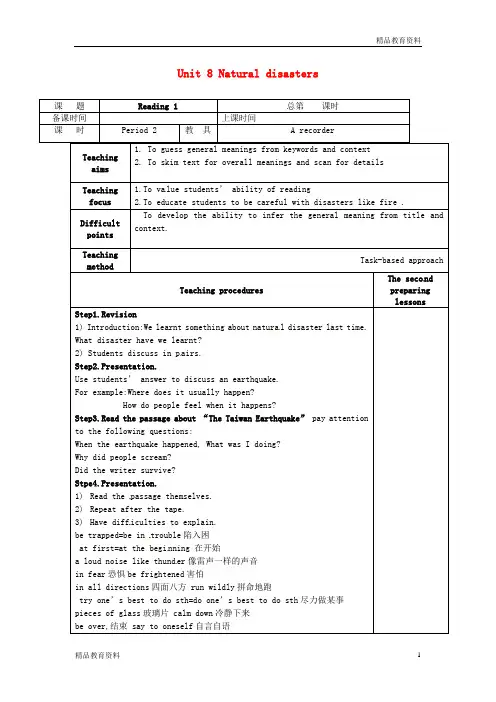
Unit 8 Natural disastersTeachingaims 1. To guess general meanings from keywords and context 2. To skim text for overall meanings and scan for detailsTeaching focus 1.To va lue students ’ ability of reading2.To educate students to be careful with disasters like fire .Difficult points To develop the ability to infer the general meaning from title and context.Teaching methodbased approach-Task Teaching proceduresThe seco nd preparing lessonsStep1.Revision1) Introduction:We learnt something about natura l disaster last time. What disaster have we learnt? 2) Students discuss in p airs. Step2.Presentation.Use students ’ answer to discuss an earthquake. For example:Where does it usually happen?How do people feel when it happens?Step3.Read the passage about “The Taiwan Earthquake ” pay attention to the following questions:When the earthquake happened, What was I doing? Why did people scream? Did the writer survive? Stpe4.Presentation.1) Read the passage themselves. 2) Repeat after the tape.3) Have diff iculties to explain. be trapped=be in trouble 陷入困 at first=at the begi nning 在开始a loud noise like thund er 像雷声一样的声音 in fear 恐惧be frightened 害怕in all directions 四面八方 run wildly 拼命地跑try one ’s best to do sth=do one ’s best to do sth 尽力做某事 pieces of glass 玻璃片 calm down 冷静下来 be over,结束 say to oneself 自言自语课 题 Reading 1总第 课时 备课时间 上课时间课 时Period 2 教 具A recordershout for help喊救命in a great hur ry急匆匆move away搬look at each other in fear恐惧地对看着do some shopping买东西 stay alive活着 go through my mind闪过头脑Sentences: I was doing my homework when it started.I didn’t know if anyone was around me.I didn’t know where I was.Some people screamed because they were very frightened.People were runn ing wildly while pieces of glass and brickswere falling down.They didn’t know where to go.Some people ran out of the shopping centre.I thought somebody could hear me but no one came for a longtime.I was trying to find my way out when I suddenly heared somenoise above me.Step5.Consolidation.1).Read the passage again.2).Give students some key words, and ask them to retell the story if time permitted.Step6.Home work:Teachingnotes。
Unit8 Natural disasters 2教案(译林牛津版八上)
Introduce new words and phrases:
slight shaking ; in fear , scream; bombs; below the ground ,in all directions ; run wildly; fall down ;come down ;be trapped; calm down ,be alive; in a hurry
(3)What did Timmy see?
4. Questions:
(1) How did Timmy feel after he was trapped?
(2) Did Timmy short for food?
(3) What did Timmy do to save himself?
(4) How was Timmy saved?
To talk about a natural disaster.
教学过程
教师复备
Step 1。Revision
1. Translate the following phrases:
1.输掉一场比赛
2.数以千计的人
3.撞上一棵树
4.把村庄冲走
5.从树上掉下来
6.引发一场大火
2.Go over the names of bad weather conditions and natural disasters.
Ask students to do Part B2 on page 96.
complete her diary.
教
学
反
思
Para1.
(1)I felt a _____ _____through my body. Then I heard a _____ _____ like ______.
最新牛津译林初中八年级英语上册 Unit 8 Natural disasters教案 (2)
Natural disasters第一课时 Welcome to the unitTeaching aims:To introduce the top ic of disaters.To identify vocabulary related to disasters.To identify weather conditions and label pictures with correct words. Focus and difficulties: To recognize the weather conditions and natural disaster. Teaching methods:Communication and descriptionTeacing aids: recorder Multi-media computerTeaching procedures:Step1 Lead in :T: What’s the weather like today?Ss: It …Revise some other words about weather.e.g. rain, snow, wind.…Step2 Presentation1.Show some pictures of snowstorm that happened inChina during last Spring Festival .Get them to answer the questions abo ut it.﹙1﹚.Do you like snow in winter?﹙2﹚.Do you think too much snow is good or bad for people?2.Encourage students to tell their ideas.Show more pictures of bad weather.Ask: What caused the trouble or problems?Help students to answer : nature. They a re natural disasters.They cause the bad weather .They make people get into the trouble.Step3 Practice1.T: Do you know what other natural disasters ? What words do we use to talk about bad weather ?Elicit from students other bad weather conditions. ( rainstorm, snow storm,typhoon.e.g.)2. Read the words in Part B and ask more able students to describe each weather conditiononly with simple phrases and words.3. Help Ss to complete the task on their own and c heck the correct answers with the class as a whole.4.Show more pictures of natural disasters,help students to know their names and describle them. Help students to use the Past Continuous Tense to talk about the pictures. 5.T: Can you distinguish natural disasters from disasters caused by other reasons?Get them to look at part A on P93 and try to finish this partcheck the correct answers with the class as a whole,then read together.Teach some new words.Step4 ActivityDivide the students into groups of four to discuss. Bring some photos to each group and ask students to write a headline about natural disasters or accidents.Step5 Presentation1.T: Look at the pictures ,people suffered from these natural disasters . What can we do to help them.Students will discuss it warmly. Then teacher leads students to the comic strip.2.T:Hobo has some trouble. What happened to him? Let’s have a look. Students look at the pictures. Teacher asks some open questions about each picture.1).What’s the weather like?( It’s raining)2). What happened to Hobo?( He got wet.)3).What was Hobo doing when it started to rain? ( He was sleeping)4).Did he hear the rain? ( Half an hour later.)5).What do you think happened o Hobo’s house?(The floor was all wet.)6). Why doesn’t he want to go home alone?(Because he wants Eddie to mopall the water up)7).Will Eddie help him?(No. I don’t think Eddie likes his idea.)2. Play the tape and students read after it.Explain some language points.Step 5.gamesAsk students to role-play the conversation.Step 6.Homework:Revises the contents we have learned.Preview Reading8A Unit6 Natural disastersReading(1)Teaching aims:1.To infer the meaning from the key words,pictures and the context.2.To elicit any information about the earthquakes in Taiwan orin other parts of the world.3.To develop the Ss’ability and skills reading comprehension andlet the Ss learn how to describe natural disasters and how o protectthemselves in the natural disasters.Difficult points: The key words and phrases the comprehension of the story. Teaching methods: reading and talkingTeacing aids: recorder Multi-media computerTeaching procedures:Step1 Lead in :T: we have learnt some natural disastrs last time .What disasters have we leart?Encourage students to say something about the natural disasters.Show some picturs of an earthquake that happened in Wengchuan,sichuan on May12,2008 . Step2 Presentation1.Let the students guess the new words by showing the pictures and talk about the earthquake that happened in Sichuan.2.T: What do people often feel/do when the earthquake happened? etc.Teach some new words and phrases.shake v. 摇动,震动(shaking n. )hear a big noise like thunder 听到一声像打雷一样的声音in fear (be frightened) 害怕,恐惧Scream v. 尖叫run in all directions 奔向四面八方run wildly 疯狂地奔跑fall down 掉下来come down 倒塌,塌陷3.After learning these new words ,help students finish PatrB1. Check it together.4.T: There was an earthquake in Taiwan in 1999. Many people lost their lives in the earthquake , but a boy called Timmy surrived. Let’s listen to the story to see what happened to himStep3 Listening and skiming1.Play the tape for Studenets and check general understanding by asking some ‘wh’questions and doing exercises PartC.2.Students skim the passage and do exercises on PartD.Step4 Reading and answering1. Listen and read after the tape one paragraph by one paragraph.Check if they understand by asking more questions about the passage.2.Invite the students to read the whole passage in front of the class.Encourage them to mime and gesture in order to illustrate the different aspects of the experience.Step5. Practice1.Ask stuednts to read the sentences in the boxes in PartC and fill in the blanks. Check the answers with the whole class.2.Divide the students into groups of four.Retell the story ,then encourage some of them to retell in front of the class.Homework1.Recite the new words .2.Try to read the story as fluently as you can8A Unit6 Natural disastersReading(2)Teaching aims:1.To scan the passage.2.To explain some difficult and important language points and to use them.3.To make an interview about the earthquake.Difficult points: some language structuresTeaching methods: reading and talkingTeacing aids: recorder Multi-media computerTeaching procedures:Step1 revision1.Revise the names of natural disasters.2.Show the students the photos of the story of Taiwan earthquake and help them to retellit.Step2 ScanningScan each paragraph and encourage the students to tell their difficulties.Teacher helps students to solve them. Teacher explains language points to students. shaking (n.)震动,摇动Fear (n.)恐惧,害怕一阵恐惧a moment of fearin fear 在恐惧中direction方向,方位人们四处逃散。
Unit8 Natural disasters 3教案(译林牛津版八上)
Step 2 Further reading
1.Questions:
(1) Is it safe to run wildly during an earthquake?
(4) How did Timmy feel? (When he found that he was trapped, a moment of fear went through his mind but he told himself to calm down.)
(5) What did Timmy do while he was waiting for help? (He shouted for help. He ate some chocolate.)
(5) is it safe to hide under a big tree during a rainstorm with thunder and lightning?
2.Ask Ss what the right action is in a certain situation.
Step 3 Language points
重点
难点
1.To revise what they learned about the earthquake andthe passage better .
2.To read the passage again and help them to highlight the important language points and sentence patterns.
牛津译林版-英语-八上-8单元 Natural disasters grammar教案
Step3.Practice:
1. Show another pictures to the Ss. describe the pictures in general questions and give them the positive and negative answers. Ss practise in groups or in pairs. Write two kinds answers on the Bb.
What are they doing? They are fishing.
2.Ss watch another picture and try to answer the questions orally.
What are the children doing before tt Ss read the dialogues aloud.
Step4.when&while&as
1.Ask some questions about this passage to elicit the structures with ‘when’ or ‘while’.
What were they doing when the snowstorm happened?
What was Han Mei doing? What were the twins doing?
2.Explain the past continuous tense to the Ss.Was/were + V-ing.
3.Explain when to use the past continuous tense. And pay attention