
人教版英语七年级下册第三单元课件-Unit3Section A Section A 第一课时
【教学方案】人教版七年级英语下册第三单元教师使用教案Unit 3 Section A 第1课时 (七下)

1 Unit 3 How do you get to school?
Section A (1a-2e)
一、教学目标
1. 词汇:train, bus, subway, ride, bike, sixty, seventy, eighty, ninety, hundred, minute, far,
kilometer, new, every, by
2. 句型:
(1) —How do you get to school? —I take the…/ride…/walk.
(2) —How long does it take...? —It takes...
(3) —How far is it from…to…? —It’s about...
3. 功能:能谈论出行方式、时长和两地之间的距离。
4. 语法:能运用how,how long,how far引导的特殊疑问句询问出行方式、所花费的时间和两地之间的距离。
5. 听:能听懂询问距离及出行方式的对话。
6. 说:能正确运用句型询问距离及出行方式。
7. 倡导自觉遵守交通法规及礼貌,构建和谐的人际关系。
8. 能记录听力对话中的数字。
二、教学重点及难点
重点:
1. how/how far/how long引导的特殊疑问句。
2. 乘坐交通工具的表示方法。
3. 句型“It takes sb. some time to do sth.”的使用。
难点:
学生能用相关句型询问距离及出行方式,并做出回答。
三、教学准备
教师:教学课件;多媒体设备
学生:课前预习
四、教学过程
Task 1
Step 1. Warming-up
2 Show the video How do you usually get to school and get Ss to guess what they’ll learn.
【设计意图】通过观看视频,让学生初步感知有关交通工具的词汇和描述交通方式、花费时间及距离的句型,从而顺利引入今天的主题。
人教版英语七年级下册 Unit 3 Section A (2e-3c)

Period 2 Section A (2e-3c)
1.The bus ride takes about 20 minutes.乘公共汽车大约需要20分钟。(课本第14页)
此句中的ride是名词,意为“(骑动物或乘车等的)旅行;旅程”。如:
a bus ride公共汽车旅程 a bike/horse ride骑自行车/马
ride还可以作动词,意为“骑(马、自行车等)”。如:
I ride my bike to school every day.我每天骑自行车去上学。
2.-How long does it take you to get to school?你到学校要用多少时间?
-About 15 minutes by bike.骑自行车大约15分钟。(课本第14页)
(1)how long意为“多久”,用来提问时间长短,通常指某个动作的持续时间的长短。
(2)句中it为形式主语,真正的主语是后面的to get to school。设置形式主语的目的是防止句子结构“头重脚轻”。
(3)take作动词,意为“需要;花费(时间)”,常用于“It takes sb.some time to do sth.”句型中,意为“做某事需要花费某人多长时间”。
3.-How far is it from your home to school?你家距离学校多远?
-It's only about two kilometers.大约只有2千米。(课本第15页)
how far意为“多远”,用来询问距离或路程的远近。常用句型有“How far is it from A to B?”=“How far is
B from A?”,意为“从A到B有多远?”,其回答为:
①It's...meters/kilometers/miles(away).
②It's about+数词+minutes' walk/ride/drive.
人教版初中七年级英语下册第三单元Unit3教案含教学反思
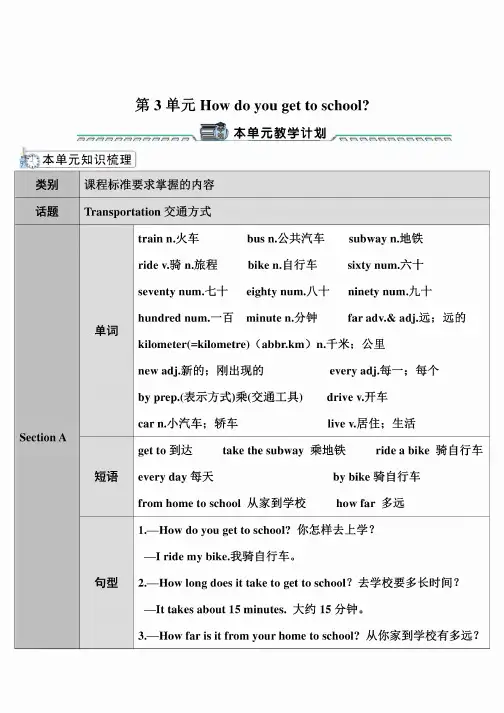
第 3
单元 How do you get to school?
本单兀教学计划
弋,本单元知识梳理
类别课程标准要求掌握的内容
话题Transportation
交通方式
Section A单词train n.
火车 bus n
.公共汽车 subway n
.地铁
ride v.
骑n
.旅程 bike n.
自行车 sixty num.
六十
seventy num.
七十 eighty num.
八十 ninety num.
九十
hundred num.一百 minute n.
分钟 far adv.& adj.远;远的
kilometer(-kilometre) (abbr.km) n.
千米;公里
new adj.
新的;刚出现的 every adj.每一;每个
by prep.
(表小方式)乘(交通工具) drive v.开车
earn.
小汽车;轿车 live v.
居住;生活
短语get to到达 take the subway
乘地铁 ride a bike
骑自行车
every day
每天 by bike
骑自行车
from home to school
从家到学校 how far
多远
句型1. —How do you get to school?
你怎样去上学?
一I ride my bike.
我骑自行车。
2.
一How long does it take to get to school?
去学校要多长时间?
—It takes about 15 minutes.
大约 15
分钟。
3. —How far is it from your home to school?
从你家到学校有多远
?一Ifs only about two kilometers.
大约只有 2
千米。
4. Have a good day at school.
祝你在校过得愉快。
5. Does Jane walk to school?
简步行去学校吗?
Section B单词stop n.
初中英语_人教版七年级下册第三单元SectionA教学设计学情分析教材分析课后反思

A Teaching Design
of Unit Three SectionA
I. 学习目标Learning objectives:
After this class, students are expected to:
知识目标: Listen to and understand, talk about, read, and write
different ways of transportation, and three questions:
How do you get to …?
How long does it take you…?
How far is it from…to…?
能力目标:Finish listening tasks.
Ask and answer questions about how to get to places, how
long it takes and how far it is.
Can make a survey and write a report, with the help of
group members.(The report may be left as homework if
unfinished)
情感目标:Choose the right way of transportation if possible.
II.学习重难点 What will be difficult to learn:
1. How to ask and answer the three questions:How do you get to …?
How long does it take you…?How far is it from…to…? Especially the
last two.
2. Make a survey and write the report.
人教版英语七年级下册Unit3 SectionA 教材知识详解
.
下载后可自行编辑修改,页脚下载后可删除。 Unit3 SectionA 教材知识详解
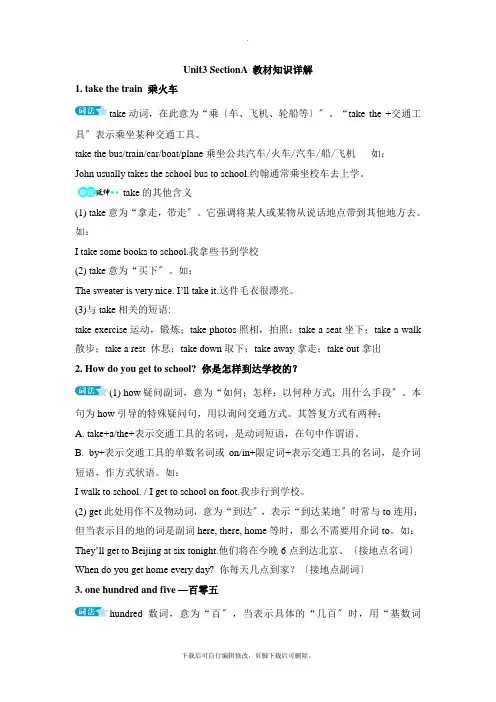
1. take the train 乘火车
take动词,在此意为“乘〔车、飞机、轮船等〕〞。“take the +交通工具〞表示乘坐某种交通工具。
take the bus/train/car/boat/plane乘坐公共汽车/火车/汽车/船/飞机 如:
John usually takes the school bus to school.约翰通常乘坐校车去上学。
take的其他含义
(1) take意为“拿走,带走〞。它强调将某人或某物从说话地点带到其他地方去。如:
I take some books to school.我拿些书到学校
(2) take意为“买下〞。如:
The sweater is very nice. I’ll take it.这件毛衣很漂亮。
(3)与take相关的短语:
take exercise运动,锻炼;take photos照相,拍照;take a seat坐下;take a walk散步;take a rest 休息;take down取下;take away拿走;take out拿出
2. How do you get to school? 你是怎样到达学校的?
(1) how疑问副词,意为“如何;怎样;以何种方式;用什么手段〞。本句为how引导的特殊疑问句,用以询问交通方式。其答复方式有两种:
A. take+a/the+表示交通工具的名词,是动词短语,在句中作谓语。
B. by+表示交通工具的单数名词或on/in+限定词+表示交通工具的名词,是介词短语,作方式状语。如:
I walk to school. / I get to school on foot.我步行到学校。
(2) get此处用作不及物动词,意为“到达〞,表示“到达某地〞时常与to连用;但当表示目的地的词是副词here, there, home等时,那么不需要用介词to。如:
Starter+Unit+1+HeSectio课时练习2024-2025学年人教版七年级英语上册

Starter Unit 1 Hello
Section A How do you greet people?
基础训练
I 根据所给音标写出相应字母大小写。
1. /ei/ 2./ef/ 3. /el/ 4. /em/
5./ɑː(r]/ 6./i:/ 7. /dʒiː/ 8./keɪ/
II根据意及汉语或音标提示填写单词
9.This_______(单元) is easy because there are few new words in it.
10.Every morning the_______(问候) the teachers with students smiles at the school gate.
11. We students can borrow _______( 借) two books from the school library_______time.
12.City walking is an interesting way for _______[ 'pi:pl ] to keep fit.
13.Can you find some fishcakes in the frozen (冷冻的)_______ food_______[ 'sekʃn ]
III单项选择
14.字母 A 和_______含有相同的音素。
A.E B.C C.H D.G
15.将字母按其在字母表中的顺序排列,错误的是_______.
A.DEF B.ABC C.ADF D.CFD
16.“中华人民共和国”的!英文缩略词是_______。
A.NBA B.PRC C.PLA D.WHO
17.-Is _______here today?
-No,Bill is not here because he is ill (生病的).
人教版初中英语七年级上册Unit7大单元作业设计案例(2)
Unit 7 How much are these socks?
—、单元信息
基本信息学科年级学期教材版本单元名称
英语七年级第一学期人教版How much are
these socks?
单元组织方式自然单元 重组单元
课时
信息序
号
一教学内容课型课时
Sectio
n
AClothes:names of the clothes
and prices听说
第1
课时
How much are the objects ?说,语法
第2
课时
Sectio
n
BReview numbers. Learn to shop.听说
第3
课时
A clothes store advertisement.阅读
第4
课时
Write an ad for your own
clothes store写作应用
第5
课时
二、单元分析
(一)课标要求
本单元话题为“购物〃,教材选编了多模态语篇,包括对话、应用文等连续性文
本和图表、图示等非连续性文本以及音频、视频等。根据《义务教育英语课程标准
(2022 W)
》(以下简称《课程标准》)要求,从语言技能、语言知识、情感态
度、学习策略和文化意识等方面对本单元的课程内容进行分析。
1
语言技能:学生能够根据场景听懂--How much is this T-shirt? --How much
are these socks?
听后能做出相应的回 一It is seven dollars. --They are two
dollars,
学生能够运用所学词汇及目标语言询问价格及回答。学生能读彩图及录音
稿中对话并理解。学生能在调查采访环节后写出调查报告。
2
语言知识;学生学习并掌握词汇how
much,trousers, sock, shirt
T-shirt, shorts, sweater, skirt, dollar, hat.
学生应
熟练运用目 标语言---How much is this T-shirt?
一It is seven
2019-2020年人教版英语七年级下册Unit 7 It’s raining! Sectio
2019-2020学年人教版英语七年级下册
Unit 7 It’s raining! Section A(1a-2c)
情智导航:
1. 掌握描绘天气状态的形容词及现在分词,学会如何描述天气。
How’s the weather?
=What’s the weather like ?
—It’s cloudy/ It’s sunny./ It’s raining.
2.学会应用现在进行时: be(am/is/are) + v.–ing
3. 会描述某人正在干什么。
1、—What are you doing? — I’m cooking.
2、—What is he doing? —He is watching TV .
3、—What is she doing? —she is playing computer games.
4、—What are they doing?—They’re playing basketball
一、【自主预习 启动情智】
【温馨提示】
1. How is the weather? It’s cloudy/ It’s sunny./ It’s raining.
it在本课中指代天气, 翻译时可不译出中文,根据上下文理解其含义。
如: It’s windy. (天气) 在刮风。
It’s cold today. 今天很冷。
2. rain 名词“雨,雨水”, 动词“下雨”。
It’s raining cats and dogs. 正下倾盆大雨。
其形容词为:rainy 下雨的
“下雨了。”可说:
It’s raining.
It’s rainy.
3.snow 名词“雪”, 动词“下雪”, 其形容词为snowy。
七年级英语下册Unit1Where39;syourpenpalfromPeriod1SectionA
文档从互联网中收集,已重新修正排版,word格式支持编辑,如有帮助欢迎下载支持。
1word格式支持编辑,如有帮助欢迎下载支持。 七年级英语下册《Unit 1 Where's your pen pal from Period 1
Section A 1a-2d》导学案(无答案)
设计: 审
核:
备 课 日 期:
班级: 学生姓名: 教师查阅情况:
课 题:Unit 1 Where’s your pen pal from? Period 1 (p1-2/Section A: 1a-2d)
学
习
目
标 1.通过本课学习,我们要学会英国,法国,美国等一些常用的国家名。
2.学会询问和表达自己以及他人的国籍。
3.掌握一些著名国家的城市名并能询问和表达某人居住地。
4.重点词汇和语句:
pal/pen pal/Canada/France/Japan/Australia/ the United American/ the United
Kingdom/ Singapore/country/ city/ Sydney/ New York/ Paris/ Toronto/ Tokyo/live
1. ——Where’s your pen pal from?
——He’s from Japan.
2. ——Where does he live?
——he lives in Tokyo.
学 习 程 序
知识宝库 学习内容与方法 文档从互联网中收集,已重新修正排版,word格式支持编辑,如有帮助欢迎下载支持。
2word格式支持编辑,如有帮助欢迎下载支持。 1. be from与come from
1)这两个短语都可以表示“来自于---”。例如:
牛津译林版高中英语选修六Unit 3《Understanding each other》Sectio
牛津译林版高中英语选修六Unit 3《Understanding each other》Section D同步练习
Section D Task & Project
Ⅰ、单词拼写
1、 Buddhism is the __________ (宗教) founded
by Buddha in North India、
2、 To show sadness, he hangs his head and holds
a hand up to his face in a __________ (手势) of grief、
3、 We all got a warm __________ (招呼) on our
arrival、
4、 January’s sales were __________ (稍微)
better than the average、
5、 It was found only a very small __________
(少数) of pigs had been fed with the banned
substance、
6、 John gave us a detailed __________ (叙述) of his plan、
7、 He got a medal for __________ (勇敢)、
8、 All guests wore __________ (面具) to the
ball、
9、 Shortly after, the United States
__________ (政府) forced them to live in
internment camps (收容所)、
10、 Please __________ (复述) the fairy story
in English、
Ⅱ、用方框中短语的适当形式填空
take up, take away, account for, show