
ASKING超短秘笈
ASKING谈话记录-超短秘笈1、涨停那一定要行情活络才好搞,等股票行情来的时候那不是随便买随便赚,一点也不难。
赚大钱的都是在行情好,要大干快上。
其余的看看啦,有机会赚点生活费就OK啦。
炒股很简单,个股活跃你就追涨,追板块的龙头就行啦。
反之你就看看好啦,有超跌,你抢一把就走。
道理谁都懂,但没几个人能管得住自己的手脚。
这就是杯具。
最近(行情不好)涨停要少做,多做多伤心。
最近大盘环境明显不适合做涨停,没有赚钱效应,可能今天这涨停行,明天又不行。
做得好,赚点点。
不好的话,吃锤。
难啊当没有赚钱效应时,一定要控制好仓位。
不要想着赚钱啦,拿少少钱练练敢觉啦我只跟市场走,不预测,不操纵。
十分里边,心态,控制力占7分,技术占3分。
相信不相信,控制得好,去赌场玩百家乐都会赢。
我是盘盘都赌,赢概率。
赔钱就少压,赢了就翻倍压,效果很好。
每次都赢钱,就上次老婆跟我讴气,坏了心态,结果输光。
赌博就好像做期货,没有罢手就不能言赚。
但有一个方法可以克服,就是本金留下,每次赚的钱都拿走。
亏了,不能追加本金。
赌博我一点都不敢兴趣。
炒股比赌博刺激多了。
我一点都不好赌。
要不现在还在骑自行车。
我已破产两次,第一次股票。
第二次期货。
想让我在赌上破掉,比登天还难啦。
技术指标主要看成交量、均线、K线。
收盘后不用翻看大量个股,主要看公告,再结合市场热点锁定相关个股。
至于做下跌股的反弹选择前期热门强势股。
广播股评节目都没听。
小钱要博,大钱要稳。
关于操作的随意性,这是人性的弱点,我也经常犯。
一般随意了一二把,第二天立马就纠错。
不会跟他纠缠,然后把他忘记,重新谨慎再来人生格言:与人为善,知恩图报2、十年来的江湖,我认为只有职业炒手的热点轮炒的灵敏,荣展的美女无数老婆只有一个的龙头战法,asking的只做好行情的真传,构成了一个立体的绝顶功夫,从此无人超越3、我只用最简单的方法赚到最多的钱4、我觉得该股明天很有可能高开收盘封涨停,理由:昨天出利空回调,但并没放天量,说明主力无意出货。
再结合其基本面,此价位应属偏低。
周五科技股又开始走强,炒作氛围很好,理应再涨!5、519赚的不多,才120%,主要是那时才开始做超短,不熟。
2000年赚了11倍,那是专追涨停,很好赚钱。
2001,2002做不好。
去年做600231,600073赚了很多6、今天我追了600458,000931,000029,基本都是涨停追的,操作思路跟你很雷同,我觉得超短一定要及时获利了解,在稳建的前提下尽量做大成交量。
行情好时我都是满仓滚动操做,因为这时亏钱概率小。
不好时应尽量轻仓小玩玩7、今年的成交量这么大,是我们的天下。
是啊,有量就能来钱,操短对行情好坏只有一个标准:量8、现在乱轰轰的,有时简直找不到感觉。
主要是没有一个清析,稳定的热点。
只好在午盘找行态好强势股往涨停干。
我追求的是那种帐户市值大涨小回,不断创新高的那种状态。
并不追求大起大落的赚钱速度。
小资金要想快速变大一定要超短线,只有超短线才能做到一年10多倍。
才能最快速度挖到第一桶金9、前几天我状态也不好,主要是太贪心,满仓000920(17.5买的)到20.61没卖,最后没赚啥钱跑出来,搞得心态很不好,这两天才恢复过来/10、超短线,心态最关键,有了良好的心态才能成功。
心态是内功,如张无忌练的九阳真经。
方法就如十八般武艺,没有内功的配合,什么方法都不行。
这个比喻恰当极了。
职业炒手兄头脑好啊11、其实这波真正可能只赚70%,原因是我做了1:1.2融资。
可是冒着大风险啊,因此只敢做超短线,风险控制在自己手里。
12、请教:买四买五老出大单什么意思?也就是好玩.我就经常这样子,比如有朋友买了一点股,故意逗他玩,下面放的多多的13、600854应该是这几天龙头个股,有三大优势.1新能源概念,2绝对价位低,无亏损.3大大低于净资产.14、昨天的000972也是我做的,炒股一定要借力打力,四两拨千斤,硬干是不行的,顺势最关键/15、一定要做市场高度认同的票,要不独脚戏可不好唱哦16、这时侯追涨停.风险偏大,逢大跌买点更稳妥17、这年头哪有主力,上涨靠的是市场合力,快换换脑筋吧18、我99年到05年,年年获利,总盈利率超120倍以上,算不算超一流高手20、99年到现在,专门做超短线.99年100%的收益,2000年获利12倍,2004年大概赚了300%,今年少点,有赚了将近190%.明年只要求翻一番就好了,因资金太大了,要想大幅获利不易。
2001,2002赚得不多,2003大概翻了一番多,时间久了点,有点记不清了.98年初开始做超短线,亏了,有20%.之前到94年做中长线,不错,有赚了几十万,97年做期货给打透了.这个月又开始做期货,要报仇雪恨.4万以上做空铜,中长线,放它一,两年,翻它一两番出来,总比储蓄强98年借钱起家的,之前书上说炒股千万不要借钱炒股,我就不信邪.不过当时不借也不行,钱都叫期货给吃光了,工作也丢了.所以当时压力也很大.考虑到风险,做超短线最好了,并且96年陶永根3个月赚了500%多,名列第一.后来2000年时,从1月到4月,我好象也赚了500%多.那年元旦后第一天就重仓杀入600073,赚得太爽了21、也今常有失误,但每次都尽量在第一时间脱身.虽然每年都会有一两次刻骨铭心的割肉.一年操作下来总的是输少胜多,小亏大赢,所以才有如此可观的成绩22、哪有办法每年翻番,除非他是精神病,这几年能稳定在50%,以后一年都能赚20-30%,我就心满意足了,现在要是只有几十万,一年随便赚他个2-3倍的,轻轻松松的。
94年炒股,破了两次产.今年34岁,在股市掘金超千万23、超短线我最有发言权了,5.19到现在,资金从10几万到几千万,成交量从两三百万到7,8个亿.豪宅,名车,吃喝玩乐,通通从股市中来.我看全中国也没几个啊.榜样的力量是伟大的.周围的人现在不做中长线,只做超短啦.把营业部老总给乐坏啦.但是我现在想做中长线啦,超短太累啦.有钱啦,想轻松一点,享受生活吧24、闽发里没几个人有保时捷吧,我做超短把它们都赚到了.明年准备买一法拉利.没钱人,'要想爽,做超短'.听我的,错不了.我一个月的返佣,几乎都够买一部保时捷了25、注明一下,当年的10几万还都是借的,一分半利息,我妈帮我借的.当时我家从乡下上来,租了一15平米民房,铺了三张床,煤气灶放在阳台,还经常被房东及邻居欺负.谁叫你没钱,没办法啊,一份5毛钱的都市报都舍不得买,经常站在报摊前看一会儿就走,看久了摊主会赶人啊.当时可谓是坚苦卓绝,背水一战啊26、做超短,应该是从陶永根处得到启发.96年上证报举行的一场比赛,他第一,赵笑云第二.好象是3个月,赚了4倍多.经常是尾市买,第二天就卖.我当时就尝试一下,效果不行,上班没时间,顾不过来.只好做中长线,当时买了一只东大阿派,上市就买,96年行情如火如荼,他就瘟股一只,那个急啊,恨不得甩他两巴掌.还好最后不辜负厚望,隔年高位卖掉赚了四倍多.就此把工作辞了专职炒股.没想到被人拉去做期货三个月就被打爆了.今年又去做了,还是不行,亏了我N多钱.还好5.8以后行情来,一周就把他扳回.还是做股票好啊,安全,包赚.以后打死也不去做了,可能包括股指期货.他坏就坏在一点,你做的再好,也绝不能犯一次大错误,一次就能要你的命.你说跟这样的老板还怎么混.而股市,只要你足够优秀,即使犯了好多次大错误,只要勇于及时认错.股市老板还是会原谅你的,职位还给留着,薪水照发,加薪还有机会.现在不说了,吃饭了.有空再聊聊我是怎么做发家的27、97年期货打暴以后,休息了几个月,钱没了,再去上班赚千把块钱也没这心情了.怎么办,以后路怎么走,想想只能再去炒股了.还好我妈很支持我.到处张罗,总算凑了10来万.于是98春节后,我又杀回来了.其实这是我第三次重返股市了,最早要从94年说起.那一年指数从1500点一直绵绵阴跌到600点时,忠言在收音机里一直狂吹界龙,直听得我热血沸腾,恨不得马上去买.于是我极力怂恿我妈。
我前面说那么多话干吗,主要是告诉大家,做超短一样可以发家致富.特别是职业小散们.做超短可能是一个最佳选择.你一点点钱,做中长线,普通年景一年一倍,已经是很好了,但你很难很难都做到年年都一倍.请问你如何发财.做超短,一年1倍2倍随便赚,5倍10倍也是有可能的.2,3年就能实现资本的快速积累.只要你入门了,一切尽在掌握.不象中长线,运气成分太大,收益不可控.当然钱多了,做中线是必然了,但现在你一年只要赚30%,可能相当于原始资金的10倍,20倍.一年10至20倍,而神光的3年才10倍都吹到天上去了,我们岂不是比他NB多了.今年钱赚的多,要出手本市的一顶级豪宅,心情好,上来瞎聊,没啥企图,大家不要想歪了.谢谢28、50万就怕被人奸,除非是西施.我一天成交量60%都干过,第二天还好好的给我拉了一涨板,我都不知谁是主力了29、最近大盘量小,个股活跃度欠佳,短线少做,仓位应当控制.当然这是针对数百万以上的短线资金而言.对小资金来说,今年天天有机会,天天都要满仓30、有啊,大盘不好就少做点.但是天天都要做,锻炼盘感,免得行情一来摸不找北.反正现在能赚点零花钱就好了./31、其实,股票投机跟艺术创作一样,是有天赋的.它没有什么太多比较固定的规律,经常是飘忽不定的,买入卖出有时就是靠感觉或突然的灵感,当然这需要长期专注看盘积累的.没有天赋,有的一辈子的努力也悟不透其中的窍窍。
32、当初刚入门时,一心一意都在想绝招,弄窍门,确实也摸到了一点窍窍,刚好赶上5.19那一波,着实赚了一大笔.以为这下找到了金钥匙.那想2001年那一波大跌,也被打的丢盔弃甲.后来痛定思痛,经过半年的潜心研究,摸索出了多种方法,学会了18般武艺,兵来将档,水来土淹.随着时间的流逝,经验越来越丰富,各种技巧烂熟于心.渐渐的到现在基本上靠感觉炒股,虽然也经常出错,但都能下意识的第一时间认错.所以一波行情下来,胜利果实基本都在.运气好得话,在大盘调整时,资金还能不断创新高.说实话,我今天盘中创了新高.没想到今天尾盘杀跌.和预想的有点出入.导致仓位偏重,亏了点钱.明天可能会反弹吧.猜猜而已.其实我是很少去预测大盘或个股的,一切以盘中走势为准.因为我们不是神仙,即使你有80%的准确率.那20%的失误都有可能把你的利润都磨平.33、现在做些超跌反弹最安全.前期一些强势股或热门股这几天跌幅巨大的,周一逢低可买点,具体股票就不说了,我害怕有人跟我抢34、最近600018 601588 601872 很好炒啊,随便进出,又活又很强.可以评为五星股票.跟取款机似。
这么好的票没做,确实可惜.大资金,大行情啊.一定要跟着主流资金跑啊.切莫自作主张35、不动明王兄,你好.追涨停这招只能在市场活跃疯狂时好用.一但市场陷入盘整或下跌.那是输多赢少.容易使人失去信心。
Asking and Answer

Asking and Answerchapter iv asking and answering questionsi. inviting questionsso, letd be glad to try and answer any questions.are there any questions?any questions?ii. raising questionssignaling your intention to ask a questioni want to ask dr. bi a question.i have a guest ion for dr. anderson.mr. smith, i have a question to ask you.there is a question id like to ask prof. li.a question for mr. liu.one question, dr. wei.could i ask you a question, prof. li?may i venture to ask prof. zhang a question? expressing your attitudebefore asking your question, you can express your positive attitude or make a comment on the speakers presentation. for example,dr. johnson, i was fascinated by your description of your study, but what will happen if...mr. li, you did splendid work! just one question.asking the specific questionyou mentioned very briefly that you used two experiments that were the same.would you please elaborate on that point?would you be so kind as to give me more information about the method of your experiment?would you tell me the reason why you set such a high temperature?comprehensive samplesdr. wang, id like to say your research is very interesting. may i ask two questions? do you see any relation between cigarette smoking and peptic ulcers? and what advantage do you expect by using this approach?iii. response to questionsasking for repetitionpardon, i couldnre getting at.welcoming the questionwelcome the question by saying ll try my best to answer it.repeating or paraphrasing the questionquestioner: have you tried it on human bodies?presenter: this gentleman would like to know whether we have tried this on human bodies.responding to difficult or challenging questionquestion: so what happens if the new budget isnll answer your question in a few weeks.the only answer i can give at present is to wait a few more years, at which time something better might ultimately come out of all our efforts.i think it will be possible to answer this question when more experiments are completed.the answer to this question needs further study.i hope i will be able to answer your question later.responding to improper questioni appreciate your interest in my research, but i just donresponding to the questions you do not knowif you don yon could discuss his or her question in more detail after your talk.referring back to the questionerhaving finished answering questions, you should check that the questioner is satisfied or further elaboration or explanation is called for. the following expressions might be helpful.did i answer your question?did i answer you satisfactorily?did your question get answered?i dont know if this is a satisfactory answer.i hope this may serve as an answer to dr. li.i hope this answers ~0ur question.:,sometimes when question lime is over and ff time permits, you can restate, your main proposition, including any good comments from the audience and ignoring adverse questions or remarks. thus, you demonstrate that you are confident mid can cope calmly with controversy.remember that your last words to the audience will be retained longest and you are expected to behave in a professional manner.。
Asking-the-way

Asking the wayPart 1(At the classroom)B:Hi,Linda.(把手搭在对方肩上) What are you going to do this weekend? DI will go to Foshan with my friend Coco, what about you? B: I have no idea.(耸耸肩,摇摇头)D:Would you like to join us ?B:Really?(两手握住) Can I do that?(惊喜状)I’d love to. D: Of course. L et’s meet the gate of our school.B: Ok,got it. See you then.D: see you.Part 2(At the school gate)D: Becky ,come here.B: Good morning. Linda.D: Morning. This is my good friend Coco.C: Nice to meet you, BeckyB: Nice to meet you, Coco.C: Here comes the bus.D: L et’s get on the bus.(招呼ABC上车)Part3(On the bus)B: (看着窗外)So many trees and flowers, so beautiful. I love it. C:Metoo. It is cool today. And the air is fresh.D: Look, (用手指着某处)they are taking the pictures.Part 4Bus:做个旁白,表明要去的地点到了BCD: Here we are,Foshan.C:(左右看看)How can we get to Zumiao?B: I don’t know. This is my first time to come to Foshan.(转头看向Linda)Linda, Do you know the way to Zumiao? D:(尴尬)E r…, let me look at the map.(看看地图,看看路,摸着脖子)Er…, er…, sorry, I can’t find it.BC: What? My god. We are lost.D:Calm down. Let’s ask the lady over there.C:Excuse me. We are new here. We are lost. Could you help us find the way to Zumiao, please?A: Of course. My pleasure. Follow me.Look, Zumiao is over there.BCD: Wow, wonderful.A: Here is Zumiao. You need to buy tickets to get inside. BCD: Oh,I see. Thank you for your guiding. Would you like to join us?A:E m…, that’s all right. I can be your guide.My name is Amy, tour guide of your visit. L et’s go inside. Are you ready?BCD:Yes, go, go,go.BCD:So many people here.A: Comehere. Here is Huangfeihong museum. Do you guys know Huangfeihong?C:He is very famous in China.D:打功夫哼哼哈。
小学英语AskingtheWay问路教案

Asking the WayI.Teaching ContentAsking the WayA: Excuse me, sir. Can you tell me the way to Bihai Hotel, please?B: Sure. You can go there by bus.A: Is it a long way from here?B: No, it'll take you fifteen minutes.A: Which bus can I take?B: You can take a No. 2 bus.A: Where is the bus stop?B: Just go straight. Look, the bus is coming.A: Thank you very much.B: You're welcome.II. Teaching proceduresStep 1. Warming-upT: Nice to meet you. My name is Bright. B-R-I-G-H-T.Shall we sing an English song named "Bingo", and try to change the' word "Bingo" with my name "Bright"?Step 2. PresentationT: I'm new here, when I arrived at the airport, I heard someone said "对不起"(注①),"早晨好"(注②).I really want to know their meanings in English. Could you help me?S: "对不起" is "Excuse me" and "早晨好" is "Good morning".T: Thanks a lot. And now could you tell me something about your city? I want to travel in this city, but I don't know where I should go.S1: Bai Lian Dong Park.S2: Fisher Girl.S3: Jiuzhou Town.T: Good. But I want to find a hotel now.Please do me a favour. Can you tell me the names of some hotels in this city?S1: 2000 Hotel.S2: Yindu Hotel.S3: Bihai Hotel.(The teacher takes notes while the students are speaking.)Step 3. New structures learningT: They all sound very nice. But how can I get there, by bus or by bike?S: By bus.T: And how long will it take me to get there? Maybefifteen minutes is enough.(The teacher looks at the watch and gives the students a gesture.)1) Draw a stick-figure picture to help the students understand the meaning of the sentence:"It'll take someone some time to do something."2) Write the sentence "It'll take you fifteen minutes. " on the blackboard, and have the studentsimitate the sentence.3) A guessing game:T: Please look at these pictures and guess "How long will it take me to ...?"T: How long will it take me to have a football match?S1: It'll take you ninety minutes.T: Yes.4) Get the students to listen to the recording of the dialogue, in order to introduce the new sentence: "Just go straight."5) Use the multi-media to help the students understand the meaning of the sentence "Go straight."6) Write the sentence on the blackboard, and have the students imitate the sentence: "Just go straight."Step 4. Practice1) Ask the students to listen to the dialogue once more, then ask them to repeat after the tape, first individually and then in pairs.2) Encourage the students to read their dialogue with their deskmates.Step 5. ConsolidationT: You know I'm fromShanghai. Maybe in the future you'll go to Shanghai, so I've prepared some photographs for you.1) Show the photographs of "Nanjing Road", "Pudong New Area" and "the Bund" to the students.2) Get the students to ask the teachers from Shanghai something they don't know, such as directions, transportations in Shanghai.3) Ask some students to introduce their tour plans to Shanghai.-温馨提示:如不慎侵犯了您的权益,可联系文库删除处理,感谢您的关注!。
英语演讲稿范文:英语演讲教程:AskingandAnsweringQuestions
英语演讲稿范文:英语演讲教程:AskingandAnsweringQuestions12月23日英语频道特为大家准备相关的学习资料,希望对大家有用。
I. Inviting QuestionsSo, let's throw it open to questions.Now I' d like to answer any questions, if you have any.Now I am ready to answer your questions, if any.I'd be glad to try and answer any questions.Are there any questions?Any questions?II. Raising QuestionsSignaling Your Intention to Ask a QuestionI want to ask Dr. bi a question.I have a guest ion for Dr. Anderson.Mr. Smith, I have a question to ask you.There is a question I'd like to ask Prof. Li.A question for Mr. Liu.One question, Dr. Wei.Could I ask you a question, Prof. Li?May I venture to ask Prof. Zhang a question?Expressing Your AttitudeBefore asking your question, you can express your positive attitude or make a comment on the speaker's presentation. For example,Dr. Johnson, I was fascinated by your description of your study, but what will happen if...Mr. Li, you did splendid work! Just one question.Asking the Specific QuestionYou mentioned very briefly that you used two experiments that were the same.Would you please elaborate on that point?Would you be so kind as to give me more information about the method of your experiment?Would you tell me the reason why you set such a high temperature?Comprehensive SamplesDr. Wang, I'd like to raise one question. First, may I say how much I enjoyed talk. But, may I ask, do you have experience with the new method?Congratulations, Dr. Li. I can't help but admire your achievement. But I want to know what's your attitude toward abuse of antibiotics?I'd like to congratulate Mr. Liu on a very interesting presentation.May I ask you a question? How does subjective evaluation differ from objective evaluation?First, I'd like to say your research is very interesting. May I ask two questions? Do you see any relation between cigarette smoking and peptic ulcers? And what advantage do you expect by using this approach?III. Response to QuestionsAsking for RepetitionPardon, I couldn't hear what you said.I beg your pardon, I didn't catch what you said.I'm sorry I forgot your first question. Would you be so kind as to say it again?I'm not quite surge what your question is.I didn't quite get the last point of your question.You mean, there may be some mistake in the calculation?Are you referring to the significance of the difference?Are you suggesting that the temperature might have affected the results?If I understand you correctly, you are saying/asking...I didn't quite catch that.Could you go over that again?I'm not sure what you're getting at.Welcoming the QuestionWelcome the question by saying "thank you" or commenting on it saying "That’s a good question" or "That's a challenging question."This is a very good question.Thank you for that question.I'm glad this question has been brought up-I appreciate that question.This is a hard question.This is an interesting question.This is a big question.I'd be delighted to answer your question.I'll try to answer this question very briefly.In answer to your question, I would say that...I can only provide a partial answer to that question.Let me try to answer your questions one by one.My answer to your first question is...May I answer your second cjuestion first?I have only a partial answer to your question.Thank you for that question. This is a challenging question and I'm afraid I can only provide a partial answer to it. Anyway, I'll try my best to answer it.Repeating or Paraphrasing the QuestionQuestioner: Have you tried it on human bodies?Presenter: This gentleman would like to know whether we have tried this on human bodies.Responding to Difficult or Challenging QuestionQuestion: So what happens if the new budget isn't approved?Answer (1): We've spent two months preparing the new budget. It's a good budget and we're confident we'll get approval to put it into practice.Answer (2): There is too much supposition in the question for me to give a sound answer.The following are some other examples of answers to challenging questions:Perhaps in another year or so we can answer that question, because these studies are now in progress.We are now working on this problem and, if you agree, I'll answer your question in a few weeks.The only answer I can give at present is to wait a few more years, at which time something better might ultimately come out of all our efforts.I think it will be possible to answer this question when more experiments are completed.The answer to this question needs further study.I hope I will be able to answer your question later. Responding to Improper QuestionI appreciate your interest in my research, but I just don't want to talk about it now. Let's talk about something else.I'd rather not say.Why do you want to know?Sometimes you can relay the question back to the questioner.For example,Before I answer you that question, let me ask you: where do you think we should have the project?In this way, sometimes you encourage the questioner to answer his or her own question, e.g. "What do you think? Are people prepared to pay an extra $ 2 for faster service?" Responding to the Questions You Do Not KnowIf you don't know the answer to a particular question, simply admit that you don't know. Say something like this:"I'm sorry. I don't happen to know the answer to that question, but I'll be happy to check into it for you."Here are some further examples:I don't think I can answer your question.I wish I could answer your question, but unfortunately I have no good answer.I'm not sure that I can answer your question. What I'm going to say is not quite an answer to your question.Another technique to cope with the situation is to direct the attention to another expert who may know it or you can use the audience. Ask if anyone could help the questioner and hence it won't be necessary for you to admit that you do not know the answer. See examples below.I think that question could be better answered by Dr. Liu than by me.I think perhaps Dr. Chen would be better able to answer this question.Prof. Li would be a better person to answer your question since he has done a lot of work in this field.Fortunately, Prof. 'Ma, who is an authority in this area, is 'here.I think no one is more suitable than him to answer your question.Dr. Sawyer is perhaps in a better position to tell us something about it.Perhaps my colleague Dr. Emery here has some better ideas.I think it would be better if Prof. Wu were to make some comments on this matter.Avoid using the following expressions to embarrass the questioner:"I've already answered that but you obviously weren't listening." Instead say something like "I'm sorry I didn't explain that clearly."Avoid talking to one questioner. Look towards the other, side of the conference hall or room and indicate that there is another question. Suggest that as there are several more questioners,' yon could discuss his or her question in more detail after your talk.Referring Back to the QuestionerHaving finished answering questions, you should check that the questioner is satisfied or further elaboration or explanation is called for. The following expressions might be helpful.Did I answer your question?Did I answer you satisfactorily?Did your question get answered?I don't know whether this answered your question.I don't know if this is a satisfactory answer.I hope this may serve as an answer to Dr. Li.I hope this answers ~0ur question.:,Sometimes when question lime is over and ff time permits, you can restate, your main proposition, including any good comments from the audience and ignoring adverse questions or remarks. Thus, you demonstrate that you are confident mid cancope calmly with controversy.Remember that your last words to the audience will be retained longest and you are expected to behave in a professional manner.名词解释:演讲稿也叫演说辞,它是在较为隆重的仪式上和某些公众场所发表的讲话文稿。
英美小学教育课件 asking-for-and-giving
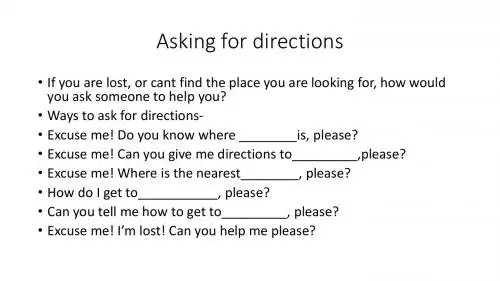
Giving simple irections
• Go straight on/ Carry straight on. • Turn right. • Turn left. • Take the …..1st road on the left/2nd road on the right • It is opposite…… • It is in between…… • It is next to……. • It’s on the corner. • It’s about a …..minute walk, from here.
Asking for directions
• If you are lost, or cant find the place you are looking for, how would you ask someone to help you? • Ways to ask for directions• Excuse me! Do you know where ________is, please? • Excuse me! Can you give me directions to_________,please? • Excuse me! Where is the nearest________, please? • How do I get to___________, please? • Can you tell me how to get to_________, please? • Excuse me! I’m lost! Can you help me please?
Listening activity
• Look at map. You are going to listen to directions to four different places. Write in the places as you hear them. A. Post office B. Underground station C. Cinema D. Bus station
Asking and Answer
---------------------------------------------------------------范文最新推荐------------------------------------------------------Asking and Answerchapter iv asking and answering questionsi. inviting questionsso, let's throw it open to questions.now i' d like to answer any questions, if you have any.now i am ready to answer your questions, if any.i'd be glad to try and answer any questions.are there any questions?any questions?ii. raising questionssignaling your intention to ask a questioni want to ask dr. bi a question.i have a guest ion for dr. anderson.mr. smith, i have a question to ask you.1 / 13there is a question i'd like to ask prof. li.a question for mr. liu.one question, dr. wei.could i ask you a question, prof. li?may i venture to ask prof. zhang a question?expressing your attitudebefore asking your question, you can express your positive attitude or make a comment on the speaker's presentation. for example,dr. johnson, i was fascinated by your description of your study, but what will happen if...mr. li, you did splendid work! just one question.asking the specific questionyou mentioned very briefly that you used two experiments that were the same.would you please elaborate on that point?would you be so kind as to give me more information about the method of your experiment?---------------------------------------------------------------范文最新推荐------------------------------------------------------ would you tell me the reason why you set such a high temperature?comprehensive samplesdr. wang, i'd like to raise one question. first, may i say how much i enjoyed talk. but, may i ask, do you have experience with the new method?congratulations, dr. li. i can't help but admire your achievement. but i want to know what's your attitude toward abuse of antibiotics?i'd like to congratulate mr. liu on a very interesting presentation.may i ask you a question? how does subjective evaluation differ from objective evaluation?first, i'd like to say your research is very interesting. may i ask two questions? do you see any relation between cigarette smoking and peptic ulcers? and what advantage do you expect by using this approach?iii. response to questionsasking for repetition3 / 13pardon, i couldn't hear what you said.i beg your pardon, i didn't catch what you said.i'm sorry i forgot your first question. would you be so kind as to say it again?i'm not quite surge what your question is.i didn't quite get the last point of your question.you mean, there may be some mistake in the calculation?are you referring to the significance of the difference?are you suggesting that the temperature might have affected the results?if i understand you correctly, you are saying/asking...i didn't quite catch that.could you go over that again?i'm not sure what you're getting at.welcoming the questionwelcome the question by saying thank you or commenting on it saying that¡¯s a good question or that's a challenging question.this is a very good question.---------------------------------------------------------------范文最新推荐------------------------------------------------------ thank you for that question.i'm glad this question has been brought up-i appreciate that question.this is a hard question.this is an interesting question.this is a big question.i'd be delighted to answer your question.i'll try to answer this question very briefly.in answer to your question, i would say that...i can only provide a partial answer to that question.let me try to answer your questions one by one.my answer to your first question is...may i answer your second cjuestion first?i have only a partial answer to your question.thank you for that question. this is a challenging question and i'm afraid i can only provide a partial answer to it. anyway, i'll try my best to answer it.repeating or paraphrasing the questionquestioner: have you tried it on human bodies?5 / 13presenter: this gentleman would like to know whether we have tried this on human bodies.responding to difficult or challenging questionquestion: so what happens if the new budget isn't approved?answer (1): we've spent two months preparing the new budget. it's a good budget and we're confident we'll get approval to put it into practice.answer (2): there is too much supposition in the question for me to give a sound answer.the following are some other examples of answers to challenging questions:perhaps in another year or so we can answer that question, because these studies are now in progress.we are now working on this problem and, if you agree, i'll answer your question in a few weeks.the only answer i can give at present is to wait a few more years, at which time something better might ultimately come out of all our efforts.i think it will be possible to answer this question when more---------------------------------------------------------------范文最新推荐------------------------------------------------------ experiments are completed.the answer to this question needs further study.i hope i will be able to answer your question later.responding to improper questioni appreciate your interest in my research, but i just don't want to talk about it now. let's talk about something else.i'd rather not say.why do you want to know?sometimes you can relay the question back to the questioner. for example,before i answer you that question, let me ask you: where do you think we should have the project?in this way, sometimes you encourage the questioner to answer his or her own question, e.g. what do you think? are people prepared to pay an extra $ 2 for faster service?responding to the questions you do not know7 / 13if you don't know the answer to a particular question, simply admit that you don't know. say something like this: i'm sorry. i don't happen to know the answer to that question, but i'll be happy to check into it for you.here are some further examples:i don't think i can answer your question.i wish i could answer your question, but unfortunately i have no good answer.i'm not sure that i can answer your question. what i'm going to say is not quite an answer to your question.another technique to cope with the situation is to direct the attention to another expert who may know it or you can use the audience. ask if anyone could help the questioner and hence it won't be necessary for you to admit that you do not know the answer. see examples below.i think that question could be better answered by dr. liu than by me.i think perhaps dr. chen would be better able to answer this question.prof. li would be a better person to answer your question since he has done a lot of work in this field.fortunately, prof. 'ma, who is an authority in this area,---------------------------------------------------------------范文最新推荐------------------------------------------------------is 'here. i think no one is more suitable than him to answer your question.dr. sawyer is perhaps in a better position to tell us something about it.perhaps my colleague dr. emery here has some better ideas.i think it would be better if prof. wu were to make some comments on this matter.avoid using the following expressions to embarrass the questioner:i've already answered that but you obviously weren't listening. instead say something like i'm sorry i didn't explain that clearly.avoid talking to one questioner. look towards the other, side of the conference hall or room and indicate that there is another question. suggest that as there are several more questioners,' yon could discuss his or her question in more detail after your talk.referring back to the questionerhaving finished answering questions, you should check that9 / 13the questioner is satisfied or further elaboration or explanation is called for. the following expressions might be helpful.did i answer your question?did i answer you satisfactorily?did your question get answered?i don't know whether this answered your question.i don't know if this is a satisfactory answer.i hope this may serve as an answer to dr. li.i hope this answers ~0ur question.:,sometimes when question lime is over and ff time permits, you can restate, your main proposition, including any good comments from the audience and ignoring adverse questions or remarks. thus, you demonstrate that you are confident mid can cope calmly with controversy.remember that your last words to the audience will be retained longest and you are expected to behave in a professional manner.--亚伯拉罕.林肯the gettysburg address---------------------------------------------------------------范文最新推荐------------------------------------------------------ by abraham lincoln八十七年以前,我们的祖先在这大陆上建立了一个国家,它孕育于自由,并且献身给一种理念,即所有人都是声来平等的。
Asking for InformationPPT教学课件
• 专科学历:college’s degree学士学位:bachelor’s degree 硕士
学位:Master’s degree 博士学位:PHD/doctor’s degree 英语口 语证书:Spoken English certificate 商务英语证书:business English certificate
• 快递:fast mail 航空邮件:air mail/mail by
air
• 平邮:ordinary mail
2020/12/10
4
PPT教学课件
谢谢观看
Thank You For Watching
5
2020/12/10
2
MakingBiblioteka up dialogues• 2.You are at the National Library. You
want to find out at what hours the library is open and closed. You also want to know how to borrow a book from the library.
Asking for Information
Who, what, when, where, why, How long, how much, how many,
英语演讲教程-AskingandAnsweringQuestions
First, I'd like to say your research is very interesting。 May I ask two questions? Do you see any relation between cigarette smoking and peptic ulcers? And what advantage do you expect by using this approach?
Congratulations, Dr。 Li。 I can't help but
admire your achievement。 But I want to know what's your attitude toward abuse of antibiotics?
I'd like to congratulate Mr。 Liu on a very interesting presentation。
I'm not quite surge what your question is。
I didn't quite get the last point of your question。
You mean, there may be some mistake in the calculation?
Are you referring to the significance of the difference?
I can only provide a partial answer to that
【精品】英语四级听力考试中的七类关键词提问方式及解题对策和得分秘笈
英语四级听力考试中考生要注意的七类关键词四级考试听力部分的短对话、长对话和短文听力其实考察的都是对听力材料的要点和信息的把握。
什么是要听懂并且记下来的信息呢,要把握吨化和短文中的七种关键词,KEYWORD,后面一般都是考点,尤其是对话部分,要学会听小词。
一、转折性词汇:课堂上强调了很多的涵义发生180度转弯的BUT转折题,要学会听BUT,还有yet,however,though,whereas,unfortunately,unexpectedly,instead,ratherthan,otherthan,tobefrank,franklyspeaking,totellyouthetruth,etc.二、逻辑类词汇:就是因为所以不但而且这一类的词,表原因的because,becauseof,for,as,dueto,owingto,inthat,nowthat,accordingto,表结果的therefor,so,asaresult,consequently,eventually,表递进的apartfrom,inaddition,furthermore,what'smore,moreover,etc.三、最高级词汇:形容词和副词的最高级永远是最需要关注的,mostimportantly,themostpopular.。
thebiggestof。
.四、事实罗列词汇:在这些词汇后就是关键和重要的事实性息,actually,infact,asamatteroffact,etc.五、序数词后面,最重要的是thefirst,firstlyandfinally.六、情态动词:sb.hasgotto,can,could,may,might,need,should,oughtto,etc.七、重要形容词:表示重要的词,important,crucial,chief,major,significant,theonly,unique,essential,necessary,vital,etc。
五年级下册英语教案-Unit 3 Asking the way 译林版三起
五年级下册英语教案-Unit 3 Asking the way 译林版三起一、教学内容本课时将学习以下内容:1.掌握一些关于问路的基本用语;2.学会简单的指路;3.了解英语国家一些交通规则和安全常识;4.学习基本口头交流技能。
二、教学目标1.让学生能够听懂关于问路的基本用语并回答;2.让学生能够用简单的英语指路;3.让学生了解交通规则和安全常识;4.让学生掌握基本口头交流技能。
三、教学重难点重点1.掌握一些关于问路的基本用语;2.学会简单的指路。
难点1.学习基本口头交流技能。
四、教学方法1.讲解法;2.互动交流法。
五、教学过程1. 情境导入引导学生回忆在生活中问路时的场景,鼓励学生描述并讨论。
2. 学习关于问路的基本用语1.首先,教师可以通过播放录音或者视频来让学生熟悉一些英语问路用语,如:–Excuse me, can you tell me the way to the library, please?–Sorry, I’m not sure. Let me ask someone else.–Go straight ahead for two blocks, and then turn left at the post office.2.然后,教师可以让学生跟读、模仿这些用语,巩固语音和语调。
3. 学习简单的指路1.首先,教师可以通过图片或者实物让学生了解些常见的交通指示牌和标志,比如:–Stop sign–No parking sign–Keep right sign2.然后,教师可以通过演示来教授一些常见的指路用语,如:–Go straight ahead–Turn left/right at the corner–It’s on your left/right4. 学习交通规则和安全常识1.首先,教师可以通过图片或者实物让学生了解一些英语国家的基本交通规则和安全常识,如:–Look left/right before crossing the street–Follow traffic signs and signals–Wear your seat belt when you’re in a car2.然后,教师可以通过互动讨论来鼓励学生跟自己的父母或者其他大人谈论一些交通安全问题,并引导学生做个小组展示。