
六年级英语下册比较级总结
英语形容词比较级
(一)一般句式的构成:A + is / are+ 形容词比较级+ than + B
A 是主格B 是宾格
如:She is taller than me.
主格+ be + 形容词比较级+ than + 宾格
规则变化:
1)单音节词末尾加-er(比较级),
【例】 原级 比较级
great greater
small smaller
clean cleaner
2)单音节如以e结尾,只加-r(比较级),
【例】fine finer
nice nicer
wide wider
3)闭音节单音节词如末尾只有一个辅音字母,须先双写这个辅音字母,再加-er(比较级),
【例】big bigger
hot hotter
red redder
4)以-y结尾的词,如-y前是辅音字母,则变y为-i,再加-er(比较级)。
【例】
easy easier
heavy heavier
5)其它双音节和多音节词皆在前面加单词more和most。
【例】careful more careful
difficult more difficult
delicious more delicious
不规则变化:
原级 比较级
good/well better
bad worse
many/much more
little less
far farther/further
注:有些形容词一般没有比较等级。如:right, wrong, woolen等。
形容词的比较等级的用法:
比较级用于二者的比较。
【例】Li Ping is older than Wang Hai. 李平比王海年纪大。
There are more students in Class One than in Class Two.一班比二班学生多。
英语中人称代词和物主代词的表格
一、人称代词
表示“我”、“你”、“他”、“她”、“它”、“我们”、“你们”、“他们”的词,叫做人称代词。人称代词有人称、数和
格的变化,见下表:
人称
单数 复数
主格 宾格 主格 宾格
第一人称 I me we us
第二人称 you you you you
第三人称 he him they them she her
it it
人称代词主格:作主语,表示谁怎么样了、干什么了。
I am a teacher. You are student. He is a student, too.
We/You/They are students.
人称代词宾格作宾语,表示动作行为的对象。
Give it to me. Let’s go (let’s =let us)
二、物主代词
表示所有关系的代词叫做物主代词,也可叫做代词所有格。物主代词分形容词性物主代词和名词性物主代词二种,
其人称和数的变化见下表。
数
人称
类别
单数 复数
第一 人称 第二 人称 第三 人称 第一 人称 第二人称 第三
人称
形容词性物主
代词
my your his her its our your their
名词性物主代
词
mine yours his hers its ours yours theirs
汉语 我的 你的 他的 她的 它的 我们的 你们的
他(她、它)
们的
形容词性物主代词(my/your/his/her/its/our/their)+名词
而名词性物主代词则相单于形容词性物主代词+名词,故其后不必加名词。如:
Is this your book
No,,it isn’t, it’s hers(her book)
This pen is mine.
详细PEP新人教版小学英语六年级下册知识点归纳总结(高效记忆)课件

I wear size 7 shoes. 我穿7码的鞋。
句型
比较级,用来对自己和 他人的身体特征进行比较
I'm thinner than you. 我比你瘦。
My hands are bigger than yours. 我的手比你的手大。
Your feet are bigger than mine. 你的脚比我的脚大。
badminton 羽毛球运动
cycling 骑自行车运动
go cycling 骑自行车
原形→过去式。
be 动 词
am/ is→ was
are→were
feel→felt感觉
think→thought认为,想
wake→woke 醒来
Unit 4 Then and now
句型—
表示以前 没有某物
过去不能做或 者不会做某事
PEP人教版六年级下册
Unit 2 Last Weekend
思维导图记忆法
Unit 2 Last Weekend
clean my room 打扫我的房间
clean→cleaned 打扫
watched TV 看电视
watch→ watched 看
stayed at home 待在家里
stay→stayed 待在
There was no+单数名词/不可数名词+过去时间 chool.
There was no library in my old s 在我以前的学校里没有图书馆 。
There were no+复数名词+过去时间
time.
在我那时候没有电脑有没有网络。 There were no computers or Internet in my
六年级下册第1单元英语作文 比较级
Comparisons in Daily Life: The Magic of theComparative DegreeIn the realm of daily life, comparisons are inevitable. They help us understand our surroundings, evaluate situations, and make informed decisions. The comparative degree, a grammatical tool that enables us to compare two or more things, is the backbone of these comparisons. In this essay, we will explore the wonders of the comparative degree and how it shapes our understanding of the world.At the heart of the comparative degree lies the use of adjectives and adverbs. By adding suffixes like "-er" or "-more" to these words, we can convey the idea of one thing being better, faster, or stronger than another. For instance, when we say "He is taller than me," we are using the comparative degree to emphasize the difference in height between two individuals. Similarly, when we describe a car as "faster than the previous model," we are highlighting its improved speed characteristics.The comparative degree is not limited to adjectives and adverbs, however. It can also be found in nouns, verbs, and even entire sentences. For example, in the sentence "Iprefer apples to oranges," we are comparing two fruits and expressing a preference. Here, the use of "to" creates a comparison between the two nouns, apples and oranges.The importance of the comparative degree lies in its ability to foster critical thinking and analysis. By comparing different options, we can gain a deeper understanding of their relative strengths and weaknesses. This, in turn, helps us make informed decisions that align with our goals and preferences.In the academic world, the comparative degree is an essential tool for writing and research. It allows students to compare and contrast different theories, experiments, or studies. By highlighting the similarities and differences between these topics, students can gain a more comprehensive understanding of the subject matter.Moreover, the comparative degree finds its application in everyday conversations. Whether we are comparing prices at the market, discussing the relative merits of different sports, or evaluating the quality of restaurants, the comparative degree helps us communicate our thoughts and opinions effectively.In conclusion, the comparative degree is a powerfultool that shapes our understanding of the world. It enables us to compare and contrast different things, fostering critical thinking and analysis. As we move through life, the ability to use the comparative degree effectively will become increasingly important, helping us make informed decisions and communicate our ideas effectively.**日常生活中的比较:比较级的魔力**在日常生活中,比较是不可避免的。
六年级下英语语法知识点归纳总结
六年级下英语语法知识点归纳总结英语语法对于学习者来说是非常重要的一部分,它是我们正确运用英语的基础。
在六年级下学期的英语学习中,我们接触、学习了很多语法知识点。
在本文中,将对这些知识点进行归纳总结,旨在帮助大家更好地理解和掌握英语语法。
介词短语介词短语是一种常见的句子成分,在句子中起着修饰、名词补充等作用。
介词短语通常由介词加上一个或多个名词、代词、动名词等组成。
例如:1. on the table(在桌子上)2. by the river(在河边)3. after school(放学后)时态时态是英语句子中表示时间的一种语法形式,它能够准确地描述动作发生的时间。
在六年级下学期中,我们学习了以下几种时态:1. 一般现在时:表示经常发生的动作或事实。
例如:I go to school every day.(我每天去学校。
)2. 一般过去时:表示过去某个时间发生的动作。
例如:She walked to the park yesterday.(她昨天步行去公园。
)3. 一般将来时:表示将要发生的动作或事件。
例如:They will visit Beijing next week.(他们下周将去北京参观。
)4. 现在进行时:表示现在正在进行的动作。
例如:He is playing basketball with his friends.(他正在和朋友们打篮球。
)副词副词是一种修饰动词、形容词或其他副词的词语,它可以提供附加的信息,例如时间、地点、程度等。
以下是一些常见的副词类型:1. 时间副词:now(现在)、then(那时)、today(今天)、yesterday(昨天)等2. 地点副词:here(这里)、there(那里)、nowhere(无处)、everywhere(到处)等3. 程度副词:very(非常)、quite(相当)、really(真正地)等形容词和副词的比较级和最高级形容词和副词在表达程度、大小、数量等方面可以使用比较级和最高级来进行比较。
六年级英语形容词 副词比较级的用法讲义
形容词/ 副词比较级的用法1. 两类人/事物的比较用比较级Which is stronger, a tiger or a dog?The elephant is bigger than the dog.2. 比较级之前用the 特指两个之中更….的一个,He is the taller of the two. (他是两者中比较高的那个)He is the stronger of the two boys (他是两个中比较强壮的那个)The watch is __________ _________ of the two. (cheap)He is ________ ________ of the two. (good)3. “the +比较级…, the +比较级….” 表示“越….就越…‘The sooner the better. (越快越好。
)The _________ he is, the _______ he feels.A. busier, happierB. busy, happierC. busier, happy.4. 比较级and 比较级表示越来越…He runs faster and faster. (他跑得越来越快)More and more people are interested in sports. (越来越多的人对运动感兴趣)The weather is getting __________ and __________ (warm)She becomes __________ and __________ ____________ (beautiful)当三个或者三个以上的人或者物进行比较时,形容词和副词要用最高级,最高级后面常和of,in等短语来限定比较的范围。
Li lei is the tallest of all . She is the shortest in our class.Lie lei runs fastest of the three. He studies hardest in his school.规则原形比较级最高级1.一般情况下,直接加-er, -est talllong________________________________________________________________2. 以e结尾,直接加-r,-st largelate________________________________________________________________3.以单元音、但辅音结尾的重读闭音节,双写该辅音,在加-er,-est hotwetthin________________________________________________________________4. 以辅音字母加y结尾的,变y为i,在加-er,est busyheavy________________________________________________________________5.多数双音节和多音节词在前面加more,most famousimportant________________________________________________________________不规则变化原形比较级最高级good better best bd/ill worse worst mny/much more most far farther farthest little less least专项练习一.写出下列形容词和副词的反义词。
六年级下册英语比较级作文介绍身高,体重
六年级下册英语比较级作文介绍身高,体重As sixth-grade students, we are all going through a phase of rapid growth. One of the most obvious differences among us is our heights and weights. In this essay, I will compare the heights and weights of my classmates and myself to see who is taller, heavier, or even more proportional. To start with, let's talk about our heights. In our class, there is a wide range of heights. Some of us are as tall as small trees, while others are still as short as bushes. I myself am 150 centimeters tall, which is average compared to my classmates. The tallest student in our class is Jack, who stands at a whopping 170 centimeters. On the other hand, the shortest girl is Lily, who is only 130 centimeters tall. Although Lily is shorter than most of us, she is very confident and always smiles brightly, showing that height is not the only measure of someone's worth.Next, let's compare weights. Unlike heights, our weights are more variable and can change depending on ourdiets and exercise habits. In our class, the heaviest student is Tom, who weighs a whopping 60 kilograms. Tom loves to eat and is always seen snacking during breaks. However, he is also very strong and often helps us with heavy tasks. On the other hand, the lightest girl is Emily, who weighs only 35 kilograms. Emily is very slim and active, and she always encourages us to eat healthily and exercise regularly.Finally, let's talk about body proportions. Although heights and weights are important, they are not the only factors that determine someone's physical attractiveness. Body proportions also play a crucial role. In our class, some students may be taller or heavier, but their bodiesare well-proportioned, making them look more attractive.For example, Alice is not the tallest or the lightest inour class, but her body is very well-proportioned, and she always looks elegant and confident.In conclusion, heights and weights are just two aspects of our physical development. Although they can vary widely among us, it is important to remember that everyone is unique and beautiful in their own way. What matters most isour health and confidence, not just our physical appearance. Let's embrace our differences and celebrate our uniqueness together!**比较我们班级中的身高和体重**作为六年级的学生,我们都在经历一个快速发展的阶段。
小学六年级英语:比较级最高级
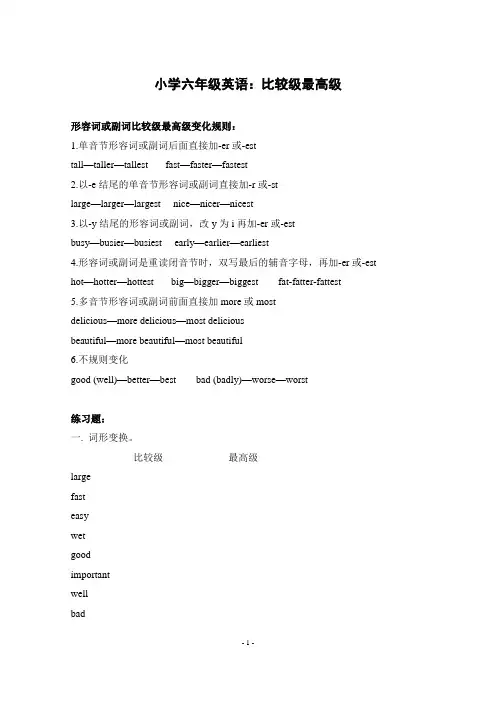
小学六年级英语:比较级最高级形容词或副词比较级最高级变化规则:1.单音节形容词或副词后面直接加-er或-esttall—taller—tallest fast—faster—fastest2.以-e结尾的单音节形容词或副词直接加-r或-st large—larger—largest nice—nicer—nicest3.以-y结尾的形容词或副词,改y为i再加-er或-est busy—busier—busiest early—earlier—earliest4.形容词或副词是重读闭音节时,双写最后的辅音字母,再加-er或-est hot—hotter—hottest big—bigger—biggest fat-fatter-fattest5.多音节形容词或副词前面直接加more或mostdelicious—more delicious—most deliciousbeautiful—more beautiful—most beautiful6.不规则变化good (well)—better—best bad (badly)—worse—worst练习题:一. 词形变换。
比较级最高级large _________________ ___________________fast _________________ ___________________easy _________________ ___________________wet _________________ ___________________good _________________ ___________________important _________________ ___________________well __________________ ___________________bad _________________ ___________________many _________________ ___________________little _________________ ___________________far _________________ ___________________strong _________________ ___________________patient _________________ ___________________safe _________________ ___________________expensive _________________ ___________________二. 选择填空。
六年级英语下册Unit1知识点总结
人教PEP版英语六年级下册各单元知识点Unit 1 How tall are you ?一、必背单词(形容词的比较级)①一般形容词→词尾+ertall ——taller 高的更高的short ——shorter 矮的/短的更矮的/更短的long ——longer 长的更长的strong——stronger 强壮的更强壮的old ——older 老的/旧的更老的/更旧的young——younger 年轻的更年轻的small ——smaller 小的更小的low ——lower 低地更低地smart——smarter 聪明的更聪明的②以e结尾的形容词→词尾+rlarge ——larger 大的更大的late ——later 晚的更晚的simple ——simpler 简单的更简单的safe ——safer 舒服的更舒服的③以重读闭音节结尾,辅+元+辅→双写最后一个辅音字母+erbig——bigger 大的更大的thin——thinner 瘦的更瘦的fat——fatter 胖的更胖的sad ——sadder难过的更难过的hot——hotter 热的更热的wet——wetter 潮湿的更潮湿的④辅音字母+y 结尾→改y 为i +erhappy——happier 开心的更开心的heavy——heavier 重的更重的funny——funnier 滑稽的更滑稽的angry——angrier 生气的更生气的sunny——sunnier 天晴的更晴朗的windy——windier 有风的的更有风的busy——busier 忙的更忙的early——earlier 提早的更早的⑤其它双音节和多音节词皆在前面→加单词more。
careful——more careful difficult——more difficult delicious——more delicious不规则变化:原级比较级good/well betterbad worsemany/much morelittle lessfar farther/further注:有些形容词一般没有比较等级。
六年级下册第一单元英语范文比较级
从比较级看成长:我与我的影子As a sixth-grader, I am constantly comparing myself to others, whether it's in school, sports, or social media. It seems like everyone is taller, faster, smarter, prettier,or cooler than me. However, recently, I realized that the real comparison I should be making is not with others, but with my own past—my own shadow.在六年级的这段时间里,我总是不断地将自己与他人进行比较,无论是在学校、体育活动中,还是在社交媒体上。
似乎每个人都比我高、比我快、比我聪明、比我漂亮、比我酷。
然而,最近我意识到,我真正应该进行的比较不是与他人,而是与我自己的过去——我自己的影子。
In English class, we learned about comparativeadjectives and adverbs. We practiced comparing things using “more” or “less” and adding “-er” to the end of words. At first, I thought this was boring and pointless. But as I began to apply these comparative structures to my own life, I started to see the value in them.在英语课上,我们学习了比较级形容词和副词。
我们通过使用“more”或“less”并在单词末尾加上“-er”来练习比较事物。
六年级下册英语第一单元范文比较级
六年级下册英语第一单元范文比较级全文共3篇示例,供读者参考篇1English Class ComparisonsFor us sixth graders, English class is always a mix of fun and challenging material. This semester, our textbook has five really interesting units that are quite different from each other. I'll compare and contrast the units using lots of comparative adjectives so you can see which ones are more difficult, more engaging, or just plain more awesome than the others!Unit 1 is called "A Changing World" and it's probably the most thought-provoking of the units. The readings are longer pieces about how technology and innovation have transformed our lives over time. The language is more formal and academic compared to some other units. The vocabulary is also more advanced, with lots of terms related to science, technology, and society. I'd say this unit requires more critical thinking skills than some of the others.In contrast, Unit 2 called "Cultural Celebrations" is way more lighthearted and easier to relate to. The lessons revolve aroundholidays, festivals, and traditions from different cultures. The readings are shorter excerpts, poems, and stories that are more narrative and descriptive. The activities have us do a lot more hands-on cultural projects like making crafts and trying new foods. For sure, this unit is more fun but perhaps a bit less challenging than Unit 1.Unit 3 is named "Remarkable Lives" and in my opinion, it's one of the most inspiring and motivating units. We learn about famous people who overcame huge obstacles to achieve amazing things. From scientists to athletes to activists, their life stories are far more compelling than anything you'd see in a movie. The writing assignments push us to set bigger goals and be more determined. I'd say the language is moderate – not quite as hard as Unit 1 but not as simple as Unit 2. The lessons are just as engaging though!If you're into adventure and drama, then you'll probably find Unit 4 "Extreme Explorers" to be even more thrilling than "Remarkable Lives". This is where we read first-hand accounts from explorers who ventured into the most remote places on Earth and beyond. Their risky journeys are fraught with more danger, more hardship, and ultimately more reward than you can imagine. The readings are packed with vivid details and imagerythat really puts you there in the intense action. Vocabulary gets quite specific with geographic terms too. Overall, it's an exhilarating unit but possibly more overwhelming than others.My personal favorite so far has been Unit 5: "World of Work". Yeah, I know it sounds kind of dull and grown-up, but hear me out! This unit is filled with way more real-world relevance than the previous ones. We've learned about different career paths, workplace skills, money management, and entrepreneurship. Rather than just reading, we get to do more independent projects like mock job interviews, business plans and budgeting simulations. The concepts are pretty straightforward but you have to flex more problem-solving and organizational skills. It's been so much more applicable and useful than I expected going in.Those are the five main units we've covered so far and each one has its own unique strengths and challenges. Unit 1 "A Changing World" is the most intellectual whereas Unit 4 "Extreme Explorers" is the most adventurous and thrilling. Units 2 "Cultural Celebrations" and 3 "Remarkable Lives" place more emphasis on creativity, culture, and inspiration respectively. Meanwhile, Unit 5 "World of Work" takes a more practical approach and is most relatable to our futures.As you can see, there's plenty of variety to keep us engaged and well-rounded! While the comparative difficulty level varies across units, they all contribute important skills. Whether building our academic proficiency, broadening our awareness, stoking our ambition, stimulating our imagination, or preparing us for the real world, these units collectively make English class one of the most formative experiences of sixth grade.I'm already seeing so much more improvement in my reading, writing, speaking, and overall comprehension compared to last semester. Each new unit pushes us further and helps reinforce those core competencies. Who knows what new frontiers await as the year progresses?Looking back at the course so far though, I'd have to say "World of Work" has been the most directly applicable and beneficial for me personally. The skills I've gained there will serve me better and more immediately than anything else we've covered. Not that the other units are less valuable by any means. "Remarkable Lives" was probably the most inspirational while "Extreme Explorers" was definitely the most exhilarating read. In terms of difficulty though, nothing was more academically rigorous and complex as "A Changing World". "CulturalCelebrations" was perhaps the most fun and creatively engaging unit overall.So in summary, for an engaging, well-rounded English curriculum that builds diverse skills and awareness, this textbook has it all! The comparative highlights of each unit are:-Unit 1 "A Changing World" = most intellectual/academic-Unit 2 "Cultural Celebrations" = most creative/hands-on-Unit 3 "Remarkable Lives" = most inspirational-Unit 4 "Extreme Explorers" = most adventurous/thrilling-Unit 5 "World of Work" = most practical/applicableThere's a little something for every type of learner and interest packed into these units. English class has been an incredibly enriching experience so far and I can't wait to see what other amazing units await!篇2Unit 1 - The Comparative DegreeThe first unit of our 6th grade English textbook covers the comparative degree. At first, I wasn't sure why learning about comparing things was so important. But as we worked throughthe lessons and examples, I realized just how useful and common comparatives are in everyday English.The basics of comparatives are pretty straightforward. We use them to compare two people, animals, objects, or things. The main comparative forms are:Adding "-er" to short adjectives (e.g. tall -> taller, quick -> quicker)Adding "more" before longer adjectives (e.g. more beautiful, more intelligent)Using "less" to show something is smaller or lower in degree (e.g. less expensive, less challenging)At first, these rules seemed simple enough. But then we learned about all the irregular adjective forms that don't follow the regular patterns. Good becomes better, bad becomes worse, and little becomes less. Remembering which adjectives are irregular took some memorization.Once we had the basics down, things got more interesting. We started comparing quantities and amounts using phrases like "as...as" (e.g. She is as tall as her brother). And we learned how to form the superlative degree using "-est" or "most/least" to showthe highest or lowest degree (e.g. the tallest, the most expensive).Some of the examples in the textbook seemed silly at first, like comparing animals (A cheetah runs faster than a snail) or food (Ice cream is sweeter than broccoli). But the more we practiced, the more I saw how comparatives are essential for describing and contrasting all sorts of things clearly.One tricky area was using "than" properly after comparatives. It sounds simple, but knowing when to use "than" versus "as...as" takes some practice. Another hurdle was remembering to make subjects and verbs agree properly after phrases like "one of the..." (e.g. He is one of the most talented singers thathas/have...).Where comparatives really came alive for me was when we started applying them to real-world situations and experiences. Giving opinions and making choices is all about comparing options. Is math harder or easier than English for you? Whose painting is more creative? Which city has less traffic? Is working part-time better than being a full-time student?I found myself using comparatives constantly to evaluate experiences, explain preferences, and make recommendations to friends and family. Describing my day, I could say things like"Math class was more boring than usual today" or "The new cafeteria food is way better than last year's meals." When deciding between activities, I could weigh pros and cons: "Seeing that movie sounds less fun than going to the park."Beyond just personal observations, comparatives let us interpret and discuss information objectively. In science class, we used them to analyze data (The current was faster than last year's) and describe processes (Erosion is caused more by water than wind). Talking about trends in history or current events requires making comparisons too.One of my favorite comparative exercises was comparing two stories or books. We had to analyze the characters, identify themes, and contrast the plots. Using comparatives made it easy to highlight key similarities and differences clearly and precisely. For example: "While both protagonists faced difficult challenges, Alma's obstacles were ultimately more complicated andhigher-stakes than Dario's."Of course, no discussion of comparatives would be complete without addressing their hypothetical and idiomatic uses as well. We spent time studying common phrases and expressions that use comparative forms figuratively, like:The sooner, the better (Implying something should be done as soon as possible)The more the merrier (Suggesting having morepeople/things is better)(None) the worse for wear (Meaning someone/something wasn't damaged or harmed)These idiomatic usages showed how comparatives permeate so much of natural, informal English speech.Looking back over this unit, I'm honestly impressed by how far my comparative skills have come. What started as simple grammar concepts grew into capacities for nuanced analysis, evaluation, and even figurative communication. While remembering all the rules took work, the payoff is indispensable.Whether discussing personal experiences, interpreting data and literature, or just trying to get a point across clearly, the comparative degree is irreplaceable. It allows us to rank, prioritize, and discern differences that would otherwise be vague or unclear. With comparatives, we can articulate thoughts, opinions, and ideas with structure and precision.Comparatives make our communication richer and more impactful. Being able to say definitively that "A is more/less thanB" carries weight that the simple "A and B are different" cannot. We can make a much stronger case, form deeper insights, and relate more vividly using comparative degrees.Needless to say (pun intended), this unit on comparatives has proven incredibly valuable. The concepts took some initial effort, but applying them has become second nature. I find myself evaluating things through a comparative lens constantly now, which helps me think critically and express myself clearly.While comparatives may have seemed like an arbitrary grammar topic at first, they've revealed themselves to be powerful tools for logic, analysis, and effective communication. Whether comparing the significance of historical events, the features of product options, or simply two experiences from my own life, I now wield comparatives with skill and nuance. This unit has elevated my English aptitude significantly and will undoubtedly serve me well going forward.篇3Unit 1 - Comparatives Galore!Wow, Unit 1 in our new English textbook this semester is all about comparative adjectives and adverbs. At first, I thought it would be kind of boring, but Mrs. Robertson has made it reallyfun and interesting! She says comparing things is one of the most useful skills in English.Basically, comparatives are what you use when you want to compare two things, people or situations. You use words like "bigger," "smarter," "more quickly," etc. It lets you say if something or someone has more or less of a certain quality than something or someone else.The main comparatives we've learned so far are:-er for short adjectives (smart -> smarter)more + adjective for longer adjectives (more intelligent)more + adverb for adverbs (more slowly)Those are just the basic rules though. There's a lot more to keep track of with comparatives!Irregular FormsA bunch of really common adjectives have totally irregular comparative forms that you just have to memorize. Likegood/better, bad/worse, little/less. Mrs. Robertson made us practice those ones a lot. Like "My little sister is lesswell-behaved than me!" Haha, just kidding sis!Double ComparativesYou also have to be careful not to use a double comparative, like "more bigger" or "most intelligenter." That's a big no-no and Mrs. Robertson's eagle eyes always catch it. You'd say "bigger" or "more intelligent."Other Degrees of ComparisonSpeaking of "most," we've learned about three degrees of comparison:The positive degree just describes something with no comparison. Like "It's a fast car."The comparative degree compares two things, using -er, more, less, etc. "This car is faster than that one."The superlative degree compares one thing to all others in a group, using -est or most/least. "This is the fastest car I've ever driven."Using "Than"One key thing with comparatives is using "than" to make it clear what you're comparing. Like "Luke is taller than Leia." If you leave out "than Leia" it's not a complete comparison.You also have to be careful with "than" and pronouns/nouns. Like you'd say "He is smarter than me" not "He is smarter than I"even though "I" is technically correct. It just sounds unnatural in English.Comparing with "As...As"Another way to make comparisons is with "as...as" like "Luke is not as short as Leia." Or you can use "so...as" like "Leia is not so tall as Luke." Those can get tricky!When Not to Use ComparativesYou're not supposed to use comparatives after:"This" or "That" (this apple, not this appler)Superlatives (the biggest, not more biggest)"No" or "None" (no people, not no peopler)Whoops, just remembered we're not covering superlatives until next unit. My bad!Comparatives with AdverbsWe've also practiced a ton of comparative adverbs:Fast/faster, well/better, badly/worse, hard/harderEarly/earlier, soon/soonerOften/more oftenYou use them the same way as adjectives. Like "I ran faster than him" or "She works harder than me."Comparatives with "More" and "Less"With lots of adverbs and adjectives, you make the comparative form by putting "more" or "less" before them:More comfortably, more easily, more unfortunatelyLess happily, less carelessly, less certainlyThose "more" and "less" ones can get really wordy! Mrs. Robertson says we have to be careful they don't sound unnatural.Omitting Words with ComparativesTo make comparisons more concise, you can sometimes leave out words that are understood:"He is taller (than he is old)" -> "He is taller than old""She runs faster (than he runs)" -> "She runs faster than he"It's a way to avoid repeating words, but you have to be sure the meaning is still totally clear.Double ComparisonsOne other thing we learned is you can make a "double comparison" using two comparatives in a row:"English is more difficult than Spanish is easy."Those double comparisons are pretty advanced though, so we don't use them much yet.Whew, I think that covers most of the key points we've learned so far about comparatives! Who knew there was so much to keep track of? Looking back, comparatives seem pretty straightforward at first. But there are all these little extra rules and exceptions.I definitely have a long way to go before I fully understand all the nuances. Fortunately, Mrs. Robertson keeps having us practice constantly with all kinds of speaking, writing, reading and listening activities. I can already feel my comparative skills improving more quickly than before!By the end of this unit, I'll be forming comparative statements more comfortablier than my classmates. Just kidding, I know that's a double comparative and totally wrong! But you get what I mean. Comparatives are a hugely important part of English, and I'm super lucky we have such a good teacherwalking us through it all step-by-step. One thing's for sure - this unit is way more interesting than I thought it would be!。
新标准英语六年级下册专题复习——比较级和最高级
新标准英语六年级下册专题复习——比较级和最高级1、形容词或副词的比较级和最高级的含义:在英语中,当我们需要对事物做出比较时,也就是在表示“比较……”和“最……”时,形容词或副词要用特别的形式,称为“比较级”和“最高级”,原来的形容词或副词称为“原级”。
原级比较级最高级young年轻 younger较年轻 youngest最年轻old老 older较老 oldest最老clean干净 cleaner较干净 cleanest最干净a.注意:英语中只有形容词或副词才有比较级或最高级。
要分别记住形容词和副词的两个用法(形容词:修饰名词a good girl,和系动词连用It is good;副词:修饰动词sing very loudly,修饰形容词very good)。
b.区别:形容词或副词有原级、比较级和最高级;而名词有可数和不可数之分,可数名词又有单、复数之分;而动词有单三形式、现在分词和过去式以及小学阶段尚未接触的过去分词等形式。
各种词性的变化形式及其变化规则不要混淆。
2. 形容词或副词的比较级和最高级的构成方法:a. 单音节词和少数双音节词(少数以-y,-er,-ow,-ble结尾的双音节词,末尾加-er (比较级),-est(最高级)。
以-y结尾的词,如-y前是辅音字母,则变y为-i,再加-er和-est。
以-e结尾的词只加-r和-st。
例如:clever cleverer cleverest,narrow narrower narrowest,able abler ablest,easy easier easiest,early earlier earliest,sunny sunnier sunniest)以加-er和-est的方式构成比较级和最高级(-er读作/ /;-est读作/ /):A.一般直接加-er/-est long – longer/longestB.以-e结尾直接加-r/-est nice – nicer/nicestC.以辅音字母加-y结尾的,变y为i,再加-er/-estheavy – heavier/heaviest early – earlier/earliestD.闭音节词如末尾只有一个辅音字母须双写这个字母,再加-erbig –bigger/biggest red–redder reddest (fat,thin,hot,wet)E、不规则变化(小学阶段没有强调比较级或最高级的不规则变化)good/well-better/best bad/badly-worse/worstlittle –less/least many/much-more/most old/elder/eldestfar-farther/farthest(仅用于指距离)或further furthest 注:有些形容词一般没有比较等级。