
(完整版)外研版三起小学英语五年级下册知识点归纳
1 外研社三起小学英语五年级下册知识点归纳
Module 1
短语
1. many years ago 许多年前
2. live in a small house 住在一所小房里
3. enough food 足够的食品
4. how about 怎么样
5. lots of buses and cars许多公共汽车与小汽车
6. 6. every day 每天
7. talk to 和….交谈
8. 8. miss China 想念中国
9. four years ago 四年前
10. a television programme about China 一个关于中国的电视节目
11. last night 昨天晚上
12. talk about 谈论
13. cook on a fire 在炉火上做饭
14 work in the fields 在田地里劳作
句型
1、There was(were)+某人或某物+某地
2、过去式:We didn’t have enough food .
句型: 肯定句:主语+动词过去式+其他
否定句:主语+be动词过去式+not+其他
或主语+did not+动词原形+其他
Module 2
短语
1. in lots of Chinese cities 在许多中国城市 2. foreign language 外语
3. learn English 学习英语 4. welcome to Beijing 欢迎到北京来
5. make a cake 做蛋糕 6. do homework 做家庭作业
7. in his class 在他的班级 8. a good pupil 一个好学生
9. study hard 努力学习 10. an English teacher 一位英语老师
11. walk to school 走路去学校 12. by school bus 乘坐校车
句型
1、 询问他人做过某事的句型及回答
句型例:Did she learn any foreign languages?
问:Did+主语+动词原形+其他
答:Yes ,人称代词主格+did .或 No ,人称代词主格+didn’t .
2、描述他人做过某事例: She learnt English . 主语+动词过去式+其他
2 3、描述他们现在在做某事例:He is learning English now .
主语+be+动词ing+其他
Module 3
短语
1.have got 拥有
2.an e-mail from Linglin一封来自玲玲的电子邮件
3.about English food 关于英国食物
4.have an English breakfast 吃了一顿英式早餐
5.have …for lunch 吃…作为午餐
6.a traditional English dinner 一顿传统的英式晚餐
7.very different 非常不同 8.give …to … 把…给
9.at school 在学校
10.cook Chinese food for Llingling 为玲玲做中式食物
11.be going to 打算 12.tell a story 讲故事
句型
1、描述吃过某些食物:主语 + had + 食物名称 + 其他
2、询问他人打算吃 /喝什么:What are you going to eat/drink ?
3、询问他人三餐吃了什么:
What + did + 主语 + have + for breakfast / lunch / dinner ?
Module 4
短语
1. want to 想要
2. make an e-card for Mum 为妈妈制作一张电子卡片
3. be good at 擅长 4. go to the library 去图书馆
5. find a book about e-cards 找到一本关于电子卡片的书
6. at the library 在图书馆
7. the book about computers 关于电脑的书
8. on Shelf C 在C架上 9. library card 借书卡
10. bring back 带回来 11. in two weeks’ time 在两周时间内
12. use our computer 使用我们的电脑 13. be easy with 用…很简单
14. find out 找到、找出
15. in this dictionary 在这本词典里
16. on this CD-ROM 在这张光盘上
17. in this newspaper 在这张报纸上
18. at the zoo 在动物园
19. on TV 在电视上
3 句型
询问某物在何处及回答的句型: 1、Where are the„about…,,please ?
2、Where can you find out about …?
3、You can find out .. in / on ..
Module 5
短语
1. take it to China 带它到中国 2. buy you a new one 给你买一个新的
3. this black bag 这个黑包 4. two pockets 两个口袋
5. big and light 又大又轻 6. be easy for you 对你来说很容易
7. at the department store 在百货商店 8. a panda on it 有一个熊猫在上面
9. be too…for 对…来说太… 10. take…to… 把…带到…
句型
1、 描述事物特征的句型:It’s get…(big反义small,heavy反义light,easy反义hard)
2、表达看法:It’s + 形容词 + for +人称代词宾格
Module 6
短语
1. of course 当然 2. photos of China 中国的照片
3. in the west of China 在中国的西部 4. go there 去那儿
5. last year 去年
6.go with your mother and father 和你的妈妈、爸爸一起去
7. stay with 和…呆在一起 8. in July 在七月
9. live there 住在那儿 10. every year 每年
11. Li people 黎族人
12. visit her friend 拜访她的朋友 13. ride a horse 骑马
14. climb the Tianshan Mountain 爬天山
15. visit the Tianchi Lake 参观天池
16. have a lovely time 度过一段愉快的时光
17. a lot of /lots of 许多
句型
1、人称代词和物主代词的区别和用法;
2、用方位词表达地点:It’s in the north / south / east / west of….
Module 7
短语
1. Get up 起床 2. Have breakfast 吃早餐
3. Go to school 去上学.. 4. Have lunch 吃午饭
5. Go home 回家 6. Have dinner 吃晚饭
4 7. Be home 到家 8. In a factory 在工厂
9. Every morning 每天早上
10. Every evening 每天晚上
11. Go to work 去上班
职业单词:
Policeman 警察 worker 工人 nurse 护士
Taxi driver 出租车司机 doctor 医生
Teacher 教师
句型
1. What does she/he do?
She/he is a ........
2.英语时间的表达:①10:00 ten o’clock ②1:58 one fifty-eight
③7:10 ten past seven ④9:48 twelve to ten
⑤4:45 a quarter to five ⑥9:30 half past nine
具体时间前用介词at
Module 8
短语
1. come quickly 快来 2. on the phone 在通话中
3. be excited 激动的 4. in the summer 在这个夏天
5. take a present for my cousin 为我的堂弟带一份礼物
6. a Chinese dragon kite 一个中国龙的风筝
7. the same as 与…..相同
8. I think so ./I don’t think so. 我认为这样./我认为不这样
9. go to a party 去参加聚会
10. wear a beautiful dress 穿着漂亮的衣服 句型
句型
1、表示建议的几种方法:
(1)What about …. ? ……怎么样?
(2)Why don’t you … ? 你为什么不……呢?
(3)How about … ? ……怎么样? 2、形容词比较级的构成:
五年级英语下册Module3模块知识梳理外研版(三起)

1 五年级英语下册:
第三模块
一、重点单词:
egg鸡蛋 email电子邮件 sandwich三明治 traditional传统的
delicious美味的,可口的 hamburger汉堡 ate(eat的过去式)吃
gave(give的过去式)给 tonight在今夜,今晚
drank(drink的过去式)
二、重点短语及知识点:
an email一封邮件 English food英国食物
an English breakfast一顿英国早餐 at school在学校
a traditional English dinner一顿传统的英国晚餐
Chinese food中国食物 last night昨晚
过去式:have——had do——did eat——ate give——gave
buy——bought
第三人称单数形式:do——does say——says
sandwich(复数) sandwiches does(否定形式)doesn’t
三、重点句型:
1.A:What did she have for breakfast?她早餐吃的什么?
B:She had eggs and sausages.她吃的鸡蛋和香肠。
2 2.I have got an email from Lingling.我收到玲玲的邮件。
3.Yesterday she had an English breakfast.昨天她吃了一顿英国早餐。
4.A:Does Lingling like English food?玲玲喜欢英国食物吗?
B: Yes,she does.\No,she doesn’t.是的,她喜欢。\不,她不。
外研版小学英语五年级下册知识点梳理
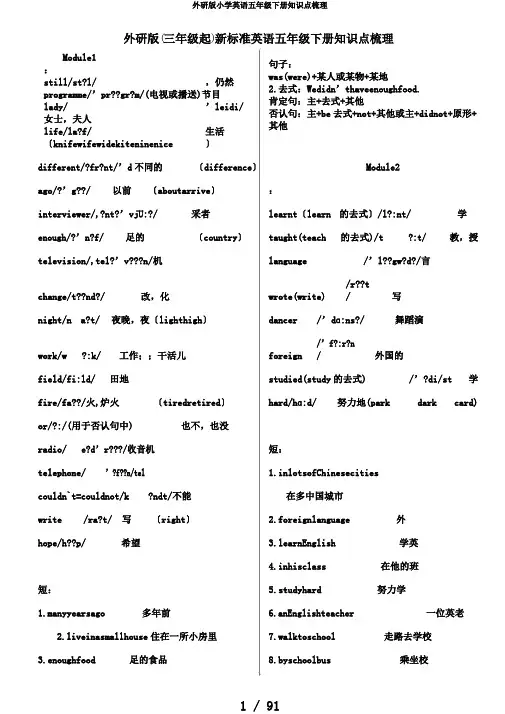
外研版小学英语五年级下册知识点梳理 1 / 91 外研版(三年级起)新标准英语五年级下册知识点梳理Module1
:
still/st?l/ ,仍然
programme/’pr??gr?m/(电视或播送)节目
lady/ ’leidi/女士,夫人
life/la?f/ 生活
〔knifewifewidekiteninenice 〕
句子:
was(were)+某人或某物+某地
2.去式:Wedidn’thaveenoughfood.
肯定句:主+去式+其他
否认句:主+be去式+not+其他或主+didnot+原形+其他
陰櫝鸛厙維鈹呒賜寻顰鋤錄讼閏晖。different/?fr?nt/’d不同的 〔difference〕 Module2
ago/?’g??/ 以前 〔aboutarrive〕 :
interviewer/,?nt?’vjU:?/ 采者 learnt〔learn 的去式〕/l?:nt/ 学
enough/?’n?f/ 足的 〔country〕 taught(teach 的去式)/t ?:t/ 教,授
television/,tel?’v???n/机 language /’l??gw?d?/言
change/t??nd?/ 改,化 wrote(write) /r??t/ 写
night/n a?t/ 夜晚,夜〔lighthigh〕 dancer /’dɑ:ns?/ 舞蹈演
work/w ?:k/ 工作;;干活儿 foreign /’f?:r?n/ 外国的
field/fi:ld/ 田地 studied(study的去式) /’?di/st 学
fire/fa??/火,炉火 〔tiredretired〕 hard/hɑ:d/ 努力地(park dark card)
or/?:/(用于否认句中) 也不,也没
radio/ e?d’r???/收音机 短:
2017-2018学年外研版英语(三起点)五年级下册全册知识点归纳
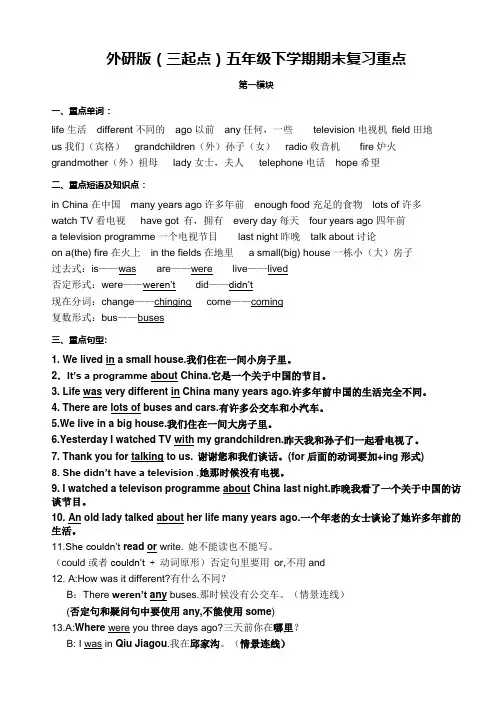
外研版(三起点)五年级下学期期末复习重点
第一模块
一、重点单词:
life生活 different不同的 ago以前 any任何,一些 television电视机 field田地
us我们(宾格) grandchildren(外)孙子(女) radio收音机 fire炉火
grandmother(外)祖母 lady女士,夫人 telephone电话 hope希望
二、重点短语及知识点:
in China在中国 many years ago许多年前 enough food充足的食物 lots of许多
watch TV看电视 have got 有,拥有 every day每天 four years ago四年前
a television programme一个电视节目 last night昨晚 talk about讨论
on a(the) fire在火上 in the fields在地里 a small(big) house一栋小(大)房子
过去式:is——was are——were live——lived
否定形式:were——weren’t did——didn’t
现在分词:change——chinging come——coming
复数形式:bus——buses
三、重点句型:
1. We lived in a small house.我们住在一间小房子里。
2.It’s a programme about China.它是一个关于中国的节目。
3. Life was very different in China many years ago.许多年前中国的生活完全不同。
4. There are lots of buses and cars.有许多公交车和小汽车。
最新外研版小学英语五年级下册知识点归纳

外研社小学英语五年级下册知识点归纳
Module 1
短语
1. many years ago 许多年前 2. live in a small house 住在一所小房里
3. enough food 足够的食品 4. how about 怎么样
5. lots of buses and cars许多公共汽车与小汽车 6. every day 每天
7. talk to 和„.交谈 8. miss China 想念中国
9. four years ago 四年前
10. a television programme about China 一个关于中国的电视节目
11. last night 昨天晚上 12. talk about 谈论
13. cook on a fire 在炉火上做饭 14 work in the fields 在田地里劳作
句型
1、There was(were)+某人或某物+某地
2、过去式:We didn’t have enough food .
句型: 肯定句:主语+动词过去式+其他
否定句:主语+be动词过去式+not+其他
或主语+did not+动词原形+其他
Module 2
短语
1. in lots of Chinese cities 在许多中国城市 2. foreign language 外语
3. learn English 学习英语 4. welcome to Beijing 欢迎到北京来
5. make a cake 做蛋糕 6. do homework 做家庭作业
外研版英语(三起点)五年级下册第三、四、五模块知识点归纳
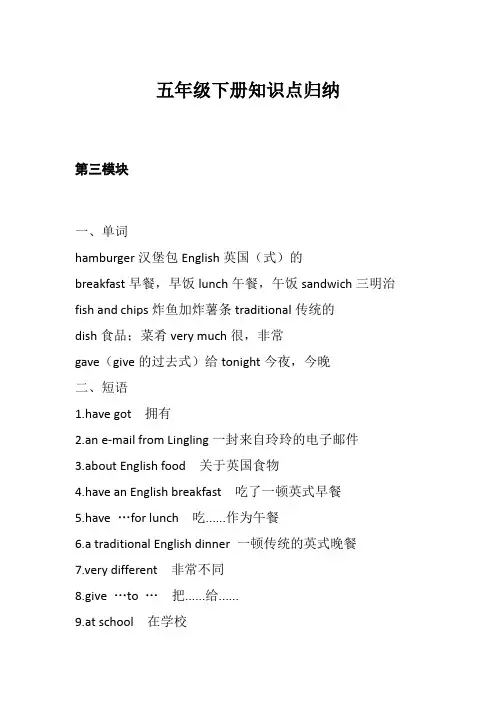
五年级下册知识点归纳
第三模块
一、单词
hamburger汉堡包English英国(式)的
breakfast早餐,早饭lunch午餐,午饭sandwich三明治
fish and chips炸鱼加炸薯条traditional传统的
dish食品;菜肴very much很,非常
gave(give的过去式)给tonight今夜,今晚
二、短语
1.have got 拥有
2.an e-mail from Lingling一封来自玲玲的电子邮件
3.about English food 关于英国食物
4.have an English breakfast 吃了一顿英式早餐
5.have …for lunch 吃......作为午餐
6.a traditional English dinner 一顿传统的英式晚餐
7.very different 非常不同
8.give …to … 把......给......
9.at school 在学校 10.cook Chinese food for Lingling 为玲玲做中式食物
11.be going to 打算 12.tell a story 讲故事
三、句型
1、描述吃过某些食物:主语 + had + 食物名称 + 其他
Yesterday she had an English breakfast.
昨天她吃了一顿英式早餐。
2、询问他人打算吃 /喝什么:What are you going to
eat/drink?
3、询问他人三餐吃了什么:
What + did + 主语 + have + for breakfast / lunch / dinner ?
A: What did she have for dinner?
B: She had fish and chips.
第四模块
一、单词
外研版小学英语五年级下册-知识点梳理
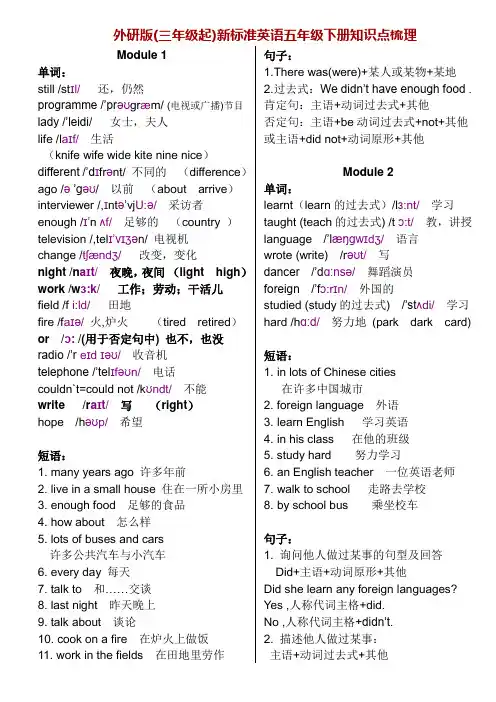
外研版(三年级起)新标准英语五年级下册知识点梳理
Module 1
单词:
still /stɪl/ 还,仍然
programme /’prəʊgræm/ (电视或广播)节目
lady /’leidi/ 女士,夫人
life /laɪf/ 生活
(knife wife wide kite nine nice)
different /’dɪfrənt/ 不同的 (difference)
ago /ə ’gəʊ/ 以前 (about arrive)
interviewer /,ɪntə’vjU:ə/ 采访者
enough /ɪ’n ʌf/ 足够的 (country )
television /,telɪ’vɪʒən/ 电视机
change /tʃændʒ/ 改变,变化
night /naɪt/ 夜晚,夜间 (light high)
work /wɜ:k/ 工作;劳动;干活儿
field /f i:ld/ 田地
fire /faɪə/ 火,炉火 (tired retired)
or /ɔ: /(用于否定句中) 也不,也没
radio /’r eɪd ɪəʊ/ 收音机
telephone /’telɪfəʊn/ 电话
couldn`t=could not /kʊndt/ 不能
write /raɪt/ 写 (right)
hope /həʊp/ 希望
短语:
1. many years ago 许多年前
2. live in a small house 住在一所小房里
3. enough food 足够的食品
4. how about 怎么样
5. lots of buses and cars
许多公共汽车与小汽车
6. every day 每天
7. talk to 和……交谈
外研版小学英语(三起)五年级下学期Module10Unit1基础知识解析(A)
- 1 - 外研版小学英语(三起)五年级下册Module10Unit1
基础知识解析(A)
Module10Unit1基础知识解析
Module10Unit1 Where are you going?你打算去哪里?
1.Look,listen and say.看一看,听一听,说一说。
斯玛特女士:萨姆,这个周末你打算去哪里?
萨姆:我不知道。
斯玛特女士:你打算什么时候起床?
萨姆:我不知道。 萨姆:妈妈,你对我说了什么?
斯玛特女士:我不知道。
“现在进行时态”表示“将来”
“Where are you going this weekend,Sam?”意为“萨姆,这个周末你打算去哪里?”句中are going是go的现在进行时结构,在此表示将来。当句子涉及确切的计划、明确的意图和为将来安排好的活动时,现在进行时可用于表示将来。现在进行时表将来就是时态是现在进行时但意义是将来。现在进行时表将来时态常有“意图”“安排”或“打算”的含义,这种现在进行时比较生动,给人一种期待感。,
★一般表示位移的词如leave stay arrive go come 等用现在进行时表将来。如:
(1) I’m going.我要走了。(2) I'm coming.我要来了。(3) When are you starting?你什么时候动身?
★表将来的现在进行时除用于位移动词外,亦可用于fly walk ride drive take(a
bus, a taxi)等某些非转移动词。如:(1) I’m meeting you after class.课后我找你。(2) What are you doing next Sunday?下星期你打算干什么?(3) She is buying a
new bike soon.她不久将买一辆新自行车。(4)I’m flying to Beijing nexe week.下周我将飞到北京去。(5)I’m dying.我要死了。
完整版)外研版小学英语五年级下册知识点梳理
完整版)外研版小学英语五年级下册知识点梳理
New Standard English Grade 5 Module 1 and 2 Knowledge
Points
Module 1
In the past。XXX。Many years ago。there were no ns。s。XXX every day。They didn't have lots of buses and cars like we
do now.
When we talk about the past。we use the past tense。For
example。"We didn't have enough food." We also use "was" or
"were" to describe things in the past。For example。"There was a
lady in the house."
Module 2
Learning a language is important。We have to learn new
words and grammar rules。We learn by listening。speaking。reading。and writing。We also need to practice every day.
Last night。XXX me a lot about how to talk to people and
ask good ns。It was very interesting.
If we want to change something。we need to work hard and
have hope。We can't give up easily。We need to keep trying and
learning。We should also talk to others about our ideas and listen
2017外研版(三起点)小学英语五年级英语下册期中期末复习重点
外研版(三起点)五年级下学期
期末复习重点
第一模块
一、重点单词:
life生活 different不同的 ago以前 any任何,一些 television电视机 field田地
us我们(宾格) grandchildren(外)孙子(女) radio收音机 fire炉火
grandmother(外)祖母 lady女士,夫人 telephone电话 hope希望
二、重点短语及知识点:
in China在中国 many years ago许多年前 enough food充足的食物 lots of许多
watch TV看电视 have got 有,拥有 every day每天 four years ago四年前
a television programme一个电视节目 last night昨晚 talk about讨论
on a(the) fire在火上 in the fields在地里 a small(big) house一栋小(大)房子
过去式:is——was are——were live——lived
否定形式:were——weren’t did——didn’t
现在分词:change——chinging come——coming
复数形式:bus——buses
三、重点句型:
1. We lived in a small house.我们住在一间小房子里。
2.It’s a programme about China.它是一个关于中国的节目。
3. Life was very different in China many years ago.许多年前中国的生活完全不同。
4. There are lots of buses and cars.有许多公交车和小汽车。
5.We live in a big house.我们住在一间大房子里。
外研版小学英语(三起)五年级下学期Module3Unit1基础知识解析(C)
- 1 - 外研版小学英语(三起)五年级下册Module3Unit1
基础知识解析(C)
Module3Unit1基础知识解析
Module3Unit1 She had eggs and sausages.她吃了鸡蛋和香肠。
凡凡:她晚饭吃了什么?
大明:她吃了炸鱼加炸薯条。
凡凡:炸鱼加炸薯条?
大明:是的。它是一道传统的英国菜(英式菜肴)。
凡凡:玲玲喜欢英式食物吗?
大明:是的,她喜欢。她说食物很美味。
一词多义的fish
fish既可以作名词,又可以作动词,其用法如下:
★作名词,既可以是可数名词也可以是不可数名词,可数名词意为“鱼”,不可数名词意为“鱼肉”。
【注意】fish作可数名词,指“同一类的鱼”的“条数”时,单复数形式相同,例如:two fish两条鱼,five fish五条鱼。There are many fish in the river.河里有很多鱼。指“不同种类的鱼”的“种类”时,复数形式是fishes,例如:two fishes两种鱼,six fishes六种鱼。There are all kinds of fishes in the river.河里有各种各样的鱼。fish作不可数名词,意思是“鱼肉”,指的是食物“鱼”,例如:Help
yourself to some fish.随便吃些鱼。She had some fish and noodles.她吃了些鱼和面条。I have fish for lunch today.我今天午饭吃鱼。
★作动词,意为“钓(捕)鱼”。例如:go fishing去钓鱼。I often go fishing on
Fridays.我经常星期五去钓鱼。
【拓展】在英语口语里,fish还常常被用来指“人”,类似于汉语里的“家伙,东西”等。如:a poor fish可怜虫;a big fish大亨;a cool fish无耻之徒;a strange