
九年级英语6单元An-accidental-invention说课材料
新目标英语九年级Section A (3a-3b)
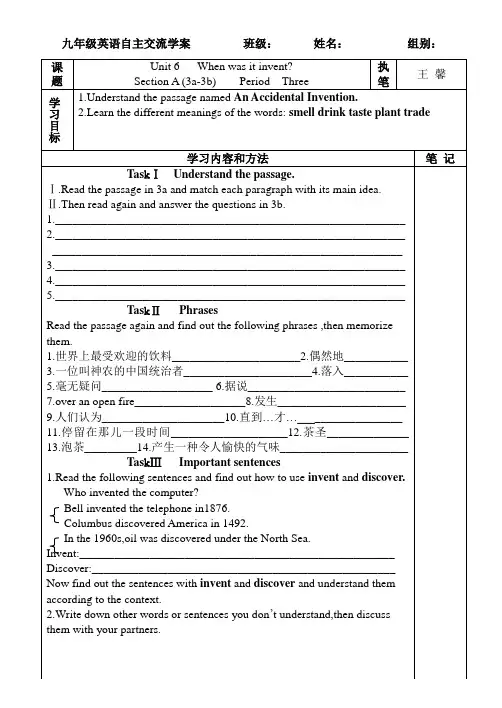
九年级英语自主交流学案 班级: 姓名: 组别:
课题 Unit 6 When was it invent?
Section A (3a-3b) Period Three 执笔 王 馨
学习目标 1.Understand the passage named An Accidental Invention.
2.Learn the different meanings of the words: smell drink taste plant trade
学习内容和方法 笔 记
TaskⅠ Understand the passage.
Ⅰ.Read the passage in 3a and match each paragraph with its main idea.
Ⅱ.Then read again and answer the questions in 3b.
1.____________________________________________________________
2.________________________________________________________________________________________________________________________
3.____________________________________________________________
4.____________________________________________________________
5.____________________________________________________________
TaskⅡ Phrases
人教版英语九年级全一册教案:Unit6 SectionA(1a-2d)
本文由一线教师精心整理/word可编辑
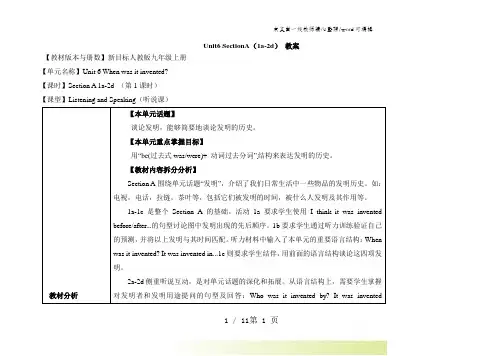
1 / 11第 1 页 Unit6 SectionA(1a-2d) 教案
【教材版本与册数】新目标人教版九年级上册
【单元名称】Unit 6 When was it invented?
【课时】Section A 1a-2d (第1课时)
【课型】Listening and Speaking(听说课)
教材分析 【本单元话题】
谈论发明,能够简要地谈论发明的历史。
【本单元重点掌握目标】
用“be(过去式was/were)+ 动词过去分词”结构来表达发明的历史。
【教材内容拆分分析】
Section A围绕单元话题“发明”,介绍了我们日常生活中一些物品的发明历史。如:电视,电话,拉链,茶叶等,包括它们被发明的时间,被什么人发明及其作用等。
1a-1c是整个Section A的基础。活动1a要求学生使用I think it was invented
before/after...的句型讨论图中发明出现的先后顺序。1b要求学生通过听力训练验证自己的预测,并将以上发明与其时间匹配。听力材料中输入了本单元的重要语言结构:When
was it invented? It was invented in...1c则要求学生结伴,用前面的语言结构谈论这四项发明。
2a-2d侧重听说互动,是对单元话题的深化和拓展。从语言结构上,需要学生掌握对发明者和发明用途提问的句型及回答:Who was it invented by? It was invented 本文由一线教师精心整理/word可编辑
2 / 11第 2 页 by...What was/is it used for...? It was/is used for...从活动和内容上看,2a要求学生听对话谈论三项发明,并按所听顺序为其排序;2b需要学生听懂发明的用途,补全表格。2c要求学生结伴谈论听力中的发明用途。2d作为示范性对话,介绍了生活中随处可见的小发明-拉链。
英语教案人教版新目标九年级英语全册Unit 6第六单元

Unit 6 When was it invented?
Grade level: 9th Grade
Course: English
Textbook: New Standard English, Book 9, published by People's Education Press.
Objectives:
To introduce students to the use of the past tense in English language
To help students improve their reading, writing, listening and speaking skills in English.
To encourage students to use their imagination and creativity in discussing technological
inventions and their impact on human life.
To enhance students' understanding of the significance of technological advances throughout
history.
Materials:
Textbook: New Standard English, Book 9, published by People's Education Press.
Whiteboard or blackboard and markers.
Handouts with comprehension questions related to the reading.
Audio or video materials related to the topic.
Pictures or diagrams of some of the most important technological inventions in history.
九年级英语全册 Unit 6 When was it invented Section A(3a-4c)教案 (新版)人教新目标版
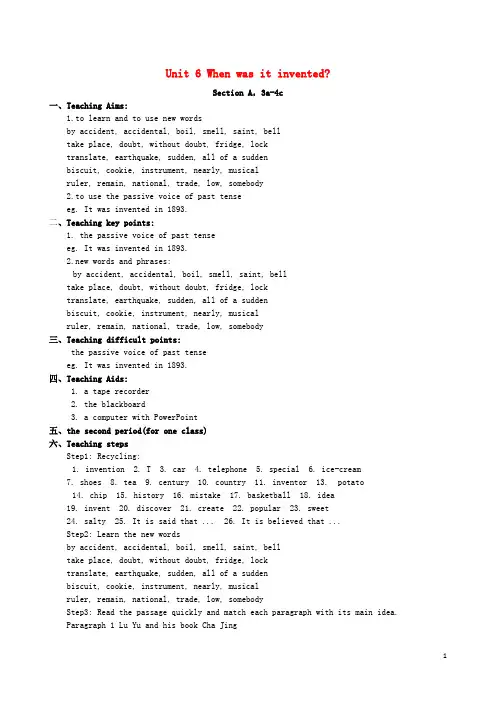
1 Unit 6 When was it invented?
Section A,3a-4c
一、Teaching Aims:
1.to learn and to use new words
by accident, accidental, boil, smell, saint, bell
take place, doubt, without doubt, fridge, lock
translate, earthquake, sudden, all of a sudden
biscuit, cookie, instrument, nearly, musical
ruler, remain, national, trade, low, somebody
2.to use the passive voice of past tense
eg. It was invented in 1893.
二、Teaching key points:
1. the passive voice of past tense
eg. It was invented in 1893.
2.new words and phrases:
by accident, accidental, boil, smell, saint, bell
take place, doubt, without doubt, fridge, lock
translate, earthquake, sudden, all of a sudden
biscuit, cookie, instrument, nearly, musical
人教版九年级英语全Unit6WhenwasitinventedSectionB(1a1e)说课稿
人教版九年级英语全Unit6WhenwasitinventedSectionB(1a1e)说课稿
一、教材分析
(一)内容概述
本节课是人民教育出版社九年级英语全Unit6 When was it invented? Section B (1a-1e)的教学内容。本单元主题为“发明与创新”,旨在让学生了解和探讨人类历史上的重要发明及其对生活的影响。本节课在整个课程体系中处于第六单元的第二课时,起着承上启下的作用。
教学内容主要包括以下知识点:
1. 了解并运用过去时态描述发明的时间。
2. 学会运用情态动词“was”和“were”进行过去时的提问和回答。
3. 掌握与发明相关的词汇,如:invent、invention、inventor等。
4. 通过阅读课文,了解一些重要发明的历史背景和影响。
5. 培养学生的阅读理解能力、口语表达能力和合作学习能力。
(二)教学目标
1. 知识与技能:
(1)学生能够运用过去时态描述发明的时间。
(2)学生能够运用情态动词“was”和“were”进行过去时的提问和回答。
(3)学生能够掌握与发明相关的词汇,如:invent、invention、inventor等。
2. 过程与方法:
(1)通过阅读课文,培养学生获取和处理信息的能力。
(2)通过小组讨论,培养学生合作学习的能力。
(3)通过课堂活动,提高学生的口语表达能力和思维能力。
3. 情感态度与价值观:
(1)激发学生对发明创新的兴趣,培养学生的探究精神。
(2)引导学生关注科技发展对人类生活的影响,增强环保意识。
(3)培养学生的爱国情怀,为我国科技发展自豪。
(三)教学重难点
1. 教学重点:
(1)过去时态的运用,包括描述发明的时间。
(2)情态动词“was”和“were”的提问和回答。
(3)与发明相关的词汇学习。
2. 教学难点:
(1)过去时态的构成和运用,尤其是动词过去式的变化规律。
(2)阅读课文时,理解发明的历史背景和影响。
初中英语_An accidental invention教学设计学情分析教材分析课后反思

1
课题:Unit 6 When was it invented?.
Section A 3a-3c Reading
【课题类型与教材分析】
本单元为人教版九年级英语(全一册)第6单元,以“产品的发明”为话题展开教学。围绕此话题,教材涵盖了相关单词、短语及听说读写素材。旨在基于学生的生活背景和周边素材用目标语言被动语态加以表述,在完成任务中提高学生的综合语用能力,并培养学生热爱高科技,热爱传统文化,乐于求知的情感。本单元计划共用6课时来完成,本教学设计为第2课时。
【学情分析】
通过以往的学习,学生已经掌握了一定量的词汇、形成了一定的视听说能力,并对未知世界充满的幻想和求知欲。就本课时而言,传统茶文化的学习是学生乐于探索的。
【教学理念与方法】
本节课在英语新课程标准理念的指引下创设情境、采用任务型的教学模式,让学生在完成任务的过程中体验、参与、互助、提高,培养他们以读为主的听说读写综合语用能力。
【学习目标】
一、 知识与技能目标
一、 知识与技能目标
1. 词汇:accidental nearly ruler boil remain smell saint national trade doubt
2. 短语:by accident, without doubt, take place, be used for, fall into…
3. 句型结构:It is believed that…;be+动词过去分词
4.技能:在完成任务的过程中正确运用阅读策略,理清文章脉络,提高阅读能力。
二、 过程与方法目标
通过自主学习和合作探究在完成多样的阅读任务过程中养成正确的阅读策略和习惯。
三、 情感态度与价值观目标
1. 培养热爱高科技,乐于求知的学习热情。
2. 培养热爱传统文化,传承传统文化的情感。
【重点】
1. 养成正确的记叙文阅读策略和习惯,掌握文章中语言知识点,练习怎样抓住文章脉络。
an accidental invention课件
An Accidental Invention
Introduction
In the world of scientific discoveries, some of the most significant breakthroughs
have been made by accident. One such example is the accidental invention that
occurred in the field of science. This incident not only transformed the way we view
science, but also had a profound impact on various industries. In this presentation,
we will delve deeper into this accidental invention and explore its implications.
Historical Background
It was during the late 19th century when a scientist named Dr. Alexander
Smithson was working in his laboratory on a completely unrelated experiment.
Dr. Smithson was conducting research on a newly discovered chemical compound
when an unexpected reaction occurred. This reaction led to the creation of a
completely different substance, which had unique properties and characteristics
最新6教案an--accidental-invention
学习-----好资料
更多精品文档 Unit 6When was it invented.?(SectionA3a—3c)
四十七团中学:邓远新
课 题 Unit 6 When was it
invented.? 课 型 新授课 课 时 3/7
教 学
目 标 1:1) 学习掌握下列词汇:by accident, ruler, boil, remain, smell, saint, national,
take place, doubt, without doubt 2)阅读短文,能按要求找到相应的信息。
2:通过阅读了解茶的发展历史,并且能用简单的语言描述出来。
3:培养一种科学创新精神,尝试着发挥自己想象发明一些小制作。
教 学
重 点
1) 掌握本部分出现的生词和词组,达到熟练运用的目标。 2) 阅读短文,获得相关的信息。通过阅读练习,来提高阅读能力。 教 学
方 法
讨论法、自主学习、任务型
教 学
难 点 1) 阅读短文,获得相关的信息的能力。 2) 理解并运用所学的词汇及表达方式。
教 具 多媒体
板
书
设
计
Unit6 An Accidental invention
1st Paragraph:How tea was invented by accident New words:
2nd Paragraph :Lu Yu and his book Cha Jing by accident, ruler,
3rd Paragraph: How tea spread to other countries boil, remain, smell,
saint, national,
take place, doubt,
without doubt
it is said/believed that
英语人教版九年级全册Unit 6 An accidental invention
A Teaching Plan for Unit 6 An accidental Invention
Teaching aims:
1.Key vocabulary: accidental, ruler, boil, remain, smell, saint, mention, describe, high
heat, send out, put on…
2. Help the students understand the passage about how tea was invented.
3. Help the students to understand how to use the passive voice.
Ability skills: Help the students to master the reading strategies
Emotional aims: Love our country and our people.
Important points: Reading comprehension and reading strategies.
Important and difficult points :
1. Improve reading ability.
2. Help students to express their opinion freely. .
Teaching procedures:
Step 1. Show the teaching aims:
Step 2. Learn the new words in this passage
Step 3. Ask the students to listen to the tape and find out the sentences with the passive voice.
An Accidental Invention教学设计
Unit 6 When was it invented?
Section A(3a-3c) An Accidental
Invention
教
学
设
计
Unit 6 When was it invented?
Section A(3a-3c) An Accidental Invention
教学设计
一、教学目标:
1. 语言知识目标:
1) 学习掌握下列词汇:by accident, ruler, boil, remain, smell, saint, national,
take place, doubt, without doubt
2)阅读短文,能按要求找到相应的信息。
3) 了解茶叶被发明的历史及生产制作的简要过程。
2. 能力目标:
通过阅读提高学生们的阅读能力并运用到阅读理解试题中。
2. 情感态度价值观目标:
通过学习中国茶文化,了解中国博大精深的文化底蕴,热爱祖国。
二、教学重难点
1. 教学重点:
1) 掌握本部分出现的生词和词组,达到熟练运用的目标。
2) 阅读短文,获得相关的信息。通过阅读练习,来提高阅读能力。
2. 教学难点:
1) 阅读短文,获得相关的信息的能力。
2) 理解并运用所学的词汇及表达方式。
三、教学过程
Ⅰ.Greetings
Ⅱ. Lead-in
一、播放视频《茶叶的起源》,让学生们了解中国的茶文化,及茶叶被发明的渊源,并了解其发展过程。
1. What is the video about?
2. Who is the writer of Cha Jing?
Ss try to answer the questions:
It’s about the tea. Lu Yu.
Ⅲ. Reading
Work on 3a: