
七年级英语上册M4教案-外研版
课题: 七年级英语外研版(上)教案
冯芝芳
Module 4—My family
Unit 1: How many people are there in your family?
教材、学情分析
本单元的学习主题是“My family”,主要内容是家庭主要成员的称谓,包括描述大家庭、小家庭的情况,以及提问有几口人、有没有某人的句型。表示称谓的词汇小学阶段学过,教学中注重对其的识记和拼写。注重设置能将学生已有知识综合考察的练习,注重听力及提取信息能力的培养。值得一提的是,班内可能会有单亲家庭,教师在授课时应注意该问题,在不伤害学生自尊心的同时注意培养学生的移情能力。
【教学方法】 Bottom-up approach
【教学目标】知识目标、能力目标、情感目标
1. 知识目标
单词和短语:
Many, people, aunt, uncle, grandfather, grandmother, grandparents, father, mother,
sister, brother, parents, have got, email, him
重点句型:
1) How many people are there in your family? --There are…in my family.
2) “have got” 引导的句式
2. 能力目标
围绕How many people are there in your family?进行英语口语综合训练,培养学生自主学习、分析问题、解决问题和合作交流的能力。
3. 情感目标
本单元学习实际应用性强,在学习中注重学生主观能动性的激发,培养学生学以致用的能力。
【教学重点及难点】
1. 单词和短语:
Many, people, aunt, uncle, grandfather, grandmother, grandparents, father, mother, sister, brother, parents, have got, email, him
2. 重点句型:
1) How many people are there in your family? --There are…in my family.
2) “have got” 引导的句式
教学过程:
【课前延伸】
预习词汇:布置学生预习词汇,能够根据音标读出并了解汉语意思即可。
【课上探究】
一、新课导入
播放有家庭成员的英语歌曲,并鼓励学生随唱/show/W9q90ZrOQRpeCtWbmn865Q...html?loc=tashangchuan
设计意图:简单的儿童歌曲,紧扣本单元学习主题,快速熟悉家庭成员称谓,同时引起学生学习兴趣,快速进入英语学习状态。
二、 探究新知——词汇学习
① 展示父母照片并向学生介绍:
This is my mother.
This is my father. I love my father and mother. And you?
写下句子及标题: Father and mother, I love you.→FAMILY
My family:How many people are there in your family?
② 学生说出歌曲中的称谓与预习单词之间的不同,教师解释因为是口语与书面
语的区别,并领读、齐读单词。
设计意图:领读、齐读单词,培养学生积累词汇的好习惯,并为下面的听力口语、训练打好基础。有趣的单词构成更能意识到对父母的爱。
看图说话:
① 展示Tony全家福,让学生独立将词语对号入座,并相互检查。
② 引导学生小组谈论Tony的家庭:Who is she/he?He is Tony’s father. 教师巡视并指导。
设计意图:本环节遵循逐步深入的原则,由词汇到句子,由易到难,学生更进一步巩固词汇。
三、 对话处理——听力大比拼
1. 读前听:
一听: Listen and choose the best answers.
( ) 1) How many people are there in Tony’s family? A. three B. four C. five
( ) 2) What’s Tony’s sister’s name? A. Lingling
B. Linda
C. Lisa
二听: Listen again and draw Tony’s family tree.
三听:完成句子。
There are four people in Tony’s family — Tony, his [1] ________, his mother and his
[2] ________. His mother and his father are his [3] ________. Tony’s also got four [4]
________, two uncles and one [5] ________. He hasn’t got any [6] ________.
听后说:小组活动,每组学生分成两部分分别扮演Lingling、Tony口述原文。
设计意图:听力设计题目由易到难,有整体到细节,变换方式地引导学生掌握对话信息。
2. 读中学:
一读:读对话,根据自己的情况找出其他疑难问题,并进行处理:
自学找难点——小组求助——展示难点——组间或教师解决
① 知识点点拨:(课件展示)
※ How many people are there in your family? 你家里有几口人?
There are four—my mum and dad, my sister Linda, and me.
※ Have you got any aunts or uncles? 你有阿姨或舅舅吗?
注意人称:
He has got…
He hasn’t got…
Has he got … Yes, he has.
No, he hasn’t.
I have got…
I haven’t got…
Have you got…
Yes, I have./No ,I haven’t. 二读:朗读短文,整体把握。
3. 读后说:
一说:展示自己的全家福,同桌仿照例句进行对话练习。
How many people are there in your family?
There are …
Have you got any sisters/brothers/aunts/uncles..?
Yes,I have./No,I haven’t.
二说:展示《家有儿女》全家福:全班分成六组,引导学生介绍刘星一家:
How many people are there in Liuxing’s family?
There are …
Has he got …
Yes,he has./NO,he hasn’t.
小组内活动,教师巡视指导,再组间交流,评出最佳小组。
/i?ct=503316480&z=0&tn=baiduimagedetail&word=%BC%D2%D3%D0%B6%F9%C5%AE%C8%AB%BC%D2%B8%A3%CA%D3%C6%B5&in=10875&cl=2&lm=-1&st=&pn=7&rn=1&di=109449206655&ln=870&fr=&
4. 学以致用
人人都是小记者:Make a survey先口头采访,课后整理出采访笔记。
How many people are there in your family?
aunt uncle grandfather grandmother sister brother
S1
S2
S3
S4
S5
设计意图:学生自学为主,教师点拨引导为辅,从听到读再到说,知识层层剖析,有学有用,利于培养学生自行思考、发现问题并解决问题的能力。
四、 课堂达标
游戏:每组派出两名代表参加比赛,评选出课堂之星和最佳小组。/flash/html/4804.html family member
name 设计意图:① 寓教于乐,培养学生动手、动脑、动口能力,在学习中体验快乐,在游戏中提升能力;② 学生在欢快的歌曲Happy!Happy!Home中结束本节课的学习。/flash/1/145959.html
五、 板书
How many people are there?
六、 课后提升
1. Draw your family tree.
2. 完成调查表。
3. 向朋友介绍自己的家庭。
七、教学反思
本节课是一堂听说课,通过一首儿歌引入主题My family,通过提问学生熟悉的句型“How many people are there in your family?”启动本节课。在输入阶段强调了对词汇和重点句型的练习,在加工阶段强调了对听说能力的练习。在输出阶段强调了学生自由运用能力的训练。不足之处是由于受时间限制,个别环节训练不足,教学资源不能充分利用。
F
A
M
I
L
Y
brother uncle
LOVE aunt mother
Sister How many people are there
in your family?
There are…
I have got…
I haven’t got…
Have you got…
Yes, I have./No ,I haven’t.
father
外研版七年级英语上册教案全集
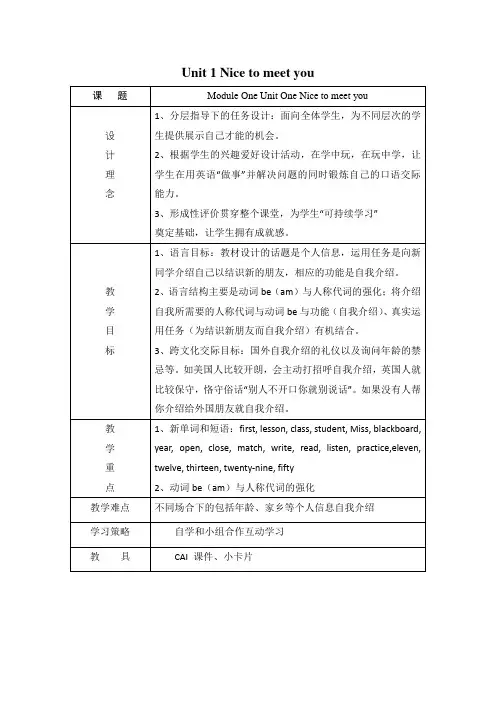
Unit 1 Nice to meet you
课 题 Module One Unit One Nice to meet you
设
计
理
念 1、分层指导下的任务设计:面向全体学生,为不同层次的学生提供展示自己才能的机会。
2、根据学生的兴趣爱好设计活动,在学中玩,在玩中学,让学生在用英语“做事”并解决问题的同时锻炼自己的口语交际能力。
3、形成性评价贯穿整个课堂,为学生“可持续学习”
奠定基础,让学生拥有成就感。
教
学
目
标 1、语言目标:教材设计的话题是个人信息,运用任务是向新同学介绍自己以结识新的朋友,相应的功能是自我介绍。
2、语言结构主要是动词be(am)与人称代词的强化;将介绍自我所需要的人称代词与动词be与功能(自我介绍)、真实运用任务(为结识新朋友而自我介绍)有机结合。
3、跨文化交际目标:国外自我介绍的礼仪以及询问年龄的禁忌等。如美国人比较开朗,会主动打招呼自我介绍,英国人就比较保守,恪守俗话“别人不开口你就别说话”。如果没有人帮你介绍给外国朋友就自我介绍。
教
学
重
点 1、新单词和短语:first, lesson, class, student, Miss, blackboard,
year, open, close, match, write, read, listen, practice,eleven,
twelve, thirteen, twenty-nine, fifty
2、动词be(am)与人称代词的强化
教学难点 不同场合下的包括年龄、家乡等个人信息自我介绍
学习策略 自学和小组合作互动学习
教 具 CAI 课件、小卡片 教学流程图:
教学步骤
l (1课时)
一、第一教学环节:情景创设、布置任务、激趣导入
教 师 活 动 学 生 活 动 Leading-in:
1.制作Name Card(此任务针对中低层次而设计)
外研版七年级英语上册教案完整版

外研版七年级英语上册教案
HEN system office room 【HEN16H-HENS2AHENS8Q8-HENH1688】
课题 Starter Module1 Unit1 课型 Listening and speaking
教学目标 学习称呼语和问候语
教学重点 打招呼用语
教学难点 如何正确运用打招呼用语
教具 多媒体、录音机 课时 1
教学课程 1. Greeting.
2. Warming-up
T: Class,Please stand up. Hello, class.
S: Hello, Ms…
T: Sit down please.
S: Thank you.
3. Drills
(1) 练习打招呼问好。
(2) 练习感谢他人。
(3) 练习告别语Goodbye。
4. Practise
1)Work in pairs part7 and part8
2) Complete the sentences.
Daming, ______ ______, please(请坐)
_____,______ (同学们好)
______(你好).Jack.
_______,_______ (谢谢), Miss Li.
_______(再见), Lucy.
5. Conclude
6. Homework
Complete part5 and part 6 个人修改
课后评价 教案
课题 Starter Module1 Unit2 课型 listeningandspeaking
教学目标 学习打招呼的用语,询问姓名和相互间的问候。
教学重点 打招呼用语,询问对方姓名的特殊疑问句及回答。
教学难点 一天中不同时间的打招呼用语
教具 多媒体、录音机 课时 1
教学课程 .
T: Good ’s your name?
S: I’m … / My name is…
新版外研版英语七年级上册全册教案
新版外研版英语七年级上册全册教案
Module1Myclassmates
Unit1Nicetomeetyou
Unit2I’mWangLinglingandI’mthirteenyearsold.
Unit3Languageinuse
Module2MyFamily
Unit1Isthisyourmum?
Unit2Thesearemyparents.
Unit3Languageinuse
Module3Myschool
Unit1Therearethirtystudentsinmyclass.
Unit2Thelibraryisontheleftoftheplayground.
Unit3Languageinuse
Module4Healthyfood
Unit1We’vegotlotsofapples.
Unit2Isyourfoodanddrinkhealthy?
Unit3Languageinuse
Module5MySchoolDay
Unit1Ilovehistory.
Unit2Westartworkatnineo’clock.
Unit3Languageinuse
Module6Atriptothezoo
Module6Atriptothezoo
新外研版初中七年级上册英语全册教案修正版
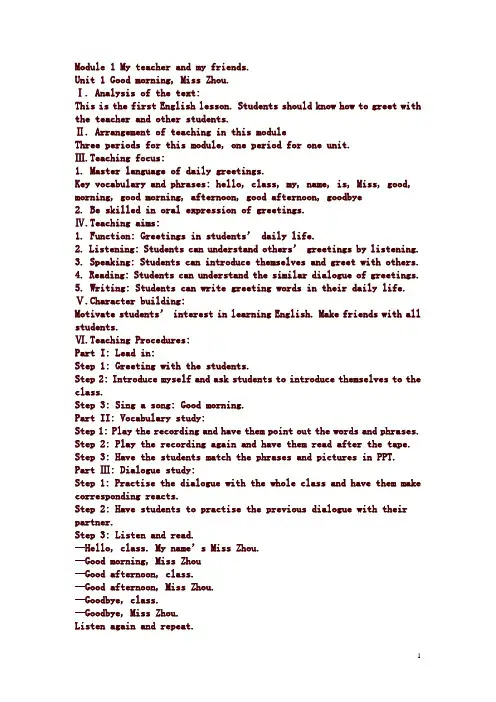
1 Module 1 My teacher and my friends.
Unit 1 Good morning, Miss Zhou.
Ⅰ. Analysis of the text:
This is the first English lesson. Students should know how to greet with
the teacher and other students.
Ⅱ. Arrangement of teaching in this module
Three periods for this module, one period for one unit.
Ⅲ.Teaching focus:
1. Master language of daily greetings.
Key vocabulary and phrases: hello, class, my, name, is, Miss, good,
morning, good morning, afternoon, good afternoon, goodbye
2. Be skilled in oral expression of greetings.
Ⅳ.Teaching aims:
1. Function: Greetings in students’ daily life.
2. Listening: Students can understand others’ greetings by listening.
3. Speaking: Students can introduce themselves and greet with others.
4. Reading: Students can understand the similar dialogue of greetings.
5. Writing: Students can write greeting words in their daily life.
外研版七年级英语上册_教材分析

外研版七年级英语上册_教材分析
课程标准的总体要求培养学生的综合语言运用能力
1语言技能2语言知识3情感态度4学习策略
5文化意识
①教材基本内容Talkingabouthealthyfood
M4DecribinganewHealthychoolfood
TalkingaboutDecribinganimalroutine
Talkingaboutfamilymember
M3mychool
M6AtriptoM5Mychooldaythezoo
DecribingaproceInvitinganddecribingbirthdaypartie
M2Myfamily
M8Chooingpreent
Module1ReviionAM1Myclamate.Givingperonalinformation
Module6ReviionB外研版七年级英语上册
M9PeopleandplaceDecribingwhatihappeningDecribingevent
M10SpringFetival
一、基本要求培养学生的综合语言运用能力听听懂熟悉话题的语段、简短的故事听说读写与教师或同学就熟悉的话题交换信息。小故事及其他文体的简单书读面材料能参照范例或图片写出简写单的句子使用适当的学习方法,克服学习中的困难。
说
学习策略情感态度文化意识
英语学习表现出积极性和初步的信心能意识到语言交际中存在文化差异有关学校、家庭的介绍;健康食物、热爱动物;电脑的使用等。
二、编写意图新型的学习方式学习策略
学会学习
面向全体
起点低由浅入深,循序渐进
功能法听说法促进学生全面发展
新教法
生活化
贴近学生现实生活
多功能
创新精神
丰富文化
编写意图
体验跨文化交往 跨文化
教材的编写体例知识技能阅读训练写作练习
reading
litening
peaking
主要教学活动
writing
主要教学活动
读写Unit1
高考英语M4全模块教案外研版必修5

小学+初中+高中+努力=大学
小学+初中+高中+努力=大学Module 4 Carnival Period One Teaching aims: 1. To revise Chinese and western festivals. 2. To develop the students reading ability. 3. To understand what is about Carnival. Important and difficult points: 1 Get the students to understand the history of carnival. 2 Get the students to describe the festivals in groups. Teaching procedures: Step 1. Revision. Read the new words of this passage. Step 2. Introduction 1. We have learned many festivals both Chinese and the Western. What festivals do you know? Divide the class into 2 groups. One group is for Chinese Festivals, the other group is for Western festivals. Make a list of them on the blackboard.. 2. Turn to Page 31—Match the festivals with the description. Step 3. Lead-in Today we will learn another festival ---- Carnival. It originates from Europe, and during these days, people often love wearing special clothes and masks for it. Step 4. Fast-reading Match the main idea with every paragraph. Paragraph 1 A meaning of carnival and how it was celebrated Paragraph 2 B the law about wearing masks Paragraph 3 C general impression of carnival Paragraph 4 D how it is celebrate today in Venice and the feature of it Paragraph 5 E carnival in Venice and the problem it caused Paragraph 6 F the revival of the tradition of celebrating it. 小学+初中+高中+努力=大学
2024年秋季新外研版七年级英语上册 Starter 单元整体教学设计
2024年秋季新外研版七年级英语上册Starter
Welcome to junior high单元整体教学设计
一、单元教学目标
知识目标
(Language
objective) 1.学习用品、科目、服装类、学校设施、兴趣爱好等相关词汇;
名词、数词、冠词和并列连词(and,but,or);
2.There be 句型;
3.一般现在时、一般过去时和一般将来时。
能力目标
(Ability
objective) 1.了解和掌握学习用品类词汇、科目名词、服装类、校园设施和兴趣爱好和形容人的性格和感受等相关词汇;
2.能够听懂有关学习用品,学习科目相关的对话;
3.能够描述服装的颜色和款式;
4.能够与同学谈论新学校相关的话题;
5.能够在班上大胆自我介绍,以及介绍自己的愿望和计划;
6.能正确使用there be 句型,并列连词(and,but,or)以及三种基本句型描写新学校;
7.能够正确使用一般将来时书写表达自己的愿望和计划。
情感态度价值观(Emotional
attitude
and values) 1.通过对比小学和初中所学科目不同,意识到小学和初中学习的不同,增加对初中学习的兴趣和信心。
2.通过学习校园设施,以及介绍自己学校,增强对学校的熟悉感和归属感,热爱学校。
3.通过学习自我介绍,以及在班上介绍自己,促进学生之间的友谊,增强学生自信心。
4.通过为举办聚会做准备的过程中,学生能够对自己的学习生活更明确目标,增强自信心;进一步了解身边的新同学,更好地融入新班级。
二、单元教材分析
本单元话题Welcome to junior high!主要围绕着get ready,know
your school,introduce yourself hold a party四个子话题共设计了10个主要语篇。
1.在Get ready板块,学生将学习四个语篇,了解关于学习用品、科目和服装的词汇,复习名词单复数、冠词和一般将来时的用法。学生整理好学习用品、教科书,准备好得体的着装,为开启初中生活做好物质准备。
新外研版英语七年级上册m5-3《my school day》优秀教案(重点资料).doc
1 天津市小王庄中学七年级英语上册 M5-3 My school day教案
年级 七年级 学科 英语 第一备课 审核
第二备课
课题 课型 复习 章节
备课时间 授课时间 第 周 星期
第 节
学习目标 1、 能掌握词汇:finish ,housework 及do, have, go短语
2、 能掌握并正确运用实义动词(主语为I, they ,we , you)一般现在时的陈述句和否定句形式。
3、 时间前不同介词(at, in, on)的使用。
4、 时间表达法。
重点 能掌握并正确运用实义动词(主语为I, they ,we , you)一般现在时的陈述句和否定句形式。
难点 能掌握并正确运用实义动词(主语为I, they ,we , you)一般现在时的陈述句和否定句形式。
教学准备 2
1、 写出下列短语:
吃晚饭 _______________ 休息 ____________
做家务 ___________
做作业 ________________ 去上学_____________
回家 _____________
上一节英语课 ___________________ 上床睡觉
_____________
在一点半 _____________上历史课 ____________ 吃早饭 _____________
去操场 ________________起床 ______________ 在晚上 _____________【课堂活动】
1、 学生根据复习任务,自主复习,并记录疑难问题。
_______________________________________________________________________________________________________
当主语为I, you, we, they 时,实义动词一般现在时的肯定句谓语动词用____________________,变否定句时_______________________ 。
外研版七年级 上册StarterM4 U1Whatdayisittoday课堂练习
What day is it today
1.Today is Thursday.Tomorrow is ________.
A.Wednesday B.Friday
C.Saturday D.Sunday
2.Sunday is my ________day.
A.birthday B.like C.favourite D.the
3.—What day is it tomorrow
—________Sunday.
A.It's B.This is
C.He is D.She is
4.—________?—No,it is Saturday.
A.What day is it today B.Is it Saturday today
C.Is it Friday today D.What is today
5.把它写在你的书上。
________ ________ ________your book.
6.我们从星期一到星期五去上学。
We go to school from _______to________.
7.His favourite food is bread.(改为同义句)
He________bread________.
8.My favourite class is maths.(对画线局部提问)
________is your favourite class 答案:
1.B 点拨:由常识可知“今天是星期四,明天是星期五。〞应选B项。
2.C 点拨:此题考查单词辨析。此处缺少形容词,句意为“周日是我最喜爱的一天。〞应选C项。
3.A 点拨:What day is it today/tomorrow?的答语是“It's...〞,应选A项。
4.C 点拨:此题是交际中的对话用语,根据答语中的No可知前面是一般疑问句。
5.Write it in 点拨:“把……写在……上(里)〞用“write...in...〞,是固定搭配。
外研版七年级英语上册Module4 Healthy food 知识点
Module4 Healthy food 知识点
单词
1、* food [fu:d] n. 食物;食品
2、* drink [driŋk] n. 饮料;vt. 喝
3、* candy ['kændi] n. 糖果(等于sweets);
4、* fruit [fru:t] n. 水果;产物
5、meat [mi:t] n. 肉,肉类(食用)
6、* vegetable ['vedʒitəbl] n. 蔬菜
7、* apple ['æpl] n. 苹果
8、bean [bi:n] n. 豆
9、beef [bi:f] n. 牛肉
10、carrot ['kærət] n. 胡萝卜
11、* chicken ['tʃikin] n. 鸡肉;小鸡
12、chocolate ['tʃɔkəlit] n. 巧克力
13、coffee ['kɔfi] n. 咖啡;咖啡豆;
14、cola ['kəulə] n. 可乐
15、* juice [dʒu:s] n. (水果)汁,果汁
16、* milk [milk] n. 牛奶
17、* potato [pə'teitəu] n. 土豆,马铃薯
18、* tea [ti:] n. 茶叶;茶树
19、* tomato [tə'mɑ:təu] n. 番茄,西红柿
20、* water ['wɔ:tə] n. 水 21、* shop [ʃɔp] vi. 购物;买东西
22、go shoping 去买东西,去购物
23、* have [hæv, həv] aux. 助动词。vt. 有,吃,喝
24、* get [ɡet] vt. 得到;获得
25、have got 有;拥有
26、* some [sʌm] adj. 一些;若干;少量。pron. 一些;某些
27、* much [mʌtʃ] adj. 大量的,许多。
28、too much 太多