
最新2019年人教版小学二年级英语下册教案全册
- 1 - UNIT 1 Playtime 第一课时 Lesson 1 教学目标: 1、学习有关各类活动的词组play football, fly a kite, ride a bike, make a model plane, swim, make a snowman。 2、能够听懂他人所说的词组并迅速做出相应的动作。 教学重点: 能够准备说出有关各类活动的词组play football, fly a kite, ride a bike, make a model plane, swim, make a snowman。 教学难点: 能够听懂他人所说的词组并迅速做出相应的动作。 教学模式: “合作-进步-快乐”教学模式。 教具准备: 录音机、教学录音磁带和单词卡片。 教学过程: Step1 Warm-up: 1、Greeting! T: Hello ! boys and girls. I missed you. Did you miss me? Ss: Yes. T: Do you have a good time in the holiday? Ss: Yes. T: Oh! I’m happy. Because I do some things in my holiday. What did you do in your holiday? Ss:自由汇报。 Step2 Presentation: 1、New lesson T: Ok! You are very well. In the holiday our friends do some things, too. Today let’s see our friends what to do in their holiday. 2、Learn new phrase (1)Show Bill and Binbin’s a picture and ask: T: What are they doing? Ss: 踢足球 (2)Show phrase card and teach the phrase “play football” (3)Free to read the phrase. (4)Please some students to read the phrase. (5)Please a student to act “play football” 修改与补充 - 2 -
(6)One by one say all together. (7)Use the same way to learn phrase: fly a kite, ride a bike, make a model plane, swim, make a snowman。 (8)Read these new phrase all together, then drive train. Step3 Consolidation 1、Listen and do. (1)Teacher say and student act. T: play football, fly a kite, ride a bike, make a model plane, swim, make a snowman (学生根据老师所说的做出相应动作) (2)Please a good student say and the anther students act. (3)Say and do with your partner. 2、Listen and chant. (1)Play the tape and Listen to the chant twice. (2)Learn the chant. (3)Let’s chant all together. Step4、Homework 熟读并认会本课所学词组。 板书设计: Lesson 1 play football fly a kite ride a bike make a model plane swim make a snowman
教学后记:
备课组成员: 主 备 人: 修改与补充 - 3 -
Unit1 Playtime 第二课时 Lesson 2 教学目标: 1、学习句型Can you ________? Yes, I can./No, I can’t.并能用所学句型对他人进行询问,同时能根据他人询问做出准备回答。 2、通过Let’s survey巩固句型提高学生表达能力。 教学重点: 学习句型Can you ________? Yes, I can./No, I can’t.并能用所学句型对他人进行询问,同时能根据他人询问做出准备回答。 教学难点: 通过Let’s survey巩固句型提高学生表达能力。 教学模式: “合作-进步-快乐”教学模式。 教具准备: 教学课件、单词卡片。 教学过程: Step1 Warm-up: 1、Greeting T: Good morning boys and girls. Ss: Good morning teacher. T: Nice to meet you. Ss: Nice to meet you, too. 2、Review the phrase. Show phrase cards and read one by one. 3、Let’s say and do. Step2 Presentation 1、New lesson Teacher do a act and say “I can play football. Can you play football?” 2、Learn new sentence (1)Show new sentence and teach the sentence “Can you play football?” (2)Ask a student “Can you play football?” and lead Ss to answer “Yes, I can./No, I can’t.” (3)Free to read the sentence. (4)Please some students to read the sentence. (5)Practice the sentence. I ask and Ss answer. T: Can you fly a kite? Ss: Yes, I can./No, I can’t. T: Can you make a snowman? Ss: Yes, I can./No, I can’t.
修改与补充 - 4 -
T: Can you make a snowman Ss: Yes, I can./No, I can’t. 3、Look listen and repeat. (1)Play the carton and listen. (2)Practice the dialogue. Step3 Consolidation Let’s survey. (1) Pair work and finish student’s book P4 (2) Have a report. Step4、Homework 熟读句子,替换造句。 板书设计: Lesson2 play football? make a snowman? Can you fly a kite? make a snowman? swim? make a model plane? Yes, I can. / No, I can’t.
教学后记:
备课组成员: 主 备 人: 修改与补充 - 5 -
Unit1 Playtime 第三课时 Lesson 3 教学目的: 1、通过活动,巩固与各类活动有关的词组和相应的功能句:Can you _______? Yes, I can. /No, I can’t. 2、能够在四线三格中准备书写英文字母A、B、C、D的大小写和四个单词apple, book, cat, door的拼读和书写。 3、通过活动培养学生的语言表达能力。 教学重点: 1、通过Let’s play复习本单元词组和句型。 2、能够在四线三格中准备书写英文字母A、B、C、D的大小写和四个单词apple, book, cat, door的拼读和书写。 教学难点: 通过活动培养学生的语言表达能力。 教学模式: “合作-进步-快乐”教学模式。 教具准备: 教学光盘、单词卡片 教学过程: Step1 Warm-up 1、Greeting T: Good morning! Boys and girls. Ss: Good morning, Miss Lu. T: Nice to meet you! Ss: Nice to meet you too! 2、Review the phrases and sentences. (1)Show phrase cards and read them one by one. (2)Show sentence and ask a student to read. Step2 Presentation 1、Pair work. (1)Do the replacement exercise according to produce phrases and sentences. (2)Please report the inspection. 2、Let’s play (1)Give Ss a little time and practice the dialogue P6 (2)Perform the dialogue. S1: Tiger, can you make a snowman? S2: No, I can’t./Yes, I can. 修改与补充
二年级下册英语教案全册(7)二年级下册英语教案

二年级下册英语教案全册(7)二年级下册英语教案二年级下册英语教案全册(7)Unit2一、教学重点:复习现在进行时,并继续学习进行时及五个口令。
二、教学难点:五个口令发音较难,教师要鼓励学生多说,敢练。
三、教具准备:1、教师准备 Point up! Point down! Touch the sky! Touch the ground! Turn around! 的五张短语卡片。
2 、教学课件(包括歌曲和动画)。
四、教学过程:1、热身复习 (Warm-up)(1)师生进行问候。
(2)让学生起立,师生共同表演小唱,边做边唱。
如:唱Up up stand up. Down down sit down. Point point point to your nose. Point point point to your head.(3)游戏:教师做动作,让学生猜意思,导出新知。
2、呈现新课 (Presentation)(1)教师继续进行以上的游戏,并把卡片拿出,让学生跟读。
(2)让学生边读边做动作,加深对短语的印象。
(3)播放课文第一部分的动画课件, 让学生边看边小声跟读。
教师还可请学生来操作课件,训练学生的听力,认读及动手能力。
(4) 在学生学完五个口令之后都很累的时候,教学生一首新歌。
介绍两个拓展单词: shake stamp。
3、趣味操练 (Practice)(1)游戏:短语接力教师让一个学生任意说一个短语,请他后面的同学做动作,然后这个同学再任意说一个短语,请下一个同学做动作,以此类推。
(2)学生边听录音,边做动作。
做动作时教师要努力示范动作夸张的同时强调短语的发音。
(3)教师打开动画课件,让学生跟读:(4)让学生在自己的课本上指出句子读。
(5)找一名学生上讲台下口令,教师和其他学生一起来做动作,让学生感受到老师也是他们当中的“大朋友”。
4、课堂评价 (Assessment)做活动手册本单元的练习。
二年级英语下册全册教案
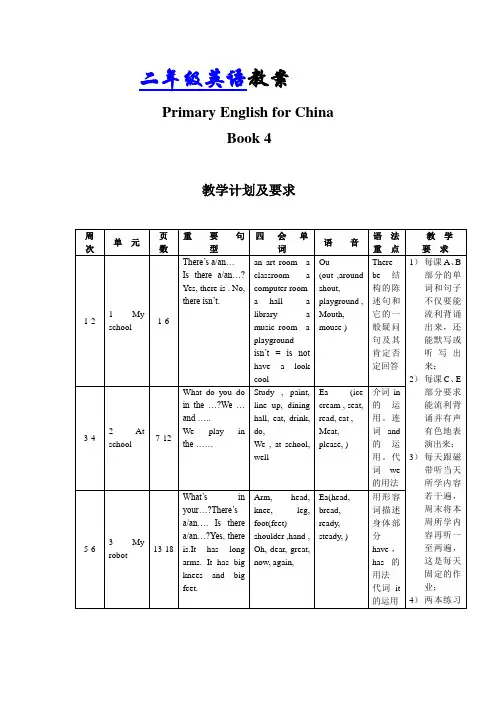
二年级英语教案Primary English for ChinaBook 4教学计划及要求第1课时课题Unit 1 My school 教学目标New words: room, library, hall, music, art, playground Sentence patterns: This is …There is a an …教材分析重点New words: room, library, hall, music, art, playground难点Sentence patterns: This is …There is a an …教具Word cards, picture, tape-recorder教学过程I. Free talkⅡ. Presentation1.Bring in a picture of a school and photos or pictures of thedifferent rooms taught in the Unit.2.( Books closed ) Show the picture of you the school,saying This is my school.Give individual pupils the picture and ask them to repeat the sentence.3.Show the pictures of the different rooms in the school.Say their names and ask the pupils to repeat them after me Then practise by showing a room and asking the pupils to tell me the name.4.Choose a picture and point to something in the picture thepupils know, e. g. a tree, a well-known room and say There’s a/an …Show the picture to individual pupils and ask them to point to the object and repeat the sentence.Point to other known items in the picture and encourage them to make sentences about them.5.Play the Pupil’s Book Cassette and point to the speechbubble. Ask the pupils to repeat after the beeps.Ⅲ. Practice1.( Books open ) Show Transparency. Point to the places inthe school on the page, saying There’s a classroom, etc.Encourage the pupils to repeat the sentences after you. 2.Introduce the new character, Mike. Explain that Tim isshowing Mike a picture of his school. Teach the pupils the name of the school ( No. 1 Primary School ).教学过程3.Read Tim’s speech bubble. Get the pupils to point to thecorrect places. Make sentences about the other places using There’s a/an …4.Encourage the pupils to make sentences by using there isa /an…while I point to the places in the picture.5.Get the pupils to look at each of the rooms. Point at anobject in a room and say There’s a …布置作业1.Copybook 12.Workbook 13. Write the newwords on thenotebook.板书设计Unit 1 My schoolwords(picture cards)This is my school.There’s an art room.There’s a library.教学后记1.Teaching new words with motions impresses pupils.ing ‘a’ and ‘an’ should be emphasized.3. Pupils feel hard in pronouncing the words library, hall, and playground.第2课时课题Unit 1 My school教学目标New words: art room, music room, hall, library …Sentence patterns: Welcome to …Is there a …Yes, there is./ No, there isn’t.New words: art room, music room, hall, library…Sentences: Is there a … Yes, there is. / No, there isn’t.Word cards, picture, tape-recorderⅠ. Free talkⅡ. PresentationMake a plan of your school with the places marked on it.The plan does not need to have the English names written on it.( Books closed ) Show the pupils a plan of your school with the places marked on it, revising the English names for the places.Point to the plan and ask, for example, Is there a music room?Ask a pupil to come out and point to the place named and say Yes, there is. Ask about a place not in the school, e.g. Is there a swimming pool? Is there a zoo?Then teach No, there isn’t.4. ( Books open ) Show Transparency. Play the Pupil’s BookCassette and ask the pupils to repeat the characters’ words after the beeps.Ⅲ. Practice1.Show Transparency and play the Pupil’s Book Cassette.Explain that Tim and Pat are visiting Mike’s school. The Ss listen and follow in their books. Continue to play the cassette and ask the pupils to repeat.2.Show the words in Tim and Pat’s thought bubbles. Drillthe question form with the pupils by giving them the six word cues one by one and getting the pupils to ask Is there a/an …? For each place in the school.3.Show the words with ticks and crosses in Mike’s thoughtbubble. Explain that a tick means they should answer Yes, there is. A cross means that they should answer No, there isn’t.4.Divide the class into three groups to role-play Tim, Patand Mike. Get them to chorus the conversation following the order of the word cues in Tim and Pat’s thought bubbles.1.Copybook 22.Workbook 23.Review whatwe learnedtoday.Unit1 My school Welcome to my school!Is there a …Is there an …Yes, there is./No, there isn’t.1. Practice the sentence with the plans of different school, doing a survey, or drawing a plan of pupils’ ideal school may enable the lesson more interesting.2. Pupils need to be remind to add a ‘a’ in the sentence.第3课时Unit 1 My school教学目标New words: can’t coolSentence patterns: Come and have a look.Is there a/an …?Yes, there is./ No, there isn’t. Words and sentence patternsSentence patterns: Is t here a/an… Yes, .../ No, … Picture cards, tape-recorderⅠ. Free talkWhat’s in your classroom?Is there a computer?Yes, there is. / No, there isn’tWhat’s on your desk?Is there a pencil case?…Ⅱ. Presentation1.Point to the characters in the pictures and read their speech bubblesaloud. Ask the pupils to point to the speech bubbles as you read them.2.Play the Pupil’s Book Cassette for the pupils and ask them to saythe sentences after the cassette.3.Explain that the man in the story is the school principal.4.Ask questions about what the boy can do, e. g. Can he sing ?Encourage the pupils to answer Yes, he can./ No, he can’t.5.Ask the pupils to role-play the story in groups of three and to readthe characters’ speech bubbles. Some groups may like to come out to the front and act the story.6.You may use Storycards to revise sequence and language of thestory.Ⅲ. Tick ( ) or cross ( )1.Ask the pupils to read the story again. I Read the words in thespeech bubbles with the pupils.2.Demonstrate how to tick or cross the first sentence with the pupilsas an example. If the pupils are not sure of the answer go backand read the story with them again until they find the answer.3.Check answers using Transparency.Ⅳ. SummaryI can sing. I can draw.I can’t sing. I can’t draw.1.Copybook P32.Workbook P33. Review what we learned todayUnit 1 My schoolIs there an art room? Yes, there is. /No, there isn’t.I can’t swim.I can play.1.Pupils have difficulty in understanding ‘come and have a look’, so they need tobe told the meaning and some situations and some practice are needed.2.Pupils have fun in reading the story imitating the record.With the guidance of the teacher, better pupils can retell the story---- feel delighted第4课时Unit 1 My school教学目标The pronunciation of “ou”in the following words: out, around, shout, playgroundsound “ou” in the words: around, shout, playground sound “ou” in the words: around, shout, playgroundPicture cards, tape-recorderⅠ.Free talkWhat’s in your pencil case?Is there a rubber?Is there a ruler?Yes, there is. /No, there isn’t.Are there any pencils?Yes, there are. /No, there aren’t.Ⅱ. Presentation ( E. say the sound and the words.)1.Play the Pupil’s Book cassette and ask the pupils to listento the sound and the words. Point out the spelling of this sound. It is important that the pupils realize the vowel sound is spelt with two letters. Demonstrate how to make the sound and get the pupils to look a t your face while doing so. Check that the pupils are opening their mouths sufficiently and making the sound correctly.2.Say the words slowly and clearly. Check that the pupilsare saying the sound correctly.3.Point to the pictures and check that the pupils can say thewords without your model.4.Play the Pupil’s Book Cassette again. Ask the pupils tolisten to the rhyme and to tick the correct picture. Get the pupils to say the rhyme.Ⅲ. More to do. ( Workbook P.4 )1.Ask Ss to look at the first part of the page and listen tothe Workbook Cassette.2.Draw a line to the correct words according to what theyhear on the tape.Tapescript and answers: ou ( mouth, playground )3. Ask Ss to look at the second part of the page. Tell them tolook at the pictures and fill in the blanks in the sentence.What’s in your school? Is there a library? Yes, there is.What’s in your school? Is there an art room? No, there isn’t.1.Copybook P42.Workbook P43. Review what we learned today Unit 1 My school out, around, shout, playground go out run around in the playgroundPupils feel hard to pronounce the word round and shout for they have never learned these words. So more practise is needed. Saying the rhyme with clapping hands for several times make pupils feel more interesting.第5课时Unit 1 My school教学目标Get Ss to be more familiar with the words and the sentence patterns “There be”“Is there a/an …”“Yes, there is/No, …”Words and sentence patterns Is there a/an … Yes, ../No,.. Words and sentence patterns Is there a/an … Yes, ../No,..Word cards, pictures and tape-recorderⅠ. Free talkWhat’s in your room?Is there a big TV?Is there a computer?Is there a fan?Yes, there is. /No, there is n’t.Ⅱ. Revision1.Review the wordclassroom, library, hall, music room, art room, playground…2. Choose some students to spell the words, and choose someable students, make sentences with these words.Ⅲ. Presentation ( F. Look and do. P.5)1.Tell the pupils to work in pairs. One should be Student Aand the other one Student B. ask all the pupils who are student A to put up their hands. Repeat with the pupils who are Student B.2.Read the instructions on the page with the pupil. Askthem to turn to pages 60 and 61. point out the different plans Students A and B should look at. Explain that the places on the plans are the same, but the objects are in different places.3.Tell the pupils to put ticks in the correct places in the gridon page 60 or page 61.4.Demonstrate one conversation by having one student Aask, e.g. Is there a fan?Get Student B to answer No, there isn’t. Then have Student A ask Is there a TV? Get Student B to answer Yes, there is. It’s in the classroom.Show the pupils that Student A should tick the box across from classroom and under the TV in the grid.IV. Tell them to take turns to ask and answer questions and to put ticks in their grid according to their partner’s answers. V. Summary1. Workbook P52. Review what we learned today Unit 1 My school Is there a fan? No, there isn’t.Is there a TV? Yes, there is.It’s in the classroom.第6课时Unit 1 My school教学目标Consolidate all the new words and sentence patterns of Unit 1Part G: Sing the songsThe words and sentence patterns in unit1Sentence patterns in unit1Word cards, picture cards, tape-recorder, projectorI. Free talkWhat’s the weather like today?Is there a computer in the classroom?Are there any fans in the classroom?How many fans in the classroom?Ⅱ. Revision1.Review the new wordsart room, library, hall, music room, playground, classroom, computer room, music room, around, shout 2. Review sentence patterns.This is my school. There’s an art room. There’s a library.Welcome to my school!Is there a library?Yes, there is./ No, there isn’t.Ⅲ. Sing and play1.Play the Pupil’s Book Cassette for the pupils to listen tothe song.2.Play the cassette again and tell the pupils to tick thecorrect pictures for the rooms in the first two verses ofthe song.3.Play the cassette again and encourage the pupils to joinin with the words. Then point to one of the rooms shownat the bottom of the page and ask the pupils to sing thenext three verses substituting the name of the room Ipoint to.Ⅳ. Workbook. (P5)1. Ask the pupils to read the speech bubbles in the pictureson the left.2. Then match them to the pictures on the right by writingthe correct letter in the circle.Ⅴ. Summary1.Read partA and partB together.2.Sing the songs again.1.Review the words and Part A,B,C,D,E,F.2.Prepare Unit 2Unit 1 My school There is an art roomIn my school,In my school,There’s an art room in …My school’s cool.第1课时Unit 2 At school (Ⅰ)New words: study, paint, line up, dining hall, eat,drink…Sentence patterns: Let’s …New words: study, paint, line up, dining hall, drink …Sentence patterns: Let’s …Word cards, picture, tape-recorderⅠ. Free talkWhat can you do?Can you run?Can you jump?Can you dance?Ⅱ. Presentation1.Revise with the pupils the verbs they learned in Pupil’sBook Unit 3 (run, dance, jump, sing, read, write). Doactions for run, dance, jump, sing, read and write andhave the pupils repeat the words after you. Thenencourage the pupils to do the actions with you bysaying, for example, Let’s run.2.Teach the new words with actions to demonstrate theirmeanings. For example, open more than one book, andmake notes for study, draw a paintbrush and pretend topaint, get a few pupils to line up, mime eat and drink andgently throw a ball to a pupil, saying Let’s play.3.Drill the new words by saying a word and getting thepupils to do the appropriate action or by doing an action and getting the pupils to say Let’s …4.Show Transparency and play the tape. Ask the pupils torepeat the words in the speech bubbles after the beeps.Do the same with the vocabulary items.Ⅲ. Practice1.Show Transparency. Point to the children on the pagewho are painting. Say Let’s paint. Get the pupils to do the action and join in with them. Let’s line up.2.Point to the other words. Ask the pupils to repeat themafter you and to do the action you have taught them.3.Ask the pupils to work in groups of four. Give a word cuelike study.Nominate one pupil in the group to make a sentence with Let’s …and to invite Ss to do the action with him or her.3.Copybook 54.Workbook 6 3. Write the new words on the notebook. Unit 2 At schoolwords (picture cards) Let’s study. Let’s paint. Let’s line up.The activity that teacher give orders (say the words) and pupils do actions is good for memorizing the new words and sentence pattern.第2课时Unit 2 At school (Ⅱ)New words: sing, play, study …Sentence patterns: What do you do in the …? We … and …New words: sing, play, study …Sentence patterns: What do you do in the …? We … andWord cards, picture, tape-recorderⅠ. GreetingHow are you today?Is there a library in the school?Can we shout in the library?Ⅱ. Presentation1.Bring in the plan of the school again.2.Point to an appropriate room on the plan. Make sentences about whatthe pupils do in the room. For example, say We study in the classroom.3.Drill the pupils by asking about the different rooms, e.g. What do youdo in the dining hall?Encourage the more able pupils to use morethan one verb by saying And? With rising intonation after they havetold you one thing they do, e.g. S: We eat. T: And? S: We drink.4.Show Transparency and play the tape. Point to the speech bubbles andget the pupils to repeat the sentences after the beeps.Ⅲ. Practice1.Show Transparency and play the tape. The pupils listen and follow intheir books. Continue to play the cassette and ask the pupils to repeat the words after the beeps.2.Show Ss the characters and explain Mike is in Pat’s school.3.Point to the pictures and ask, for example, what do you do in theplayground? Encourage the pupils to make a sentence about each small picture in the thought bubbles.4.Show the pupils, using the sentences in the speech bubbles, that whenwe talk about more than one thing we can use … and … to link the actions. We can also use …, too to link a sentence to a previous sentence.5.Point to Pat’s thought bubbles in picture 3. help Ss to link the actionsshown by saying … and … or …, too.6.Ask the pupils to work in pairs to complete the conversation. Thepupils take turns to role-play P and M.1.Copybook 62.Workbook 73. Review what welearned today.Unit 2 At school What do you do in the playground? We line up and sing.We play, too.Enlargement:1.We surf the internet/ play computer game in the computer room.2.We sing and dance/ have a show in the hall.3.We swim in the swimming pool.jump, run, read, write, etc.第3课时Unit 2 At school (Ⅲ)Words: here ,pool, coolSentence patterns “What do you do in the …?”“We …and …”“We play in the …”the sentence patterns of “ What do you do in the …?”the sentence patterns of “ What do you do in the …?”Picture cards, tape-recorderⅠ. GreetingWhat do you do at home?We eat and drink.We play, too.Ⅱ. Presentation1.Point to the characters in the pictures and read their speech bubblesaloud. Ask the pupils to point to the speech bubbles as you readthem.2.Play the Pupil’s Book Cassette for the pupils and ask them to saythe sentences after the cassette.3.Pupils say the speech bubbles together. And then say them groupby group, see which group is best.4.Ask the pupils to role-play the story in groups of three and to readthe characters’ speech bubbles. Some groups may like to come outto the front and act the story.e the storycards to revise sequence and language of the story.Ⅲ.Do the part D1.Ask the pupils to read the story again. Read the words in thespeech bubble with pupils and tell them to repeat the sentences.2.Demonstrate how to write a cross in the first one as an example.e Transparency to check the answers.Ⅳ. More to do1.Write the names of the different rooms on the board. Using stripsof paper with the action verbs written on them, ask the pupils to stick a strip of paper under an appropriate room name.2.Ask a pupil about a room, for example, what do you do in themusic room? The pupil makes a sentence using the word on the strip of paper under the room name. This game can also be played in teams for points.1.Copybook 72.Workbook 83. Review what welearned today.Unit 2 At schoolWe fly in here.We read in the swimming pool. Your school’s cool.Role-playing and acting out the story gain a good effect.Retelling the story with the help of teacher help pupils understand the story.第4课时Unit 2 At school (Ⅳ)The pronunciation of “ea” in the following words: ice cream, seat,read, eatpronunciation ea in the words: ice cream, seat, read, eatpronunciation ea in the words: ice cream, seat, read, eatPicture cards, word cards, tape-recorderⅠ. GreetingWhat’s your favourite food?Do you like apple?Do you like ice cream?Ⅱ. Presentation1.Play the Pupil’s Book Cassette and ask the pupils to listen to thesound and the words.2.Point out the spelling of this sound. It is important that the pupilsrealize the vowel sound is spelt with two letters.3.Say the words slowly and clearly. Check that the pupils are sayingthe sounds correctly.4.Point to the pictures and check that the pupils to listen to the rhymeand point to the children. Ask the pupils to read what is written onthe wrappers of each child’s ice cream. Tell them to circle thewinner. Get the pupils to say the rhyme.Ⅲ. Play the game1.Write the names of the different rooms on the board. Using stripsof paper with the action verbs written on them, ask the pupils to stick a strip of paper under an appropriate room name.2.Ask a pupil about a room, for example, What do you do in themusic room? The pupil makes a sentence using the word on the strip of paper under the room name. This game can also be played in teams for points.Ⅳ. Do workbook.(P9)1.Ask Ss to look at the first part of the page and listen to the tape.They need to circle the correct TVs according to the sound theyhear on the tape.2.Ask the pupils to look at the second part of the page. Tell them tolook at the pictures and fill in the blanks in the sentences.1.Copybook 82.Workbook 93. Review what welearned today.Unit 2 At school What do you do in the playground? We line up and sing.What do you do in the music room? We sing and dance.第5课时Unit 2 At school (Ⅴ)Get pupils to be more familiar with the words and thesentence patterns “ What do you do in the …?”“We …and …”…words and the sentence patterns “ What do you do …?”words and the sentence patterns “ What do you do …?”word cards, pictures andtape-recorderⅠ. Free talkWhat do you do in the playground?I play…What do you do in the classroom?I study………Ⅱ. Word revisionReview the words. Ask some pupils do actions for study, paint, line up, eat, drink…the others guess the wordsand spell the words.Choose some students to spell the words, and choose some able students, make sentences with words.Ⅲ. Presentation ( F. Look and do. P.11)1.Ask the pupils to draw their own face in the blank faceson page 62. Tell them to cut out the pictures and to stickthem in the four rooms at the top of page 11. Tell themnot to show their friend.2.Tell the pupils to work in pairs. Ask them to take turns toask What do you do in the …? The other pupil answers according to the picture he or she has put in that room.The pupil asking the questions ticks the correct boxes in the grid at the bottom according to their partner’s answer.3.At the end, the pupils check to see if their pictures andtheir partner’s grid match.Ⅳ. More to doThe pupils draw a picture of their favorite room in the school. They write a caption to tell what they do there.Ⅴ. SummaryWhat do you do in the library?I study.What do you do in the dining hall?We eat and drink.What do you do in the …?1.Workbook 102.Review the words3.Review what we learned today.Unit 2 At schoolWhat do you do in the library?I study.What do you do in the dining hall? We eat and drink.第6课时Unit 2 At school (Ⅵ)Consolidate all the new words and sentence patterns ofUnit 2Sing the songsNew words and sentence patternsSentence patternsWord cards, picture cards, tape-recorderⅠ. GreetingWhat do you do in the home?I do my homework.I eat and drink. I play, too.Ⅱ. Revision2.Review the new wordsstudy, paint, line up, dining hall, eat, drink, do, weat school, well2. Review sentence patterns.What do you do in the playground?We line up and sing. We play, too.What do you do in the classroom?We study.What do you do in the dining hall?We eat and drink.What do you do in the art room?We paint and draw.Ⅲ. Sing and play1.Play the Pupil’s Book Cassette for the pupils to listen tothe song. Ask the pupils What do you do in the …? For each of the rooms listed at the bottom of the page.2.Play the cassette again and tell the pupils to point to thecorrect pictures for each of the verses.3.Play the cassette again and encourage the pupils to join inwith the words.Ⅳ. The pupils play a miming game.Give a pupil a strip of paper with a verb from this unit written on it. The pupil reads the word on the strip of paper silently and then mimes the action. The others guess what action he or she is doing by making a sentence like We sing in the music room. Award points for correct guesses.Ⅴ. Summary1.Review theunit.2.Recite PartAand PartB3.Prepare Unit3第1课时Unit 3 My robot (Ⅰ)New words: arm, head, knee, leg, foot, feet, shoulder, hand, finger,toe…Sentence patterns: What’s in your…? There’s a/an …New words: arm, head, knee, leg, foot, shoulder, hand...Sentence patterns: What’s in your …? There’s a/an …Word cards, picture, tape-recorderⅠ.Free talkWhat’s the weather like today?Is there a computer in the classroom?Where’s the computer?Is it on the desk?Ⅱ. Presentation1.Introduce the parts of the body by pointing to your own body partsand saying the names.2.Draw a simple robot on the board. Label the robot and its bodyparts.3.Drill the names by getting the pupils to point to their own bodyparts when you say the names.4.Check that the pupils remember by pointing to your body parts andgetting the pupils to say the names.5.Show Transparency. Play the Pupil’s Book Cassette and ask thepupils to repeat the words in the speech bubbles after the beeps. Dothe same with the vocabulary items.Ⅲ. Practice1. Show Transparency. Show the robots on the shelf above the man’shead. Ask What’s this? Encourage the pupils to answer It’s a robot.2. Point to the box. Tell them that pieces of Tim’s robot are in the box.3. Read the speech bubbles. Get the pupils to point to the correct bodyparts in Tim’s box.4. Point to the body parts or say their names and get the pupils to ask Isthere a …?5. Divide the class into two halves. Point to or say the names of thebody parts. Tell half the class to ask the question Is there a …? Tell the other half to replay Yes, there is./No, there isn’t. Try to catch the class out by sometimes saying words like a car, a kite, a doll, etc.exchange the roles so half the other half of the class become the questions.1.Copybook 92.Workbook 113.Write the newwords on thenotebook.Unit3 My robotNew words(picture cards) What’s in your bag? There’s a /an…Is there a/an…1)Revision: eyes, nose, ears, mouth, fingers 2)Supplement: face, body, neck, toes.3)All the words presents in a picture of a man with labels. singing the song with motions, playing a game, and drawing enable pupils memorize all the words.第2课时Unit 3 My robot (Ⅱ)New words: big/small, long/short …Sentence patterns: It has …New words: big/small, long/short …Sentence patterns: It has …Word cards, picture cards, tape-recorderⅠ. GreetingⅡ. Presentation1.Draw two pictures of the same body part on the board. Make onebig and one small. Point to and talk about the pictures, saying, e.g.This is a big head. This is a small…2.Now draw two contrasting robots, i.e. one has a big head and theother has a small head etc. Talk about the robots, for example,Look at this robot. It has a big head. Look at this robot. It has asmall head.3.Point to the robots’ arms or legs. Count them. Tell the pupils thereare two. Remind them to say and write the ‘s’ at the end of pluralnouns. Write on the board, two arms, two legs. Say it has twoarms. It has two legs. Point out the plural of foot (feet).4.Revise the adjectives long and short by pointing to the arms andlegs of the two robots. Make sentences like It has long arms. Ithas short legs.5.Point to the different body parts and prompt the pupils to makesimilar sentences. Prompt them by giving the adjective and then the name of the body part if necessary.Ⅲ. Practice1.(Book open) Play the Pupil’s Book Cassette. The pupils listen andfollow in their books.2.Help the pupil’s to complete the sentences about the other robotsin picture3 and picture4.IV. Guessing game.1. Describe one of the robots on the page. Describe the robots inpictures 1 and 2 by using a different sentence order from the one in the book. Get the pupils to say the number of the picture for the robot you are describing.2. Then when I make a sentence describing a body part, Ss should pointto the body part and make a gesture to fit the description.1.Copybook 102.Workbook 123.Write the sentences we learned today.Unit 3 My robotLook at my robot.It has a big head.It has long arms.It has short legs.It has big knees and big feet.More pictures should be given to practise, not only the robot, but the bears or the doll, even pictures of a man.Revision: fat/thin, tall/short, big/small, long/ short。
2019-2020年二年级英语下册 Unit 12 Lesson 71(1)教案 人教新起点
2019-2020年二年级英语下册 Unit 12 Lesson 71(1)教案人教新起点一、教学目标:1.情感目标:A.通过开展丰富多彩的课堂活动,激发学习英语的兴趣,培养他们英语听说的基本能力。
B.加深学生对祖国的了解,激发他们以祖国为容的情怀。
2.知识目标:A.让学生在特定的语言情景中感知语言,学会运用所学的知识和对上下文的理解及猜测来理解一篇小故事。
B.能在本课涉及的情景条件下使用本课所学的句型。
3.能力目标:A.能够初步识别天气预报形式图上的小图标,并能正确地说出他的含义。
B.能够听懂,并会说、唱本单元涉及的有关天气、季节的歌谣和歌曲。
二、教学重点:能够让学生根据听和做,检测学生对天气和季节及其活动的单词的掌握情况。
三、教学难点:培养学生的动手和语言表达能力。
四、教具准备:录音机,教学卡片,教学挂图、实物。
五、学具准备:自做卡片。
六、教学过程:1. The teacher shows the pictures.Let the students listen to the tape. Play the games.The teacher shows the pictures. And let the students say the words.2. The teacher teaches the new words. And make the dialogues.Let the students perform the dialogues.Two students a group to perform the dialogues.3. Play the games. and help the students to grasp the words.A. The teacher reads the words.B. Let the students show the pictures of the new words.C. The teacher let the students do the actions.D. Pair work.E. Use the pictures to play the games.4. Dialogues:It’s a very hot summer day.Yes, It’s going to rain.Really?Yes, look at the ants.Look at the swallows and dragonglies.Look at the fish.It’s raining. It’s cool.Go home.Listen to the tape. And then make dialogues.5. Listening.Song6. Homework:Copy the words.Read the text.附送:2019-2020年二年级英语下册 Unit 12 Lesson 72(1)教案人教新起点一、教学目标:1.情感目标:A.通过开展丰富多彩的课堂活动,激发学习英语的兴趣,培养他们英语听说的基本能力。
人教版二年级下册英语教案通用
人教版二年级下册英语教案通用1500字二年级下册教案参考Unit 1: My SchoolLesson 1: Let's startObjectives:1. To introduce basic greetings and classroom instructions.2. To introduce vocabulary related to school objects.3. To practice speaking and listening skills.Warm-up:- Greet the students and ask how they are feeling today.- Review previous knowledge about school objects.- Play a quick game of charades with school objects.Presentation:1. Introduce and model the use of greetings and classroom instructions: - Good morning/afternoon/evening.- Hello/Hi.- How are you?- I'm fine/good/okay.- What's your name?- My name is ______.- Sit down/Stand up.- Open your book/close your book.- Listen carefully.2. Introduce and practice vocabulary:- whiteboard, marker, book, pencil, eraser, ruler, desk, chair, bag- Use flashcards, real objects, and pictures to demonstrate and elicit the vocabulary.Practice:1. Pair the students and have them practice greeting and introducing themselves to each other.2. Ask individual students to come to the front and demonstrate the use of a classroom instruction (e.g., open/close the book, stand up/sit down).3. Use flashcards or real objects to play a game of \。
二年级英语下册全册教案-原创

二年级英语教案Primary English for ChinaBook 4教学计划及要求第1课时课题 Unit 1 My school 教学目标New words: room, library, hall, music, art,playgroundSentence patterns: This is … There is a an …教材分析重点New words: room, library, hall, music, art, playground难点Sentence patterns: This is … There is a an …教具Word cards, picture, tape-recorder教学过程I. Free talk Ⅱ. Presentation1.Bring in a picture of a school and photos orpictures of the different rooms taught in the Unit.2.( Books closed ) Show the picture of you theschool, saying This is my school.Give individual pupils the picture and ask them to repeat the sentence.3.Show the pictures of the different rooms in theschool. Say their names and ask the pupils to repeat them after me Then practise by showing a room and asking the pupils to tell me the name.4.Choose a picture and point to something in thepicture the pupils know, e. g. a tree, a well-known room and say There’s a/an …Show the picture to individual pupils and ask them to point to the object and repeat the sentence. Point to other known items in the picture and encourage them to make sentences about them. 5.Play the Pupil’s Book Cassette and point to thespeech bubble. Ask the pupils to repeat after the beeps.Ⅲ. Practice1.( Books open ) Show Transparency. Point to theplaces in the school on the page, saying There’s a classroom, etc. Encourage the pupils to repeat the sentences after you.2.Introduce the new character, Mike. Explain thatTim is showing Mike a picture of his school. Teach the pupils the name of the school ( No. 1 Primary School ).教 学过程3. Read Tim ’s speech bubble. Get the pupils to point to the correct places. Make sentences about the other places using There ’s a/an …4. Encourage the pupils to make sentences by using there is a /an… while I point to the places in the picture.5. Get the pupils to look at each of the rooms. Point at an object in a room and say There ’s a … 布置作业 1. Copybook 1 2. Workbook 1 3. Write the new words on the notebook. 板书设计 Unit 1 My schoolwords(picture cards)This is my school. There’s an art room.There’s a library.教学后记 1. Teaching new words with motions impresses pupils. 2. Using ‘a’ and ‘an’ should be emphasized. 3. Pupils feel hard in pronouncing the words library,hall, and playground .第2课时课题 Unit 1 My school教学目标New words: art room, music room, hall, library …Sentence patterns: Welcome to … Is there a …Yes, there is./ No, there isn’t.New words: art room, music room, hall, library…Sentences: Is there a …Yes, there is. / No, there isn’t.Word cards, picture, tape-recorderⅠ. Free talkⅡ. PresentationMake a plan of your school with the places marked on it.The plan does not need to have the English names written on it.( Books closed ) Show the pupils a plan of your school with the places marked on it, revising the English names for the places.Point to the plan and ask, for example, Is there a music room? Ask a pupil to come out and point to the place named and say Yes, there is. Ask about a place not in the school, e.g. Is there a swimming pool? Is there a zoo? Then teach No, there isn’t.4. ( Books open ) Show Transparency. Play the Pupil’sBook Cassette and ask the pupils to repeat the characters’ words after the beeps.Ⅲ. Practice1.Show Transparency and play the Pupil’s BookCassette. Explain that Tim and Pat are visiting Mike’s school. The Ss listen and follow in their books.Continue to play the cassette and ask the pupils to repeat.2.Show the words in Tim and Pat’s thought bubbles.Drill the question form with the pupils by giving them the six word cues one by one and getting the pupils to ask Is there a/an …? For each place in the school.3.Show the words with ticks and crosses in Mike’sthought bubble. Explain that a tick means they should answer Yes, there is. A cross means that they should answer No, there isn’t.4.Divide the class into three groups to role-playTim, Pat and Mike. Get them to chorus the conversation following the order of the word cues in Tim and Pat’s thought bubbles.1.Copybook 22.Workbook 23.Review whatwe learnedtoday.Unit1 My schoolWelcome to my school!Is there a …Is there an …Yes, there is./No, there isn’t.1. Practice the sentence with the plans of different school, d oing a survey, or drawing a plan of pupils’ ideal school may enable the lesson more interesting.2. Pupils need to be remind to add a ‘a’ in the sentence.第3课时Unit 1 My school教学目标New words: can’t coolSentence patterns: Come and have a look.Is there a/an …?Yes, there is./ No, there isn’t. Words and sentence patternsSentence patterns: Is there a/an… Yes, .../ No, … Picture cards, tape-recorderⅠ. Free talkWhat’s in your classroom?Is there a computer?Yes, there is. / No, there isn’tWhat’s on your desk?Is there a pencil case?…Ⅱ. Presentation1.Point to the characters in the pictures and read theirspeech bubbles aloud. Ask the pupils to point to the speech bubbles as you read them.2.Play the Pupil’s Book Cassette for the pupils and ask themto say the sentences after the cassette.3.Explain that the man in the story is the school principal.4.Ask questions about what the boy can do, e. g. Can he sing ?Encourage the pupils to answer Yes, he can./ No, he can’t.5.Ask the pupils to role-play the story in groups of threeand to read the characters’ speech bubbles. Some groups may like to come out to the front and act the story.6.You may use Storycards to revise sequence and language ofthe story.Ⅲ. Tick ( ) or cross ( )1.Ask the pupils to read the story again. I Read the wordsin the speech bubbles with the pupils.2.Demonstrate how to tick or cross the first sentence withthe pupils as an example. If the pupils are not sure of the answer go back and read the story with them again until they find the answer.3.Check answers using Transparency.Ⅳ. SummaryI can sing. I can draw.I c an’t sing. I can’t draw.1.Copybook P32.Workbook P33. Review what welearned todayUnit 1 My schoolIs there an art room?Yes, there is. /No, there isn’t.I can’t swim.I can play.1.Pupils have difficulty in understanding ‘come and have a look’, sothey need to be told the meaning and some situations and some practice are needed.2.Pupils have fun in reading the story imitating the record.With the guidance of the teacher, better pupils can retell the story---- feel delighted第4课时Unit 1 My school教学目标The pronunciation of “ou”in the following words: out, around, shout, playgroundsound “ou”in the words: around, shout, playgroundsound “ou”in the words: around, shout, playgroundPicture cards, tape-recorderⅠ.Free talkWhat’s in your pencil case?Is there a rubber?Is there a ruler?Yes, there is. /No, there isn’t.Are there any pencils?Yes, there are. /No, there aren’t.Ⅱ. Presentation ( E. say the sound and the words.)1.Play the Pupil’s Book cassette and ask the pupilsto listen to the sound and the words. Point out the spelling of this sound. It is important that the pupils realize the vowel sound is spelt with two letters.Demonstrate how to make the sound and get the pupils to look a t your face while doing so. Check that the pupils are opening their mouths sufficiently and making the sound correctly.2.Say the words slowly and clearly. Check that thepupils are saying the sound correctly.3.Point to the pictures and check that the pupilscan say the words without your model.4.Play the Pupil’s Book Cassette again. Ask thepupils to listen to the rhyme and to tick the correct picture. Get the pupils to say the rhyme.Ⅲ. More to do. ( Workbook P.4 )1.Ask Ss to look at the first part of the page andlisten to the Workbook Cassette.2.Draw a line to the correct words according to whatthey hear on the tape.Tapescript and answers: ou ( mouth, playground )3. Ask Ss to look at the second part of the page. Tellthem to look at the pictures and fill in the blanks in the sentence.What’s in your school? Is there a library? Yes, there is. What’s in your school? Is there an art room? No, there isn’t.1.Copybook P42.Workbook P43. Review whatwe learnedtoday Unit 1 My school out, around,shout, playground go out run around in the playgroundPupils feel hard to pronounce the word round and shout for they have never learned these words. So more practise is needed. Saying the rhyme with clapping hands for several times make pupils feel more interesting.第5课时Unit 1 My school教学目标Get Ss to be more familiar with the words and the sentence patterns “There be”“Is there a/an …”“Yes, there is/No, …”Words and sentence patterns Is there a/an …Yes, ../No,..Words and sentence patterns Is there a/an …Yes, ../No,..Word cards, pictures and tape-recorderⅠ. Free talkWhat’s in your room?Is there a big TV?Is there a computer?Is there a fan?Yes, there is. /No, there is n’t.Ⅱ. Revision1.Review the wordclassroom, library, hall, music room, art room, playground…2. Choose some students to spell the words, andchoose some able students, make sentences withthese words.Ⅲ. Presentation ( F. Look and do. P.5)1.Tell the pupils to work in pairs. One should beStudent A and the other one Student B. ask all the pupils who are student A to put up their hands. Repeat with the pupils who are Student B.2.Read the instructions on the page with the pupil.Ask them to turn to pages 60 and 61. point out the different plans Students A and B should look at.Explain that the places on the plans are the same, but the objects are in different places.3.Tell the pupils to put ticks in the correct placesin the grid on page 60 or page 61.4.Demonstrate one conversation by having onestudent A ask, e.g. Is there a fan? Get Student B to answer No, there isn’t. Then have Student A ask Is there a TV?Get Student B to answer Yes, there is. It’s in the classroom.Show the pupils that Student A should tick the box across from classroom and under the TV in the grid.IV. Tell them to take turns to ask and answer questions and to put ticks in their grid according to theirpartner’s answers.V. Summary1. Workbook P52. Review what we learned today Unit 1 My schoolIs there a fan?No, there isn’t.Is there a TV?Yes, there is.It’s in the classroom.第6课时Unit 1 My school教学目标Consolidate all the new words and sentence patterns of Unit 1Part G: Sing the songsThe words and sentence patterns in unit1 Sentence patterns in unit1Word cards, picture cards, tape-recorder, projectorI. Free talkWhat’s the weather like today?Is there a computer in the classroom?Are there any fans in the classroom?How many fans in the classroom?Ⅱ. Revision1.Review the new wordsart room, library, hall, music room, playground, classroom, computer room, music room, around, shout2. Review sentence patterns.This is my school. There’s an art room. There’s a library.Welcome to my school!Is there a library?Yes, there is./ No, there isn’t.Ⅲ. Sing and play1.Play the Pupil’s Book Cassette for the pupilsto listen to the song.2.Play the cassette again and tell the pupils totick the correct pictures for the rooms in the first two verses of the song.3.Play the cassette again and encourage the pupilsto join in with the words. Then point to one of the rooms shown at the bottom of the page and ask the pupils to sing the next three verses substituting the name of the room I point to.Ⅳ. Workbook. (P5)1. Ask the pupils to read the speech bubbles in thepictures on the left.2. Then match them to the pictures on the right bywriting the correct letter in the circle.Ⅴ. Summary1.Read partA and partB together.2.Sing the songs again.1.Review the words and PartA,B,C,D,E,F.2.Prepare Unit 2 Unit 1 My schoolThere is an art roomIn my school,In my school,There’s an art room in …My school’s cool.第1课时Unit 2 At school (Ⅰ)New words: study, paint, line up, dining hall,eat, drink…Sentence patterns: Let’s …New words: study, paint, line up, dining hall,drink …Sentence patterns: Let’s …Word cards, picture, tape-recorderⅠ. Free talkWhat can you do?Can you run?Can you jump?Can you dance?Ⅱ. Presentation1.Revise with the pupils the verbs they learned inPupil’s Book Unit 3 (run, dance, jump, sing, read, write). Do actions for run, dance, jump, sing, read and write and have the pupils repeat the words after you.Then encourage the pupils to do the actions with you by saying, for example, Let’s run.2.Teach the new words with actions to demonstratetheir meanings. For example, open more than one book, and make notes for study, draw a paintbrush and pretend to paint, get a few pupils to line up, mime eat and drink and gently throw a ball to a pupil, saying Let’s play.3.Drill the new words by saying a word and gettingthe pupils to do the appropriate action or by doing an action and getting the pupils to say Let’s …4.Show Transparency and play the tape. Ask thepupils to repeat the words in the speech bubbles after the beeps. Do the same with the vocabulary items.Ⅲ. Practice1.Show Transparency. Point to the children on thepage who are painting. Say Let’s paint.Get the pupils to do the action and join in with them. Let’s line up.2.Point to the other words. Ask the pupils to repeatthem after you and to do the action you have taught them.3.Ask the pupils to work in groups of four. Give aword cue like study. Nominate one pupil in the group to make a sentence with Let’s … and to invite Ss to do the action with him or her.3.Copybook 54.Workbook 63. Write thenew words onthe notebook. Unit 2 At schoolwords (picture cards) Let’s study. Let’s paint. Let’s line up.The activity that teacher give orders (say the words) and pupils do actions is good for memorizing the new words and sentence pattern.第2课时Unit 2 At school (Ⅱ)New words: sing, play, study …Sentence patterns: What do you do in the …? We …and …New words: sing, play, study …Sentence patterns: What do you do in the …? We … andWord cards, picture, tape-recorderⅠ. GreetingHow are you today?Is there a library in the school?Can we shout in the library?Ⅱ. Presentation1.Bring in the plan of the school again.2.Point to an appropriate room on the plan. Make sentencesabout what the pupils do in the room. For example, say We study in the classroom.3.Drill the pupils by asking about the different rooms, e.g.What do you do in the dining hall?Encourage the more able pupils to use more than one verb by saying And?With rising intonation after they have told you one thing they do, e.g. S: We eat. T: And? S: We drink.4.Show Transparency and play the tape. Point to the speechbubbles and get the pupils to repeat the sentences after the beeps.Ⅲ. Practice1.Show Transparency and play the tape. The pupils listen andfollow in their books. Continue to play the cassette and ask the pupils to repeat the words after the beeps.2.Show Ss the characters and explain Mike is in Pat’s school.3.Point to the pictures and ask, for example, what do you doin the playground? Encourage the pupils to make a sentence about each small picture in the thought bubbles.4.Show the pupils, using the sentences in the speech bubbles,that when we talk about more than one thing we can use …and …to link the actions. We can also use …, too to link a sentence to a previous sentence.5.Point to Pat’s thought bubbles in picture 3. help Ss to linkthe actions shown by saying … and … or …, too.6.Ask the pupils to work in pairs to complete the conversation.The pupils take turns to role-play P and M.1.Copybook 62.Workbook 73. Review what welearnedtoday.Unit 2 At schoolWhat do you do in the playground? We line up and sing.We play, too.Enlargement:1.We surf the internet/ play computer game in the computer room.2.We sing and dance/ have a show in the hall.3.We swim in the swimming pool.jump, run, read, write, etc.第3课时Unit 2 At school (Ⅲ)Words: here ,pool, coolSentence patterns “What do you do in the …?”“We …and …”“We play in the …”the sentence patterns of “ What do you do in the …?”the sentence patterns of “ What do you do in the …?”Picture cards, tape-recorderⅠ. GreetingWhat do you do at home?We eat and drink.We play, too.Ⅱ. Presentation1.Point to the characters in the pictures and read theirspeech bubbles aloud. Ask the pupils to point to the speech bubbles as you read them.2.Play the Pupil’s Book Cassette for the pupils and ask themto say the sentences after the cassette.3.Pupils say the speech bubbles together. And then say themgroup by group, see which group is best.4.Ask the pupils to role-play the story in groups of threeand to read the characters’ speech bubbles. Some groups may like to come out to the front and act the story.e the storycards to revise sequence and language of thestory.Ⅲ.Do the part D1.Ask the pupils to read the story again. Read the wordsin the speech bubble with pupils and tell them to repeat the sentences.2.Demonstrate how to write a cross in the first one as anexample.e Transparency to check the answers.Ⅳ. More to do1.Write the names of the different rooms on the board. Usingstrips of paper with the action verbs written on them, ask the pupils to stick a strip of paper under an appropriate room name.2.Ask a pupil about a room, for example, what do you do inthe music room? The pupil makes a sentence using the word on the strip of paper under the room name. This game can also be played in teams for points.1.Copybook 72.Workbook 83. Review what welearnedtoday.Unit 2 At schoolWe fly in here.We read in the swimming pool. Your school’s cool.Role-playing and acting out the story gain a good effect. Retelling the story with the help of teacher help pupils understand the story.第4课时Unit 2 At school (Ⅳ)The pronunciation of “ea” in the following words: icecream, seat, read, eatpronunciation ea in the words: ice cream, seat, read, eatpronunciation ea in the words: ice cream, seat, read, eatPicture cards, word cards, tape-recorderⅠ. GreetingWhat’s your favourite food?Do you like apple?Do you like ice cream?Ⅱ. Presentation1.Play the Pupil’s Book Cassette and ask the pupils tolisten to the sound and the words.2.Point out the spelling of this sound. It is important thatthe pupils realize the vowel sound is spelt with two letters.3.Say the words slowly and clearly. Check that the pupilsare saying the sounds correctly.4.Point to the pictures and check that the pupils to listento the rhyme and point to the children. Ask the pupils to read what is written on the wrappers of each child’s ice cream. Tell them to circle the winner. Get the pupils to say the rhyme.Ⅲ. Play the game1.Write the names of the different rooms on the board. Usingstrips of paper with the action verbs written on them, ask the pupils to stick a strip of paper under an appropriate room name.2.Ask a pupil about a room, for example, What do you do inthe music room? The pupil makes a sentence using the word on the strip of paper under the room name. This game can also be played in teams for points.Ⅳ. Do workbook.(P9)1.Ask Ss to look at the first part of the page and listento the tape. They need to circle the correct TVs according to the sound they hear on the tape.2.Ask the pupils to look at the second part of the page.Tell them to look at the pictures and fill in the blanks in the sentences.1.Copybook 82.Workbook 93. Review what welearned today.Unit 2 At schoolWhat do you do in the playground? We line up and sing.What do you do in the music room? We sing and dance.第5课时Unit 2 At school (Ⅴ)Get pupils to be more familiar with the words andthe sentence patterns “What do you do inthe …?”“We … and …”…words and the sentence patterns “ What do youdo …?”words and the sentence patterns “ What do youdo …?”word cards, pictures andtape-recorderⅠ. Free talkWhat do you do in the playground?I play…What do you do in the classroom?I study………Ⅱ. Word revisionReview the words. Ask some pupils do actions for study, paint, line up, eat, drink…the others guess the words and spell the words.Choose some students to spell the words, and choose some able students, make sentences with words.Ⅲ. Presentation ( F. Look and do. P.11)1.Ask the pupils to draw their own face in the blankfaces on page 62. Tell them to cut out the pictures and to stick them in the four rooms at the top of page 11.Tell them not to show their friend.2.Tell the pupils to work in pairs. Ask them to taketurns to ask What do you do in the …?The other pupil answers according to the picture he or she has put in that room. The pupil asking the questions ticks the correct boxes in the grid at the bottom according to their partner’s answer.3.At the end, the pupils check to see if theirpictures and their partner’s grid match.Ⅳ. More to doThe pupils draw a picture of their favorite room in the school. They write a caption to tell what they do there.Ⅴ. SummaryWhat do you do in the library?I study.What do you do in the dining hall?We eat and drink.What do you do in the …?1.Workbook 102.Review the words3.Review what we learned today.Unit 2 At schoolWhat do you do in the library?I study.What do you do in the dining hall?We eat and drink.第6课时Unit 2 At school (Ⅵ)Consolidate all the new words and sentencepatterns of Unit 2Sing the songsNew words and sentence patternsSentence patternsWord cards, picture cards, tape-recorder Ⅰ. GreetingWhat do you do in the home?I do my homework.I eat and drink. I play, too.Ⅱ. Revision2.Review the new wordsstudy, paint, line up, dining hall, eat, drink, do, weat school, well2. Review sentence patterns.What do you do in the playground?We line up and sing. We play, too.What do you do in the classroom?We study.What do you do in the dining hall?We eat and drink.What do you do in the art room?We paint and draw.Ⅲ. Sing and play1.Play the Pupil’s Book Cassette for the pupils tolisten to the song. Ask the pupils What do you do in the …? For each of the rooms listed at the bottom of the page.2.Play the cassette again and tell the pupils topoint to the correct pictures for each of the verses.3.Play the cassette again and encourage the pupilsto join in with the words.Ⅳ. The pupils play a miming game.Give a pupil a strip of paper with a verb from this unit written on it. The pupil reads the word on the strip of paper silently and then mimes the action. The others guess what action he or she is doing by makinga sentence like We sing in the music room. Award pointsfor correct guesses.Ⅴ. Summary1.Review theunit.2.RecitePartA andPartB3.PrepareUnit3第1课时Unit 3 My robot (Ⅰ)New words: arm, head, knee, leg, foot, feet, shoulder,hand, finger, toe…Sentence patterns: What’s in your…? There’s a/an …New words: arm, head, knee, leg, foot, shoulder, hand...Sentence patterns: What’s in your …? There’s a/an …Word cards, picture, tape-recorderⅠ.Free talkWhat’s the weather like today?Is there a computer in the classroom?Where’s the computer?Is it on the desk?Ⅱ. Presentation1.Introduce the parts of the body by pointing to your ownbody parts and saying the names.2.Draw a simple robot on the board. Label the robot and itsbody parts.3.Drill the names by getting the pupils to point to theirown body parts when you say the names.4.Check that the pupils remember by pointing to your bodyparts and getting the pupils to say the names.5.Show Transparency. Play the Pupil’s Book Cassette and askthe pupils to repeat the words in the speech bubbles after the beeps. Do the same with the vocabulary items.Ⅲ. Practice1. Show Transparency. Show the robots on the shelf above the man’s head. Ask What’s this?Encourage the pupils to answer It’s a robot.2. Point to the box. Tell them that pieces of Tim’s robot are in the box.3. Read the speech bubbles. Get the pupils to point to the correct body parts in Tim’s box.4. Point to the body parts or say their names and get the pupils to ask Is there a …?5. Divide the class into two halves. Point to or say the names of the body parts. Tell half the class to ask the question Is there a …?Tell the other half to replay Yes, there is./No, there isn’t. Try to catch the class out by sometimes saying words like a car, a kite, a doll, etc. exchange the roles so half the other half of the class become the questions.1.Copybook 92.Workbook 113.Write the newwords on thenotebook. Unit3 My robotNew words(picture cards)What’s in your bag?There’s a /an…Is there a/an…1)Revision: eyes, nose, ears, mouth, fingers 2)Supplement: face, body, neck, toes.3)All the words presents in a picture of a man with labels. singing the song with motions, playing a game, and drawing enable pupils memorize all the words.第2课时Unit 3 My robot (Ⅱ)New words: big/small, long/short …Sentence patterns: It has …New words: big/small, long/short …Sentence patterns: It has …Word cards, picture cards, tape-recorderⅠ. GreetingⅡ. Presentation1.Draw two pictures of the same body part on the board. Makeone big and one small. Point to and talk about the pictures, saying, e.g. This is a big head. This is a small…2.Now draw two contrasting robots, i.e. one has a big headand the other has a small head etc. Talk about the robots, for example, Look at this robot. It has a big head. Look at this robot. It has a small head.3.Point to the robots’ arms or legs. Count them. Tell thepupils there are two. Remind them to say and write the ‘s’at the end of plural nouns. Write on the board, two arms, two legs. Say it has two arms. It has two legs. Point out the plural of foot (feet).4.Revise the adjectives long and short by pointing to thearms and legs of the two robots. Make sentences like It has long arms. It has short legs.5.Point to the different body parts and prompt the pupilsto make similar sentences. Prompt them by giving the adjective and then the name of the body part if necessary.Ⅲ. Practice1.(Book open) Play the Pupil’s Book Cassette. The pupilslisten and follow in their books.2.Help the pupil’s to complete the sentences about theother robots in picture3 and picture4.IV. Guessing game.1. Describe one of the robots on the page. Describe the robotsin pictures 1 and 2 by using a different sentence order from the one in the book. Get the pupils to say the number of the picture for the robot you are describing.2. Then when I make a sentence describing a body part, Ss shouldpoint to the body part and make a gesture to fit the description.1.Copybook 102.Workbook 123.Write the sentences we learned today. Unit 3 My robotLook at my robot.It has a big head.It has long arms.It has short legs.It has big knees and big feet.More pictures should be given to practise, not only the robot, but the bears or the doll, even pictures of a man.Revision: fat/thin, tall/short, big/small, long/ short第3课时Unit 3 My robot (Ⅲ)。
2019-2020年二年级英语下册 Unit 9 Lesson 54(2)教案 人教新起点

2019-2020年二年级英语下册 Unit 9 Lesson 54(2)教案 人教新起点 一、教学目标与要求 1. 能听、说、读、写单词和词组 seed,plant,fly a kite,swimming,delicious,no pain,no gain
2. 了解Fun time的故事内容。 二、教学重点、难点分析 1. 重点掌握四会句子。 2. 难点:故事的寓意。 三、课前准备 教学挂图、录音机、录音磁带、拼图、中国地图 四、教学步骤与建议 1.Warm-up 日常口语问答 T: What’s the weather like today? What’s the weather like in spring? What’s the weather like in Beijing in March? Which season is it now in Beijing /Australia / Canada? 2.Revision and presentation Fun time a) T:What were monkey and mouse doing in the beginning? What about them later? What did they get finally? 让学生回答问题,检查预习的情况。 b)学生看完故事后,老师问:Why monkey get hungery in winter? 让学生举手发言,表达自己的观点,再由学生自由讨论, 最后,老师说出自己的观点,让学生领悟这个故事中的所含的寓意。 No pain,no gain. 不劳,无获。 3.Practice 填词写话 1)用课件或板书形式出示习题,书写四会句子。 -- Why do you like summer? -- . -- ? -- Because I can sleep a long time. 2)完成对话(也可设计为对话排序) -- Which do you like best? (season) -- I like best. (summer) -- do you like summer? (Why) -- Because I can in the lake. (swim) -- Summer is good, but is my favourite season. (winter) -- why? -- I can sleep a long time. (Because) 4.Consolidation and extension 1) 把故事讲给父母听。 2)完成活动手册的配套练习。
二年级英语下册全册教案【新】
二年级英语教案Primary English for ChinaBook 4教学计划及要求第1课时课题 Unit 1 My school 教学目标New words: room, library, hall, music, art,playgroundSentence patterns: This is … There is a an …教材分析重点New words: room, library, hall, music, art, playground难点Sentence patterns: This is … There is a an …教具Word cards, picture, tape-recorder教学过程I. Free talk Ⅱ. Presentation1.Bring in a picture of a school and photos orpictures of the different rooms taught in the Unit.2.( Books closed ) Show the picture of you theschool, saying This is my school.Give individual pupils the picture and ask them to repeat the sentence.3.Show the pictures of the different rooms in theschool. Say their names and ask the pupils to repeat them after me Then practise by showing a room and asking the pupils to tell me the name.4.Choose a picture and point to something in thepicture the pupils know, e. g. a tree, a well-known room and say There’s a/an …Show the picture to individual pupils and ask them to point to the object and repeat the sentence. Point to other known items in the picture and encourage them to make sentences about them. 5.Play the Pupil’s Book Cassette and point to thespeech bubble. Ask the pupils to repeat after the beeps.Ⅲ. Practice1.( Books open ) Show Transparency. Point to theplaces in the school on the page, saying There’s a classroom, etc. Encourage the pupils to repeat the sentences after you.2.Introduce the new character, Mike. Explain thatTim is showing Mike a picture of his school. Teach the pupils the name of the school ( No. 1 Primary School ).教 学过程3. Read Tim ’s speech bubble. Get the pupils to point to the correct places. Make sentences about the other places using There ’s a/an …4. Encourage the pupils to make sentences by using there is a /an… while I point to the places in the picture.5. Get the pupils to look at each of the rooms. Point at an object in a room and say There ’s a … 布置作业 1. Copybook 1 2. Workbook 1 3. Write the new words on the notebook. 板书设计 Unit 1 My schoolwords(picture cards)This is my school. There’s an art room.There’s a library.教学后记 1. Teaching new words with motions impresses pupils. 2. Using ‘a’ and ‘an’ should be emphasized. 3. Pupils feel hard in pronouncing the words library,hall, and playground .第2课时课题 Unit 1 My school教学目标New words: art room, music room, hall, library …Sentence patterns: Welcome to … Is there a …Yes, there is./ No, there isn’t.New words: art room, music room, hall, library…Sentences: Is there a …Yes, there is. / No, there isn’t.Word cards, picture, tape-recorderⅠ. Free talkⅡ. PresentationMake a plan of your school with the places marked on it.The plan does not need to have the English names written on it.( Books closed ) Show the pupils a plan of your school with the places marked on it, revising the English names for the places.Point to the plan and ask, for example, Is there a music room? Ask a pupil to come out and point to the place named and say Yes, there is. Ask about a place not in the school, e.g. Is there a swimming pool? Is there a zoo? Then teach No, there isn’t.4. ( Books open ) Show Transparency. Play the Pupil’sBook Cassette and ask the pupils to repeat the characters’ words after the beeps.Ⅲ. Practice1.Show Transparency and play the Pupil’s BookCassette. Explain that Tim and Pat are visiting Mike’s school. The Ss listen and follow in their books.Continue to play the cassette and ask the pupils to repeat.2.Show the words in Tim and Pat’s thought bubbles.Drill the question form with the pupils by giving them the six word cues one by one and getting the pupils to ask Is there a/an …? For each place in the school.3.Show the words with ticks and crosses in Mike’sthought bubble. Explain that a tick means they should answer Yes, there is. A cross means that they should answer No, there isn’t.4.Divide the class into three groups to role-playTim, Pat and Mike. Get them to chorus the conversation following the order of the word cues in Tim and Pat’s thought bubbles.1.Copybook 22.Workbook 23.Review whatwe learnedtoday.Unit1 My schoolWelcome to my school!Is there a …Is there an …Yes, there is./No, there isn’t.1. Practice the sentence with the plans of different school, d oing a survey, or drawing a plan of pupils’ ideal school may enable the lesson more interesting.2. Pupils need to be remind to add a ‘a’ in the sentence.第3课时Unit 1 My school教学目标New words: can’t coolSentence patterns: Come and have a look.Is there a/an …?Yes, there is./ No, there isn’t. Words and sentence patternsSentence patterns: Is there a/an… Yes, .../ No, … Picture cards, tape-recorderⅠ. Free talkWhat’s in your classroom?Is there a computer?Yes, there is. / No, there isn’tWhat’s on your desk?Is there a pencil case?…Ⅱ. Presentation1.Point to the characters in the pictures and read theirspeech bubbles aloud. Ask the pupils to point to the speech bubbles as you read them.2.Play the Pupil’s Book Cassette for the pupils and ask themto say the sentences after the cassette.3.Explain that the man in the story is the school principal.4.Ask questions about what the boy can do, e. g. Can he sing ?Encourage the pupils to answer Yes, he can./ No, he can’t.5.Ask the pupils to role-play the story in groups of threeand to read the characters’ speech bubbles. Some groups may like to come out to the front and act the story.6.You may use Storycards to revise sequence and language ofthe story.Ⅲ. Tick ( ) or cross ( )1.Ask the pupils to read the story again. I Read the wordsin the speech bubbles with the pupils.2.Demonstrate how to tick or cross the first sentence withthe pupils as an example. If the pupils are not sure of the answer go back and read the story with them again until they find the answer.3.Check answers using Transparency.Ⅳ. SummaryI can sing. I can draw.I c an’t sing. I can’t draw.1.Copybook P32.Workbook P33. Review what welearned todayUnit 1 My schoolIs there an art room?Yes, there is. /No, there isn’t.I can’t swim.I can play.1.Pupils have difficulty in understanding ‘come and have a look’, sothey need to be told the meaning and some situations and some practice are needed.2.Pupils have fun in reading the story imitating the record.With the guidance of the teacher, better pupils can retell the story---- feel delighted第4课时Unit 1 My school教学目标The pronunciation of “ou”in the following words: out, around, shout, playgroundsound “ou”in the words: around, shout, playgroundsound “ou”in the words: around, shout, playgroundPicture cards, tape-recorderⅠ.Free talkWhat’s in your pencil case?Is there a rubber?Is there a ruler?Yes, there is. /No, there isn’t.Are there any pencils?Yes, there are. /No, there aren’t.Ⅱ. Presentation ( E. say the sound and the words.)1.Play the Pupil’s Book cassette and ask the pupilsto listen to the sound and the words. Point out the spelling of this sound. It is important that the pupils realize the vowel sound is spelt with two letters.Demonstrate how to make the sound and get the pupils to look a t your face while doing so. Check that the pupils are opening their mouths sufficiently and making the sound correctly.2.Say the words slowly and clearly. Check that thepupils are saying the sound correctly.3.Point to the pictures and check that the pupilscan say the words without your model.4.Play the Pupil’s Book Cassette again. Ask thepupils to listen to the rhyme and to tick the correct picture. Get the pupils to say the rhyme.Ⅲ. More to do. ( Workbook P.4 )1.Ask Ss to look at the first part of the page andlisten to the Workbook Cassette.2.Draw a line to the correct words according to whatthey hear on the tape.Tapescript and answers: ou ( mouth, playground )3. Ask Ss to look at the second part of the page. Tellthem to look at the pictures and fill in the blanks in the sentence.What’s in your school? Is there a library? Yes, there is. What’s in your school? Is there an art room? No, there isn’t.1.Copybook P42.Workbook P43. Review whatwe learnedtoday Unit 1 My school out, around,shout, playground go out run around in the playgroundPupils feel hard to pronounce the word round and shout for they have never learned these words. So more practise is needed. Saying the rhyme with clapping hands for several times make pupils feel more interesting.第5课时Unit 1 My school教学目标Get Ss to be more familiar with the words and the sentence patterns “There be”“Is there a/an …”“Yes, there is/No, …”Words and sentence patterns Is there a/an …Yes, ../No,..Words and sentence patterns Is there a/an …Yes, ../No,..Word cards, pictures and tape-recorderⅠ. Free talkWhat’s in your room?Is there a big TV?Is there a computer?Is there a fan?Yes, there is. /No, there is n’t.Ⅱ. Revision1.Review the wordclassroom, library, hall, music room, art room, playground…2. Choose some students to spell the words, andchoose some able students, make sentences withthese words.Ⅲ. Presentation ( F. Look and do. P.5)1.Tell the pupils to work in pairs. One should beStudent A and the other one Student B. ask all the pupils who are student A to put up their hands. Repeat with the pupils who are Student B.2.Read the instructions on the page with the pupil.Ask them to turn to pages 60 and 61. point out the different plans Students A and B should look at.Explain that the places on the plans are the same, but the objects are in different places.3.Tell the pupils to put ticks in the correct placesin the grid on page 60 or page 61.4.Demonstrate one conversation by having onestudent A ask, e.g. Is there a fan? Get Student B to answer No, there isn’t. Then have Student A ask Is there a TV?Get Student B to answer Yes, there is. It’s in the classroom.Show the pupils that Student A should tick the box across from classroom and under the TV in the grid.IV. Tell them to take turns to ask and answer questions and to put ticks in their grid according to theirpartner’s answers.V. Summary1. Workbook P52. Review what we learned today Unit 1 My schoolIs there a fan?No, there isn’t.Is there a TV?Yes, there is.It’s in the classroom.第6课时Unit 1 My school教学目标Consolidate all the new words and sentence patterns of Unit 1Part G: Sing the songsThe words and sentence patterns in unit1 Sentence patterns in unit1Word cards, picture cards, tape-recorder, projectorI. Free talkWhat’s the weather like today?Is there a computer in the classroom?Are there any fans in the classroom?How many fans in the classroom?Ⅱ. Revision1.Review the new wordsart room, library, hall, music room, playground, classroom, computer room, music room, around, shout2. Review sentence patterns.This is my school. There’s an art room. There’s a library.Welcome to my school!Is there a library?Yes, there is./ No, there isn’t.Ⅲ. Sing and play1.Play the Pupil’s Book Cassette for the pupilsto listen to the song.2.Play the cassette again and tell the pupils totick the correct pictures for the rooms in the first two verses of the song.3.Play the cassette again and encourage the pupilsto join in with the words. Then point to one of the rooms shown at the bottom of the page and ask the pupils to sing the next three verses substituting the name of the room I point to.Ⅳ. Workbook. (P5)1. Ask the pupils to read the speech bubbles in thepictures on the left.2. Then match them to the pictures on the right bywriting the correct letter in the circle.Ⅴ. Summary1.Read partA and partB together.2.Sing the songs again.1.Review the words and PartA,B,C,D,E,F.2.Prepare Unit 2 Unit 1 My schoolThere is an art roomIn my school,In my school,There’s an art room in …My school’s cool.第1课时Unit 2 At school (Ⅰ)New words: study, paint, line up, dining hall,eat, drink…Sentence patterns: Let’s …New words: study, paint, line up, dining hall,drink …Sentence patterns: Let’s …Word cards, picture, tape-recorderⅠ. Free talkWhat can you do?Can you run?Can you jump?Can you dance?Ⅱ. Presentation1.Revise with the pupils the verbs they learned inPupil’s Book Unit 3 (run, dance, jump, sing, read, write). Do actions for run, dance, jump, sing, read and write and have the pupils repeat the words after you.Then encourage the pupils to do the actions with you by saying, for example, Let’s run.2.Teach the new words with actions to demonstratetheir meanings. For example, open more than one book, and make notes for study, draw a paintbrush and pretend to paint, get a few pupils to line up, mime eat and drink and gently throw a ball to a pupil, saying Let’s play.3.Drill the new words by saying a word and gettingthe pupils to do the appropriate action or by doing an action and getting the pupils to say Let’s …4.Show Transparency and play the tape. Ask thepupils to repeat the words in the speech bubbles after the beeps. Do the same with the vocabulary items.Ⅲ. Practice1.Show Transparency. Point to the children on thepage who are painting. Say Let’s paint.Get the pupils to do the action and join in with them. Let’s line up.2.Point to the other words. Ask the pupils to repeatthem after you and to do the action you have taught them.3.Ask the pupils to work in groups of four. Give aword cue like study. Nominate one pupil in the group to make a sentence with Let’s … and to invite Ss to do the action with him or her.3.Copybook 54.Workbook 63. Write thenew words onthe notebook. Unit 2 At schoolwords (picture cards) Let’s study. Let’s paint. Let’s line up.The activity that teacher give orders (say the words) and pupils do actions is good for memorizing the new words and sentence pattern.第2课时Unit 2 At school (Ⅱ)New words: sing, play, study …Sentence patterns: What do you do in the …? We …and …New words: sing, play, study …Sentence patterns: What do you do in the …? We … andWord cards, picture, tape-recorderⅠ. GreetingHow are you today?Is there a library in the school?Can we shout in the library?Ⅱ. Presentation1.Bring in the plan of the school again.2.Point to an appropriate room on the plan. Make sentencesabout what the pupils do in the room. For example, say We study in the classroom.3.Drill the pupils by asking about the different rooms, e.g.What do you do in the dining hall?Encourage the more able pupils to use more than one verb by saying And?With rising intonation after they have told you one thing they do, e.g. S: We eat. T: And? S: We drink.4.Show Transparency and play the tape. Point to the speechbubbles and get the pupils to repeat the sentences after the beeps.Ⅲ. Practice1.Show Transparency and play the tape. The pupils listen andfollow in their books. Continue to play the cassette and ask the pupils to repeat the words after the beeps.2.Show Ss the characters and explain Mike is in Pat’s school.3.Point to the pictures and ask, for example, what do you doin the playground? Encourage the pupils to make a sentence about each small picture in the thought bubbles.4.Show the pupils, using the sentences in the speech bubbles,that when we talk about more than one thing we can use …and …to link the actions. We can also use …, too to link a sentence to a previous sentence.5.Point to Pat’s thought bubbles in picture 3. help Ss to linkthe actions shown by saying … and … or …, too.6.Ask the pupils to work in pairs to complete the conversation.The pupils take turns to role-play P and M.1.Copybook 62.Workbook 73. Review what welearnedtoday.Unit 2 At schoolWhat do you do in the playground? We line up and sing.We play, too.Enlargement:1.We surf the internet/ play computer game in the computer room.2.We sing and dance/ have a show in the hall.3.We swim in the swimming pool.jump, run, read, write, etc.第3课时Unit 2 At school (Ⅲ)Words: here ,pool, coolSentence patterns “What do you do in the …?”“We …and …”“We play in the …”the sentence patterns of “ What do you do in the …?”the sentence patterns of “ What do you do in the …?”Picture cards, tape-recorderⅠ. GreetingWhat do you do at home?We eat and drink.We play, too.Ⅱ. Presentation1.Point to the characters in the pictures and read theirspeech bubbles aloud. Ask the pupils to point to the speech bubbles as you read them.2.Play the Pupil’s Book Cassette for the pupils and ask themto say the sentences after the cassette.3.Pupils say the speech bubbles together. And then say themgroup by group, see which group is best.4.Ask the pupils to role-play the story in groups of threeand to read the characters’ speech bubbles. Some groups may like to come out to the front and act the story.e the storycards to revise sequence and language of thestory.Ⅲ.Do the part D1.Ask the pupils to read the story again. Read the wordsin the speech bubble with pupils and tell them to repeat the sentences.2.Demonstrate how to write a cross in the first one as anexample.e Transparency to check the answers.Ⅳ. More to do1.Write the names of the different rooms on the board. Usingstrips of paper with the action verbs written on them, ask the pupils to stick a strip of paper under an appropriate room name.2.Ask a pupil about a room, for example, what do you do inthe music room? The pupil makes a sentence using the word on the strip of paper under the room name. This game can also be played in teams for points.1.Copybook 72.Workbook 83. Review what welearnedtoday.Unit 2 At schoolWe fly in here.We read in the swimming pool. Your school’s cool.Role-playing and acting out the story gain a good effect. Retelling the story with the help of teacher help pupils understand the story.第4课时Unit 2 At school (Ⅳ)The pronunciation of “ea” in the following words: icecream, seat, read, eatpronunciation ea in the words: ice cream, seat, read, eatpronunciation ea in the words: ice cream, seat, read, eatPicture cards, word cards, tape-recorderⅠ. GreetingWhat’s your favourite food?Do you like apple?Do you like ice cream?Ⅱ. Presentation1.Play the Pupil’s Book Cassette and ask the pupils tolisten to the sound and the words.2.Point out the spelling of this sound. It is important thatthe pupils realize the vowel sound is spelt with two letters.3.Say the words slowly and clearly. Check that the pupilsare saying the sounds correctly.4.Point to the pictures and check that the pupils to listento the rhyme and point to the children. Ask the pupils to read what is written on the wrappers of each child’s ice cream. Tell them to circle the winner. Get the pupils to say the rhyme.Ⅲ. Play the game1.Write the names of the different rooms on the board. Usingstrips of paper with the action verbs written on them, ask the pupils to stick a strip of paper under an appropriate room name.2.Ask a pupil about a room, for example, What do you do inthe music room? The pupil makes a sentence using the word on the strip of paper under the room name. This game can also be played in teams for points.Ⅳ. Do workbook.(P9)1.Ask Ss to look at the first part of the page and listento the tape. They need to circle the correct TVs according to the sound they hear on the tape.2.Ask the pupils to look at the second part of the page.Tell them to look at the pictures and fill in the blanks in the sentences.1.Copybook 82.Workbook 93. Review what welearned today.Unit 2 At schoolWhat do you do in the playground? We line up and sing.What do you do in the music room? We sing and dance.第5课时Unit 2 At school (Ⅴ)Get pupils to be more familiar with the words andthe sentence patterns “What do you do inthe …?”“We … and …”…words and the sentence patterns “ What do youdo …?”words and the sentence patterns “ What do youdo …?”word cards, pictures andtape-recorderⅠ. Free talkWhat do you do in the playground?I play…What do you do in the classroom?I study………Ⅱ. Word revisionReview the words. Ask some pupils do actions for study, paint, line up, eat, drink…the others guess the words and spell the words.Choose some students to spell the words, and choose some able students, make sentences with words.Ⅲ. Presentation ( F. Look and do. P.11)1.Ask the pupils to draw their own face in the blankfaces on page 62. Tell them to cut out the pictures and to stick them in the four rooms at the top of page 11.Tell them not to show their friend.2.Tell the pupils to work in pairs. Ask them to taketurns to ask What do you do in the …?The other pupil answers according to the picture he or she has put in that room. The pupil asking the questions ticks the correct boxes in the grid at the bottom according to their partner’s answer.3.At the end, the pupils check to see if theirpictures and their partner’s grid match.Ⅳ. More to doThe pupils draw a picture of their favorite room in the school. They write a caption to tell what they do there.Ⅴ. SummaryWhat do you do in the library?I study.What do you do in the dining hall?We eat and drink.What do you do in the …?1.Workbook 102.Review the words3.Review what we learned today.Unit 2 At schoolWhat do you do in the library?I study.What do you do in the dining hall?We eat and drink.第6课时Unit 2 At school (Ⅵ)Consolidate all the new words and sentencepatterns of Unit 2Sing the songsNew words and sentence patternsSentence patternsWord cards, picture cards, tape-recorder Ⅰ. GreetingWhat do you do in the home?I do my homework.I eat and drink. I play, too.Ⅱ. Revision2.Review the new wordsstudy, paint, line up, dining hall, eat, drink, do, weat school, well2. Review sentence patterns.What do you do in the playground?We line up and sing. We play, too.What do you do in the classroom?We study.What do you do in the dining hall?We eat and drink.What do you do in the art room?We paint and draw.Ⅲ. Sing and play1.Play the Pupil’s Book Cassette for the pupils tolisten to the song. Ask the pupils What do you do in the …? For each of the rooms listed at the bottom of the page.2.Play the cassette again and tell the pupils topoint to the correct pictures for each of the verses.3.Play the cassette again and encourage the pupilsto join in with the words.Ⅳ. The pupils play a miming game.Give a pupil a strip of paper with a verb from this unit written on it. The pupil reads the word on the strip of paper silently and then mimes the action. The others guess what action he or she is doing by makinga sentence like We sing in the music room. Award pointsfor correct guesses.Ⅴ. Summary1.Review theunit.2.RecitePartA andPartB3.PrepareUnit3第1课时Unit 3 My robot (Ⅰ)New words: arm, head, knee, leg, foot, feet, shoulder,hand, finger, toe…Sentence patterns: What’s in your…? There’s a/an …New words: arm, head, knee, leg, foot, shoulder, hand...Sentence patterns: What’s in your …? There’s a/an …Word cards, picture, tape-recorderⅠ.Free talkWhat’s the weather like today?Is there a computer in the classroom?Where’s the computer?Is it on the desk?Ⅱ. Presentation1.Introduce the parts of the body by pointing to your ownbody parts and saying the names.2.Draw a simple robot on the board. Label the robot and itsbody parts.3.Drill the names by getting the pupils to point to theirown body parts when you say the names.4.Check that the pupils remember by pointing to your bodyparts and getting the pupils to say the names.5.Show Transparency. Play the Pupil’s Book Cassette and askthe pupils to repeat the words in the speech bubbles after the beeps. Do the same with the vocabulary items.Ⅲ. Practice1. Show Transparency. Show the robots on the shelf above the man’s head. Ask What’s this?Encourage the pupils to answer It’s a robot.2. Point to the box. Tell them that pieces of Tim’s robot are in the box.3. Read the speech bubbles. Get the pupils to point to the correct body parts in Tim’s box.4. Point to the body parts or say their names and get the pupils to ask Is there a …?5. Divide the class into two halves. Point to or say the names of the body parts. Tell half the class to ask the question Is there a …?Tell the other half to replay Yes, there is./No, there isn’t. Try to catch the class out by sometimes saying words like a car, a kite, a doll, etc. exchange the roles so half the other half of the class become the questions.1.Copybook 92.Workbook 113.Write the newwords on thenotebook. Unit3 My robotNew words(picture cards)What’s in your bag?There’s a /an…Is there a/an…1)Revision: eyes, nose, ears, mouth, fingers 2)Supplement: face, body, neck, toes.3)All the words presents in a picture of a man with labels. singing the song with motions, playing a game, and drawing enable pupils memorize all the words.第2课时Unit 3 My robot (Ⅱ)New words: big/small, long/short …Sentence patterns: It has …New words: big/small, long/short …Sentence patterns: It has …Word cards, picture cards, tape-recorderⅠ. GreetingⅡ. Presentation1.Draw two pictures of the same body part on the board. Makeone big and one small. Point to and talk about the pictures, saying, e.g. This is a big head. This is a small…2.Now draw two contrasting robots, i.e. one has a big headand the other has a small head etc. Talk about the robots, for example, Look at this robot. It has a big head. Look at this robot. It has a small head.3.Point to the robots’ arms or legs. Count them. Tell thepupils there are two. Remind them to say and write the ‘s’at the end of plural nouns. Write on the board, two arms, two legs. Say it has two arms. It has two legs. Point out the plural of foot (feet).4.Revise the adjectives long and short by pointing to thearms and legs of the two robots. Make sentences like It has long arms. It has short legs.5.Point to the different body parts and prompt the pupilsto make similar sentences. Prompt them by giving the adjective and then the name of the body part if necessary.Ⅲ. Practice1.(Book open) Play the Pupil’s Book Cassette. The pupilslisten and follow in their books.2.Help the pupil’s to complete the sentences about theother robots in picture3 and picture4.IV. Guessing game.1. Describe one of the robots on the page. Describe the robotsin pictures 1 and 2 by using a different sentence order from the one in the book. Get the pupils to say the number of the picture for the robot you are describing.2. Then when I make a sentence describing a body part, Ss shouldpoint to the body part and make a gesture to fit the description.1.Copybook 102.Workbook 123.Write the sentences we learned today. Unit 3 My robotLook at my robot.It has a big head.It has long arms.It has short legs.It has big knees and big feet.More pictures should be given to practise, not only the robot, but the bears or the doll, even pictures of a man.Revision: fat/thin, tall/short, big/small, long/ short第3课时Unit 3 My robot (Ⅲ)。
小学二年级下册英语教案三篇
小学二年级下册英语教案三篇导读:本文小学二年级下册英语教案三篇,仅供参考,如果觉得很不错,欢迎点评和分享。
【篇一】教学目标:1.知识目标:能够听懂、会说有关天气状况的五个词汇:rainy,cloudy,snowy,windy,sunny,以及表示雨具的单词:umbrella,并尝试借助图片和首、尾字母提示整体识别单词。
2.技能目标:培养注意力和观察力,引导学生积极使用英语表达。
3.情感目标:引导学生了解气象有关知识,了解自然常识,培养学生热爱自然的情操。
教学重点:学会读rainy,cloudy,snowy,windy,sunny这五个有关天气的词汇还有表示雨具的单词umbrella.教学难点:能够在本单元涉及的情境下初步使用五个天气形容词。
教学准备:课件、教学光盘、有关天气的图片和视频教学过程:Step 1. Warming up (热身活动)Greetings Review Review the chant and conversational practice (Unit 1)Step 2. Learning(学习新课)Part A:Look,listen and chant. ?Ask the students look at the video(让学生观看天气预报视频片段)T:Let’s watch a video together.What kind of TV show is it?Ss:It’s a we ather forecast. (天气预报可用中文回答)T:Yes,this is a weather report.So today we will learn something about the weather.(板书:weather)Listen the chant.(第二遍时可引导学生指认图片,初步建立词汇音义间的关系)Learn the new words. Teacher points to the picture and says.(教师指出A项词汇图片教读单词)(板书:rainy,cloudy,snowy,windy,sunny,umbrella)尝试让学生感受go up和go down.⑴认读单词三遍⑵分组读单词Practice(练习巩固单词)⑴边听歌谣边指出图片⑵看天气图标说出词汇Step 3. Practicing(操练)Part B:Draw and say. 学生听录音跟读句子,自己在四幅图上作画,教师请几位同学展示图片,尝试用It’s...进行描述。