
2016年6月英语四级真题及答案详解和听力原文 第二套
2016年6月英语四级真题及答案详解和听力原文第二套2016年6月英语四级真题第二套Part I Writing (30minutes)For this part,you are allowed 30 minutes to write a letter to express your thanks to one of your school teachers upon entering college.You should write at least 120 words but no more than 180 words。
Part ⅡListening Comprehension (25 minutes)Section ADirections:In this section,you will hear three news reports.At the end of each news report,you will hear two or three questions.Both the news report and the questions will be spoken only once.After you hear a question,you must choose the best answer from the four choices marked A.,B.,C.,and D.,Then mark the corresponding letter on answer Sheet 1 with d single line through the centre.Questions 1 and 2 are based on the news report you have just heard.1.A.How college students can handle their psychological problems.B.Why college students are more likely to have stress problems.C.Why sufficient sleep is important for college students.D.How college students can improve their sleep habits.2.A.It is not easy to improve one’s sleep habits.B.It is not good for students to play video games.C.Making last-minute preparations for tests may be less effective than sleeping.D.Students who are better prepared generally get higher scores in examinations. Questions 3 and 4 are based on the news report you have just heard .3.A.Whether adequate investment is being made to improve airport facilities.B.Whether the British Airports Authority should sell off some of its assets.C.Whether the Spanish company could offer better service.D.Whether more airports should be built around London.4.A. Poor ownership structure.B.Inefficient management.C. Lack of innovation and competition.D. Lack of runway and terminal capacity.Questions 5 to7 are based on the news report you have just heard.5.A.study the effects of nicotine on young smokers.B.Set a limit to the production of their cigarettes.C.Take steps to reduce nicotine in their products.D.Report the nicotine content of their cigarettes.6.A.The biggest increase in nicotine content tended to be in brands young smokers like.B. Brands which contain higher nicotine content were found to be much more popular.C.Tobacco companies refused to discuss the detailed nicotine content of their products.D.Big tobacco companies were flank with their customers about the hazards of smoking .7.A.They will pay more attention to the quality of their products.B.They were not prepared to comment on the cigarette study.C.They promised to reduce the nicotine content in cigarettes.D.They have not fully realized the harmful effect of nicotine.Section BDirections:In this section,you will hear two long conversations.At the end of eachconversation,you will hear four questions.Both the conversation and the questions will be spoken only once.After you hear a question,you must choose the best answer from the four choices marked A,B,C and D.Then mark the corresponding letter on Answer Sheet 1 with a single line through the centre.Questions 8 tol1 are based on the conversation you have just heard.8.A.Holland. B.Indonesia. C.England. D.Sweden.9.A.Talking with her boyfriend in Dutch. C.Acquiring the necessary ability to socialize.B.Getting a coach who can offer real help. D.Learning a language where it is not spoken10.A.Practicing reading aloud as often as possible.B.Listening to language programs on the radio.C.Trying to speak it as much as one can.D.Making friends with native speakers.11.A.It provides opportunities for language practice.B.It trains young people’s leadership abilities.C.It offers various courses with credit points.D.It creates an environment for socializing .Questions 12 tol5 are based on the conversation you have just heard.12.A.A sense of freedom driving gives. C.The role policemen play in traffic safety.B.Rules and regulations for driving . D. The impact of engine design on road safety.13.A.Make cars with automatic control. C.Make cars that are less powerful.B.Make cars with higher standards. D. Make cars that have better brakes.14.A.They follow traffic rules closely. C.They like to go at high speed.B. They keep within speed limits. D. They tend to drive responsibly.15.A. It is a bad idea.B.It is as effective as speed bumps.C.It is not useful.D.It should be combined with education.Section CDirections:In this section,you will hear three passages.At the end of each passage,you will hear three or four questions.Both the passage and the questions will be spoken only once.After you hear a question,you must choose the best answer from the four choices marked A,B,C,and D,Then mark the corresponding letter on Answer Sheet l with a single line through the centre.Questions 16 tol8 are based on the passage you have just heard.16.A.The card got damaged. C.The card reader broke down unexpectedly.B.The card was found invalid. D.The card reader failed to do the scanning.17.A.By seeking help from the card reader maker Verifone.B.By covering the credit card with a layer of plastic.C.By calling the credit card company for confirmation.D.By typing the credit card number into the cash register.18.A.Produce many low-tech fixes for high.tech failures.B. Give birth to many new technological inventions.C. Change the lifestyle of many Americans.D. Affect the sales of high.tech appliances.Questions 19 to21 are based on the passage you have just heard.19.A.They vary among different departments.B.They leave much room for improvement.C.They are determined by the advising board.D.They are set by the dean of the graduate school.20.A.By consulting the examining committee. C. By visiting the university’s website.B. By reading the Bulletin of Information. D. By contacting the departmental office.21.A.They are harder to meet than those for undergraduates.B.They specify the number of credits students must earn.C.They have to be approved by the examining committee.D.They are the same among various divisions of the university.Questions 22 to 25 are based oil the passage you have just heard.22.A.Ph.D.candidates in dieting.B.Students majoring in nutrition.C.Students in health classes.D.Middle and high school teachers.23.A.Its overemphasis on thinness.B.Its changing criteria for beauty.C.Its mistaken conception of nutrition.D.Its overestimate of the effect of dieting.24.A.To demonstrate the magic effect of dieting on women.B.To explain how computer images can be misleading.C.To prove that technology has impacted our culture.D.To illustrate her point that beauty is but skin deep.25.A.To help students rid themselves of bad living habits.B.To establish an emotional connection with students.C.To promote her own concept of beauty.D.To persuade girls to stop dieting.Part III Reading Comprehension (40 minutes)Section ASigns barring cell-phone use are a familiar sight to anyone who has ever sat in a hospital waiting room. But the_____(26)popularity of electronic medical records has forced hospital-based doctors to become_____(27)on computers throughout the day, and desktops-which keep doctors from besides-are_____(28)giving way to wireless devices.As clerical loads increased, "something had to_____(29), and that was always face time with patients," says Dr.Bhakti Patel, a former chief resident in the University of Chicago's internal-medicine program. In fall 2010, she helped_____(30)a pilot project in Chicago to see if the iPad could improve working conditions and patient care. The experiment was so_____(31)that all internal-medicine program adopted the same_____(32)in 2011. Medical schools at Yale and Stanford now have paperless, iPad-based curriculums. "You'll want an iPad just so you can wear this" is the slogan for one of the new lab coats_____(33)with large pockets to accommodate tablet computers.A study of the University of Chicago iPad project found that patients got tests and_____(34) faster if they were cared for by iPad-equipped residents.Many patients also_____(35) a better understanding of the illnesses that landed them in the hospital in the first place.A.dependentB.designedC.fastD.flyingE.gainedF.giveG.growingunchI.policyJ.prospectK.ratherL.reliableM.signalN.successfulO.treatmentsSection BAncient Greek Wisdom Inspires Guidelines to Good Life[A] Is it possible to enjoy a peaceful life in a world that is increasingly challenged by threats and uncertainties from wars, terrorism, economic crises and a widespread outbreak of infectious diseases? The answer is yes, according to a new book The 10 Golden Rules: Ancient Wisdom from the Greek Philosophers on Living a Good Life. The book is co-authored by Long Island University's philosophy professor Michael Soupios and economics professor Panos Mourdoukoutas.[B] The wisdom of the ancient Greek philosophers is timeless, says Soupios. The philosophy professor says it is as relevant today as when it was first written many centuries ago. "There is no expiration(失效)date on wisdom," he says "There is no shelf life on intelligence. I think that things have become very gloomy these day, lots of misunderstanding, misleading cues, a lot of what the ancients would have called sophistry(诡辩). The nice thing about ancient philosophy as offered by the Greeks is that they tended to see life clear and whole, in a way that we tend not to see life today."Examine your life.[C] Soupies, along with his co-author Panos Mourdoukoutas, developed their 10 golden rules by turning to the men behind that philosophy-Aristotle, Socrates, Epictetus and Pythagoras, among others. The first rule-examine your life-is the common thread that runs through the entire book. Soupios says that it is based on Plato's observation that the unexamined life is not worth living. "The Greek are always concerned about boxing themselves in, in terms of convictions(信念)," he says. "So take a step back, switch off the automatic pilot and actually stop and reflect about things like our priorities, our values, and our relationships."Stop worrying about what you can not control.[D] As we begin to examine our life, Soupios says, we come to Rule No.2: Worry only about things that you can control. "The individual who promoted this idea was a Stoic philosopher His name is Epictetus, "he says." And what the Stoics say in general is simply this. There is a larger plan in life. You are not really going to be able to understand all of the dimensions of this plan. You are not going to be able to control the dimensions of this plan."[E]So, Soupios explains, it is not worth it to waste our physical, intellectual and spiritual energy worrying about things that are beyond our control. "I can not control whether or not I wind up getting the disease swine flu, for example." He says. "I mean, there are some cautious steps. I can take, but ultimately I can not guarantee myself that. So what Epictetus would say is sitting at home worrying about that would be wrong and wasteful and irrational. You should live your life attempting to identify and control those things which you can genuinely control."Seek true pleasure.[F]To have a meaningful, happy life we need friends. But according to Aristotle-a student of Plato and teacher of Alexander the Great-most relationships don't qualify as true friendships. "Just because I have a business relationship with an individual and I can profit from that relationship, it does not necessarily mean that this person is my friend." Soupios says. "Real friendship is when two individuals share the same soul. It is a beautiful and uncharacteristically poetic image that Aristotle offers."[G]In our pursuit of the good life, he says, it is important to seek out true pleasures-advice which was originally offered by Epicurus. But unlike the modern definition of Epicureanism as a life of indulgence(放纵)and luxury, for the ancient Greeks, it meant finding a state of calm, peace and mental case.[H]"This was the highest and most desirable form of pleasure and happiness for the ancientEpicureans." Soupios says. "This is something that is very much well worth considering here in the modern era. I do not think that we spend nearly enough time trying to concentrate on achieving a sort of calmness, a sort of contentment in mental and spiritual, which was identified by these people as the highest form of happiness and pleasure."Do good to others[I]Other golden rules counsel us to master ourselves, to avoid excess and not to be a prosperous(发迹的)fool. There are also rules dealing with interpersonal relationships. Be a responsible human being and do not do evil things to others.[J]"This is Hesiod, of course, a younger contemporary poet, we believe, with Homer," Soupios says. "Hesiod offers an idea-which you very often find in some of the word's great religions, in the Judeo-Christian tradition and in Islam an others-that in some sense, when you hurt another human being, you hurt yourself. That damaging other people in your community and in your life, trashing relationships, results in a kind of self-inflicted(自己招致的)spiritual wound."[K]Instead, Soupios says,ancient wisdom urges us to do good. Golden Rule No.10 for a good life is that kindness toward others tends to be rewarded.[L]"This is Aesop, the fabulist(寓言家), the man of these charming little tales, often told in terms of animals and animal relationships." He says. "I think what Aesop was suggesting is that when you offer a good turn to another human being. One can hope that that good deed will come back and sort of pay a profit to you, the doer of the good deed. Even if there is no concrete benefit paid in response to you good deed. At the very least, the doer of the good deed has the opportunity to enjoy a kind of spiritually enlightened moment."[M]Soupios say following the 10 Golden Rules based on ancient wisdom can guide us to the path of the good life where we stop living as onlookers and become engaged and happier human beings. And that, he notes, is a life worth living.36.According to an ancient Greek philosopher, it is impossible for us to understand every aspect of our life.37.Ancient Philosophers saw life in a different light from people of today.38.Not all your business partners are your soul mates.39.We can live a peaceful life despite the various challenges of the modern world.40.The doer of a good deed can feel spiritually rewarded even when they gain no concrete benefits.41.How to achieve mental calmness and contentment is well worth our consideration today.42.Michael Soupios suggests that we should stop and think carefully about our priorities in life.43.Ancient philosophers strongly advise that we do good.44.The wise teachings of ancient Greek thinkers are timeless, and are applicable to contemporary life.45.Do harm to others and you do harm to yourself.Section CDirections:There are 2 passages in this section.Each passage is followed by some questions or unfinished statements.For each of them there are four choices marked A,B,C and D.You should decide on the best choice and mark the corresponding letter on Answer Sheet 2 with a single line through the centre.Passage OneQuestions 46 to 50 are based on the following passage.As Artificial Intelligence(AI)becomes increasingly sophisticated,there are growing concerns that robots could become a threat.This danger can be avoided,according to computer science professor Stuart Russell,if we figure out how to turn human values into a programmable code.Russell argues that as robots take on more complicated tasks,it's necessary to translate our morals into AI language.For example,if a robot does chores around the house,you wouldn’t want it to put the pet cat in the oven to make dinner for the hungry children.“You would want that robot preloaded with a good set of values,”said Russell.Some robots are already programmed with basic human values.For example,mobile robots have been programmed to keep a comfortable distance from humans.Obviously there are cultural differences,but if you were talking to another person and they came up close in your personal space,you wouldn’t think that’s the kind of thing a properly brought—up person would do.It will be possible to create more sophisticated moral machines,if only we can find a way to set out human values as clear rules.Robots could also learn values from drawing patterns from large sets of data on human behavior.They are dangerous only if programmers are careless.The biggest concern with robots going against human values is that human beings fail to do sufficient testing and they’ve produced a system that will break some kind of taboo(禁忌).One simple check would be to program a robot to check the correct course of action with a human when presented with an unusual situation.If the robot is unsure whether an animal is suitable for the microwave,it has the opportunity to stop,send out beeps(嘟嘟声),and ask for directions from a human.If we humans aren’t quite sure about a decision.We go and ask somebody else.The most difficult step in programming values will be deciding exactly what we believe is moral,and how to create a set of ethical rules.But if we come up with an answer,robots could be good for humanity.46.What does the author say about the threat of robots?A.It may constitute a challenge to computer programmers.B.It accompanies all machinery involving high technology.C.It Can be avoided if human values are translated into their language.D.It has become an inevitable peril as technology gets more sophisticated.47.What would we think of a person who invades our personal space according to the author?A.They are aggressive.B.They are outgoing.C.They are ignorant.D.They are ill.bred.48.How do robots learn human values?A.By interacting with humans in everyday life situations.B.By following the daily routines of civilized human beings.C.By picking up patterns from massive data on human behavior.D.By imitating the behavior of properly brought—up human beings.49.What will a well—programmed robot do when facing an unusual situation?A.Keep a distance from possible dangers. C.Trigger its built—in alarm system at once.B.Stop to seek advice from a human being. D.Do sufficient testing before taking action.50.What is most difficult to do when we turn human values into a programmable code?A.Determine what is moral and ethical. C.Set rules for man—machine interaction.B.Design some large—scale experiments. D.Develop a more sophisticated program.Passage TwoQuestions 51 to 55 are based on the following passage.Why do some people live to be older than others?You know the standard explanations:keeping a moderate diet,engaging in regular exercise,etc.But what effect does your personality have on your longevity(长寿)?Do some kinds of personalities lead to longer lives?A new study in the Journal of the American Geriatrics Society looked at this question by examining the personality characteristics of 246 children of people who had lived to be at least 100.The study shows that those living the longest are more outgoing,more active and less,neurotic(神经质的)than other people.Long—living women are also more likely to be sympathetic and cooperative than women with a normal life span.These findings are in agreement with what you would expect from the evolutionary theory:those who like to make friends and help others can gather enough resources to make it through tough times.Interestingly,however,other characteristics that you might consider advantageous had no impact on whether study participants were likely to live longer.Those who were more self-disciplined,for instance,were no more likely to live to be very old.Also,being open to new ideas had no relationship to long life,which might explain all those bad-tempered old people who are fixed in their ways.Whether you can successfully change your personality as an adult is the subject of a longstanding psychological debate.But the new paper suggests that if you want long life,you should strive to be as outgoing as possible.Unfortunately,another recent study shows that your mother’s personality may also help determine your longevity.That study looked at nearly 28,000 Norwegian mothers and found that those moms who were more anxious,depressed and angry were more likely to feed their kids unhealthy diets.Patterns of childhood eating can be hard to break when we’re adults,which may mean that kids of depressed moms end up dying younger.Personality isn’t destiny(命运),and everyone knows that individuals can learn to change.But both studies show that long life isn’t just a matter of your physical health but of ,your mental health.51.The aim of the study in the Journal of the American Geriatrics Society is .A.to see whether people’s personality affects their life spanB.to find out if one’s lifestyle has any effect on their healthC.to investigate the role of exercise in living a long lifeD.to examine all the factors contributing to longevity52.What does the author imply about outgoing and sympathetic people?A.They have a good understanding of evolution.B.They are better at negotiating an agreement.C.They generally appear more resourceful.D.They are more likely to get over hardship.53.What finding of the study might prove somewhat out of our expectation?A.Easy—going people can also live a relatively long life.B.Personality characteristics that prove advantageous actually vary with times.C.Such personality characteristics as self-discipline have no effect on longevity.D.Readiness to accept new ideas helps one enjoy longevity.54.What does the recent study of Norwegian mothers show?A.Children’s personality characteristics are invariably determined by their mothers·B.People with unhealthy eating habits are likely to die sooner.C.Mothers’influence on children may last longer than fathers’.D.Mothers’negative personality characteristics may affect their children’s life spans.55.What can we learn from the findings of the two new studies?A.Anxiety and depression more often than not cut short one’s life span.B.Longevity results from a combination of mental and physical health.C.Personality plays a decisive role in how healthy one is.D.Health is in large part related to one’s lifestyle.Part ⅣTranslation (30 minutes)Directions: For this part, you are allowed 30minutes to translate a passage from Chinese into English. You should write your answer on Answer Sheet 2.在山东省潍坊市,风筝不仅仅是玩具,而且还是这座城市文化的标志。
2016年6月四级听力原文

2016年6月四级考试听力原文(第一套) (1)2016年6月四级考试听力原文(第二三套) (27)2016年6月四级考试听力原文(第一套)Part II Listening ComprehensionSection ANews Report One听力原文:You probably think college students are experts at sleeping.But parties,preparations for tests,personal problems and general stress can wreck(vt. 破坏) a student’s sleep habits,which can be bad for the body and the mind. / Texas Tech University is even offering a class called“Improving Your Sleep Habits”.[1]People suffering from sleep loss are at an increased risk from (增加...的风险)obesity (n. 肥大,肥胖),psychological problems(心理问题) and car crashes(车祸).Students (who don't get enough sleep) have poorer attendance(出勤率低) and lower grades(成绩差).On top of all that,[2] a new study published in状况好的) sleeping than making last-minute preparations for atest.200 college kids were taught to play some unfamiliar video games.Subjects who learned the games in the morning lost some skills when they played again 12 hours later,but they did much better after getting a good night’s sleep.[1]So,if you really want to do your job well,don't forget to get some sleep.解析:1.A.How college students can handle their psychological problems.B.Why college students are more likely to have stress problems.C.Why sufficient sleep is important for college students.D.How college students can improve their sleep habits.Q:What is the news report mainly about?【解析】选项为how或why开头的句子表明,本题可能考查新闻要点。
2016年6月大学英语四级考试真题第二套

2016年6月大学英语四级考试真题第二套全文共3篇示例,供读者参考篇12016年6月大学英语四级考试真题第二套Part I Writing (30 minutes)Directions: For this part, you are allowed 30 minutes to write a composition on the topic, The Importance of Having a Positive Attitude. You should write at least 120 words following the outline given below:1. 起始句:Having a positive attitude is crucial in facing challenges and achieving success in life.2. 重点阐述:Positive attitude helps people stay optimistic and motivated in difficult situations.3. 具体例子:For example, students with a positive attitude are more likely to perform well in exams.4. 结尾句:In conclusion, it is important to cultivate a positive attitude in order to overcome obstacles and achieve goals.The Importance of Having a Positive AttitudeHaving a positive attitude is crucial in facing challenges and achieving success in life. A positive attitude helps people stay optimistic and motivated in difficult situations, allowing them to persevere and ultimately reach their goals. For example, students with a positive attitude are more likely to perform well in exams because they approach studying with confidence and determination.In today's fast-paced and competitive world, it is easy to become overwhelmed by the pressures and demands of daily life. However, maintaining a positive attitude can make all the difference in how we handle these challenges. When faced with setbacks or obstacles, a positive attitude helps us see the silver lining and find solutions rather than succumbing to despair. This resilience and optimism are essential for success in both our personal and professional lives.Furthermore, a positive attitude can also impact our relationships with others. People are naturally drawn to those who exude positivity and optimism, making it easier to form connections and build meaningful relationships. By maintaining a positive attitude, we not only improve our own well-being but also spread positivity to those around us.In conclusion, it is important to cultivate a positive attitude in order to overcome obstacles and achieve goals. Whether facing academic challenges, work-related stress, or personal hardships, a positive attitude can make all the difference in how we navigate life's ups and downs. By embracing positivity and optimism, we can unlock our full potential and reach new heights of success and fulfillment.篇2The June 2016 College English Test (CET) Level-4, also known as the CET-4, is a standardized English proficiency test in China. It is designed to assess the English language skills of college students and is a requirement for graduation in many universities. The June 2016 CET-4 exam was the second set of questions for the year, and it tested students' listening, reading, writing, and translation abilities.The listening section of the exam consisted of various recordings, including conversations, lectures, and news reports. Students had to answer multiple-choice questions based on the information they heard. The listening section tested students' ability to understand spoken English in different contexts and accents.The reading section of the exam included passages on a wide range of topics, such as science, history, literature, and social issues. Students had to answer comprehension questions and identify key information in the passages. The reading section tested students' ability to understand and analyze written English texts.The writing section of the exam required students to write an essay on a given topic. Students had to express their thoughts clearly and coherently, and provide examples to support their arguments. The writing section tested students' ability to organize and present ideas in written English.The translation section of the exam tested students' ability to translate sentences from Chinese to English. Students had to accurately convey the meaning of the original sentences while maintaining grammatical accuracy and fluency in English.Overall, the June 2016 CET-4 exam was challenging and required students to have a strong grasp of English language skills. Students who successfully passed the exam demonstrated their proficiency in listening, reading, writing, and translation, and were able to communicate effectively in English. The exam results were crucial for students' academic and career advancement, as they could use their CET-4 certificate to applyfor graduate programs, scholarships, and job opportunities that required English proficiency.篇32016年6月大学英语四级考试真题第二套Part I Writing (30 minutes)Directions: For this part, you are allowed 30 minutes to write an essay explaining why it is unwise to put all eggs in one basket. You can give examples to illustrate your point. You should write at least 150 words but no more than 200 words.【范文】In life, it is unwise to put all eggs in one basket. This metaphor emphasizes the importance of diversification and risk management. Just as putting all eggs in one basket risks losing everything if that basket is dropped, relying on a single source of income, investment, or opportunity can be disastrous if it fails.One practical example of why it is unwise to put all eggs in one basket is the story of a friend who invested all his savings in one volatile stock. When the stock market crashed, he lost everything and was left with nothing to fall back on. Conversely,those who diversified their investments across different sectors were able to weather the storm and even profit during the crisis.Another example can be seen in career choices. People who focus all their efforts on a single career path without developing additional skills or seeking new opportunities may find themselves at a disadvantage if that industry declines or automation replaces their role. On the other hand, those who continually learn and adapt are more likely to succeed in today's rapidly changing job market.In conclusion, putting all eggs in one basket is a risky strategy that can have serious consequences. Diversification and risk management are crucial in both financial investments and career choices to mitigate potential losses and ensure long-term success.。
2016年6月英语四级真题2
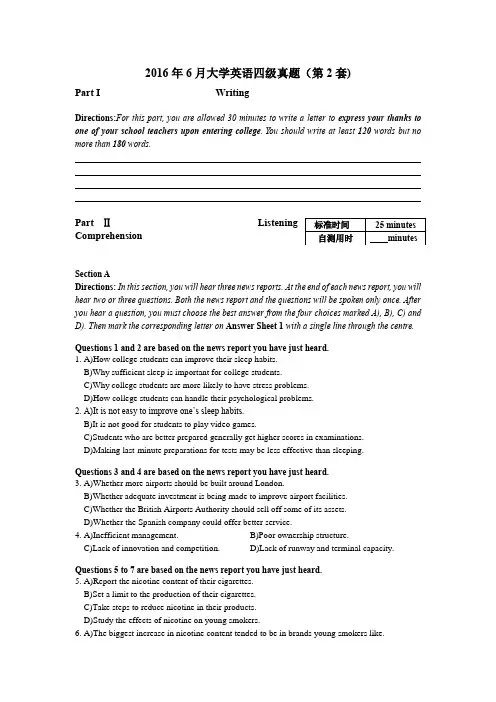
2016年6月大学英语四级真题(第2套)Part I WritingDirections:For this part, you are allowed 30 minutes to write a letterto express your thanks to one of your school teachers upon entering college. You should write at least 120 words but no more than 180 words.ComprehensionSection ADirections: In this section, you will hear three news reports. At the end of each news report, you will hear two or three questions. Both the news report and the questions will be spoken only once. After you hear a question, you must choose the best answer from the four choices marked A), B), C) and D). Then mark the corresponding letter on Answer Sheet 1 with a single line through the centre. Questions 1 and 2 are based on the news report you have just heard.1. A)How college students can improve their sleep habits.B)Why sufficient sleep is important for college students.C)Why college students are more likely to have stress problems.D)How college students can handle their psychological problems.2. A)It is not easy to improve one’s sleep habits.B)It is not good for students to play video games.C)Students who are better prepared generally get higher scores in examinations.D)Making last-minute preparations for tests may be less effective than sleeping.Questions 3 and 4 are based on the news report you have just heard.3. A)Whether more airports should be built around London.B)Whether adequate investment is being made to improve airport facilities.C)Whether the British Airports Authority should sell off some of its assets.D)Whether the Spanish company could offer better service.4. A)Inefficient management. B)Poor ownership structure.C)Lack of innovation and competition. D)Lack of runway and terminal capacity. Questions 5 to 7 are based on the news report you have just heard.5. A)Report the nicotine content of their cigarettes.B)Set a limit to the production of their cigarettes.C)Take steps to reduce nicotine in their products.D)Study the effects of nicotine on young smokers.6. A)The biggest increase in nicotine content tended to be in brands young smokers like.B)Big tobacco companies were frank with their customers about the hazards of smoking.C)Brands which contain higher nicotine content were found to be much more popular.D)Tobacco companies refused to discuss the detailed nicotine content of their products.7. A)They promised to reduce the nicotine content in cigarettes.B)They have not fully realized the harmful effect of nicotine.C)They were not prepared to comment on the cigarette study.D)They will pay more attention to the quality of their products.Section BDirections: In this section, you will hear two long conversations. At the end of each conversation, you will hear four questions. Both the conversation and the questions will be spoken only once. After you hear a question,you must choose the best answer from the four choices marked A),B),C)and D). Then mark the corresponding letter on Answer Sheet 1 with a single line through the centre.Questions 8 to 11 are based on the conversation you have just heard.8. A)Indonesia. B)Holland. C)Sweden. D)England.9.A)Getting a coach who can offer real help. B)Talking with her boyfriend in Dutch.C)Learning a language where it is not spoken . D)Acquiring the necessary ability to socialize .10. A)Listening language programs on the radio. B)Trying to speak it as much as one can.C)Making friends with native speakers. D)Practicing reading aloud as often as possible.11.A)It creates an environment for socializing.B)It offers various courses with credit points.C)It trains young people’s leadership abilities.D)It provides opportunities for language practice.Questions 12 to 15 are based on the conversation you have just heard.12. A)The impact of engine design on rode safety. B)The role policemen play in traffic safety.C)A sense of freedom driving gives. D)Rules and regulations for driving.13. A)Make cars with automatic control. B)Make cars that have better brakes.C)Make cars that are less powerful. D)Make cars with higher standards.14. A)They tend to drive responsibly. B)They like to go at high speed.C)They keep within speed limits. D)They follow traffic rules closely.15.A)It is a bad idea. B)It is not useful.C)It is as effective as speed bumps . D)It should be combined with education.Section CDirections: In this section, you will hear three passages. At the end of each passage, you will hear three or four questions. Both the passage and the questions will be spoken only once. After you hear a question, you must choose the best answer from the four choices marked A),B),C)and D).Then mark the corresponding letter on Answer Sheet 1 with a single line through the centre.Questions 16 to 18 are based on the passage you have just heard.16.A)The card got damaged . B)The card was found invalid.C)The card reader failed to do the scanning. D)The card reader broke down unexpectedly.17. A)By converting the credit card with a layer of plastic.B)By calling the credit card company for confirmation.C)By seeking help from the card reader maker Verifone.D)By typing the credit card number into the cash register.18.A)Affect the sales of high-tech appliances.B)Change the life style of many Americans.C)Give birth to many new technological inventions.D)Produce many low-tech fixes for high-tech failures.Questions 19 to 21 are based on the passage you have just heard.19. A)They are set by the dean of the graduate school.B)They are determined by the advising board.C)They leave much room for improvement.D)They vary among different departments.20. A)By consulting the examining committee . B)By reading the Bulletin of Information.C)By contacting the departmental office. D)By visiting the university’s website.21. A)They specify the number of credits students must earn.B)They are harder to meet than those for undergraduates.C)They have to be approved by the examining committee.D)They are the same among various divisions of the university.Questions 22 to 25 are based on the passage you have just heard.22. A)Students majoring in nutrition. B)Students in health classes.C)Ph.D. candidates in dieting. D)Middle and high school teachers.23. A)Its overestimate of the effect of dieting. B)Its mistaken conception of nutrition.C)Its changing criteria for beauty. D)Its overemphasis on thinness.24. A)To illustrate her point that beauty is but skin deep.B)To demonstrate the magic effect of dieting on women.C)To explain how computer images can be misleading.D)To prove that technology has impacted our culture.25. A)To persuade girls to stop dieting.B)To promote her own concept of beauty.C)To establish an emotional connection with students.D)To help students rid themselves of bad living habits.Part III Reading ComprehensionSection ADirections:In this section, there is a passage with ten blanks. You are required to select one word for each blank from a list of choices given in a word bank following the passage. Read the passage through carefully before making your choices. Each choice in the bank is identified by a letter. Please mark the corresponding letter for each item on Answer Sheet 2 with a single line through the centre. You may not use any of the words in the bank more than once.Contrary to popular belief, older people generally do not want to live with their children. Moreover, most adult children 26 every bit as much care and support to their aging parents as was the case in the “good old days”, and most older people do not feel 27 .About 80% of people 65years and older have living children, and about 90% of them have 28 contact with their children. About 75% of elderly parents who don’t go to nursing homes livewithin 30 minutes of at least one of their children.However, 29 having contact with children does not guarantee happiness in old age. In fact, some research has found that people who are most involved with their families have the lowest spirits. This research may be 30 , however, as ill health often makes older people more 31 and thereby increases contact with family members. So it is more likely that poor health, not just family involvement, 32 spirits.Increasingly, researchers have begun to look at the quality of relationships, rather than at the frequency of contact, between the elderly and their children. If parents and children share interests and values and agree on childrearing practices and religious 33 , they are likely to enjoy each other’s company. Disagreements on such matters can 34 cause problems. If parents are agreed by their daughter’s divor ce, dislike her new husband, and disapprove of how she is raising their grandchildren, 35 are that they are not going to enjoy her visits.Section BDirections: In this section, you are going to read a passage with ten statements attached to it. Each statement contains information given in one of the paragraphs. Identify the paragraph from which the information is derived. You may choose a paragraph more than once. Each paragraph ismarked with a letter. Answer the questions by marking the corresponding letter on Answer Sheet 2.Could Food Shortages Bring Down Civilization?[A] For many years I have studied global agricultural, population, environmental and economictrends and their interactions. The combined effects of those trends and the political tensions they generate point to the breakdown of governments and societies. Yet I, too, have resisted the idea that food shortages could bring down not only individual governments but also our global civilization.[B] I can no longer ignore that risk. Our continuing failure to deal with the environmentaldeclinesthat are undermining the world food economy forces me to conclude that such a collapse is possible.[C] As demand for food rises faster than supplies are growing, the resulting food-price inflationputs severe stress on the governments of many countries. Unable to buy grain or grow their own, hungry people take to the streets. Indeed, even before the steep climb in grain prices in 2008, the number of failing states was expanding. If the food situation continues to worsen, entire nations will break down at an ever increasing rate. In the 20th century the main threat to international security was superpower conflict; today it is failing states.[D] States fail when national governments can no longer provide personal security, food securityand basic social services such as education and health care. When governments lose their control on power, law and order begin to disintegrate. After a point, countries can become so dangerous that food relief workers are no longer safe and their programs are halted. Failing states are of international concern because they are a source of terrorists, drugs, weapons and refugees(难民), threatening political stability everywhere.[E] The surge in world grain prices in 2007 and 2008—and the threat they pose to foodsecurity——has a different, more troubling quality than the increases of the past. During the second half of the 20th century, grain prices rose dramatically several times. In 1972, for instance, the Soviets, recognizing their poor harvest early, quietly cornered the world wheat market. As a result, wheat prices elsewhere more than doubled, pulling rice and corn prices up with them. But this and other price shocks were event-driven——drought in the Soviet Union, crop-shrinking heat in the U.S. Corn Belt. And the rises were short-lived: prices typically returned to normal with the next harvest.[F] In contrast, the recent surge in world grain prices is trend-driven, making it unlikely to reversewithout a reversal in the trends themselves. On the demand side, those trends include the ongoing addition of more than 70 million people a year, a growing number of people wanting to move up the food chain to consume highly grain-intensive meat products, and the massive diversion(转向) of U.S. grain to the production of bio-fuel.[G] As incomes rise among low-income consumers, the potential for further grain consumption ishuge. But that potential pales beside the never-ending demand for crop-based fuels. A fourth of this year’s U.S. grain harvest will go to fuel cars.[H] What about supply? The three environmental trends——the shortage of fresh water, the lossof topsoil and the rising temperatures——are making it increasingly hard to expand the world’s grain supply fast enough to keep up with demand. Of all those trends, however, the spread of water shortages poses the most immediate threat. The biggest challenge here is irrigation, which consumes 70% th e world’s fresh water. Millions of irrigation wells in many countries are now pumping water out of underground sources faster than rainfall can refill them. The result is falling water tables(地下水位)in countries with half the world’s people, including the three big grain producers——China, India and the U.S.[I] As water tables have fallen and irrigation wells have gone dry, China’s wheat crop, the world’slargest, has declined by 8% since it peaked at 123 million tons in 1997. But water shortages are even more worrying in India. Millions of irrigation wells have significantly lowered water tables in almost every state.[J] As the world’s food security falls to pieces, individual countries acting in their own self-interest are actually worsening the troubles of many. The trend began in 2007, when leading wheat-exporting countries such as Russia and Argentina limited or banned their exports, in hopes of increasing local food supplies and thereby bringing down domestic food prices.Vietnam banned its exports for several months for the same reason. Such moves may eliminate the fears of those living in the exporting countries, but they are creating panic in importing countries that must rely on what is then left for export.[K] In response to those restrictions, grain-importing countries are trying to nail down long-term trade agreements that would lock up future grain supplies. Food-import anxiety is even leading to new efforts by food-importing countries to buy or lease farmland in other countries. In spite of such temporary measures, soaring food prices and spreading hunger in many other countries are beginning to break down the social order.[L] Since the current world food shortage is trend-driven, the environmental trends that cause it must be reversed. We must cut carbon emissions by 80% from their 2006 levels by 2020, stabilize the world’s population at eight billion by 2040, completely re move poverty, and restore forests and soils. There is nothing new about the four objectives. Indeed, we have madesubstantial progress in some parts of the world on at least one of these——the distribution of family-planning services and the associated shift to smaller families.[M]For many in the development community, the four objectives were seen as positive, promoting development as long as they did not cost too much. Others saw them as politically correct and morally appropriate. Now a third and far more significant motivation presents itself: meeting these goals may be necessary to prevent the collapse of our civilization. Yet the cost we project for saving civilization would amount to less than $200 billion a year, 1/6 of current global military spending. In effect, our plan is the new security budget.36.The more recent steep climb in grain prices partly results from the fact that more and morepeople want to consume meat products.37. Social order is breaking down in many countries because of food shortages.38. Rather than superpower conflict, countries unable to cope with food shortages now constitutethe main threat to world security.39. Some parts of the world have seen successful implementation of family planning.40. The author has come to agree that food shortages could ultimately lead to the collapse of worldcivilization.41. Increasing water shortages prove to be the biggest obstacle to boosting the world’s grainproduction.42. The cost for saving our civilization would be considerably less than the world’s currentmilitary spending.43. To lower domestic food prices, some countries limited or stopped their grain exports.44. Environmental problems must be solved to ease the current global food shortage.45. A quarter of this year’s American grain harvest will be used to produce bio-fuel for cars. Section CDirections: There are 2 passages in this section. Each passage is followed by some questions or unfinished statements. For each of them there are four choices marked A), B), C) and D). You should decide on the best choice and mark the corresponding letter on Answer Sheet 2 with a single line through the centre.Passage OneQuestions 46 to 50 are based on the following passage.Declining mental function is often seen as a problem of old age, but certain aspects of brain function actually begin their decline in young adulthood, a new study suggests.The study, which followed more than 2,000 healthy adults between the ages of 18 and 60, found that certain mental functions—including measures of abstract reasoning, mental speed and puzzle-solving—started to dull as early as age 27.Dips in memory, meanwhile, generally became apparent around age 37.On the other hand, indicators of a person’s accumulated knowledge—like performance on tests of vocabulary and general knowledge—kept improving with age, according to findings published in the journal Neurobiology of Aging.The results do not mean that young adults need to start worrying about their memories. Most people’s minds function at a high level even in their later years, according to researcher Timothy Salthouse.“These patterns suggest that some types of mental flexibility decrease relatively early in adulthood, but that the amount of knowledge one has, and the effectiveness of integrating it withone’s abilities, may increase throughout all of adulthood if there are no diseases,” Salthouse said in a news release.The study included healthy, educated adults who took standard tests of memory, reasoning and perception at the outset and at some point over the next seven years.The tests are designed to detect subtle (细微的) changes in mental function, and involve solving puzzles, recalling words and details from stories, and identifying patterns in collections of letters and symbols.In general, Salthouse and his colleagues found, certain aspects of cognition (认知能力) generally started to decline in the late 20s to 30s.The findings shed light on normal age-related changes in mental function, which could aid in understanding the process of dementia (痴呆), according to the researchers.“By following individuals over time,” Salthouse said, “we gain insight in cognition changes, and may possibly discover ways to slow the rate of decline.”The researchers are currently analyzing the study participants’ health and lifestyle to see which factors might influence age-related cognitive changes.46. What is the common view of mental function?A)It varies from person to person. B)It weakens in one’s later years.C)It gradually expands with age. D)It indicates one’s health condition.47. What does the new study find about mental functions?A)Some diseases inevitably lead to their decline.B)They reach a peak at the age of 20 for most people.C)They are closely related to physical and mental exercise.D)Some of them begin to decline when people are still young.48. What does Timothy Salthouse say about people’s minds in most cases?A)They tend to decline in people’s later years.B)Their flexibility determines one’s abilities.C)They function quite well even in old age.D)Their functioning is still a puzzle to be solved.49. Although people’s minds may function less flexibly as they age, they _____.A)may be better at solving puzzlesB)can memorize things with more easeC)may have greater facility in abstract reasoningD)can put what they have learnt into more effective use50. According to Salthouse, their study may help us_____.A)find ways to slow down our mental declineB)find ways to boost our memoriesC)understand the complex process of mental functioningD)understand the relation between physical and mental healthPassage TwoQuestions 51 to 55 are based on the following passage.The most important thing in the news last week was the rising discussion in Nashville about the educational needs of children. The shorthand(简写)educators use for this is “pre-K”—meaning instruction before kindergarten—and the big idea is to prepare 4-year-olds andeven younger kids to be ready to succeed on their K-12 journey.But it gets complicated. The concept has multiple forms, and scholars and policymakers argue about the shape, scope and cost of the ideal program.The federal Head Start program, launched 50 years ago, has served more than 30 million children. It was based on concepts developed at Vanderbilt University’s Peabody Coll ege by Susan Gray, the legendary pioneer in early childhood education research.A new Peabody study of the Tennessee V oluntary Pre-K program reports that pre-K works, but the gains are not sustained through the third grade. It seems to me this highlights quality issues in elementary schools more than pre-K, and indicates longer-term success must connect pre-K with all the other issues related to educating a child.Pre-K is controversial. Some critics say it is a luxury and shouldn’t be free to families able to pay. Pre-K advocates insist it is proven and will succeed if integrated with the rest of the child’s schooling. I lean toward the latter view.This is, in any case, the right conversation to be having now as Mayor Megan Barry takes office. She was the first candidate to speak out for strong pre-K programming. The important thing is for all of us to keep in mind the real goal and the longer, bigger picture.The weight of the evidence is on the side of pre-K that early intervention (干预)works. What government has not yet found is the political will to put that understanding into full practice with a sequence of smart schooling that provides the early foundation.For this purpose, our schools need both the talent and the organization to educate each child who arrives at the schoolhouse door. Some show up ready, but many do not at this critical time when young brains are developing rapidly.51.What does the author say about pre-kindergarten education?A)It should cater to the needs of individual children.B)It is essential to a person’s future academic success.C)Scholars and policymakers have different opinions about it.D)Parents regard it as the first phase of children’s development.52.What does the new Peabody study find?A)Pre-K achievements usually do not last long.B)The third grade marks a new phase of learning.C)The third grade is critical to children’s development.D)Quality has not been the top concern of pre-K programs.53.When does the author think pre-K works the best?A)When it is accessible to kids of all families.B)When it is made part of kids’ education.C)When it is no longer considered a luxury.D)When it is made fun and enjoyable to kids.54.What do we learn about Mayor Megan Barry?A)She knows the real goal of education. B)She is a mayor of insight and vision.C)She has once run a pre-K program. D)She is a firm supporter of pre-K.55.What does the author think is critical to kids’ education?A)Teaching method. B)Kids’ interes t.C)Early intervention. D)Parents’ involvement.Part IV TranslationDirections:For this part, you are allowed 30 minutes to translate a passage from Chinese into English. You should write your answer on Answer Sheet 2.在山东省潍坊市,风筝不仅仅是玩具,而且还是这座城市文化的标志。
6大学英语四级听力真题及答案详解

三、2016年6月英语四级听力真题第二套答案1. B)Why sufficient sleep is important for college students.2. D)Making last-minute preparations for tests may be less effective than sleeping.3. C)Whether the British Airports Authority should sell off some of its assets.4. D)Lack of runway and terminal capacity.5. A)Report the nicotine content of their cigarettes.6. A)The biggest increase in nicotine content tended to be in brands young smokers like.7. C)They were not prepared to comment on the cigarette study.8. B)Holland.9. C)Learning a language where it is not spoken.10. B)Trying to speak it as much as one can.11. D)It provides opportunities for language practice.12. D)Rules and regulations for driving.13. C)Make cars that are less powerful.14. A)They tend to drive responsibly.15. B)It is not useful.16 C)The card reader failed to do the scanning.17 A)By covering the credit card with a layer of plastic.18 D)Produce many low-tech fixes for high-tech failures.19. D)They vary among different departments.20. C)By contacting the departmental office.21. A)They specify the number of credits students must earn.22 B)Students in health classes.23 D)Its overemphasis on thinness.24 C)To explain how computer images can be misleading.25 A)To persuade girls to stop dieting.Part II Listening ComprehensionSection ANews Report One,听力原文:You probably think college students are experts at parties,preparations for tests,personal problems and general stress can wreck a student’s sleep habits,which can be bad for the body and the Tech University is even offering a class called“Improving Your Sleep Habits”.[1]People suffering from sleep loss are at an increased risk from obesity,psychological problems and car who don't get enough sleep have poorer attendance and lower top of all that,[2] anew study published in the Journal Learning&Memory finds you're probably better off sleeping than making last-minute preparations for a college kids were taught to play some unfamiliar video who learned the games in the morning lost some skills when they played again 12 hours later,but they did much better after getting a good night’s sleep.[1] you really want to do your job well,don't forget to get some sleep.解析:college students can handle their psychological problems.college students are more likely to have stress problems.sufficient sleep is important for college students.college students can improve their sleep habits.Q:What is the news report mainly about?^【解析】选项为how或why开头的句子表明,本题可能考查新闻要点。
2016年6月英语四级真题 (第二套)
2016年6月英语四级真题(第二套)Part I Writing (30 minutes)Directions:For this part, you are allowed 30 minutes to write a letter to express your thanks to one of your school teachers upon entering college. You should write at least 120 words but no more than 180 words.Part III Reading Comprehension (40 minutes)Section ADirections: In this section, there is a passage with ten blanks. You are required to select one word for each blank from a list of choices given in a word bank following the passage.Contrary to popular belief, older people generally do not want to live with their children. Moreover, most adult children _____(26)every bit as much care and support to their aging parents as was the case in the "good old days", and roost older people do not feel _____(27).About 80% of people 65 years and older have living children, and about 90% of them have _____(28)contact with their children. About 75% of elderly parents who don't go to nursing homes live within 30 minutes of at least one of their children.However, _____(29)having contact with children does not guarantee happiness in old age. In fact, some research has found that people who are most involved with their families have the lowest spirits. This research may be _____(30), however, as ill health often makes older people more _____(31)and thereby increases contact with family members. So it is more likely that poor health, not just family involvement, _____(32)spirits.Increasingly, researchers have begun to look at the quality of relationships, rather than at the frequency of contact, between the elderly and their children. If parents and children share interests and values and agree on childrearing practices and religious _____(33)they are likely to enjoy each other's company. Disagreements on such matters can _____(34)cause problems. If parents are angered by their daughter's divorce, dislike her new husband, and disapprove of how she is raising their grandchildren, _____(35)are that they are not going to enjoy her visits.A.abandonedB.advancedC.biasedD.chancesmitmentF.dampensG.dependentH.distantI.frequentJ.fulfillmentK.grantL.merelyM.provideN.understandablyO.unrealisticallySection BDirections: In this section, you are going to read a passage with ten statements attached to it. Each statement contains information given in one of the paragraphs. Identify the paragraph from which the information is derived. You may choose a paragraph more than once. Each paragraph is marked with a letter. Answer the questions by marking the corresponding letter on Answer Sheet 2.Could Food Shortages Bring Down Civilization?[A] For many years I have studied global agricultural, population, environmental and economic trends and their interactions. The combined effects of those trends and the political tensions they generate point to the breakdown of governments and societies. Yet I, too, have resisted the idea that food shortages could bring down not only individual governments but also our global civilization.[B] I can no longer ignore that risk. Our continuing failure to deal with the environmental declines that are undermining the world food economy forces me to conclude that such a collapse is possible.[C] As demand for food rises faster than supplies are growing, the resulting food-price inflation puts severe stress on the governments of many countries. Unable to buy grain or grow their own, hungry people take to the streets. Indeed, even before the steep climb in grain prices in 2008, the number of failing states was expanding. If the food situation continues to worsen, entire nations will break down at an ever increasing rate. In the 20th century the main threat to international security was superpower conflict; today it is failing states.[D] States fail when national governments can no longer provide personal security, food security and basic social services such as education and health care. When governments lose their control on power, law and order begin to disintegrate. After a point, countries can become so dangerous that food relief workers are no longer safe and their programs are halted. Failing states are of international concern because they are a source of terrorists, drugs, weapons and refugees(难民), threatening political stability everywhere.[E] The surge in world grain prices in 2007 and 2008—and the threat they pose to food security——has a different, more troubling quality than the increases of the past. During the second of the 20th century, grain prices rose dramatically several times. In 1972, for instance, the Soviets. I recognizing their poor harvest early, quietly cornered the world wheat market. As a result, wheat prices elsewhere more than doubled, pulling rice and com prices up with them. But this and other price shocks were event-driven——drought in the Soviet Union, crop-shrinking heat in the U.S. Corn Belt. And the rises were short-lived: prices typically returned to normal with the next harvest.[F]In contrast, recent surge in world grain prices is trend-driven, making it unlikely to reverse without a reversal in the trends themselves. On the demand side, those trends include the ongoing addition of more than 70 million people a year, a growing number of people wanting to move up the food chain to consume highly grain-intensive meat products, and the massive diversion(转向)of U.S. grain to the production of bio-fuel.[G]As incomes rise among low-income consumers, the potential for further grain consumption is huge. But that potential pales beside the never-ending demand for crop-based fuels. A fourth of this year's U.S. grain harvest will go to fuel cars.[H]What about supply? The three environmental trends——the shortage of fresh water, the loss of topsoil and the rising temperatures——are making it increasingly hard to expand the world's grain supply fast enough to keep up with demand. Of all those trends, however, the spread of water shortages poses the most immediate threat. The biggest challenge here is irrigation, which consumes 70% the world's fresh water. Millions of irrigation wells in many countries are now pumping water out of underground sources faster than rainfall can refill them. The result is falling water tables(地下水位)in countries with half the world's people, including the three big grain producers——China, India and the U.S.[I]As water tables have fallen and irrigation wells have gone dry, China's wheat crop, the world's largest, has declined by 8% since it peaked at 123 million tons in 1997. But water shortages are even more worrying in India. Millions of irrigation wells have significantly lowered water tables in almost every state.[J]As the world's food security falls to pieces, individual countries acting in their own self-interest are actually worsening the troubles of many. The trend began in 2007, when leading wheat-exporting countries such as Russia and Argentina limited or banned their exports, in hopes of increasing local food supplies and thereby bringing down domestic food prices. Vietnam banned its exports for several months for the same reason. Such moves may eliminate the fears of those living in the exporting countries, but they are creating panic in importing countries that must rely on what is then left for export.[K]In response to those restrictions, grain-importing countries are trying to nail down long-term trade agreements that would lock up future grain supplies. Food-import anxiety is even leading to new efforts by food-importing countries to buy or lease farmland in other countries. In spite of such temporary measures, soaring food prices and spreading hunger in many other countries are beginning to break down the social order.[L]Since the current world food shortage is trend-driven, the environmental trends that cause it must be reversed. We must cut carbon emissions by 80% from their 2006 levels by 2020, stabilize the world's population at eight billion by 2040, completely remove poverty, and restore forests and soils. There is nothing new about the four objectives. Indeed, we have made substantial progress in some parts of the world on at least one of these——the distribution of family-planning services and the associated shift to smaller families.[M]For many in the development community, the four objectives were seen aspositive, promoting development as long as they did not cost too much. Others saw them as politically correct and morally appropriate. Now a third and far more significant motivation presents itself: meeting these goals may necessary to prevent the collapse of our civilization. Yet the cost we project for saving civilization would amount to less than $200 billion a year, 1/6 of current global military spending. In effect, our plan is the new security budget.36.The more recent steep climb in grain prices partly results from the fact that more and more people want to consume meat products.37.Social order is breaking down in many countries because of food shortages.38.Rather than superpower conflict, countries unable to cope with food shortages now constitute the main threat to world security.39.Some parts of the world have seen successful implementation of family planning.40.The author has come to agree that food shortages could ultimately lead to the collapse of world civilization.41.Increasing water shortages prove to be the biggest obstante to boosting the world's grain production.42.The cost for saving our civilization would be considerably less than the world's current military spending.43.To lower domestic food prices, some countries limited or stopped their grain exports.44.Environmental problems must be solved to case the current global food shortage.45.A quarter of this year's American grain harvest will be used to produce bio-fuel for cars.Section CPassage OneQuestions 46 to 50 are based on the following passage.Declining mental function is often seen as a problem of old age,but certain aspects of brain function actually begin their decline in young adulthood, a new study suggests.The study, which followed more than 2,000 healthy adults between the ages of 18 and 60, found that certain mental functions—including measures of abstract reasoning, mental speed and puzzle-solving—started to dull as early as age 27.Dips in memory, meanwhile, generally became apparent around age 37.On the other hand, indicators of a person’s accumulated knowledge—like performance on tests of vocabulary and general knowledge—kept improving with age, according to findings published in the journal Neurobiology of Aging.The results do not mean that young adults need to start worrying about their memories. Most people’s minds function at a high level even in their later years, according to researcher Timothy Salthouse."These patterns suggest that some types of mental flexibility decrease relatively early in adulthood, but that the amount of knowledge one has, and the effectiveness of integrating it with one’s abilities,may increase throughoutall of adulthood if there are no dispases," Salthouse said in a news release.The study included healthy, educated adults who took standard tests of memory, reasoning and perception at the outset and at some point over the next seven years.The tests are designed to detect subtle (细微的)changes in mental function, and involve solving Puzzles, recalling words and details from stories, and identifying patterns in collections of letters and symbols.In general, Salthouse and his colleagues found, certain aspects of cognition (认知能力)generally started to decline in the late 20s to 30s.The findings shed light on normal age-related changes in mental function, which could aid in understanding the process of dementia(痴呆),according to the researchers.“By following individuals over time,” Salthouse said, "we gain insight in cognition changes, and may possibly discover ways to slow the rate of decline.”The researchers are currently analyzing, the study participants' health and lifestyle to see which factors might influence age-related cognitive changes.46.What is the common view of mental function?A.It varies from person to person.C.It gradually expands with age.B.It weakens in one’s later years.D.It indicates one’s health condition.47.What does the new study find about mental functions?A.Some diseases inevitably lead to their decline.B.They reach a peak at the age of 20 for most people.C.They are closely related to physical' and mental exercise.D.Some of them begin to decline when people are still young.48.What does Timothy Salthouse say about people's minds in most cases?A.They tend to decline in people’s later years.B.Their flexibility determines one’s abilities.C.They function quite well even in old age.D.Their functioning is still a puzzle to be solved.49.Although people’s minds may function less flexibly as they age, they_____.A.may be better at solving puzzlesB.can memorize things with more easeC.may have greater facility in abstract reasoningD.can put what they have learnt into more effective use50.According to Salthouse, their study may help us_____.A.find ways to slow down our mental decline6.find ways to boost our memoriesC.understand the complex process of mental functioningD.understand the relation between physical and mental healthPassage TwoQuestions 51 to 55 are based on the following passage.The most important thing in the news last week was the rising discussion inNashville about the educational needs of children. The shorthand(简写)educators use for this is "pre-K"—meaning instruction before kindergarten—and the big idea is to prepare 4-year-olds and even younger kids to be ready to succeed on their K-12 journey.But it gets complicated. The concept has multiple forms, and scholars and policymakers argue about the shape, scope and cost of the ideal program.The federal Head Start program, launched 50 years ago, has served more than 30 million children. It was based on concepts developed at Vanderbilt University's Peabody College by Susan Gray, the legendary pioneer in early childhood education research.A new Peabody study of the Tennessee Voluntary Pre-K program reports that pre-K works, but the gains are not sustained through the third grade. It seems to me this highlights quality issues in elementary schools more than pre-K, and indicates longer-term success must connect pre-K with all the other issues, related to educating a child.Pre-K is controversial. Some critics say it is a luxury and shouldn't be free to families able to pay. Pre-K advocates insist it is proven and will succeed if integrated with the rest of the child's schooling. I lean toward the latter view.This is, in any case, the right conversation to be having now as Mayor Megan Barry takes office. She was the first candidate to speak out for strong pre-K programming. The important thing is for all of us to keep in mind the real goal and the longer, bigger picture.The weight of the evidence is on the side of pre-K that early intervention (干预)works. What government has not yet found is the political will to put that understanding into full practice with a sequence of smart schooling that provides the early foundation.For this purpose, our schools need both the talent and the organization to educate each child who arrives at the schoolhouse door. Some show up ready, but many do not at this critical time when young brains are developing rapidly.51.What does the author say about pre-kindergarten education?A.It should cater to the needs of individual children.B.It is essential to a person's future academic success.C.Scholars and policymakers have different opinions about it.D.Parents regard it as the first phase of children's development.52.What does the new Peabody study find?A.Pre-K achievements usually do not last long.B.The third grade marks a new phase of learning.C.The third grade is critical to children's development.D.Quality has not been the top concern of pre-K programs.53.When does the author think pre-K works the best?A.When it is accessible to kids of all families.B.When it is made part of kids' education.C.When it is no longer considered a luxury.D.When it is made fun and enjoyable to kids.54.What do we learn about Mayor Megan Barry?A.She knows the real goal of education.B.She is a mayor of insight and vision.C.She has once run a pre-K program.D.She is a firm supporter of pre-K.55.What does the author think is critical to kids' education?A.Teaching method.B.Kids' interest.C.Early intervention.D.Parents' involvement.Part IV Translation (30 minutes)Directions: For this part, you are allowed 30 minutes to translate a passage from Chinese into English。
2016年6月大学英语CET四级试题及解析

2016年6月大学英语四级真题及参考答案Part ⅡListening Comprehension(听力部分共有两套)四级第一套Section A1。
C) Rising unemployment worldwide.2。
A)Many countries have not taken measures to create enough jobs.3。
B) Put calorie information on the menu.4。
A)They will be fined.C) They will get a warning。
5. D)Failure to integrate innovation into their business。
6. B)It is the creation of something new。
7. C) Its innovation culture。
Section B8。
D)He does not talk long on the phone。
9. B)Talk at length.10。
A) He thought it was cool。
11. C)It is childish and unprofessional。
12. B)He is unhappy with his department manager.13. A) His workload was much too heavy。
14。
C) His boss has a lot of trust in him.15。
D)Talk to his boss in person first.Section C16. A)The importance of sleep to a healthy life。
17。
C) They get less and less sleep。
18. D)Their blood pressure will rise。
2016年6月大学英语四级真题第二套
2016年6月大学英语四级真题(第2套)该真题及答案摘自于巨微英语四级真题逐句精解,中间省略听力原文,详细资料可以关注公众号:巨微英语四六级 或者官网渠道获得电子版。
Part I WritingDirections:For this part, you are allowed 30 minutes to write a letterto express your thanks to one of your school teachers upon entering college . You should write at least 120 words but no more than 180 words.Part Ⅱ Listening ComprehensionSection ADirections: In this section, you will hear three news reports. At the end of each news report, you will hear two or three questions. Both the news report and the questions will be spoken only once. After you hear a question, you must choose the best answer from the four choices marked A), B), C) andD). Then mark the corresponding letter on Answer Sheet 1 with a single line through the centre. Questions 1 and 2 are based on the news report you have just heard.1. A)How college students can improve their sleep habits.B)Why sufficient sleep is important for college students.C)Why college students are more likely to have stress problems.D)How college students can handle their psychological problems.2. A)It is not easy to improve one ’s sleep habits.B)It is not good for students to play video games.C)Students who are better prepared generally get higher scores in examinations.D)Making last-minute preparations for tests may be less effective than sleeping.Questions 3 and 4 are based on the news report you have just heard.3. A)Whether more airports should be built around London.B)Whether adequate investment is being made to improve airport facilities.C)Whether the British Airports Authority should sell off some of its assets.D)Whether the Spanish company could offer better service.4. A)Inefficient management. B)Poor ownership structure.C)Lack of innovation and competition. D)Lack of runway and terminal capacity.Questions 5 to 7 are based on the news report you have just heard.5. A)Report the nicotine content of their cigarettes.B)Set a limit to the production of their cigarettes.C)Take steps to reduce nicotine in their products.D)Study the effects of nicotine on young smokers.6. A)The biggest increase in nicotine content tended to be in brands young smokers like.B)Big tobacco companies were frank with their customers about the hazards of smoking.C)Brands which contain higher nicotine content were found to be much more popular.D)Tobacco companies refused to discuss the detailed nicotine content of their products.7. A)They promised to reduce the nicotine content in cigarettes.B)They have not fully realized the harmful effect of nicotine.C)They were not prepared to comment on the cigarette study.D)They will pay more attention to the quality of their products.Section BDirections: In this section, you will hear two long conversations. At the end of each conversation, you will hear four questions. Both the conversation and the questions will be spoken only once. After you hear a question,you must choose the best answer from the four choices marked A),B),C)and D). Then mark the corresponding letter on Answer Sheet 1 with a single line through the centre.Questions 8 to 11 are based on the conversation you have just heard.8. A)Indonesia. B)Holland. C)Sweden. D)England.9.A)Getting a coach who can offer real help. B)Talking with her boyfriend in Dutch.C)Learning a language where it is not spoken . D)Acquiring the necessary ability to socialize .10. A)Listening language programs on the radio. B)Trying to speak it as much as one can.C)Making friends with native speakers. D)Practicing reading aloud as often as possible.11.A)It creates an environment for socializing.B)It offers various courses with credit points.C)It trains young people’s leadership abilities.D)It provides opportunities for language practice.Questions 12 to 15 are based on the conversation you have just heard.12. A)The impact of engine design on rode safety. B)The role policemen play in traffic safety.C)A sense of freedom driving gives. D)Rules and regulations for driving.13. A)Make cars with automatic control. B)Make cars that have better brakes.C)Make cars that are less powerful. D)Make cars with higher standards.14. A)They tend to drive responsibly. B)They like to go at high speed.C)They keep within speed limits. D)They follow traffic rules closely.15.A)It is a bad idea. B)It is not useful.C)It is as effective as speed bumps . D)It should be combined with education.Section CDirections: In this section, you will hear three passages. At the end of each passage, you will hear three or four questions. Both the passage and the questions will be spoken only once. After you hear a question, you must choose the best answer from the four choices marked A),B),C)and D).Then mark the corresponding letter on Answer Sheet 1 with a single line through the centre.Questions 16 to 18 are based on the passage you have just heard.16.A)The card got damaged . B)The card was found invalid.C)The card reader failed to do the scanning. D)The card reader broke down unexpectedly.17. A)By converting the credit card with a layer of plastic.B)By calling the credit card company for confirmation.C)By seeking help from the card reader maker Verifone.D)By typing the credit card number into the cash register.18.A)Affect the sales of high-tech appliances.B)Change the life style of many Americans.C)Give birth to many new technological inventions.D)Produce many low-tech fixes for high-tech failures.Questions 19 to 21 are based on the passage you have just heard.19. A)They are set by the dean of the graduate school.B)They are determined by the advising board.C)They leave much room for improvement.D)They vary among different departments.20. A)By consulting the examining committee . B)By reading the Bulletin of Information.C)By contacting the departmental office. D)By visiting the university’s website.21. A)They specify the number of credits students must earn.B)They are harder to meet than those for undergraduates.C)They have to be approved by the examining committee.D)They are the same among various divisions of the university.Questions 22 to 25 are based on the passage you have just heard.22. A)Students majoring in nutrition. B)Students in health classes.C)Ph.D. candidates in dieting. D)Middle and high school teachers.23. A)Its overestimate of the effect of dieting. B)Its mistaken conception of nutrition.C)Its changing criteria for beauty. D)Its overemphasis on thinness.24. A)To illustrate her point that beauty is but skin deep.B)To demonstrate the magic effect of dieting on women.C)To explain how computer images can be misleading.D)To prove that technology has impacted our culture.25. A)To persuade girls to stop dieting.B)To promote her own concept of beauty.C)To establish an emotional connection with students.D)To help students rid themselves of bad living habits.Section ADirections:In this section, there is a passage with ten blanks. You are required to select one word for each blank from a list of choices given in a word bank following the passage. Read the passage through carefully before making your choices. Each choice in the bank is identified by a letter. Please mark the corresponding letter for each item on Answer Sheet 2 with a single line through the centre. You may not use any of the words in the bank more than once.Contrary to popular belief, older people generally do not want to live with their children. Moreover, most adult children 26 every bit as much care and support to their aging parents as was the case in the “good old days”, and most older people do not feel 27.About 80% of people 65years and older have living children, and about 90% of themhave 28contact with their children. Ab out 75% of elderly parents who don’t go to nursing homes live within 30 minutes of at least one of their children.However, 29 having contact with children does not guarantee happiness in old age. In fact, some research has found that people who are most involved with their families have the lowest spirits. This research may be 30 ,however, as ill health often makes older people more 31 and thereby increases contact with family members. So it is more likely that poor health, not just family involvement, 32 spirits.Increasingly, researchers have begun to look at the quality of relationships, rather than at the frequency of contact, between the elderly and their children. If parents and children share interests and values and agree on childrearing practices and religious 33 , they are likely to enjoy each other’s company. Disagreements on such matters can 34 cause problems. If parents are agreed by their daughter’s divorce, dislike her new husband, and disapprove of how she is raising their grandchildren, 35 are that they are not going to enjoy her visits.Section BDirections: In this section, you are going to read a passage with ten statements attached to it. Each statement contains information given in one of the paragraphs. Identify the paragraph from which the information is derived. You may choose a paragraph more than once. Each paragraph ismarked with a letter. Answer the questions by marking the corresponding letter on Answer Sheet 2.Could Food Shortages Bring Down Civilization?[A] For many years I have studied global agricultural, population, environmental and economictrends and their interactions. The combined effects of those trends and the political tensions they generate point to the breakdown of governments and societies. Yet I, too, have resisted the idea that food shortages could bring down not only individual governments but also our global civilization.[B] I can no longer ignore that risk. Our continuing failure to deal with the environmental declinesthat are undermining the world food economy forces me to conclude that such a collapse is possible.[C] As demand for food rises faster than supplies are growing, the resulting food-price inflationputs severe stress on the governments of many countries. Unable to buy grain or grow their own, hungry people take to the streets. Indeed, even before the steep climb in grain prices in 2008, the number of failing states was expanding. If the food situation continues to worsen, entire nations will break down at an ever increasing rate. In the 20th century the main threat to international security was superpower conflict; today it is failing states.[D] States fail when national governments can no longer provide personal security, food securityand basic social services such as education and health care. When governments lose their control on power, law and order begin to disintegrate. After a point, countries can become so dangerous that food relief workers are no longer safe and their programs are halted. Failing states are of international concern because they are a source of terrorists, drugs, weapons and refugees(难民), threatening political stability everywhere.[E]The surge in world grain prices in 2007 and 2008—and the threat they pose to foodsecurity——has a different, more troubling quality than the increases of the past. During the second half of the 20th century, grain prices rose dramatically several times. In 1972, for instance, the Soviets, recognizing their poor harvest early, quietly cornered the world wheat market. As a result, wheat prices elsewhere more than doubled, pulling rice and corn prices up with them. But this and other price shocks were event-driven——drought in the Soviet Union, crop-shrinking heat in the U.S. Corn Belt. And the rises were short-lived: prices typically returned to normal with the next harvest.[F]In contrast, the recent surge in world grain prices is trend-driven, making it unlikely to reversewithout a reversal in the trends themselves. On the demand side, those trends include the ongoing addition of more than 70 million people a year, a growing number of people wanting to move up the food chain to consume highly grain-intensive meat products, and the massive diversion(转向)of U.S. grain to the production of bio-fuel.[G]As incomes rise among low-income consumers, the potential for further grain consumption ishuge. But that potential pales beside the never-ending demand for crop-based fuels. A fourth of this year’s U.S. grain harvest will go to fuel cars.[H]What about supply? The three environmental trends——the shortage of fresh water, the loss oftopsoil and the rising temperatures——are making it increasingly hard to expand the w orld’s grain supply fast enough to keep up with demand. Of all those trends, however, the spread of water shortages poses the most immediate threat. The biggest challenge here is irrigation, which consumes 70% the world’s fresh water. Millions of irrigatio n wells in many countries are now pumping water out of underground sources faster than rainfall can refill them. The result is falling water tables(地下水位)in countries with half the world’s people, including the three big grain producers——China, India and the U.S.[I]As water tables have fallen and irrigation wells have gone dry, China’s wheat crop, the world’slargest, has declined by 8% since it peaked at 123 million tons in 1997. But water shortages are even more worrying in India. Millions of irrigation wells have significantly lowered water tables in almost every state.[J]As the world’s food security falls to pieces, individual countries acting in their own self-interest are actually worsening the troubles of many. The trend began in 2007, when leadingwheat-exporting countries such as Russia and Argentina limited or banned their exports, in hopes of increasing local food supplies and thereby bringing down domestic food prices.Vietnam banned its exports for several months for the same reason. Such moves may eliminate the fears of those living in the exporting countries, but they are creating panic in importing countries that must rely on what is then left for export.[K]In response to those restrictions, grain-importing countries are trying to nail down long-term trade agreements that would lock up future grain supplies. Food-import anxiety is even leading to new efforts by food-importing countries to buy or lease farmland in other countries. In spite of such temporary measures, soaring food prices and spreading hunger in many other countries are beginning to break down the social order.[L]Since the current world food shortage is trend-driven, the environmental trends that cause it must be reversed. We must cut carbon emissions by 80% from their 2006 levels by 2020, stabilize the world’s population at eight billion by 2040, completely remove poverty, and restore forests and soils. There is nothing new about the four objectives. Indeed, we have made substantial progress in some parts of the world on at least one of these——the distribution of family-planning services and the associated shift to smaller families.[M]For many in the development community, the four objectives were seen as positive, promoting development as long as they did not cost too much. Others saw them as politically correct and morally appropriate. Now a third and far more significant motivation presents itself: meeting these goals may be necessary to prevent the collapse of our civilization. Yet the cost we project for saving civilization would amount to less than $200 billion a year, 1/6 of current global military spending. In effect, our plan is the new security budget.36.The more recent steep climb in grain prices partly results from the fact that more and morepeople want to consume meat products.37. Social order is breaking down in many countries because of food shortages.38. Rather than superpower conflict, countries unable to cope with food shortages now constitutethe main threat to world security.39. Some parts of the world have seen successful implementation of family planning.40. The author has come to agree that food shortages could ultimately lead to the collapse of worldcivilization.41. Increasing water shortages prove to be the biggest obstacle to boosting the world’s gra inproduction.42. The cost for saving our civilization would be considerably less than the world’s currentmilitary spending.43. To lower domestic food prices, some countries limited or stopped their grain exports.44. Environmental problems must be solved to ease the current global food shortage.45. A quarter of this year’s American grain harvest will be used to produce bio-fuel for cars. Section CDirections:There are 2 passages in this section. Each passage is followed by some questions or unfinished statements. For each of them there are four choices marked A), B), C) and D).You should decide on the best choice and mark the corresponding letter on Answer Sheet 2 with a single line through the centre.Passage OneQuestions 46 to 50 are based on the following passage.Declining mental function is often seen as a problem of old age,but certain aspects of brain function actually begin their decline in young adulthood, a new study suggests.The study, which followed more than 2,000 healthy adults between the ages of 18 and 60, found that certain mental functions—including measures of abstract reasoning, mental speed and puzzle-solving—started to dull as early as age 27.Dips in memory, meanwhile, generally became apparent around age 37.On the other hand, indicators of a person’s accumulated knowledge—like performance on tests of vocabulary and general knowledge—kept improving with age, according to findings published in the journal Neurobiology of Aging.The results do not mean that young adults need to start worrying about their memories. Most people’s minds function at a high level even in their later years, according to researcher Timothy Salthouse.“These patterns suggest that some types of mental flexibility decrease relatively early in adulthood, but that the amount of knowledge one has, and the effectiveness of integrating it with one’s abilities,may increase throughout all of adulthood if there are no dis e ases,” Salthouse said in a news release.The study included healthy, educated adults who took standard tests of memory, reasoning and perception at the outset and at some point over the next seven years.The tests are designed to detect subtle (细微的)changes in mental function, and involve solving puzzles, recalling words and details from stories, and identifying patterns in collections of letters and symbols.In general, Salthouse and his colleagues found, certain aspects of cognition (认知能力)generally started to decline in the late 20s to 30s.The findings shed light on normal age-related changes in mental function, which could aid in understanding the process of dementia(痴呆),according to the researchers.“By following individuals over time,” Salthouse said, “we gain insight in cognition changes, and may possibly discover ways to slow the rate of decline.”The researchers are currently analyzing the study participants’ health and lifestyle to see which factors might influence age-related cognitive changes.46. What is the common view of mental function?A)It varies from person to person. B)It weakens in one’s later years.C)It gradually expands with age. D)It indicates one’s health condition.47. What does the new study find about mental functions?A)Some diseases inevitably lead to their decline.B)They reach a peak at the age of 20 for most people.C)They are closely related to physicaland mental exercise.D)Some of them begin to decline when people are still young.48. What does Timothy Salthouse say about people’s minds in most cases?A)They tend to decline in people’s late r years.B)Their flexibility determines one’s abilities.C)They function quite well even in old age.D)Their functioning is still a puzzle to be solved.49. Although people’s minds may function less flexibly as they age, they_____.A)may be better at solving puzzlesB)can memorize things with more easeC)may have greater facility in abstract reasoningD)can put what they have learnt into more effective use50. According to Salthouse, their study may help us_____.A)find ways to slow down our mental declineB)find ways to boost our memoriesC)understand the complex process of mental functioningD)understand the relation between physical and mental healthPassage TwoQuestions 51 to 55 are based on the following passage.The most important thing in the news last week was the rising discussion in Nashville about the educational needs of children. The shorthand(简写)educators use for this is “pre-K”—meaning instruction before kindergarten—and the big idea is to prepare 4-year-olds and even younger kids to be ready to succeed on their K-12 journey.But it gets complicated. The concept has multiple forms, and scholars and policymakers argue about the shape, scope and cost of the ideal program.The federal Head Start program, launched 50 years ago, has served more than 30 million children. It was based on concepts developed at Vanderbilt University’s Peabody College by Susan Gray, the legendary pioneer in early childhood education research.A new Peabody study of the Tennessee Voluntary Pre-K program reports that pre-K works, but the gains are not sustained through the third grade. It seems to me this highlights quality issues in elementary schools more than pre-K, and indicates longer-term success must connect pre-K with all the other issues related to educating a child.Pre-K is controversial. Some critics say it is a luxury and shouldn’t be free to families able to pay. Pre-K advocates insist it is proven and will succeed if integrated with the rest of the child’s schooling. I lean toward the latter view.This is, in any case, the right conversation to be having now as Mayor Megan Barry takes office. She was the first candidate to speak out for strong pre-K programming. The important thing is for all of us to keep in mind the real goal and the longer, bigger picture.The weight of the evidence is on the side of pre-K that early intervention (干预)works. What government has not yet found is the political will to put that understanding into full practice with a sequence of smart schooling that provides the early foundation.For this purpose, our schools need both the talent and the organization to educate each child who arrives at the schoolhouse door. Some show up ready, but many do not at this critical time when young brains are developing rapidly.51.What does the author say about pre-kindergarten education?A)It should cater to the needs of individual children.B)It is essential to a person’s future academic success.C)Scholars and policymakers have different opinions about it.D)Parents regard it as the first phase of children’s development.52.What does the new Peabody study find?A)Pre-K achievements usually do not last long.B)The third grade marks a new phase of learning.C)The third grade is critical to children’s development.D)Quality has not been the top concern of pre-K programs.53.When does the author think pre-K works the best?A)When it is accessible to kids of all families.B)When it is made part of kids’ education.C)When it is no longer considered a luxury.D)When it is made fun and enjoyable to kids.54.What do we learn about Mayor Megan Barry?A)She knows the real goal of education. B)She is a mayor of insight and vision.C)She has once run a pre-K program. D)She is a firm supporter of pre-K.55.What does the author think is critical to kids’ education?A)Teaching method. B)Kids’ interest.C)Early intervention. D)Parents’ involvement.Directions:For this part, you are allowed 30 minutes to translate a passage from Chinese into English. You should write your answer on Answer Sheet 2.在山东省潍坊市,风筝不仅仅是玩具,而且还是这座城市文化的标志。
6月英语四级听力真题及答案第2套
2016年6月英语四级听力真题及答案第2套-CAL-FENGHAI-(2020YEAR-YICAI)_JINGBIAN2016年6月真英语四级真题及答案:第2套Section ANews Item 1You probably think college students are experts at sleeping, but parties, preparations for tests, personal problems and general stress can rack a student's sleep habits, which can be bad for the body and the mind. Texas Tech University is even offering a class called Improving Your Sleep Habits. People suffering from sleep loss are at an increased risk from obesity, psychological problems and car crashes. Students who don't get enough sleep have poor attendance and lower grades. On top of all that, (2)a new study published in the journal Learning and Memory finds you are probably better off sleeping than making last-minute preparations for a test. Two hundred college kids were taught to play some unfamiliar video games. Subjects who learned the games in the morning lost some skills when they played again 12 hours later, (1)but they did much better after getting a good night's sleep. So if you really want to do your job well, don't forget to get some sleep.News Item 2Long queues, delayed flights and overcrowding at airport shave become almost as much a topic for conversation in Britain as the traditional complaining about the weather. Meanwhile there are complaints that poor service in London's major airports is discouraging foreigners from doing business in Britain. Much of the criticism is directed at the British Airports Authority which runs seven major airports, including the three main ones serving in London. (3) The Competition Commission is now to investigate whether the British Airports Authority needs to sell off some of its assets. The idea is the competition between rival operators would lead to better service at airports. The British Airports Authority recently bought by a Spanish company, says the root cause of the problem is not the ownership structure (4) but a lack of runway and terminal capacity which is addressing through a program of heavy investment.News Item 3(5)Under the law in Massachusetts, tobacco companies have to measure the nicotine content of every type of cigarette and report the results. The Department of Public Health in Boston gathers and carefully examines the figures and then draws its conclusions. A hundred and sixteen brands were looked at for this study. Ninety-twowere found to have higher nicotine yields than they did six years previously. (6)The biggest increases tended to be in brands that were popular with young smokers. That worries the department because of the addictive nature of nicotine. Stand Glance, a professor of medicine in San Francisco explains why. “The amount of nicotine that's delivered in every cigarette is 10% higher than it was six years ago, which means that it is easier to get hooked and harder to quit. (7)The big tobacco companies have always insisted that they are frank with their customers about the dangers of smoking and provide them with enough detail to make an informed decision. However, none of them were prepared to comment on this study or discuss the detailed n icotine content of their products.”Section BConversation 1M: And you know, one thing that I want to ask you. It's great that you have had this experience of teaching in Indonesia and following up on what you just mentioned, what would you recommend for students who do not live in an English speaking country and, you know, they want to learn. I don't know about perfecting but they want to at least be able to communicate decently. How can they go about this?W: Yeah, it's really hard. That's the real struggle because, right now, (8) I do live in Holland, but I really don't socialize much with Dutch people and my boyfriend's English is so good that we just basically speak English all the time. So I have to make a real effort to practice. There is as much listening exposure as I want—all I have to do is turn on the TV.M: And reading also, right?W: Yeah, reading. (10)There is plenty I can get to read and listen to, but for speaking, there really is no substitute for trying to speak and use the language in a relaxed atmosphere. (9)So I think that's really the challenge for people who live in a country where their target language isn't spoken. And for that, gosh, what would I do if I didn't have people here, (10) probably try to find a club. In Sweden, they have a really cool system called study circles, well, it's not... (11) it's like a course. But really, you just have a course leader who is there, sort of, as a coach and guide and to help out, and you don't get grades, and you go just because you want to learn. Conversation 2W: Okay, Nelson. (12)So we are talking about driving and are there any rules or regulations that you like to change?M: I'm not sure I want to change rules, but I'd like the police to be stricter on the rules. Like if people jump traffic lights, I don't know why there isn't a camera of thetraffic lights to stop people doing that. Or like speeding. It's very easy to put speed cameras in certain places.W: (13)Maybe car manufacturers should have some responsibility in limiting the power of their engines. What's the point in producing an engine that is big and powerful enough to go, like 200km/h when the speed limit is only 100?M: (14)Right, but do you know there are no speed limits in Germany?W: People there do drive responsibly, though. Often people break laws simply because the laws are there. If the law isn't there, people will drive within their ability range. When you got speed limits, this creates situations that actually present dangers on the road.M: Do you think Germans have better education about personal responsibility when driving?W: Possibly. They also have very good cars.M: Right.W: If you got a good car that can go at a high speed then it's really nice to do that. M: But still, with care.W: So I think it's the restrictions that create the dangers sometimes.M: Okay.W: Obviously, when driving through a residential area or where there is a school, you've got to have speed policemen.M: Speed bumps.W: Yes, speed bumps. Those speed bumps that force you to slow down. I think they are a good idea.M:(15)So you don't think fining people is useful.W: Not really, because the police don't have time to police every single driver. Questions 12 to 15 are based on the conversation you have just heard.Section CPassage 1Behind the cash register at a store in downtown San Francisco, Sam Azar swiped his credit card to pay for a pack of cigarettes. (16)The store's card reader failed to scan the card's magnetic strip. Azar tried again, and again. No luck. As customers began to queue, Mr. Azar reached beneath the counter for a black plastic bag.(17) He wrapped one layer of the plastic around the card and tried again. Success! The sale was completed. “I don't know how it works. It just does.” said Mr. Azar who learned the trick from another clerk. Verifone, the company that makes the store's card reader would not confirm or deny that the plastic bag trick worked. But it's one of many low-tech fixes for high-tech failures that people without engineering degrees have discovered, often out of desperation, and shared. “(18) Today's shaky economy is likely to produce many more such tricks. In postwar Japan, the economy wasn't doing so great, so you couldn't get everyday-use items like household cleaners.” says Lisa Katayama, author of Urawaza, a book named after the Japanese term for “clever lifestyle tips and tricks.” So people look for ways to do with what they had. Today, Americans are finding their own tips and tricks for fixingmal-functioning devices with supplies as simple as paper and glue. Some like Mr. Azar's plastic bag are open to argument as to how they work or whether they really work at all. But many tech home remedies can be explained by a little science. Passage 2If you are a graduate student, you may depend on your adviser for many things, including help with improving grades, acquiring financial support, forming an examining committee and getting letters of recommendation. If you're a graduate teaching assistant, your adviser also may be your boss. (19)Academic departments vary in their procedures for assigning academic advisers to graduate students. In some departments, either the chairman or the director of graduate studies serves for at least the first semester as a new student adviser. Then students select an adviser based on shared academic interests. In other departments, a new student is assigned a faculty adviser based on some system of distribution of the department's advising load. Later, students may have the opportunity of selecting the adviser that they prefer. (20)In any case, new graduate students can learn who their advisers or temporary advisers are by visiting or emailing the departmental office and asking for the information. (21)Graduation requirements specify the number of credits you must earn, the minimum grade point average you must achieve and the distribution of credits you must have from among differing departments or fields of study. In addition, it is necessary to apply for graduation when you are near the time that you will be completing your graduation requirements. Since graduation requirements vary among divisions of the university, you should consult the Bulletin of Information. You should also direct your questions to your departmental office or academic adviser.Passage 3Jody Harbert is a diet and nutrition expert who travels around the state to speak in middle and high schools. (22)She primarily speaks to students in health classes, but sometimes the school will arrange for her to speak to several different groups of girls. (23)Her biggest concern is the emphasis American culture places on thinness and the negative ways this affects girls today. Jody has a Ph.D. innutrition, but more important, she has personal experience. Her mother talked her to diet when she was only eight years old. Jody has created several different presentations which she gives to different types of audiences, and she tries to establish an emotional connection with the students so that they will feel comfortable asking questions or talking to her privately. (24)She shows them pictures and images from popular culture of beautiful women and explains how computers are used to make the women look even more thin and beautiful than they are in real life. She describes how the definition of beauty has changed over the years and even from culture to culture. She then talks about health issues and the physical damage that can occur as a result of dieting. Finally, she addresses self-respect and the notion that a person's sense of beauty must include more than how much a person weighs. (25)Sometimes, Jody feels that she succeeds in persuading some students to stop dieting. Other times, she feels that she fails.。
2016年6月大学英语四级考试真题两套
2016年6月大学英语四级考试真题两套全文共3篇示例,供读者参考篇1In June 2016, two sets of the English Proficiency Test for College Students (CET-4) were conducted in China. The exams consisted of four parts: listening, reading, writing, and translation. Each part challenged students in different aspects of their English language skills. Below are the sets of questions for each part of the exams.Listening Section:Part A:1. How does the man feel about his new job?2. What is the woman's job?3. What will the man do on Sunday?4. What does the man think of the woman's apartment?Part B:5. What are the speakers mainly discussing?6. What is the relationship between the speakers?7. What does the woman want to do?8. What will the woman do next?Reading Section:Passage 1:9. What did the author find out about his grandfathers?10. What did the country food make the author realize?11. What does the author say about city food?12. What did the author conclude about his trip?Writing Section:13. Write an essay on the benefits and drawbacks of social media.14. Write a letter to a friend inviting them to visit your hometown.Translation Section:15. Translate the following into English.生活中,最痛苦的莫过于别人背叛我们。
2016年全国英语四级真题及答案
【导语】2016年全国英语四级真题及答案,以下⽂章由整理发布。
2016年6⽉⼤学英语四级真题(第2套) Part I Writing Directions:For this part, you are allowed 30 minutes to write a letterto express your thanks to one of your school teachers upon entering college. You should write at least 120 words but no more than 180 words.Part Ⅱ ListeningComprehensionSection A Directions: In this section, you will hear three news reports. At the end of each news report, you will hear two or three questions. Both the news report and the questions will be spoken only once. After you hear a question, you must choose the best answer from the four choices marked A), B), C) and D). Then mark the corresponding letter onAnswer Sheet 1 with a single line through the centre.Questions 1 and 2 are based on the news report you have just heard.1. A)How college students can improve their sleep habits.B)Why sufficient sleep is important for college students.C)Why college students are more likely to have stress problems.D)How college students can handle their psychological problems.2. A)It is not easy to improve one’s sleep habits.B)It is not good for students to play video games.C)Students who are better prepared generally get higher scores in examinations.D)Making last-minute preparations for tests may be less effective than sleeping.Questions 3 and 4 are based on the news report you have just heard. 3.A)Whether more airports should be built around London.B)Whether adequate investment is being made to improve airport facilities.C)Whether the British Airports Authority should sell off some of its assets.D)Whether the Spanish company could offer better service.4. A)Inefficient management.B)Poor ownership structure.C)Lack of innovation and competition.D)Lack of runway and terminal capacity.Questions 5 to 7 are based on the news report you have just heard. 5.A)Report the nicotine content of their cigarettes.B)Set a limit to the production of their cigarettes.C)Take steps to reduce nicotine in their products.D)Study the effects of nicotine on young smokers.6. A)The biggest increase in nicotine content tended to be in brands young smokers like.B)Big tobacco companies were frank with their customers about the hazards of smoking.C)Brands which contain higher nicotine content were found to be much more popular.D)Tobacco companies refused to discuss the detailed nicotine content of their products.7. A)They promised to reduce the nicotine content in cigarettes.B)They have not fully realized the harmful effect of nicotine.C)They were not prepared to comment on the cigarette study.D)They will pay more attention to the quality of their products.Section B Directions: In this section, you will hear two long conversations. At the end of each conversation, you will hear four questions. Both the conversation and the questions will be spoken only once. After you hear a question,you must choose the best answer from the four choices marked A),B),C)and D). Then mark the corresponding letter on Answer Sheet 1 with a single line through the centre.Questions 8 to 11 are based on the conversation you have just heard.8. A)Indonesia.B)Holland.C)Sweden. D)England.9.A)Getting a coach who can offer real help.B)Talking with her boyfriend in Dutch.C)Learning a language where it is not spoken .D)Acquiring the necessary ability to socialize .10. A)Listening language programs on the radio.B)Trying to speak it as much as one can.C)Making friends with native speakers.D)Practicing reading aloud as often as possible.11.A)It creates an environment for socializing.B)It offers various courses with credit points.C)It trains young people’s leadership abilities.D)It provides opportunities for language practice.。