
外研版英语七年级下册:Module 11 Unit 1 They touch noses! 教案设计
Module11 Body language
一、教学内容:Unit 1 They touch noses
二、课型:Listening and speaking
三、教学目标:
1、能够正确使用下列单词和词组:
kiss, head , smile ,German, British ,Japanese ,Russian
hug, India ,together ,touch ,shake hands with sb, nod one’s
head, each other
2、能听懂有关身势语的对话。
3、在不同国家初次见面时,能用身势问候语进行对话。
4、注意自己和他人在日常交际中的体态,姿势和面部表情等,学会
有礼貌地表达自
己的思想。
四、教学重难点:
1、能听懂有关在不同国家初次见面和表达问候时的身势语。
2、在不同国家初次见面时,能用身势问候语进行对话。
五、预习要求:
根据音标自学本课新单词;
六、教学过程:
Step One
Warming-up Lead in
1.Greetings
2.Free talk: show Ss a video , have Ss talk about
What are they doing?”“How do you greet foreigners when you
meet them?”
1. Greetings.
2. Talk with the teacher and partners.
Task: Check the new words.
1.Show some pictures and See pictures
Step Two
1.Organize the students to read the new words together.
2.Ask the Ss to match the pictures with the words and expression
from the box.(Activity 1)
Step Three
While-task
Task1:Listening
(1) Play the tape, ask students to listen and match the pictures
with the nationality. (Activity 2)
(2)Guide the students to listen to the conversation in Activity
3 and choose “what do the people in China/US/ India/ New
Zealand do when they meet?”
(1) Listen to the tape and match the pictures with the
nationality
(2) Listen to the conversation in Activity 3 and answer the
questions:
利用听读,练习的方式加强学生对课文的理解,培养学生细节听力的
技巧,能够听取信息,培养学生细节听力技巧。通过听读对话,帮助
学生进一步理解课文内容。
小组活动能通
①In China______
A. Shake hand, kiss or hug each other.
②In the US _____
B. Shake hands, smile or nod heads.
③In India______
C. Touch nose.
④In New Zealand_____
D. Put their hands together and nod their heads
Task 2: Reading
(1) Organize the students to read the conversation with the
tape.
(2).Ask the Ss to work with their groups to read the
conversation.
(3)Organize the students to complete the table with the correct
form of the words.
Task :
3: Solve the language points
Task4: Retell the dialogue
(1)Ask two of the students to retell the dialogue.
(2)Read the conversation with the tape.
(3) Read the conversation in groups.
(4) Read the conversation again and complete the table
4、 Check the answers one by one.
(1). Students come to the blackboard to show out some language
points, the other students listen to them carefully and note .
(2).solve the difficult points. with the teacher’s help.
(3)Two students retell the dialogue, the others listen.
过学生间的自主、合作学习,让学生充分地实践运用语言,并培养团
结合作精神。通过让学生上台展示他们所找的语言点,既培养了学生
的胆量,又培养了他们自主学习的能力。教师点拨、补充语言点,让
学生进一步理解知识点。通过复述对话,加深对课文的掌握,同时也
锻炼了口语。
Step Four
Post-task
Exercises and then check.
外研版英语七年级下册Module11Unit1《Theytouchnoses》word教案2
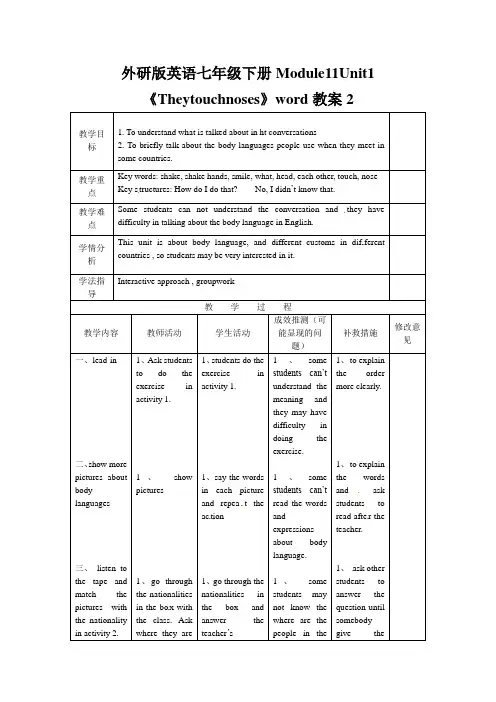
外研版英语七年级下册Module11Unit1《Theytouchnoses》word教案2教学目标1. To understand what is talked about in ht conversations2. To briefly talk about the body languages people use when they meet in some countries.教学重点Key words: shake, shake hands, smile, what, head, each other, touch, nose Key s tructures: How do I do that? No, I didn’t know that.教学难点Some students can not understand the conversation and they have difficulty in talking about the body language in English.学情分析This unit is about body language, and different customs in dif ferent countries , so students may be very interested in it.学法指导Interactive approach , groupwork教学过程教学内容教师活动学生活动成效推测(可能显现的问题)补救措施修改意见一、lead-in二、show more pictures about body languages三、listen to the tape and match the pictures with the nationality in activity 2. 1、Ask studentsto do theexercise inactivity 1.1、showpictures1、go throughthe nationalitiesin the bo x withthe class. Askwhere they are1、students do theexercise inactivity 1.1、say the wordsin each pictureand repea t theac tion1、go through thenationalities inthe box andanswer theteacher’s1、somestudents can’tunderstand themeaning andthey may havedifficulty indoing theexercise.1、somestudents can’tread the wordsandexpressionsabout bodylanguage.1、somestudents maynot know thewhere are thepeople in the1、to explainthe ordermore clearly.1、to explainthe wordsand askstudents toread afte r theteacher.1、ask otherstudents toanswer thequestion untilsomebodygive the四、Act and guess五、Introduce more about the body language indifferent countries六、Homework from.2、Askstudents todescrib e thepictures in pairswith their ownwords andguess theirnationalities.3、Play therecording andtell students todecide whichpicture isdescribed.4、check theanswers.1. ask onestudents tocome to thefront and actout the wordson the PPT,then the otherstudents guess.Show studentsPPTquestions.2、describe thepictures in pairswith their ownwords and guesstheirnationalities.3、listen to thetape and decidewhich picture isdescribed in thetape.4、elicit answersfrom the classand ask studentsto say why.1. one students tocome to the frontand act out thewords on thePPT, then theother studentsguesspicture from.2. studentscan’t describethe pictureswith their ownwords.3、students areunable tounderstand theconversation inthe tape.4. somestudents maygive the wronganswers.1. somestudents maynot understandtheirclassmates.correctanswers.2、the teachergive them anexample.3、play thetape again.4. ask otherstudents toanswer thequestion andthe teachercan give theanswers too.1. a sk theirclassmatesfor theanswers.板书设计Module 11 Body languageUnit 1 They touch nosesBow : 3 Homework: Kiss: 1Shake hands: 2Smile: 1 2 3。
外研社版初中英语七年级下册Module11Unit1教案
外研社版初中英语七年级下册Module11Unit1教案Module 11 Body languageUnit 1 They touch noses!一、教学目标【知识能力目标】1) 能正确使用下列单词和词组:kiss, shake hands, smile, German, British, Japanese, Russian, hug, India, together, nod one’s head, each other...2) 能听懂有关手势语的对话。
【情感态度目标】1) 学习一些见面礼仪。
2) 了解西方国家的风土人情和习俗。
二、教学重难点【教学重点】能听懂有关在不同国家初次见面和表达问候时的手势语。
【教学难点】中西方人们见面礼仪的差别;培养学生跨文化交际意识。
三、教学过程Step 1 Leading-in1. Review the key words about human body.2. Learn the new words学习新词汇,播放词汇音频。
3. Shows some body action and ask students to guess the meaning.老师自己或请两名同学上台表演,其他同学猜测肢体语言所传达的含义。
Step 2 Match1. Ask the students to look at the pictures and say what body language they can see.2. Match the pictures with the words and expression from thebox.Step 3 Listening1. Play the tape, ask the students to listen and match the pictures with the nationality in Activity2.2. Work in pairs and check the right answers each other.Step 4 Reading1. Guide the students to listen to the conversation in Activity 3 and answer the question:What so the people in China/US/India/New Zealand do when they meet?1)In China a. shake hands, kiss or hug each other2)In the US b. shake hands, smile or nod heads3)In India c. touch nose4)In New Zealand d. put their hands together and nod their heads2. ScanningScan the language and answer the questions:1)Who will come to Linging’s school?2)What will Maori people do when they meet?3. Careful readingAsk the students to read the dialogue carefully and complete the table with the correct form of the words from the box.Step 5 Post-reading1. Let the students act out the dialogue.2. Show some pictures and things to organize the students to talk about them.3. Have the students act out their new dialogues.Step 6 listen and repeatListen to the recording and pay attention to thepronunciation.Step 7 Group workMake a conversation to talk about what you do and say when you meet.—What do you do and say when you meet your teacher in the morning?—I smile and say good morning.Step 8 Language points1. … in Russia, people usually kiss three times, left, right, left.kiss v. 吻,亲吻eg. The mother kissed the sleeping baby on his head.妈妈亲了一下这个睡着的婴儿的额头。
外研版七年级英语下Module 11 Body Language Unit 1 They touch
外研版七年级英语下Module 11 Body Language Unit 1 They touch noses!教案初一16班苏肖育【教学目标】Knowledge objective1. To master some words and expressions: bow, kiss, shake hands, smile, British, German, Japanese, Russian, visitor, Russia, nod, head, hug, each, each other, India, together, Maori, touch, noseAbility objective1. To listen and speak about body language.2. To understand a conversation about body language.Moral objectiveTo be glad to know about other kinds of culture, and respect the foreign culture.【教学重点】To learn about the different body languages in different countries.【教学难点】To speak out different body languages in different countries. 【课的类型】Listening and Speaking【教学方法】Task-based method and interactive approach【教学用具】A tape recorder, multimedia and some pictures【教学过程】Teaching Procedures:Step 1 Leading-in1.Greetings.2. Play a game: Let’s do it. (The teacher speaks out some words about body language and Ss do the action).Step 2 Pre-listening1.The teachers shows the pictures and teaches the new words and expression s about body language.2. Match the picture with the words and expression from the box3. Learn about the different body languages in different countries.What do ______ do when they meet visitors?They usually ______________.4.Show time ( T say and Ss do the action)Step 3 While- listening1.Listen recording(Activity 3) and choose.1)Who will come to Lingling’s school?A. Some Russian teachersB. Some Japanese teachersC. Some Indian teachers2.Listen and number the countries.Russia3. Listen and fill in the blanks.4.Reading the conversation1)Get Ss to read the conversation after teacher.2)Read in group.3)Read in role.4)Read and complete the table.Step 5 Post- listeningGroup work : The voice of QiongqiaoStep 6 SummaryStep 7 Homework1.Make a dialogue in pairs when you meet a foreigner.2. Finish exercise book.【板书设计】。
初中七年级英语教案Unit 1 They touch noses!-优秀奖

教案设计外语教学和研究出版社七年级下册Module 11 Body languageUnit 1They touch noses!一、教案背景二、1,面向学生: 中学2,学科:英语3,课时:14,学生课前准备:Task 1: Learn the key words by themselves. Try to master the pronunciation of them.方法:通过百度翻译或者百度词典,自主学习关键单词的发音和用法。
二、教学课题:Module 11 Body language Unit 1 They touch noses!教养方面:本节课主要以初次见面和表达问候时的身势语为题材,通过学习Lingling和Betty 的对话,讨论俄罗斯人、美国人、印度人以及新西兰毛利人不同的身势语,使学生了解不同国家风俗习惯和文化,学会使用英语描述初次见面的身势语,并能学会基本的接待礼仪。
教育方面:1、充分运用互联网优势降低学生学习的理解难度,创设语言交际情境,激发学生的学习兴趣,增强学生的自信心,培养学生自主学习的良好习惯。
2、充分运用互联网及多媒体教学,提高学生的听说读写译等基本能力,开发学生的潜能,培养学生的英语交际能力和合作学习的习惯。
发展方面:在本课的学习过程中,我们应该始终将语言知识的学习、语言能力的训练和跨文化意识结合起来;在介绍外国文化的同时,努力让学生应该更多的了解不同国家的文化,增强国际意识,尊重他国文化,引导学生形成开放合理的跨文化认知与理解的观念,以提高学生的全面素质。
三、教材分析《They touches noses!》是外研社《新标准英语》(三年级起始)七年级下册第十一模块第一单元的内容。
对于七年级下学期的学生来说,通过半年多的初中英语学习,他们已经基本适应了初中的生活方式和教师的教学方法,英语学习也有一定的英语基础。
对适应了生活方式的学生来说,在英语学习内容上增加本单元的学习,正好可以开阔学生视野,激发学生的学习兴趣,让学生通过学习获得更多的知识,以丰富自己的交际内容,提高交际能力和综合素养。
外研版七年级英语下册Module11BodylanguageUnit1Theytouchnoses!精品教案
Module 11 Body language【教学内容分析】本模块以肢体语言为话题。
比较详细的介绍了各国的肢体语言,利用对话等相关内容展示了各国应该遵守的肢体语言规则。
内容充实,且功能性强,学生在语言学习和语言训练的同时可以了解更多的外国文化。
本模块的语法内容是祈使句。
掌握祈使句的定义及特点。
会运用祈使句表达自己的情感、命令和要求。
教师在教学的过程中要运用归纳法来帮助学生形成一个整体的概念。
【学情分析】学生对本模块的中心话题会很感兴趣,握手等身体语言为学生所熟悉,所以便于开展听、说、读、写活动,激发学生的学习热情,积极参加小组活动。
Unit 1 They touch noses!【教学目标】Knowledge objective1. To master some words and expressions: bow, kiss, shake hands, smile, British,German, Japanese, Russian, visitor, Russia, what, nod, head, hug, each, each other, India, together, Maori, touch, nose2. To master the imperative sentence.Ability objective1. To understand a conversation about body language.2. To make a new dialogue about body language.Moral objectiveTo be glad to know about other kinds of culture, and respect the foreign culture. 【教学重点】To learn about the different body languages in different countries.【教学难点】To make a new dialogue in pairs.【教学方法】PWP method, task-based method and interactive approach【教学手段】A tape recorder, multimedia and some pictures【教学过程】Teaching Procedures:Step 1 Leading-inSs look the pictures and say what body language they can see.Step 2 Consolidate new wordsLook and say. The teachers shows the pictures of new words and let the students to say as quickly as possible.Step 3 Listen and match the pictures with the nationality1. Look at the pictures and choose the right pictures.2. Work in pairs and check the right answers each other.Step 4 Listen and answerListen and answer the question.Who will come to Linging’s school?What will Maori people do when they meet?Answers: Some Russian teachers.They will touch noses.Step 5 Listen and read1. Complete the table with the correct form of the words from the box.2. Point out the everyday English.3. Point out the language points of the dialogue in Activity 3.Step 6 Learning to learnLet Ss know to understand and respect the body language in other countries.Step 7 Listen and repeatStep 8 Group workMake a conversation to talk about what you do and say when you meet. - What do you do and say when you meet your teacher in the morning? - I smile and say good morning.Step 11 Summary短语。
外研版七年级英语下册探究式教学设计Module 11 Unit 1教案

Module 11 Unit 1 They touch noses!教学模式介绍探究式教学模式是指在教学过程中,要求学生在教师指导下,通过以“自主、探究、合作”为特征的学习方式对当前教学内容中的主要知识点进行自主学习、深入探究并进行小组合作交流,从而较好地达到课程标准中关于认知目标与情感目标要求的一种教学模式。
其中认知目标涉及与学科相关知识、概念、原理与能力的掌握;情感目标则涉及思想感情与道德品质的培养。
探究式课堂教学模式的教学环节:创设情境——启发思考——自主(或小组)探究——协作交流——总结提高设计思路说明【创设情境】教师首先用英语问好,营造良好的英语氛围,让学生在视频和free talk的过程中感受新的语言项目,通过这个环节,既可以活跃课堂气氛,还调动了学生的学习兴趣。
【启发思考】在上一环节的基础上,教师积极引导学生思考问题,逐步引出本节课教学内容,让学生边阅读边思考,养成勤于思考的习惯。
【自主或小组探究】自主探究环节让学生自主发现课文中的语言点,培养学生善于发现积极解决问题的能力。
合作探究环节的对话练习活动让加强小组合作的意识,以达成巩固和熟练运用单词和句型的能力。
【协作交流】通过前面环节的学习,学生已基本掌握本节课的内容,教师让学生找出课文的语言点并积极完成本课的测验,既培养了学生的胆量,又培养了他们自主学习的能力,同时也对本课的学习成效进行检测。
【总结提高】通过对于本节课内容的思考、探究和迁移,学生逐步掌握本节课知识点,教师带领学生将本课的知识框架进行回顾和总结,让学生学以致用,最后点通过本课学习注意自己和他人在日常交际中的体态,姿势和面部表情等,了解更多其它国家的礼仪文化。
教材分析本节课是外研七下M11U1,通过本节课的学习,学生将学会有关在不同国家初次见面和表达问候时的身势语,在不同国家初次见面时,能用身势问候语进行对话。
通过阅读了解世界各地不同地区的地域差异,培养积极了解不同文化的兴趣。
初一英语(外研版)-M11 Unit 1 They touch noses!-1教案
教学环节
主要教学活动
设置意图
Lead-in
1. Askstudents to think about what they know aboutbodylanguageand then check the answer by showing words and pictures.
2. Askstudents to think about why bodylanguageis important and then show theanswer.
教 案
教学基本信息
课题
M11 Unit 1 They touch noses!
学科
英语
学段:初中
年级
初一
教材
书名:英语7七年级下册出版社:外语教学与研究出版社出版日期:2013年7月
教学设计参与人员
姓名
单位
设计者
实施者
指导者
指导者
课件制作者
其他参与者
其他参与者
教学目标及教学重点、难点
Teaching Objectives:
3.talk aboutwhatthey do and say when they meetdifferentpeoplesuch as their teacher, their best friend, an American, or a Russian.
Teaching emphasis:
Students will be able to know the details about howpeoplefromdifferentcountries greet each other indifferent ways.
外研版英语七年级下册:Module 11 Unit 1 They touch noses! 课程教学
Module11 Unit1 They touch noses! (Listening and speaking)In China, people usually shake hands and smile when they meet.2. Be able to understand the body language in different countries for the first time to meet and greet.3. Make a dialogue about the first time greetings with body language in different countries.Anticipated Difficulties & Solutions:1.There are many new words in this period, students may have difficulties in reading and spelling them.2.Students may have a difficult time telling different ways of greetings with body languages in different countries. Solutions:1.Get students to use the preview sheet and mind map to preview the new words and phrases2.Enable students to look at the pictures, cooperate with partners and show their ideas.Teaching methods:Mind map, straight spelling word method, the audio—lingual method, pair work, situational communicative approach and other task-based approaches.Teaching aids:Multi-media, class activity sheet, preview sheet, PPTTeaching and learning arrangementsSteps/timing Activities PurposeDo body language (1mins) Before class, the teacher asks students to do the bodylanguages and tell the meanings of them in English.This step is designed to letstudents to do warming upas well as leading to thetopic of Module 11“bodylanguage”Watch a video about greetings (1mins) The teacher asks students to watch a video and answer: What’sthe video about? A. The ways of greetings B. The ways ofvisiting friends( Answer: A)This step is designed to letstudents to watch visualand dynamic video aboutgreetings with bodylanguages as well asgetting ready to show theirpreview work.Check new words and phrases of greetings (2mins) Ask students to read and memorize different ways of greetingson the preview sheet for one minute, then check the words andphrases of greetings by asking students to tell you one by one.This step is designed tocheck students’previewwork and get students tomemorize and deepen thenew words and phrasesthey previewed.Learn the new words and phrases about greetings( 4 mins) The teacher asks students to look at the mind map of greetingsand ask them to tell words and phrases of different ways ofgreetings with the aid of pictures .Teacher can ask students thefollowing questions:What is it ?This step is designed toactivate students’brain inlearning today’s newwords and phrases andhelp students to memorizethe new words accordingto the learned words withthe same pronunciationand the help of pictures ofthe mind map.greetingst ou ch n o ses[tʌtʃ] [nəʊz]What body language is it?How do you spell“touch noses”?(Ss look at the pictures in the mind map and learn the new words according to the phonetic symbols and the learned words with the same pronunciation such as cousin—touch,close—nose, teach the other ways of greetings in the same way like this.(Teacher writes the new words and phrases “touch noses ,nod the head, put hands together, shake hands, kiss, bow, hug each other, smile”on the blackboard, get Ss to read aloud and spell them.)Learn the countries, nationalities and the key sentences(5mins) The teacher presents the picture of two Japanese womenbowing to each other and asks students :T: What are they doing?Ss: They’re bowing.T: Where are they from?Ss: They’re from Japan.T: They’re Japanese. /dʒæpə'n i:z/(Teacher asks Ss about the country and nationality ,teach thenew word Japanese and write it on the blackboard, studentsspell and read it aloud)T: What do people in Japan usually do when they meetvisitors ? /'v I z I tə/(Teach the word “visitor” and guess the meaning of the wordby the root “visit”, get students to learn the key sentences)In Japan, people usually ? when they meet.(For the question mark ?, get students to think and look at thepicture of the Japanese woman , focus on the red circledmark around her body , with the help of the visual bodylanguage, lead Ss to say the following key sentence)Ss: In Japan, people usually bow when they meet.Repeat with a RussianT:Where is she from?(Ss focus on the red circled mark around the word “Russia”)Ss: She is from Russia. /'rʌʃə/She is Russian. /'rʌʃən/T: What do people in Russia usually do when they meetvisitors?This step is designed tolearn the countries 、nationalities and the keysentences. With the help ofpictures of the famousbuildings and people suchas Japanese women inkimonos , a Russian playerwith the word“Russia”onher team shirt, an Indianwoman , the Eiffel Tower,the Big Ben, theBrandenburg Gate inGermany as well asnational flags, get Ss tolearn the countries andnationalities. Meanwhile,with the help of theobvious red circled marksaround the body of abowing Japanese woman,an Indian woman’s handsthat are put together aswell as pictures aboutways of greetings, get Ssto learn the key sentences“What do people inRussia usually do whenthey meet visitors? InRussia, people usuallyshake hands and kiss threetimes when they meetInRussia , people usuallyandwhen they meet visitors.Ss: In Russia, people usually shake hands or kissthree times when they meet visitors.(Students learn the country 、nationality and key sentences ofgreetings with the help of the picture of people、the nationalflag and body language, T writes Russia and Russian on theblackboard, students spell and read them aloud )Repeat with an IndianShe is from India. /'I nd iə/She is Indian.What do people in India usually do when they meet visitors ?In India, people usually ?and when they meetvisitors.(For the question mark ?,get students to think and look atPPT ,focus on the red circled mark around the Indian woman’shands as well as the picture of nodding the head ,lead them tosay the key sentences. )In India, people usually put hands together and nod headswhen they meet.( T writes India and Indian on the blackboard, students spelland read them aloud )Teach nationalities “French,British,German”FranceT: Where is she from?( Ask students to look at the building in the picture)Ss: She is from France. ( Help Ss to say)T: She is French. [ fr e ntʃ]Repeat with British and German in the same way as French.the UK/ Englandvisitors easily and vividly.Ss: She is from England/ the UK.T: She is British. ['br I t I∫]GermanySs: She is from Germany.T: She is German. [dʒə:m ən](T writes French、British and German on the blackboard, students spell and read them aloud .)Check the words of countries and nationalities( 2mins) T asks students to memorise the words of countries andnationalities for one minute, then check by showing themprinted coloured national flags on the paper, get them to tellyou the countries and nationalities one by one.This step is designed tocheck students if they haveremembered the wordsof countries andnationalities , get studentsto memorize and deepenthe new words they learntjust now as well as gettingready for the listening andpair work.Match the greetings with the pictures ( 1mins) Ask Ss to match the greetings with the rightpictures.( Activity 1 on Page 66)After finishing, T checks the answers with Ss.Greetingsbow ①kiss②shake handssmile ③Matching the greetingswith the right picturescan help Ss to deepen thememory of the greetingwords.德国勃兰登堡门Listen and match the nationalities with the pictures ( 3mins ) Get students to listen and match the nationalities with thepictures. (Activity 2)NationalityBritish ?French ?German ?JapaneseRussianBefore listening, get Ss to look at each picture and ask them:T: What are the people doing in Picture1/ Picture2/ Picture3 ?Ss: They’re kissing / shaking hands / bowing.T: What nationality are they in Picture1? (Let Ss guess)Ss: Are they British ? / French ? / German ?T: Maybe they’re …I don’t know. Let’s try to predict theanswers before listening, get Ss to focus on the listening tipTip1: try to predict the answers before listeningAsk individual Ss to check the answers after they have finishedlistening.This listening activity aimsat getting Ss to look at thefive nationalities and threepictures, describe whatpeople are doing in eachpicture , get Ss to look atPicture1 and guess “whatnationality are they?”, inorder to teach Ss thelistening Tip1: try topredict the answers beforelistening as well as gettingready for practicing pairwork.①②③Do pair work asking and answering about greetings and nationalities( 4 mins)T gets Ss to look at the picture on the right and the model pairwork ,ask and answer the model pair work with the Ss.A: What are they doing?B: They are kissing.A: Are they French ?B: Yes, they are./ No, they aren’t.T gives Ss more pictures to practice the pair work like theabove model , then ask some pairs to show their pair work.After Ss showing their pair work, Teacher teaches “Maori”“New Zealand”by presenting Ss the following picture andask:T: What are they doing ?Ss: They are touching noses.T: Are they Indian, too?Ss: No, they aren’t.T: They are M ao r i people in New Z ea l a nd.['m aʊr i] ['z iːlənd]This step is designed to letSs practice asking andanswering about ways ofgreetings and guessing thenationalities. With the helpof national flags 、greetings with bodylanguages and pictures ofpeople, such as Japanesewomen in kimonos、thepresidents Obama in theUS and Vladimir Putin inRussia,Indian air hostessesIt’s much easier and moreinteresting for Ss to do thepair work. They are morelikely to do this.Meanwhile, leading Ss tolearn the greeting ofMaori people in NewZealand as well as learningnew words“Maori”“NewZealand”Listen and number the countries as you hear in Activity 3 ( 2mins) T: New Zealand is a country. What other countries are talkedabout in the following dialogue? (Activity3) Please listen to adialogue between Betty and Lingling. They are talking aboutdifferent ways of greeting in different countries. Get Ss tolisten and number the countries as they hear.Number the countries as you hearChina New Zealand US Russia IndiaCheck the answers after Ss finish listening.This step is designed to letSs get the firstunderstanding of thedialogue in Activity 3,develop Ss’skills oflistening andunderstanding familiartopics ( greetings withbody language), train Ss inorder to enable them tounderstand the key anddetailed information whilelistening.Read the dialogue in Activity 3 and answer questions Get Ss to open their books, turn to Page 66, read the dialoguein Activity 3 and answer the following three questions.1.Who will come to Lingling’s school tomorrow?Get Ss to feel the topicand read for the maincontent of the dialogue1 23 4(2 mins) A. Russian teachers B. American teachers2. What do the US people usually do when they meet?(t ick √ the answers)A.put hands togetherB. shake handsC. bowD. nod their headsE. hug each otherF. kiss3. Maori people in New Zealand _____ when they meetvisitors?A. B. C. D.After finishing, Teacher checks the answers by askingindividual students to answer.As for Maori people touch noses, T says:T: Wow, that’s really an interesting way to greet people.as well as reading for certain information . Ss can be trained to search for specific information in order to understand the dialogue further.Listen and read after the recording in Activity3 ( 4 mins) T plays the recoding of the dialogue in Activity3 , Ss repeatafter it one by one, try to imitate the pronunciation andintonation.After Ss repeat after the recording, ask them to read bythemselves or role reading the dialogue.This step is created to helpstudents to strengthen theirunderstanding of thedialogue by listening andreading aloud after therecording as well asimitating the pronunciationand intonation. Allow Ssto fully practice the use oflanguage by reading ontheir own or reading inroles.Retell the dialogue in Activity3 with the help of the words in the box(4 mins) T: This time you know better about the greetings in differentcountries.Get Ss to retell the dialogue with the help of the words in thebox.touch, shake, visitor, put, kiss, together, hug, smile, nodWhat do people in different countries do when they meet___________? In China, people often __________ hands and__________. In Russia, people usually _______ three times. InIndia, people ________ their hands ___________ and________ their heads. In the US, people shake hands ,andsometimes kiss or ______ each other. In New Zealand, Maoripeople _________ noses. So remember to do as Romans dowhen in Rome.Get individual Ss to tell the answers one by one.Through retelling thedialogue, deepen Ss’understanding of the text,at the same time , sum upthe dialogue and exercisethe spoken language.Moral education “When in Rome, Undertaking the last sentence in the above step “When in This step is designed to getSs to compare differencesdo as Romans do.”(1 mins) Rome, do as Romans do. ”People in different countries mayuse different body language. Try to understand them andrespect them. (Moral education)of body language indifferent countries.Understand the customsand cultures of differentcountries. Try tounderstand and respecttheir body language.Remember to do asRomans do when in Rome.Situational pair work , use body language to ask and answer about ways of greetings in different countries.(7 mins) T: Now it’s our show time. Let’s do pair work.Suppose you are in an international class. Choose one countryand tell us the ways of greeting in your country. Use bodylanguage to make it interesting if possible.Model:A: What do people in… usually do when they meet?B: In …, they …Before doing the pair work, T explains the requirements to theSs, then the teacher asks a student to make a model pair workwith her for the whole class. Finally T gets Ss to practicedoing the pair work and ask several pairs to share their pairwork with the class.Countries Ways of greetingIn ChinaIn the USIn IndiaIn RussiaIn New Zealand(Maori People)In JapanThis step is created toenable students to beactive in class. It is goodfor improving students’oral communication andalso cooperating withpartners. Furthermore, itcreated a languagesituation for Ss topractice using the targetlanguage. It is alsodesigned to improvestudents’speaking skills.Meanwhile, the pictures ofways of greetings can helpstudents to do pair workbetter. To train students'ability to speak throughthe dialogue. Enablestudents to deepen theunderstanding of thecontent of the text Theright amount of oralpractice can help studentsto consolidate the languagefocus in this period..Summary:words 、phrases and key sentences Ss have learned in this class. (2mins)Get Ss to sum up the greeting words and phrases、countries 、nationalities and key sentences they have learnt in this class.New words and phrases: bow, kiss, shake hands, smile, nod thehead, put hands together, hug each other, touch noses…Countries and nationalities: British, French, German, Japanese,To sum up the new words,phrases and key sentencesin this lesson, get studentsto consolidate what theyhave learnt today.Blackboard Design:Module11 Body languageUnit 1 They touch nosesCountries and nationalities:British, French, German, Japanese, India, Indian, Russia, Russian…Key sentences:What do people in China usually do when they meet ?In China, people usually shake hands and smile。
外研版英语七年级下册:Module 11 Unit 1 They touch noses!. 课程教
渗透
教师需要引导学生正确合理的运用网络。
教育学生尊重他人,有礼貌地表达自己的思想。
作
业
板
书
设
计
Unit1 They touch noses!
Russia(1)kiss three times
China(2)shake hands and smile
America(3)shakehands and kiss or hug
Task1: Show the gif listening and let students read after it.
Task2: Let students act out conversations according to the pictures.
Let the students sum up the key points。
教育方面:
1、充分运用互联网优势降低学生学习的理解难度,创设语言交际情境,激发学惯。
2、充分运用互联网及多媒体教学,提高学生的听说读写译等基本能力,开发学生的潜能,培养学生的英语交际能力和合作学习的习惯。
发展方面:
在本课的学习过程中,我们应该始终将语言知识的学习、语言能力的训练和跨文化意识结合起来;在介绍外国文化的同时,努力让学生应该更多的了解不同国家的文化,增强国际意识,尊重他国文化,引导学生形成开放合理的跨文化认知与理解的观念,以提高学生的全面素质。
2.句型:We Chinese often shake hands and smile when we meet visitors.
InIndiapeople put their hands together and nod their heads.
That’s because people do different things in different countries.
外研版英语七年级下册:Module11Unit1Theytouchnoses!.课程教
Module 11 Body languageUnit 1 They touch noses!教课方案【教课内容剖析】本课是外研版七年级下第十一模块第一单元第一课时,本单元以身势语为话题向学生介绍一些国家人们常用的身势语,侧重介绍了在不一样国家首次会面和表达问候时的身势语,目的是经过这些使学生认识不一样文化,加强国际意识,尊敬他国文化,同时也使学生理解包含身势语在内的语言在国际沟通中的重要性,内容充分,且功能性强。
【学情剖析】学生对本单元的中心话题会很感兴趣,握手等身体语言为学生所熟习,因此便于展开听、说、读、写活动,激发学生的学习热忱,踊跃参加小组活动。
【教课目的】语言知识目标会读并记着本课单词和短语: bow, kiss, shake hands, smile, British, German, Japanese, Russian, India,, nod, hug, Maori, touch, nose语言技术目标1.能听懂并会读简单的不一样国家的身势语。
2.能听懂简单的介绍不一样国家身势语的对话。
感情目标经过身势语认识世界不一样国家的民俗习惯【教课要点和难点】认识并能正确的说出不一样国家的不一样身势语。
【教课方法和手段】利用交互式电子白板,让学生参加讲堂教课环节,为教课重难点的打破确立基础。
【教课过程】Step1. Lead-in1) Explain the title“Body language” (书写功能)【设计企图】引课,老师示范让学生理解“body language”的意思。
2) Tell students the teaching aims.设计企图】告诉学生本课所学的主要内容。
3)Look at the pictures and say body languages. (显现器,文字拖拽)【设计企图】经过看图,让学生学会一些简单的身势语,为对话学习做铺垫。
4)Play a gameOne student say body language, the other acts body language .【设计企图】经过游戏,稳固方才所学到身势语。