
2013年12月英语六级听力真题原文及答案
【短对话】1.W: What a wonderful performance! Your rock band has never sounded better. M: Many thanks. I guess all those hours ofpractice in the past month are finally paying off.Q:What does the man mean?2.M: I can't decide what to do for my summer vacation. I either want to go on a bike tour ofEurope or go diving in Mexico.W: Well, we're offering an all-inclusive two-week trip to Mexico for only 300 dollars.Q:What does the woman suggest the man do for his vacation?3.W: How long do you think this project might take?M: I'd say about three months, but it could take longer if something unexpec ted happened. Maybe we'd better allow an extra month, so we won’t have to worry about beinglate.Q: Why does the man say extra time should be allowed for the project?4.M: I'm thinking about becoming a member here, and I'd like some informatio n.W: Sure. A three-month membership costs 150 dollars, and that includes use of the wait-room, sauna and pool. I'll give you a free path so that you can try out the faci lities before youdecide.Q: What do we learn from the conversation?5.W: I'm sorry to hear that you failed the Physics course, Ted.M: Let's face it. I'm just not cut out to be a scientist.Q: What does the man mean?6.M: Gary insisted on buying the food for the picnic.W: That's pretty generous of him. But shouldn't we at least offer to share th e expenses?He has a big family to support.Q: What does the woman suggest they do?7.W: Did you see the headlines in the paper this morning?M: Year. Apparently the bus company will be laying off its employees if they c an't reach anagreement on wages by midnight.Q: What did the man read about?8.W: Have we received payment for the overseas order we delivered last mont h?M: Yes. The cheque came in yesterday afternoon. I'll be depositing it when I g o the banktoday.Q: What is the woman concerned about?W: OK, that's it. Now we have to make a decision. We might as well do that now, don't youthink?M: Sure, let's see. First we saw Frank Brisenski.What did you think of him?W: Well, he's certainly a very polite young man.M: And very relaxed, too.W: But his appearance…M: En… He wasn't well dressed. He wasn't even wearing a tie.W: But he did have a nice voice. He sounded good on the telephone.M: True. And I thought he seemed very intelligent. He answered Dona's que stions verywell.W: That's true, but dressing well is important. Well, let's think about the othe rs. Now whatabout Barber Jones? She had a nice voice, too. She sounded goo d on the telephone, and shewas well dressed, too.M: En… She did look very neat, very nicely dressed, but…W: But so shy. She wouldn't be very good at talking to people at the front des k.M: En…OK. Now who was the next? Ar…Yes, David Wallace. I thought he was very good,had a lot of potential. What do you think?W: En… He seemed like a very bright guy. He dressed very nicely, too. And h e had a reallynice appearance.M: He seemed relaxed to me, the type of person people feel comfortable with right away.W: He was polite, but also very friendly and relaxed as you say. I think he'll be good withthe guests at the front desk.M: He had a very pleasant voice, too.W: That's right. OK, good! I guess we have our receptionist then, don't you?M: Yes, I think so. We'll just offer the job to…Question 9: What are the speakers looking for?Question 10: What is Frank Brisenski's weakness?Question 11: What do the speakers decide to do?【六级听力长对话原文2】W: Hello.M: Hello. Is that the reference library?W: Yes, can I help you?M: I hope so. I ran earlier and asked for some information about Dennis Hutt on, thescientist. You asked me to ring back.W: Oh, yes. I have found something.M: Good. I've got a pencil and paper. Perhaps you could read out what it says .W: Certainly. Hutton Dennis, born Darlington, 1836, died New York, 1920.M: Yes, got that.W: Inventer and physicist, the son of a farmworker. He was admitted to the U niversity ofLondon at the age of 15.M: Yes.W: He graduated at 17 with the first class degree in physics and mathematics . All right?M: Yes, all right.W: He made his first notable achievement at the age of 18. It was a metho d ofrefrigeration which rolls from his work in low temperature physics. He be came professor ofmathematics at the University of Manchester at 24, where he remained for twelve years. Duringthat time, he married one of his students, Natasha WilloughbyM: Yes, go on.W: Later working together in London, they laid the foundations of modern ph ysics byshowing that normal laws of cause and effect do not apply at the level of subatomic particles.For this he and his wife received the Nobel Prize for ph ysics in 1910, and did so again in 1912for their work on very high frequency radio waves. In his lifetime, Hutton patented 244inventions. Do you want an y more?M: Yes, when did he go to America?W: Let me see. In 1920 he went to teach in New York and died there suddenl y after onlythree weeks. Still he was a good age.M: Yes, I suppose so. Well, thanks.Question 12: What do we learn about Dennis Hutton when he was 15?Question 13: What did Dennis Hutton do at the age of 24?Question 14: For what were Dennis Hutton and his wife awarded the Nobel Pri ze a secondtime?Question 15: Why did Dennis Hutton go to New York?In America, white tailed deer are more numerous than ever before, so abun dant in factthat they've become a suburban nuisance and ahealth hazard.Why can't the herd be thinned the old-fashionedway? The small community of North Haven on LongIsland is home to some six hundred to sevenhundred deer. The department of Environmental Conservation estimates the optimum population at 60. The town has been b rowsed bare of vegetation except where gardens andshrubs are protected by high fences.Drivers routinely collide with deer and there are so many dead bodies left by the side of theroad that the town has made it a deal with a local pet cemetery to collect and dispose of thebodies. Some people in the town have become ill from deer transmitted diseases. On theoccasions when hunting has been tri ed, local animal rights people have worked to secure courtorders against the hunts. And when that is failed, they stop the hunters, banging on pots andpans to alert the deer. Town meetings called to discuss the problem inevitably dissolved intoconfrontations.The activists believe simply that the deer are not the problem. Some commun ities have evendiscussed the possibility of bringing wolves back into the ecolo gical mix. That means wolves inthe suburbs of New York. It is almost too wo nderful not to try it. The wolves would kill deer ofcourse. They would also terr orize and kill dogs and cats which is not what the suburbandwellers have in m ind.Questions 16 to 18 are based on the passage you have just heardQ16. What do we learn about white-tailed deer in North Haven?Q17. Why do local animal rights people bang on pots and pans?Q18. What would happen if wolves were brought back into the ecological mi x?六级短文2原文And now, if you'll walk this way, ladies and gentlemen, the next room we're g oing to see isthe room in which the family used to hold their formal dinner par ties and even occasionallyentertain heads of state and royalty. However, th ey managed to keep this room friendly and intimate. And I think you'll agree. It has a very informal atmosphere, quite unlike some grandhouses you visit. The curtains were never drawn, even at night, so guests got a view of the lak eand fountains outside which were lit up at night – a very attractive sight. A s you can see,ladies and gentlemen, the guests were seated very informally a round this oval table, whichwould add to the relaxed atmosphere. The table dates from the 18th century and is made fromSpanish oak. It's rather remar kable for the fact that although it's extremely big, it'ssupported by just six r ather slim legs. However, it seems to have survived like that for 200years. So it's probably going to last a bit longer. The chairs which go with the table are not acomplete set. There were originally six of them. They are interesting for the fact that they arevery plain and undecorated for the time, with only one plain central panel at the back and noarmrests. I myself find them rather un comfortable to sit in for very long, but people wereused to more discomfor t in the past. And now, ladies and gentlemen, if you'd like to follow meinto th e great hall…Q19. What do we learn about the speaker?Q20. What does the speaker say about the room they are visiting?Q21. What is said about the oval table in the room?Q22. What does the speaker say about the chairs?六级短文3原文Janet James was 22 years old when she was diagnosed with MS—a disease that attacks thebody's nerves. She has just graduated from college and got a job at an advertising agencywhen she began to sense that somethi ng strange was going on inside her body.When Jamesrealized how severe he r illness was, she knew she had better hurry up and live life. MS is thebiggest cripplerof young adults. And although she didn't have many symptoms, she k new it wasjust a matter of time. First on her agenda was to pursue her drea m of hosting a pop musicprogramme. She worked at a radio station for a year , always aware that her body wasdegenerating. Then her best friend moved a way. And one night James began screaming,"I gotto go! I got to go!" Two weeks later, she arrived at Alaska, thousands of miles from her friends,her family and her past."Everything fell into a place", she recalls. A 23-year-old girl with anincurable disease can fly to Alaska and everything can work ou t. The MS attacks came and went.And most of the time they hardly slowed he r down. James hiked, fished, learnt to sail andexperimented with hot air ballo oning. "I lived for adventure", she says."Nobody ever had abetter time or did more exotic strange things than I did i n an 80-year period." Inevitablyhowever, the day came when she was so weakened th at she had to return to Pittsburgh, herhome town. There she began relieving her adventures by writing a book about them. Her bookwas published in 1993 .Questions 23 to 25 are based on the passage you have just heard.Questions 23What does the speaker say about MS?Questions 24What did Janet James decide to do after her disease was ?Questions 25What's sort of person can we infer Janet James is?the ecological mix? It’s difficult to estimate the number ofyoungsters involved in home schooling wherechildren are not sent to school and receive theirformal education from one or both parents.Legislation and court decisions have made it legallypossibl e in most states for parents to educate theirchildren at home and each year more people take advantage of that opportunity.Some states require parents or a home tutor to meet teacher certification s tandards, andmany require parents to complete legal forms to verify that th eir children are receiving instruction in state approved curriculum.Supporters of home education claim that it is less expensive and far more eff icient than mass public education. Moreover they site several advantages: all eviation of schoolovercrowding, strengthen family relationships, lower dropo ut rates, the facts that students areallowed to learn at their own rate, increas ed motivation, higher standardized test scores, andreduced discipline proble ms.Critics of the home schooling movement content that it creates as many pro blems as itsolves. They acknowledge that, in a few cases, home schooling of fers educationalopportunities superior to those found in most public schools, but few parents can providesuch educational advantages. Some parents who withdraw their children from the schools infavor of home schooling have an i nadequate educational background and insufficient formaltraining to provid e a satisfactory education for their children. Typically, parents have fewertech nological resources at their disposal than do schools. However, the relatively inexpensive computer technology that is readily available today is causing s ome to challenge the notionthat home schooling is in any way inferior to m ore highly structured classroom education.1. 答案:D) Their hard work has resulted in a bigsuccess.2. 答案:B) Join a package tour to Mexico.3. 答案:B) In case some problem should occur.4. 答案:C) The man can try out the facilitiesbefore he becomes a member.5. 答案:A) He is not fit to study science.6. 答案:C) Pay for part of the picnic food.7. 答案:A) A labor dispute at a bus company.8. 答案:D) The payment for an order.本次六级短对话难度变化不大,考查的话题还是我们以前考试中经常提及的日常生活,工作以及学习方面,例如,对话1、2、4、6、7和日常生活话题有关(演出、度假、办卡,野餐,新闻);对话3、8涉及商务工作;对话5则为校园生活话题(考试)。
2013年12月英语六级真题及答案下载(第三套)(word版)
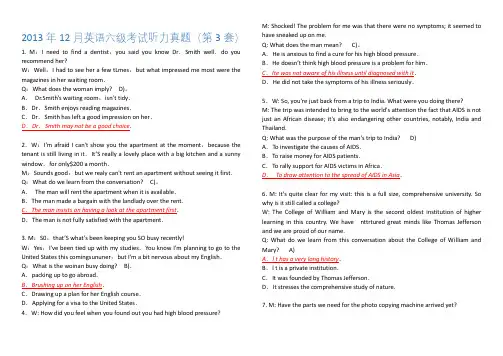
2013年12月英语六级考试听力真题(第3套)1. M:I need to find a dentist,you said you know Dr.Smith well.do you recommend her?W:Well,I had to see her a few tLmes,but what impressed me most were the magazines in her waiting room.Q:What does the woman imply? D)。
A.Dr.Smith’s waiting room,isn’t tidy.B.Dr.Smith enjoys reading magazines.C.Dr.Smith has left a good impression on her.D.Dr.Smith may not be a good choice.2.W:I'm afraid I can't show you the apartment at the moment,because the tenant is still living in it.It’S really a lovely place with a big kitchen and a sunny window.for only$200 a month.M:Sounds good,but we realy can't rent an apartment without seeing it first.Q:What do we learn from the conversation? C)。
A.The man will rent the apartment when it is available.B.The man made a bargain with the landlady over the rent.C.The man insists on having a look at the apartment first.D.The man is not fully satisfied with the apartment.3. M:S0,that’S what's been keeping you SO busy recently!W:Yes,I've been tied up with my studies.You know I'm planning to go to the United States this comingsununer,but I'm a bit nervous about my English.Q:What is the woinan busy doing? B).A.packing up to go abroad.B.Brushing up on her English.C.Drawing up a plan for her English course.D.Applying for a visa to the United States.4.W: How did you feel when you found out you had high blood pressure?M: Shocked! The problem for me was that there were no symptoms; it seemed to have sneaked up on me.Q: What does the man mean? C)。
2013年12月六级考试真题答案解析(第一套)

2013年6月大学英语六级考试真题(一)答案与详解Part ⅠWriting1、审题:这是一篇评论性话题作文。
首先,抓住题目中的主题词life 和meaningful ,避免跑题。
接着,借助谚语内容(将生命花在比生命更长远的事上,就是尽用生命),谚语与题目相结合,可提炼出主题:怎样使生命更有意义。
然后,弄清题目与谚语的关系:主题与例证关系勒最后,确定行文思路:引出话题+提出观点+举例论证+总结建议;总结时,注意要观点明确,贴合所给主题,切勿模棱两可。
2、写作思路:第一段:以“总一分一总”形式引出话题,解释谚语。
第二段:提出观点,指出自己将怎样做,并举例论证。
第三段:做出呼吁,提出建议,总结全文。
How to Live a Meaningf ul Lif ePeople always say that the greatest use of life is to spend it for something that will outlast it.On the one hand,life is spent on something for the future,or for our offspring.For example,people work to build the Three Gorges Dam to make electricity.On the other hand,doing some little but meaningful things can also show the greatest use of life,such as offering a seat to a woman with a child.I will do the following things to make my life meaningful.First,I will plant trees every year to contribute my effort to make the sky blue and the water clean.Second,I will learn my major biology well to cure some diseases,such as cancers.Third,as the saying goes,to do your own job is to contribute your effort to the society.Only by spending our life for something that will outlast it can we contribute to our society.For one thing,we should learn from Lei Feng who did little but meaningful things.For another,we can do whatever we can to protect the environment.In a word,we can make our life meaningful by doing meaningful things.Part ⅡListening Comprehension1.听力原文:W:Has my order arrived yet?I had been expecting it since last week.M:I called the company this morning.They had some labor problems,so your order will be shipped late.It should be here by the end of the week.Q:What has caused the delay of the shipment?【预测】选项中的weather conditions,labor problems 和an error in the order 均为可能导致送货推迟的原因表明,对话可能与送货推迟的原因有关。
【English真题】2013年12月英语六级真题(含答案)考试历年试题训练

2013年12月大学英语六级考试真题(第3套)Part I Writing (30 minutes)(请于正式开考后半小时内完成该部分,之后将进行听力考试)Directions:For this part, you are allowed 30 minutes to write an essay on happiness by referring to the saying“Happiness is not the absence of problems, but the ability to de al with them.”You can cite examples to illustrate your point and then explain how you can develop your ability to deal with problems and be happy. You should write at least 150 words but no more than 200 words.Part II Listening Comprehension (30 minutes)Section ADirections:In this section, you will hear 8 short conversations and 2 long conversations. At theend of each conversation, one or more questions will be asked about what was said. Both the conversation and the questions will be spoken only once. After each question there will be a pause. During the pause, you must read the four choices marked A), B), C) and D), and decide which is the best answer. Then mark the corresponding letter on Answer Sheet 1with a single line through the centre.注意:此部分试题请在答题卡1 上作答。
2013.12第三套六级真题及答案
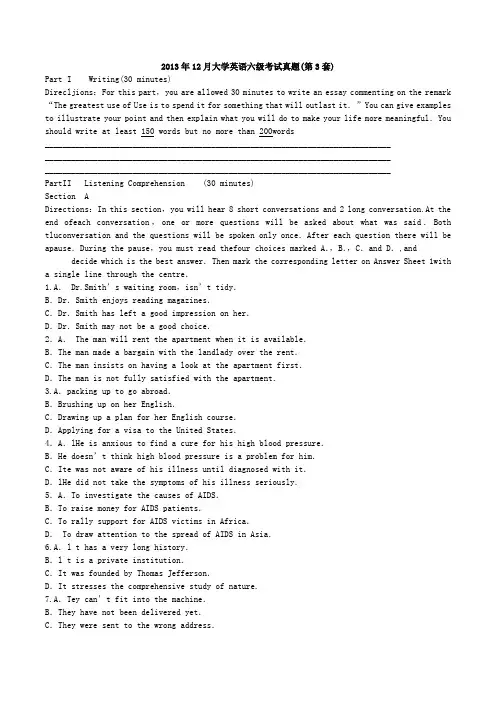
2013年12月大学英语六级考试真题(第3套)Part I Writing(30 minutes)Direcljions:For this part,you are allowed 30 minutes to write an essay commenting on the remark “The greatest use of Use is to spend it for something that will outlast it.”You can give examples to illustrate your point and then explain what you will do to make your life more meaningful.You should write at least 150 words but no more than 200words_____________________________________________________________________________________________________________________________________________________________________________________________________________________________________________PartII Listening Comprehension (30 minutes)Section ADirections:In this section,you will hear 8 short conversations and 2 long conversation.At the end ofeach conversation,one or more questions will be asked about what was said.Both tluconversation and the questions will be spoken only once.After each question there will be apause.During the pause,you must read thefour choices marked A.,B.,C.and D.,anddecide which is the best answer.Then mark the corresponding letter on Answer Sheet 1witha single line through the centre.1.A.Dr.Smith’s waiting room,isn’t tidy.B.Dr.Smith enjoys reading magazines.C.Dr.Smith has left a good impression on her.D.Dr.Smith may not be a good choice.2.A. The man will rent the apartment when it is available.B.The man made a bargain with the landlady over the rent.C.The man insists on having a look at the apartment first.D.The man is not fully satisfied with the apartment.3.A.packing up to go abroad.B.Brushing up on her English.C.Drawing up a plan for her English course.D.Applying for a visa to the United States.4.A.lHe is anxious to find a cure for his high blood pressure.B.He doesn’t think high blood pressure is a problem for him.C.Ite was not aware of his illness until diagnosed with it.D.lHe did not take the symptoms of his illness seriously.5.A.To investigate the causes of AIDS.B.To raise money for AIDS patients.C.To rally support for AIDS victims in Africa.D. To draw attention to the spread of AIDS in Asia.6.A.l t has a very long history.B.l t is a private institution.C.It was founded by Thomas Jefferson.D.It stresses the comprehensive study of nature.7.A.Tey can’t fit into the machine.B.They have not been delivered yet.C.They were sent to the wrong address.D.They were found to be of the wrong type.8.A.1I?he food served in the cafeteria usually lacks variety.B.The cafeteria sometimes provides rate food for the students.C.The students find the service in the cafeteria satisfactory.D.The cafeteria tries hard to cater to the students,needs.conversation OneQuestt l ms 9 to12 are based on the conversation you have just heard.9.A.He picked up some apples in his yard.B.He cut some branches off the apple tree.C.He quarreled with his neighbor over the fence.D.He cleaned up all the garbage in the woman’s yard.10. A. Trim the apple trees in her yard.B. Pick up the apples that fell in her yard.C. Take the garbage to the curb for her.D. Remove the branches from her yard.11. A. File a lawsuit against the man.B. Ask the man for compensation.C. Have the man's apple tree cut down.D. Throw garbage into the man's yard.12. A. He was ready to make a concession.B. He was not prepared to go to court.C. He was not intimidated.D. He was a bit concerned.Conversation TwoQuestions 13 to 15 are based on the conversation you have just heard.13. A. Bad weather.B. Human error.C. Breakdown of the engines.D. Failure of the communications system.14. A. Two thousand feet.B. Twelve thousand feet.C. Twenty thousand feet.D. Twenty-two thousand feet.15. A. Accurate communication is of utmost importance.B. Pilots should be able to speak several foreign languages.C. Air controllers should keep a close watch on the weather.D. Cooperation between pilots and air controllers is essential.Section BDirections: In this section, you will hear 3 short passages. At the end of each passage, you will hearsome questions. Both the passage and the questions will be spoken only once. After you heara question, you must choose the best answer from the four choices marked A., B., C. andD ). Then mark the corresponding letter,on Answer Sheet 1 with a single line through thecentre. Passage OneQuestions 16 to 19 are based on the passage you have just heard.16. A. His father caught a serious disease.B. His mother passed away.C. His mother left him to marry a rich businessman.D. His father took to drinking.17. A. He disliked being disciplined.B. He was expelled by the university.C. He couldn't pay his gambling debts.D. He enjoyed working for a magazine.18. A. His poems are heavily influenced by French writers.B. His stories are mainly set in the State of Virginia.C. His work is difficult to read.D. His language is not refmed.19. A. He grieved to death over the loss of his wife.B. He committed suicide for unknown reasons.C. He was shot dead at the age of 40.D. He died of heavy drinking.Passage TwoQuestions 20 to 22 are based on the passage you have just heard.20. A. Women.B. Prisoners.C. Manual workers.D. School age children.21. A. He taught his students how to pronounce the letters first.B. He matched the letters with the sounds familiar to the learners.C. He showed the learners how to combine the letters into simple words. D. He divided the letters into groups according to the way they are written.22. A. It can help people to become literate within a short time. B. It was originally designed for teaching the English language.C. It enables the learners to master a language within three months.D. It is effective in teaching any alphabetical language to Brazilians. Passage ThreeQuestions23 to 25 are based on the passage you have just heard.23. A. The crop's blooming period is delayed.B. The roots of crops are cut off.C. The topsoil is seriously damaged.D. The growth of weeds is accelerated.24. A. It's a new way of applying chemical fertilizer.B. It's an improved method of harvesting crops.C. It's a creative technique for saving labor.D. It's a farming process limiting the use of ploughs.25. A. In areas with few weeds and unwanted plants.B. In areas with a severe shortage of water.C. In areas lacking in chemical fertilizer.D. In areas dependent on imported food.Section CDirections: In this section, you will hear a passage three times. When the passage is read for the firsttime, you should listen carefully for its general idea. When the passage is read for thesecond time, you are required to fill in the blanks with the exact words you have just heard.Finally, when the passage is read for the third time, you should check what you havewritten. Adults are getting smarter about how smart babies are. Not long ago, researchers learned that4-day-old could understand 26______and subtraction. Now, British research psychologist Graham Schaferhas discovered that infants can learn words for uncommon things long before they can speak. He foundthat 9-month-old infants could be taught, through repeated show-and-tell, to 27______the names of objectsthat were foreign to them, a result that 28______in some ways the received wisdom that, apart from learningto29______ things common to their dally lives, children don't begin to build vocabulary until well into theirsecond year. "It's no 30______that children learn words, but the words they tend to know are words linkedto 31______situations in the home," explains Schafer. "This is the first demonstration that we can choosewhat words the children will learn and that they can respond to them with an unfamiliar voice 32______in anunfamiliar setting. "Figuring out how humans acquire language may 33______why some children learn to read and writelater than others, Schafer says, and could lead to better treatments for developmental problems. What'smore, the study of language 34______offers direct insight into how humans learn. "Language is a test casefor human cognitive development," says Schafer. But parents eager to teach their infants should takenote : even without being taught new words, a control group 35______the other infants within a few months."This is not about advancing development," he says. "It's just about what children can do at an earlierage than what educators have often thought. "Part Ill Reading Comprehension (40 minutes)Section ADirections: In this section, there is a passage with ten blanks. You are required to select one word foreach blank from a list of choices given in a word bank following the passage. Read thepassage through carefully before making your choices. Each choice in the bank is identifiedby a letter. Please mark the corresponding letter for each item on Answer Sheet 2 with asingle line through the centre. You may not use any of the words in the bank more thanonce.Questions 36 to 45 are based on the following passage.Cell phones provide instant access to people. They are creating a major 36______ in the socialexperiences of both children and adolescents. In one recent U.S. survey, about haft the teens polled saidthat their cell phone had 37______ their commtmication with friends. Almost all said that their cell phone was the way they stayed in touch with peers, one-third had used the cell phone to help a peer in need, andabout 80% said the phone made them feel safer. Teenagers in Australia,38______, said that their mobilephones provided numerous benefits and were an 39______part of their lives; some were so 40______to theirphones that the researchers considered it an addiction. In Japan, too, researchers are concerned aboutcell phone addiction. Researchers in one study in Tokyo found that more than half of junior high schoolstudents used their phones to exchange e-mails with schoolmates more than 10 times a day.Cell phones 41______social connections with peers across time and space. They allow young people toexchange moment-by-moment experiences in their daily lives with special partners and thus to have a more42______sense of connection with friends. Cell phones also can 43______socialtolerance because they reducechildren's interactions with others who are different from them. In addition to connecting peers, cellphones connect children and parents. Researchers studying teenagers in Israel concluded that, in that44______environment, mobile phones were regarded as "security objects" in parent-teen relationships--important because they provided the possibility of 45______and communication at all times..A. affiliated I) hazardousB. attached J) improvedC. contact K) instantaneousD. contend L) intrinsicE) continuous M) relativelyF) diminish N) shiftG) endurance O) similarlyH) fosterSection BDirections: In this section, you are going to read a passage with ten statements attached to it. Eachstatement contains information given in one of the paragraphs. Identify the paragraphfrom which the information is derived. You may choose a paragraph more than once. Eachparagraph is marked with a letter. Answer the questions by marking the correspondingletter on Answer Sheet 2.Waste Not, Want NotFeeding the 9 Billion: The Tragedy of Waste[A] By 2075, the United Nations' mid-range projection for global population is about 9.5 billion. Thismeans that there could be an extra three billion mouths to feed by the end of the century, a period inwhich substantial changes are anticipated in the wealth, calorie intake and dietary preferences ofpeople in developing countries across the world. Such a projection presents mankind with wide-ranging social, economic, environmental and political issues that need to be addressed today toensure a sustainable future for all. One key issue is how to produce more food in a world of finiteresources.[B] Today, we produce about four billion metric tonnes of food per year. Yet due to poor practices inharvesting, storage and transportation, as well as market and consumer wastage, it is estimated that30-50% of all food produced never reaches a human stomach. Furthermore, this figure does notreflect the fact that large amounts of land, energy, fertilisers and water have also been lost in theproduction of foodstuffs which simply end up as waste. This level of wastage is a tragedy that cannotcontinue if we are to succeed in the challenge of sustainably meeting our future food demands.Where Food Waste Happens[C] In 2010, the Institution of Mechanical Engineers identified throe principal emerging population groups acrossthe world, based on characteristics associated with their current and projected stage of economic development.~ Fully developed, mature, post-industrial societies, such as those in Europe, characterised by stable ordeclining populations which are increasing in age.~ Late-stage developing nations that are currently industrialising rapidly, for example China, which willexperience declining rates of population growth, coupled with increasing affluence (富裕)and age profile.~ Newly developing countries that are beginning to industrialise, primarily in Africa, with high to very high population growth rates, and characterised by a predominantly young age profile.[D] Each group over the coming decades will need to address different issues surrounding food production, storageand transportation, as well as consumer expectations, if we are to continue to feed all our people.[E] In less-devel0ped countries, such as those of sub-Saharan Africa and South-East Asia, wastage tends to occurprimarily at the farmer-producer end of the supply chain. Inefficient harvesting, inadequate localtransportation and poor infrastructure (基础设施) mean that produce is frequently handled inappropriatelyand stored under unsuitable farm site conditions.[F] In mature, fully developed countries such as the UK, more,efficient farming practices and better transport,storage and processing facilities ensure that a larger proportion of the food produced reaches markets andconsumers. However, characteristics associated with modem consumer culture mean produce is often wastedthrough retail and customer behaviour.[G] Major supermarkets, in meeting consumer expectations, will often reject entire crops of perfectly edible fruitand vegetables at the farm because they do not meet exacting marketing standards for their physicalcharacteristics, such as size and appearance.[H] Of the produce that does appear in the supermarket, commonly used sales promotions frequently encouragecustomers to purchase excessive quantities which, in the case of perishable foodstuffs, inevitably generatewastage in the home. Overall between 30% and 50% of what has been bought in developed countries isthrown away by the purchaser.Better Use of Our Finite Resources[I] Wasting food means losing not only life-supporting nutrition but also precious resources, including land,water and energy. As a global society, therefore, tackling food waste will help contribute towards addressinga number of key resource issues.[J] Land Usage: Over the last five decades, improved farming techniques and technologies have helped tosignificantly increase crop yields along with a 12% expansion of farmed land use. However, a further increasein farming area without impacting unfavourably on what remains of the world's natural ecosystems appearsunlikely. The challenge is that an increase in animal-based production will require more land and resources, aslivestock (牲畜) fanning demands extensive land use. [K] Water Usage: Over the past century, human use of fresh water has increased at more than double the rate ofpopulation growth. Currently about 3.8 trillion m3 of water is used by humans per year. About 70% of this isconsumed by the global agriculture sector, and the level of use will continue to rise over the coming decades.[L] Better irrigation can dram.atically improve crop yield and about 40% of the world's food supply is currentlyderived from irrigated land. However, water used in irrigation is often sourced unsustainably. In processingfoods after the agricultural stage, there are large additional uses of water that need to be tackled in a world ofgrowing demand. This is particularly crucial in the case of meat production, where beef uses about 50 timesmore water than vegetables. In the future, more effective washing techniques, management procedures, andrecycling and purification of water will be needed to reduce wastage.[M] Energy Usage: Energy is an essential resource across the entire food production cycle, withestimates showingan average of 7-10 calories of input being required in the production of one calorie of food. This variesdramatically depending on crop, from three calories for plant crops to 35 calories in the production of beef.Since much of this energy comes from the utilisation of fossil fuels, wastage of food potentially contributes tounnecessary global warming as well as inefficient resource utilisation.[N] In the modern industrialised agricultural process--which developing nations are moving towards in order toincrease future yields--energy usage in the making and application of fertilisers and pesticides represents thesingle biggest component. Wheat production takes 50% of its energy input for these two items alone. Indeed,on a global scale, fertiliser manufacturing consumes about 3-5% of the world's annual natural gas supply.With production anticipated to increase by 25% between now and 2030, sustainable energy sourcing willbecome an increasingly major issue. Energy to power machinery, both on the farm and in the storage andprocessing facilities, adds to the energy total, which currently represents about 3.1% of annual global energyconsumption.Recommendations[O] Rising population combined with improved nutrition standards and shifting dietary preferences will exertpressure for increases in global food supply. Engineers, scientists and agriculturalists have the knowledge, tools and systems that will assist in achieving productivity increases. However, pressure will grow on finiteresources of land, energy and water. The potential to provide 60-100% more food by simply eliminatinglosses, while simultaneously freeing up land, energy and water resources for other uses, is an:opportunity thatshould not be ignored. In order to begin tackling the challenge, the Institution recommends that:~ The UN Food and Agriculture Organisation work with the international engineering community to ensuregovernments of developed nations put in place programmes that transfer engineering knowledge, designknow-how, and suitable technology to newly developing countries. This will help improve producehandling in the harvest, and immediate post-harvest stages of food production.~ Governments of rapidly developing countries incorporate waste minimisation thinking into the transportinfrastructure and storage facilities currently being planned, engineered and built.~ Governments in developed nations devise and implement policy that changes consumer expectations. Theseshould discourage retailers from wasteful practices that lead to the rejection of food on the basis of cosmeticcharacteristics, and losses in the home due to excessive purchasing by consumers.46. Elimination of waste alone can potentially provide over sixty percent more food for the growing world population.47. The production and application of fertilisers and pesticides account for the largest part of energy use in the modem industrialised agricultural process.48. Consumers in developed countries throw away nearly half of their food purchases because they tend to buy in excessive quantities.49. It is recommended that engineering knowledge and suitable technology in developed countries be introduced to developing .countries to improve produce handling in the harvest.50. The predicted global population growth means that, ways have to be found to produce more food with finite resources.51. A further expansion of farming area will adversely impact on the world's natural ecosystems.52. Perfectly eatable fruit and vegetable crops often fail to reach supermarkets due to their size or physical appearance.53. Poor practices in harvesting, storage and transportation have resulted in a waste of much of the food we produce and thus a waste of land and resources.54. Food waste in less-developed countries happens mainly at the producers' end.55. Beef consumes far more water to produce than vegetables.Section CDirections: There are 2 passages in this section. Each passage is followed by some questions orunfinished statements. For each of them there are four choices marked A., B., C. andD ). You should decide on the best choice and mark the corresponding letter on AnswerSheet 2 with a single line through the centre.Passage OneQuestions 56 to 60 are based on the following passage.Call it the "learning paradox" : the more you struggle and even fail while you're trying to learn newinformation, the better you're likely to recall and apply that information later.The learning paradox is at the heart of "productive failure," a phenomenon identified by researcherManu Kapur. Kapur points out that while the model adopted by many teachers when introducing studentsto new knowledge--providing lots of structure and guidance.early on, until the student show that theycan do it on their own--makes intuitive sense, it may not be the best way to promote learning. Rather, it'sbetter to let the learners wrestle (较劲) with the material on their own for a while, refraining from givingthem any assistance at the start. In a paper published recently, Kapur applied the principle of productivefailure to mathematical problem solving in three schools.With one group of students, the teacher provided strong"scaffolding"--instructional support--andfeedback. With the teacher's help, these pupils were able to find the answers to their set of problems,Meanwhile, a second group was directed to solve the same problems by collaborating with one another,without any prompts from their instructor. These students weren't able to complete the problems correctly. But in the course of trying to do so, they generated a lot of ideas about the nature of theproblems and about what potential solutions would look like. And when the two groups were tested onwhat they'd learned, the second group "significantly outperformed" the first.The apparent struggles of the floundering (挣扎的) group have what Kapur calls a "hidden efficacy":they lead people to understand the deep structure of problems, not simply their correct solutions. Whenthese students encounter a new problem of the same type on a test, they're able to transfer the knowledgethey've gathered more effectively than those who were the passive recipients of someone else's expertise.In the real world, problems rarely come neatly packaged, so being able to discern their deep structureis key. But, Kapur notes, none of us like to fail, no matter how often Silicon Valley entrepreneurs praisethe beneficial effects of an idea that fails or a start-up company that crashes and burns. So we need to"design for productive failure" by building it into the learning process. Kapur has identified threeconditions that promote this kind of beneficial struggle. First, choose problems to work on that "challengebut do not frustrate. " Second, provide learners with opportunities to explain and elaborate on whatthey're doing. Third, give learners the chance to compare and contrast good and bad solutions to theproblems. And tothose students who protest this tough-love teaching style: you'll thank me later.56. Why does the author call the learning process a paradox?A. Pains do not necessarily lead to gains.B. What is learned is rarely applicable in life.C. Failure more often than not breeds success.D. The more is taught, the less is learnt.57. What does Kaput disapprove of in teaching?A. Asking students to find and solve problems on their own.B. Developing students' ability to apply what they learn.C. Giving students detailed guidance and instruction.D. Allowing students a free hand in problem solving.58. What do people tend to think of providing strong "scaffolding" in teaching?A. It will make teaching easier.B. It is a sensible way of teaching.C. It can motivate average students.D. It will enhance students' confidence.59. What kind of problem should be given to students to solve according to Kapur?A. It should be able to encourage collaborative learning.B. It should be easy enough so as not to frustrate students.C. It should be solvable by average students with ease.D. It should be difficult enough but still within their reach.60. What can be expected of "this tough-love teaching style" ( Line 8, Para.5) ?A. Students will be grateful in the long run.B. Teachers will meet with a lot of resistance.C. Parents will think it too harsh on their kids.D. It may not be able to yield the desired results.Passage TwoQuestions 61 to 65 are based on the following passage.Vernon Bowman, a 75-year-old farmer from rural Indiana, did something that got him sued. Heplanted soybeans (大豆) sold as cattle feed. But Monsanto, the agricultural giant, insists it has a patenton the kind of genetically modified seeds Bowman used and that the patent continues to all of theprogeny (后代) of those seeds.Have we really gotten to the point that planting a seed can lead to a high-stakes Supreme Court patentlawsuit? We have, and that case is Bowman vs. Monsanto, which is being argued on Tuesday.Monsanto's critics have attacked the company for its "merciless legal battles against small farmers," andthey are hoping this will be the case that puts it in its place. They are also hoping the court's ruling willrein in patent law, which is increasingly being used to claim new life forms as private property.Monsanto and its supporters, not surprisingly, see the case very differently. They argue that when acompany like Monsanto goes to great expense to create a valuable new genetically modified seed, it mustbe able to protect its property interests. If farmers like Bowman are able to use these seeds without payingthe designated fee, it will remove the incentives for companies like Monsanto to innovate.Monsanto accused Bowman of patent infringement and won an $ 84,456 damage award. Rather thanpayup or work out a settlement, Bowman decided to appeal--all the way to the Supreme Court. He said"Monsanto should not be able, just because they've got billions of dollars to spend on legal fees, to try to terrify farmers into obeying their agreements by massive force and threats. "The central issue in the case is whether patent rights to living things extend to the progeny of thosethings. Monsanto argues that its patents extend to later generations. But Bowman's supporters argue thatMonsanto is trying to expand the scope of patents in ways that would enrich big corporations and hurtsmall farmers. They say that ff Monsanto wins, the impact will extend far beyond agriculture--locking upproperty rights in an array of important areas. Knowledge Ecology International contends that the SupremeCourt's ruling could have "profound effects" on other biotech industries.If this were a Hollywood movie, the courageous old Indiana farmer would beat the profit-mindedcorporation before the credits rolled. But this is a real-life argument before a Supreme Court that has awell-earned reputation for looking out for the interests of large corporations. This case gives the court anopportunity to rein in the growing use of patents to protect genetically engineered crops and other lifeforms--but the court may well use it to give this trend a powerful new endorsement.61. Why did Vernon Bowman get sued?A. He used genetically modified seeds to feed his cattle.B. He planted soybeans without paying for the patent.C. He made a profit out of Monsanto's commercial secrets.D. He obtained Monsanto's patented seeds by illegal means.62. What are Monsanto's critics hoping the Supreme Court will do?A. Allow small farmers to grow genetically modified soybeans.B. Punish Monsanto for infringing on small farmers' interests.C. Rule against Monsanto's excessive extension of its patent rights.D. Abolish the patent law concerning genetically engineered seeds.63. What is the argunent of Monsanto and its supporters?A. Patent rights should be protected to encourage innovation.B. Bowman cannot plant the seeds without Monsanto's consent.C. Monsanto has the right to recover the costs of its patented seeds.D. Patent law on genetically modified seeds should not be challenged.64. What is the key issue in the Bowman vs. Monsanto case?A. Whether patent for seeds is harmful to agricultural production.B. Whether the biotech industry should take priority over agriculture.C. Whether measures should be introduced to protect small farmers.D. Whether patent for living things applies to their later generations.65. What do we learn from the last paragraph?A. Hollywood movies usually have an unexpected, dramatic impact on real-life arguments. B. The Supreme Court will try to change its reputation for supporting large corporations. C. The Supreme Court is likely to persuade the parties concerned to work out a settlement. D. The ruling would be in Bowman's favor if the case were argued in a Hollywood movie.Part IV Translation (30 minutes)Directions: For this part, you are allowed 30 minutes to translate a passage from Chinese. into。
2013年12月大学英语六级试题听力题目(第一套)
Part II Listening Comprehension (30minutes)Section ADirections:In this section,you will hear 8 shortconversations and 2 long c onversations.At the endof each conversation,one or more questions will beasked about what was said.Both the conversation and the questions wil l be spoken onlyonce.After each question there will be a pause.During the pause,you must read the four choicesmarked A),B),C)and D),and decide which is the best answer,Then mark the corresponding letteron Answer S heet 1 with a single line through the centre.注意:此部分试题请在答题卡1上作答。
1.A) The rock band needs more hours ofpractice.B) The rock band is going to play here fora month.C) Their hard work has resulted in a bigsuccess.D) He appreciates the woman's help with theband.2.A) Go on a diving tour in Europe.B) Add 300 dollars to his budget.C) Travel overseas on his own.D) Join a package tour to Mexico.3.A) In case some problem should occur.B) Something unexpected has happened.C) To avoid more work later on.D) To make better preparations.4.A) The woman asked for a free pass to try outthe facilities.B) The man is going to renew his membershipin a fitness center.C) The woman can give the man a discount ifhe joins the club now.D) The man can try out the facilitiesbefore he becomes a member.5.A) He is not afraid of challenge.B) He is not fit to study science.C) He is worried about the test.D) He is going to drop the physics course.6.A) Pay for part of the picnic food.B) Invite Gary's family to dinner.C) Buy something special for Gary.D) Take some food to the picnic.7.A) Bus drivers' working conditions.B) A labor dispute at a bus company.C) Public transportation.D) A corporate takeover.8.A) The bank statement.B) Their sales overseas.C) The payment for an order.D) The check just deposited.Questions 9 to 11 are based on theconversation you have just heard.9.A) A hotel receptionist.B) A private secretary.C) A shop assistant.D) A sales manager.10.A) Voice.B) Intelligence.C) Appearance.D) Manners.11.A) Arrange one more interview.B) Offer the job to David Wallace.C) Report the matter to their boss.D) Hire Barbara Jones on a trial basis.Questions 12 to 15 are based on theconversation you have just heard.12.A) He invented the refrigerator.B) He patented his first invention.C) He got a degree in Mathematics.D) He was admitted to university.13.A) He distinguished himself in lowtemperature physics.B) He fell in love with Natasha Willoughby.C) He became a professor of Mathematics.D) He started to work on refrigeration.14.A) Finding the true nature of subatomicparticles.B) Their work on very high frequency radiowaves.C) Laying the foundations of modernmathematics.D) Their discovery of the laws of 15.A) To teach at a university.B) To patent his inventions.C) To spend his remaining years.D) To have a three-week holiday.Section BDirections: In this section, you will hear 3 shortpassages. At the end of ea ch passage, you will hearsome questions. Both the passage and thequestio ns will be spoken only once. After you hear aquestion, you must choose the best answer from thefour choices marked A), B), C) and D). Then mar k the corresponding letter on Answer Sheet 1with a single line through th e centre.注意:此部分试题请在答题卡1上作答。
2013年12月英语六级力原文中国园林篇

听力部分(中国园林篇)短对话1. W: What a wonderful performance! Your rock band has never sounded better. M: Many thanks. I guess all those hours of practice in the past month are finally paying off.Q:What does the man mean?2. M: I can't decide what to do for my summer vacation. I either want to go on a bike tour of Europe or go diving in Mexico.W: Well, we're offering an all-inclusive two-week trip to Mexico for only 300 dollars.Q:What does the woman suggest the man do for his vacation?3. W: How long do you think this project might take?M: I'd say about three months, but it could take longer if something unexpected happened. Maybe we'd better allow an extra month, so we won’t have to worry about being late.Q: Why does the man say extra time should be allowed for the project?4. M: I'm thinking about becoming a member here, and I'd like some information.W: Sure. A three-month membership costs 150 dollars, and that includes use of the wait-room, sauna and pool. I'll give you a free path so that you can try out the facilities before you decide.Q: What do we learn from the conversation?5. W: I'm sorry to hear that you failed the Physics course, Ted.M: Let's face it. I'm just not cut out to be a scientist.Q: What does the man mean?6. M: Gary insisted on buying the food for the picnic.W: That's pretty generous of him. But shouldn't we at least offer to share the expenses? He has a big family to support.Q: What does the woman suggest they do?7.W: Did you see the headlines in the paper this morning?M: Year. Apparently the bus company will be laying off its employees if they can't reach an agreement on wages by midnight.Q: What did the man read about?8.W: Have we received payment for the overseas order we delivered last month? M: Yes. The cheque came in yesterday afternoon. I'll be depositing it when I go the bank today.Q: What is the woman concerned about?【六级听力长对话原文2】W: Hello.M: Hello. Is that the reference library?W: Yes, can I help you?M: I hope so. I ran earlier and asked for some information about Dennis Hutton, the scientist. You asked me to ring back.W: Oh, yes. I have found something.M: Good. I've got a pencil and paper. Perhaps you could read out what it says.W: Certainly. Hutton Dennis, born Darlington, 1836, died New York, 1920.M: Yes, got that.W: Inventer and physicist, the son of a farmworker. He was admitted to the University of London at the age of 15.M: Yes.W: He graduated at 17 with the first class degree in physics and mathematics. All right?M: Yes, all right.W: He made his first notable achievement at the age of 18. It was a method of refrigeration which rolls from his work in low temperature physics. He became professor of mathematics at the University of Manchester at 24, where he remainedfor twelve years. During that time, he married one of his students, Natasha WilloughbyM: Yes, go on.W: Later working together in London, they laid the foundations of modern physics by showing that normal laws of cause and effect do not apply at the level of subatomic particles. For this he and his wife received the Nobel Prize for physics in 1910, and did so again in 1912 for their work on very high frequency radio waves. In his lifetime, Hutton patented 244 inventions. Do you want any more?M: Yes, when did he go to America?W: Let me see. In 1920 he went to teach in New York and died there suddenly after only three weeks. Still he was a good age.M: Yes, I suppose so. Well, thanks.Question 12: What do we learn about Dennis Hutton when he was 15? Question 13: What did Dennis Hutton do at the age of 24?Question 14: For what were Dennis Hutton and his wife awarded the Nobel Prize a second time? Question 15: Why did Dennis Hutton go to New York?六级短文1原文In America, white tailed deer are more numerous than ever before, so abundant in fact that they've become a suburban nuisance and a health hazard. Why can't the herd be thinned the old-fashioned way? The small community of North Haven on Long Island is home to some six hundred to seven hundred deer. The department of Environmental Conservation estimates the optimum population at 60. The town has been browsed bare of vegetation except where gardens and shrubs are protected by high fences. Drivers routinely collide with deer and there are so many dead bodies left by the side of the road that the town has made it a deal with a local pet cemetery to collect and dispose of the bodies. Some people in the town have become ill from deer transmitted diseases. On the occasions when hunting has been tried, local animal rights people have worked to secure court orders against the hunts. And when that is failed, they stop the hunters, banging on pots and pans to alert the deer. Town meetings called to inevitably dissolved into confrontations. The activists believe simply that the deer are not the problem. Some communities have even discussed the possibility of bringing wolves back into the ecological mix. That means wolves in the suburbs of New York. It is almost too wonderful not to try it. The wolves would kill deer of course. They would also terrorize and kill dogs and cats which is not what the suburban dwellers have in mind.Questions 16 to 18 are based on the passage you have just heardQ16. What do we learn about white-tailed deer in North Haven?Q17. Why do local animal rights people bang on pots and pans?Q18. What would happen if wolves were brought back into the ecological mix?【听力原文短文3】Janet James was 22 years old when she was diagnosed with MS—a disease that attacks the body's nerves. She has just graduated from college and got a job at an advertising agency when she began to sense that something strange was going on inside her body.When James realized how severe her illness was, she knew she had better hurry up and live life. MS is the biggest cripplerof young adults. And although she didn't have many symptoms, she knew it was just a matter of time. First on her agenda was to pursue her dream of hosting a pop music programme. She worked at a radio station for a year, always aware that her body was degenerating. Then her best friend moved away. And one night James began screaming, "I got to go!I got to go!" Two weeks later, she arrived at Alaska, thousands of miles from her friends, her family and her past. "Everything fell into a place", she recalls. A23-year-old girl with an incurable disease can fly to Alaska and everything can work out. The MS attacks came and went. And most of the time they hardly slowed her down. James hiked, fished, learnt to sail and experimented with hot air ballooning. "I lived for adventure", she says. "Nobody ever had a better time or did more exotic strange things than I did in an 80-year period." Inevitably however, the day came when she was so weakened that she had to return to Pittsburgh, her home town. There she began relieving her adventures by writing a book about them. Her book was published in 1993.Questions 23 to 25 are based on the passage you have just heard. Questions 23 What does the speaker say about MS?Questions 24 What did Janet James decide to do after her disease was diagnosed? Questions25 What's sort of person can we infer Janet James is?the ecological mix?【六级短文2原文】And now, if you'll walk this way, ladies and gentlemen, the next room we're going to see is the room in which the family used to hold their formal dinner parties and even occasionally entertain heads of state and royalty. However, they managed to keep this room friendly and intimate. And I think you'll agree. It has a very informal atmosphere, quite unlike some grand houses you visit. The curtains were never drawn, even at night, so guests got a view of the lake and fountains outside which were lit up at night – a very attractive sight. As you can see, ladies and gentlemen, the guests were seated very informally around this oval table, which would add to the relaxed atmosphere. The table dates from the 18th century and is made from Spanish oak. It's rather remarkable for the fact that although it's extremely big, it's supported by just six rather slim legs. However, it seems to have survived likethat for 200 years. So it's probably going to last a bit longer. The chairs which go with the table are not a complete set. There were originally six of them. They are interesting for the fact that they are very plain and undecorated for the time, with only one plain central panel at the back and no armrests. I myself find them rather uncomfortable to sit in for very long, but people were used to more discomfort in the past. And now, ladies and gentlemen, if you'd like to follow me into th e great hall…Q19. What do we learn about the speaker?Q20. What does the speaker say about the room they are visiting?Q21. What is said about the oval table in the room?Q22. What does the speaker say about the chairs?【听力填空原文】It’s difficu lt to estimate the number of youngsters involved in home schooling where children are not sent to school and receive their formal education from one or both parents. Legislation and court decisions have made it legally possible in most states for parents to educate their children at home and each year more people take advantage of that opportunity. Some states require parentsor a home tutor to meet teacher certification standards, and many require parents to complete legal forms to verify that their children are receiving instruction in state approved curriculum. Supporters of home education claim that it is less expensive and far more efficient than mass public education. Moreover they site several advantages: alleviation of school overcrowding, strengthen family relationships, lower dropout rates, the facts that students are allowed to learn at their own rate, increased motivation, higher standardized test scores, and reduced discipline problems.Critics of the home schooling movement content that it creates as many problems as it solves. They acknowledge that, in a few cases, home schooling offers educational opportunities superior to those found in most public schools, but few parents can provide such educational advantages. Some parents who withdraw their children from the schools in favor of home schooling have an inadequate educational background and insufficient formal training to provide a satisfactory education for their children. Typically, parents have fewer technological resources at their disposal than do schools. However, the relatively inexpensive computer technology that is readily available today is causing some to challenge the notion that home schooling is in any way inferior to more highly structured classroom education.。
2013年12月英语六级真题及答案汇总
>> ☆2013年12月英语六级真题答案及解析 <>>>part 1 <>>>part 2 <>>>part 3 <>>>part 4 <>>>part 5 <>>>part 6
以上就是为了广大考生发布的2013年12月英语六级真题,英语六级答案,六级真题答案解析,预祝广大考生顺利通过考试!
2013年12月英语六级考试将于12月14日举行2013年12月英语六级真题六级答案公布时间是在考试结束之后届时?无忧考网四六级考试频道会在第一时间发布2013年12月英语六级真题英语六级答案六级真题答案解析敬请考试关注
2013年12月英语六级考试将于12月14日举行, 2013年12月英语六级真题、六级答案公布时间是在考试结束之后,届时频道会在第一时间发布2013年12月英语六 级真题、英语六级答案、六级真题答案解析,敬请考试关注!预祝考生考试顺利。
2013年12月英语六级真题(含答案共3套)
2013年12月大学英语六级考试真题(第1套)Section CDirections:There are 2 passages in this section. Each passage is followed by some questions orunfinished statements. For each of them there are four choices marked A), B), C) and D). Youshould decide on the best choice and mark the corresponding letter on Answer Sheet 2with asingle line through the centre.Passage OneQuestions 56 to 60 are based on the following passage.Among the government’s most interesting reports is one that estimates what parents spend ontheir children. Not surprisingly, the costs are steep. For a middle-class, husband-and-wife family(average pretax income in 2009: $76,250), spending per child is about $12,000 a year. With.inflation the family’s spending on a child will total $286,050 by age 17The dry statistics ought to inform the ongoing deficit debate, because a budget is not just acatalog of programs and taxes. It reflects a society’s priorities and values. Our society does not despite rhetoric(说辞) to the contrary—put much value on raising children. Present budgetpolicies tax parents heavily to support the elderly. Meanwhile, tax breaks for children are modest.If deficit reduction aggravates these biases, more Americans may choose not to have children or tohave fewer children. Down that path lies economic decline.Societies that cannot replace their populations discourage investment and innovation. Theyhave stagnant (萧条的) or shrinking markets for goods and services. With older populations,theyresist change. To stabilize its population—discounting immigration—women must have an2.0.Many countries with struggling economiesaverage of two children. That’s a fertility rate ofare well below that.shaped by culture, religion, Though having a child is a deeply personal decision, it’sa good answer” asto why fertility varies amongeconomics, and government policy. “No one hascountries, says sociologist Andrew Cherlin of The Johns Hopkins University. Eroding religiousbelief in Europe may partly explain lowered birthrates. In Japan young women may be rebellingisolated lives of child rearing. General optimism and pessimism count.against their mothers’ Hopefulness fueled Ameri ca’s baby boom. After the Soviet Union’s collapse, says Cherlin,Russiaand Eastern Europe.“anxiety for the future” depressed birthrates inIn poor societies, people have children to improve their economic well-being by increasingthe number of family workers and providing supports for parents in their old age. In wealthysocieties, the logic often reverses. Government now supports the elderly, diminishing the need forchildren. By some studies, the safety nets for retirees have reduced fertility rates by 0.5 children inthe United States and almost 1.0 in Western Europe, reports economist Robert Stein in the journalNational Affairs. Similarly, some couples don’t have children because they don’t want to sacrificetheir own lifestyles to the lime and expense of a family.Young Americans already face a bleak labor market that cannot instill (注入) confidenceabout having children. Piling on higher t axes won’t help, “If higher taxes make it more expensiveto raise children,” says Nicholas Eberstadt of the American Enterprise Institute, “peopletwice about having another child.” That seems like common sense, despite the multiple influences on becoming parents.注意:此部分试题请在答题卡2上作答。
2013年12月六级真题第3套
2013年12月大学英语六级考试真题(第3套)Part I Writing(30minutes) Directions:For this part,you are allowed30minutes to write an essay about theimpact of the information explosion by referring to the saying“Awealth of information creates a poverty of attention.”You can giveexamples to illustrate your point and then explain what you can do toavoid being distracted by irrelevant information.You should write atleast150words but no more than200words.Part II Listening Comprehension(30minutes)说明:2013年12月六级真题全国共考了两套听力。
本套(即第三套)的听力内容与第二套的完全一样,只是选项的顺序不一样而已,故在本套中不再重复给出。
Part III Reading Comprehension(40minutes) Section ADirections:In this section,there is a passage with ten blanks.You are required to select one word for each blank from a list of choices given in a word bankfollowing the passage.Read the passage through carefully before makingyour choices.Each choice in the bank is identified by a letter.Please markthe corresponding letter for each item on Answer Sheet2with a singleline through the centre.You may not use any of the words in the bank morethan once.Questions36to45are based on the following passage.Some performance evaluations require supervisors to take action.Employees who receive a very favorable evaluation may deserve some type of recognition or even a promotion.If supervisors do not acknowledge such outstanding performance, employees may either lose their36and reduce their effort or search for a new job at a firm that will37them for high performance.Supervisors should acknowledge high performance so that the employee will continue to perform well in the future.Employees who receive unfavorable evaluations must also be given attention. Supervisors must38the reasons for poor performance.Some reasons,such as a family illness,may have a temporary adverse39on performance and can be corrected.Other reasons,such as a bad attitude,may not be temporary.When supervisors give employees an unfavorable evaluation,they must decide whether to take any40actions.If the employees were unaware of their own deficiencies,the unfavorable evaluation can pinpoint(指出)the deficiencies that employees must correct.In this case,the supervisor may simply need to monitor the employees41 and ensure that the deficiencies are corrected.If the employees were already aware of their deficiencies before the evaluation period,however,they may be unable or unwilling to correct them.This situation ismore serious,and the supervisor may need to take action.The action should be42 with the firm’s guidelines and may include reassigning the employees to new jobs, 43them temporarily,or firing them.A supervisor’s action toward a poorly performing worker can44the attitudes of other employees.If no45is imposed on an employee for poor performance,other employees may react by reducing their productivity as well.注意:此部分题请在答题卡2上作答。
2013年12月大学英语六级考试真题(第一套)
2013年12月大学英语六级考试真题(第一套)Part I Writing (30 minutes)Directions: For this part, you are allowed 30 minutes to write an essay on happiness by referring to the saying “Happiness is not the absence of problems, but the ability to deal with them.”You can cite examples to illustrate your point and then explain how you can develop your ability to deal with problems and be happy. You should write at least 150 words but no more than 200 words.Part II Listening prehension (30 minutes)Section ADirections: In this section, you will hear 8 short conversations and 2 long conversations. At the end of each conversation, one or more questions will be asked about what was said. Both the conversation and the questions will be spoken only once. After each question there will be a pause. During the pause, you must read the four choices marked A), B), C)and D), and decide which is the best answer. Then mark the corresponding letter on Answer Sheet 1 with a single linethrough the centre.1.A)The rock band needs more hours of practice.B)The rock band is going to play here for a month.C)Their hard work has resulted in a big success.D)He appreciates the woman’s help with the band.2.A)Go on a diving tour in Europe.C)Travel overseas on his own.B)Add 300 dollars to his budget.D)Join a package tour to Mexico.3.A)In case some problem should occur. C)To avoid more work later on. B)Something unexpected has happened. D)To make better preparations.4. A)The woman asked for a free pass to try out the facilities.B)The man is going to renew his membership in a fitness center.C)The woman can give the man a discount if he joins the club now.D)The man can try out the facilities before he bees a member.5. A)He is not afraid of challenge. C)He is worried about the test.B)He is not fit to study science. D)He is going to drop the physics course.6. A)Pay for part of the piic food. C)Buy something special for Gary.B)Invite Gary’s family to dinner. D)Take some food to the piic.7.A)Bus drivers’working conditions. C)Public transportation.B)A labor dispute at a bus pany. D)A corporate takeover.8. A)The bank statement. C)The payment for an order.B)Their sales overseas.D)The check just deposited.Questions 9 to 11 are based on the conversation you have just heard.9. A)A hotel receptionist.C)A shop assistant.B)A private secretary.D)A sales manager.10. A)Voice.C)Appearance.B)Intelligence.D)Manners.11.A)Arrange one more interview. C)Report the matter to their boss. B)Offer the job to David Wallace. D)Hire Barbara Jones on a trial basis.Questions 12 to 15 are based on the conversation you have just heard. 12. A)He invented the refrigerator. C)He got a degree in Mathematics. B)He patented his first invention. D)He was admitted to university.13. A)He distinguished himself in low temperature physics.B)He fell in love with Natasha Willoughby.C)He became a professor of Mathematics.D)He started to work on refrigeration.14. A)Finding the true nature of subatomic particles.B)Their work on very high frequency radio waves.C)Laying the foundations of modern mathematics.D)Their discovery of the laws of cause and effect.15. A)To teach at a university. C)To spend his remaining years.B)To patent his inventions. D)To have a three-week holiday.Section BDirections: In this section, you will hear 3 short passages. At the end of each passage, you will hear some questions. Both the passage and the questions will be spoken only once. After you hear a question, you must choose the best answer from the four choices marked A), B), C)and D). Then mark the corresponding letter on Answer Sheet 1 with a single line through the centre.Passage OneQuestions 16 to 18 are based on the passage you have just heard.16.A)They have fallen prey to wolves.B)They have bee a tourist attraction.C)They have caused lots of damage to crops.D)They have bee a headache to the munity.17.A)To celebrate their victory.C)To scare the wolves.B)To cheer up the hunters. D)To alert the deer.18.A)They would help to spread a fatal disease.B)They would pose a threat to the children.C)They would endanger domestic animals.D)They would eventually kill off the deer.Passage TwoQuestions 19 to 22 are based on the passage you have just heard.19.A)She is an interpreter.C)She is a domestic servant.B)She is a tourist guide.D)She is from the royal family.20.A)It was used by the family to hold dinner parties.B)It is situated at the foot of a beautiful mountain.C)It was frequently visited by heads of state.D)It is furnished like one in a royal palace.21. A)It is elaborately decorated.C)It is very big, with only six slim legs.B)It has survived some 2,000 years. D)It is shaped like an ancient Spanish boat.22. A)They are unfortable to sit in for long. C)They have lost some of their legs. B)They do not match the oval table at all.D)They are interesting to look at.Passage ThreeQuestions 23 to 25 are based on the passage you have just heard.23. A)It is an unmon infectious disease.B)It destroys the patient’s ability to think.C)It is a disease very difficult to diagnose.D)It is the biggest crippler of young adults.24. A)Search for the best cure. C)Write a book about her life.B)Hurry up and live life.D)Exercise more and work harder.25. A)Aggressive.C)Sophisticated.B)Adventurous.D)Self-centered.Section CDirections: In this section, you will hear a passage three times. When the passage is read for the first time, you should listen carefully for its general idea. When the passage is read for the second time, you are required to fill in the blanks with the exact words you have just heard. Finally, when the passage is read for the third time, you should check what you have written.It’s difficult to estimate the number of youngsters involved in home schooling, where children are not sent to school and receive their formal education from one or both parents. (26)_________ and court decisions have made it legally possible in most states for parents to educate their children at home, and each year more people take advantage of that opportunity. Some states require parents or a home tutor to meet teacher certification standards, and many require parents to plete legal forms to verify that their children are receiving (27)_________ in state-approved curricula.Supporters of home education claim that it’s less expensive and far more (28)_________ than mass public education. Moreover, they cite several advantages: alleviation of school overcrowding, strengthened family relationships, lower (29)_________ rates, the fact that students are allowed to learn at their own rate, increased (30)_________, higher standardized test scores, and reduced (31)_________ problems.Critics of the home schooling movement (32)_________ that it creates as many problems as it solves. They acknowledge that, in a few cases, home schooling offers educational opportunities superior to those found in most public schools, but few parents can provide such educational advantages. Some parents who withdraw their children from the schools (33)_________ home schooling have an inadequate educational background and insufficient formal training to provide a satisfactory education for their children. Typically, parents have fewer technological resources (34)_________ than do schools. However, the relatively inexpensive puter technology that is readily available today is causing some to challenge the notion that home schooling is in any way (35)_________ more highly structured classroom education.Part III Reading prehension (40 minutes)Section ADirections: In this section, there is a passage with ten blanks. You are required to select one word for each blank from a list of choices given in a word bank following the passage. Read the passage through carefully before making your choices. Eachchoice in the bank is identified by a letter. Please mark the corresponding letter for each item on Answer Sheet 2 with a single line through the centre. You may not use any of the words in the bank more than once.Questions 36 to 45 are based on the following passage.Quite often, educators tell families of children who are learning English as a second language to speak only English, and not their native language, at home. Although these educators may have good ___36___, their advice to families is misguided, and it ___37___ from misunderstandings about the process of language acquisition. Educators may fear that children hearing two languages will bee ___38___ confused and thus their language development will be ___39___; this concern is not documented in the literature. Children are capable of learning more than one language, whether ___40___ or sequentially (依次地). In fact, most children outside of the United States are expected to bee bilingual or even, in many cases, multilingual. Globally, knowing more than one language is viewed as an ___41___ and even a necessity in many areas.It is also of concern that the misguided advice that students should speak only English is given primarily to poor families with limited educational opportunities, not to wealthier families who have many educational advantages. Since children from poor families often are___42___ as at-risk for academic failure, teachers believe that advising families to speak English only is appropriate. Teachers considerlearning two languages to be too ___43___ for children from poor families, believing that the children are already burdened by their home situations.If families do not know English or have limited English skills themselves, how can they municate in English? Advising non-English-speaking families to speak only English is ___44___ to telling them not to municate with or interact with their children. Moreover, the ___45___ message is that the family’s native language is not important or valued.A)asset I)permanentlyB)delayedJ)prevalentC)deviatesK)simultaneouslyD)equivalentL)stemsE)identifiedM)successivelyF)intentionsN)underlyingG)objectO)visualizingH)overwhelmingSection BDirections: In this section, you are going to read a passage with ten statements attached to it. Each statement contains information given in one of the paragraphs. Identify the paragraph from which the information is derived. You may choose a paragraph more than once. Each paragraph is marked with a letter. Answer the questions by marking the corresponding letter on Answer Sheet 2.The Uses of DifficultyThe brain likes a challenge—and putting a few obstacles in its way may well boost its creativity.A)Jack White, the former frontman of the White Stripes and an influential figure among fellow musicians, likes to make things difficult for himself. He uses cheap guitars that won’t stay in shape or in tune. When performing, he positions his instruments in a way that is deliberately inconvenient, so that switching from guitar to organ mid-song involves a mad dash across the stage. Why? Because he’s on the run from what he describes as a disease that preys on every artist:“ease of use”. When making music gets too easy, says White, it bees harder to make it sing.B)It’s an odd thought. Why would anyone made their work more difficult than it already is? Yet we know that difficulty can pay unexpected dividends. In 1966, soon after the Beatles had finished work on “Rubber Soul”, Paul McCartney looked into the possibility of going to America to record their next album. The equipment inAmerican studios was more advanced than anything in Britain, which had led the Beatles’great rivals, the Rolling Stones, to make their latest album, “Aftermath”, in Los Angeles. McCartney found that EMI’s(百代唱片)contractual clauses made it prohibitively expensive to follow suit, and the Beatles had to make do with the primitive technology of Abbey Road.C)Lucky for us. Over the next two years they made their most groundbreaking work, turning the recording studio into a magical instrument of its own. Precisely because they were working with old-fashioned machines, George Martin and his team of engineers were forced to apply every ounce of their creativity to solve the problems posed to them by Lennon and McCartney. Songs like “Tomorrow Never Knows”, “Strawberry Fields Forever”, and “A Day in the Life”featured revolutionary sound effects that dazzled and mystified Martin’s American counterparts.D)Sometimes it’s only when a difficulty is removed that we realise what it was doing for us. For more than two decades, starting in the 1960s, the poet Ted Hughes sat on the judging panel of an annual poetry petition for British schoolchildren. During the 1980s he noticed an increasing number of long poems among the submissions, with some running to 70 or 80 pages. These poems were verbally inventive and fluent, but also“strangely boring”. After making inquiries Hughes discovered that they were being posed on puters, then just finding their way into British homes.E)You might have thought any tool which enables a writer to get words on to thepage would be an advantage. But there may be a cost to such facility. In an interview with the Paris Review Hughes speculated that when a person puts pen to paper, “you meet the terrible resistance of what happened your first year at it, when you couldn’t write at all”. As the brain attempts to force the unsteady hand to do its bidding, the tension between the two results in a more pressed, psychologically denser expression. Remove that resistance and you are more likely to produce a 70-page ramble (不着边际的长篇大论).F)Our brains respond better to difficulty than we imagine. In schools, teachers and pupils alike often assume that if a concept has been easy to learn, then the lesson has been successful. But numerous studies have now found that when classroom material is made harder to absorb, pupils retain more of it over the long term, and understand it on a deeper level.G)As a poet, Ted Hughes had an acute sensitivity to the way in which constraints on self-expression, like the disciplines of metre and rhyme (韵律), spur creative thought. What applies to poets and musicians also applies to our daily lives. We tend to equate (等同)happiness with freedom, but, as the psychotherapist and writer Adam Phillips has observed, without obstacles to our desires it’s harder to know what we want, or where we’re heading. He tells the story of a patient, a first-time mother who plained that her young son was always clinging to her, wrapping himself around her legs wherever she went. She never had a moment to herself, she said, because her son was “always in the way”. When Phillips asked herwhere she would go if he wasn’t in the way, she replied cheerfully, “Oh, I wouldn’t know where I was!”H)Take another mon obstacle: lack of money. People often assume that more money will make them happier. But economists who study the relationship between money and happiness have consistently found that, above a certain ine, the two do not reliably correlate. Despite the ease with which the rich can acquire almost anything they desire, they are just as likely to be unhappy as the middle classes. In this regard at least, F. Scott Fitzgerald was wrong.I)Indeed, ease of acquisition is the problem. The novelist Edward St Aubyn has a narrator remark of the very rich that, “not having to consider affordability, their desires rambled on like unstoppable bores, relentless (持续不断的)and whimsical (反覆无常的)at the same time.”When Boston College, a private research university, wanted a better feel for its potential donors, it asked the psychologist Robert Kenny to investigate the mindset of the super-rich. He surveyed 165 households, most of which had a net worth of $25m or more. He found that many of his subjects were confused by the infinite options their money presented them with. They found it hard to know what to want, creating a kind of existential bafflement. One of them put it like this: “You know, Bob, you can just buy so much stuff, and when you get to the point where you can just buy so much stuff, now what are you going to do?”J)The internet makes information billionaires out of all of us, and the architects ofour online experiences are catching on to the need to make things creatively difficult. Twitter’s huge success is rooted in the simple but profound insight that in a medium with infinite space for self-expression, the most interesting thing we can do is restrict ourselves to 140 characters. The music service This Is My Jam helps people navigate the tens of millions of tracks now available instantly via Spotify and iTunes. Users pick their favourite song of the week to share with others. They only get to choose one. The service was only launched this year, but by the end of September 650,000 jams had been chosen. Its co-founder Matt Ogle explains its raison d’être (存在的理由)like this: “In an age of endless choice, we were missing a way to say: ‘This. This is the one you should listen to’.”K)Today’s world offers more opportunity than ever to follow the advice of the Walker Brothers and make it easy on ourselves. pared with a hundred years ago, our lives are less tightly bound by social norms and physical constraints. Technology has cut out much of life’s donkeywork, and we have more freedoms than ever: we can wear what we like and municate with hundreds of friends at once at the click of a mouse. Obstacles are everywhere disappearing. Few of us wish to turn the clock back, but perhaps we need to remind ourselves how useful the right obstacles can be. Sometimes, the best route to fulfillment is the path of more resistance.46. The rigorous requirements placed on the writing of poetry stimulate the poet’s creativity.47. With creativity, even old-fashioned instruments may produce spectacular sound effects.48. More money does not necessarily bring greater happiness.49. It is a false assumption that lessons should be made easier to learn.50. Obstacles deliberately placed in the creation of music contribute to its success.51. Those who enjoy total freedom may not find themselves happy.52. Ted Hughes discovered many long poems submitted for poetry petition were posed on puters.53. Maybe we need to bear in mind that the right obstacles help lead us to greater achievements.54. An investigation found that many of the super-rich were baffled by the infinite choices their money made available.55. One free social networking website turned out to be successful because it limited each posting to one hundred and forty characters.Section CDirections: There are 2 passages in this section. Each passage is followed by somequestions or unfinished statements. For each of them there are four choices marked A), B), C)and D). You should decide on the best choice and mark the corresponding letter on Answer Sheet 2 with a single line through the centre.Passage OneQuestions 56 to 60 are based on the following passage.There was a time not long ago when new science Ph.D.s in the United States were expected to pursue a career path in academia (学术界). But today, most graduates end up working outside academia, not only in industry but also in careers such as science policy, munications, and patent law. Partly this is a result of how bleak the academic job market is, but there’s also a rising awareness of career options that Ph.D. scientists haven’t trained for directly—but for which they have useful knowledge, skills, and experience. Still, there’s a huge disconnect between the way we currently train scientists and the actual employment opportunities available for them, and an urgent need for dramatic improvements in training programs to help close the gap. One critical step that could help to drive change would be to require Ph.D. students and postdoctoral scientists to follow an individual development plan (IDP).In 2002, the U.S. Federation of American Societies for Experimental Biology remended that every postdoctoral researcher put together an IDP in consultationwith an adviser. Since then, several academic institutions have begun to require IDPs for postdocs. And in June, the U.S. National Institutes of Health (NIH)Biomedical Research Workforce Working Group remended that the NIH require IDPs for the approximately 32,000 postdoctoral researchers they support. Other funding agencies, public and private, are moving in a similar direction.IDPs have long been used by government agencies and the private sector to achieve specific goals for the employee and the organization. The aim is to ensure that employees have an explicit tool to help them understand their own abilities and aspirations, determine career possibilities, and set (usually short-term)goals. In science, graduate students and new Ph.D. scientists can use an IDP to identify and navigate an effective career path.A free Web application for this purpose, called myIDP, has bee available this week. It’s designed to guide early-career scientists through a confidential, rigorous process of introspection (内省)to create a customized career plan. Guided by expert knowledge from a panel of science-focused career advisers, each trainee’s self-assessment is used to rank a set of career trajectories(轨迹). After the user has identified a long-term career goal, myIDP walks her or him through the process of setting short-term goals directed toward accumulating new skills and experiences important for that career choice.Although surveys reveal the IDP process to be useful, trainees report a need for additional resources to help them identify a long-term career path and plete an IDP.Thus, myIDP will be most effective when it’s embedded in larger career-development efforts. For example, universities could incorporate IDPs into their graduate curricula to help students discuss, plan, prepare for, and achieve their long-term career goals.56. What do we learn about new science Ph.D.s in the United States today?A)They lack the skills and expertise needed for their jobs.B)They can choose from a wider range of well-paying jobs.C)They often have to seek jobs outside the academic circle.D)They are regarded as the nation’s driving force of change.57. What does the author say about America’s Ph.D. training?A)It should be improved to better suit the job market.B)It is closely linked to future career requirements.C)It should be re-oriented to careers outside academia.D)It includes a great variety of practical courses.58. What was remended for Ph.D.s and postdoctoral researchers?A)They meet the urgent needs of the corporate world.B)A long-term career goal be set as early as possible.C)An IDP be made in consultation with an adviser.D)They acquire an explicit tool to help obtain jobs.59. Government agencies and the private sector often use IDPs to ______.A)bring into full play the skills and expertise of their postdoctoral researchers B)help employees make the best use of their abilities to achieve their career goals C)place employees in the most appropriate positionsD)hire the most suitable candidates to work for them60. What do we know about myIDP?A)It is an effective tool of self-assessment and introspection for better career plans.B)It enables people to look into various possibilities and choose the career they love.C)It promises a long-term career path.D)It is part of the graduate curricula.Passage TwoQuestions 61 to 65 are based on the following passage.Just over a decade into the 21st century, women’s progress can be celebrated across a range of fields. They hold the highest political offices from Thailand to Brazil, Costa Rica to Australia. A woman holds the top spot at the International Monetary Fund; another won the Nobel Prize in economics. Self-made billionaires in Beijing, tech innovators in Silicon Valley, pioneering justices in Ghana—in these and countless other areas, women are leaving their mark.But hold the applause. In Saudi Arabia, women aren’t allowed to drive. In Pakistan, 1,000 women die in honor killings every year. In the developed world, women lag behind men in pay and political power. The poverty rate among women in the U.S. rose to 14.5% last year.To measure the state of women’s progress, Newsweek ranked 165 countries, looking at five areas that affect women’s lives: treatment under the law, workforce participation, political power, and access to education and health care. Analyzing data from the United Nations and the World Economic Forum, among others, and consulting with experts and academics, we measured 28 factors to e up with our rankings.Countries with the highest scores tend to be clustered in the West, where gender discrimination is against the law, and equal rights are constitutionally enshrined (神圣化). But there were some surprises. Some otherwise high-ranking countries had relatively low scores for political representation. Canada ranked third overall but 26th in power, behind countries such as Cuba and Burundi. Does thissuggest that a woman in a nation’s top office translates to better lives for women in general? Not exactly.“Trying to quantify or measure the impact of women in politics is hard because in very few countries have there been enough women in politics to make a difference,”says Anne-Marie Goetz, peace and security adviser for U.N. Women.Of course, no index can account for everything. Declaring that one country is better than another in the way that it treats more than half its citizens means relying on broad strokes and generalities. Some things simply can’t be measured. And cross-cultural parisons can’t account for differences of opinion.Certain conclusions are nonetheless clear. For one thing, our index backs up a simple but profound statement made by Hillary Clinton at the recent Asia-Pacific Economic Cooperation summit. “When we liberate the economic potential of women, we elevate the economic performance of munities, nations and the world,”she said. “There’s a stimulative effect that kicks in when women have greater access to jobs and the economic lives of our countries: Greater political stability. Fewer military conflicts. More food. More educational opportunity for children. By harnessing the economic potential of all women, we boost opportunity for all people.”61. What does the author think about women’s progress so far?A)It still leaves much to be desired. C)It has greatly changed women’s fate. B)It is too remarkable to be measured. D)It is achieved through hard struggle.62. In what countries have women made the greatest progress?A)Where women hold key posts in government.B)Where women’s rights are protected by law.C)Where women’s participation in management is high.D)Where women enjoy better education and health care.63. What do Newsweek rankings reveal about women in Canada?A)They care little about political participation.B)They are generally treated as equals by men.C)They have a surprisingly low social status.D)They are underrepresented in politics.64. What does Anne-Marie Goetz think of a woman being in a nation’s top office? A)It does not necessarily raise women’s political awareness.B)It does not guarantee a better life for the nation’s women.C)It enhances women’s status.D)It boosts women’s confidence.65. What does Hillary Clinton suggest we do to make the world a better place? A)Give women more political power. C)Allow women access to education. B)Stimulate women’s creativity. D)Tap women’s economic potential.Part IV Translation (30 minutes)Directions: For this part, you are allowed 30 minutes to translate a passage from Chinese into English. You should write your answer on Answer Sheet 2.中国人自古以来就在中秋时节庆祝丰收。