
人教版七年级英语下册Unit2_SectionA(Grammar_Focus-3c)精品课件
七年级下册英语Unit2:SectionA(Grammar__Focus-3c)教案
Unit2: Section A (Grammar Focus-3c 精品教案
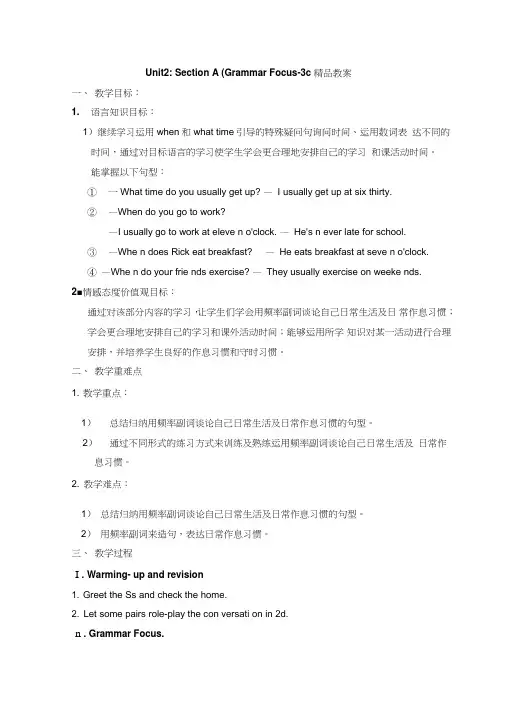
一、 教学目标:
1. 语言知识目标:
1)继续学习运用when和what time引导的特殊疑问句询问时间、运用数词表 达不同的时间,通过对目标语言的学习使学生学会更合理地安排自己的学习 和课活动时间。
能掌握以下句型:
① 一What time do you usually get up? — I usually get up at six thirty.
② —When do you go to work?
—I usually go to work at eleve n o'clock. — He's n ever late for school.
③ —Whe n does Rick eat breakfast? — He eats breakfast at seve n o'clock.
④ —Whe n do your frie nds exercise? — They usually exercise on weeke nds.
2■情感态度价值观目标:
通过对该部分内容的学习,让学生们学会用频率副词谈论自己日常生活及日 常作息习惯;学会更合理地安排自己的学习和课外活动时间;能够运用所学 知识对某一活动进行合理安排,并培养学生良好的作息习惯和守时习惯。
二、 教学重难点
1. 教学重点:
1) 总结归纳用频率副词谈论自己日常生活及日常作息习惯的句型。
2) 通过不同形式的练习方式来训练及熟练运用频率副词谈论自己日常生活及 日常作息习惯。
2. 教学难点:
1) 总结归纳用频率副词谈论自己日常生活及日常作息习惯的句型。
2) 用频率副词来造句,表达日常作息习惯。
三、 教学过程
I . Warming- up and revision
1. Greet the Ss and check the home.
Unit 2 Section A-grammar focus-3c-人教版英语七年级下册 教案
上外附属浙江宏达南浔学校集体备课纸
课 题 Unit 2What time do you go to school?
(Section A grammar focus-3c)(听说课) 学期第(1)课时
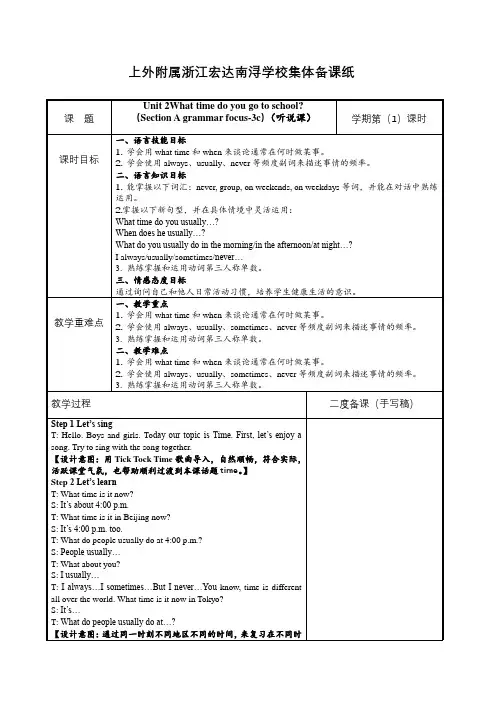
课时目标 一、语言技能目标
1. 学会用what time和when来谈论通常在何时做某事。
2. 学会使用always、usually、never等频度副词来描述事情的频率。
二、语言知识目标
1. 能掌握以下词汇:never, group, on weekends, on weekdays等词,并能在对话中熟练运用。
2.掌握以下新句型,并在具体情境中灵活运用:
What time do you usually…?
When does he usually…?
What do you usually do in the morning/in the afternoon/at night…?
I always/usually/sometimes/never…
3. 熟练掌握和运用动词第三人称单数。
三、情感态度目标
通过询问自己和他人日常活动习惯,培养学生健康生活的意识。
教学重难点 一、教学重点
1. 学会用what time和when来谈论通常在何时做某事。
2. 学会使用always、usually、sometimes、never等频度副词来描述事情的频率。
3. 熟练掌握和运用动词第三人称单数。
二、教学难点
1. 学会用what time和when来谈论通常在何时做某事。
2. 学会使用always、usually、sometimes、never等频度副词来描述事情的频率。
3. 熟练掌握和运用动词第三人称单数。
教学过程 二度备课(手写稿)
Step 1 Let’s sing
T: Hello. Boys and girls. Today our topic is Time. First, let’s enjoy a
人教版新起点英语七年级下册Grammar-Focus翻译

人教版新起点英语七年级下册Grammar-Focus翻译
在人教版新起点英语七年级下册中,Grammar-Focus部分是重点的语法内容。本文将对该部分进行翻译,以帮助学生更好地理解和掌握。
Unit 1
1. be动词的用法
be动词用于表示人或物的状态、特征、身份等。be动词有三种形式:am(第一人称单数)、is(第三人称单数)、are(其他人称及复数)。
例句:I am a student.(我是一名学生。)He is my friend.(他是我的朋友。)They are students.(他们是学生。)
2. 形容词的比较级和最高级
形容词的比较级用于比较两者之间的程度,最高级用于三者或三者以上之间的比较。
例句:This book is more interesting than that one.(这本书比那本书更有趣。)She is the tallest girl in our class.(她是我们班最高的女孩。)
3. 代词的用法
代词用于替代名词,分为主格代词、宾格代词和物主代词。
例句:He is my brother. I love him very much.(他是我的兄弟。我非常爱他。)It is my book.(这是我的书。)
Unit 2
1. 一般现在时的用法
一般现在时表示经常性的动作或客观事实。
例句:She often plays basketball on weekends.(她经常在周末打篮球。)The earth goes around the sun.(地球绕太阳转。)
2. 不能数的名词的用法
不能数的名词表示不可分割的整体,不能用于复数形式。
例句:I have some homework to do.(我有些功课要做。)Can
you give me some advice?(你能给我一些建议吗?)
3. 数词的用法
数词用于表示数量,分为基数词和序数词。
新版(人教版)七年级(下)英语Unit2课文详解
Unit 2 What time do you go to school?
Section A 1a — 1c (P7)
* 教师寄语:No man can do two things at once. 一心不可二用。
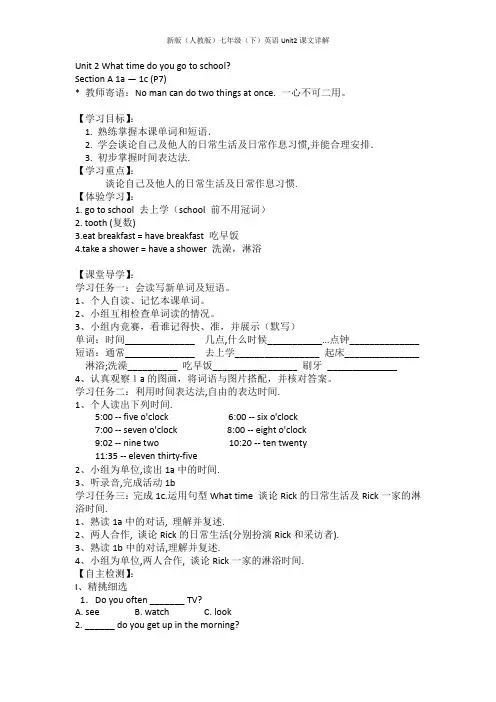
【学习目标】:
1. 熟练掌握本课单词和短语.
2. 学会谈论自己及他人的日常生活及日常作息习惯,并能合理安排.
3. 初步掌握时间表达法.
【学习重点】:
谈论自己及他人的日常生活及日常作息习惯.
【体验学习】:
1. go to school 去上学(school 前不用冠词)
2. tooth (复数)
3.eat breakfast = have breakfast 吃早饭
4.take a shower = have a shower 洗澡,淋浴
【课堂导学】:
学习任务一:会读写新单词及短语。
1、个人自读、记忆本课单词。
2、小组互相检查单词读的情况。
3、小组内竞赛,看谁记得快、准,并展示(默写)
单词:时间______________ 几点,什么时候___________...点钟______________
短语:通常______________ 去上学_________________ 起床_______________
淋浴;洗澡__________ 吃早饭_________________ 刷牙 ______________
4、认真观察1a的图画,将词语与图片搭配,并核对答案。
学习任务二:利用时间表达法,自由的表达时间.
1、个人读出下列时间.
5:00 -- five o'clock 6:00 -- six o'clock
7:00 -- seven o'clock 8:00 -- eight o'clock
9:02 -- nine two 10:20 -- ten twenty
人教七年级英语下册各单元Grammar_Focus和中文
By Ano 1 Grammar Focus
Grade 7
Unit 1 Can you play the guitar?
Can you swim? Yes, I can.
Can he play chess? Yes, he can./ No, he can’t.
Can you and Tom play chess? Yes, we can./ No, we can’t.
Can Jane and Jill swim? Yes, they can./No, they can’t.
What can you do? I can dance./I can’t sing.
What club do you \want to join? We want to join the chess club.
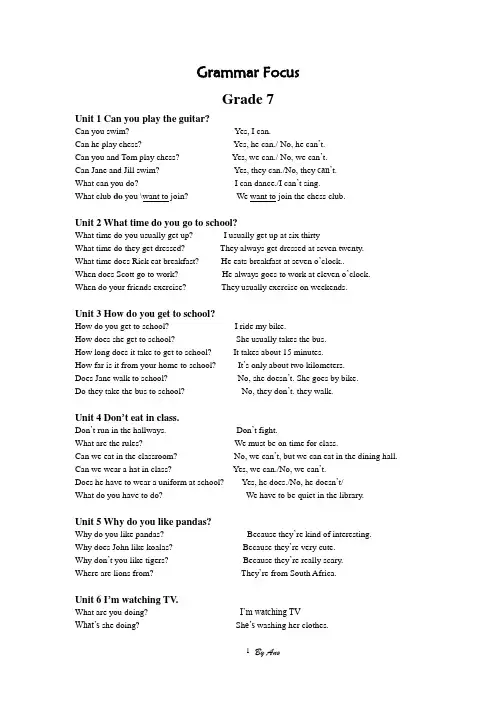
Unit 2 What time do you go to school?
What time do you usually get up? I usually get up at six thirty
What time do they get dressed? They always get dressed at seven twenty.
What time does Rick eat breakfast? He eats breakfast at seven o’clock..
When does Scott go to work? He always goes to work at eleven o’clock.
When do your friends exercise? They usually exercise on weekends.
人教版七年级下册英语 【课时练】Unit 2 Section A 试卷含答案(2)
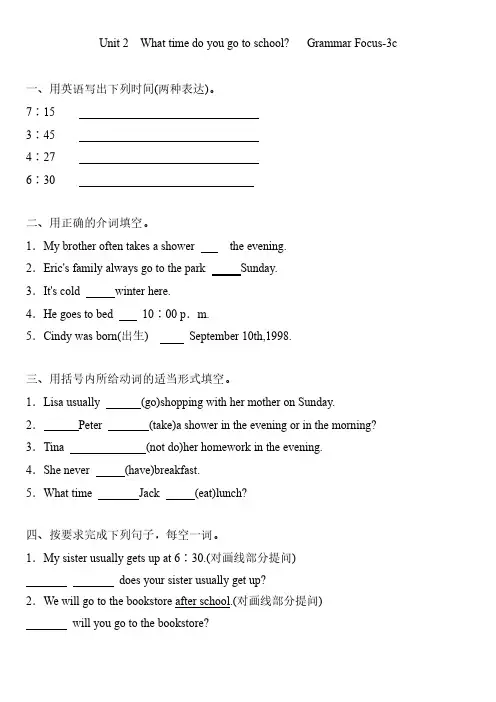
Unit2Whattimedoyougotoschool?GrammarFocus-3c
一、用英语写出下列时间(两种表达)。7∶153∶454∶276∶30二、用正确的介词填空。1.Mybrotheroftentakesashowertheevening.2.Eric'sfamilyalwaysgototheparkSunday.3.It'scoldwinterhere.4.Hegoestobed10∶00p.m.5.Cindywasborn(出生)September10th,1998.三、用括号内所给动词的适当形式填空。1.Lisausually(go)shoppingwithhermotheronSunday.2.Peter(take)ashowerintheeveningorinthemorning?3.Tina(notdo)herhomeworkintheevening.4.Shenever(have)breakfast.5.WhattimeJack(eat)lunch?四、按要求完成下列句子,每空一词。1.Mysisterusuallygetsupat6∶30.(对画线部分提问)doesyoursisterusuallygetup?2.Wewillgotothebookstoreafterschool.(对画线部分提问)willyougotothebookstore?五、单项选择:1.Wewanttwogoodactors_______ourschoolshow.A.forB.withC.in2.Doesyoursisterwant_______home?A.goB.togotoC.togo3.Mr.Wangis______C.we4.Isyourfriendaboy_____agirl?A.andB.orC.but5.Musicians________forSchoolMusicFestival.A.wantsB.wantC.wanted6.Doyouoften_______TV?A.seeB.watchC.look7.______doyougetupinthemorning?A.WhereB.WhattimeC.How8.When______Tomtakeashower?A.doesB.doC.has9.WhattimedoesAnn______everyday?A.goschoolB.gototheschoolC.gotoschool10.--Whattimeisit?--It’s______7:00.Weoftenhavebreakfast____7:00A.at,atB./,atC.at,/答案:一、1.sevenfifteenfifteenpastseven2.threeforty-fivefifteentofour3.fourtwenty-seventwenty-sevenpastfour4.sixthirtyhalfpastsix二、1.in2.on3.in4.at5.on三、1.goes2.Doestake3.doesn'tdo4.has5.doeseat四、1.Whattime2.When五、1-10ACABCBBACB
人教版七年级下册英语Unit2 SectionA(Grammar Focus-3c)优质教学设计(含教学反思)
Unit 2 What time do you go to school?
第二课时 Section A (Grammar Focus-3c)
Target Navigation 【目标导航】
Key words and phrases:
best,group,on weekends
Key sentences:
(1)—What time do you usually get up?
—I usually get up at six thirty.
(2)—What time do they get dressed?
—They always get dressed at seven twenty.
(3)—What time does Rick eat breakfast?
—He eats breakfast at seven thirty.
(4)—When does Scott go to work?
—He always goes to work at eleven o'clock.
(5)—When do your friends exercise?
—They usually exercise on weekends.
Skills:进一步掌握what time和when引导的疑问句。
Emotion:能听懂听力并能根据听力对话进行自由交际,培养学生学会常规管理。
The guidance of learning methods 【学法指导】
把握学习的主要内容,在学习中善于记要点,善于抓住用英语进行交际的机会。
Learning important and difficult points【学习重难点】
1.进一步掌握what time和when引导的疑问句。
2.掌握usually,always,never,on weekends 等词的用法。
Teaching Steps 【教学过程】
人教版七年级英语下册unit2 教案
教师
授课时间
课时 The first period
课题 Unit 2 Section A (1a-2d) 课型 新 授
教具准备 多媒体
教学目标 1. 语言知识目标:
1) 能掌握以下单词:
up get up dress get dressed brush tooth (pl. teeth) brush teeth shower take a shower usually forty
fifty wow never early job work station radio station o'clock funny exercise
能掌握以下句型:
① —What time do you usually get up? —I usually get up at six thirty.
② —When do you go to work? —I usually go to work at eleven o'clock.
③ —He has an interesting job. —He works at a radio station.
2) 用when和what time引导的特殊疑问句询问时间和时间的表达法;用所学的目标语言对生活和学习活动做计划,学会合理地安排作息时间。
2. 情感态度价值观目标:
本部分的话题是“日常作息时间”,学习内容贴近学生的生活,因为学生的作息时间安排是非常有规律的。通过互相询问或谈论自己或对方的作息时间安排和活动计划,可以培养学生良好的作息习惯和守时习惯。
重点 1) 掌握时间的简单表达方式。
2) 学习询问和谈论时间和制订作息时间表。
难点 when和what time引导的特殊疑问句和时间的表达法。
教学环节 旁注
教
学
内
复习旧课(新
课预习、作业的检查) 检查第一单元单词及课文内容掌握情况
新目标七年级英语下册Unit 2教案
Unit2 Where’s the post office?
一.教学目标
1.知识目标
1).重点词汇
* post office, hotel, video arcade, bank, park, supermarket, street, pay phone, avenue
* new, clean, quiet, big, small, dirty, old, busy
* left, right, next to, across from, near, between
2). 语言目标
* Is there a bank near here ? Yes, there’s a bank on Center Street.
* Where’s the supermarket ? It’s next to the library.
* Is there a pay phone in the neighborhood ? Yes, it’s on Bridge Street on the right.
* Where 引导的特殊疑问句
* 肯定陈述
* 表示方位的介词
3).语言功能
在街道上问路与指路
2.能力目标
通过本单元的学习,掌握问路与指路的基本语句,并能运用于现实生活中。
3.策略目标
1).联系上下文,利用情景思维。
2).转换具体信息。
4.情感目标
1).培养方位感。
2).在社会这个大家庭中,注重人际关系与交往,养成助人为乐的好习惯。
二.教学重、难点
1.重点: 1).表方位的介词:near、across from、next to、between、on
2).问路与指路的基本语句
2.难点:
1).本单元词汇量较大( 生词表中列出44个单词,9条短语;课文中还有一些短语)。
2).个别句子有一定难度,如:
初中英语七年级下册 Unit2 what time do you go to school
人教版英语科目第二单元第二课时教学设计
Unit 2 What time do you go to school?
Section A (Grammar Focus-3c)
课题 Unit 2 What time do you go to school? 单元 第二单元 学科 英语 年级 七年级下册
学习
目标与核心素养 1. 继续学习运用when和what time引导的特殊疑问句询问时间、运用数词表达不同的时间,通过对目标语言的学习使学生学会更合理地安排自己的学习和课活动时间。
能掌握以下句型:
① —What time do you usually get up? —I usually get up at six thirty.
② —When do you go to work?
—I usually go to work at eleven o'clock. —He's never late for school.
③ —When does Rick eat breakfast? —He eats breakfast at seven o'clock.
④ —When do your friends exercise? —They usually exercise on weekends.
2.通过对该部分内容的学习,让学生们学会用频率副词谈论自己日常生活及日常作息习惯;学会更合理地安排自己的学习和课外活动时间;能够运用所学知识对某一活动进行合理安排,并培养学生良好的作息习惯和守时习惯。
重点 1) 总结归纳用频率副词谈论自己日常生活及日常作息习惯的句型。
2) 通过不同形式的练习方式来训练及熟练运用用频率副词谈论自己日常生活及日常作息习惯。
难点 1) 总结归纳用频率副词谈论自己日常生活及日常作息习惯的句型。
2) 用频率副词来造句,表达日常作息习惯。