
人教版英语八年级下册Unit3教案
4. Consolidate the ways ofusingtheexpressions with the sentence patterns.
Step 5 Post-listening
1.To work in groups to discuss what they havelearnt.
2. Pair work:
Practicethe conversations with their partners by using the information in the listening materials.
2. Next, enlarge thequestions,“What do your parents always ask you to do?”and“What can you ask your parents to do?”, as to introduce the key expressions in this lesson.
1.Ask the Ss towork in groups.
2.Show the subject on the screen. Ask students to make their own situational conversations.
anize an interview, ask students to introducewhat they can help when having a barbecue.
2. Play a guessing game and score them in groups.
3.Let studentsfinish 1a.
4. Ask students to do pair work using the sentences in 1b. Then, give scores to each group.
3.Group work
To introducewhat they can help when having a barbecue with their classmates.
4. Use the giving expressions and fill in the blank in the handout.Then, rethink their thoughts and be ready to act out.
3. Finish the oral and written homework.Practice makes perfect. Be ready for a dictation.
4. Be wiling to help others in life, especially their parents.Try to be independent soon.
b)Written work
Ask Ss to hand in their reports.
4. To educate students to help others and be independent.
1. To master all the key points.
2. To memorize the important information in thislesion.
教学重点
Teaching important points:
1. Learn to make polite requests and ask for permissions.
2. Help students learn how to make polite requests and ask for permissions with the target language.
1.Listen for checkingthings.
Listen for the first time, let Sscheck the things they hear in 1a.
2.Listen fororders.
Listen again, Let Ssnumber the orders they hear.
中学部教师教学案
年级学科:八年级英语学科 任课教师:
日期:2021年 月 日
课型:听说课
主备人:
教学目标
Knowledge aims:
1. Master the new words and expressions. Such as: snack, go to the store, invite sb to do sth, etc.
2.Listen fororders.
Listen again,number the orders.
3.Listen formatching things.
Listen andmatch the things the people are going to do.
4. Listen to the tape scripts carefully.
1.Summarize all the key points for students.
2.Check what they have learnt in this lesson.
3.Assign homework
a) Oral work
Ask Ss to make more conversations and practice withtheirclassmates.
3.To excite students’minds and arouse their attentions.
4.To form an atmosphere of cooperation.
Step 4 While-listening
The teacher gives out the handouts and asks students to do the following things:
4.Provide the students with some phrases they may use and show them an example.
5. Ask students in groups to act out how they work, then, give them scores.
1.Answer the questions freely.
2.Pick up some thoughts aboutwhat they can do for their parents and what they can ask their parents to do for them.
1.Train the students to use theexpressionsin a proper way.
Purposes
Step 1Lead-in
Greet the class as usual.
Showsome pictures on PPT, ask students to say the chores.
Students sayout the chores on PPT. Such as: wave the cloth, pick some coconuts, etc.
1. Consolidate the knowledge.
2. Help the Ss to practice using the language points.
3. Improve the abilities of grasping key points and outputting them in real life.
1.Readaloud the expressions and try to memorize them as quick as they can.
2.To guess the expressions in the game and have fun.
3.Finish the exercise in 1a.
5. To imitate a real situation and gain scores from the teacher.
1.To consolidate the knowledge.
2. Improve the abilities of listeningand speaking.
3. Help the students to use the language points fluently.
2.Practice their oral English.
3.Be able to communicatewith othersfreely.
Step3 Pre-listening
1.Get the students to read the expressions and ask them to memorize these quickly.
教学难点
Teaching difficult points:
Be able to use the sentence patterns,“Could you…?”and“Could I…?”.
中考考点
教学过程(教师活动及学生活动)
个人备课
Teacher’s activities
Students’ activities
4.Help the students to foster the ability ofusing the known knowledge to practice in real life.
5.To educate Ss tohelp others as more as they can.
新目标人教版八年级英语下册Unit3公开课用教案
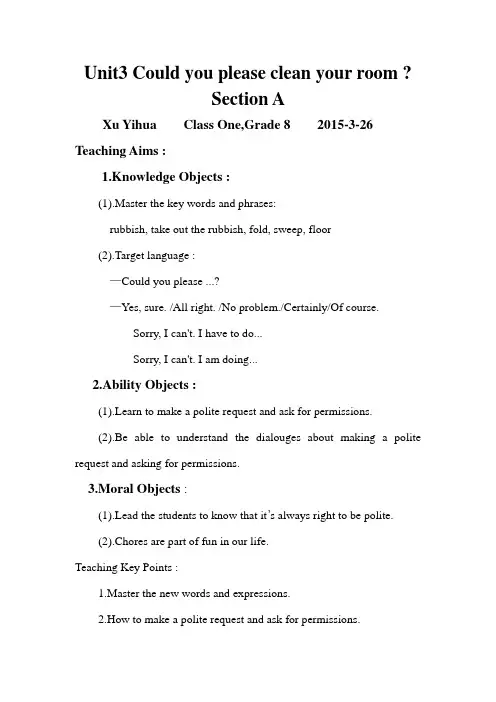
Unit3 Could you please clean your room ?Section AXu Yihua Class One,Grade 8 2015-3-26 Teaching Aims :1.Knowledge Objects :(1).Master the key words and phrases:rubbish, take out the rubbish, fold, sweep, floor(2).Target language :—Could you please ...?—Yes, sure. /All right. /No problem./Certainly/Of course.Sorry, I can't. I have to do...Sorry, I can't. I am doing...2.Ability Objects :(1).Learn to make a polite request and ask for permissions.(2).Be able to understand the dialouges about making a polite request and asking for permissions.3.Moral Objects :(1).Lead the students to know that it’s always right to be polite.(2).Chores are part of fun in our life.Teaching Key Points :1.Master the new words and expressions.2.How to make a polite request and ask for permissions.Teaching Difficult Points :Be able to make polite requests and ask for permissions. Teaching Procedures :Step 1. Lead-inGreet the class Show some pictures about home in the projector.)Ask some questions:Eg: Do you like your family ? Do you like your father ? Do you like your mother ? Who is the busiest at your home? Why is your house clean?Step 2. Presentation1.Introduction and new words learning.T: Your mothers are always busy, beacuse there are many chores at home. (Learn chore.) For example : do the dishes, take out the rubbish, fold the clothes, sweep the floor, make the bed, clean the living room.Next teach the new words and phrases by using the pictures in the projector.Then ask students “ what other chores do you know?”2.Guessing game. What is she doing ?3.Pair work. Do you do these things at home? Write “Y”for “yes”and “N”for “no”.4.The key sentence introduction.T: If you want Peter to do the dishes, what should you say ? “Peter, do the dishes.”“Can you do the dishes ?”“Could you please do the dishes ?” Which sentence is the most polite ?Ss :Could you please do the dishes ?T: Here, could is not the past tense. Using could is more polite.—Could you please ...?Yes, sure. /All right. /No problem./Certainly/Of course.Sorry, I can't. I have to do...Sorry, I can't. I am doing...Step 3. PracticeActivity 1 Group work.Welcome to my room ! But this is a dirty room. How to make the room clean? Division of labor within the group.The fastest group is the winner. The key sentence:—Could you please ...?Yes, sure. /All right. /No problem./Certainly/Of course.Sorry, I can't. I have to do...Sorry, I can't. I am doing...Activity 2 Listening.1.Review the chores. Then listen to the tape, who will do these chores?Check (√)Peter’s mother or Peter.2.Listen again, finish the blanks.3.Role play the tapescript. The boys PK the girls.Step 4. Summary1. New vocabularydo the dishes, sweep the floor, take out the trash, make the bed, fold the clothes, clean the room2. —Could you please ...?—Yes, sure. /All right. /No problem./Certainly/Of course.Sorry, I can't. I have to do...Sorry, I can't. I am doing...Step 5. Homework1.Conversation practice:Make a conversation between you and your parent about doing the chores. Remember to use the sentences we learnt today.2.Review and remember the new words.。
人教版八年级英语下册教案:Unit3SectionB(2a2e)教学设计

(四)课堂练习
1.教师设计一系列关于一般过去时的练习题,包括填空、选择、改错等,让学生独立完成,巩固所学知识。
2.学生互相交换练习本,进行批改和讨论,培养学生互帮互助、共同进步的良好氛围。
3.教师针对学生练习中出现的共性问题进行讲解,帮助学生突破难点。
八年级下册的学生经过前期的英语学习,已经具备了一定的英语基础,包括词汇、语法和听说能力。在此基础上,他们对本节课的话题“过去的活动”有一定的认知,能够运用一般过去时描述过去发生的事情。然而,学生在实际运用中,对一般过去时的动词变化和句型结构掌握不够熟练,需要教师在教学中进行针对性的指导。
此外,学生在学习过程中,对英语学习的兴趣和动机存在差异。部分学生对英语学习表现出较高的热情和自信,积极参与课堂活动;而另一部分学生则相对被动,缺乏自信,课堂参与度较低。因此,教师在教学过程中应关注学生的情感态度,通过多样化的教学活动,激发学生的学习兴趣,增强学生的学习自信心。
3.通过小组合作,让学生完成2b的练习,互相检查动词过去式的使用,提高学生的合作能力和语言实践能力。
4.教师针对学生的完成情况进行点评,纠正错误,强化正确用法。
(三)学生小组讨论
1.教师将学生分成小组,要求每组讨论并分享组员们过去做过的有趣活动,用一般过去时进行描述。
2.每个小组选取一个代表进行汇报,其他组员补充,培养学生团队合作和口语表达能力。
3.引导学生关注动词的过去式变化,为学生讲解一般过去时的基本概念和用法,为新课的学习做好铺垫。
(二)讲授新知
1.教师呈现Unit 3 Section B 2a的听力材料,引导学生边听边关注动词的过去式形式,让学生在语境中感知和学习一般过去时。
人教版八年级英语下-unit3-could-you-please-clean-your-room教案
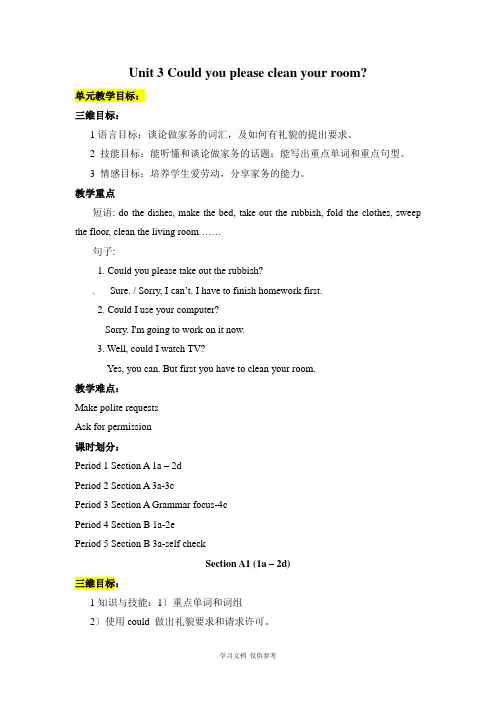
Unit 3 Could you please clean your room?单元教学目标:三维目标:1语言目标:谈论做家务的词汇,及如何有礼貌的提出要求。
2 技能目标:能听懂和谈论做家务的话题;能写出重点单词和重点句型。
3 情感目标:培养学生爱劳动,分享家务的能力。
教学重点短语: do the dishes, make the bed, take out the rubbish, fold the clothes, sweep the floor, clean the living room ……句子:1. Could you please take out the rubbish?. Sure. / Sorry, I can’t. I have to finish homework first.2. Could I use your computer?Sorry. I'm going to work on it now.3. Well, could I watch TV?Yes, you can. But first you have to clean your room.教学难点:Make polite requestsAsk for permission课时划分:Period 1 Section A 1a – 2dPeriod 2 Section A 3a-3cPeriod 3 Section A Grammar focus-4cPeriod 4 Section B 1a-2ePeriod 5 Section B 3a-self checkSection A1 (1a – 2d)三维目标:1知识与技能:1〕重点单词和词组2〕使用could 做出礼貌要求和请求许可。
2.过程与方法:通过合作探究的方法结局本课的重点知识点3.情感态度与价值:学会照顾自己,培养自己的独立意识。
教学重点:谈论做家务的词汇,情态动词could的使用方法。
Unit 3 Section A (3a -3c)教案人教版英语八年级下册
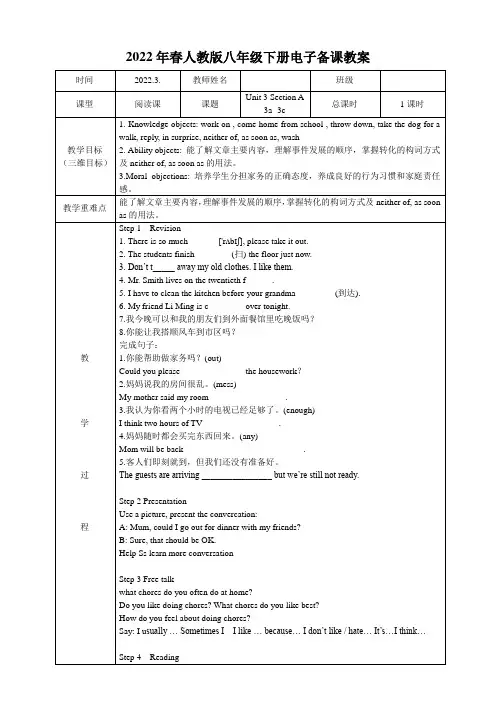
Step 2 Presentation
Use a picture, present the convercation:
A: Mum, could I go out for dinner with my friends?
Read the story and choose the best answer.
( )1. Who wanted a walk?
A.Nancy’s room B. The dog C. Nancy’s dad D. Nancy
( )2. Nancy came home from ________.
B: Sure, that should be OK.
Help Ss learn more conversation
Step 3Free talk
what chores do you often do at home?
Do you like doing chores? What chores do you like best?
D.Because she got back home late.
( )5. How did they solve the problem?
A.Nancy’s mother said sorry to Nancy.
B.Nancy said sorry to her mother and now she understood she should share the housework.
3.我认为你看两个小时的电视已经足够了。(enough)
八年级英语下册 Unit 3 Could you please clean your room?教案
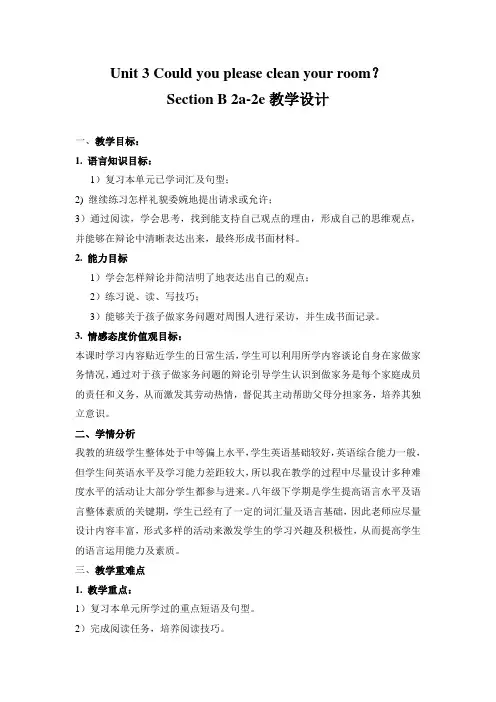
Unit 3 Could you please clean your room?Section B 2a-2e教学设计一、教学目标:1. 语言知识目标:1)复习本单元已学词汇及句型;2) 继续练习怎样礼貌委婉地提出请求或允许;3)通过阅读,学会思考,找到能支持自己观点的理由,形成自己的思维观点,并能够在辩论中清晰表达出来,最终形成书面材料。
2. 能力目标1)学会怎样辩论并简洁明了地表达出自己的观点;2)练习说、读、写技巧;3)能够关于孩子做家务问题对周围人进行采访,并生成书面记录。
3. 情感态度价值观目标:本课时学习内容贴近学生的日常生活,学生可以利用所学内容谈论自身在家做家务情况,通过对于孩子做家务问题的辩论引导学生认识到做家务是每个家庭成员的责任和义务,从而激发其劳动热情,督促其主动帮助父母分担家务,培养其独立意识。
二、学情分析我教的班级学生整体处于中等偏上水平,学生英语基础较好,英语综合能力一般,但学生间英语水平及学习能力差距较大,所以我在教学的过程中尽量设计多种难度水平的活动让大部分学生都参与进来。
八年级下学期是学生提高语言水平及语言整体素质的关键期,学生已经有了一定的词汇量及语言基础,因此老师应尽量设计内容丰富,形式多样的活动来激发学生的学习兴趣及积极性,从而提高学生的语言运用能力及素质。
三、教学重难点1. 教学重点:1)复习本单元所学过的重点短语及句型。
2)完成阅读任务,培养阅读技巧。
3)能够清晰表达自己对做家务一事的看法。
2. 教学难点:1)能够采访周围人对孩子做家务一事的看法,并做书面记录。
2)能够思考并得到找到能支持自己观点的理由,并形成书面材料。
3)通过完成阅读任务提高自己的阅读能力。
四、教学过程I. Warming-up and lead-in1. Greet students as usual and tell students that there is a group competition in which the winner group can get the gift.2.Interview some of the students about whether they do housework at home and what they often do.3. Show the chatting records of parents group about kids doing chores at home to lead in the topic of this class—whether children should do chores at home or not.II. Pre-readingAsk the following two questions:1.What can you know from the chatting records of your parents?2.Do you think kids should do chores at home?III. While-reading1.Students read the two letters quickly to find out which one agrees and which one disagrees and give the reasons.2.Introduce the reading skill “Skimming”—looking quickly through a piece of writing to find the main idea without reading every word. It is still a good idea to read the first sentence in each paragraph quickly.3.Students read the examples already given in 2c and guess the meanings of “pros” and “cons”. Ask students to do a group work-- according to Mr. Smith and Ms. Miller, what are the pros and cons about kids doing chores?4.Students read the letters again and fill in the blanks to review the reasons given by Mr. Smith and Ms. Miller.IV. Post-reading.1. Be a good debater. Ask the students choose one side freely and have a debate onwhether children should do chores at home.2. Ask students to prepare for the debate and give some tips to them. Students can use the information they get before class. Students write down their ideas during their preparation.3. Introduce the rules of debate and the debate begins. Students from the positive side and the negative side can stand up and give ideas. The teacher concludes the debate in the end.V. Emotional sublimationShow some pictures of parents who work hard and remind students of the great contributions parents make to our family. Encourage students to be a good helper at home and try their best to do chores. Give the winner group some housework cards to encourage them to do chores at home.VI. HomeworkWrite a passage to express your ideas about kids doing chores at home.五、板书设计Unit 3 Section B 2a-2ekids doing chores at homeMs. Miller VS. Mr. Smithnegative side positive side。
新人教版八年级下册英语全册教案及教学反思
新人教版八年级下册英语全册教案及教学反思一、教案目标本教案旨在帮助八年级下册英语学习,通过教学活动的设计和实施,提高学生的听、说、读、写能力,同时培养学生的跨文化交际能力。
二、教学内容本教案涵盖八年级下册英语全册的教学内容,包括以下单元:1. Unit 1: Let’s Go Shopping 2. Unit 2: How Often Do You Exercise? 3. Unit 3: Travel Journal 4. Unit 4: Look Before You Leap 5. Unit 5: Virtual World 6. Unit 6: Fun in Paris 7. Unit 7: My New Room 8. Unit 8: All Aboard! 9. Unit 9: Young Entrepreneurs 10. Unit 10: Science in Everyday Life三、教学方法本教案采用多样化的教学方法,以激发学生的学习兴趣和积极参与课堂互动。
具体教学方法如下: 1. 情境教学法:通过模拟真实情境,培养学生运用英语进行交际的能力。
2. 合作学习法:组织学生进行小组活动,培养学生的合作与沟通能力。
3. 多媒体教学法:利用多媒体资源,如图片、音频和视频,提供真实的语言环境,增强学生的学习效果。
4. 游戏教学法:设计各种语言游戏,使学生在愉快的氛围中学习和巩固英语知识。
四、教学步骤1. Unit 1: Let’s Go Shopping•阅读教材课文,学习并掌握新单词和短语。
•完成课后练习,加强对词汇和语法的理解。
•制作购物清单,进行角色扮演,练习购物对话。
2. Unit 2: How Often Do You Exercise?•听取学生的运动习惯,并进行统计分析。
•学习频率副词的用法,如often、usually、sometimes等。
•小组活动:就运动习惯展开讨论,激发学生的口语表达能力。
人教版八年级下册英语Unit3_Section A 第1课时(1a~2d)教案与反思
大地二中张清泉Section A 单词rubbish n.垃圾;废弃物 fold v.折叠;对折 sweep v.(swept)扫;打扫floor n.地板 mess n.杂乱;不整洁 throw v.(threw)扔;掷neither adv.也不; pron.两者都不 shirt n.衬衫 pass v.给;递;走过;通过borrow v.借;借用 lend v.(lent)借给;借出 finger n.手指hate v.厌恶;讨厌while conj.与……同时;当……的时候;而;然而chore n.杂务;乏味无聊的工作 snack n.点心;小吃;快餐短语take out the rubbish 倒垃圾 all the time频繁;反复as soon as 一……就……句型1.Peter,could you please take out the rubbish? 彼得,你能把垃圾倒了吗?2.And she won’t be happy if she sees this mess.而且如果她看到这么乱,她会不高兴的。
3.Could I at least finish watching this show?至少等我看完这个节目可以吗?4.For one week, she did not do any housework and neither did I.在—周时间里,她没有做任何家务,我也没有做。
5.I’ll finish my homework while you help me with the dishes.当你帮我洗碗的时候,我会完成家庭作业。
Section B单词stress n.精神压力;心理负担waste n.浪费;垃圾 v.浪费;滥用provide v.提供;供应anyway adv.而且;加之depend v.依靠;信赖develop v.发展;壮大fairness n.公正性;合理性since conj.因为;既然 prep.,conj.& adv.从……以后;自……以来neighbor(=neighbour) n.邻居ill adj.有病;不舒服drop v.落下;掉下fair adj.理的;公正的unfair adj.不合理的;不公正的snack n.点心;小吃;快餐independence n.独立independent adj.独立的;自主的短语in order to目的是;为了 depend on 依靠;信赖a waste of time浪费时间 take care of 照顾;处理句型1.Could I invite my friends to a party? 我能邀请我的朋友们参加聚会吗?2.They should spend theirtime on schoolwork in order to get good gradesand get into a good university.为了取得好成绩并考入一所好大学,他们应该把时间花在学业上。
人教版八年级英语下册教案:Unit3SectionB(2a2e)优秀教学案例
6.学生能够撰写一篇关于描述人物的短文,运用所学知识和词汇,提高写作能力。
(二)过程与方法
1.学生通过观察、讨论、实践等方式,掌握描述人物特征和喜好的方法和技巧。
2.学生通过听力练习,培养捕捉关键信息、预测和推断的能力,提高听力理解水平。
3.学生通过阅读理解,学会分析人物特征,提高阅读分析和归纳能力。
4.学生通过小组合作、讨论交流等方式,培养团队协作能力,提高口语表达能力。
5.学生通过自主学习、探究学习,培养独立思考和解决问题的能力。
(三)情感态度与价值观
1.学生能够认识到描述人物特征和喜好对于了解他人、增进友谊的重要性,培养良好的人际交往能力。
3.教师对学生的学习过程和结果进行评价,关注学生的进步和发展,鼓励学生持续努力,提高学生的学习动力。
四、教学内容与过程
(一)导入新课
1.利用多媒体展示一幅图片,图片中包含一位正在从事冒险活动的人物。引导学生观察并描述这位人物的特征和喜好,引发学生对描述人物特征和喜好的兴趣。
2.邀请一位学生上台表演一个具有特定特征和喜好的人物角色,让其他学生猜测并描述这位人物。通过这种互动方式,激发学生的学习兴趣和积极性。
人教版八年级英语下册教案:Unit3SectionB(2a2e)优秀教学案例一 Nhomakorabea案例背景
本案例背景基于人教版八年级英语下册Unit 3 Section B(2a-2e)的内容。本节课主要围绕描述不同人物特征和喜好展开,通过听力练习、口语交流、阅读理解和写作训练等形式,提高学生的英语听、说、读、写综合技能。同时,本节课还旨在培养学生的观察力、思维力和创造力,以及激发他们对英语学习的兴趣和积极性。
八年级英语下册第三单元第一课时教案(人教版)
Unit3 SectionA(1a-1c)教案 人教版八年级英语下册
T: If your mom wants some help, what should she say to you?
S:She should say,’’Could you please…?’’
Help students to answer it.
通过图片呈现本节课的目标词汇和目标语。层层递进,由浅入深。
Talk about the chores they can do before listening.
2. Listen for the first time and check Peter or Mum.
3. And then check the answer with “Peter’s mother will…Peter will…”
Names
What kind of chores do you do at home? Why?
Make a report: Hello! I’m … In my group, … does the dishes and …. at home. He/she thinks it is …._____________ .We think ... does the most chores at home.
1. Look at the pictures and learn new words and phrases.
T: What other chores does mom do for family?
S: She needs totake out the rubbish, sweep the floor, clean the living room, do the dishes, fold the clothes and make the bed.