
外研版英语六年级上册Module 8 Unit 2 I often go swimming. 同步教案
1 / 3
Unit 2 I often go swimming.
教学目标:
1. 学习本课生词:always, often, sometimes, never.
2. 学习使用always, often, sometimes, never等频度副词讲述做的动作、习
惯和爱好。
3. 注意一般疑问句读时用升调。
4. 能用所学的频度副词讲述行为、习惯和喜好等,培养学生开口说英语
的习惯。
教学重点:
能用所学的频度副词讲述行为、习惯和喜好等。
教学难点:
在用所学的频度副词讲述行为、习惯和喜好的同时注意第三人称单数的变
化。
教学准备:
图片、录音机
教学过程:
1. Greetings.(预习情况交流)
(1)将课前准备中的情况与同学交流。
(2)讨论预习中遇到的问题(老师点拨)。
2. Free Talk.
(1)Do you often ?
(2)I often watch TV. What do you often do?
3. Presentation
(1)New words
T: Always ● ● ● ● ● ● ●边说边画圈边涂色。
I read English on Monday, Tuesday, Wednesday, Thursday, Friday, Saturday,
Sunday.
Use always make a sentence.
Ss: I always read English. (学生造句)
T: What does he\she always do? (引出第三人称单数)
2 / 3
Ss: He always listens to music.(用同样的方法教授often、never、
sometimes)。
Often ● ○ ○ ○ ● ● ●
T: I go swimming on Monday, Friday, Saturday, Sunday. I often go
swimming.
Sometimes ● ○ ○ ○ ○ ● ●
T: I don’t like computer games very much. I play them when I feel bored. I
sometimes play computer games.
Never ○ ○ ○ ○ ○ ○ ○
T: I don’t like playing football. I can’t play football. I never play football.
(2)Look at the part 1 and then talk about these pictures.
看图介绍人物。引导学生尽可能多说出图中的人物在做什么。
Eg: This is Mike. He’s reading an English book.
This is Simon. He’s riding a bicycle
This is Heping. He’s writing stories in English.
This is Maomao. She can’t play football.
This is Lili. She’s cleaning the blackboard.
This is Lingling. She doesn’t play with dolls.
This is Daming. He is eating.
4. Homework
(1)Listen and learn to say.听录音跟读,注意重读轻读。
(2)Listen and say, then chant.听录音机播放歌曲,并跟着唱,体会歌曲美
妙的旋律和歌曲的大意。
(3)Ask and answer.两个同学一组,根据图中的内容一个学生进行提问,
另一个学生回答。教师选择其中一组检查学生的问和答。
(4)语言知识归纳。
(5)分组讨论你认为本课有哪些重要的单词、句子。
教学练习:
1. 回想本节课所学的内容,你学到了哪些新的知识?还有哪些疑问?
2. 应用交际:现在很多同学利用业余时间学有一技之长。用always, often,
sometimes, never说说自己平时的爱好、学习的习惯。如:I often have
English lessons at 8 o’clock on Sunday.接着请另一位同学以第三人称重复
3 / 3
该同学的发言。如:She often have English lessons at 8 o’clock on Sunday.
请用always, sometimes, often, never等频度副词介绍一下你爱好、生活习
惯和动作,同学之间进行互相交流。
教学反思:
本节课要学习四个频度词always/ sometimes/often/never这也是考试最常出
现的考点。听力材料内容较多,教师能通过让学生按人物活动排顺序,让学生能
轻松反馈出图片上每个人物活动使用的频度词的什么,并且适时停顿加以讲解。
本课课堂氛围较热烈,学生能积极主动参与课堂中,教学成效较理想。
外研版小学英语六年级上册Module8Unit2Ioftengoswimming.的教学设计
外研版小学英语六年级上册Module8Unit2Ioftengoswimming.的教学设计新标准第七册Module 8 Unit 2 I often go swimming.教案1.Teaching aims(1)Words: students must understand new word , and remember always, never.(2) Sentences: students can use do you often---? To talk about others’ habits. Students can use I always\ often \sometimes\ never---. And She always \often\ sometimes\ never ---.(3) Grammar: students can understand always\ often\ sometimes\ never and the General tense.(4)Abilities : students can use always\ often\ sometimes\ never. Talk about own and other people’s habits.(5)Emotion: know own and other people’s habits, to get on well with together.2.Teaching important tents(1)Words: always, often, sometimes, never(2)Sentences: Do you always\ often\ sometimes\ never---?I always\ often\ sometimes\ never---.He\ She always\ often\ sometimes\ never---.(3)Grammar: the general continue tense3. Teaching difficult tentsHow to read always , never, how to use always, often, sometimes, never.4.Teaching toolsCAI, recorder, stickers, exercise books5. Teaching methods(1)Say the chant together.(2)Have a brain storm.(3)Practice in pair.(4) Have a press conference.(5)Talk about own activities.(6)Listen to the tape.(7)Make a survey.6.Teaching procedureStep 1. Warming upSay the chant and do actions.Step 2. Presentation(1)Show some pictures and say,which group can say most phrases.(2)T: I have lots of hobbies. Reading English books is my hobby. Look at this picture. Wh at’s he doing?S1: He’s reading English books.T: Do you always read English books?S2: Yes, I do. \Yes, of course.\ No, I don’t .\ Not really.Teach always.Then show write stories.T: What’s he doing?S1:---.T:I often write stories. Do you often write stories?S3: ---.Teach often.Show the picture of playing football.T: I like playing football. Do you like playing football?S1:---.T: Do you sometimes play football?S1:---.Teach sometimes.Show the picture of cleaning the blackboard.T: What’s she doing?S1: She is cleaning the blackboard.T: I never clean the blackboard. Do you never clean the blackboard?S2: ---.Teach never.(3)Show some pictures , students practice in pairs, then show.(4)Make a press conference.Today we will meet four famous people. Guess it who they are .Welcome Xiyangyang , Meiyangyang, Huitailang, Hongtailang.First, introduce and say hello.Second , Xiyangyang says : today we have a press conference, if you have some questions, please ask.Third, teacher makes an example like this:T: Hello, Xiyangyang.Do you always watch TV?X: ---.T: Thank you.Then students begins to ask. Which group ask more?Step 3. Listening(1)Look at my activities in a week. T eacher says: I always\ often\ sometimes\ never---. Explain them , then do exercise.(2)Take out own charts , then say like this: I ---.(3)Listen to the tape and number the picture. Then show the pictures to check the answers.(4)Listen to the tape and fill in the blanks.Xiaoyu__________ reads English books.Heping __________ writes stories in English.Maomao ___________ plays football.Lili ______________ clean the blackboard.Lingling ___________ goes swimming.Daming ____________ eat with a knife and fork.Simon ______________ rides bikes to school , he ________ goes by bus.Check with listening material.Step 4. Production(1)Take out the chart, we will have a survey.(2)Teacher make an exampleT: What do you do at the weekend?S: I always\ often \ sometimes\ never---.T: Do you ----?S: Yes, I always\ often\ sometimes---.No, I never---.(3)Students begins to serve. Then fill in the blanks.(4) Write a short passage, then give a report.Step 5. HomeworkAsk your family, then write down.。
Module 8 Unit 2 I often go swimming. 课件 外研版英语六年级上册
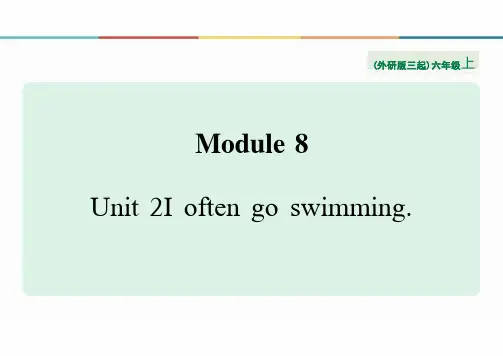
03 ◎ Presentation Ilove English.I often read English books.
◎ Presentation
you want to see mypbofos?
I sometimes clean the blackboard for my teacher.
◎ Presentation I never play with dolls.I don't like them.
clean the classroom
go shopping send emails drink tea
go to the doctor collect stamps
◎ Practice
Ask and answer
Do you eat bananas?
Yes,I sometimes eat bananas.
◎ Presentation
Read and complete
5.Xiaoyu often reads English books. 6.Sam often goes swimming. 7.Jack often eats with a knife and fork. 8.Si mon always rides his bike to school,he never goes by bus.
What do th ey often do? Xiaoyu
Heping
Lili
Maomao
Lingling
03
Presentation
播放
停 止 字幕工 原
音
I always ride my bike to school.I never go by bus.
2023六年级英语上册Module8Unit2Ioftengoswimming教案外研版(三起)
1.通过例句和练习,让学生反复练习频率副词的用法,加深对频率副词用法的理解。
2.创设情境,让学生在实际情境中练习描述日常活动,并正确运用频率副词。
3.提供反馈和纠正,引导学生注意频率副词பைடு நூலகம்位置和使用场合。
4.鼓励学生多开口说英语,通过互动交流,提高语言运用能力。
教学资源准备
1.教材:确保每位学生都有外研版六年级英语上册Module 8 Unit 2的教材,以便学生能够跟随教学进度进行学习和复习。
8.教学反馈表:为学生准备教学反馈表,用于收集学生对课堂教学的反馈意见。这可以帮助教师了解学生的学习需求和教学效果,从而进行相应的调整和改进。
9.教学指导手册:教师需要准备教学指导手册,其中包含本节课的教学计划、教学步骤、教学资源等详细信息。教学指导手册可以帮助教师更好地组织和实施课堂教学。
10.教学评估工具:准备一些评估工具,如测验、考试等,用于评估学生对频率副词用法和日常活动表达方式的理解和掌握程度。这些评估工具可以帮助教师及时了解学生的学习进度,并根据需要进行教学调整。
5.鼓励学生继续努力,并提出他们在学习频率副词和日常活动描述方面可能遇到的任何问题。
课后拓展
1.拓展内容:
-阅读材料:选择与频率副词和日常活动相关的英语阅读材料,如短文、故事等。
-视频资源:查找与频率副词和日常活动相关的英语视频,如短片、动画等。
2.拓展要求:
-鼓励学生利用课后时间自主阅读和观看拓展内容,以加深对频率副词和日常活动的理解和运用。
教材分析
《2023六年级英语上册Module 8 Unit 2 I often go swimming教案外研版(三起)》是对话课教学设计。本节课主要围绕频率副词和日常活动进行教学。教材内容通过描述日常活动和频率副词,帮助学生掌握频率副词的用法,并能够运用所学知识进行真实情境下的语言交流。本节课的内容与学生的日常生活紧密相关,有利于激发学生的学习兴趣和积极性。通过本节课的学习,学生能够进一步巩固和拓展已学的英语知识,提高他们的语言运用能力。
Unit2 I often go swimming 优秀教学设计
外研社《新标准英语》(三年级起点)六年级上册Module8 Unit2 I often go swimming.教材分析本课主题是I often go swimming。
主要内容是通过观察图片,正确使用always, sometimes, often, never。
本课又通过活动三的大量词组,让学生练习这些句型。
这个模块主要是要求学生学会四个频度副词,即:sometimes、often、always、never,并要求学生把他们运用到一般现在时的句子当中。
另外,新课标还要求学生在这个单元里学习感知一般疑问句的语调。
学情分析对于六年级的学生来说,该模块的知识点并不陌生,因为他们在此之前的学习活动中已经有一定的基础,他们基本能够把握一般现在时的概念及含义。
但是在运用相关的词语写句子时仍然觉得很困难,原因是他们平时不善于积累词语,没有在日常的学习中积极运用到具体的句子中。
在这节课里,我把几个频度副词以造句的形式让学生去实践,从而巩固他们所学的知识。
教学目标(一)语言知识目标1、学习目标语句:She sometimes cleans the blackboard.2、掌握单词often,sometimes,always,never3、能听懂I always swim on Sunday.I sometimes clean the blackboard.I never play football.这类说明行为频率的语句。
4、学习感知一般疑问句的语调。
(二)语言技能目标1、通过使用频度副词(always ,sometimes,often,never)讲述行为、习惯和喜好等。
2、能理解并会使用频度副词:sometimes,often,always,never. 懂得这些频度副词在句中的位置、区别、用法及所在句子中的时态。
(三)情感态度目标1、培养学生积极参与合作学习的意识。
2、通过活动提升学生的学习情感,并拓展学生实际语用的能力。
六年级上册英语教案(含作业设计和反思) Module 8 Unit 2 I often go swi
六年级上册英语教案(含作业设计和反思)Module 8 Unit 2 I often go swimming Period 2 外研版(三起)教学目标1.能够学习和掌握本课重点单词和短语;2.能够学习和巩固本课重点语法;3.能够运用本课所学的语言进行口语和书面表达。
教学重点1.本课重点单词和短语的掌握;2.本课重点语法的学习和巩固。
教学难点能够运用本课所学的语言进行口语和书面表达。
教学过程1. Revision(10分钟)•复习上一课的重点单词和词组。
2. Presentation(30分钟)1.T:Hello, boys and girls. Today we are going to learn Unit 2 of Module 8 in our English textbook. This unit is all about people’s hobbies and what they like to do in their free time.2.T:I’ll introduce some new words first. Please look at the screen and listen carefully. (出示短语并读音) swimming, playing football, playing basketball, playing table tennis, playing computer games, watching TV, reading, skateboarding,playing volleyball3.T:Now, please say the words after me and try to remember them.4.T:The new words are all about hobbies and interests. What’s your hobby? Can you tell me in English? I like ________. (音乐声:I like swimming.)(孩子们跟读)5.T:Now, please look at the sentence on the screen and read itafter me.。
外研版六年级上册英语Module8 Unit 2 I often go swimming 授课课件
知识点2 bybus乘坐公共汽车 例句:Ioftengotoschoolbybus.
我经常乘坐公共汽车去上学。 用法: by+交通工具名词,意为“乘/骑……”,且by后
一定不要用任何冠词,表示交通工具的名词不加s。
例句: Myfriendgoestoschoolbybike. 我 朋友骑自行车去上学。 MrLiuwenttoworkbytrain. 刘先生乘坐火车去上班了。
我想要下国际象棋。 用法:play与棋类,球类名词连用时,中间不加冠
词。如:playbasketball打篮球
知识点9 gotothedoctor去看医生 例句:Theboyisill. Hewantstogotothedoctor.
这个男孩病了,他想要去看医生。 同义短语: seethedoctor
总是 经常 有时
●●●●● ●●●○○
100%
60% 30%
never
从不 ○○○○○
0%
2. 频率副词在句中的位置。 都可以放在be动词、助动词、情态动词后面,行 为动词前面。 例句:Shesometimesgoeshomebybus. 她有时乘坐公共汽车回家。
IalwaysreadbooksathomeonSundays. 星期天我总是在家里看书。
Doyouwanttoseemyphotos? Doyoulikereadingbooksnow? Doyouoftenplaywithdolls? Doyouoftencleanyourroom?
I’m making a list of things I like doing.
Laughing and playing and running and swimming. Flying a kite and singing and clapping. Having a picnic and climbing a tree. Reading a good book and watching TV.
外研版(三起)-英语-六年级上册-Module 8 Unit 2 I often go swimming.教学课件
I can speak English
I can speak English, “How do you do?” You can speak English, so speak to me too. I can write English, “Dear pen friend.” I’ll write to you again and again. I can sing English songs. Listen to me ! I’ll sing the A-B-C song.
Summary
Do you ...?
Yes, I always.... Yes, I often.... Yes, I sometimes.... No, I never....
New Standard English Students’ Book 7
Module 8 Unit 2
I often go swimming.
本课的教学内容为新标准三年级起点六年级上册第八模块第二 单元I often go swimming.本课围绕always, often, sometimes, never来展 开讲述学生的行为、习惯和爱好等,主要运用Do you…? Yes, I always/ often/ sometimes…. / No, I never ….来训练学生听、说、写综 合运用语言的能力,从而实现知识与技能、过程与方法、情感态度 与价值观三维目标的实现。六年级的学生积累了一定的英语基础知 识,开始进入“自我定位期”,思想容易波动,形象思维能力强, 注意力容易分散,教师运用生动的课件,竞赛等方式来增强学生学 习的兴趣和注意力。因此“采用活动途径,倡导体验参与,利用小 组合作”将是本课的主要学习方法。教学中以基本知识为基础,长 效激励性的评价手段为办法,扩展综合运用语言为目标。
外研版英语六年级上册module 8《unit 2 i often go swimming》优秀教案(重点资料).doc
外研版六年级英语上册教案Module 8 Unit 2 I often go swimming.教学内容:Unit 2 I often go swimming.学习任务:1.在同学中调查他们对一些物品和活动的喜爱程度;2.AB UNIT 2 练习曲和练习本;3.学习过活动家的韵诗后,以小组为单位将韵诗表演出来;教学程序:1.WarmerTell the students you are going to mime three things you often do. They have to guess what the three things are.Now mime three things you don’t often do and once again, get the students to guess what you’re doing. Make sure they say complete sentences,i.e.,’You often/don’t often….’Now get the students continue the activity in pairs.they should take turns to do the mines.2. Memory game: listen and say.Get four students to come to the front of the class.Have each student make up a statement using ‘always’, ‘never’, ‘sometimes’ or ‘often’.Make sentences with ‘he, she , his, her’.Examples: T (points to or indicates daming)Ss: he always cleans his room.TLpoints to or indicates lingling)Ss: she never plays with dolls.3.Listen and say, then chant.Get the students to look at the pictures and describe them(a child laughing, singing, clapping, reading a book). Ask the students if they like doing these activities.Play the tape and let the students listen to the chant, play it again and have the students say the chant at the same time.Go through the chant and cemonstrate the mime for each of the actions mentioned in the chant. The students should do the appropriate mime as they read the activities in the chant.4. after saying the chantHave the students substitute other actions instead of the ones mentioned in the chant. Explain that as ‘tree’ and ‘tv’ rhyme. They should not change those two activities.Point out that they shoud choose activities with the same number of syllables as the originals.5.homework: read the chant6. blackboard design:Unit 2 I often go swimming.Always never sometimes or oftenhe always cleans his room.she never plays with dolls.教学札记:*************************************★祝学习顺利★。
六年级上册英语教案 Module 8 Unit 2 I often . 外研版(三起)
She/He always/often/sometimes/never... . /No, never.
1) Talkabout the chart with teacher.
2)Learn“always, often, sometimes, never”.
Listen and answer
Ss: Yes , I do. I always read books.
s: I often clean my room.
Q: Do you always read books?
Sometimes, I clean my room on Sunday、Monday、Thursday andFriday. soI often clean my room. T shows word card and teach the pronunciation of often.
Open the book, turn to page 47.
Ss read and mimic the tape.
The whole class read together.
Ss chant always, should clap their hands.When they chant never,stand up. When they chant sometimes, clap their hands again.When they chant often, they have to sit down.
5.Listen and repeat,and use the third person singular to describe the pupils.
(外研版)六年级英语上册教案Module8Unit2(2)
外研版六年级英语上册教案Module 8 Unit 2 I often go swimming.教学内容:Unit 2 I often go swimming.学习任务:1.在同学中调查他们对一些物品和活动的喜爱程度;2.AB UNIT 2 练习曲和练习本;3.学习过活动家的韵诗后,以小组为单位将韵诗表演出来;教学程序:1.WarmerTell the students you are going to mime three things you often do. They have to guess what the three things are.Now mime three things you don’t often do and once again, get the students to guess what you’re doing. Make sure they say complete sentences,i.e.,’You often/don’t often….’Now get the students continue the activity in pairs.they should take turns to do the mines.2. Memory game: listen and say.Get four students to come to the front of the class.Have each student make up a statement using ‘always’, ‘never’, ‘sometimes’ or ‘often’.Make sentences with ‘he, she , his, her’.Examples: T (points to or indicates daming)Ss: he always cleans his room.TLpoints to or indicates lingling)Ss: she never plays with dolls.3.Listen and say, then chant.Get the students to look at the pictures and describe them(a child laughing, singing, clapping, reading a book). Ask the students if they like doing these activities.Play the tape and let the students listen to the chant, play it again and have the students say the chant at the same time.Go through the chant and cemonstrate the mime for each of the actions mentioned in the chant. The students should do the appropriate mime as they read the activities in the chant.4. after saying the chantHave the students substitute other actions instead of the ones mentioned in the chant. Explain that as ‘tree’ and ‘tv’ rhyme. They should not change those two activities.Point out that they shoud choose activities with the same number of syllables as the originals.5.homework: read the chant6. blackboard design:Unit 2 I often go swimming.Always never sometimes or oftenhe always cleans his room.she never plays with dolls.教学札记:。