
新pep人教版2018年四年级英语下册全册单元知识点归纳
人教版小学四年级英语下册复习资料
一、知识点
1.同义词:How about ,? ===What about ,? 怎么样?
2、表示天气的几个形容词都是同是由相应的名词变化而来的,它们的对应形式是:
名词形式形容词形式
rain 雨rainy 下雨的
snow雪snowy 下雪的
wind 风windy 有风的
cloud 云cloudy 有云的
sun 阳光sunny 晴朗的
3、一般疑问句Can you,?的回答形式有两种
肯定回答是:Yes, I can. 否定回答是: No, I can’t.
一般疑问句Can I ,? 的回答形式也有两种
肯定回答是:Yes, you can. 否定回答是: No, you can’t.
4、当问某个地方的天气如何时,要用What’s the weather like in +地名?
如:What’s the weather like in Beijing?北京的天气怎么样?
二、单词
cold 寒冷,感冒cool 凉爽warm取暖,温暖的hot热的sunny 阳光,
windy有风的cloudy多云的snowy下雪的rainy 下雪的outside 在外面
be careful 小心weather天气New York纽约degree温度world世界
London 伦敦Moscow莫斯科Singapore 新加坡Sydney 悉尼fly 飞行love
爱
人教版小学四年级下册英语复习资料二
一、复数形式
人教版英语四年级下册知识点总结
人教版英语四年级下册知识点总结根据您的需求,我会为您提供人教版英语四年级下册的知识点总结。
以下是各单元的知识点概述和解释:Unit 1: My Day这个单元主要介绍了日常生活中的时间和活动。
学生将学习如何描述自己的一天,并学会用一般现在时来表示日常活动。
Unit 2: My Family这个单元主要介绍了家庭成员的称呼和描述。
学生将学习如何用英语来介绍自己的家庭成员,并学会用形容词来描述他们。
Unit 3: My School这个单元主要介绍了学校的各种设施和活动。
学生将学习如何用英语来描述他们的学校,以及学习如何表达自己对学校活动的喜好和不喜好。
Unit 4: My Toys这个单元主要介绍了各种玩具的名称和描述。
学生将学习如何用英语来描述他们的玩具,以及学习如何表达自己对不同玩具的喜好。
Unit 5: My Body这个单元主要介绍了人体各个部位的名称和功能。
学生将学习如何用英语来描述自己的身体,以及学习如何表达身体上的感觉和状况。
Unit 6: My Food这个单元主要介绍了各种食物的名称和描述。
学生将学习如何用英语来描述他们喜欢的食物和饮料,以及学习如何表达饮食的偏好和限制。
Unit 7: My Clothes这个单元主要介绍了各种服装的名称和描述。
学生将学习如何用英语来描述他们穿着的衣物,以及学习如何表达对不同服装的喜好和颜色。
Unit 8: My House这个单元主要介绍了房屋的各个部分和家具的名称和描述。
学生将学习如何用英语来描述他们的房子和房间,以及学习如何表达对不同家具和颜色的喜好。
以上是人教版英语四年级下册的知识点总结。
希望对您有所帮助。
四年级pep下册教学知识点
四年级pep下册教学知识点四年级下学期的PEP英语教材是针对小学四年级学生的英语学习材料,它旨在通过多样化的教学活动,提高学生的英语听说读写能力。
以下是一些四年级下学期PEP英语教材的教学知识点:1. 词汇学习:学生将学习新的词汇,包括日常生活用品、家庭成员、动物、食物、颜色、数字等基础词汇。
2. 基本语法:教材将教授一些基础的英语语法规则,如名词的单复数形式、动词的现在时和过去时、形容词的比较级和最高级等。
3. 日常会话:学生将学习一些基本的日常会话,如问候、自我介绍、询问和回答时间、表达喜好等。
4. 阅读理解:通过阅读简短的英语故事或对话,学生将提高阅读理解能力,并能够回答一些基于阅读材料的问题。
5. 写作技能:学生将练习写简单的句子和段落,包括自我介绍、描述家庭成员、写日记等。
6. 听力理解:通过听英语歌曲、故事和对话,学生将提高听力理解能力,并能够回答一些听力问题。
7. 文化意识:教材中包含了一些关于不同文化和节日的内容,帮助学生了解和尊重不同的文化背景。
8. 游戏和活动:通过各种英语游戏和活动,如角色扮演、小组讨论、猜谜语等,学生可以在轻松愉快的氛围中学习英语。
9. 学习策略:教材还教授学生一些有效的学习策略,如如何记忆单词、如何提高听力和口语技巧等。
10. 情感态度:鼓励学生积极参与英语学习,培养他们对英语的兴趣和自信心。
通过这些知识点的学习,四年级的学生不仅能够打下坚实的英语基础,还能够培养对英语学习的兴趣和热情。
教师在教学过程中应注重学生的个体差异,采用多样化的教学方法,确保每个学生都能在英语学习中取得进步。
四年级pep下册英语各单元知识点
四年级pep下册英语各单元知识点In the second semester of the fourth grade PEP English, students will learn a variety of knowledge points in different units. Let's take a look at the key points of each unit.Unit 1: My Day。
In this unit, students will learn how to talk about daily routines and time. They will be able to use words and phrases related to daily activities, such as "get up", "have breakfast", "go to school", "have lunch", "do homework", "go to bed", etc. They will also learn how to tell time using "o'clock", "half past", "quarter past", and "quarter to".Unit 2: My Schoolbag。
In this unit, students will learn to talk about school supplies and express their preferences. They will be able to use words and phrases related to school supplies, such as "pen", "pencil", "ruler", "book", "bag", etc. They will also learn how to use the expressions "I like" and "I don't like" to express their preferences.Unit 3: My Family。
人教版四年级下册英语知识点总结(一)
人教版四年级下册英语知识点总结(一)前言人教版四年级下册英语是小学生英语学习的重要阶段,也是打下英语基础的关键时期。
在这个学习阶段,学生需要掌握并运用各种语法知识、词汇和句型结构,提高听说读写的能力。
本文将对人教版四年级下册英语的知识点进行总结,帮助学生更好地理解和记忆英语知识。
正文1. 内容概述•人教版四年级下册英语共包括8个单元,涵盖了日常生活、家庭、食物、动物等主题。
•每个单元包括课文、单词、句型、语法等内容,通过听、说、读、写等方式进行综合训练。
2. 语法知识点•本学期学生将学习一些基本的语法结构,如be动词的用法、一般现在时的陈述句和疑问句、there be句型等。
•其他语法知识点包括复数形式的构成、情态动词can的用法等。
3. 重点词汇•学生需要掌握每个单元中的重点词汇,例如:family、home、food、animal等。
•可通过课文朗读、单词卡片、图片等多种方式进行记忆与巩固。
4. 句型表达•在学习过程中,学生将学习到一些基础的句型表达,如询问家人情况、询问并提供食物、描述动物等。
•学生要通过多种情境练习,提高口语表达和写作能力。
5. 听力训练•人教版四年级下册注重培养学生的听力理解能力,每个单元都设置了听力训练环节。
•学生需要通过听力材料,听懂对话内容,做到听懂、听快、听准。
6. 阅读训练•学生将通过阅读课文、小故事等,提高阅读理解能力。
•学生可通过阅读理解题目巩固对课文的理解和运用。
7. 口语训练•在课堂上,学生将进行口语对话练习,培养口语表达能力。
•教师可通过角色扮演、对话练习等方式,激发学生的口语积极性。
结尾通过人教版四年级下册英语的学习,学生将逐步掌握一些基本的英语知识和技能,提高听说读写的能力。
但是,英语学习需要长期的积累和坚持,希望同学们能够在学习过程中保持积极的态度,勤学苦练,取得更好的学习成果。
前言人教版四年级下册英语是小学生英语学习的重要阶段,也是打下英语基础的关键时期。
PEP四年级英语下册 Unit 1单元知识梳理(1) 精品
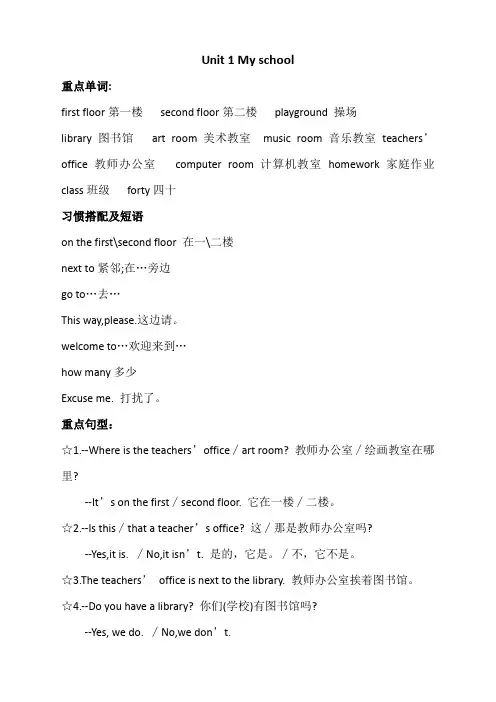
Unit 1 My school重点单词:first floor第一楼second floor第二楼playground 操场library 图书馆art room美术教室music room 音乐教室teachers’office教师办公室computer room计算机教室homework家庭作业class班级forty四十习惯搭配及短语on the first\second floor 在一\二楼next to紧邻;在…旁边go to…去…This way,please.这边请。
welcome to…欢迎来到…how many多少Excuse me. 打扰了。
重点句型:☆1.--Where is the teachers’office∕art room? 教师办公室∕绘画教室在哪里?--It’s on the first∕second floor. 它在一楼∕二楼。
☆2.--Is this∕that a teacher’s office? 这∕那是教师办公室吗?--Yes,it is. ∕No,it isn’t. 是的,它是。
∕不,它不是。
☆3.The teachers’office is next to the library. 教师办公室挨着图书馆。
☆4.--Do you have a library? 你们(学校)有图书馆吗?--Yes, we do. ∕No,we don’t.语法点:特殊疑问句Where’s the+事物? ……在哪里?及其回答:It’s+表地点的介词短语。
它……一般疑问句:--Do you have+某物?你\你们有……吗?肯定回答:--Yes,I\we do.否定回答:--No,I\we don’t.Is this∕that…? 这∕那是…?肯定回答:--Yes,it is.否定回答:No,it isn’t.。
人教PEP版四年级英语下册Unit 4 At the farm知识点归纳
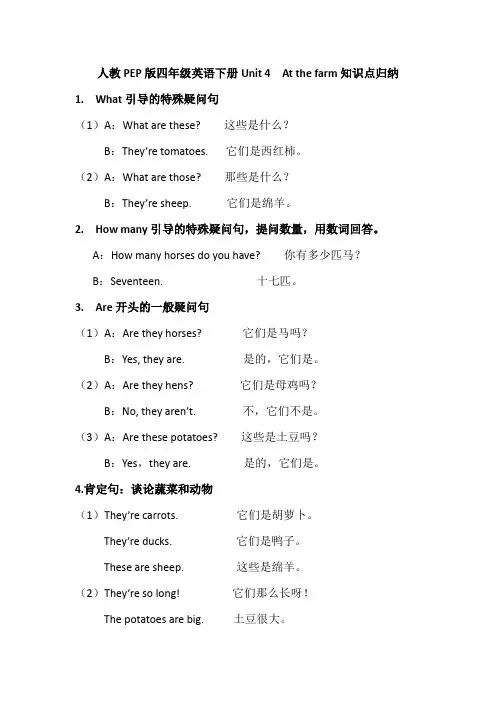
人教PEP版四年级英语下册Unit 4 At the farm知识点归纳1. What引导的特殊疑问句(1)A:What are these? 这些是什么?B:They’re tomatoes. 它们是西红柿。
(2)A:What are those? 那些是什么?B:They’re sheep. 它们是绵羊。
2. How many引导的特殊疑问句,提问数量,用数词回答。
A:How many horses do you have? 你有多少匹马?B:Seventeen. 十七匹。
3. Are开头的一般疑问句(1)A:Are they horses? 它们是马吗?B:Yes, they are. 是的,它们是。
(2)A:Are they hens? 它们是母鸡吗?B:No, they aren’t. 不,它们不是。
(3)A:Are these potatoes? 这些是土豆吗?B:Yes,they are. 是的,它们是。
4.肯定句:谈论蔬菜和动物(1)They’re carrots. 它们是胡萝卜。
They’re ducks. 它们是鸭子。
These are sheep. 这些是绵羊。
(2)They’re so long! 它们那么长呀!The potatoes are big. 土豆很大。
They’re so cute! 它们真可爱呀!5.其他句子(1)I like tomatoes. 我喜欢西红柿。
I like potatoes. 我喜欢土豆。
(2)Let me try one. 让我尝一个。
Let me count. 让我数一数。
(3)I feel sleepy. 我觉得困了。
(4)Look at these. 看这些。
Look at the green beans. 看豆角。
(5)Try some! They’re good. 尝一些吧。
它们很好。
(6)I love to eat green beans. 我爱吃豆角。
人教版四年级下册英语知识点汇总
人教版四年级下册英语知识点汇总一、词汇1. 日常生活词汇•家庭生活相关词汇(如bedroom, living room, kitchen, bathroom等)•家具与家居用品(如table, chair, sofa, bed, lamp, fridge等)•服装与配饰(如shirt, dress, skirt, shoes, hat, scarf等)•餐饮词汇(如breakfast, lunch, dinner, rice, noodles, soup等)2. 学校与学习•学习用品与文具(如pencil case, eraser, ruler, crayon, marker等)•学科词汇(如Chinese, English, Maths, Music, PE等,可进一步拓展)•学校设施与活动(如classroom, playground, library, reading, singing等)3. 自然与天气•季节与天气词汇(如spring, summer, autumn, winter, sunny, rainy, windy 等)•自然界元素(如flower, tree, grass, river, mountain等)4. 社交与情感•社交用语(如excuse me, thank you, sorry, please等)•情感表达(如happy, sad, tired, hungry, thirsty等)二、语法1. 现在进行时复习•巩固现在进行时的基本结构和用法,能够准确描述正在进行的动作。
2. 一般现在时•深入学习一般现在时的用法,特别是第三人称单数形式的动词变化。
•能够用一般现在时描述日常习惯、事实或真理。
3. 介词与连词•学习并掌握常用介词(如in, on, under, near, by, with等)和连词(如and, but, or等)的用法。
4. 特殊疑问句与回答•熟练使用特殊疑问词(如what, where, who, when, why, how等)提问,并能给出恰当的回答。
四年级英语下册各单元知识点归纳
四年级英语下册各单元知识点归纳Unit 1: Friends1. Greetings and introductions:- How to greet someone: "Hello," "Hi," "Goodmorning/afternoon/evening."- How to introduce oneself: "My name is [name]."2. Classroom objects:- Vocabulary related to classroom objects: desk, chair, book, pencil, eraser, etc.- How to ask for classroom objects: "Can I have a pencil, please?"3. Daily routines:- Vocabulary related to daily routines: wake up, brush teeth, have breakfast, go to school, etc.- How to talk about daily routines: "I wake up at 7 o'clock."4. Family members:- Vocabulary related to family members: mother, father, sister, brother, etc.- How to talk about family: "This is my brother. His name is Tom."5. Colors:- Vocabulary related to colors: red, blue, yellow, green, etc.- How to describe colors: "The sky is blue."Unit 2: Animals1. Animal names:- Vocabulary related to animals: dog, cat, bird, fish, etc.- How to identify animals: "Look at the bird in the tree."2. Animal sounds:- Vocabulary related to animal sounds: bark, meow, tweet, etc.- How to describe animal sounds: "Dogs bark."3. Food and habitat:- Vocabulary related to animal food: meat, plants, etc.- Vocabulary related to animal habitat: forest, ocean, zoo, etc.4. Body parts:- Vocabulary related to animal body parts: head, tail, wings, etc.- How to describe animal body parts: "A bird has wings."5. Classification of animals:- Vocabulary related to animal classification: mammals, reptiles, birds, etc.- How to classify animals: "A snake is a reptile."Unit 3: Food and Drinks1. Food names:- Vocabulary related to food: apple, bread, milk, juice, etc.- How to describe food: "I like apples."2. Drinks:- Vocabulary related to drinks: water, tea, coffee, soda, etc.- How to ask for drinks: "Can I have a glass of water, please?"3. Likes and dislikes:- Vocabulary related to preferences: like, love, dislike, hate, etc.- How to express likes and dislikes: "I love pizza."4. Healthy and unhealthy food:- Vocabulary related to healthy food: fruits, vegetables, etc.- Vocabulary related to unhealthy food: fast food, sweets, etc.5. Table manners:- Vocabulary related to table manners: chew, eat with a fork, use a napkin, etc.- How to talk about good table manners: "We should chew our food."Unit 4: Weather1. Weather conditions:- Vocabulary related to weather: sunny, rainy, cloudy, windy, etc.- How to describe the weather: "It's sunny today."2. Seasons:- Vocabulary related to seasons: spring, summer, autumn, winter, etc.- How to talk about seasons: "My favorite season is summer."3. Weather clothing:- Vocabulary related to clothing: coat, hat, umbrella, etc.- How to talk about weather clothing: "I wear a coat when it's cold."4. Weather activities:- Vocabulary related to weather activities: swim, play in the snow, fly a kite, etc.- How to talk about weather activities: "We can swim in the summer."5. Weather forecasts:- Vocabulary related to weather forecasts: temperature, rain showers, etc.- How to understand weather forecasts: "The temperature will be 25 degrees Celsius."These are some of the key knowledge points for each unit in the fourth-grade English textbook. Understanding and studying these topics will help students improve their English language skills and broaden their vocabulary.。
pep四年级下册英语知识点
pep四年级下册英语知识点
PEP四年级下册英语是小学英语教学中的一个重要阶段,它在帮助学生巩固和拓展基础知识的同时,也注重培养学生的英语听说读写能力。
以下是一些四年级下册英语的主要知识点:
1. 词汇:学生需要掌握的词汇量会有所增加,包括日常生活用品、学校用品、食物、动物、颜色、数字等。
2. 句型:学生将学习如何使用基本的英语句型来表达自己,例如询问和回答个人信息,表达喜好,描述日常活动等。
3. 语法:四年级下册英语会介绍一些基础的英语语法规则,如名词的单复数,动词的时态,形容词和副词的使用等。
4. 听力:通过听力练习,学生能够理解简单的英语对话和短文,识别关键词和信息。
5. 口语:鼓励学生参与对话练习,提高他们的口语表达能力,包括自我介绍、日常交流等。
6. 阅读:通过阅读简单的英语故事和文章,学生能够理解基本的故事情节和主题。
7. 写作:学生将学习如何写简单的句子和段落,如写日记、书信等。
8. 文化知识:通过学习英语,学生也会接触到一些与英语国家相关的文化知识,如节日、习俗等。
9. 歌曲和韵律:通过学习英语歌曲和韵律,学生可以在轻松愉快的氛
围中学习语言。
10. 游戏和活动:通过参与英语游戏和活动,学生可以在实践中巩固
所学知识。
在教学过程中,教师应注重激发学生的学习兴趣,通过多样化的教学
手段,如角色扮演、小组合作、互动游戏等,让学生在轻松的环境中
掌握知识。
同时,也要鼓励学生积极参与,培养他们自主学习的能力。
通过一学期的学习,学生应能够达到一定的英语听说读写能力,并为
更高年级的英语学习打下坚实的基础。