
高中英语人教版 必修5 unit1 Great scientists
高中英语 Unit1 Great scientists综合检测 新人教版必修5

高中英语 Unit1 Great scientists综合检测新人教版必修5(满分100分)Ⅰ.单项填空(共15小题;每小题1分,满分15分)1.Cars do cause us some health problems—in fact far more serious ______ than mobile phones do.A.one B.onesC.it D.those2.I don't think he will pass the exam,______?A.do I B.don't IC.will he D.won't he3.______ the ending,it's a really good film.A.Apart from B.As well asC.Besides D.Instead of4.What do you think of the suggestion ______ by the expert?A.put forward B.put up withC.put off D.put out5.—Can I help you,sir?—Yes,I bought this radio here yesterday,but it ______.A.didn't work B.won't workC.can't work D.doesn't work6.From the ______ look of the boys,I found they were ______.A.satisfying;satisfied B.satisfying;satisfyingC.satisfied;satisfied D.satisfied;satisfying7.The result of this discussion will be ______ tomorrow.A.published B.declaredC.announced D.opened8.Before using the machine,you must ______ carefully to these instructions.A.join B.join inC.take part in D.attend9.With the world ______ fast,we have something new to face every day.A.changed B.changingC.change D.to change10.The bridge being built now will link our town ______ that big city.A.over B.onC.to D.about11.It is widely believed that laughter has ______ effect on physical and mental health.A.positive B.popularC.energetic D.sensitive12.Our monitor is not only strict ______ us,but also cautious ______ expressing her ideas in public.A.with;in B.on;ofC.with;about D.in;about13.It is human being rather than pigs that are ______ for the disastrous H1N1 flu circling the globe.A.to be blamed B.to have blamedC.blaming D.to blame14.No matter how I tried to read it,I just couldn't make ______ of this sentence.A.meaning B.thoughtC.sense D.idea15.Don't stop ______ you come to a word or a phrase you don't know.A.for the first time B.becauseC.every time D.sinceⅡ.完形填空(共20小题;每小题1.5分,满分30分)A successful scientist is generally a good observer.He makes full __16__ of the facts he observes.He doesn't accept ideas which are not __17__ on obvious facts,and therefore refuses to accept authority(权威)as the only __18__ for truth.He always __19__ ideas carefully and makes experiments to prove them.The rise of __20__ science may perhaps be considered to __21__ as far back as the __22__ of Roger Bacon,the wonderful philosopher of Oxford,who lived __23__ the years 1214 and 1292.He was probably the first in the Middle __24__ to suggest that we shoul d learn science __25___ observing and experimenting on the things around us,and he himself __26__ many important discoveries.Galileo,however,who lived more than 300 years later,was the greatest of several great men,__27__ lived in Italy,France,Germany or England,began by __28__ to show how many important __29__ could be discovered by o bservation.Before Galileo,learned men believed that large bodies fell more __30__ towards the earth than small ones,__31__ Aristotle said so.But Galileo,going to the __32__ of the Leaning Tower of Pisa,let fall two __33__ stones and proved Aristotle was wrong.It was Galileo's __34__ of going direct to N ature,and proving our __35__ and theories by experiments,that has led to all the discoveries of modern science.16.A.use B.time C.speed D.trust17.A.worked B.based C.lived D.written18.A.reason B.cause C.advice D.result19.A.thinks B.checks C.has D.learns20.A.natural B.physical C.ancient D.modern21.A.date B.keep C.look D.take22.A.study B.time C.year D.birth23.A.both B.each C.between D.among24.A.Schools B.Ages C.Days D.Countries25.A.in B.with C.on D.by26.A.did B.made C.took D.gave27.A.who B.when C.that D.where28.A.ways B.degrees C.levels D.chance29.A.truths B.problems C.people D.subjects30.A.slowly B.rapidly C.lightly D.heavily31.A.when B.because C.although D.if32.A.place B.foot C.top D.ceiling33.A.big B.small C.equal D.unequal34.A.spirit B.skill C.theory D.discovery35.A.plans B.opinions C.world D.abilityⅢ.阅读理解(共20小题;每小题2分,满分40分)AScientists in the United States have developed a computer program that they say could provide an early warning of major earthquakes.The new system is designed to give warnings seconds before an earthquake strikes.That may not sound like very long.However,it could give people time to get under a table or take shelter someplace safe.The flow of electric power or gas could becut off.Air traffic controllers could warn away pilots.Even socalled “smart buildings” could be de signed to get ready.The system uses a mathematical program to measure information collected by instruments deployed across the Los Angeles area.Southern California has more than 150 seismic(地震的)stations that measure movements within the ground.The information they collect is sent to a highspeed computer.An earthquake shakes the ground with two kinds of waver.The new system uses information from a lowenergy wave that moves quickly but causes little damage.Experts call thi s the Pwave.The slower but stronger Swave is the main threat to life and property.Japan has a system based on Pwaves.There,the warnings are used to slow down highspeed b ullet trains.Other countries have warning systems that measure Swaves.The new system is designed to estimate the strength of the earthquake once the shaking starts.Areas directly above the center of the earthquake would have the least warning.Distant places might have as long as forty seconds.The scientists are still testing their proposed system in the Los Angeles area.Professor Allen notes that an early warning system for earthquakes would require a major campaign of public education.36.Which of the following is TRUE about the new earthquake warning system?A.It can give people enough time to run away from earthquakes.B.It can give people seconds to take immediate measures.C.It is developed in Japan.D.It is a system based on Swaves.37.Which of the following can benefit from the new system most?A.Areas far away from the center of the earthquake.B.Areas directly above the center of the earthquake.C.The Los Angeles area.D.Highspeed bullet trains.38.From what Professor Allen notes in the last paragraph we can infer that ______.A.it's very important for people to become educatedB.it's very important to warn people before an earthquake startsC.it's very important for people to know about earthquakesD.it's very important for people to know about the new system39.What do we learn from the passage?A.People could cut off electric power or gas immediately after the new system gives a warning.B.A lowenergy wave may move slowly and cause little damage.C.Japan has a warning system based on Swaves to slow down bullet trains.D.The new system has been employed in warning of major earthquakes all over the United States.40.What's the BEST title fo r the passage?A.A New Earthquake Warning SystemB.Earthquakes Caused by Different Kinds of WavesC.Warning Systems in Different CountriesD.The Principle of a New Warning SystemBAlbert Einstein had a great effect on science and history,and his achievement was even greater than only a few other great scientists have achieved.An American university president once said that Einstein had made a new outlook,a new view of the universe.It may be some time before the average mind understands fully theidentity(识别)of time and space and so on—but even ordinary men now understand that the universe is something larger than ever thought before.By 1914 young Einstein had been worldfamous.He accepted the offer to become a professor at the Prussian Academy of Science in Berlin.He had few duties,little teaching and unlimited chances for study,but soon his peace and quietness were broken by World War Ⅰ.Einstein hated fighting and killing.The great suffering of war affected him deeply,and he sat unhappily in his office doing little.He lost interest in his research.Only when peace came in 1918 was he able to get back to work.In the year following World War Ⅰ honors were increasingly put on him.He became head of the Kaiser Whihem Institute of Theoretical Physics.But he himself refused the effort to put him in a position far above other people.He was well known for his humble(谦逊的)manner.He often said that his success would certainly have been achieved by others if he had never lived.In 1921 he won the Nobel Prize,and he was honored in Germany until the rise of Nazism(纳粹)when he was driven from Germany because he was a Jew.41.The main idea of the first paragraph is ______.A.the difficulty of Einstein's thought to othersB.the feeling of an American university president towards EinsteinC.the difference between science and historyD.the change in human thought produced by Einstein42.It seems to the American university president that ______.A.Einstein achieved more than any other scientist in historyB.everybody understands Einstein's scientific ideasC.the new view of the universe can be quickly learned by everyoneD.our ideas about the universe are different today because of Einstein43.Between 1914 and 1918 Einstein ______.A.received worldwide praiseB.had no chances for studyC.almost did nothing in his officeD.still continued his scientific research44.Einstein did his greatest work ______.A.when Nazism roseB.when he was youngC.during World War ⅠD.after he left EuropeCIn 1901 a German scientist named William Roentgen received the first Nobel Prize in Physics.He had discovered Xrays.He made his discovery when he noticed that in certain experiments a special kind of light was made by the cathode rays(阴极射线)hitting a screen.The other scientists working with him had noticed this light but they did not think it was important.Roentgen was the first person to ask himself questions about this special kind of light.When he examined it,he discover ed a new kind of radiation called Xrays.We often think that a creative idea suddenly comes into our heads from nowhere.This is not usually the case—it comes because we are ready to receive it.When someone asked Issac Newton how he had discovered the laws of gravity(引力),he replied,“I am certain that any mind working on a problem continuously will be prepared for the sudden answer.”Albert Einstein received the Nobel Prize in Physics in 1921 and said that there are discoveries waiting to be made if people continue to look and study all the time.One of the problems facing creative people is that their ideas may be too new for the rest of the world.It often happens that people laugh at the work of artists and scientists.Barbara McClintock is a good example of someone who continued to think she was right although for 30 years other scientists thought that she was wrong.Finally,her work proving that genes(基因)can make sudden changes in heredity (遗传)won her the Nobel Prize in 1983.Many creative people looking for ideas or solutions find them in a visual(幻觉)form first.Elias Howe,the man who invented the sewing machine,had a big problem facing him.He could not understand how to connect the needle to the rest of the machine.Needles had always had a pointed end.One ni ght in a dream he was“attacked”by people with sharp spears(矛).In the morning he said,“There is the answer staring me in the face!”He made a hole in the sharp end of the needle and then connected it to the sewing machine.45.We can infer from the passage that“creativity”means ______.A.the imagination to find a way of doing thingsB.the plan to make an important discoveryC.the ability to make something differentD.the power to make something new46.The writer's purpose in writing this passage is ______.A.to tell some interesting storiesB.to prove that people are creative in many waysC.to praise some great scientistsD.to explain why some people are clever47.Which of the following statements is BEST supported by the third paragraph?A.Believe in your own ideas.B.Pay attention to your dreams.C.Ask questions about everything around you.D.Collect as much information as you can.48.Which of the following statements is FALSE?A.You can be more creative if you read a lot.B.You can improve your creativity by asking lots of questions.C.You can help your creativity by getting into the habit of thinking about ordinary things.D.Doing a lot of preparation can help you be more creative.DAnthropologists are scientists that study people who often lived hundreds or even thousands of years ago.Items those men,women,and children left behind when they died—everything from clothing to jewelry and tools—tell anthropologists a lot.And sometimes even their words survive.Experts believe that a discovery in Mexico is the oldest example of writing ever found in America.The people who created it probably lived 3,000 years ago,long before Christopher Columbus arrived in the New World.Workers digging in a rock mine happened to notice a stone block with marks carved onto its surface.They found the large piece of stone near the city of Cascajal,Mexico,which was once the capital of an ancient people called the Olmec.“There are signs on the block that seem to show objects used by the Olmec during their religious ceremonies,”says Dr.Stephen H ouston,of Brown University in the USA.“There is a sign that looks very similar to a knife and another that looks like the chair of a King,”he explains.Houston,an expert on the writing systems of ancient cultures,says the discovery is exciting because“it m akes clear that the Olmec could read and write.It is likehearing voices from the past.”But experts don't know exactly what the writing says.Finding other examples of Olmec writing could help decipher the puzzle.“We could have whole sets of ancient writi ng which will basically make ancient people speak to us directly,”says Houston.“There are many puzzles to be solved,and this is just one of them.”49.According to the passage,what items do scientists often use to learn more about the past?A.Clothing and jewelry.B.Books and stones.C.Knives and chairs.D.People and animals.50.What is important about the stone block mentioned in the passage?A.It proves that people lived in this part of the world more than 3,000 years ago.B.It allows scientists to translate the ancient language used in this area.C.It is evidence of the oldest form of writing ever found in America.D.It shows the people of the area have a written language.51.Why are scientists interested in ancient languages?A.It can allow them to better understand ancient societies.B.So they can speak directly with ancient people.C.It will help learn about the origins of modern languages.D.They can learn stories told during that time.EMany parents don't love to read to their children.But there are so many professionals and PhDs doing the opposite thing.And they really promote reading to children,which is so good for children.I have found that this is true with my own children.I am not sure if it is the book or the fact that you are spending quality time with them,undivided time that they will remember for their entire life.Reading to children is one of the most bonding experiences you can have.Children enjoy sitting on your lap while your voice flows over them.As the reader it is fun to watch their little face s as they are moved with the flow of the story.They are laughing one moment and on the next page the story has moved them to tears.As the story teller,I am just as moved as they are;I am caught up in the story as our emotions flow up and down.You can easily lose a whole afternoon in reading.This is an experience that children then try to pass on to younger children,reading books to them.My daughter was so into reading that if she couldn't line up some neighbors' children she could be reading her books to,she would line up her stuffed animals and read to them.Well,she also tried to teach her neighbors and teddy bears math,and “ocean science” as she called it.She would read anything she could to them.And to my astonishment the neighbors' parents told me they really appreciated the fact that their children were doing so much better in school.52.The writer mentions the idea of professionals and PhDs so as to ______.A.introduce his own viewpointB.show the importance of his ideaC.please readersD.attract the attention of readers53.The writer mentions his own daughter in this text for the purpose of ______.A.showing the cleverness of his childrenB.explaining the advantages of reading to daughterC.telling the importance of studying together with parentsD.showing his children were interested in reading54.The writer thinks that ______.A.you should place your children on your lap while reading to themB.children's feelings change while you read books to themC.it is easy to kill time while you are reading books to childrenD.reading to children is one of the most interesting experiences55.According to the text,which of the following is NOT true about the writer's daughter?A.She lined up some neighbors' children and read to them.B.She lined up her stuffed animals and read to them.C.She would teach her teddy bears math and “ocean science”.D.She would read anything she could to her parents.附加题下面文章中有5处(第1~5题)需要添加小标题。
人教版英语必修5:Unit 1 Great Scientists - Lanugage points

of 的意思是“因……而死”,常表示 由于疾病、饥饿、年老、情感等原因引起 的死亡。例如: He died of old age. 他寿终正寝了。 In a cold winter, many wild animals may die of hunger. 在严寒的冬天,很多野生动物可能饿死。 The old woman died of grief soon after her husband's death. 那位老太太在丈夫去世 后不久因悲伤而死。
Who
did you have____ (paint) the wall yesterday? I’m sorry I can’t help you because I have a lot of letters __ (answer). The villagers are going to have a new bridge ___ (build) over the river. Who had the candle____ (burn) throughout the whole night?
Unit 1 Great Scientists
Language Points
1. die from 表示“死于……原因”,常 用于表示“由外因引起的死亡” die of表示“死于……原因”,常用于 表示“由疾病或内因引起的死亡” 这里,由于but引导两个并列句,根据 省略的要求,并列句中相同的部分可 以省略,some后面应接的是die of, 根 据省略要求,它与前面的die of 一样, 因此可以省略。所以,答案是C
3. attend vt., vi.
To
be present at; go to (meeting, conference, lecture…) He decided to attend the meeting himself. To look after, care for, serve Which doctor is attending to (on) you? To go with The work was attended with much difficulty. attendance n. There is a doctor in attendance.
高中英语Unit1GreatscientistsSectionⅢGrammar_过去分词作定语和表语教案(含解析)新人教版必修5
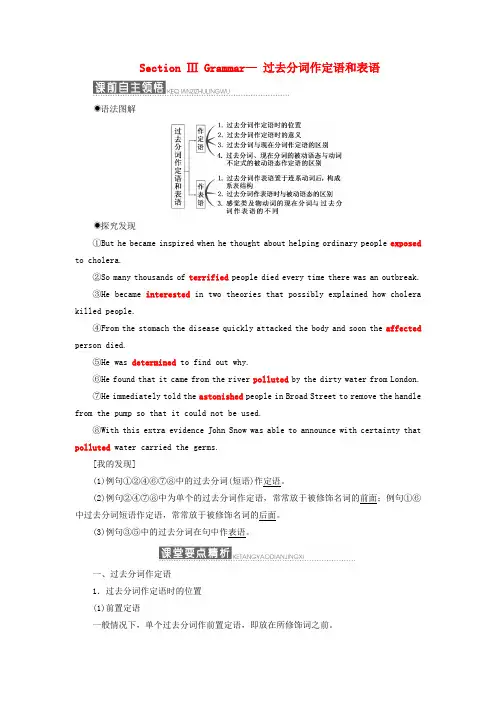
Section Ⅲ Grammar—过去分词作定语和表语语法图解探究发现①But he became inspired when he thought about helping ordinary people exposed to cholera.②So many thousands of terrified people died every time there was an outbreak.③He became interested in two theories that possibly explained how cholera killed people.④From the stomach the disease quickly attacked the body and soon the affected person died.⑤He was determined to find out why.⑥He found that it came from the river polluted by the dirty water from London.⑦He immediately told the astonished people in Broad Street to remove the handle from the pump so that it could not be used.⑧With this extra evidence John Snow was able to announce with certainty that polluted water carried the germs.[我的发现](1)例句①②④⑥⑦⑧中的过去分词(短语)作定语。
(2)例句②④⑦⑧中为单个的过去分词作定语,常常放于被修饰名词的前面;例句①⑥中过去分词短语作定语,常常放于被修饰名词的后面。
英语:unit1《Great scientists》Period4课件(新人教版必修5)
4 Jessica was expensive. The family was deep in
Things were bad. Roland saw no light at the 6
5
.
of this tunnel
(隧道). Then he saw an ad in the newspaper: “Security guards
【 解 析 】 选 D 。 Roland 和 Sheila 夫 妇 有 三 个 孩 子 , 从 句 末 “two boys and baby Jessica”判断。 2. A. other B. another C. puzzling D. strange
7
, $150, 000 a year. ”
He called the number. The line was busy, but he
were all taken, 9
8
calling and finally got through. He was worried that the jobs they told him plenty of jobs were still 10 in 11 him to Iraq for his assignment. available. They said they would give him two weeks of Texas. Then they would
【解析】选 D。 devote to 意为“致力于”; stick to 意为“坚 持”;refer to意为“提及;参考”。句意为“正是晚上睡得 晚才导致了上班迟到”。lead to意为“导致”,其中的to为介 词,后跟动词时应用 -ing形式。该句为强调句型,即Sleeping late in the evening leads to being late for work. 的强调形式。
Unit 1 Great Scientists Reading 课件-高中英语人教新课标必修五
People absorbed it with their meals.
2023/1/25
(3) aiming to kill or destroy 意在杀死的; 不共戴天的: a deadly enemy 不共戴天的敌人 2)deadly adv. (1) very 极度; 非常; 十分 deadly serious 十分认真 (2) like death 死一般地
John Snow was a well-known _d_o_c_to_r_ in London in the _1_9_th__ century. He wanted to find the _c_a_u_s_e_ of cholera in order to _d_e_fe_a_t_ it. In 1854 when a cholera _b_r_o_k_e_ out, he began to gather information.
He _m__a_r_k_e_d__ on a map where all the dead people had lived and he found that many people who had drunk the dirty water from the _p_u_m__p_ died. So he decided that the polluted water carried cholera. He suggested that the _s_o_u_r_ce__ of all water supply be _e_x_a_m__in_e_d__ and new methods of _d_e_a_l_in__g_ with polluted water be found. Finally, “King Cholera” was defeated.
高中英语 Unit 1 Great scientists Period 3 优秀教案 新人教版必修5
用心 爱心 专心 1 The General Idea of This Period This is the third period of this unit. At the beginning of this period, the teacher should (can) design some exercises to review what the students learned in the last period, that is to say, go over what the students learned about that John Snow defeats“King Cholera”. The teacher can begin with asking some questions or having a competition to make some sentences with“John Snow”according to the passage. During this period, listening and speaking will be mainly dealt with. At the beginning, teachers focus on training the Ss’ listening. This listening content is about the importance of Qian Xuesen for space travel in China, the contributions made by a botanist named Carl Linnaeus and the research into the life and work of a mathematician called Leonhard Euler. When training the Ss’ listening ability, teachers should start with pre-listening, that is, lead-in. If it is necessary, teachers had better introduce some background knowledge about the listening material. Later, let the Ss listen to it. At the same time, teachers should design some simple questions. After that, the Ss have known about the listening material, and then teachers can ask them to listen to it again to be ready for more difficult questions. If necessary, the Ss can be given another time to listen. While practicing, teachers had better offer students some advice on how to do it well. Especially, train the students to predict what to be talked about according to the hints and limited information and let them form the good listening habit of listening with the purpose of finding useful information and to summarize. Certainly, suppose there are many new words and expressions, teachers should help them to deal with them at the first place. All the listening practice should focus on developing the students’ listening skill. After practicing listening, the Ss are expected to learn some expressions about talking about scientific job as well as scientists’ achievements and recount stories. Besides those, the students are expected to learn the skill of describing a person. During the course, teachers should rank class activities from the easy to the difficult. First, ask them to learn the expressions. Then, ask them to imitate it to have a dialogue. Finally, the students are expected to create a dialogue or discuss the given topic. In order to draw students’ attention, the teacher had better prepare for some interesting situations. This period centers on emphasis on speaking and listening. The teacher should try his or her best to encourage the students to say something. Don’t always correct the mistakes that the students would make while speaking. Otherwise, the students would feel reluctant to speak out their opinions. Teaching Important Points Train the students’ speaking ability by describing, talking and discussing. Help the students improve their listening ability. Teaching Difficulties Train the students’ listening ability. Especially listen and understand what the speakers mean beyond words. Teaching Aids a tape recorder, a projector and the blackboard Three Dimensional Teaching Aims Knowledge aims: Let the Ss know about some scientists and their life and contributions. Get the Ss to learn how to talk about scientific work and how to describe a person. Ability Aims: 用心 爱心 专心 2
2012版高中英语全程复习方略配套课件:Unit1《Great scientists》(新人教版必修5)
Neither (既不)its cause nor (也不)its cure was understood.
2. every time用作从属连词引导从句 So many thousands of terrified people died every time (每 次)there was an outbreak.
3. have sth. done结构
A woman,who had moved away from Broad Street,liked the water from the pump so much that she had it delivered (让人运送水)to her house every day. 4. prevent. . . from doing sth. 防止/阻止……做某事; suggest(建议)+宾语从句 To prevent this from happening (为防止这种情况发生)again, John Snow suggested that the source of all the water supplies
【解析】选C。考查“介词+关系代词”引导的定语从句。此
句中介词on和先行词basis构成固定搭配。
1. He______ from their remarks that they were not in favor of the plan. A. concluded B. made C. put D. attended
【解析】选 A。句意:他从他们的话语中推断出他们不赞同
这项计划。conclude推断出,符合句意。
Unit 1《Great scientists》教案2(人教版必修5)
Module 5 Unit 1 Great scientists遂昌中学刘仁海分课时教案Period 1 Warming up, Pre-reading & ReadingTeaching goals:1.To talk about some great scientists and their achievements.2.To develop some basic reading skills.3.To get the general idea of the passage and to relate the passage to stages in a scientific experiment. Teaching procedures:Step one Warming upIntroduce some famous scientists and their achievements, and then do the quiz.There are some great scientific achievements that have changed the world. Can you name some of them? What kind of role do they play in the field of science? Do these achievements have anything in common? Match the inventions with their inventors below before you answer all these questions.Alexander Bell electricityThomas Edison the First telephoneLaite Brothers the electric LampMadame Curie black holes in UniverseFranklin Theory of GravitySteven Hawking the First PlaneElbert Einstein RadiumIsaac Newton the Theory of RelativityStep two Reading1.Pre-reading:1). Pair work : What do you know about infectious diseases?2). Group work: Do you know how to prove a new idea in scientific research? Discuss in small groups the stages in examining a new scientific idea. What order would you put them in?draw a conclusion think of a method collect results make up a questionfind a problem analyse the results find supporting evidence repeat if necessary2. While-reading:1).Predicting:Introduce the title of the passage—John Snow Defeats King Cholera.●What does the title imply?●Predict what the text is about after reading the title and the first paragraph.●Guess what kind of person John Snow was by analyzing the key words in the first paragraph.2). Skimming:●Get the students to read the passage fast . Ask them to pay attention to the first sentence in each paragraph andtry to find several key words to sum up the main idea of the whole passage.●Compare what the students have predicted with the content given by the author.●Read the passage again to get the general idea of each paragraph.Para.1: The causes of cholera.Para.2: The correct or possible theory.Para.3: Collect data on those where people were ill and died and where they got their water. Para.4: Plot information on a map to find out where people died or did not die.Para.5: Analyse the water to see if that is the cause of the illness.Para.6: Find other evidences to confirm his conclusion.Para.7: The polluted dirty source of drinking water was to blame for the cause of the London cholera.3). Scanning:●Read the passage and try to put the correct stages into the reading about research into a disease.A. draw a conclusionB. think of a methodC. collect resultsD. make up a questionE. find a problemF. analyse the resultsG. find supporting evidenceH. repeat if necessaryKeys: E→D→B→C→F→G→A●Answer some detailed questions about the passage and learn some language points:1. Wha t do you know about Dr. John Snow’s being well-known in London?(He attended Queen Victoria to ease the birth of her babies.).e.g. I may be late – I have got one or two things to attend to.Mother had to attend to her sick son .2. From what disease did Londoners suffer in his age?(They exposed themselves to cholera.).e.g. The wolf opened its mouth to expose a row of sharp teeth.Don’t expose your skin to the sun; your skin will be hurt.People in many provinces of China exposed themselves to the SARS in 2003.3. Did people know how to cure the disease?e.g Aspirin is said to be a wonderful cure for the pain.Although the boy was beyond cure, his parents tried to cure him of bad habits.4.When did Dr. Snow think the disease would be controlled?(He knew he would never be controlled until its cause was found.)e.g. The Ministry of Health has set up a program to control the spread of AIDSThe buttons control the temperature in the building5. What was the second theory explaining how the disease killed people?(People absorbed this disease into their bodies with their meals.)be absorbed in = concentrate oneg. He is absorbed in the research of Chinese history recently.absorb one’s attentioneg. Chinese history absorbs his attention recently.5.How serious was the disease outbreak in London?(The cholera outbreak was so severe that more than 500 people had died in 10 days.)e.g. He has such a severe illness that he has been in hospital.I was caught in a severe storm last night and couldn’t go back home in time.7. Did the map which Dr. Snow draw help find the cause of the disease?(The map gave a valuable clue about the cause of the disease.)e.g. -- What is the value of this 18k white gold diamond necklace?-- It cost me $2,000 (=It was worth $2,000.),but I valued the necklace at $1,000.It was a valuable diamond necklace.We never know the value of water till the well is dry.8. Where were many of the deaths in Broad Street?(Many of the deaths were near the water pump in Broad Street.)e.g. If you have a flat tyre, you will pump air into the tyre.We had a debate yesterday. The lively debate really pumped us up.9. Why did some houses have no deaths?(These families worked in the pub at 7 Cambridge Street. They were given free beer and so had not drunkthe water from the Broad street pump.)10. What did Dr. Snow think was responsible for the disease?(It seemed the water was to blame.)e.g. They blamed the secretary for the delay of the plan.The driver was not to blame for the traffic accident.He is ready to take the blame for what had happened.11. What did Dr. Snow advised the people in Broad Street do?(He told the people to remove the handle from the water pump so it could not be used.)12. What else did Dr. Snow find in another part of London that were linked to the Broad Street outbreak?(In addition, he found 2 other deaths.)e.g. The new bridge will link the island to the mainland.Compare: in addition, also, as well as, besidesIn addition to apples you asked for, I bought you some oranges.13. What conclusion did Dr. Snow tell the public?(He announced that polluted water carried the disease.)e.g. The captain announced that the plane was going to land.The army announced a cease-fire.14. What did Dr. Snow tell the water companies?(They were instructed not to expose people to polluted water anymore.)e.g. She instructed me in the use of this telephone.I've been instructed to wait here until the lecturer arrives.3. Post-reading:Work in groups of four and discuss the following questions:1).What should you do if you're traveling to a country that has a cholera outbreak according to Snow’s theory? (Drink only water that you have boiled or treated with chlorine or iodine. Other safe drinks include tea or coffee made with boiled water and carbonated, bottled beverages with no ice. Eat only food that's been thoroughly cooked and is still hot, or fruit that you've peeled yourself. Avoid undercooked or raw fish and shellfish. Avoid raw salads and vegetables. Avoid food and drinks from street vendors.)2.) What spirit can we find in John Snow? As a student, what should we learn from him? Step three ConsolidationListen to the tape and get a better comprehension of the passage. While listening , pay special attention to the new words and expressions as well as the sentence structures they have learned. Step four Homework1.Read the passage aloud after class.2.Prepare for comprehending and learning about language.3.Writing: What I think of John Snow.Period 2 Comprehending & learning about language.Teaching goals:1.To find the scientific report by John Snow and to further understand the passage.2.To get a better understanding of the passage.3.To discover useful words and expressions, structures.Teaching procedures:Step one Revision1.Ask some students to read the text aloud fluently.2.Check the homework exercises.Step two Comprehending1.Fill in the chart after reading the passage.2.Read the passage again and answer these questions.1). Cholera was a 19th century disease. What disease do you think is similar to cholera today?2). John Snow believed Idea 2 was right. How did he finally prove it?3). Do you think John Snow would have solved this problem without the map? Give a reason.Step three Learning about the language1.Discovering useful words and expressions.1)Choose the suitable words or expressions to complete this passage: valuable, instruct, cure, expose, look into, examine, put forward, immediately, announceLi Heping was a famous football player, but his career came to an end when he became very ill. The doctor _________ him but could not find the cause of this illness. He___________ the theory that Li Heping had been _______ to a new virus. He knew he would not be able to ____ him___________, but promised he would ________the possibility of finding one in the future. Sadly, Li Heping __________ that he would take up a new career to _______ footballers in planning for the future. At his last match he thanked his fans for their _______ support by singing the popular song: “Thanks for the memory”.2). Sometimes in English we put the verb make with a noun instead of using a simple verb; for example, make a mistake instead of to mistake. Look at these simple verbs and make another construction using make + a + noun.3). In English verbs like make are very active and useful. Try to remember them and make sentences with the following words.make a face make friends make money make up one’s way to make suremake a decision make up one’s mind make the bed make room for4). This is a report on living conditions in England in the nineteenth century. Choose the correct verb or conjunction to put into the text. Each word may be used only once.link ... to blame expose ... to testdefeat reject absorb examine severe connect…toIn the twenty-first century, educated people find it difficult to believe that living conditions in the nineteenth century ______ people ___ serious illnesses. The reports of many doctors ____illness ___ drinking polluted water. However, one hundred years ago people did not _____a disease ___ the environment. So they did not _____ the companies that supplied dirty water. The doctors found that the dirtier the water, the more ______ the illness. It was only later when people began to ________ the water and ____ its quality that they _______ the idea that cholera was_________ from the air. It was only when everybody began to attack the dirty conditions that cholera was________ and was not a problem any more.2.Discovering useful structures.1). Look at the following sentences where the past participle is used, and find two more examples in thereading passage.Examples: So many thousands of terrified people died. (Attribute)Doctor John Snow was a well-known doctor in London.John Snow told the astonished people in Broad Street.But he became inspired when he thought about helping ordinary people.(Predicative)He got interested in the two theories.Neither its cause, nor its cure was understood.2). Complete the table with phrases that have the same meaning.3). Complete the sentences using the past participle as the predicative.1.He got ______ about losing the money.2.Why do you always look so ____? Do you sleep well these days?3.I was ___________ with the film I saw last night. I had expected it to be better.4.Everybody was ________________ to hear the death of the famous film star.5.The children are really _______ about going to the zoo.6.His wound became _______with a new virus.4). Rewrite the following sentences with the past participle as attributive.1.Let’s try the bookstore that was opened last month.(Let’s try the bookstore opened last mo nth.)2. Nine out of ten women who were interviewed about the product said they liked it.(Nine out of ten women interviewed about the product said they liked it.)3. Yesterday, the President went to visit the workers who had retired.(Yesterday, the President went to visit the retired workers.)Step four Homework1.Go through the grammar items on p89 and finish Using Structures on p44.2.Finish the exercises about using words and expressions on p42.Period 3 Listening and speakingTeaching goals:1.To learn how to get required information by listening.2.Be familiar with some expressions about describing a person’s qualities.3.Practise communicating with their classmates about their futures realistically.Teaching procedures:Step one Listening:1.Lead in: A brief introduction to Fei Junrong and Nie haisheng, and then lead to the famous scientist QianXueshen.2.Explain some new words which will appear in the listening material--astronomer (天文学家), astronaut (宇航员)institute (研究所)then read the questions and ask the students to guess what this passage may be about.3.Listen to the passage twice, then let the students answer these questions.4.Play the tape once again, and check the answers together.Step two Speaking:In pairs discuss what scientific job each of you would like to choose in the future.1.These questions may help you:What job do you want to do?What education will you need? What personality will be needed?How long will the training take?What work experience would be useful?How will you prepare for this career?2.Theses expressions may help you:I always wanted to.. because…I might find it difficult to …My greatest problem will be to …Theexperience I will need is…I need to practise…I will need to be /become: patient, creative, hard-working, co-operative, confident, brave, positive, pleasant, polite, determined, energetic, strict with…3. Let the students practise it in pairs, then ask some of them to give the report.4. Show the slides of the sample conversation.Sample conversation:A : What do you want to do when you grow up?B: I want to build robots. I will have to do a physics and mathematics degree in China. After that I hope to go abroad to Reading University in England where you can study all about robots. There is a special cybernetics(控制论) department there.A: Why personality will be needed for that job?B: They have a lot of uses: for example, in making cars on a production line or doing other repetitive jobs.A: What personality will be needed for that job?B: I think I need to be patient for my ideas will take a long time to develop. I also need to be creative enough to have good ideas.A: What experience will be most useful to you?B: I think technology and engineering projects. I hope to work in a factory in my holidays.A: What kind of person makes a good inventor?B: I think someone who is happy to persevere at something and learns from his mistakes.A: Thank you. I think designing robots sounds fun.Step three Listening. (p.41)1. Some short introduction to this passage and some new words in it. New words in the listening passage:species (种类),parrot (鹦鹉) blackbird (乌鸦)2. Read the questions before listening to the tape.3. Listen to it twice.4. Finish the exercises on p41, then check the answers.5. Show the slides of the reading text and listen again if necessary.Step 4 Homework:1. Do the listening task on P44.2.Writing: What I would like to be in the future.Period 4 Reading, writing and learning tipsTeaching goals:1.To learn about Copernicus’ revolutionary theory.2.To learn to write a persuasive essay and improve their integrating skills .Teaching procedures:Step one Pre-readingWe know the first scientist is Copernicus. He was one of the first scientists to use mathematical observations to collect information. He believed the sun is the center of the universe and the earth and other planets went around it. The chart on P.7 shows his theory.Let’s enjoy a video of Copernicus’ Revolutionary Theory.Step two While-reading1 Skimming:Read through the passage fast and try to get the main idea of the passage.2. Scanning:Scan the passage and find the experiences of CopernicusBirth: February 19, 1473Death: May 24, 1543Place of Birth: Toruń, PolandCareer:1491-1494 Studied mathematics at Kraków Academy1496 Went to Italy to study astronomy and law at the University of Bologna1497 Began observations of the Sun, Moon, and planets1514Wrote Commentariolus, an outline of his astronomical ideas, but did not circulate it widely1543Published De Revolutionibus Orbium Coelestium (On the Revolutions of the Celestial)●Read through the passage again, and tell whether the following statements are true or false.1. At Copernicus’ time, Christian Church was in charge of many western countries.2. Copernicus noticed that observed from the earth, some planets appears in front of or behind the earth.3. Copernicus didn’t show his new theory to his friends until he completed it.4. His friends were not interested in his ideas.5. Since he was not afraid of being attacked by the Church, Copernicus published his book as soon as hefinished working on it.6. Newton, Einstein, and Hawking are all scientists who made contribution to the study of the universe.Step three Explain some language points1. Fill in the blankets with proper words.1) Mao Zedong is the great leader of the Chinese R_________.2) The Invention of the computer caused a r________ in our way of living.3) Sun Zhongsan is a great r___________ leader.4) Yuan Longping created a r___________ new way of growing rice.2. lead to: to result in 导致Your carelessness will lead to the trouble in the future.3. make sense1) to have a clear meaningNo matter how I tried to read it, the sentence didn't make sense.2) to be wise course of actionIt makes sense to take care of your health.4. spin--- spun(span)--- spinninge.g. We span the coin to see who would have first turn.I spun around to see who had spoken.5. If you don’t like Tom, you may r_____ his gift.If you don’t think the suggestion is suitable for you, you may r____ it.6. enthusiastic: be interested inShe’s very ______________________ singing.We explain our plan, and he is very___________.enthusiastic enthusiasm enthusiasticallyShe shows boundless __________ for the work.She greeted him _____________ with a kiss.She is very __________ about Eastern music.7. cautious-- cautiously :careful to avoid riskbe cautious about/of sb./sth.e.g. The bank is very cautious about lending money.My father is a very cautious driver.The guard warned me to be cautious about strangers.Step four DiscussionIf you were Nicolaus Copernicus, would you have hidden your theory for so many years? Give a reason. (Suggested answer:As a scientist, Copernicus was more cautious than coward. If he had published his ideas at his time, he would have been killed just as Bruno who was burnt to death because his theory was against the Christian Church’s. Every time when a new idea appears, there are always rejections. It’s normal. Scientists should have patience to spread their truth..)Step five Writing1. Now write a short letter asking Copernicus to publish his ideas so everyone can read them.2. Learning tips.This article is a persuasive writing, which is about changing somebody else’s point of view. When you are doing this kind of writing, you must always have some evidence to support your idea. To make this easier, you can hold discussions with your family and friends. Give your ideas and reasons to them whenever you are making choices. You may argue with them and try to persuade them. Then you will find it easier to do your persuade writing.However, when you are writing, do not forget to plan your work and put your ideas in a logical order.Now please discuss in a group of four and decide how to write this letter. Try to collect your ideas and make a plan. You can read the tips given to you in Ex.3 on page 7.Here is a plan:Beginning: Tell Copernicus who you are and why you want him to publish his ideas.Paragraph 1: Reason 1 and evidence.Paragraph 2: Reason 2 and evidence.Summing up: Ask him to think again about publishing his ideas.3. Sample writingDear Nicolaus Copernicus,I am a student studying astronomy and I would very much like to read your new theory about the solar system. I hope you will publish it for several reasons.I understand the problems with the present theory. The way the planets move is not what you would expect if the earth was the centre of the universe. It is also odd that the brightness of some stars seems to change. So I agree with you that we need a new theory.I know your observations have been very carefully carried out over many years. Now you must have the courage to publish them. Science can never advance unless people have the courage of their beliefs. I know you worry about what will happen if you publish your new theory.No matter how people oppose it, time will show if your ideas are right or wrong.So I hope you will feel you can publish your new theory.Yours sincerely,(your name)Step six Homework1. Write down your persuasive essay on your exercise books.2. Review the whole unit and prepare for the dictation.Period 5 Summing up & AssessmentTeaching goals:1.To know about what they have learned in this unit.2.To check their work and give a self-assessment.Teaching procedures:Step one Revision1. Have a dictation of the words and expression learned in this unit.scientific conclude repeat defeat attend expose control blame immediately announce complete cautious put forward draw a conclusionin addition link…to apart from lead to make sense point of view2. Translate the following sentences(p42)1) 除了公园以外,这个夏天我就没有出过公寓。
2021高考英语一轮优编选题Unit1GreatScientists(含解析)新人教版必修5
2021高考英语一轮优编选题Unit1GreatScientists(含解析)新人教版必修5李仕才一、阅读明白得The American Family Immigration History Center is an exciting new interactive area at the Ellis Island Immigration Museum where more than 100 million Americans may search for their family's beginnings in the New World. Now, for the first time, the passengers records of the ships that landed some 22 million immigrants, crewmembers and other passengers at the Port of New York and Ellis Island from 1892 to 1924 have been computerized, making it easier than ever to discover your own family history.Five years in the making, the center was developed and funded by the Statue of the LibertyEllis Island Foundation, Inc., which was responsible for the restoration and preservation of the Statue of the Liberty and Ellis Island, and the creation of the Immigration Museum.For visitors to the Museum, the excitement begins at a welcoming kiosk where you can enter ancestors' names and see if their arrival records are included in the database and are available in the History Center in the Museum's West Wing. Once inside the Center itself, in the very place where your ancestors (grandgrandparents) may have ended their long journey, you and your family can log on the one of 41 computers, type in name, and, within seconds, set in motion your own special journey of discovery.Imagine the excitement you'll share with your family as you use the latest technology to sort through a vast computerized archive (档案馆) with millions of records, and see your family's own personal story in America come to life before your eyes.Millions of hours were spent creating this vast database and, if you find your ancestors' names, you'll discover answers to questions you've always wondered about... What ship did my family members take? When did they arrive? How old were they? Were they married? Then, take these valuable records and create your own Family History Scrapbook, preserving forever the story of the past while keeping the legacy of your family alive.1.Why is it easier for visitors to find their family histories in the History Center?A. More clerks are employed there.B. All of its documents are computerized.C. Facilities of the museum are restored.D. Workers are more creative than before.2.Who sponsors the restoration of the American Family Immigration History Center?A. Families whose family histories are kept here.B. National Park Service in the United States.C. Local government and visitors to the Museum.D. The Statue of LibertyEllis Island Foundation, Inc.3.The word “kiosk” in the passage is most probably______.A. a museum assistantB.an advertisementC. a self¬service deviceD. a receptionist4.In which part of a newspaper would this passage most probably be found?A. Science.B. Entertainment.C. Life.D. Travel.【文章大意】本文要紧介绍了美国家庭移民历史中心,数以亿计的美国人能够在那个地点找到他们的家庭。
必修5-人教版高中英语课文原文和翻译
必修5Unit 1 Great scientistsReadingJOHH SHOW DEFEATS “KING CHOLERA”约翰·斯洛击败“霍乱王John Snow was a famous doctor in London - so expert, indeed, that he attended Queen Victoria as her personal physician. But he became inspired when he thought about helping ordinary people exposed to cholera. This was the deadly disease of its day. Neither its cause nor its cure was understood. So many thousands of terrified people died every time there was an outbreak. John Snow wanted to face the challenge and solve this problem. He knew that cholera would never be controlled until its cause was found.约翰·斯洛是伦敦一位著名的医生——他的确医术精湛,因而成为照料维多利亚女王的私人医生。
但他一想到要帮助那些得了霍乱的普通百姓时,他就感到很振奋。
霍乱在当时是最致命的疾病,人们既不知道它的病源,也不了解它的治疗方法。
每次霍乱暴发时,就有大批惊恐的老百姓死去。
约翰·斯洛想面对这个挑战,解决这个问题。
他知道,在找到病源之前,霍乱疫情是无法控制的。
He became interested in two theories that possibly explained how cholera killed people. The first suggested that cholera multiplied in the air. A cloud of dangerous gas floated around until it found its victims. The second suggested that people absorbed this disease into their bodies with their meals. From the stomach the disease quickly attacked the body and soon the affected person died.斯洛对霍乱致人死地的两种推测都很感兴趣。