
高中英语同步单元复习 Unit3 A taste of English humour学案(教师版)新人教版必修1
必修四 Unit 3 A taste of English humour 复习学案 一. 词汇短语 I. 重点词汇 1. 满足的;满意的adj; 满足n; 使满足vt content 2.使信服vt convince adj convincing 3. 使欢乐;款待vt/vi entertain n entertainment adj entertaining 4. 战胜;克服vt/vi overcome 过去式 overcame 过去分词 overcame 5. 导演;指示;指挥vt/vi; 直接的;直率的adj direct 6. 作出反应;回应vi react n reaction 7. (使)滑动/滑行vt/vi; 滑;幻灯片n slide 8. 耳语;低语n; 小声说;低语vt/vi whisper II. 识记词汇 1. 幽默n humor/humour 2. 平常的;普通的adj ordinary 3. 厌烦的adj bored 4. 遍及;贯穿prep; 到处;始终;全部adv throughout 5. 时刻;场合n occasion 6. 预算;开支n budget 7. 解释;说明n explanation 8. 脏或乱的状态n mess 9. 表演者;演出者n performer 表演;执行vt/vi perform 10. 巨大的;辽阔的adj vast 11. 使发笑vt amuse adj amusing amused n amusement 12. 使惊讶vt astonish adj astonishing astonished n astonishment 13. 特殊的;特别的adj;细节;细目n particular 特别地adv particularly =(in particular) 14. 幸运的;吉利的adj fortunate adv fortunately反义词 adj unfortunate adv fortunately III. 认读词汇(写汉语) 1. verbal 口头的 nonverbal 不用语言的 2. comedy 喜剧 tragedy 悲剧 mime 哑剧 3. brighten 使更有希望;使更愉快 4. depressed 忧愁的;沮丧的 5. subtle 微妙的;精巧的 6. charming 迷人的;有魅力的 7. a homeless tramp 无家可归的流浪汉 8. stiffly 僵硬地 9. worn-out 磨破的;穿旧的 10. optimism 乐观;乐观主义 pessimism 悲观;悲观主义 11. underdog 失败者 12. chew 咀嚼 13. mouthful 一口;满口 14. lace 蕾丝;鞋带 15. outstanding 杰出的;显著的 16. costume 戏装;服装 17. detective 侦探 18. leather皮革 IV. 重点短语 1. 对……满足 feel/be content with 2. 穷的;缺少的 badly off 反义词 well off 3. 挑出;辨别出 pick out 摘掉;拔下 pick off 4. 捡起;开车接送某人;搭载;接收无线电信号;偶然学到 pick up 5. 主演;担任主角 star in 6. 直到现在 up to now 7. 切断;断绝 cut off 砍倒;削减cut down 插入/话 cut in 切碎 cut up 8. 遵守/遵循;不偏离/不背离;坚持 keep to sth (keep to a strict budget 课本P21) 9. 使某人确信某事 convince sb of sth/confirm sb in sth 10. 对……做出回应;回应 react to sb/sth V. 用本单元所学短语的正确形式填空 1. Charlie Chaplin wrote, directed and produced the films he starred in , brightening the lives of Americans and British. Up to now nobody has been able to do this better than him. 2. He made people laugh at a time when they felt depressed, so they could feel more content with their lives. 3. Unfortunately his father died, leaving the family even worse off. 4. We were able to convince the students of the need for wider reading. 5. The students reacted to the headmaster’s speech immediately. 6. It took her a long time to pick out a dress for her daughter. 7. Our water supply was cut off. 8. He picked up French while he was staying in Paris. 二. 精讲词汇 1. content 满足的;满意的adj; 满足n; 使满足vt be content to do sth 做……满意 be/feel content with 对……感到满意 content oneself with 满足于某事 do sth to one’s heat’s content 尽情地/心满意足地做某事 2. convince 使信服vt convince sb of sth 使某人确信/明白某事 convince sb to do sth(=persuade sb to do sth) 说服某人去做某事 convince sb that… 使某人相信…… sb be convinced that… 某人相信…… 3. direct 导演;指示;指挥vt/vi; 直接的;直率的adj; 径直地; 直接地 direct sb to do sth 指挥/指示/指导某人去做某事 direct that sb (should) do 命令……(从句用虚拟语气) direct sth to/at 把某物指向、针对 direct sb. to a place 告诉某人去某地;给某人指路 eg: Can you direct me to the airport?
辨析:direct和directly的区别 1) direct 用作adj是“径直的;直接的;直率的”。用作adv是“径直地;直接地”。 2) direct作副词和directly的区别: A. direct表示具体路径,指途中不耽搁不走弯路。 B. directly表示抽象意义,意为“直接地”。 Eg: The tourists flew direct to New York. He was directly responsible for the accident. 4. occasion 时刻;场合 n on occasion(s) 偶尔;偶然;有时 eg: He has been known on occasion to lose his temper. on this/that occasion 这/那次 on the occasion of 在...的时候 eg: He got the watch on the occasion of his retirement. by occasion of… 因为 take the occasion 利用这个机会 eg: I will take the occasion to deliver a speech. 5. whisper 耳语;低语n 低语;小声说vt/vi
in a whisper=in whispers=in a low voice 耳语地;低声地 whisper to sb. 向某人低声说 whisper sth in one’s ear 在某人耳旁小声说… give sb the whisper 对某人耳语; 给某人以暗示 It is/was whispered that… 据秘密传闻…… eg: It is whispered that the mayor has been arrested. 三. 重点句型 The answer to the question contains a word which, when spoken, can have two meanings. 本句中when spoken是状语从句的省略,省略了it is. 完整的句子应该是: when it is spoken. 状语从句的省略:1. 主从句主语一致,并且从句中谓语动词是be的某种形式,从句主语和be的某种形式一起省略。 2. 主从句主语不一致,但是从句主语是it时,从句谓语动词是be的某种形式,从句中it和be的某种形式一起省略。 Eg: I did not to say anything until (I was) asked. Fill in the blanks with articles where (it is) necessary. 常见的状语从句中省略形式 I. 时间状语从句: 1. Don’t speak until spoken to. 2. While in Beijing, I paid a visit to the Summer Palace. 3. He often makes mistakes when speaking English. 4. I’ll attend church whenever/when possible. 5. As a young man, he was a storekeeper and a postmaster. 6. She always sings while doing her work. II. 条件状语从句: 1. Come tomorrow if possible. 2. If so, you must go back and get it. 3. I’ll buy a car if necessary. 4. The girl never gave in unless wrong. 5. Unless repaired, the machine is of no use. III. 方式状语从句: 1. She stood at the gate as if waiting for someone.
高中人教版英语必修4 Unit 3 A taste of English humour运用导学案
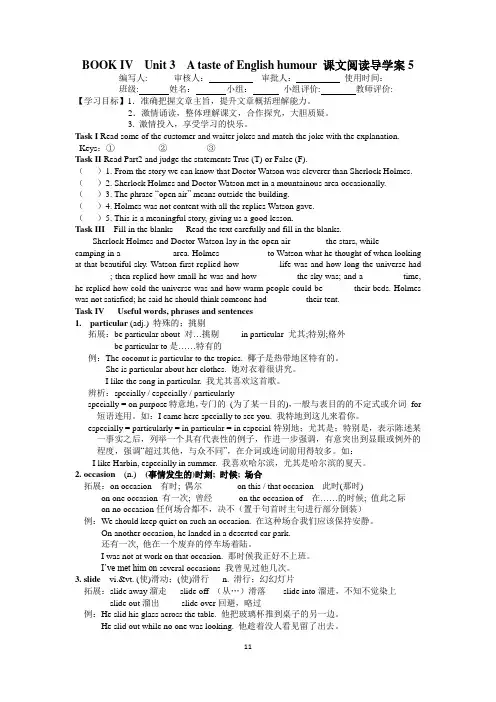
BOOK IV Unit 3 A taste of English humour 课文阅读导学案5 编写人: 审核人:审批人:使用时间:班级: 姓名:小组:小组评价: 教师评价:【学习目标】1.准确把握文章主旨,提升文章概括理解能力。
2.激情诵读,整体理解课文,合作探究,大胆质疑。
3. 激情投入,享受学习的快乐。
Task I Read some of the customer and waiter jokes and match the joke with the explanation. Keys:①______ ②______ ③______Task II Read Part2 and judge the statements True (T) or False (F).()1. From the story we can know that Doctor Watson was cleverer than Sherlock Holmes. ()2. Sherlock Holmes and Doctor Watson met in a mountainous area occasionally.()3. The phrase “open air” means outside the building.()4. Holmes was not content with all the replies Watson gave.()5. This is a meaningful story, giving us a good lesson.Task III Fill in the blanks Read the text carefully and fill in the blanks.Sherlock Holmes and Doctor Watson lay in the open air _______ the stars, while _________ camping in a ___________ area. Holmes __________ to Watson what he thought of when looking at that beautiful sky. Watson first replied how ________ life was and how long the universe had ________; then replied how small he was and how ________ the sky was; and a ________ time, he replied how cold the universe was and how warm people could be ______ their beds. Holmes was not satisfied; he said he should think someone had ________ their tent.Task IV Useful words, phrases and sentences1.particular (adj.) 特殊的;挑剔拓展:be particular about 对…挑剔in particular 尤其;特别;格外be particular to 是……特有的例:The coconut is particular to the tropics. 椰子是热带地区特有的。
人教新课标高中英语必修四Unit 3 A taste of English humour导学案(2)

精品文档[语境助记]① He got a new job in a hotel and he________ ______ ______ it.(对…满意) ① There is now ___________ (让人信服的)evidence that smoking causes lung cancer.[新题型演练]Although I tried my best to convince them_______the importance and urgency of the operation, the doctors were not convinced________ ______(perform) it immediately.①The judge directed that the child ________ _____ taken good care of by his mother. ②He ________ (导演了)many Shakespearian plays in London.[新题型演练]She has already tried her best. Please don't ______ too ______ ________(particular) her job.短语归纳:①________ (更糟糕的是), my car broke down on the way.[新题型演练]-How are the things in your village?-Modern farming methods have been brought in and the villagers are________ ______ now than 考点2 pick out挑出;辨别出教材原句Charlie first picks out the laces and eats them as if they were spaghetti. 查理首先挑出鞋带来吃,像是吃意大利面一样。
2020高考英语一轮复习同步攻关 Unit 3 a taste of English humor学案 必修4
Unit 3 a taste of English humor导读:英国人的幽默用看似轻描淡写的几句话,让全场会心一笑,事后还能不断回味。
笑,并非许多中国人所想的那样,只是人生一瞬,只是逗个乐子,而是隽永的,多角度的,能够弥漫整个社会的一种精神,一种生活,一种享受。
你了解英国人的幽默吗?Fun seems to be the possession of the English race. Fun is John Bull's idea of humor, and there is no intellectual judgment in fun. Everybody understands it because it is practical. More than that, it unites all classes and sweetens even political life. To study the elemental form of English humor, you must look to the school-book. It begins with the practical joke, and unless there is something of his nature about it, it is never humor to an Englishman. In an English household, fun is going all the time. The entire house resounds withit. The father comes home and the whole family contribute to the amusement; puns, humorous uses of words, little things that are meaningless nonsense, if you like, fly round, and everyone enjoys them thoroughly for just what they are. The Scotch are devoid of this trait, and the Americans seem to be, too.—Excerpt from Scottish Humor by John Watson1. Whatever difficulty we have, we should try to __________ (克服) it.2. I have found his classes both informative and __________(趣味性).3. The dictionary is __________(particular)useful for beginners.4. There is now __________(令人信服的)evidence that smoking causes lung cancer.5. He was __________(大吃一惊) to hear that he hadgot the job.6. Soon news spread t__________ the country.7. Success came after many f__________.8. I've been f__________ to have so many good teachers.9. He was given a reward for his o__________ work.10. Tom is jobless, penniless and h__________.overcome 2. entertaining 3. particularly4. convincing5. astonished6. throughout7. failures 8. fortunate 9. outstanding10. homeless请根据语义写出短语1. __________ to now 直到现在2. feel/be __________ with 对……满足3. __________ off 穷的;缺少的4. __________ out 挑选出;辨认出5. __________ off 切断;断绝6. __________ in 担任主角;主演7. __________ achievements突出的成就8. a __________ of humour 幽默感9. in __________ 特别;尤其是10. in search __________ 寻找;寻求11. be born in __________ 出身贫寒12. be __________ in 以……为背景13. go __________ 野营up 2. content 3. badly 4. pick5. cut6. star7. outstanding8. sense9. particular 10. of 11. poverty 12. set 13. camping1. He made people laugh at a time when they felt depressed, so they could feel more content with their lives.(P18)2. No one was ever bored watching him — his subtle acting made everything entertaining.(P18)3. Instead they are hiding in a small hut on the edge of a mountain duringa snowstorm with nothing to eat. (P18)① content n.& adj.根据语境猜词义(1) He is content despite his great poverty.(2) Can you tell me the content of the box?(3) He is always content to help others.根据语义找匹配感到满足的B. 愿意,乐意C. 所含之物(1) A (2) C (3) B① content n.& adj.短语be/feel content with 对……感到满足、对……满意be content to do sth. 愿意做某事、乐意做某事to one's heart' s content 尽情地;心满意足地① content n.& adj.单项填空( )We sat there, ______with what we listened to.A. satisfyingB. to satisfyC. contentedD. contentD 本题考查动词用法。
高一英语期末精品复习学案:Unit3《A taste of English humour》(新人教版必修4)-推荐下载
be/feel content with 对……感到满足
to one’ s heart’ sΒιβλιοθήκη content 尽情地;心满意足地
【即境活用】If you are not ______ the progress you’ve made, you will have greater success.
A. interested in
2. astonish vt. 使惊诧;使吃惊
[重点用法]
be astonished at/by sth. 因/被……感到惊讶
be astonished to do sth. 对做某事感到惊讶
高二英语期末精品复习学案:Unit3 A taste of English humour
【基础知识透析】
【重点单词】
1. content vt. (使)满足;满意 n.[u]满足;书的内容目录;容器里的东西 adj.感到满足的
[重点用法]
content oneself with sth. 满足或满意於某事物
【解析】D 考查短语词义辨析。be popular with 受……的欢迎
B. strict in
-1-
对全部高中资料试卷电气设备,在安装过程中以及安装结束后进行高中资料试卷调整试验;通电检查所有设备高中资料电试力卷保相护互装作置用调与试相技互术关,系电通,力1根保过据护管生高线产中0不工资仅艺料可高试以中卷解资配决料置吊试技顶卷术层要是配求指置,机不对组规电在范气进高设行中备继资进电料行保试空护卷载高问与中题带资2负料2,荷试而下卷且高总可中体保资配障料置2试时32卷,3各调需类控要管试在路验最习;大题对限到设度位备内。进来在行确管调保路整机敷使组设其高过在中程正资1常料中工试,况卷要下安加与全强过,看度并25工且52作尽22下可护都能1关可地于以缩管正小路常故高工障中作高资;中料对资试于料卷继试连电卷接保破管护坏口进范处行围理整,高核或中对者资定对料值某试,些卷审异弯核常扁与高度校中固对资定图料盒纸试位,卷置编工.写况保复进护杂行层设自防备动腐与处跨装理接置,地高尤线中其弯资要曲料避半试免径卷错标调误高试高等方中,案资要,料求编试技5写、卷术重电保交要气护底设设装。备备置管4高调、动线中试电作敷资高气,设料中课并技3试资件且、术卷料中拒管试试调绝路包验卷试动敷含方技作设线案术,技槽以来术、及避管系免架统不等启必多动要项方高方案中式;资,对料为整试解套卷决启突高动然中过停语程机文中。电高因气中此课资,件料电中试力管卷高壁电中薄气资、设料接备试口进卷不行保严调护等试装问工置题作调,并试合且技理进术利行,用过要管关求线运电敷行力设高保技中护术资装。料置线试做缆卷到敷技准设术确原指灵则导活:。。在对对分于于线调差盒试动处过保,程护当中装不高置同中高电资中压料资回试料路卷试交技卷叉术调时问试,题技应,术采作是用为指金调发属试电隔人机板员一进,变行需压隔要器开在组处事在理前发;掌生同握内一图部线纸故槽资障内料时,、,强设需电备要回制进路造行须厂外同家部时出电切具源断高高习中中题资资电料料源试试,卷卷线试切缆验除敷报从设告而完与采毕相用,关高要技中进术资行资料检料试查,卷和并主检且要测了保处解护理现装。场置设。备高中资料试卷布置情况与有关高中资料试卷电气系统接线等情况,然后根据规范与规程规定,制定设备调试高中资料试卷方案。
高中英语真题-学高中英语Unit3ATasteofEnglishHumour语法学案新人教版必修4_
高中英语真题:学高中英语Unit3ATasteofEnglishHumour语法学案新人教版必修4
教学内容 Learning aims: To master some sentence patterns To msater the v-ing形式作定语、表语、宾补 Learning key points: To master some sentence patterns Learning difficult points: To msater the v-ing形式作定语、表语、宾补 【学案使用说明】在提前预习的前提下完成
学习指导即时感悟
【回顾复习】 Check the home work (have a dictation of the language points) 【自主 合作 探究】 (一)v –in g形式作定语 1. 单个动词的-ing形式作定语位于被修饰名词的前 根据例面,既可以表示被修饰者的作用或功能,也可以表示被修饰者的动作或状态。如: building materials = materials for building 建筑材料 drinking water = water for drinking 饮用水 a walking stick = a stick for walking 手杖 a reading room = a room for reading 阅览室 a writing desk = a desk for writing 写字台 tiring music = music that is tiring 烦人的音乐 a surprising result = a result that is surprising 一个惊人的结果 2. v-ing形式短语作定语时, 放在所修饰的名词之后, 并且在意思上相当于一个定语从句。如: They lived in a room facing the street. = They lived in a room that faces the street. 他们住在一间面朝街的房子。 The man standing there is Peter’s father. = The man who is standing there is Peter’s father. 站在那儿的那个人是彼得的父亲。 His brother, working as a teacher, lives in . = His brother, who is working as a teacher, lives in . 他的哥哥是个教师,住在北句理解并掌握语法规则 京。 (二)、v-ing形式作表语 v-ing形式作表语时放在系动词之后,用来泛指某种动作或行为,以说明主语的身份、性质或情况。如: Her hobby is painting. 她的业余爱好是画画。 My job is looking after the children.我的工作就是照顾这些孩子。 English is quite interesting. 英语是非常令人感兴趣的。 体会 1. He is cleaning the street. 他正在打扫街道。(进行时) 2. His job is cleaning the street. 他的工作是打扫街道。(V-ing形式作表语) 三、作宾语补足语: V-ing形式作宾补时通常用放在动词之后,表示该动作正在发生。 能跟现在分词作宾语补足语的常见动词有这些:make、let、have、look at、see、watch、hear、listen to、notice、feel. keep,find ,get (“三让、三看、两听、注意感觉,一直找就得到”。)如: I saw him getting on the bus. 我看见他正上公共汽车。 We are watching the teacher doing the experiment. 我们在观察老师做实验。 We had the fire burning all day. 我们让火整天燃烧着。 I won’t have you doing that. You won’t catch me doing that again. 【当堂达标】 1. We all believe that if a book is ______, it will surely ______ the readers. A. interested; interest B. interesting; be interested C. interesting; interest D. interested; be interesting 2. The purpose of new teaching method is making study easier, ______ it more difficult. A. not make B. not to make C. not making D. do not make 3. It is said that the missing students were last seen ______ near the river. A. playing B. to be playing C. play D. to play 4. The policewoman looked around and caught a young man ______ his hand into the pocket of a passenger. A. put B. to be putting C. to put D. putting 5. Mr White, ______ of the ______ TV play, started to read a novel. A. tired; boring B. tiring; bored C. tired; bored D. tiring; boring 6.Don’t let me catch you ______. A . do that again B . to do that again C. doing that again D.. done that again 7.“What did you do in the garden?” “I watched my father ______ his motorbike.” A.. to repair B.. repaired C . repairing D. . repairs 8.I didn’t mean ______ anything, but these apples looked so good I couldn’t resist ______ one. A.. to eat…trying B. to eat…o trying C.eating…to try D. eating…to trying 【反思提升】 将本节课所学语法规则和错题整理到笔记上。 【拓展延伸】 完成《同步训练》语法部分 学高中英语Unit3ATasteofEnglishHumour语法学案新人教版必修4
2020年高考英语总复习 Unit 3 A taste of English humour练案+学案 新人教版必修4
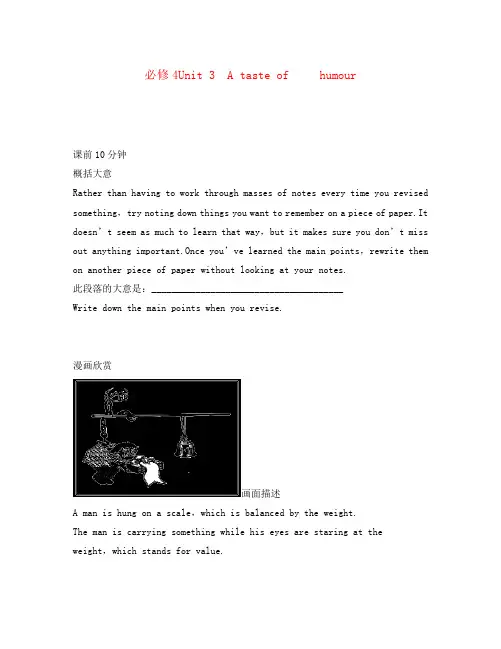
必修4Unit 3 A taste of humour课前10分钟概括大意Rather than having to work through masses of notes every time you revised something,try noting down things you want to remember on a piece of paper.It doesn’t seem as much to learn that way,but it makes sure yo u don’t miss out anything important.Once you’ve learned the main points,rewrite them on another piece of paper without looking at your notes.此段落的大意是:_______________________________________Write down the main points when you revise.漫画欣赏画面描述A man is hung on a scale,which is balanced by the weight.The man is carrying something while his eyes are staring at theweight,which stands for value.寓意理解The man is eager to get more in return for what he has done for the society.Without pay he would probably do nothing.你能否对此加以扩展,写一篇120词左右的小短文?课堂双基回归Ⅰ.词义辨析1 . Effective treatments do exist,but ________ they are very expensive.A.unfortunately B.ParticularlyC.independently D.approximately2.This television programme is designed to educate and notmerely to ________.A.Astonish B.ConvinceC.entertain D.slide3.She was ________ with joy when she was informed that shewould be promoted.A.Struggled B.DefeatedC.conquered D.overcomeACD4.He will demand ________ evidence before he adopts a new theory.A.outstanding B.convincing C.amusing D.charming5.In every field of science,art,literature,drama and sport,they have made ______ contributions.A.swift B.outstanding C.considerate D.genuine 6.As is often the case,deaf people communicate mainly by _____. A.gesture B.whisper C.contact D.signal 7.My brother likes eating very much but he isn’t very ________ about the food he eats.A.special B.ordinary C.particular D.contentBBAC8.I saw Bob play the piano at John’s party and on that________ he was simply brilliant.A.scene B.CircumstanceC.occasion D.situation9.Mum ________ to us,“Be quiet! Your little sister’s sleeping.”A.Whispered B.ShoutedC.explained D.replied10.Workers ________ angrily to the news of more job lossesat the factory.A.convinced B.FocusedC.adapted D.reactedCADⅡ.短语填空1.___________,no wonder drug has been found which cancure cancers.2.He seems to ______________ a fairly minor role in the government.3.Sarah has missed her chance of ____________ the school play. 4.Thieves ___________ the bank by digging a tunnel and took away lots of money.5.We have two lessons this morning,but there’s some free time ___________.Up to nowbe content withstarring inbroke intoin between6.As time ________,my credit history was gradually building up.7.They were ________ for not paying their phone bill.8.He went ____________ a doctor for his sick wife.9.She was ___________ from dozens of applicants for the job. 10.Tom has been out of work for years.He is now quite__________.went bycut offin search ofpicked outbadly offⅢ.完成句子1.Unfortunately his father died,________________________________ (使整个家庭状况更糟了).(leave)2.He walked around stiffly _______________________(手里拿着一根手杖).(carry)3.Charlie picks out the laces and eats them ______________(好像它们是) spaghetti.(as)leaving the family evenworse offcarrying a walking stickas if they wereⅣ.单项填空1.Charlie Chaplin brightened the lives of Americans and British through two world wars and the hard years ________.A.among them B.in betweenC.far apart D.away from2.You may find ________ astonishing that Charlie was taught to sing as soon as he could speak.A.it B.that C.what D.yourselfBA3.No one was ever bored ______ him—his subtle acting made everything entertaining.A.Watched B.to watchingC.watching D.having watched4.This character was _____ social failure but was loved _____his optimism and determination to overcome all difficulties. A./;for B./;by C.a;for D.a;by5.The acting is so convincing that it makes you believe that it is one of the best meals he has ______ tasted!A.never B.even C.just D.everCCD知识要点整合核心词汇梳理1.content adj. 满足的;满意的句型 be content with sth.对……感到满意或满足be content to do sth.满足于做某事She is content with her job at the moment.她目前对自己的工作非常满意。
2019-2020年高中英语 Unit3 A taste of English humour rea
2019-2020年高中英语 Unit3 A taste of English humour reading2学案新人教版必修4一、学习目标1. Understand the text (para1-3by reading2. Recite and analyze the related key sentences3. Learn about the some words and expressions二.学习重点Memorize the words and expressions in this unit三、学习方法1. Refer to(查阅) the notes (No5-6 ) in p34 and notes3,4 in p35 (《专家半读》)and finish part2 teamwork2. Individual work to finish self-learning(自主学习) .四、学习过程Part1.自主学习Translate the following into Chinese and read them aloud1. pick out the laces______________________________.2 eat them as if they were spaghetti_________________________.3. write ,direct and produce the films____________________________.4. boil a pair of leather shoes for their dinner ______________________.5. remember as a great actor _________________________.Part2.合作探究Task1. read aloud1.Read paragrah4-5aloud after the teacher2.Read them aloud to your partner to check your pronunciation(读音)mistakes.Task2.Translation1. Charlie first _____________ the laces and eats them as if they were spaghetti.____________________________________________________________________.2. Charlie Chaplin wrote, __________ and produced the films he starred in.____________________________________________________________________.3. They are_____ hungry _____they try boiling a pair of leather shoes for their dinner. ___________________________________________________________________..4. He is loved and ___________ a great actor who could inspire people with great confidence. _____________________________________________________________________.Task3. Learn and master the following notes1.pick out意思是_______,__________,_____________.A was picked outB pick out1).His story _____________as the best by the judges.2).I ____________Valerie’s voice from among the general conservation.pick 可以和介词连用,表达不同的意义,pick on ____________ pick up _________________ pick sb up________ pick sth up____________ pick sth over___________翻译下面的句子1.She picked out a navy blue dress.._______________________________________________________________.2.He sat at the piano and picked out a simple tune.________________________________________________________________.2.direct是及物动词意思是______,________,_______,______等还可以在direct sth 后接介词to 表示______________________.选择恰当的词汇或短语完成句子A. has directedB. were directed1)The opening and closing ceremonies for the xx Beijing Olympic Games ____________by Chinese director Zhang Yimou.2)Steven Spielberg __________more than 40 films and has won many awards.3.so…that是一个表示“________________”意思的状语从句结构但翻译时不一定要翻译出来。
高中英语Unit 3 A taste of humour-单元学案教案
A taste of humour-单元学案第一课时 warming up & reading 自主学习学案【学习目标】1.语言目标Language aims:Get students to master the patterns in the text.2. 能力目标Ability aims:1.Develop students’reading ability and let them learn different reading skills.2.Enable students to talk about types of English humour and Charlie Chaplin.3. 情感目标Emotional aims:1.Let students learn to find and enjoy humour to make their life easy and happy.2.Develop students’sense of cooperative learnin g.重点key points:1 Let students learn about types of English humour.2 Get students to read the passage to learn about Charlie Chaplin and earn different reading skills.难点important points:1 Develop students’reading ability.2. Enable students to understand and talk about types of English humour【教材领悟】Step 1. Warming up1. Do you know what a punchline is?____________________________________________________________________________ ________2. Do you enjoy the kinds of humour in China?_______________________________________________________________________________ ____Step 2 Pre-readingWhat do you know about Charlie Chaplin?______________________________________________________________What do you know about his films?_________________________________________________ Step 3 Reading1. Fast reading (tips:统揽全文,获得大意即可,不要句句阅读。
高中英语-Unit_3_A_taste_of_English_humour全单元学案AllHAl
Unit 3 A taste of English humourI.教学内容分析幽默能给人们带来乐趣,幽默能给人们带来享受,幽默还能带给人们深思——幽默是生活中的有益要素。
本单元就以“品尝英语幽默”为主题,让人领略到不同的文化背景下的英语幽默,同时,也让人认识到因为文化的差异,人们对同一个幽默的理解也会有所不同。
通过本单元的学习,不单单是在语言知识上有所收益,还鼓励了学生发掘,感受生活中的幽默,保持一种活泼乐观的生活态度,让生活更轻松、更美好。
因为这个单元,是把多个幽默贯穿起来了,所以学生都能在一种轻松的氛围下学英语。
Warming Up部分设计了三个练习,让学生对幽默有一点感性的认识。
练习1是让学生体会两侧笑话里的点睛之笔,引起学生对本单元话题的兴趣。
练习2是一个填表题,主要目的是让学生了解英语幽默艺术的一些国际大师级人物,并按照语言和非语言幽默形式列举我国的幽默艺术大师。
练习3是一个开放题,学生可以根据个人实际情况回答,并说明自己喜欢语言或非语言幽默的原因。
Pre-reading部分通过三个问题使学生对卓别林有一定程度的了解,并要求学生根据课文标题和插图预测文章大意。
Reading部分介绍了一位世界闻名的喜剧大师——查理·卓别林,内容包括他的生平和他对电影艺术的贡献。
虽然他的电影多是无声电影,但是通过他夸张的手法、精湛的演技,给人们带来的是幽默、是滑稽、是享受。
课文中给出两个特写,一是“小流浪汉的形象”,另一个《淘金记》中“吃皮鞋的过程”,使学生体会到在一些小的幽默背后,也隐含着一定的道理。
Comprehending通告引导学生写阅读笔记,让他们既练习了词汇,又课文内容的脉络有了更清晰的了解。
Learning about Language部分突出了词汇和语法的学习与训练。
本单元的语法是-ing形式在句子中作表语、定语和宾语补足语。
这个语法项目是英语学习中的一个重点语法项目。
Using Language部分中包括了听、读、写三个部分的内容。
高中英语 Unit 3(A taste of English humour)教案2 新人教版必修4
Teaching Plan for Unit 3 A Taste of English Humor 单元教学目标目标语言课时分配1st Period Reading2nd Period Speaking3rd Period Grammar4th Period Listening5th Period Writing6th Period Summary分课时教案The First PeriodTeaching aims: Enable students to talk about some types of English humor and Chinese humor.Key points: Help students learn how to understand and enjoy English humors. Difficult points: Help students know the differences between English and Chinese in humor.Teaching aids: picturesTeaching procedure:Step 1: Lead-inShow some pictures to students, let them talk about the pictures and then ask them what they think of the pictures, whether they are funny or not. Questions: 1) Do you know who these edians are? What makes them funny?2) Do you know other edians who are funny in the same way?3) Have you seen any of these edians or programmers? What do you think ofthem?Step 2: Warming upTask 1. Brain-stormingAsk students to name some types of humors they know. Write those they are not familiar with on the blackboard, then show some pictures and summarize.Task 2. TalkingAsk students to talk about some funny stories, any English or Chinese humors they know.Task 3. Reading on P22The purpose of the reading is to introduce the kind of verbal jokes. They use a “play on words”to be funny. Let students read the three jokes and then match the joke with the explanation. Then check the answer. After that, teacher can show some other jokes on the screen.Step 3 HomeworkAsk each student to give a joke and present it in class next period.The Second Period ReadingTeaching aims: Enable students to learn what humor means and what is nonverbal humor. Key points: Help students divide the text into several parts according to the meaning.Difficult points: Divide the paragraphs and give the main ideas.Teaching aids: A recorder and a projectorTeaching procedure:Step 1. RevisionCheck homework: ask students to present their jokes in class.Step 2. Pre-readingQuestions: (1) What do you like to laugh at?(2 ) What does humor mean? Is humor always kind?Give students some time to discuss. The purpose is to help students know that different people have different taste about humor. It is difficult to say which one is better or which one is worse.Step 3. ReadingThe purpose of this reading is to introduce nonverbal humor. This reading material takes Charlie Chaplin for example. It tells us what nonverbal humor means; what is Charlie Chaplin’s style of acting; how he made a sad situation entertaining and so on.Task 1. Divide the text into several parts according to the meaning.Part One: the first and the second paragraphPart Two: the third and the fourth paragraphPart Three: the last paragraphTask 2. Give the main idea of each partThe main idea of part one: It tells us that there are two kinds of humor. Oneis bad, while the other can inspire people.The main idea of part two: It tells us something about Charlie Chaplin’s actingstyle and how Charlie Chaplin made a sad situationentertaining.The main idea of part three: it gives us a short biography about Charlie Chaplin. Task 3. DiscussionLet students have a discussion about the text, then answer some questions. Questions: (1) What is behind fun?(2 ) Why did people like Little Tramp?(3 ) Do you think Charlie Chaplin’s eating boiled shoes funny? Why? Step 4 Language points1.content (adj.): satisfied, happy, not wanting any morephrases: content with sth; content to do sthe.g. (1) She is quite content to stay at home looking after her children.(2 ) Are you content with your present salary?Content (n.): that which is contained in sthe.g. I like the style of her writing but I don’t like the content.2.inspire sb. ( with sth.) \ inspire sth. (in sb.): To fill sb. with thoughts,feelings or aims.e.g. His speech inspired us with hope.3.badly off: in a poor position, esp. financiallyThe opposite is “ well off”e.g. (1) They are too badly off to have a holiday.(2 ) In fact most people are better off than they were five years ago. Step 5 PracticeFinish the exercises on page 18, 19, it is a good time to consolidate the whole content of the text and the useful words and expressions from the text. It is easy for most students to finish. So leave students several minutes to finish and check the answers by showing them on the screen.Step 6 HomeworkPreview grammar by finishing Exercises 3, 4 on page 20, all the exercises on page 21.The Third Period GrammarTeaching aims: Enable students to learn how to use the –ing form as the attribute, the object plement and the predicative.Key points: Let students know the structures of the sentences with the –ing form Difficult points: Help students to tell the –ing form as the predicative and the use of the present continuous tense.Teaching aids: A puterTeaching procedure:Step 1. RevisionCheck homework: the exercises on page 20 and 21.Step 2. Word formationThere are ten suffixes in the chart. And there are some new words in it. But the purpose of showing this chart is to let students learn more about the adjective suffix.Step 3. Discovering useful structuresTask 1. RevisionHave a revision about the –ing form used as the subject and object. Give students some sentences to translate:(1)Talking to him is useless.(2)Smoking does harm to your health.(3)Walking is my sole exercise.(4)Collecting stamps is my hobby.(5)I suggested bringing the meeting to an end.(6)He admitted taking the money.(7)I couldn’t help laughing.(8)Your coat needs washing.Task 2. New usage of the –ing formAsk students to look at the Exercises 4 on page 20. And then wake in pairs to finish the exercises.Teacher checks the answers and give the explanations.(1)A cooking pot: A pot that is used for cooking.(2)A drinking horse: A horse that is drinking water.(3)The man sitting on the sofa is a friend of my brother’s.Here the –ing form are used as attribute.(4)I saw the man sliding on a banner skin yesterday.(5)Did you notice the man picking up that broken bottle and putting it in hisbag?Hear the –ing form are used as object plement The structure of the sentence with an object plement is:Subject + Predicate + Object + Object plement(6)Her job is looking after babies.(7)What he likes is playing chess after supper.Here the –ing form are used as predictive. Pay attention to the differences between –ing form used as predicative and present continuous tense.(1)Her hobby is painting.(2)Her favorite sport is skiing.(3)This was very disappointing.(4)The test results are very discouraging.(5)She was very pleasing in her appearance.(6)His concern for his mother is very touching.(7)The photograph is missing.(8)The article was misleading, and the newspaper has apologized.In the first two sentences, the –ing form is used to show the character of the subject. In the next four sentences the words of the –ing form are all about the feelings. In the last two sentences, the words of the –ing form show some states and qualities.(9)It is snowing hard.(10) She is teaching in a night school.In these two sentences, the –ing form are used as the predicate in the present continuous tense.Step 4. Using StructuresTurn to page 56. Look at the Using Structure. There are two exercises in this part. Exercise 1 is to let students correct some errors in the sentences. This is not an easy job for most students, because it needs other knowledge, besides what the students learned today. So better leave them more time to do this exercise. For exercise 2, let students finish it in a short time. With the help of the pictures, students can easily understand the meaning and correctly use the –ing form to finish the blanks. Teacher can check the answers in class.Step 4. HomeworkFinish all exercises on page 56.The Fourth Period ListeningTeaching aims: Enable students to understand the humor in the listening material. Key points: Train the students to get the key wards by reading the questions before listening.Difficult points: Get the main idea from the listening materials while listening. Teaching aids: A recorderTeaching procedure:Step 1. RevisionCheck homework: (1) Ask a couple of students to tell their jokes in class.(2 ) Ask some students to e to the blackboard to write theirtranslation. After they have finished, teacher correct someerrors with the whole class.Step 2. Listening ( page 23 )This is a funny story. Mary made some plum jam and left some in the pan. Five days later, her husband came home and poured the jam into the chicken. Later Mary came home and found all of her chickens were behaving strangely. What had happened? Give students two chances to listen to the story. First, go through Exercise1 and 2 to know what are the things they will do while listening. After that teacher plays the tape for them to finish Exercise 1. The second listening is to check the answers. For Exercise 2, teacher should leave some time for students to discuss the question.Questions: (1) Did you find this story funny? Give the reason.(2 ) What do you think of John’s behavior?Step 2. Listening ( page 55 )This is a story about a thief and a man. The situation is very interesting. Before listening, ask students what they would do if they find a thief in their home one day; whether they will be afraid of the thief and so on.There are three steps for this listening. At first let students read the questions to make sure that they know what they should do in this listening. Next, play the tape for the first time to let students finish Exercise 1. Then play the tape again and let the students finish the questions in Exercise 2. After that, let the students check their answers with each other. At last, listen to the tape again, teacher can make a pause where there is an question to the question, in this way students can check all the answers.Step 3. Listening ( page 58 )There are four exercises in this listening. The first one requests students to get the general idea of the material. The second one is to ask the students to know some details of the material. The third one is a question that asks the students to speculate the teacher’s feeling. And the last one is a good exercise,it gives the students another chance to practice their oral English.Step 4. HomeworkCollect as many funny stories as possible, do some preparations for the writing in the next period.The Fifth Period WritingTeaching aims: Help the students learn how to write funny stories using the target language and according to the writing steps.Key points: Teach students to write according to the writing of the writing steps. Difficult points: Help students make up a dialogue, using the target language. Teaching aid: A projectorTeaching procedure:Step 1. RevisionCheck homework: Ask several students to read their funny stories in class. Step 2. Writing ( page 23 )Give students some instructions on writing a funny story.1)Writing down your story in a logical order.2)For each of your story try to find the most interesting words you canto describe how you felt or what was happing.3)Then write out your story using these interesting words.4)Read through your story.5)Then show it to your partner. Let him/ her suggest some new and excitingwords.6)Write out the story and put it into a class collection of stories. Give students enough time to finish the task and give them enough help in the writing. Tell them to give the outline first, then finish the story.Step 3. TalkingTask 1. Show students some pictures. Ask them to describe the pictures and explain what is happening, whether it is funny or not.Task 2. Imagine you want to play a trick on someone, maybe an April Fool’s trick. Work with partners, think up a funny thing and share it with the class.Step 4. Speaking and writing taskThis is a chance for students to learn limericks. It has only five lines. Three of them are longer than the other two. The longer lines all rhyme with each other and the shorter ones rhyme with each other. When introducing the poems, teacher read them first, and let the students enjoy the beauty of the rhyme. And at the same time point out that there must be two sets of rhyming words in the same poem, so the students can grasp the main feature of the poem.After reading, ask students to tell the rhyme of the first and the second poem. Let students read the poems several times and feel it. Find more limericks for students to enjoy.Give students some instructions on how to write a poem, let them think of rhyming words before writing. They need two sets of rhyming words.Step 5. Homework1) Finish Exercise 5 on Page 20.2) Make a summary about what has been learnt in this unit.The Six Period SummaryTeaching aims: 1) Learn to express the sentences that are connected with the positive and negative view of the same thing. 2) Make a summary aboutwhat has been learnt in this unit.Key points: Sum up what we have learnt in this unit.Difficult points: Sum up what we have learnt in this unit.Teaching aids: A projectorTeaching procedure:Step 1. RevisionCheck homework: Ask students to present their dialogue in class.Step 2. ReadingThis reading task gives us another joke. The title is “An April fool’s joke: The Noodle Harvest”. Ask students to read the sentence : “A fool sees not the same tree that a wise man sees.”After reading, explain the meaning of the sentence. (The meaning is that the thing is the same, but the way to treat it is different between a fool and a wise man.)Give students some time to read the passage, then answer some questions and retell the whole story.Questions: 1) What do children usually do on April Fool’s Day?2) Why did people believe the programme Panorama?3) Do you think the advice that the BBC gave people who asked how to grownoodle trees was serious? Give a reason..4) What would you do to find out whether a story like this was true? Step 3. ProjectAsk students to make their own collection of jokes, funny poems or short stories. They can be the ones that they enjoy in the books that they have read. Make sure they add either a joke, a funny poem or a funny short story of their own. Copy them into a book and display it in the class so that all your classmates can enjoy them.Step 4. Summing upThis is a summary about what they have learned in the unit. Leave students some time to finish the frame. Then teacher give students a dictation about the usefulwords and expressions.功能句式:1.I enjoy this very much because….2.I laugh at that kind of thing because…3.This is fun because….4.How wonderful / surprising!5.It surprises me that…6.I’m pleased we were both amused at…7.I felt happy because…8.It’s amusing that…语法:1.Word formation2.The –ing form of the verb used as predicative, attribute and objectplement.重点句子:1.Do you find it funny to see someone sliding on a banana skin, bumping intosomeone else round a Conner, or filling down a hole in the end.2.Perhaps it makes us feel more content with our life…3.He became famous for using a particular form of acting, including mime andfarce.4.But he was lived by all who watched the film for his determination in overingdifficulties and being kind even when people were unkind to him.5.Imagine you are hungry and all there is to eat is boiled shoe.6.He solved it by using nonverbal humor.7.Their job is “panning for gold”.8.This was the problem facing Charlie Chaplin in one of his most famous films. Translate the following sentences into Chinese and pay attention to the use of the–ing form.1.The two edians performing on the stage are from Liaoning Province.2.Who is the girl walking by the river.3.The children playing the violin will give a performance next week.4.The man with sunglass standing near the car is a cross talk artist.5.The old lady talking to the children is a famous musician.6.I saw a group of policemen ing out of a green jeep and running to the building.7.I saw a dog carrying a piece of meat entering your garden.8.I heard her singing a beautiful song at the party last night.9.I got frightened when I saw a man playing with a snake in the park.10.There were some boys shouting and crying under my window, so I could not fallasleep.Step 5. Check yourself1.Do you find it difficult to understand English humor? Why?2.What role do you thing humor plays in your life?3.What language points have you learned in this unit?4.How well have you done in the exercises on the –ing form?5.Did you have any problems in understanding this unit? How did you solve them? Step6. HomeworkDo some preparations for unit 4.。