
2020年9月全国大学英语六级考试
2020年9月全国大学英语四、六级考试
考生健康状况监测登记表
考点名称:
按照疫情防控要求,本人记录的考前14天体温、健康状况是真
实、准确的,如有不实,责任自负。考生在参加考试进入考场时必须
将此表交给监考人员,监考人员收齐后交考务组。
考生签名:___________
姓 名 准考证号
联系电话 居住状况
在校 非在校
健
康
状
况
登
记
日期 当日体温 本人健康状况(有无发热、咳嗽等症状) 备注
9月5日
9月6日
9月7日
9月8日
9月9日
9月10日
9月11日
9月12日
9月13日
9月14日
9月15日
9月16日
9月17日
9月18日
全国大学英语四,六级考试成绩查询方法

关于大学英语四、六级考试成绩报道及相关事宜的通知大学英语四、六级考试近期改革的一项重要举措是自2005年6月起采用新的计分体制和成绩报道方式。
现就此改革措施及相关事宜通知如下。
一、计分体制自2005年6月起,四、六级考试的分数在经过加权、等值、常模转换等数据处理后,将报道为均值500、标准差70的常模正态分,不设及格线,取消证书,改发成绩报告单,以利于广大师生和学校行政部门根据本校的教学实际,合理使用四、六级考试的成绩和相关数据。
二、成绩报道1.成绩报道自2005年6月考试起,报道的总分满分为710分,各单项分之和等于总分。
对总分在220分以上(含220分)的考生发放成绩报告单。
凡总分在220分以下者(包括缺考者和作弊违纪者),其单项分和总分均计为0分,不发成绩报告单。
本次(2005年6月)大学英语四、六级考试各单项成绩的计分如下:听力部分(20%)满分为142分;阅读部分(40%)满分为284分;综合部分(25%)满分为178分;作文部分(15%)满分为106分。
单项部分如没有作答或全部答错,该部分成绩计为0分。
考试内容和题型改革以后,将另行公布各单项成绩的计分比例和满分分值。
2.成绩报告单大学英语四、六级考试成绩报告单的内容(详见样张):名称:大学英语四级考试成绩报告单大学英语六级考试成绩报告单发放部门:教育部高等教育司委托发放单位:全国大学英语四、六级考试委员会分数报道:总分、各单项分考生信息:姓名、学校和院(系)、考试时间、准考证号、身份证号或其它有效身份证件号其他信息:成绩单编号、全国大学英语四、六级考试委员会网址考生照片:2寸证件照片注:因部分考点在组织2005年6月考试的报名时未能采集考生的照片信息,这部分考生的成绩单上无照片。
3.发放方式成绩报告单由全国大学英语四、六级考试委员会通过各省、市、自治区负责四、六级考试的教育考试机构发至各校教务处,再由教务处发至考生。
三、向考生发布的考试成绩信息1.总分报道分四、六级考试的总分报道分是常模正态分。
2019年6月大学英语六级(CET-6)真题第二套试卷及参考答案

2019年6月大学英语六级考试真题(第2套)Part I Writing (30 minutes) Directions:For this part, you are allowed 30 minutes to write an essay on the importance of mutual understanding and respect in interpersonal relationships. You should write at least 150 words but no more than 200 words.________________________________________________________________________________ ________________________________________________________________________________ _______________________________________________________________________________ PartⅡ Listening Comprehension (30 minutes) Section ADirections: In this section, you will hear two long conversations. At the end of each conversation, you will hear four questions. Both the conversation and the questions will be spoken only once. After you hear a question, you must choose the best answer from the four choices marked A),B),C)and D). Then mark the corresponding letter on Answer Sheet 1 with a single line through the centre.Questions 1 to 4 are based on the conversation you have just heard.1.A) Why Roman Holiday was more famous than Breakfast at Tiffany’s.B)Why Audrey Hepburn had more female fans than male ones.C)Why the woman wanted to be like Audrey Hepburn.D)Why so many girls adored Audrey Hepburn.2.A)Her unique personality.B)Her physical condition.C)Her shift of interest to performing arts.D)Her family’s suspension of financial aid.3.A) She was not an outgoing person.B)She was easy-going on the whole.C)She was modest and hardworking D)She was usually not very optimistic.4.A)She was influenced by the roles she played in the films.B)Her parents taught her to symbolize with the needy.C)She learned to volunteer when she was a child.D)Her family benifited from other people’s help.Questions 5 to 8 are based on the conversation you have just heard.5.A) Give a presentation.B)Rise some questions.C)Start a new company.D)Attend a board meeting.6.A) It will cut production costs.B)It will raise productivity.C)No staff will be dismissed.D)No new staff will be hired.7.A) The timeline of restructuring.B)The reasons for restructuring.C)The communication channels.D)The company’s new missions.8.A) By consulting their own department managers.B)By emailing questions to the man or the woman.C)By exploring various channels of communication.D)By visiting the company’s own computer network.Section BDirections:In this section, you will hear two passages. At the end of each passage, you will hear three or four questions. Both the passage and the questions will be spoken only once. After you hear a question, you must choose the best answer from the four choices marked A),B),C) and D). Then mark the corresponding letter on Answer Sheet 1 with a single line through the centre.Questions 9 to 11 are based on the passage you have just heard.9.A) It helps passengers to take care of their pet animals.B) It has animals to help passengers carry their language.C) It uses therapy animals to soothe nervous passengers.D) It allows passengers to have animal travel with them.10.A) Avoiding possible dangers.B) Finding their way around.C) Identifying drug smugglers.D) Looking after sick passengers.11.A) Schedule their flights around the animal visits.B) Photograph the therapy animals at the airport.C) Keep some animals for therapeutic purposes.D) Bring their animals on board their plane.Questions 12 to 15 are based on the passage you have just heard.12.A) Beside a beautifully painted wall in Arles.B) Beside the gate of an ancient Roman city.C) At the site of an ancient Roman mansion.D) At the entrance to a reception hall in Rome.13. A) A number of different images. B) A number of mythological heroes.C) Various musical instruments. D) Paintings by famous French artists.14. A) The originality and expertise shown. B) The worldly sophistication displayed.C)The stunning images vividly depicted. D) The impressive skills and costly dyes.15. A) His artistic taste is superb. B) His identity remains unclear.D) He was a collector of antiques. D) He was a rich Italian merchant.Section CDirections:In this section, you will hear three recordings of lectures or talks followed by three or four questions. The recordings will be played only once. After you hear a question, you must choose the best answer from the four choices marked A), B), C) and D). Then mark the corresponding letter on Answer Sheet 1 with a single line through the centre.Questions 16 to 18 are based on the recording you have just heard.16. A) They encourage international cooperation.B) They lay stress on basic scientific research.C) They place great emphasis on empirical studies.D) They favour scientists from its member countries.17. A) Many of them wish to win international recognition.B) They believe that more hands will make light work.C) They want to follow closely the international trend.D) Many of their projects have become complicated.18. A) It requires mathematicians to work independently.B) It is faced with many unprecedented challenges.C) It lags behind other disciplines in collaboration.D) It calls for more research funding to catch up.Questions 19 to 21 are based on the recording you have just heard.19. A) Scientists tried to send a balloon to Venus.B) Scientists discovered water on Venus.C) Scientists found Venus had atmosphere.D) Scientists observed Venus from a space vehicle.20.A) It resembles Earth in many aspects.B)It is the same as fiction has portrayed.C)It is a paradise of romance for alien life.D)It undergoes geological changes like Earth.21.A) It might have been hotter than it is today.B)It might have been a cozy habitat for life.C)It used to have more water than Earth.D)It used to be covered with rainforests.Questions 22 to 25 are based on the recording you have just heard.22.A) Causes of sleeplessness.B)Cross-cultural communication.C)Cultural psychology.D)Motivation and positive feelings.23.A) They attach great importance to sleep.B)They often have trouble falling asleep.C)They pay more attention to sleep efficiency.D)They generally sleep longer than East Asians.24.A) By asking people to report their sleep habits.B)By observing people’s sleep patterns in labs.C)By having people wear motion-detecting watches.D)By videotaping people’s daily sleeping processes.25.A) It has made remarkable progress in the past few decades.B)It has not yet explored the cross-cultural aspect of sleep.C)It has not yet produced anything conclusive.D)It has attached attention all over the world.Part Ⅲ Reading Comprehension (40 minutes) Section ADirections:In this section, there is a passage with ten blanks. You are required to select one word for each blank from a list of choices given in a word bank following the passage. Read the passage through carefully before making your choices. Each choice in the bank is identified by a letter. Please mark the corresponding letter for each item on Answer Sheet 2with a single line through the centre. You may not use any of the words in the bank more than once.The dream of personalised flight is still vivid in the minds of many inventors, some developing cycle-powered craft, others 26 money into jetpacks (喷气飞行背包). However, the flying car has always remained the 27 symbol of personal transport freedom.Several companies around the world have produced 28 that can drive on roads and fly. Airbus has a futuristic modular (组件式的) concept involving a passenger capsule that can be 29 from the road-going chassis (底盘) and picked up by a helicopter-type machine.But all these concepts are massively expensive, require safety certification standards for road and air, need 30 controls, involve complex folding wings and propellers, and have to be flown from air-strips. So they are likely to remain rich people’s playthings rather than practical transport solutions for the masses.“A car that takes off from some London street and lands in another 31 street is unlikely to happen,” says Prof. Gray, a leading aeronautical engineer. “Sky taxis are much more likely.” But that won’t stop inventors from dreaming up new ways to fly and trying to persuade investors to back their sometimes 32 schemes.Civilian aviation is being disrupted, not by the age-old desires for speed, romanticism and 33 , but by the pressing need to respond to a changing climate. New electric engines coupled with artificial intelligence and 34 systems will contribute to a more efficient, integrated transport system that is less polluting and less noisy. That may sound simple, but as Prof. Gray says, “When Itravel somewhere I like this notion that when I finish my journey I feel better than when I started it.Directions:In this section, you are going to read a passage with ten statements attached to it. Each statement contains information given in one of the paragraphs. Identify the paragraph from which the information is derived. You may choose a paragraph more than once. Each paragraph is marked with a letter. Answer the questions by marking the corresponding letter on Answer Sheet 2.Companies Are Working with Consumers to Reduce WasteA) As consumers, we are very wasteful. Annually, the world generates 1.3 billion tons of solid waste. This is expected to go up to 2.2 billion by 2025. The developed countries are responsible for 44% of waste, and in the U.S. alone, the average person throws away their body weight in rubbish every month.B) Conventional wisdom would seem to suggest that companies have no incentive to lengthen the life cycle of their products and reduce the revenue they would get from selling new goods. Yet, more and more businesses are thinking about how to reduce consumer waste. This is partly driven by the rising price of raw materials and metals. It is also partly due to both consumers and companies becoming more aware of the need to protect our environment.C) When choosing what products to buy and which brands to buy from, more and more consumers are looking into sustainability. This is opposed to just price and performance they were concerned about in the past. In a survey of 54 of the world’s leading brands, almost all of them reported that consumers are showing increasing care about sustainable lifestyles. At the same time, surveys on consumers in the U.S. and the U.K. show that they also care about minimizing energy use and reducing waste.D) For the most part, consumers control what happens to a product. But some companies are realizing that placing the burden of recycling entirely on the consumer is not an effective strategy, especially when tossing something away seems like the easiest and most convenient option.E) Some retailers and manufacturers in the clothing, footwear, and electronics industries have launched environmental programs. They want to make their customers interested in preserving their products and preventing things that still have value from going to the garbage dump. By offering services to help expand the longevity of their products, they’re promising quality and durability to consumers, and receiving the reputational gains for being environmentally friendly. F) For example, the Swedish jeans company Nudie Jeans offers free repair at twenty of their shops. Instead of discarding their old worn-out jeans, customers bring them in to be renewed. The company even provides mail-order repair kits and online videos, so that customers can learn how to fix a pair of jeans at home. Their philosophy is that extending the life of a pair of jeans is not only great for the environment, but allows the consumer to get more value out of their product. When customers do want to toss their pair, they can give them back to the store, which will repurpose and resell them. Another clothing company, Patagonia, a high-end outdoor clothingstore, follows the same principle. It has partnered with DIY website iFixit to teach consumers how to repair their clothing, such as waterproof outerwear, at home. The company also offers a repair program for their customers for a modest fee. Currently, Patagonia repairs about 40,000 garments a year in their Reno, Nevada, service center. According to the company’s CEO, Rose Marcario, this is about building a company that cares about the environment. At the same time, offering repair supports the perceived quality of its products.G) In Brazil, the multinational corporation Adidas has been running a shoe-recycling program called “Sustainable Footprint” since 2012. Customers can bring shoes of any brand into an Adidas store to be shredded and turned into alternative fuels for energy creation instead of being burned as trash. They are used to fuel cement ovens. To motivate visitors to bring in more old shoes, Adidas Brazil promotes the program in stores by showing videos to educate customers, and it even offers a discount each time a customer brings in an old pair of shoes. This boosts the reputation and image of Adidas by making people more aware of the company’s values.H) Enormous opportunities also lie with e-waste. It is estimated that in 2014 the world produced some 42 million metric tons of e-waste (discarded electrical and electronic equipment and its parts) with North America and Europe accounting for 8 and 12 million metric tons respectively. The materials from e-waste include iron, copper, gold, silver, and aluminum—materials that could be reused, resold, salvaged, or recycled. Together, the value of these metals is estimated to be about $52 billion. Electronics giants like Best Buy and Samsung have provided e-waste take-back programs over the past few years, which aim to refurbish (翻新) old electronic components and parts into new products.I) For other companies interested in reducing waste, helping the environment, and providing the sustainable lifestyles that consumers seek, here are some first steps for building a relationship with customers that focuses on recycling and restoring value to products:J) Find partners. If you are a manufacturer who relies on outside distributors, then retailers are the ideal partner for collecting old products. Power tool maker DeWalt partners with companies, such as Lowes and Napa Auto Parts, to collect old tools at their stores for recycling. The partnership benefits both sides by allowing unconventional partners (for example, two companies from two different industries) to work together on a specific aspect of the value chain, like, in this example, an engine firm with an accessory one.K) Create incentives. Environmental conscientiousness isn’t always enough to make customers recycle old goods. For instance, DeWalt discovered that many contractors were holding on to their old tools, even if they no longer worked, because they were expensive purchases and it was hard to justify bringing them in to recycle. By offering instant discounts worth as much as $100, DeWalt launched a trade-in program to encourage people to bring back tools. As a result, DeWalt now reuses those materials to create new products.L) Start with a trial program, and expect to change the details as you go. Any take-back program will likely change over time, depending on what works for your customers and company goals. Maybe you see low customer participation at first, or conversely, so much success that the cost of recycling becomes too high. Best Buy, for instance, has been bearing the lion’s share of e-waste volume since two of its largest competitors, Amazon and Wal-mart, do not have their own recycling programs. Since the launch of its program, Best Buy changed its policy to add a $25 fee for recycling old televisions in order to keep the program going.M) Build a culture of collective values with customers. A stronger relationship between the retailer/producer and the consumer isn’t just about financial incentives. By creating more awareness around your efforts to reduce waste, and by developing a culture of responsibility, repair, and reuse, you can build customer loyalty based on shared values and responsibilities.N) These examples are just the tip of the iceberg, but they demonstrate how helping customers get more use of their materials can transform value chains and operations. Reducing waste by incorporating used materials into production can cut costs and decrease the price of procurement (采购): less to be procured from the outside and more to be re-utilized from the inside.O) Companies play a big role in creating a circular economy, in which value is generating less from extracting new resources and more from getting better use out of the resources we already have—but they must also get customers engaged in the process.36. Some companies believe that products’ prolonged lifespan benefits both the environment and customers.37. A survey shows shoppers today are getting more concerned about energy conservation and environmental protection when deciding what to buy.38. Companies can build customer loyalty by creating a positive culture of environmental awareness.39. When companies launch environmental programs, they will have their brand reputation enhanced.40. One multinational company offers discounts to customers who bring in old footwear to be used as fuel.41. Recycling used products can help manufacturers reduce production costs.42. Electronic products contain valuable metals that could be recovered.43. It seems commonly believed that companies are not motivated to prolong their products’ lifespan.44. It is advisable for companies to partner with each other in product recycling.45. Some businesses have begun to realize it may not be effective to let consumers take full responsibility for recycling.Section CDirections:There are 2 passages in this section.Each passage is followed by some questions or unfinished statements. For each of them there are four choices marked A), B), C)and D). You should decide on the best choice and mark the corresponding letter on Answer Sheet 2with a single line through the centre.Passage OneQuestions 46 to 50 are based on the following passage.Effective Friday, Screen Actors Guild-American Federation of Television and Radio Artists (SAG-AFTRA) has declared a strike against 11 video game publishers over games that went into production after Feb. 17, 2015. The companies include some of the heavyweights of the industry, like Electronic Arts Productions, Insomniac Games, Activision and Disney.The strike comes in light of an unsuccessful 19 months of negotiations after the existing labor contract known as the Interactive Media Agreement expired in late 2014. overall, the strike is an effort to provide more secondary compensation along with other concerns, such as transparency upon hiring talent and on-set (制作中) safety precautions.The video gaming industry has ballooned in recent years. The Los Angeles Times reports that the industry is in the midst of an intense increase in cash flow. In 2015, gaming produced $23.5 billion in domestic revenue.But SAG-AFTRA says voice actors don’t receive residuals (追加酬金) for their gaming work. Instead, they receive a fixed rate, which is typically about $825 for a standard four-hour vocal session. So the voice actors are pushing for the idea of secondary compensation—a performance bonus every time a game sells 2 million copies or downloads, or reaches 2 million subscribers, with a cap at 8 million.“It’s a very small number of games that would trigger this secondary compensation issue,” said voice actor Crispin Freeman, who’s a member of the union’s negotiating committee. “This is an important aspect of what it means to be a freelance (从事自由职业的) performer, who isn’t regularly employed every single day working on projects.”Another major complaint from the actors is the secrecy of the industry. “I can’t imagine if there’s any other acting job in the world where you don’t know what show you’re in, when you’re hired,”says voice actor Keythe Farley, who chairs the SAG-AFTRA negotiating committee.“And yet that happens every day in the video game world,”Farley told reporters during a press conference Friday. “I was a main character in Fallout 4, a character by the name of Kellogg, and I never knew that I was doing vocal recording for that game throughout the year and a half.”Scott Witlin, the lawyer representing the video game companies, says voice actors “represent less than one tenth of 1 percent of the work that goes into making a video game.” So “even though they’re the top craftsmen in their field,”Witlin says, “if we pay them under a vastly different system than the people who do the 99.9 percent of the work, that’s going to create far more problems for the video game companies.”46. Why did SAG-AFTRA declare a strike against some video game publishers?A) The labor contract between them had been violated.B) Its appeal to renegotiate the contract had been rejected.C) It had been cheated repeatedly in the 19 months of talks.D) The negotiations between them had broken down.47. What do we learn from the passage about the video gaming industry?A) It has reaped huge profits in recent years.B) It has become more open and transparent.C) It has attracted many famous voice actors.D) It has invested a lot in its domestic market.48. What are the voice actors demanding?A) More regular employment.B) A non-discriminatory contract.C) Extra pay based on sales revenues.D) A limit on the maximum work hours.49. What does Keythe Farley say about voice actors?A) They are kept in the dark about many details of their job.B) They are discriminated against in the gaming industry.C) They are not paid on a regular basis.D) They are not employed full-time.50. What is the argument of lawyer Scott Witlin?A) V oice actors should have a pay raise if they prove to be top craftsmen.B) Changing the pay system would cause the industry more problems.C) V oice actors are mere craftsmen, not professional performers.D) Paying voice actors on an hourly basis is in line with the law.Passage TwoQuestions 51 to 55 are based on the following passage.Officials at the White House announced a new space policy focused on managing the increasing number of satellites that companies and governments are launching into space. Space Policy Directive-3 lays out general guidelines for the United States to mitigate (缓解) the effects of space debris and track and manage traffic in space.This policy sets the stage for the Department of Commerce to take over the management oftraffic in space. The department will make sure that newly launched satellites don’t use radio frequencies that would interfere with existing satellites, and schedule when such new satellites can be launched. This only applies to American space activities, but the hope is that it will help standardize a set of norms in the dawning commercial spaceflight industry throughout the world.Space, especially the space directly around our planet, is getting more crowded as more governments and companies launch satellites. One impetus for the policy is that companies are already starting to build massive constellations (星座), comprising hundreds or thousands of satellites with many moving parts among them. With so much stuff in space, and a limited area around our planet, the government wants to reduce the chances of a collision. Two or more satellites slamming into each other could create many more out-of-control bits that would pose even more hazards to the growing collection of satellites in space.And it’s not like this hasn’t happened before. In 2009 an old Russian craft slammed into a communications satellite, creating a cloud of hundreds of pieces of debris and putting other hardware at risk. Journalist Sarah Scoles reports that NASA currently tracks about 24,000 objects in space, and in 2016 the Air Force had to issue 3,995,874 warnings to satellite owners alerting them to a potential nearby threat from another satellite or bit of debris.That’s why this new policy also includes directions to update the current U.S. Government Orbital Debris Mitigation Standard Practices, which already require any entity that launches a satellite or spacecraft to vigorously analyze the likelihood that any of their actions, from an unexpected failure or normal operations, will create more space debris. It includes accounting for any piece of debris they plan to release over 5mm that might stay in orbit for 25 years or more. It might seem surprising to think about an item staying in space for that long, but the oldest satellite still in orbit—Vanguard 1—turned 60 in 2018.Agencies and companies throughout the world are working on developing technology that would dispose of or capture space debris before it causes serious damage. But for now, the U.S. government is more focused on preventing new debris from forming than taking the trash out of orbit.51.What is the purpose of the new U.S. space policy?A)To lay out general guidelines for space exploration.B)To encourage companies to join in space programs.C)To make the best use of satellites in space.D)To improve traffic conditions in space.52.What is the Department of Commerce expected to do under the new policy?A)Reduce debris in space.B)Monitor satellite operations.C)Regulate the launching of new satellites.D)Update satellite communications technology.53.What does the U.S. government hope to do with the new space policy?A)Set international standards for the space flight industry.B)Monopolize space industry by developing a set of norms.C)Facilitate commercial space flights throughout the world.D)Promote international collaboration in space exploration.54.What is a space vehicle launching entity required to do according to the current U.S. Government Orbital Debris Mitigation Standard Practices?A)Give an estimate of how long its debris will stay in space.B)Account for the debris it has released into space at any time.C)Provide a detailed plan for managing the space debris it creates.D)Make a thorough analysis of any possible addition to space debris.55.What are space agencies and companies aiming to do at present?A)Recycle used space vehicles before they turn into debris.B)Develop technology to address the space debris problem.C)Limit the amount of debris entering space.D)Cooperate closely to retrieve space debris.Part Ⅳ Translation (30 minutes) Directions: For this part, you are allowed 30 minutes to translate a passage from Chinese into English.You should write your answer on Answer Sheet 2.汉语现在是世界上用作本族语人数最多的语言。
2022年12月全国大学英语六级考试真题和答案解析(第二套)

2022年12月大学英语六级考试真题(第2套)Part I Writing(30minutes) Directions:For this part,you are allowed30minutes to write an essay that begins with the sentence“In an era of information explosion,it is vitally important to develop the ability to think critically and make rational choices.”You can make statements,give reasons,or cite examples to develop your essay.You should write at least150words but no more than200 words.PartⅡListening Comprehension(30minutes) Section ADirections:In this section,you will hear two long conversations.At the end of each conversation,you will hear four questions.Both the conversation and the questions will be spoken only once.After you hear a question,you must choose the best answer from the four choices marked A),B),C)and D).Then mark the corresponding letter on Answer Sheet1 with a single line through the centre.Questions1to4are based on the conversation you have just heard.1.A)She hasn’t started writing it.B)She hasn’t decided on a topic.C)She is proofreading the first draft.D)She is working on the references.2.A)He lent many books to the man for reference.B)He offered the man advice on resource hunting.C)He published a lot in a number of reputable journals.D)He told the man to be selective when using e-resources.3.A)He didn’t think her dissertation topic viable.B)He wasn’t interested in her dissertation topic.C)He didn’t want her to rush through her dissertation.D)He wasn’t specific about the length of her dissertation.4.A)Change her research methodology.B)Narrow down her dissertation topic.C)Consult her professor more.D)Follow the man’s advice.Questions5to8are based on the conversation you have just heard.5.A)He has translated12books.B)He is a well-known nutritionist.C)His books sell well worldwide.D)His latest book sold a million copies.6.A)The desire of Americans to try exotic cuisines.B)The demand for information about food safety.C)The fact that over half of Americans are overweight.D)The fact that science books are difficult to read.7.A)The general public.B)Those who are overweight.C)Those who want to lose weight.D)The medical community.8.A)Switch to a vegetarian diet.B)Follow a personalized diet.C)Adhere to doctors’advice.D)Cut carbohydrate intake.Section BDirections:In this section,you will hear two passages.At the end of each passage,you will hear three or four questions.Both the passage and the questions will be spoken only once.After you hear a question,you must choose the best answer from the four choices marked A),B),C)and D).Then mark the corresponding letter on Answer Sheet1with a single line through the centre.Questions9to11are based on the passage you have just heard.9.A)The rate of their growth increased dramatically.B)The growth of their new brain cells doubled.C)They began to show signs of depression.D)They began to get irritated and restless.10.A)To avoid them in the future.B)To warn others against them.C)To make good sense of them.D)To reflect on their causes.11.A)Produce a surprising healing effect.B)Weaken one’s immunity in the long run.C)Make people more susceptible to illness.D)Provide protection against mental illnesses.Questions12to15are based on the passage you have just heard.12.A)Placing their own interests over their staff’s.B)Being overwhelmed by their daily routines.C)Lacking the ability to relate to their staff.D)Spending too much time handling email.13.A)Their leadership may be challenged.B)Their companies may go bankrupt.C)Unexpected events may occur.D)Major problems may result.14.A)Keep an eye on their employees.B)Motivate and inspire their team.C)Sacrifice some of the immediate goals.D)Have greater ambition in overall planning.15.A)Cultivate self-control.B)Filter their email boxes.C)Respond only after work.D)Check only when necessarySection CDirections:In this section,you will hear three recordings of lectures or talks followed by three or four questions.The recordings will be played only once.After you hear a question,you must choose the best answer from the four choices marked A),B),C)and D).Then mark the corresponding letter on Answer Sheet1with a single line through the centre.Questions16to18are based on the recording you have just heard.16.A)The key to increasing healthy food supply.B)The best way to improve marketing research.C)The impact of advertisements on consumption.D)The importance of the appearance of food.17.A)By focusing on the nutrients in different foods.B)By emphasizing the diversity of food.C)By stressing pleasing aesthetics of food.D)By winning the support of marketing professors.18.A)They can attract customers with the healthy qualities of their products.B)They can boost sales of healthy foods by making them visually appealing.C)They can turn to marketing professors for advice.D)They can rely on advertising for sales promotion.Questions19to21are based on the recording you have just heard.19.A)It has witnessed a spectacular surge in demand.B)It has met much criticism from environmentalists.C)It has seen more small businesses offering environment-friendly products.D)It has experienced increasingly fierce competition among global companies.20.A)Consumers now know much more about technology.B)Their mass production has sharply reduced the price.C)Consumers tend to favor all that is novel.D)Their quality has been greatly improved.21.A)Purchasing only this kind of products for home cleaning.B)Writing positive comments about them on social media.C)Demonstrating on TV how effective these products are.D)Telling one another about their incomparable virtues.Questions22to25are based on the recording you have just heard.22.A)Increasing cleaners’workload.B)Blocking the fountains’works.C)Breaking a time-honored ritual.D)Polluting the fountains’water.23.A)They are occasionally retrieved by curious tourists.B)They are regularly donated to charity organizations.C)They are mostly used for the fountains’maintenance.D)They are usually used as wages for fountain cleaners.24.A)It is invested in a series of businesses.B)It is used exclusively for its maintenance.C)It is used to run a supermarket for the needy.D)It is estimated to be about$40,000a month.25.A)He was arrested for stealing money from four fountain cleaners.B)He was sentenced to34years’imprisonment.C)He collected rare coins from around the world.D)He stole a lot of money from a fountain with a magnetic stick.Part III Reading Comprehension(40minutes) Section ADirections:In this section,there is a passage with ten blanks.You are required to select one word for each blank from a list of choices given in a word bank following the passage.Read the passage through carefully before making your choices.Each choice in the bank is identified by a letter.Please mark the corresponding letter for each item on Answer Sheet2 with a single line through the centre.You may not use any of the words in the bank more than once.The task of the global strategist of a business is to build a platform of capabilities derived from the resources,experiences and innovations of units operating in multiple locations,to transplant those capabilities wherever26,and then to systematically upgrade and renew them—ahead of the competition.Apple is an outstanding case of a company whose unique capabilities give it a worldwide 27advantage,particularly with respect to its ability to build platforms from a product base that integrates functional and28design.Apple has been able to leverage and exploit its California-based design and marketing advantages successfully throughout the world.IKEA is another such case.The do-it-yourself furniture and houseware company first developed a compelling set of capabilities to design,manufacture and29furniture at low cost and sell it in a novel way in ter,IKEA successfully30this formula in many other countries.By contrast,Telefónica,a Spanish telecommunications company that is now the world’s fifth largest telecom by31,first developed its special advantage abroad.In1989and 1990,Telefónica had the opportunity to enter Chile and Argentina,countries that shared many institutional and cultural characteristics with its home country but that were32more rapid market reform.Throughout the1990s,Telefónica took what it learned in Chile and Argentina about reconstructing former state-owned telecoms to other Latin American countries that were privatizing their state telecoms and deregulating their telecom markets.These examples might lead the reader to believe that creating a global advantage is an easy task.But many other33of expensive failed experiments suggest that creating a lasting global advantage actually requires a great deal of34and operational finesse(技巧).Our research suggests that global winners typically create and sustain their international presence through a systematic process of35,renewing and enhancing their core capabilities.Section B Directions:In this section,you are going to read a passage with ten statements attached to it.Each statement contains information given in one of the paragraphs.Identify the paragraph from which the information is derived.You may choose a paragraph more than once.Each paragraph is marked with a letter.Answer the questions by marking the corresponding letter on Answer Sheet 2.Fear of Nature:An Emerging Threat to ConservationA)What do we lose when natural spaces and species disappear?Increasingly,research has shown that as species and ecosystems vanish,it also chips away at our ability to preserve what remains—because we no longer understand what we’re losing.B)You probably see it all the time.The neighbor who puts pesticides on his lawn rather than deal with annoying bees.The politician who votes against wildlife protection because she’s never seen a wolf in the wild.The corporation that wants to bulldoze (用推土机推平)the habitat of a rare frog.C)At best this can be termed “the extinction of experience,”where our cultural and natural histories fade from our memories and therefore our reality.At its worst it becomes something even more concerning:“biophobia,”the fear of living things and a complete aversion to nature.D)This isn’t the fiction of living in a cold,empty dystopia (绝望的世界).Sadly,it’s becoming a way of life for too many people—especially children.A recent study in Japan paints a striking portrait of this problem.A survey of more than 5,300school children in the Tochigi Prefecture examined their perception of 14local insect species and one spider.The results?A collective “ew!”Most of the students saw the species as things to dislike or fear,or even as sources of danger.The less experience the students had with nature,the more negative their feelings.E)The results were published earlier this year in the journal Biological Conservation .Lead researcher Masashi Soga with the University of Tokyo says the study stemmed from observations about today’s nature-deficient children.“Humans inherently avoid dangerous organisms such as bees,but children these days avoid even harmless insects such as butterflies and dragonflies (蜻蜓),”he says.“I have long wondered why so many of today’s children react like this.”F)Although the children’s reactions were somewhat expected,the new study did contain an unexpected finding:Many of the surveyed children revealed that their parents also expressed fear or disgust of the same animals.In fact these parental emotions were strong A)aestheticF)fiscal K)safeguarding B)appropriateG)instances L)ship C)clustersH)rehabilitated M)strategic D)competitiveI)reproduced N)transcend E)exploitingJ)revenues O)undergoingenough to overwhelm any positive experiences the children might have gained from direct experiences in nature.As Soga and his coauthors wrote in their paper,“Our results suggest that there is likely a feedback loop in which an increase in people who have negative attitudes towards nature in one generation will lead to a further increase in people with similar attitudes in the next generation.”G)And that’s possibly the greater threat posed by extinction of experience.Soga suggests thegenerational loss—a condition previously dubbed environmental generational amnesia (遗忘)—could chip away at our societal ability to preserve what we’re losing.“I believe that increased biophobia is a major,but invisible,threat to global biodiversity,”Soga says.“As the number of children who have biophobia increases,public interest and support for biodiversity conservation will gradually decline.Although many conservation biologists still consider that preventing the loss of wildlife habitat is the most important way to conserve biodiversity,I think preventing increased biophobia is also important for conservation.”H)What’s to be done about this?The paper makes several recommendations,the mostobvious of which is that children should experience nature more often.The authors also suggest establishing policies to guide these natural experiences and increasing educational programs about the natural world.I)Helping parents to see species around them in a new light would make a difference,too.And,of course,maintaining support for preserving the wild spaces where these“scary”creatures live is the most important thing of all.That’s a point reinforced by another recent study,which found that wild spaces located within urban areas—and the plants and animals that thrive in them—are particularly important for human health and well-being. J)Published in the journal Frontiers in Sustainable Cities,the study examined attitudes toward Discovery Park,the heavily forested534-acre public park in Seattle,Washington.It found that the public had the most appreciation for—and gained the most value from—the wildest parts of the park.“I have seen whales,seals,fish,eagles,shorebirds and many other sea creatures in their natural habitat,”one survey participant wrote.“Coming here with people has allowed me to connect and talk with them about conversation that simply does not happen in everyday life,”wrote another.K)The participants reported that their most valuable experiences in the park included encountering wildlife,walking through open spaces,exploring the beach and finding beautiful views.“We saw that a large majority of participants’interactions,especially their most meaningful interactions,depended on Discovery Park’s relative wildness,”says lead author Elizabeth Lev,a master’s student in the University of Washington’s Human Interaction with Nature Lab.This is only possible because the park is relatively wild.After all,you can’t enjoy watching birds if there are no birds to follow;gaze at the sunset if it’s obscured by skyscrapers;or stop and smell the flowers if they don’t have room to grow.L)And yet even this long-protected space could someday become less hospitable to nature.Over the past few years a lot of people and organizations have suggested developing parts of Discovery Park or the neighboring area.Most recently a plan proposed building34 acres of much-needed affordable housing and parking spaces adjacent to the park, bringing with them noise,traffic and pollution.M)If anything like that happened,both the park and the people of Seattle could lose something vital.And that would continue the trend of chipping away at Seattle’s—and the world’s—natural spaces,leaving just tiny pocket parks and green-but-empty spaces that offer little real value to wildlife,plants or people.N)“It is true that any interaction with nature is better than none,but I don’t want people to be satisfied with any small bit of grass and trees,”Lev says.“We have been in this cycle of environmental generational amnesia for a long time,where the baseline keeps shifting and we don’t even realize what we’re losing until it’s gone.If we can get people to understand how much meaning and value can come from having more experiences with more wild forms of nature,then maybe we can stop this cycle and move toward conserving and restoring what we have left.”O)Building this understanding in an ever-more fearful and disconnected world may be the biggest challenge.Peter Kahn,the senior author of Lev’s paper and the director of the Human Interaction with Nature lab,made several suggestions for bridging this gap in this2011book, Technological Nature.They echo the recommendation about getting children into nature,but also include telling stories of how things used to be,imagining what things might be like in the future,and developing a common language about nature,“a way of speaking about wild and domestic interaction patterns,and the meaningful,deep and often joyful feelings that they generate.”P)No matter what techniques we use,this growing field of research illustrates that saving nature requires encouraging people to experience it more often and more deeply.That calls for additional research—Lev and her coauthors have published a toolkit that other municipalities can follow to study the value of their own wild spaces—and clear communication of the results.“If we can continue to show people the benefits of these wild spaces,”Lev says,“maybe people will begin to see more value in keeping these areas undeveloped—for the sake of our mutual benefit.”36.A new study found parents’aversion to certain animals would pass on to their children.37.The disappearance of species and ecological systems erodes our ability to keep what is left.38.A study showed that the wildest areas of Discovery Park appealed most to the public.39.The fear of living organisms is becoming more worrisome.40.Preventing the increase in children’s fear of living creatures is also important for conserving biodiversity.41.Research shows that more and deeper experience people have with nature will help save it.42.Though humans naturally tend to avoid dangerous animals,today’s children try to stay away from even harmless ones.43.Development in and around Discovery Park could cause heavy losses to the park and the local residents.44.A large survey of school children found that their negative feelings grew as their experience with nature diminished.45.Elizabeth Lev believes increased contact with more wildlife helps conserve biodiversity.Section CDirections:There are2passages in this section.Each passage is followed by some questions or unfinished statements.For each of them there are four choices marked A),B),C)and D). You should decide on the best choice and mark the corresponding letter on Answer Sheet2 with a single line through the centre.Passage OneQuestions46to50are based on the following passage.Some people in the US have asserted that forgiving student loan debt is one way to stimulate the economy and give assistance to those in need.One government proposition is to eliminate$10,000of debt for‘economically distressed’students.Some in US Congress have gone so far as to suggest forgiving up to$50,000in debt per student borrower,but does forgiving student debt necessarily correlate to helping the economically disadvantaged?The answer is no.This policy is just giving money away to universities and the most affluent students in attendance.Federal Reserve data reveals that the highest-income40 percent of households owe approximately60percent of outstanding student debt,while the lowest40percent owe just under20percent.This could be due to a combination of factors: students from high-income households are more likely to go to expensive colleges,less likely to receive financial aid,and more likely to have high incomes post-graduation.Plus,the majority of student debt is held by graduate degree earners,who earn approximately25 percent more than their undergraduate counterparts.Clearly,giving free reign to banks to forgive student debt is a step in the wrong direction.Other proposals for broader,long-term student loan plans have some fundamental problems.One idea is to cancel student debt only for undergraduate degrees and for students making less than$125,000.This attempts to address the fact that Congress’previously mentioned student loan forgiveness plan largely helps out the wealthy,but is an adverse incentive for universities to keep raising tuition and for students to choose to major in low-earning degree programs. Colleges have no reason to make their programs moreaffordable if they believe students will just take out more debt.And,students will feel more comfortable making the irresponsible decision to go tens of thousands of dollars in debt to major in impractical or idealistic subjects if they know their loans will be forgiven.This is especially concerning given the pandemic(大流行病)has rendered a college education practically worthless.Students are paying tens of thousands of dollars per year to live at home and be lectured on the Internet.Do we really want to tell colleges that they can get away with providing below-average service for an outrageous cost?In the case of any of these student debt plans,working-class Americans who chose not to or could not afford to go to college will be subsidizing the education of the professional class. Plumbers and retail workers will be paying for the degrees of doctors and lawyers.The US government’s effort to help those in debt is commendable but is this really the solution that will help the poor financially recover?46.Why do some people advocate forgiving student loan debt?A)They assert it will narrow the gap between the wealthy and the poor.B)They believe it will benefit both the economy and the underprivileged.C)They claim it will eliminate economic distress among college students.D)They think the cost of education is the responsibility of the government.47.What do we learn from the Federal Reserve data?A)Approximately60%of student debt remains unpaid.B)Cancelling student debt benefits wealthy families most.C)Forgiving student debt provides little benefit to universities.D)Low-income families owe the biggest amount of student debt.48.What does the author say students are likely to do if they know they needn’t repay their loans?A)They will choose to study subjects without considering their job prospects.B)They will be free to pursue their goals without being burdened financially.C)They will over-borrow and live beyond their means.D)They will be able to enroll in expensive universities.49.What does the author imply about colleges offering online education?A)They cannot get away with the serious consequences.B)They have suffered greatly from the current pandemic.C)The tuition they charge is not justified by the quality of their service.D)The tuition they charge has surged outrageously during the pandemic.50.What will happen if any of the proposed student debt plans is implemented?A)Plumbers and retail workers will have a chance of becoming professionals.B)Working-class students will have increasing access to subsidized education.C)Blue-collar workers will have to bear the cost of educating would-be high-earners.D)A growing number of students will be able to earn degrees in medicine and law. Passage TwoQuestions51to55are based on the following passage.If there’s one rule that most parents cling to in the confusing,fast-changing world of kids and media,it’s“No screens before age2.”As of today,that rule has been thrown out the window.The American Academy of Pediatrics(AAP),which first issued that recommendation back in1999,has extensively updated and revised its guidelines for children and adolescents to reflect new research and new habits.The new guidelines,especially for very young children,shift the focus from WHAT is on the screen to WHO else is in the room.And in doing so,they raise some intriguing points about the future of learning from media.For babies younger than18months,AAP still says no screens at all are the best idea—with one notable exception:Live video chat.Surveys indicate that families already popularly believe that“Face time doesn’t count”,or at least that the benefit of virtual visits with grandparents or other relatives outweighs the potential cost of exposing babies to the laptop or smartphone.The AAP doesn’t cite positive evidence that infants actually get something out of this kind of“conversation”,the way that they clearly do from live social interaction.But there’s some observationalresearch that infants as young as six months old are emotionally engaged by playing live peekaboo(躲猫猫游戏)with Grandma online.For infants and toddlers(学步儿童),ages15months to2years old,there’s limited evidence from a couple of very small studies that they can learn new words from educational media,if and only if parents are watching alongside them,repeating what the video says and/or drawing attention to what is on the screen.In other words,treating a video or an app like a picture book is the best bet.The flip side of this is that many studies have actually shown poorer language skills correlated with earlier solo viewing of“educational”videos.There’s also research that shows language delays in children who watch more TV and start watching earlier.In both cases,the problem seems to be media replacing interaction with people.For this reason,the new AAP guideline has changed from“avoid all screens under age2”to“avoid solo media use in this age group.”For preschoolers ages2to5,there’s more evidence that they have the ability to transfer knowledge from screens to the real world,including early literacy and math.For this age group,AAP recommends no more than an hour a day of screen use.And,just as with younger children,they want care-givers to take part in screen time:“Co-view with your children,help children understand what they are seeing,and help them apply what they learn to the world around them.”51.What do we learn about the“No screens under2”rule?A)It has met more and more resistance from parents.B)It has proved helpful to children’s healthy growth.C)It confuses parents with regard to kids’education.D)It has been discarded in line with recent research.52.What do the new AAP guidelines advocate?A)Young children should be accompanied by parents during screen time.B)Parents should be emotionally involved in their children’s upbringing.C)Young children should watch videos carefully selected by parents.D)Parents should protect their children from too much media exposure.53.What do families think of live video chat according to surveys?A)It should not be regarded as screen time.B)It helps babies to develop their verbal skills.C)It is not as harmful as playing games on laptops.D)It is a good substitute for video viewing.54.What do researches find about kids solo viewing educational videos?A)It arouses their interest in language learning.B)It works no better than reading picture books.C)It hampers their development of language skills.D)It helps them acquire independent learning skills.55.What does the author say about preschoolers ages2to5?A)They can understand pretty well what they see on the screen.B)They can learn on their own without much parental guidance.C)They can make use of educational videos to develop digital literacy.D)They can relate what they learn on the screen to real life situations.Part IV Translation(30minutes) Directions:For this part,you are allowed30minutes to translate a passage from Chinese into English.You should write your answer on Answer Sheet2.云贵高原(the Yunnan-Guizhou Plateau)大部分位于云南、贵州省境内,总面积约50万平方公里,平均海拔2000-4000米,是中国第四大高原。
2022年下半年全国大学英语四六级考试报名

2022年下半年全国大学英语四六级考试报名2022下半年大学英语四六级报名时间2022年下半年全国大学英语四、六级考试将于2022年9月10日左右组织报名。
2022年下半年全国大学英语四、六级考试将于2022年12月17日(星期六)举行。
2022下半年全国大学英语四、六级四六级笔试考试时间:12月10日四六级口试考试时间:11月19-20日2022下半年全国大学英语四、六级报名入口报名官网:全国大学英语四、六级考试(CET)-中国教育考试网采用全国集中网上报名方式,笔试和口语同时报名,考生登录网上报名系统,完成报名和缴费。
英语四六级考试注意事项1、考试前物品准备考试前一天你要准备好考试所用的一切用品。
证件类:身份证+准考证+学生证(其中准考证、身份证缺一不可!身份证如果遗失,务必找辅导员提前开带照片的证明。
)答题用品:黑色签字笔两支+涂卡铅笔1支(2B最佳)+铅笔刀1个+橡皮1个听力设备:听力考试专用耳机+备用电池其他用品:纸巾、水、巧克力等等。
2、调设备试音四六级耳机请务必要提前测试。
(如耳机有问题,请及时解决。
)考场紧张时,可以深呼吸,给自己“我能行”的心理暗示,让自己放松下来,提前做好心态上的调整。
(二)考试当天1.上午四级,考场入口进教室( 8:25开始,测温核验)2.下午六级,考场入口进教室( 14:25开始,测温核验)3.CET-4:2022年6月11日 9:00-11:20CET-6:2022年6月11日 15:00-17:25注意:请务必提前20-30分钟进入考场。
迟到禁止参加考试!4. 在A1N楼考试的考生从A1N教学楼南侧大门进入。
A4S楼考试的考生从A4教学楼南侧大门进入。
在A4N楼及1楼阶梯教室(A4J001、002、004)考试的考生从A4教学楼北侧大门进入四六级怎么准备1、坚持每天阅读和听力英语学习贵在坚持,尤其是我们没有处在英语环境当中,更需要自己去创造英语学习的环境。
2019年6月大学英语六级考试真题及参考答案(第2套)
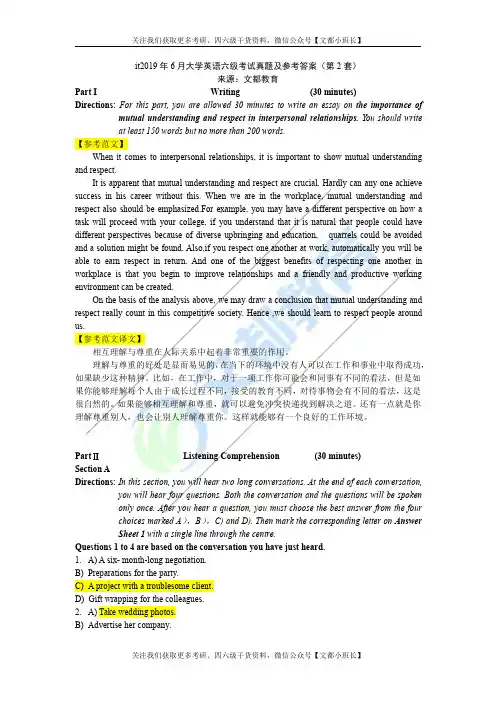
it2019年6月大学英语六级考试真题及参考答案(第2套)来源:文都教育Part I Writing(30minutes)Directions:For this part,you are allowed30minutes to write an essay on the importance of mutual understanding and respect in interpersonal relationships.You should writeat least150words but no more than200words.【参考范文】When it comes to interpersonal relationships,it is important to show mutual understanding and respect.It is apparent that mutual understanding and respect are crucial.Hardly can any one achieve success in his career without this.When we are in the workplace,mutual understanding and respect also should be emphasized.For example,you may have a different perspective on how a task will proceed with your college,if you understand that it is natural that people could have different perspectives because of diverse upbringing and education,quarrels could be avoided and a solution might be found.Also,if you respect one another at work,automatically you will be able to earn respect in return.And one of the biggest benefits of respecting one another in workplace is that you begin to improve relationships and a friendly and productive working environment can be created.On the basis of the analysis above,we may draw a conclusion that mutual understanding and respect really count in this competitive society.Hence,we should learn to respect people around us.【参考范文译文】相互理解与尊重在人际关系中起着非常重要的作用。
大学英语四级 和六级考试时间冲突吗 分别是什么时候考试

内容介绍
一般不会冲突,在同一天考试,但是四级是在早上考试,而六级是在下午进行考试。 大学英语四级考试,即CET-4,College English Test Band 4的缩写,是由国家教育部高等教 育司主持的全国性英语考试。考试的主要对象是根据教育大纲修完大学英语四级的在校专科生、 本科生或研究生。 大学英语六级考试(又称CET-6,全称为“College English Test-6”)是由国家统一出题的, 统一收费,统一组织考试,用来评定应试人英语能力的全国性的考试,每年各举行两次。 大学英语考试是教育部主管的一项全国性的教学考试,其目的是对大学生的实际英语能力进行客 观、准确的测量,为大学英语教学提供服务。 大学英语考试是一项大规模标准化考试,在设计上必须满足教育测量理论对大规模标准化考试的 质量要求,是一个“标准关联的常模参照测验”。
同样,在2022年5月,上海市教育考试院发布公告,鉴于上海市新冠肺炎疫情防控的最新情况, 为了确保广大考生和涉考工作人员的健康,上海市原定于5月21日至22日举行的全国大学英语四、 六级口语考试(CET-SET)也被迫取消。这一决定,无疑给那些准备在考试中展示他们口语技能 的上海学生带来了巨大的失望,但也体现了考试院对公众健康的关爱和负责任的态度。
参考资料:大学英语六级考试
然而,2020年5月29日,教育部考试中心发布公告,根据党中央、国务院关于新冠肺炎疫情防控 工作的有关精神,原定于2020年6月13日举行的全国大学英语四、六级考试延期并分两次举行, 考试日期分别为7月11日和9月19日。这如同天空中的两颗明星,虽然暂时隐匿了光芒,但它们终 将在未来的日子里再次闪耀。 六级考试,这个熟悉又令人振奋的名字,它伴随着我们的青春,见证着我们的成长。让我们以梦 为马,不负韶华,用知识点亮我们的未来,用努力换取我们的成功。在CET-6的考场上,让我们 再一次挑战自我,超越极限,书写属于我们的辉煌篇章!
全国大学英语四、六级考试安全类突发事件的应急处置预案.doc
四川天一学院全国大学英语四、六级考试安全类突发事件的应急处置预案第一章总则第一条为保障全国大学英语考试工作提顺利进行,及时预防和有效处理考试过程中的突发事件,结合我院的实际情况,特制定本预案。
第二条本预案的制定坚持以下几个原则:发现问题,即时上报;统一指挥,系统联动;分级负责,属地管理;快速反应,有效控制;重在预防,依法处置。
第三条本预案适用于自然因素或由人为因素引起的试题泄密、贩卖试题或蓄意破坏考试秩序、影响考试公平,破坏正常考试秩序、社会稳定等事故、事件和灾害。
第二章组织指挥体系及职责第四条全国大学英语考试突发事件应急领导小组( 以下简称“应急领导小组”) ,由学院主管教学副院长担任组长,由教务处、保卫处、学院办公室、学生处、后勤处等有关部门负责人担任副组长,其他各系处负责人任组员。
应急领导小组充分利用现有学院应急系统硬件设施,负责在考试期间统筹协调,快速有效地处理学院范围内的各类考试突发事件。
如发生重大突发事件由应急领导小组上报。
应急领导小组是学院考试安全事件应急工作的最高领导、议事和协调机构,其主要职责是:启动本预案;初步判断事件等级;根据各方面情况,作出初步决策;向上级行政部门报告有关情况;根据上级指示,协调各有关部门行动。
应急领导小组下设办公室,其主要职责是:第一时间上报事件情况,包括:事件原因、事件性质、波及范围、目前的基本处理措施、对事件等级的初步判断;落实应急领导小组进行工作部署;做好善后处理工作。
第三章预警和预防机制第五条考试安全事件应急工作要完善安全规章制度,网络责任制度,坚持早发现、早报告、早处置的方针。
要根据事件的种类和特点建立健全监测网络,划分监测区域,确定监测点,明确监测项目,落实监测人员,配备必要的设备、设施,对有关考试安全事件进行全天候监测。
要及时发现和掌握本考点存在的“苗头性”问题,包括学生考前、考中、考后的心理状况,如有重要情况须采取有效措施进行处置并及时上报。
2023年上半年全国大学英语四六级考试时间(已定)
2023年上半年全国大学英语四六级考试时间(已定)前言自从高校教育改革开展以来,英语四六级考试已成为全国大学生必选考试,考试成绩也是对大学英语教育质量的重要衡量标准之一。
所以,了解四六级考试时间是学生们备考复习的重要参考资料之一。
本文作者通过阳光高考网整理搜集得到的官方消息,将2023年上半年全国大学英语四六级考试时间整理如下。
2023年上半年全国大学英语四六级考试时间四级考试时间四级考试时间一般在每年的6、12月份,考试时间一般在该月的第二个周六。
而2023年4月份的四级考试时间如下:•2023年4月15日(周六)考试时间为8:00-11:00。
六级考试时间六级考试时间一般在每年的6、12月份,考试时间一般在该月的第二个周六。
而2023年6月份的六级考试时间如下:•2023年6月17日(周六)考试时间为14:00-17:00。
2023年上半年全国大学英语四六级考试科目2023年上半年全国大学英语四六级考试科目如下:•英语四级考试:听力、阅读、写作三个部分。
•英语六级考试:听力、阅读、写作三个部分。
以上是2023年上半年全国大学英语四六级考试时间、科目的一个简要介绍。
阅卷及成绩公布时间对于四六级考试的阅卷以及成绩的公布,通常的时间为考试后一个月至两个月内。
考生若想及时了解到自己的考试成绩,可以通过中国高等教育学生信息网或者学校教务处官网查询。
考试报名流程对于准备参加2023年上半年全国大学英语四六级考试的考生,可以在相关考试网站进行网上报名,通过网上支付相关费用实现支付,考生护照照片的上传可通过扫描或者上传等方式实现。
考试备考建议对于即将参加2023年四六级考试的考生,我们提供一些备考建议:1.提前了解考试规则,熟悉考试内容以及考试流程。
2.合理规划备考时间,根据自己的实际情况进行合理分配。
3.抓住重点,针对自己的弱项进行有针对性的练习和提高。
4.参加模拟考试,摸清自己的考试状态以及考试心态。
5.合理调节作息,保持好心情,保证充足的精力进行备考。
2023年7月全国大学生英语四六级考试六级试卷(第四套)
2023年7月全国大学生英语四六级考试六级试卷(第四套)第一部分:听力(共两节,满分30分)第一节(共5小题;每小题1.5分,满分7.5分)1. A) Borrow a pen from the speaker.2. C) Take notes on the lecture.3. B) Ask Mr. Johnson for help.4. C) Go to the campus library.5. A) Attend the talk and discuss the topic.第二节(共10小题;每小题1.5分,满分15分)6. C) Diverse cultural backgrounds.7. A) Its size and population.8. D) Rome's historical significance.9. B) The quality of local universities.10. D) The choice of cuisine.11. B) The importance of art.12. C) It is a milestone in dance music history.13. A) It is an improvisational style of music.14. C) It is often used in animated films.15. D) It reflects Jamaican culture.第二部分:阅读理解(共两节,满分40分)第一节(共15小题;每小题2分,满分30分)Passage 1:16. D) The importance of deforestation.17. A) Carbon emissions.18. B) China and India.19. C) Afforestation efforts.20. D) The current rate of deforestation.Passage 2:21. B) It lacks evidence from clinical trials.22. C) They can help reduce symptom severity.23. A) They are more effective for mild illnesses.24. C) There are potential side effects.25. D) It is necessary to find alternatives.Passage 3:26. A) The impact of increased screen time on sleep.27. C) Blue light's effect on sleep quality.28. B) Melatonin's role in regulating sleep.29. C) Using digital devices at bedtime.30. D) Limiting exposure to blue light.第二节(共5小题;每小题2分,满分10分)31. A) Promote environmental awareness.32. D) A tool for beach cleaning.33. B) It collects plastic waste effectively.34. C) It reduces the risk of marine pollution.35. D) It is inspired by the algae species.第三部分:英语知识运用(共两节,满分45分)第一节:完形填空(共20小题;每小题1.5分,满分30分)36. B) struggle37. D) exhausted38. A) convinced39. C) amazed40. B) motivated41. A) Although42. D) sooner43. C) care44. A) necessary45. B) effort46. D) transformed47. C) level48. A) declared49. B) participate50. D) missing51. A) seek52. B) expenses53. C) realistic54. D) equipped55. A) however56. C) expected第二节:语法填空(共10小题;每小题1.5分,满分15分)57. that58. a59. which60. to solve61. of62. in63. what64. them65. for66. has shown第四部分:写作(共两节,满分35分)第一节:短文改错(共10小题;每小题1分,满分10分)1. 在shares后加上an2. 将have改为has4. 将were改为was5. 将buying改为buy6. 删除the7. 将to改为of8. 将same改为similar9. 在was后加上also10. 删除is第二节:写作(满分25分)暂无参考答案。
2020年9月英语四级成绩查询时间、方式及入口【11月4日正式查分】
【导语】从中国教育考试发布的《》得知,2020年9⽉英语四级成绩已于11⽉4⽇公布了,今天⼤家就可以查分了,预祝⼤家顺利通过考试,具体详情如下:成绩查询时间2020年9⽉英语四级成绩查询时间为11⽉4⽇上午10时。
成绩查询⽅式2020年9⽉英语四级成绩采⽤上查询的⽅式,英语四级成绩查询址如下:址: /cet中国教育考试址: /cet中国⾼等教育学⽣信息2020年9⽉英语四级成绩查询步骤如下:⽅式⼀:全国⼤学英语四、六级考试考⽣登录全国⼤学英语四、六级考试()点击“考⽣服务-成绩查询”,进⼊查分界⾯;输⼊准考证号、考⽣姓名及验证码,点击“查询”即可查分。
⽅式⼆:中国⾼等教育学⽣信息(学信)考⽣登录教育部考试中⼼综合查询(https:///)点击⾸页菜单栏“四六级查询”,进⼊“⼤学英语四、六级考试(CET)”查分页⾯;输⼊准考证号、考⽣姓名及验证码,点击“查询”即可查分。
⽅式三:中国教育考试考⽣登录教育部考试中⼼综合查询(/)点击⾸页菜单栏“成绩查询”,选择进⼊“⼤学英语四、六级考试(CET)”查分页⾯;输⼊准考证号、考⽣姓名及验证码,点击“查询”即可查分。
成绩查询⼊⼝点击进⼊>>>点击进⼊>>>以下⼏种情况会造成成绩为0分:1.缺考2.违规3.参加考试,但在考试时未按规定粘贴条形码4.参加考试,总成绩在220分及以下。
准考证号查询 2020年9⽉英语四级准考证号忘记的考⽣可直接到全国⼤学英语四、六级考试报名(/)输⼊姓名和⾝份证号直接找回准考证。
合格分数线凡考试成绩在220分以上的考⽣,由国家教育部⾼教司委托“全国⼤学英语四六级考试委员会”发给成绩单,不设及格线。
但全国⼤学英语四六级规定“英语四级成绩达到425分以上(含425分)者,可以报考英语六级”。
⼀般认为英语四级的及格线是425分。
有的学校也规定英语四级过425分之后才能颁发毕业证。
但现在有的学校已取消了四级成绩与学位证挂钩。