
外研版七年级英语下册Module 1 教案
1
Module 1 Lost and found
Unit 1 Whose bag is this?
一、教学目标 :
1. 语言知识目标:
1) 能正确使用下列单词和短语:crayon, eraser, glove, wallet, watch, whose,
first of all, lose and found box, mine, hers, be careful with, from now on...
2) 掌握first of all及be careful with的用法。
2. 情感态度价值观目标:
学习英语文明礼貌的询问和回答方式,拾金不昧的做人原则和助人为乐的优良品质。
二、教学重难点:
1、能够听懂有关失物招领的简短对话。
2、能够正确使用特殊疑问句“Whose…is this/that? 对物品的所属进行提问及其回答。
三、教学过程
Step 1 Warming-up
1. Show some pictures of school things. Say what they are.
2. Look at the pictures on Page 2. Match the words from the box with the pictures.
3. Read the words after the teacher.
Step 2 Listening practice
1. Ask the students to read through the questions in Activity 2.
1) Is the football Tony’s?
2) Are the crayons Betty’s?
3) Whose gloves are these?
2. Ask the students to listen to the recording carefully.
Step 3 Listen and read.
1. Ask the students to read the conversation.
2. Act it out.
2
3. Learn “Everyday English”
Welcome back! be careful with… from now on.
Step 4 Work in pairs.
1. Show some pictures of school things. Say what they are.
2. Ask the students to talk about the pictures.
3. Ask and answer like this:
— Are the crayons Betty’s?
— No, they’re not hers. They’re Lingling’s.
Step 5 Work in pairs.
Work in groups of three or four. Put four or five school things on the desk. Ask
and answer.
1. The students choose the school things. Ask and answer like this:
A: Is this your pen?
B: Yes, it’s mine.
A: Whose pencil is it?
C: It’s …
2. Read through the example with the class.
3. Pair them to ask and answer.
Step 6 Language points
1. First of all, come and look in the lost and found box!
First of all 是在介绍准备讲的几件事情的 第一件事情。用于强调次序。
e.g. First of all, let me introduce myself to you.
首先,让我作个自我介绍。
First of all, clean the surface that you are going to paint.
首先,把要刷涂料的表面弄干净。
2. Everyone, please be careful with your things from now on.
be careful with后接名词或动名词, 表示做某事时很小心或仔细。
e.g. He’s careful with his work. 他工作很仔细。
3
Be careful with the vase, it is valuable. 这花瓶很贵, 小心点。
Step 7 Homework
1. Remember all the new words and expressions we’ve learned today;
2. Write something about your family by using words we’ve learned today.
Unit 2 Are they yours?
一、教学目标:
1. 语言知识目标:
1) 能够正确使用下列单词和短语:camera, mobile phone, in a hurry, leave,
hundreds of, look for...
2) 能读懂有关失物招领的短文,能写出一则招领启事
2. 情感态度价值观目标:
学会与他人交流时言行举止大方得体,对他人提供的帮助表示感谢
二、教学重难点:
1. 教学重点:使学生能理解课文内容。
2.教学难点:能写失物招领启事和寻物启事。
三、教学过程
Step 1 Warming-up
1. Lead in : Play a guessing game using the following sentences:
Is the …Tom’s/hers/his?
Whose...is this?
2. Make dialogues: Ask the students to make dialogues with partners using the
things they have, and try to use the sentences like these:
Is the …yours/hers/his? Whose...is this?
Step 2 Pre-reading
Learn the new words and show the students a lost and found note.
Step 3 Reading
1. Scanning
Ask students to scan the passage and answer the question:
4
What things are there at the lost and found office in New York City?
2. Skimming
Ask students to skim the passage and answer the question:
1) When do people often lose things?
2) Why are there lost and found offices at airports and stations?
3) What do people do at the lost and found office?
4) What strange things are there at the New York City Lost and Found
Office?
Step 4 Post-reading
1. Let the students fill in the blanks according to the passage.(Activity 3)
2. Let students read the lost and found notes and write notes for two more
things.
Step 5 Language points
1. People often lose things when they’re travelling or when they’re in a hurry.
in a hurry 意思是“匆匆忙忙”。
e.g. She write a letter in a hurry. 她匆匆忙忙地写了一封信。
(be) in no hurry意思是 “不急于;不忙于”
e.g. She’s in no hurry to leave here. 她不急于离开这儿。
2. Hundreds of people come here every day.
hundred是一个确数, 表示“一百”。当hundred前面有具体数字时, 要用单数形式, 但它后面跟of 时, 要用复数形式hundreds of,同时其前面不能再加具体数字。△thousand, million也有此类似的用法。
e.g. There are hundreds of mobile phones in the store. 商店里有成百上千的手机。
Thousands of people work in the factory. 成百上千的人在这家工厂上班。
Step 6 Exercises
Ⅰ.根据句意及汉语提示写出句中所缺单词。
1. This ________(照相机) is now on sale for 19 dollars only
2. Are you going to America by boat or by ________(飞机)?
外研版英语七年级下册Module 4 Life in the future Unit 1表格式教案
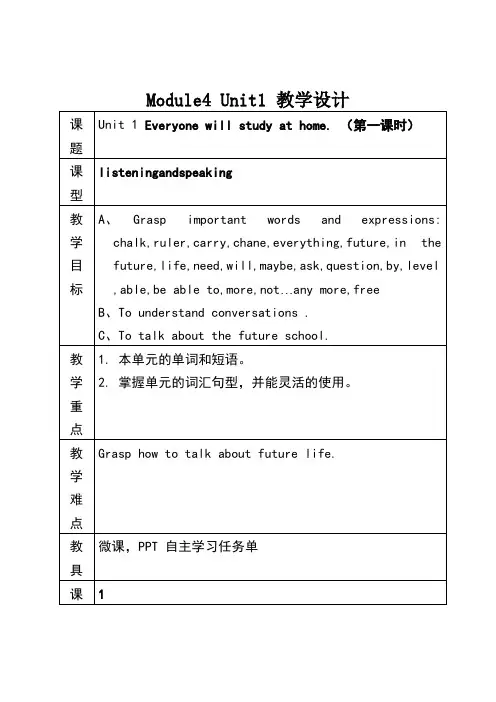
Module4 Unit1 教学设计
课题 Unit 1 Everyone will study at home. (第一课时)
课型 listeningandspeaking
教
学
目
标
A、 Grasp important words and expressions:
chalk,ruler,carry,chane,everything,future,in the
future,life,need,will,maybe,ask,question,by,level,able,be able to,more,not…any more,free
B、To understand conversations .
C、To talk about the future school.
教学
重点 1. 本单元的单词和短语。
2. 掌握单元的词汇句型,并能灵活的使用。
教学
难点 Grasp how to talk about future life.
教具 微课,PPT 自主学习任务单
课1 时
教
学
过
程 Step 1 Warming-up
1. Show some pictures about the new words. Say what
they are.
2. Look at the pictures and talk about it.
Step 2 Vocabulary study
1. Show some pictures with new words by PPT.
2. Ask and answer:
3. Read the words after the teacher.
4. Introduce the new words.
5.Give time to read and remember the new words.
Step3 Work in pairs.
新外研版七年级英语下册导学案(M3-Unit 1讲义)
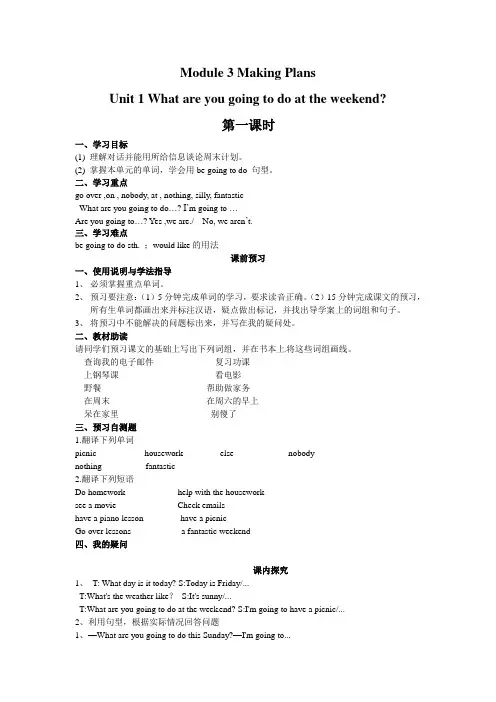
Module 3 Making Plans
Unit 1 What are you going to do at the weekend?
第一课时
一、学习目标
(1) 理解对话并能用所给信息谈论周末计划。
(2) 掌握本单元的单词,学会用be going to do 句型。
二、学习重点
go over ,on , nobody, at , nothing, silly, fantastic
What are you going to do…? I’m going to …
Are you going to…? Yes ,we are./ No, we aren’t.
三、学习难点
be going to do sth. ;would like的用法
课前预习
一、使用说明与学法指导
1、 必须掌握重点单词。
2、 预习要注意:(1)5分钟完成单词的学习,要求读音正确。(2)15分钟完成课文的预习,所有生单词都画出来并标注汉语,疑点做出标记,并找出导学案上的词组和句子。
3、 将预习中不能解决的问题标出来,并写在我的疑问处。
二、教材助读 请同学们预习课文的基础上写出下列词组,并在书本上将这些词组画线。
查询我的电子邮件______________复习功课________________
上钢琴课______________________看电影__________________
野餐________________________帮助做家务_________________
在周末______________________在周六的早上_______________
呆在家里____________________ 别傻了_____________________
三、预习自测题
1.翻译下列单词
picnic________ housework ______ else ________ nobody _______
外研版初一下册教材第一模块课文

Module 1 People and places
Unit 1 We’re haveing a great time!
Vocabulary and listening
Listen and read.
Betty: Hi Mum, can you hear me?
Betty's mum: Yes, I can. Where are you?
Betty: I'm standing on the Great Wall of China and talking to you.
Betty's mum: Really?
Betty: We're on a school trip and we're having a good time.
Betty's mum: That's great, Betty. What are the others doing?
Betty: Well, Tony is eating an ice cream, Wang Hui is taking lots of pictures and
Lingling is buying some presents and postcards. And Daming is eating lunch and
lying in the sun.
Betty's mum: Can you send me a postcard too?
Betty: Yes. Lingling and I are writing postcards. We're enjoying the school trip a lot
Anyway, we're going home now. Bye!
Betty's mum: Bye-bye, Betty!
Work in pairs. Match the people 1-7 with the actions a~g, and say what people are doing.
外研版英语七年级下册Would you like to go to the cinema全英文教案
初一英语 Module 6 Unit 1
Teaching Plan
Module Six, Unit One “Would you like to go to the cinema?”
Teaching aims and demands:
1. Learn to make and accept invitations with “Would you like to do…?” and “Good idea!”
2. Learn to be polite and active in communicating with others
3. Train Ss’ abilities to listen and speak
4. Cultivate Ss’ spirits to enjoy the beautiful life and entertainments
Main points:
1. Use sentence structure to invite : “Would you like to do…?”
2. Use sentence structures to accept invitations: “Good idea!” and “That’s a good idea!”
“What a good idea!”
3. Talk freely about invitations and entertainment
Difficult points:
1. Free talk about making and accepting invitations
2. The ability to communicate in English and try to make others join in activities and games.
3. Widen the contents and cultivate the creative thinking method and the ability to act.
外研版初中英语七年级下册(WY)教案 Module 6 Unit1 教案 3
第1页 共6页 Module6 Unit1同步练习
(20分钟 50分)
Ⅰ. 根据句意及首字母提示完成单词(10分)
1. Don’t play sports on the s________. It’s too dangerous.
2. Helen’s father didn’t have enough money to buy a car so he
borrowed some money from a b________.
3. —Can you see the theatre over there?
—Yes, the library is o________ it, on the other side of the road.
4. I went to the science m________ with my friends last week.
5. Many t________ visit Beijing every day. They come from different
countries all over the world.
Ⅱ. 单项填空(10分)
1. The club is far from our school. Let’s ________ taxi.
A. by B. take C. take a D. taking
2. —______do I reach the nearest restaurant?
—You can go there on foot.
A. What B. How C. When D. Where
3. It’s very hot in the room. Why not ________ the air
conditioner(空调)?
A. turn on B. turn off C. to turn on D. to turn off
外研版英语七年级下册Module7_Unit 1 第2课时单元教案与反思

Unitl第2课时
满招损,谦受益。《尚书》
原创不容易,【关注】店铺,不迷路!
知己知彼,百战不殆。《孙子兵法·谋攻》
原创不容易,【关注】店铺,不迷路!
原创不容易,为有更多动力,请【关注、关注、关注】,谢谢!
令公桃李满天下,何用堂前更种花。出自白居易的《奉和令公绿野堂种花》
自主学习方案
1.学生自学新词汇(见教材P108)。
2.学生自学教材(P43),找出课文中重点词组和句子。
课堂导学方案
Step1情景导入
教师提问题要求学生回答:
T:Wereyoubornin2003?
S1:Yes,Iwas.S2:No,Iwasn’t.
T:Wasyourfirstteaceyesterday.
→WereLucyandLilyateyesterday?
→Yes,teofyourprimaryscotheryesterday?
Step5家庭作业请完成模块7Unit1第2课时的练习题。
教学反思 这一课时主要是教会学生掌握be动词一般过去式的各种句式。为了避免单调枯燥的课堂教学,提高生学习的效果,教师可以运用“任务型”教学模式,使学生有了明确的任务目标,他们会更主动更积极地去学习。 【素材累】
一个从小练习芭蕾舞的女孩,决定将跳舞作为终身职业。一天,她去求见芭蕾舞团团长,说:我想成为出色的芭蕾舞演员,不知我是否有这个天分?团长看她跳了一段舞,摇了摇头说:不,你没有这个条件。女孩把舞鞋扔到箱子底下,再也没穿过。
【素材积累】
指豁出性命,进行激烈的搏斗。比喻尽最大的力量,极度的努力,去实现自己的目标。逆水行舟,不进则退。人生能有几回搏,此时不搏何时搏。——容国团.生当作人杰,死亦为鬼雄。——李清照贝多芬拼搏成长大作曲家贝多芬小时候由于家庭贫困没能上学,十七岁时患了伤寒和天花之后,肺病、关节炎、黄热病、结膜炎等又接踵而至,二十六岁不幸失去了听觉,爱情上也屡遭挫折,在这种境遇下,贝多芬发誓“要扼住生命的咽喉”。在与生命的顽强拼搏中,他的意志占了上风,在乐曲创作事业上,他的生命之火燃烧得越来越旺盛了。
外研版七年级英语下册Module 2 unit 1 教案
全国中小学“教学中的互联网搜索”优秀教学案例评选
教案设计
一、 教案背景
1,面向学生: □√中学 □小学 2,学科:英语
2,课时:1
3,学生课前准备:
1. 预习词汇Spring Festival, get ready for, sweep away, all the year round,
tradition, happen… (会读,了解意思)
2. Class report
教学课题Module 2 Spring Festival
Unit1 We are getting ready for Spring Festival
一、学习目标
1. 语言知识目标:(1) 能正确运用词汇:Spring Festival, ready, get ready
for, learn, dragon, dragon dance, lantern, sweep
(2) 现在进行时的问与答;一般现在时。
2. 语言技能目标:
听:能听辨动词词组;能听懂人们正在如何为节日做准备的对话。
说:能用现在进行时进行问答练习。
读:能读懂有关节日描述的短文,并且能将段落与图片、段落与问题匹配。
写:学会写要点、句子以及段落。
3.情感目标: 乐于接触并了解世界不同地方人们的节假日,乐于参加相关英语实践活动,提高对英语的学习兴趣,培养对异国文化,生活习俗的兴趣,提高对本国文化的认识。参加各种英语活动,克服困难,在新环境中进一步树立准确的语言学习观。
二、 教材分析
本模块话题是“节日”。要求学生掌握描述节日的表达方式,同时加强学生对中外节日的理解与认识。通过使用现在进行时,对该话题展开听、说、读、写的语言实践活动。使学生加深能够谈论或写出对该节日的介绍,并了解英语国家中重要的节假日及其主要庆祝方式。有助于学生了解世界,提高学习效率,形成自主学习的能力,为学生的终身学习奠定基础。教学中教师应随时随地以课本为出发点,灵活利用各种素材组织教学过程和内容。
外研版七年级英语下册 Module 11 Unit 1教案
教学设计
姓名 学科 英语 时间
课题 Module11 Body language
Unit 1 They touch noses.
课型 新授课 口✔ 章/单元复习课 口 专题复习课 口
习题试卷讲评课 口 学科实践活动课 口 其它 口
1. 教学内容分析
本模块主要通过对话和文章了解不同国家的人见面时的肢体语言。不同的国家地区有不同的肢体语言,这对于学生来讲很感兴趣,而且本模块需要学生动起来,很容易调动课堂气氛,对于小组合作也很有意义。
2、学习者分析
学生对本模块的中心话题会很感兴趣,握手等身体语言为学生所熟悉,所以便于开展听、说、读、写活动,激发学生的学习热情,积极参加小组活动。祈使句在上学期的学习中,已经接触过一些。学生能够大致说出祈使句的概念。本课时将在上学期的基础上,更加详尽的学习祈使句的概念,结构等用法。
3、学习目标确定
Knowledge objective
1. To learn the new words: shake hands, together, nod head, touch noses, kiss,
bow...
2. Get different body languages from the world. Ability objective
1. Read and understand the conversation.
2. work in groups, act the body languages.
Moral objective
1. Get different body languages from the world and know, When in Roma, do as
Romans do.
2. Respect different cultures.
【教学重点】
To get different body languages and try to act them out.
外研版英语七年级下册:Module 11 Unit 1 They touch noses! 教案设计
课文标题:Module 11 Body language
单元名称:Unit1 They touch noses!
教材版本:外研社《新标准》
授课年级:七年级下册
一、教学内容分析
本模块是七年级下册的第十一模块,以学习“肢体语言”为主要话题, 围绕不同国家人民在见面时使用不同的肢体语言等内容,通过开展听、说、读、写活动,帮助学生学习和体验不同国家见面时肢体语言的使用。
本模块计划五课时完成,本课是第一课时,课型是听说课。本课对话内容主要围绕Lingling和Betty 谈论如何接待俄国老师展开,近而学习其它国家人民的见面礼仪。通过听,说,读活动,学生能够感知问候肢体语言的含意,理解各国问候时肢体语言的差异性,为应用打下基础。
二、教学目标
1.语言知识目标:
1、体会各国人民在见面时使用不同的肢体语言。
2、理解和领悟以下词汇的意义,并学会运用,如bow, shake hands, kiss, smile, nod, hug,
each other, touch等; 理解并掌握以下词汇的含意, British, German, Japanese, Russian,
Russia, India等。
3、能在词汇学习过程中掌握肢体语言的含意(如bow, shake hands, kiss, smile, nod, hug,
touch)等;在对话中意识到不同国家人民(如British, German, Japanese, Russian,
India)使用肢体语言的差异。
4、理解并能恰当运用不同国家表达问候的肢体语言。
2.语言技能目标:
1、学生通过教师的课堂指令进行肢体语言词汇及国家、人民词汇的学习,获取听力材料中语句之间的联系,作简单的匹配练习;
2、了解字母组合的发音规律
3、学生能在对话分析基础上用所学内容简单地表达各国问候礼仪,并在上述口语活动中做到语音、语调基本正确
外研版初中英语七年级下册教案全册
外研版初中英语七年级下册精品教案 全册
Module 1 School Life
Unit 1 There are fifty students in the class. Preparation
在黑板上写出单词 Festival,要求学生回忆并说出已学过的节日名称, 如:New
Year, Christmas Day等,并板书。 组织两人小组活动,内容是在节日时的对话。如下例: Happy New Year... Happy New Year...
Do you...? Yes/No. We...
两人小组活动后, 请几对学生上台演示, 然后要求大家评价。 对演示认真又基本无语言错误的学生给予奖励。
介绍短语 Spring Festival, 带读后转入第 1 小节的学习
1.Look and listen. Then repeat.
1)先不打开书,问学生 :春节后 ,一些同学又见面了, 他们很高兴地在一起交谈,他们谈了些什么呢( What are they talking about ?)? 2)要求学生听一遍录音后,回答上面的问题,然后将答案 School Life 写在 黑板正上方。
3)写出以下问题,要求学生听第二遍录音后回答: How many students are there in the class?
How long are the lessons? How does Feifei go to school?
How long does the bus take to get to school ? 学生回答上述问题后翻开书,跟录音读一遍对话。 组织四人小组操练本段对话,然后要求他们演示和评价。 第 2、 3、4 小节的教学可参考“教师用书”的建议进行。 Unit 2 What’s your favourite lesson?