
(完整)仁爱版八年级英语上册语法(2)
第 1 页 共 15 页 1 UNIT 1 Topic 1 语法精讲 be going to+动词原形 1. 表示说话人根据现在已有的迹象,判断将要或即将发生某种情况。这类句子的主语可以是人,也可是物。例如: There is going to be a football match in our school tomorrow afternoon. 明天下午我们学校将有一场足球赛。(已有告示) I feel terrible.I think I'm going to die. 我感到难受极了,我想我快不行了。 Look at those black clouds!It's going to rain. 看看那些乌云!天快要下雨了。 2. 表示主语现在的意图或现已作出的决定,即打算在最近或将来进行某事。这种意图或决定往往是事先经过考虑的。例如: He isn't going to see his elder brother tomorrow. 他明天不准备去看他哥哥。 Mary is going to be a teacher when she grows up. 玛丽决定长大了当一名教师。 3. 只是单纯地预测未来的事,此时可与will互换。例如: I think it is going to/will rain this evening. 我认为今晚要下雨。 注意: (1)be going to和will在含义和用法上略有不同。be going to往往表示事先经过考虑的打算;will多表示意愿、决心。两者有时不能互换。例如: He is studying hard and is going to try for the exams. 他正努力学习,准备参加考试。(不能用will替换) —Can somebody help me? ——谁能帮我一下吗? —I will. ——我来。(不能用be going to替换) (2)在if之后,通常不用will表示预言,但可以用be going to表示意图。例如: If you are going to go to the cinema this evening,you'd better take your coat with you. 你若今晚去看电影,最好带着外套。 be going to也常可以用于主句之中。例如: If you invite Jack,there's going to be trouble. 如果你邀请杰克,那就要惹麻烦了。 如果表示将来的意愿,will可用于条件从句。此时will为情态动词。例如: If you will learn to play football,I'll help you. 如果你想学踢足球,我可以帮你。 课堂小测 1、Be careful. The train ____d. A. will come B. C. comes D. is coming 2. Look at those clouds. It ___a__ soon, I'm afraid. A. is going to rain B. is raining C. will rain D. won't rain 3. The radio says it ____c__ the day after tomorrow. A. is going to snow B. is snowing C. will snow D. snows 4. _b___ he _____ some shopping tomorrow afternoon ? A. Will…does B. is going to do C. is…doing D. Shall… do 第 2 页 共 15 页
2 UNIT 1 Topic 2 语法精讲 第 3 页 共 15 页
3 UNIT 1 Topic 3 语法精讲
随堂测试 1、 There __________ a meeting tomorrow afternoon. A. will be going to B. will going to be C. is going to be D. will go to be ( ) 2. Charlie ________ here next month. A. isn’t working B. doesn’t working C. isn’t going to working D. won’t work ( ) 3. He ________ very busy this week, he ________ free next week. A. will be; is B. is; is C. will be; will be D. is; will be ( ) 4. There ________ a dolphin show in the zoo tomorrow evening. A. was B. is going to have C. will have D. is going to be ( ) 5. –_____ you ______ free tomorrow? – No. I _____ free the day after tomorrow. A. Are; going to; will B. Are; going to be; will C. Are; going to; will be D. Are; going to be; will be ( ) 6. Mother ________ me a nice present on my next birthday. A. will gives B. will give C. gives D. give 第 4 页 共 15 页 4 UNIT 2 Topic 1 语法精讲
UNIT 2 Topic 2 语法精讲 第 5 页 共 15 页
5 UNIT 2 Topic 3 语法精讲
情态动词用法总结: 情态动词的语法特征:1) 情态动词不能表示正在发生或已经发生的事情,只表示期待或估计某事的发生;2) 情态动词 除ought 和have 外,后面只能接不带to 的不定式。3) 情态动词没有人称,数的变化,即情态动词第三人称单数不加-s。4) 情态动词没有非谓语形式,即没有不定式, 分词,等形式。 一、 比较can 和be able to 1)can could 表示能力;可能 (过去时用could),只用于现在式和过去式(could)。be able to可以用于各种时态。 They will be able to tell you the news soon. 他很快就能告诉你消息了。 2)只用be able to a. 位于助动词后。b. 情态动词后。c. 表示过去某时刻动作时。d. 用于句首表示条件。 e. 表示成功地做了某事时,只能用was/were able to, 不能用could。 He was able to flee Europe before the war broke out. He managed to flee Europe before the war broke out. 注意:could不表示时态 1)提出委婉的请求,(注意在回答中不可用could)。 —— Could I have the television on? —— Yes, you can. / No, you can't. 2)在否定,疑问句中表示推测或怀疑。 He couldn't be a bad man. 他不大可能是坏人。 二、比较may和might 1) 表示允许或请求;表示没有把握的推测;may 放在句首,表示祝愿。 May God bless you! He might be at home. 注意: might 表示推测时,不表示时态。只是可能性比may 小。 第 6 页 共 15 页 6 2) 成语: may/might as well,后面接不带to 的不定式,意为"不妨"。 If that is the case, we may as well try 三、比较have to和must 1) 两词都是'必须’的意思,have to 表示客观的需要, must 表示说话人主观上的看法,既主观上的必要。 My brother was very ill, so I had to call the doctor in the middle of the night. 我弟弟病得很厉害,我只得半夜里把医生请来。(客观上需要做这件事) He said that they must work hard. 他说他们必须努力工作。(主观上要做这件事) 2) have to有人称、数、时态的变化,而must只有一种形式。但must 可用于间接引语中表示过去的必要或义务。 He had to look after his sister yesterday. 3) 在否定结构中: don't have to 表示"不必" mustn't 表示"禁止", You don't have to tell him about it. 你不一定要把此事告诉他。 You mustn't tell him about it. 你一定不要把这件事告诉他。 四、must表示推测 1) must用在肯定句中表示较有把握的推测,意为"一定"。 2) must表对现在的状态或现在正发生的事情的推测时, must 后面通常接系动词be 的原形或行为动词的进行式。 You have worked hard all day.You must be tired. 你辛苦干一整天,一定累了。(对现在情况的推测判断) He must be working in his office. 他一定在办公室工作呢。 比较: He must be staying there. 他现在肯定呆在那里。 He must stay there. 他必须呆在那。 3) must 表示对已发生的事情的推测时,must 要接完成式。 I didn't hear the phone. I must have been asleep. 我刚才没有听到电话,我想必是睡着了。 4) must表示对过去某时正发生的事情的推测,must 后面要接不定式的完成进行式。 ——Why didn't you answer my phone call? ——Well, I must have been sleeping, so I didn't hear it. 5) 否定推测用 can't。 If Tom didn't leave here until five o’clock, he can't be home yet. 如果汤姆五点才离开这儿,他此时一定还未到家。 五、表示推测的用法 can, could, may, might, must 皆可表示推测,其用法如下: 1)情态动词+动词原形。 表示对现在或将来的情况的推测,此时动词通常为系动词。 I don't know where she is, she may be in Wuhan. 2)情态动词+动词现在进行时。 表示对现在或将来正在进行的情况进行推测。 At this moment, our teacher must be correcting our exam papers. 这时,我们老师想必在批改试卷。 3)情态动词+动词完成时。 表示对过去情况的推测。 We would have finished this work by the end of next December.
最新八年级英语(仁爱版)上册语法点归纳

Unit3 My HobbyTopic 1 I love collecting stamps一.重点词汇hobby 爱好 vacation假期 painting 绘画 friendship友谊 knowledge 知识daily 每日的 whether 是否 such as 例如 used to do sth. 过去常常做某事take a bath 洗澡 be interested in 对,,感兴趣go dancing 跳舞 go boating 划船 play volleyball 打排球 swimming 游泳drawing 画画 collecting stamps 集邮 collecting coins 收藏硬币listening to pop music 听流行音乐 listening toclassical music 听古典音乐listening to symphony 听交响乐 walking in the countryside 在乡间散步二.重点句型:1.Wow! So many stamps!(Page 53)哇,那么多的邮票!本句意为:There are so many stamps. so many意思是“那么多”,so much意思也是“那么多”。
如:1)There are so many flowers. Or: So many flowers!这里有这么多的花。
2)There is so much water on the table. Or: So much water!桌子上有那么多的水。
2. We c an learn a lot about people, places, history, and special times from stamps. (Page 53)通过这些邮票我们可以学到许多关于人文、地理、历史和特殊时代的知识。
a lot “许多、大量”,用在动词后,同very much。
2019八年级英语上册 Unit 2《Keeping Healthy》情态动词专项语法讲练 (新版)仁爱版

专项语法讲练——情态动词【概念引入】情态动词有具体的词义,但也同助动词一样,需要与其他词语一起构成句子的谓语,另外情态动词没有人称和数的变化,情态动词后必须跟动词原形。
【用法讲解】I、常见情态动词的用法一、can的用法:(1)表示能力。
表示能力时一般译为“能、会”,即有某种能力,尤其是生来具备的能力,此时may和must均不可代替它。
例如:She can swim fast, but I can’t. 她能游得很快,但我不能。
I can see with my eyes.我用眼睛看。
(2)表示许可,常在口语中。
例如:You can use my dictionary.你可以用我的字典。
(3)表示推测。
表示推测时,意为“可能”,常用于否定句和疑问句中,此时can’t 译为“不可能”。
例如:Can the news be true?这个消息会是真的吗?—Can the man be our teacher?那个人有可能是我们老师吗?—No, he can’t be our teacher. Our teacher is on a visit to theGreat Wall.不可能。
咱们老师正在游览长城呢。
二、could的用法:(1) can的过去式,意为“能、会”,表示过去的能力。
例如:He could write poems when he was 10.他十岁时就会写诗。
(2) could在疑问句中,表示委婉的语气,此时could没有过去式的意思。
例如:Could you do me a favour?你能帮我个忙吗?—Could I use your pen?我能用一下你的钢笔吗?—Yes, you can.可以。
三、may的用法:(1)表示请求、许可,比can正式。
例如:May I borrow your bike?我可以借你的自行车吗?You may go home now.现在你可以回家了。
Unit 2 Topic 3 重点语法短语及大题练习 仁爱版英语八年级上册讲义

B: Of course.I have many of her CDs. You can take the ones you like. A:(84)____________________________? B: Don't hurry. You can keep them for a month. A:(85)___________________. B: You' re welcome. 1.what are you doing? 2.who is your favorite singer? 3.Can you lend me some of her CDs? 4.How long can I keep them? 5.Thank you very much.
最新八年级英语(仁爱版)上册语法点归纳
Unit3 My HobbyTopic 1 I love collecting stamps一.重点词汇hobby 爱好 vacation假期 painting 绘画 friendship友谊 knowledge 知识daily 每日的 whether 是否 such as 例如 used to do sth. 过去常常做某事take a bath 洗澡 be interested in 对,,感兴趣go dancing 跳舞 go boating 划船 play volleyball 打排球 swimming 游泳drawing 画画 collecting stamps 集邮 collecting coins 收藏硬币listening to pop music 听流行音乐 listening toclassical music 听古典音乐listening to symphony 听交响乐 walking in the countryside 在乡间散步二.重点句型:1.Wow! So many stamps!(Page 53)哇,那么多的邮票!本句意为:There are so many stamps. so many意思是“那么多”,so much意思也是“那么多”。
如:1)There are so many flowers. Or: So many flowers!这里有这么多的花。
2)There is so much water on the table. Or: So much water!桌子上有那么多的水。
2. We c an learn a lot about people, places, history, and special times from stamps. (Page 53)通过这些邮票我们可以学到许多关于人文、地理、历史和特殊时代的知识。
a lot “许多、大量”,用在动词后,同very much。
仁爱版八年级英语上册语法
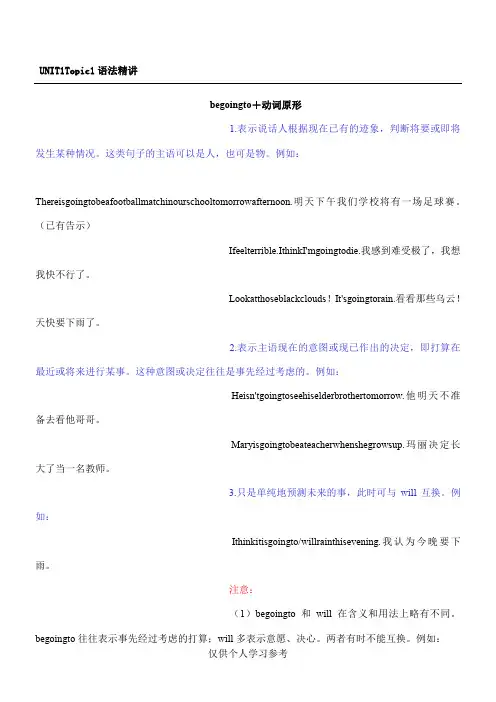
UNIT1Topic1语法精讲begoingto+动词原形1.表示说话人根据现在已有的迹象,判断将要或即将发生某种情况。
这类句子的主语可以是人,也可是物。
例如:天不准互换。
例如:Ithinkitisgoingto/willrainthisevening.我认为今晚要下雨。
注意:(1)begoingto和will在含义和用法上略有不同。
begoingto往往表示事先经过考虑的打算;will多表示意愿、决心。
两者有时不能互换。
例如:Heisstudyinghardandisgoingtotryfortheexams.他正努力学习,准备参加考试。
(不能用will替换)—Cansomebodyhelpme?——谁能帮我一下吗?—Iwill.——我来。
(不能用begoingto替换)(2)在if之后,通常不用will表示预言,但可以用begoingto表示意图。
例如:,此时will课堂小测1、A.isgoingtosnowB.issnowingC.willsnowD.snows4._b___he_____someshoppingtomorrowafternoon?A.Will…doesB.isgoingtodoC.is…doingD.Shall…doUNIT1Topic2语法精讲UNIT1Topic3语法精讲随堂测试1、There__________ameetingtomorrowafternoon.???????A.willbegoingto???????B.willgoingtobeC.isgoingtobe?????D.willgotobe(??)2.?Charlie________herenextmonth.??????A.isn’tworking?????B.doesn’tworkingC.isn’tgoingtoworking?????D.won’twork(??)3.?He________verybusythisweek,he________freenextweek.?????A.willbe;is????????????B.is;isC.willbe;willbe???????D.is;willbe(??)4.?There________adolphinshowinthezootomorrowevening.???A.was????????B.isgoingtohaveC.willhave????D.isgoingtobe(??)5.?–_____you______freetomorrow?–No.I_____freethedayaftertomorrow.A.Are;goingto;will??B.Are;goingtobe;willC.Are;goingto;willbe??D.Are;goingtobe;willbe(??)6.?Mother________meanicepresentonmynextbirthday.????????A.willgives????B.willgiveC.gives??????????????D.give?一、比较1)beableto2a.位于助动词后。
最新仁爱版八年级英语上册Unittopic2知识语法点总结

精品文档仁爱版八年级英语上册Unit1 topic2知识语法点总结1.语法:双宾语kick sb sth = kick sth to sb 符合双宾语结构的词有:kick,pass,throw,bring,show,teach,lend,give (buy,make 用介词for)2.生病be ill= fall ill3.我很乐意。
I'd be glad to. = I'd love to.4.帮助某人give sb a hand5.你介意做…吗?请做…好吗?Would∕Do you mind (not)doing sth?= Could you please(not)do sth?=Would you please(not)do sth?= Would you mind if + 从句?6.我不介意(3种表达)Not at all = Certainly not = Of course not 介意you'd better not.= better not.7.没关系Never mind=It doesn't matter=It's nothing8.继续努力keep trying9.在某方面做的好do well in…= be good at…10. 斥责某人shout at sb11. 向某人道歉say sorry to sb12. 和某人谈论某事talk about sth with sb13. 玩的开心过得愉快have (a lot of∕great)fun = enjoy oneself14. 做某事很开心have fun doing sth15. 尽某人全力try one's best= do one's best16. 尽某人全力做某事try one's best to do sth = do one's best to do sth17. 肯定要做某事be sure to do sth18. be sure of sth be sure (that)+从句be not sure if +从句(if意为是否)19. 最…之一one of +the +adj最高级+可名复20. 有多久的历史have a history of+时间21. 产生,形成come into being=appear22. invent(发明,动词)inventor(发明者,名词)invention(被发明物,名词)23. 以便…为了…so that+从句24. 阻止某人做某事stop∕prevent sb doing sth25. 遵守规则follow the rules26. 例如for example,such as,like,namely区别⑴for example:后只举一例,后有逗号,后加句子,(可放句首,句中,句末)①For example,noise is a kind of pollution. ②Noise,for example,is a kind of pollution. ③Noise is a kind of pollution,for example.⑵such as:用来列举同类人或物的几个例子,后加名词∕动名词∕动名词短语①He knows many languages,such as Chinese,English and Korean.②He does well in many kinds of sports,such as swimming,running,jumping.③We can lots of things on the Internet,such as chatting with friends,doing some shopping,playing computer games.精品文档.精品文档⑶Like:与such as用法一致⑷Namely:即,也就是。
+Unit1Topic2语法知识点讲析 仁爱科普版八年级英语上册
Would you mind (not)teaching me? Could you please do me a favor? Would youmind +if 从句?
表达道歉和回答:
I'm sorry+that 从句及其回答。 2. 学习语法:双宾语
2.Pleasethrow me the ball. Please throw the ball to me.
3.My dad bought a basketball for my brother. My dad bought my brother a basketball.
4.Bring Peter a present. Bring a present for Peter.
② 如果物在前,人在后,则由介词to,for等引出,成为介词间接
宾语 。
Eg.He gave a ticket to me. My parents bought a computer for me.
③ 如果 直 接 宾语 和间接宾语同时使用代词时,需由介词引出间
接宾 语 。
Eg.He gave me it.(误) He gave itto me.(正)
Eg. 很抱歉我来晚了。I am very sorry for coming late.
5.I t was an indoor game so that students could play in bad
weather.
P131a
so that:“目的是,为了 ”。 后面加句子。
Eg:他们很早起床是为了赶上早班车。 They get up{early So that theycan catch theearly bus.
八年级英语(仁爱版)上册语法点归纳
Unit3 My HobbyTopic 1 I love collecting stamps一.重点词汇hobby 爱好 vacation假期 painting 绘画 friendship友谊 knowledge 知识 daily 每日的 whether 是否 such as 例如 usedto do sth. 过去常常做某事take a bath 洗澡 be interested in 对,,感兴趣go dancing 跳舞 go boating 划船 play volleyball 打排球 swimming 游泳drawing 画画 collecting stamps 集邮 collecting coins收藏硬币listening to pop music 听流行音乐 listening to classical music听古典音乐listening to symphony 听交响乐 walking in the countryside 在乡间散步二.重点句型:1.Wow! So many stamps!(Page 53)哇,那么多的邮票!本句意为:There are so many stamps. so many意思是“那么多”,so much意思也是“那么多”。
如:1)There are so many flowers. Or: So many flowers!这里有这么多的花。
2)There is so much water on the table. Or: So much water!桌子上有那么多的水。
2. We c an learn a lot about people, places, history, and special times from stamps. (Page 53)通过这些邮票我们可以学到许多关于人文、地理、历史和特殊时代的知识。
a lot “许多、大量”,用在动词后,同very much。
Unit 2 Topic 1 精讲-八年级英语上册单元重难单词短语句型语法精讲(仁爱版)
同步课堂仁爱版八年级英语上Unit 2 Keeping HealthyTopic 1 You should brush your teeth twice a day.一、重点词语toothache牙疼hear听见,听到headache 头疼suggest 建议,提议fever 发烧,发热cough 咳嗽stomachache胃疼coffee 咖啡tea 茶;茶叶enough足够的,充分的。
足够lift举起,抬起;(云、烟等)消散。
(英)电梯feel觉得,感到terrible糟糕的;可怕的medicine药suggestion建议,提议day and night 日日夜夜candy糖果brush 刷;擦。
刷子tooth牙齿lie躺,平躺while当……时候;而,然而。
一段时间,一会儿cry叫喊,叫声。
哭;喊叫taxi出租车X-ray X光照片;X射线serious严重的;严肃的;认真的care照顾,照看;小心,谨慎。
关心,关怀;关注,在意still 仍然,还是fruit 水果;果实;结果worry担心,担忧advice忠告,劝告,建议二、词组1.have a cold/a toothache /a fever/a cough/a backache/ a stomachache/ a sore throat / the flu /sore eyes感冒/牙疼/发烧/咳嗽/背疼胃疼/咽喉发炎/流感/眼疼2.take a rest=have a rest 休息3.not read for too long 不要看书太久4.boiled water 开水5.stay in bed 卧病在床,躺在床上6.have a good sleep 好好睡一觉7.feel terrible 感觉难受8.day and night 日日夜夜9.You`d better=You had better 你最好-------10.not so well 很不好11.not too bad 没什么大碍12.much better 好多了13.go to see a doctor 去看病14.take /have some medicine 吃药15.take------to-----把--------带到--------16.send------to-------把-------送到-------17.hot tea with honey 加蜂蜜的热茶18.lie down 躺下19.look after=take care of 照看,照顾20.brush teeth 刷牙21.have an accident 发生一次意外/事故22.don`t worry 别担心23.worry about 担心--------24.nothing serious 没什么严重,没什么大碍25.check over 诊断,仔细检查26.thank you for------------因--------而感谢你27.buy------for----为------买------28.not------until----直到-------才----29.ice cream 冰淇淋30.both----and---------和-------都是----31.take some cold pills 吃感冒药32.plenty of 许多,大量三、重点句型1. What`s wrong with you/him/her?你/他/她怎么了?同一句:What`s the matter with-------? What`s the trouble with------?2.You should see a dentist.你应该去看牙医。
(word完整版)仁爱版八年级英语上册语法专练Unit2Topic1情态动词
语法专练-Unit2 Topic1 情态动词一、单项选择1.—Mum, may I watch TV now?—Sure, but you _____ help me with my English.A. canB. mayC. mustD. could2.—_____ I download the article again?—No, you needn't.A. ShallB. WillC. MustD. Can3.—Can you go skating with us this afternoon?—Sorry, I can't. I ______ take care of my little sister at home.A. canB. mayC. wouldD. have to4.—Must I hand in my exercise book today?—No, you _____.A. can'tB. needn'tC. mustn'tD. won't5.—May I have a word with you?—No, you ______. I'm busy today.A. needn'tB. wouldn'tC. don't have toD. can't6.—_____ I have your English name, please?—Yes, Helen. H-E-L-E-N.A. MustB. MayC. WillD. Need7.—Who is the boy over there? Is it John?—No, it _____ be him. John is much taller.A. mustn'tB. may notC. can'tD. needn't8.—Can you play Frisbee, Jay?—Yes, I _____. It's easy.A. mustB. canC. needD. may9.—You must come back every month.—Yes, I ______.A. willB. mustC. shouldD. can10.She ________ know the answer, but I'm not sure.A. maybeB. may beC. mayD. must11.—Must we clean the room right now?—No, you ____. You ____ clean it after lunch.A. needn't; mayB. needn't; mustC. mustn't; can12.John _____ come to see us tonight, but he isn't very sure yet.A. mayB. canC. has toD. must13.Children _____ play with fire.A. mustn'tB. can'tC. shouldn'tD. needn't14.—______ I come in, Mr Green?—Yes, come in, please.A. MustB. NeedC. WillD. May15.—Must I finish the work today?—No, you ______. You _____ finish it tomorrow.A. mustn't; mayB. can't; canC. needn't; may。