
仁爱版七年级英语下册知识点总结
Unit 5 Our school life 1. The same to you.也祝你......用于别人向你祝福时对对方的回应,相当于you,too! 2. by +交通工具名称,表示使用某种交通方式,中间不加限定词。 by bus/ train/ car/ plane/ air/ bike/ ship(轮船)/ sea/ boat(小舟)/ subway/underground乘公共汽车/火车/小汽车/飞机/飞机/自行车/船/船/船/地铁/地铁 on foot 步行= walk to 如果交通工具前有the,one’s等限定词,介词不能用by,而需用in或on。 On the train, in his car, on his/ the bike等。 By引导的短语不能在句子中作谓语,只能用作方式状语,与动词go,come,get连用。 3. How do you usually come to school?是由how引导的特殊疑问句,对交通方式进行提问,通常用by+交通工具来回答 4. come on 快点儿,快 5. on weekdays 在工作日 on weekends 在周末 6. The early bird catches the worm 早起的鸟儿有虫吃。 7. take the subway home = go home by subway 乘地铁回家 get home到家 on one’s way home 在......回家的路上 8.ride 动词,意为“骑(车、马等);搭乘,乘车” ride bikes ride horses 9.do one’s homework做家庭作业 do housework 做家务 10.watch TV/ football game 观看电视/足球赛 11.as always= as usual 像往常一样 12.few 修饰或代替可数名词复数,意为“很少,几乎没有”,表示否定含义 a few修饰或代替可数名词复数,意为“一些,少许”,表示肯定含义 little 修饰或代替不可数名词复数,意为“很少,几乎没有”,表示否定含义 a little修饰或代替不可数名词复数,意为“一些,少许”,表示肯定含义 a few apples 几个苹果 few apples 几乎没有苹果 a little water一点儿水 little water 几乎没有水 a little+ adj. 表示“有点儿......” a little easy 有点容易 a little+不可数名词,表示“一点儿......” 表示肯定,有点...... a little water一点儿水 13. eat out外出吃饭 have a short rest 稍作休息 be over 结束(class is over 下课了) 14.in one’s free time 在某人的业余时间里 15.play 动词,意为“击球,打球,玩,玩耍,弹(演)奏” play ping-pong打乒乓球 play the game 玩游戏 play the piano弹钢琴 (与球类名词连用时,不加冠词;与大多数乐趣名词连用时,乐器前必须加定冠词the。) 16. go+ v.-ing 表示去做某事。 go swimming 去游泳 go fishing 去钓鱼 go boating 去划船 go shopping 去买东西 go skating 去滑冰 17. and so on 诸如此类,等等。 常用在多个被例举事物之后,表示列举未尽 18.how often意为“多久一次”是对频度的提问,采用的频度副词和单位时间内次数来回答。 频度副词:表示频繁程度的副词,这些词表示经常性的动作或状态,不是某一具体动作,常用于一般现在时中。 always>usually>often>sometimes>seldom>never (频度大小) 总是 通常 经常 有时 很少 从不 单位时间内次数:once a week 一周一次 twice a week 一周两次 four times a year 一年四次 ①一般在系动词be、情态动词(can,may,must等)或助动词(do,does等)之后,行为动词前。 You must always remember this. ②有时为了表示强调,也可以放在句首或句末。 Sometimes I go to the park on foot. ③用how often提问 We go to the library sometimes.→How often do you go to the library? ④频度副词与not连用时,表示部分否定。 We’re not always this busy. 我们并不总是这么忙。 19.come first 首要,第一 20.have......classes 上......课 e.g. have an English class 上英语课 have classes 上课 have breakfast/ lunch / dinner /supper 吃早餐/午餐/晚餐/晚餐(三餐前不宜加冠词) 21.for a little while = for a moment 一会儿 22.Are you doing your homework? 是现在进行时的一般疑问句,肯定回答:Yes, 主语+Be;否定回答:No, 主语+be+not.( Yes, I am./ No, I’m not.) 23.would you like to do ......?你想或愿意做......吗?相当于Do you want to do ......? 24.at the moment= now 此刻,现在 常用于现在进行时 25.May I borrow.......? 是表达请求允许的句型。May在此表示请求对方下课,常用Yes, please./ Yes, of course. / Certainly.等来做肯定回答。 26.do better in sth./ doing sth. 在.......做得更好 do well in sth./doing sth. 在......做得好 = be good at sth./doing sth. 擅长于...... 27.look for 寻找 强调找的动作 find 找到、发现 强调找的结果 on the shelves 在架子上 shelf 的复数是 shelves 28. ①borrow 表示主语借进 borrow sth. from sb. 向某人借某物 lend 表示主语借出 lend sb. sth. ( lend sth. to sb.) 把某物借给某人 keep 表示借多长时间,意为“保存,保留” ②How long 意为“多长时间,多久” how often 意为“多久一次” 29. ①return 意为“归还”还可以用give back 来表达。 return sth. (to sb.)= give sth. back to sb. 把某物还给某人。 Please return the book to me now. = Please give the book back to me now. ②on time 意为“准时,按时” 30. It’s pleasure. 是回答感谢的客套话,类似的还有: Not at all./ My pleasure./ It’s my please./ That’s all right./ That’s ok. 31. Thank you all the same. 是你向别人寻求帮助,但别人无法帮助你时你作的回答。 31.Lost and Found 失物招领处 32. Can I help you? 是服务员的参与与,不同场合具有不同的含义。类似的还有:May I help you?/ What can I do for you?/ Is there anything can do for you?等 33.else 意为“别的”,放在疑问词who, what, where 和不定代词something, anything, nothing, somebody, anybody, nobody等后面。 34.put on 意为“穿,戴”强调穿的动作。当宾语为名词时,此名词可置于put on之间或之后。Put your coat= put on your coat 穿上你的外衣 当宾语为代词时,此代词只可置于put on之间。 35. show sb. around 领某人参观;带某人巡视 36.Write a letter 写信 write (a letter) to sb.给某人写信 write (a letter) back to sb.给某人回信 37.at the back of 意为“在......后部”。指在范围内部的后部 38. ①Here are some photos of his. 此句是倒装句。Here, there等副词置于句首时,经常与go,come等动词连用。主语如果是普通名词,全句需要完全倒装,主语如果为代词,不需要倒装。 e.g. There goes the bell. 铃响了。 Here he comes. 他来了。 ②some photos of his 他的一些照片,此处是双重所有格的用法。Of后可以是名词性物主代词,也可以是表示具体的人的名词所有格。 A friend of my father’s 我父亲的一位朋友 39. ①He looks happy because he loves swimming. 是because引导的原因状语从句,常用来回答why问句。 e.g. Why do you want to visit the Great Wall? → Because it’s very wonderful. ②love doing sth. =like doing sth. 喜欢做某事 hate doing sth.讨厌做某事 40.talk to sb.和某人谈话 talk about 谈论 41.one day (将来或过去)有一天 42. ①现在进行时是由助动词be+doing构成句子的谓语,主要句型如下: 肯定句:主语+be+doing+sth. 否定句:主语+be+not+doing+sth. 一般疑问句:be+主语+doing+sth.? 回答:Yes,主语(代词)+be./ No,主语(代词)+be+not. 特色疑问句:疑问词+be+主语+doing+sth.? ②现在分词的构成规则 (1)一般在动词原形末尾加ing work→ working (2)以不发音e结尾的动词,去e加ing make→ making (3)在重读闭音节词中以一个辅音字母结尾的,先双写这个辅音 字母,再加ing ;e.g put→ putting
(完整)仁爱版英语七年级下全部知识点总结,推荐文档
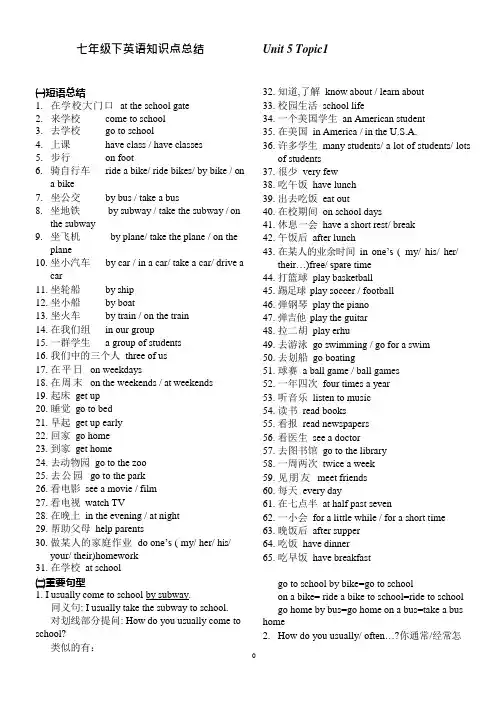
七年级下英语知识点总结Unit 5 Topic1㈠短语总结1.在学校大门口at the school gate2.来学校come to school3.去学校go to school4.上课have class / have classes5.步行on foot6.骑自行车ride a bike/ ride bikes/ by bike / ona bike7.坐公交by bus / take a bus8.坐地铁by subway / take the subway / onthe subway9.坐飞机by plane/ take the plane / on theplane10.坐小汽车by car / in a car/ take a car/ drive acar11.坐轮船by ship12.坐小船by boat13.坐火车by train / on the train14.在我们组in our group15.一群学生 a group of students16.我们中的三个人three of us17.在平日on weekdays18.在周末on the weekends / at weekends19.起床get up20.睡觉go to bed21.早起get up early22.回家go home23.到家get home24.去动物园go to the zoo25.去公园go to the park26.看电影see a movie / film27.看电视watch TV28.在晚上in the evening / at night29.帮助父母help parents30.做某人的家庭作业do one’s ( my/ her/ his/your/ their)homework31.在学校at school㈡重要句型1. I usually come to school by subway.同义句: I usually take the subway to school.对划线部分提问: How do you usually come to school? 32.知道,了解know about / learn about33.校园生活school life34.一个美国学生an American student35.在美国in America / in the U.S.A.36.许多学生many students/ a lot of students/ lotsof students37.很少very few38.吃午饭have lunch39.出去吃饭eat out40.在校期间on school days41.休息一会have a short rest/ break42.午饭后after lunch43.在某人的业余时间in one’s( my/ his/ her/their…)free/ spare time44.打篮球play basketball45.踢足球play soccer / football46.弹钢琴play the piano47.弹吉他play the guitar48.拉二胡play erhu49.去游泳go swimming / go for a swim50.去划船go boating51.球赛a ball game / ball games52.一年四次four times a year53.听音乐listen to music54.读书read books55.看报read newspapers56.看医生see a doctor57.去图书馆go to the library58.一周两次twice a week59.见朋友meet friends60.每天every day61.在七点半at half past seven62.一小会for a little while / for a short time63.晚饭后after supper64.吃饭have dinner65.吃早饭have breakfastgo to school by bike=go to schoolon a bike= ride a bike to school=ride to schoolgo home by bus=go home on a bus=take a bus home2.How do you usually/ often…?你通常/经常怎样…?3.It’s time for class.=It’s time to have class. =It’stime for having class.4.What about you? =How about you?5.How often …?询问频率,回答可以用频率副词:always, usually, often, sometimes, seldom, never, every day ,every +其他时间名词或表示频率的短语回答表示频率的短语:次数+单位时间e.g. : once a day / twice a week / three times a month6.The early bird catches the work. (谚语) 笨鸟先飞7.Work / Study must come first. 工作/ 学习必须放在第一位!8.Classes begin at eight. =Class begins at eight.提问:What time does the class begin? / What time do the classes begin?㈢重要单词的用法1. look (感官动词) 看起来,后面加形容词His mother looks very young.They look very cute.Her dress looks very nice.You look very cool in this coat.1.You new watch (look) very nice!2.Here (be) some news.3.Oh, come on! It’s time going to school.4.They usually go to school on (feet).5.In my class, forty of (we) go to schoolby bike. 2.by 介词by 后面直接加表示交通工具的名词,中间不用任何词修饰,如:by bikeby +动词ing 形式,表示通过某种方式People show love to their mothers by giving cards.You can be a good student by working hard. 3.over ( 形容词)School / Class is over.4.begin现在分词: beginning 过去式: beganbegin to do sth , begin doing sthHe begins to write a letter. =He begins writing a letter.如果begin 本身为分词,只能用begin to do sthHe is beginning to run.5.listen to 听(动作),hear 听见(结果)6.always 反义词never7.本话题涉及的时态为一般现在时,句中常有频率副词或表示频率的短语,如果主语为三单,动词一定要用三单!(四)易错题us.A. is alwaysB. seldom isC. always isD. often is19.The last class (finish) at twelve o’clock.20.Let’s go (boat).21.It’s time to have breakfast. (同义句)6.The early bird (catch) the worm.7.Kangkang often (ride) a bike to the park. .8.What time (be)school over? 22. Michael often rides a bike to school. (同义句)9.Work must come (once).10.It’s time you to get up.11.We often books in the morning..23. I always go to work on foot. (对划线部分提问)12.Jill’s friend like (study) in our school.13.Mr. Wang teaches (we) English. .of us like him.14.How about (go) out with me? 24.My mother goes shopping twice a week. ( 对划线部分提问)15.Most students go to school the school bus.16.do you go shopping with your mother?A. How soonB. How farC. How oftenD. How much.25.Mary always reads books in the library. (反义句)17.What time do you usually get up .weekdays?18.He busy, so he has no time to play with 26.He usually does his homework at school. (否定句).27.They often go to school by bus in the morning.(对划线部分提问)(一) 重要单词:Unit5 Topic2.28.Jane seldom watches TV on weekdays. (改为一般疑问句).29.He usually has lunch at home. (对划线部分提问).30.Li Ping often goes to work on foot. (同义句).31.几乎没有学生乘地铁去学校。
仁爱版英语七年级下册知识点归纳
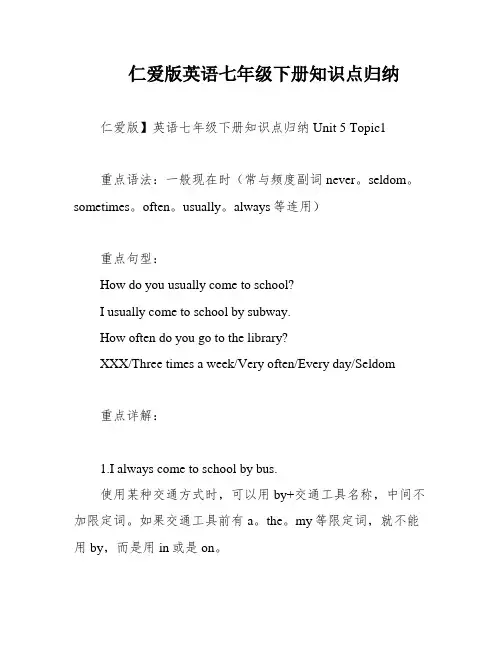
仁爱版英语七年级下册知识点归纳仁爱版】英语七年级下册知识点归纳 Unit 5 Topic1重点语法:一般现在时(常与频度副词never。
seldom。
sometimes。
often。
usually。
always等连用)重点句型:How do you usually come to school?I usually come to school by subway.How often do you go to the library?XXX/Three times a week/Very often/Every day/Seldom重点详解:1.I always come to school by bus.使用某种交通方式时,可以用by+交通工具名称,中间不加限定词。
如果交通工具前有a。
the。
my等限定词,就不能用by,而是用in或是on。
例如:on the train=by train,on his bike=by bike,in mycar=by car。
另外,on foot表示“走路”,是介词短语,不能作谓语,只作方式状语,位于句末。
而walk则是动词,可以作谓语。
例如:go to…on foot = walk to,I often go to school on foot = I often walk to school。
同样,go to…by bike = ride a bike to,go to…by car = drive a car to,go to…by plane = fly to,go to…by bus = take a bus to。
e on。
It’s time for class.Come on表示“快点,加油,来吧”。
It’XXX表示“该做某事了”,与It’s time to do sth.意思一样。
3.look的短语look the same:看起来一样look like:看起来像……look for:寻找look after:照顾4.do XXX:在学校做作业Do one'XXX school work。
仁爱版七年级下册知识点.docx
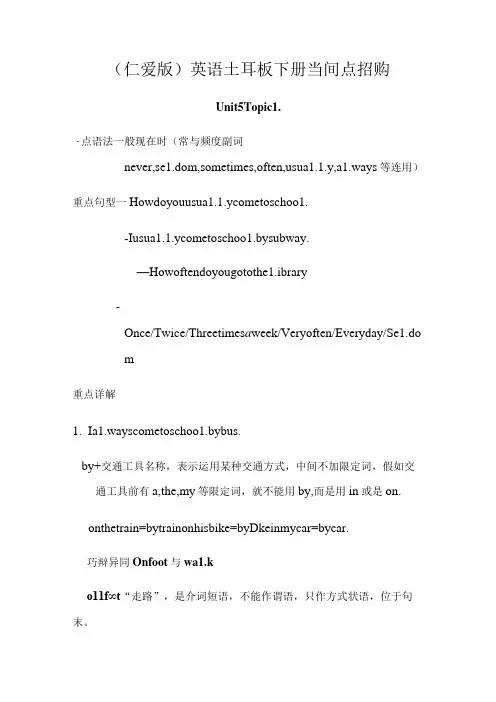
(仁爱版)英语土耳板下册当间点招购Unit5Topic1.・点语法一般现在时(常与频度副词never,se1.dom,sometimes,often,usua1.1.y,a1.ways等连用)重点句型一Howdoyouusua1.1.ycometoschoo1.-Iusua1.1.ycometoschoo1.bysubway.—Howoftendoyougotothe1.ibrary-Once/Twice/Threetimes a week/Veryoften/Everyday/Se1.dom重点详解1.Ia1.wayscometoschoo1.bybus.by+交通工具名称,表示运用某种交通方式,中间不加限定词,假如交通工具前有a,the,my等限定词,就不能用by,而是用in或是on.onthetrain=bytrainonhisbike=byDkeinmycar=bycar.巧辩异同Onfoot与wa1.ko11f∞t“走路”,是介词短语,不能作谓语,只作方式状语,位于句末。
wa1.k“走路”,是动词,可以作谓语。
goto∙∙∙onfoot=wa1.ktoIoftengotoschoo1.onfoot.=Ioftenwa1.ktoschoo1..同样,goto∙∙∙.bybike=rideabiketogoto∙∙∙.bycar=driveacartogoto∙∙∙byp1.ane=f1.ytogoto∙∙∙bybus=takeabustoeon!It,eon”快点,加油,来吧”。
It,stimeforsth.“该做某事了",与It'StimetOdoSth.意思一样。
3.1.∞k的短语1.ookthesame看起来一样100k1.ike看起来像……1.ookfor找寻1.ookafter照看4.domyhomeworkatschoo1.在学校做作业doone,shomework做家庭作业(留意:one*s要随主语的改变而改变,常用形容词性物主代词my,your,their,our,his,her等)05.wcwanttoknowabouttheschoo1.1.ifeofAmericanstudents.我们想了解一1.<美国学生的学校生活.knowabout"f解,知道关于…”o6.巧舞异同afew与few7.afew“一些”,few“很少,几乎没有”,修饰可数名词。
(仁爱版)英语七年级下册知识点归纳

(仁爱版)英语七年级下册知识点归纳Unit 5 Topic1重点语法一般现在时(常与频度副词never, seldom, sometimes, often,usually, always等连用)重点句型—How do you usually come to school—I usually come to school by subway.—How often do you go to the library—Once/Twice/Three times a week/Very often/Every day/Sedom重点详解。
always come to school by bus.by+交通工具名称,表示使用某种交通方式,中间不加限定词,如果交通工具前有a, the, my 等限定词,就不能用by,而是用in或是on.on the train=by train on his bike=by bike in my car=by car.巧辩异同on foot 与walk on foot “走路”,是介词短语,不能作谓语,只作方式状语,位于句末。
walk “走路”,是动词,可以作谓语。
go to…on foot= walk to I often go to school on foot. =I often walk to school.同样,go to….by bike = ride a bike to go to…. by car = drive a car togo to … by plane = fly to go to… by bus = take a bus to2 .Come on! It’s time for class. come on “快点,加油,来吧”。
、It’s time for sth. “该做某事了”,与It’s time to do sth.意思一样。
3 .look的短语look the same看起来一样look like看起来像……look for寻找look after 照顾4 .do my homework at school 在学校做作业do one’s homework 做家庭作业(注意:one’s 要随主语的变化而变化,常用形容词性物主代词my, your, their, our, his, her等)。
仁爱英语七年级下册知识点归纳
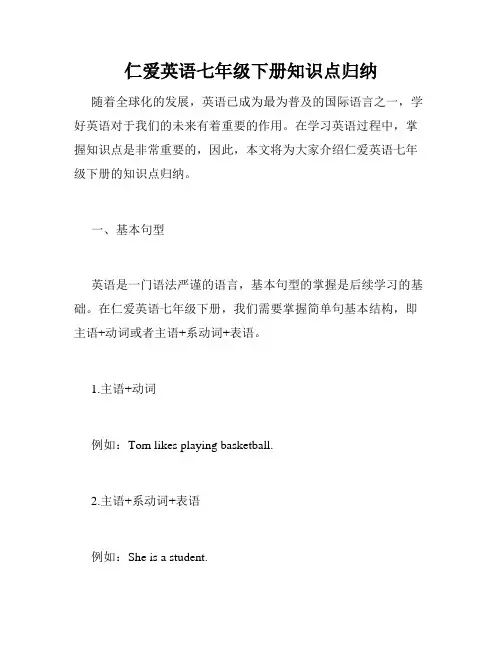
仁爱英语七年级下册知识点归纳随着全球化的发展,英语已成为最为普及的国际语言之一,学好英语对于我们的未来有着重要的作用。
在学习英语过程中,掌握知识点是非常重要的,因此,本文将为大家介绍仁爱英语七年级下册的知识点归纳。
一、基本句型英语是一门语法严谨的语言,基本句型的掌握是后续学习的基础。
在仁爱英语七年级下册,我们需要掌握简单句基本结构,即主语+动词或者主语+系动词+表语。
1.主语+动词例如:Tom likes playing basketball.2.主语+系动词+表语例如:She is a student.二、动词的时态掌握动词的时态对于英语句子的准确使用至关重要。
在仁爱英语七年级下册,我们需要掌握动词的现在时、过去时和将来时。
1.现在时例如:I eat breakfast every morning.2.过去时例如:She visited her grandparents last week.3.将来时例如:We will go to the cinema this weekend.三、名词和代词名词和代词在英语语法中也占据着重要地位。
名词的种类繁多,不同的名词在句子中扮演不同的角色,例如主语、宾语、表语等。
代词则用来替代名词,简化句子表达。
1.名词例如:This is a book.2.代词例如:She is reading it.四、形容词和副词形容词和副词用来修饰名词和动词,使得句子更加丰富。
形容词主要修饰名词,描述事物的性质、特征等;副词主要修饰动词,描述动作的方式、时间、程度等。
1.形容词例如:The beautiful flowers are in the garden.2.副词例如:She runs fast.五、介词和连词介词和连词也是英语语言中的重要组成部分,它们用来连接句子或者词组。
1.介词例如:The cat is on the table.2.连词例如:I like playing football and basketball.六、数词和时间状语数词和时间状语用来表示数字和时间,它们在句子中扮演着极为重要的角色。
仁爱英语七年级下册短语复习总结
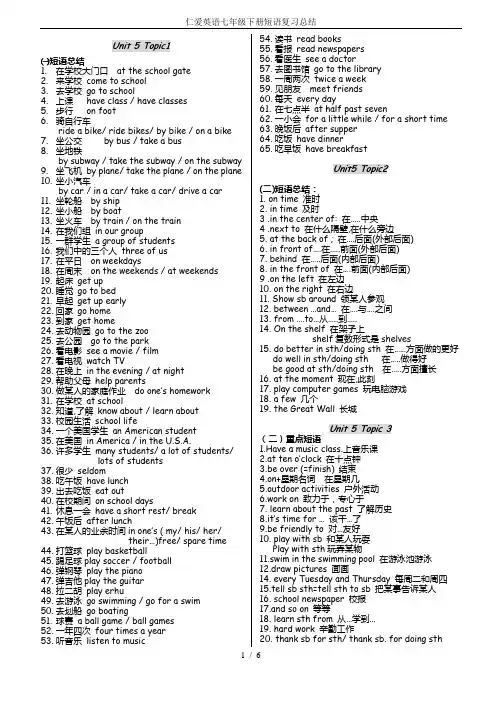
Unit 5 Topic1㈠短语总结1.在学校大门口at the school gate2.来学校come to school3.去学校go to school4.上课have class / have classes5.步行on foot6.骑自行车ride a bike/ ride bikes/ by bike / on a bike7.坐公交by bus / take a bus8.坐地铁by subway / take the subway / on the subway9.坐飞机by plane/ take the plane / on the plane10.坐小汽车by car / in a car/ take a car/ drive a car11.坐轮船by ship12.坐小船by boat13.坐火车by train / on the train14.在我们组in our group15.一群学生a group of students16.我们中的三个人three of us17.在平日on weekdays18.在周末on the weekends / at weekends19.起床get up20.睡觉go to bed21.早起get up early22.回家go home23.到家get home24.去动物园go to the zoo25.去公园go to the park26.看电影see a movie / film27.看电视watch TV28.在晚上in the evening / at night29.帮助父母help parents30.做某人的家庭作业do one’s homework31.在学校at school32.知道,了解know about / learn about33.校园生活school life34.一个美国学生an American student35.在美国in America / in the U.S.A.36.许多学生many students/ a lot of students/lots of students37.很少seldom38.吃午饭have lunch39.出去吃饭eat out40.在校期间on school days41.休息一会have a short rest/ break42.午饭后after lunch43.在某人的业余时间in one’s ( my/ his/ her/their…)free/ spare time44.打篮球play basketball45.踢足球play soccer / football46.弹钢琴play the piano47.弹吉他play the guitar48.拉二胡play erhu49.去游泳go swimming / go for a swim50.去划船go boating51.球赛a ball game / ball games52.一年四次four times a year53.听音乐listen to music 54.读书read books55.看报read newspapers56.看医生see a doctor57.去图书馆go to the library58.一周两次twice a week59.见朋友meet friends60.每天every day61.在七点半at half past seven62.一小会for a little while / for a short time63.晚饭后after supper64.吃饭have dinner65.吃早饭have breakfastUnit5 Topic2(二)短语总结:1. on time 准时2. in time 及时3 .in the center of: 在…..中央4 .next to 在什么隔壁,在什么旁边5. at the back of ; 在….后面(外部后面)6. in front of….在…..前面(外部后面)7. behind 在…..后面(内部后面)8. in the front of 在….前面(内部后面)9 .on the left 在左边10. on the right 在右边11. Show sb around 领某人参观12. between …and… 在….与….之间13. from ….to…从…..到…..14. On the shelf 在架子上shelf复数形式是shelves15. do better in sth/doing sth 在……方面做的更好do well in sth/doing sth 在…..做得好be good at sth/doing sth 在…..方面擅长16. at the moment 现在,此刻17. play computer games 玩电脑游戏18. a few 几个19. the Great Wall 长城Unit 5 Topic 3(二)重点短语1.Have a music class.上音乐课2.at ten o’clock 在十点钟3.be over (=finish) 结束4.on+星期名词在星期几5.outdoor activities 户外活动6.work on 致力于,专心于7. learn about the past 了解历史8.it’s time for … 该干…了9.be friendly to 对…友好10. play with sb 和某人玩耍Play with sth玩弄某物11.swim in the swimming pool 在游泳池游泳12.draw pictures 画画14. every Tuesday and Thursday 每周二和周四15.tell sb sth=tell sth to sb 把某事告诉某人16. school newspaper 校报17.and so on 等等18. learn sth from 从…学到…19. hard work 辛勤工作20. thank sb for sth/ thank sb. for doing sth因某事而感谢某人21. run on the playground 在操场跑步 22. watch animals 看动物23. play soccer at school 在学校踢足球 24. read a book at home 在家看书25.have dinner in the school dinning hall 在学校餐厅吃饭Unit 6 Topic 1 (一)重点短语: 在第二层 building has four floors. I am on the first floor.) 2. go upstairs ( adv.)上楼; go downstairs 下楼 3. a moment later 过了一会儿 4. play with sb 和某人一起玩 play with sth. 玩弄某物 5. in front of 和in the front of 区别:加the 的词组表示物体内部的前面 6. on the wall 在墙上 in the wall 7. on the tree (苹果) in the tree (鸟) 8. a model plane 模型飞机 9. play on the computer 玩电脑 (比较play computer games 玩电脑游戏) Unit 6 Topic 2 (一)重点短语 1. 在农村 in the country 在郊区 in the suburb2.一套三居室的房子3.. call sb. at +电话号码 ,4.a quiet double room under 300yuan per month 300元5.house with furniture for a family of three 适合三口之家,家具齐全的房子6.rent sth. to sb. 把某物租给某人 rent sth. from sb. 从某人那租某物 8.on the street corner 在街角 9. keep money 存钱 10.寄信 mail (post) letter 11.see a doctor 看医生 12.month 的复数 months munity service center in our area 15.靠近 be close (adj.) to / close (adv.) to / near / next to (紧靠) 【反义词是 far from 】 16. right now 马上,立刻= at once 17.Children’s Day 儿童节 ; 18.Teachers’ Day 教师节 ; 19.Women’s Day 妇女节Uint 6 Topic 3 1. = take the second street(turning) on the left 2. go across (prep.) the bridge = cross (v.)the bridge 过桥 3. across from 在….的对面 4. on the road 在路上 on/ in the street 在街上 5. on the corner of the street 在街角(比较in the corner of 和at the corner of ) 6. bet ween….and ….在…和….之间 7. walk on 继续走8 public phone 公用电话9. at the traffic lights 在红绿灯处 10. No right turn 禁止右转 No parking 禁止停车Go straight 直走11. be in danger 处于危险之中 12. get hurt 受伤(get 系动词,hurt 是形容词) 13. lose one’s life 失去了某人的生命 14. obey the traffic rules 遵守交通规则 15. a ticket for speeding/ drinking and driving/parking in the wrong place/ making a wrong turn 超速/酒后驾车/乱停车/转错弯罚单 16. make a wrong turn 转错弯 17. keep quiet in class. 上课时要安静。
仁爱英语七年级下册知识点总结.doc
精品文档七年级下册知识点总结(仁爱版)Unit 5 Topic1 重点短1. on foot go ⋯ on foot = walk ( to ) ⋯14. do( one ’s) homework 做作2. at the school gate 在学校大口15. go to the zoo / park 去物园/ 公园3. on weekdays 在平日 ,在工作日16. once a week 一周一次4. on weekends=on the weekend 在周末17. every day 每天5. after school 放学后18. have classes 上6. after class 下后19. for a little while 一会儿7. after breakfast / lunch / supper 20. go to bed 上床睡8. 早餐 / 午餐 / 晚餐后21. come on 快点 ,加油 ,来吧in ones free time 在某人空22. get up 起床9. have a rest 休息一下23. talk with / to sb. 与某人10. read books 24. at school 在学校、在上11. go swimming 去游泳25. go to school 去上学12. listen to music 听音26. and so on ⋯⋯等等13.watch TV 看重点句型1.2.3.4.5. Happy New Year! The same to you. 2.Your new bike looks very nice .Thank you.How do you usually come to school?—I usually come to school by subway.How often do you go to the library?—Once/Twice/Three times a week/Very often/Every day/Sedom The early bird catches the work. () 笨先Classes begin at eight. =Class begins at eight.What time does the class begin? / What time do the classes begin?6.7.8. We have no more time. 我没有更多的了。
七年级下册英语仁爱版知识点
七年级下册英语仁爱版知识点智慧,是⼈的知识、胆识、意识与把握客观世界相结合的结果。
知识,学识的深厚、⼴博是基础,胆识是视野、胸怀、⽓质、判断、能⼒结合升华,帷幄运畴才能的表现。
下⾯⼩编给⼤家分享⼀些七年级下册英语仁爱版知识,希望能够帮助⼤家,欢迎阅读!七年级下册英语仁爱版知识1重点句型1. What day is it today?---It’s Sunday. (在英语国家每周的第⼀天是星期天⽽不是星期⼀)2. What class are they having? They are having a music class.3. What time does the class begin? At ten o’clock.4. What do you think of math? = How do you like math ? 你认为数学怎么样?----It’s difficult and boring.5. Why (为什么)do you like English ? Because(因为)it’s easy and interesting.7. What subject (学科)do you like best ? I like history best.8. At school, my teachers and classmates are very friendly to me.9. I study Chinese, English, politics, geography and some other subjects.(other泛指其他的,别的+ 名词复数 another 泛指⼜⼀个、再⼀个、另⼀个+名词单数the other 两者中的另⼀个)10. English is my favorite subject.11. I also like P.E and music. = I like P.E and music , too. (也)12. Can you tell me something about it?重点详解1. 询问星期⼏⽤What day…?回答:It’s Wednesday/Sunday…。
仁爱版七年级下册Unit知识点总结
U n i t5一、语法点----现在进行时1.现在进行时表示说话时或现阶段正在进行的动作或存在的状态。
2.结构:be+动词的现在分词We are playing games.3.现在进行时的句式:肯定句:主语+be+现在分词+其他They are running.否定句:主语+be+not+现在分词+其他They are not running.一般疑问句:be+主语+现在分词+其他?Are they running肯定回答:yes,主语+be。
Yes, they are.否定回答:no,主语+be+not.No, they aren't特殊疑问句:疑问词+be+主语+现在分词+其他What are they doingThey are running.4.动词现在分词构成:&&正常变化是在动词原型后加ing 如:read----reading ; drink---drinking ; eat---eating ;&&以e结尾的动词,去掉e再加ing 如:write ---writing ; make--- making ; ride---riding ;&&重读闭音节(只有一个元音字母,而其后跟有一个辅音字母时)要双写结尾的辅音字母再加ingsit---sitting ; swim--swimming ; put---putting ; run—running &&以ie结尾的动词-ie+y+ing:lie -- lying die --- dying&&以y结尾的动词变成现在分词是,y不变,直接加上-ing总结一添一去y不变5.标志词:可用来表示现在进行时的,常用的有:now, this week, at this moment 等;或者告诉你一个准确的现在时间,或者用look, listen提醒听者注意正在发生的事。
仁爱英语七年级下册知识点总结打印版知识分享.doc
七年下册知点Unit 5 Topic1重点短on foot go ⋯ on foot = walk ( to ) ⋯do( one ’s) homework 做作at the school gate 在学校大口go to the zoo / park 去物园/ 公园on weekdays 在平日 ,在工作日once a week 一周一次on weekends=on the weekend 在周末every day 每天after school 放学后have classes 上after class 下后for a little while 一会儿after breakfast / lunch / supper go to bed 上床睡早餐 / 午餐 / 晚餐后come on 快点 ,加油 ,来吧in ones free time 在某人空get up 起床have a rest 休息一下talk with / to sb. 与某人read books at school 在学校、在上go swimming 去游泳go to school 去上学listen to music 听音and so on ⋯⋯等等watch TV 看重点句型Happy New Year! The same to you.Your new bike looks very nice. Thank you.How do you usually come to school? —I usually come to school by subway.How often do you go to the library?— Once/Twice/Three times a week/Very often/Every day/SedomThe early bird catches the work. ( ) 笨先Work / Study must come first.工作/学必放在第一位!Classes begin at eight. =Class begins at eight.What time does the class begin? / What time do the classes begin?We have no more time. 我没有更多的了。