
人教八年级英语下册 Unit4 重点知识总结归纳
Unit4 单元知识归纳汇总
1.用于提建议的句型有:
(1)What about doing sth ?=How about doing sth?….怎么样?
(2)Why don’t you do sth?= Why not do sth? 为什么不..呢?
(3)Let’s do sth.让我们一起做某事吧。
(4)Shall we/I do sth?我们做…好吗?
(5)had better do/not do sth 最好做/不做某事
(6) Will/Would you please do sth 请你做…好吗?
(7) Would you like to do sth? 你想去做某事吗?
(8)Would you mind doing sth?你介意做某事吗?
2.too many + 复数名词 太多...
too much +不可数名词 太多 much
too +形容词 太…
3.allow sb. to do sth 允许某人做某事
allow doing sth 允许做某事
be allowed to do sth 被允许做某事
let sb do sth让某人做某事
4.What’s wrong( with sb./ sth) (某人/物) 怎么了?
5.go to sleep 去睡觉
6.find sb. doing sth 发现某人正在做某事
find sb do sth 发现某人做了/经常做某事
7.look through 浏览
8.be angry with sb. 生某人的气
9.though / although 不能与but连用
10.leave sth . somewhere把某物忘在某地
leave sb. by oneself 把某人单独留下
11.Hope things work out. 希望事情顺利解决。
12.hope to do sth
hope + that 从句 (表示希望)
13.get on (well)with sb. 和某人和睦相处;
和某人关系良好 =get along with
14.argue with sb. about sth 为某事与某人争吵
15.hang over 挂在......之上;悬浮在......之上
hang out 闲逛
16.instead of +n/doing 代替,而不是
17.offer to do sth 主动提出做某事
offer sb. sth= offer sth to sb. 主动提供给某人某物
18..communicate with sb. 和某人交流
communication n 交流;沟通
19.explain sth to sb. 向某人解释某事
20. return sth to sb. = give sth back to sb. 把......还
给......return to +地点,回来;返回 = come back to+地点
1.compete with sb. 和某人竞争
2.improve =make ... better 改进 →improvement n 提高
3.in one’s opinion 以某人的观点;在某人看来
give opinions about sth. 给出关于某事的观点。
4. It takes sb. some time to do sth. 做某事花费某人多长时间
5.The Taylors 泰勒一家 (谓语用复数)
6.cut out 删除;删去
cut up 切碎
cut down 砍倒
cut in 插队
cut off 切断(部件,水、电)
7.It’s time for sth =It’s time to do sth 是到做某事的时候了。
8.continue doing sth =go on doing sth 继续做某事(前后做同一件事)
continue to do sth = go on to do sth 继续做某事(前后不是同一
件事)
9.all kinds of 各种各样的
kind of +adj.有点,有几分,
10. be kind to sb. = be good to sb.=be friendly to sb. 对某人
友好
11.have time to do sth 有时间做某事
12.compare…with… 把……与…..做比较
compare…to… 把…..比做……
13.be good for 对….有益处
be bad for对…有害处
be good at=do well in 擅长于做某事
14.cause a lot of stress for children 给孩子们带来很多压力
15.in one’s opinion 以某人的观点;在某人看来
16. be crazy about 对……着迷;热衷于……
17.keep on doing 继续做某事
keep sb. doing sth 让某人一直做某事
18.have a fight with sb.=fight with sb.与某人打架
人教版八年级英语下册 Unit 4单元重点知识点总览

人教版八年级英语下册Unit 4单元重点知识点总览1. decided用作及物动词,意为“决定”,后跟名词、代词、动词不定式或从句等。
名词形式是decision,make a decision意为“做决定(去做某事)”2. do with意为“处理,处置,对待”,常与疑问词what连用。
PS:do with=deal with(常与疑问词how连用)3. reach 用作及物动词,意为“接触,拿到”,后面跟表示地点的名词,意为“到达,抵达”。
4. be interested in 意为“对……感兴趣”。
后面跟名词、代词或动名词做宾语,与have/take interest in互换5. crash(crashed,crashed)用作不及物动词,意为“碰撞,倒下,坠落”6. as……as one can/could表示“尽某人所能”,相当于as……as possible。
7. by the time意为“到……时为止”,引导时间状语从句。
8. be tired out意为“精疲力尽”be tired of意为“对……感到厌烦”9. as连词,意为“当……的时候”,引导时间状语从句。
例如:As time goes on, he knows his students.10. tie(tied,tied,tying)用作及物动词,意为“捆,绑,系”,tie…to…意为“把……系/捆到……上”。
be tired to是它的被动语态,意为“被捆到……上”11. until用作连词,意为“直到……为止”,在(某一特定的时间)之前,其主要用法有:与延续性动词连用时,表示“直到……”,动词用肯定形式,指主句的动作一直持续到until后的动作发生为止;not…until…意为“直到……才……”,主句动词通常为非延续性动词,指主句的动作一直到until后的动作发生时才发生。
12. the same size as…意为“和……一样尺寸,与……一样大小”。
人教版英语八年级下册Unit 4总结

Unit 4 Why don’t you talk to your parents?名词Nouns1. deal 协议;交易– big deal 重要的事e.g.: Although she’s wrong, it’s not a big deal.2. relation关系;联系;交往e.g.: Relations between my parents have become difficult.3. communication交流;沟通e.g.: It’s the only communication they have.4. cloud 云;云朵e.g.: When they argue, it’s like a big, black cloud hanging over our home.5. member 成员;分子e.g.: She was introduced to all the members of his family.6. pressure 压力e.g.: My parents give me a lot of pressure about school.7. opinion意见;想法;看法e.g.: Who gives their opinion about the problem?8. skill技艺;技巧e.g.: Many of them are learning exam skills so that they can get into a good high school and later a good university.9. football(美式)橄榄球;足球e.g.: I take my son to basketball practice and my daughter to football training.10. development发展;发育;成长e.g.: Doctors says too much pressure is not good for a child’s development.动词Verbs1. allow 允许;准许e.g.: My parents don’t allow me to hang out with my friends.2. guess猜测;估计e.g.: We can only guess at her reasons for leaving.3. argue争吵;争论e.g.: We’re always arguing with each other about money.4. offer主动提出;自愿给予e.g.: If your parents are having problems, you should offer to help.5. communicate交流;沟通e.g.: We only communicate by email.6. explain解释;说明e.g.: You should explain that you don’t mind him watching TV all the time.7. copy抄袭;模仿;复制;复印e.g.: Although he’s your best friend, you should still tell him that copying others’ homework is wrong.8. return归还;回来;返回e.g.: My cousin borrows my things without returning them.9. compete竞争;对抗e.g.: I have to compete with my classmates at school.10. continue持续;继续存在e.g.: In some families, competition starts very young and continues until the kids get older.11. compare比较– compare…with 比较;对比e.g.: And they are always comparing them with other children.12. push鞭策;督促;推动e.g.: People shouldn’t push their kids so hard.13. cause造成;引起e.g.: She says all these activities can cause a lot of stress for children.形容词Adjectives1. wrong 有毛病;错误的– What’s wrong? 哪儿不舒服?e.g.: I got all the answers wrong.2. elder年纪较长的e.g.: Also, my elder brother is not very nice to me.3. nervous焦虑的;担忧的e.g.: At home I always feel lonely and nervous.4. proper正确的;恰当的e.g.: Maybe you could do more jobs around the house so that they have more time for proper communication.5. clear清楚易懂的;晴朗的e.g.: I hope I made it clear to him that he was no longer welcome here.6. typical典型的e.g.: The Taylors are a typical American family.7. quick快的;迅速的;时间短暂的e.g.: They have a quick dinner, and then it’s time for homework.8. crazy不理智的;疯狂的e.g.: She must be crazy to lend him money.9. usual通常的;寻常的e.g.: He came home later than usual.副词Adverbs1. instead代替;反而;却e.g.: He always refuses to let me watch my favorite TV show. Instead he watches whatever he wants until late at night.2. secondly第二;其次e.g.: Secondly, why don’t you sit down and communicate with your brother?3. anymore(常用于否定句和疑问句末)再也(不);(不)再e.g.: Your best friend does not trust you anymore.4. perhaps可能;大概;也许e.g.: Perhaps it would be better if you came back tomorrow.代词Pronouns1. whatever任何;每一e.g.: You have our support, whatever you decide.短语Expressions1. look through快速查看;浏览e.g.: I found my sister looking through my things yesterday.2. work out成功地发展;解决e.g.: I hope things will work out.3. get on with和睦相处;关系良好e.g.: My problem is that I can’t get on with my family.4. cut out删除;删去e.g.: Maybe I could cut out a few of their activities, but I believe these activities are important for my children’s future.5. in one’s opinion依……看e.g.: In my opinion, you could tell him to do something quiet when you’re studying. Grammar Points 语法点1. why don’t you…?e.g.:•Why don’t you forget about it?2. 连词until,so that和although•I studied until midnight last night so I didn’t get enough sleep.•He should talk to his friend so that he can say he’s sorry.•Although she’s wrong, it’s not a big deal.3. 情态动词should,could•What should I do?•What should he do?•Maybe you could go to his house.•I guess I could, but I don’t want to surprise him.。
初中英语 人教八年级下册unit4 单元知识点复习(共29张ppt)

与 学 太 给某得多某人过人(修吵多写饰架信可/打数架名词)gsttoeutodimnyttaoonaoyfmiguhcthwith sb./fight with
浏览
write sb. a letter /write to sb.
sb.
• 10.生某人的气 • 11. 成功地发展;解决
look through be angry with sb
►although意为“尽管/虽然”,相当于_t_h_o__u_g__h_,用来引导让步状语从句。 可以放在主句前可放在主句后,注意;1)句中用了although或though,就 不可再用___b_u。t 2)当although 在句首引导句子时,要用_____逗和号主句隔开, 当although引导的让步状语从句跟在句末时,不用逗号隔开。若要强调前 后两部分的对比意义,可在主句前加yet或still
• 24. 提出某人的观点
give one’ s opinion
• 25.督促某人做某事
push sb. to do sth.
• 26.把某物还给某人
return sth to sb.
• 27. 与某人竞争
compete with sb.
• 28. 担心某事
worry about sth.
• 29. 抄袭某人的作业
拓展:explain 的名词形式 explanation
在英语中,提建议的常用表达如下:
1.你为什么不找李雷帮忙呢? Why don‘t you ask Li Lei for help? =Why not ask Li Lei for help? 2.成立一个食物银行怎么样? What/How about setting up a food bank?
人教版八年级下册英语Unit 4 知识点语法归纳总结
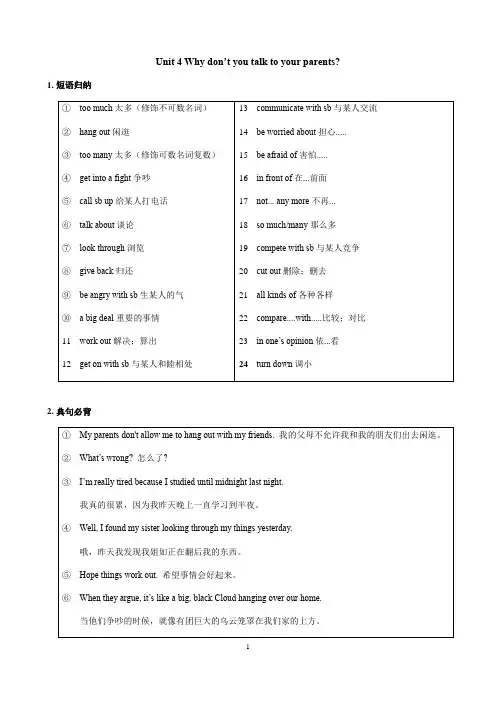
Unit 4 Why don’t you talk to your parents?1.短语归纳2.典句必背3.用法集萃(1)My parents don't allow me to hang out with my friends. 我的父母不允许我和我的朋友们出去闲逛。
❖allow作动词,意为“允许;准许”。
allow sb. to do sth. 意为“允许某人做某事”,也可以是allow sb. sth.例:His parents won't allow him to stay out late. 他的父母不允许他在外面待到很晚。
Each passenger is allowed 20 kilograms of baggage. 每位旅客准许携带20千克行李。
❖allow sb. to do sth.的被动结构是:“sb. be allowed to do sth.” 某人被允许做某事例:We are allowed to choose our own clothes. 我们被允许选择自己的衣服。
The children are not allowed to play on this lawn. 孩子们不准在这块草地上玩耍。
(2)What’s wrong?怎么了?❖wrong作形容词,意为“有毛病的;错误的”例:There’s something wrong with my bike. 我的自行车出毛病了。
I’m sorry to tell you that your answers are wrong. 我很遗憾地告诉你,你的答案错了。
❖拓展:wrong的延伸(3)I’m really tired because I studied until midnight last night.我真的很累,因为我昨天晚上一直学习到半夜。
❖because是连词,意为“因为”,引导原因状语从句。
人教版八年级下册英语Unit4知识点.doc
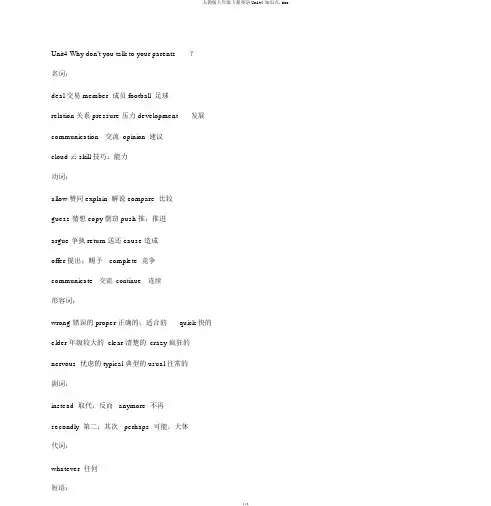
Unit4 Why don't you talk to your parents?名词:deal 交易 member 成员 football 足球relation 关系 pressure 压力 development发展communication交流opinion建议cloud 云 skill 技巧;能力动词:allow 赞同 explain 解说 compare 比较guess 猜想 copy 剽窃 push 推;推进argue 争执 return 送还 cause 造成offer 提出;赐予complete 竞争communicate交流continue连续形容词:wrong 错误的 proper 正确的;适合的quick 快的elder 年级较大的 clear 清楚的 crazy 疯狂的nervous 忧虑的 typical 典型的 usual 往常的副词:instead 取代;反而anymore 不再secondly 第二;其次perhaps 可能;大体代词:whatever 任何短语:look through阅读cut out删除big deal 重要的事 compare ? with ? 比较work out 解决 in one's opinion依某人看get on with和平共处知识点:1、allow sb to do sth赞同某人做某事allow doing sth赞同做某事Please allow me to introduce myself.请赞同我做一下自我介绍。
We don't allow eating in the classroom.不赞同在教室里吃东西。
2、What's wrong?=What's the matter?怎么了?What's wrong with sb??=What's the matter with sb?某人怎么了3、be good for sth对? ?有利反义词:be bad for对? ?有害be good to sb/sth对? ?友善be good at doing sth善于Playing sports is good for your health.做运动对你的健康有利。
人教版英语八年级下册 第四单元unit 4知识点总结
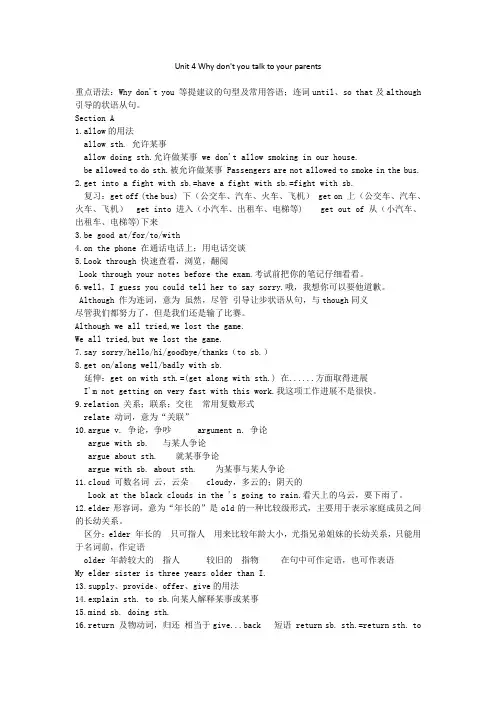
Unit 4 Why don't you talk to your parents重点语法:Why don't you 等提建议的句型及常用答语;连词until、so that及although 引导的状语从句。
Section A1.allow的用法allow sth. 允许某事allow doing sth.允许做某事 we don't allow smoking in our house.be allowed to do sth.被允许做某事 Passengers are not allowed to smoke in the bus.2.get into a fight with sb.=have a fight with sb.=fight with sb.复习:get off (the bus) 下(公交车、汽车、火车、飞机) get on 上(公交车、汽车、火车、飞机) get into 进入(小汽车、出租车、电梯等) get out of 从(小汽车、出租车、电梯等)下来3.be good at/for/to/with4.on the phone 在通话电话上;用电话交谈5.Look through 快速查看,浏览,翻阅Look through your notes before the exam.考试前把你的笔记仔细看看。
6.well,I guess you could tell her to say sorry.哦,我想你可以要他道歉。
Although 作为连词,意为虽然,尽管引导让步状语从句,与though同义尽管我们都努力了,但是我们还是输了比赛。
Although we all tried,we lost the game.We all tried,but we lost the game.7.say sorry/hello/hi/goodbye/thanks(to sb.)8.get on/along well/badly with sb.延伸:get on with sth.=(get along with sth.) 在......方面取得进展I'm not getting on very fast with this work.我这项工作进展不是很快。
人教版八年级下册英语必考知识点梳理(期末复习必备)
人教版八年级下册英语必考知识点梳理(期末复习必备)八年级下册英语知识点Unit 1 What’s the matter?【重点短语】1.have a fever 发烧2.have a cough 咳嗽3.have a toothache 牙疼4.talk too much 说得太多5.drink enough water 喝足够的水6.have a cold 受凉;感冒7.have a stomachache 胃疼8.have a sore back 背疼9.have a sore throat 喉咙痛10. take risks 冒险11.hot tea with honey 加蜂蜜的热茶12.see a dentist 看牙医13.get an X-ray 拍X 光片14.take one’s temperature 量体温15.put some medicine on sth. 在……上面敷药16. give up 放弃17. sound like 听起来像18. all weekend 整个周末19. in the same way 以同样的方式20. go to a doctor 看医生21. go along 沿着……走22. on the side of the road 在马路边23. shout for help 大声呼救24. without thinking twice 没有多想25. get off 下车26. have a heart problem 有心脏病27. to one’s surprise 另某人惊讶的是28. thanks to 多亏了;由于29. in time 及时30. make a decision 做出决定31. get into trouble 造成麻烦32. right away 立刻;马上33. because of 由于34. get out of 离开;从……出来35. keep on doing sth. 继续或坚持做某事36. put a bandage on sth. 用绷带包扎37. fall down 摔倒38. feel sick 感到恶心39. have a nosebleed 流鼻血40. cut his knee 割伤他的膝盖41. put her head back 把她的头向后仰42. have problems breathing 呼吸困难43. mountain climbing 登山运动44. be used to doing sth. 习惯做某事45. run out (of) 用完;用尽46. so that 以便47. so...that... 如此……以至于...…48. be in control of 掌管;管理49. in a difficult situation 在闲境中【重点句型】1. What's the matter with you?= What'the trouble with you? = What's wrong with you? 你怎么了?2. What should she do? 她该怎么办呢?3.Should I take my temperature? 我应该量一下体温吗?4.You should lie down and rest. 你应该躺下休息一会儿。
(完整版)人教版八年级下册英语Unit4知识点
Unit4 Why don't you talk to your parents ?名词:deal 交易member 成员f ootball 足球relation 关系pressure 压力development 发展communication 交流opinion 意见cloud 云skill 技巧;能力动词:allow 允许explain 解释c ompare 比较guess 猜测c opy 抄袭p ush 推;推动argue 争吵return归还cause 造成offer 提出;给予c omplete 竞争communicate 交流continue 持续形容词:wrong 错误的proper 正确的;恰当的quick 快的elder 年级较大的clear 清楚的crazy 疯狂的nervous 焦虑的typical 典型的usual 通常的副词:instead 代替;反而anymore 再也不secondly 第二;其次perhaps 可能;大概代词:whatever 任何短语:look through浏览cut out 删除big deal 重要的事compare⋯with ⋯比较work out 解决in one's opinion 依某人看get on with 和睦相处知识点:1、allow sb to do sth 允许某人做某事allow doing sth 允许做某事Please allow me to introduce myself. 请允许我做一下自我介绍。
We don't allow eating in the classroom. 不允许在教室里吃东西。
2、What's wrong ?=What's the matter?怎么了?What's wrong with sb ??=What's the matter with sb ?某人怎么了3、be good for sth 对⋯⋯有益反义词:be bad for 对⋯⋯有害be good to sb/sth 对⋯⋯友好be good at doing sth 擅长Playing sports is good for your health. 做运动对你的健康有益。
人教版英语八年级下册单元Unit 4 知识点+测试卷+思维导图
Unit 4 Why don’t you talk to your parents?1.重点词汇:communication, relation, allow, argue, cause, communicate, compare, compete, continue, copy, explain, guess, offer, push, return, wrong, quick, clear, crazy, nervous, proper, typical, usual, instead, perhaps, secondly....2. 短语归纳:1. look through 快速查看;浏览2. big deal 重要的事3. work out 成功地发展;解决4. get on with 和睦相处;关系良好5. cut out 删除;删去6. compare...with 比较,对比7. in one’s opinion 依……看3. 必背典句:1. Why don’t you forget about it? Although he is wrong, it’s not a big deal.你为什么不忘记呢?虽然他错了,但没什么大不了的。
2. He should talk to his friend so that he can say he’s sorry.他应该和他的朋友谈谈,这样他才能说对不起。
3. I studied until midnight last night so I didn’t get enough sleep.我昨晚一直学习到午夜,所以我没有得到足够的睡眠。
4.语法知识:1. 提建议的常用表达有:Why don’t you...?/Why not do...? (你)为什么不……呢?2. until引导时间状语从句连词until意为“直到……为止;到……时”,引导时间状语从句,常放在主句之后,也可以放在主句之前。
新人教版八年级英语下册Unit4单元总结提升(知识点总结)
Unit 4单元总结提升一、短语荟萃1.look through快速查看;浏览2.big deal重要的事3.work out成功地发展;解决4.get on with和睦相处;关系良好5.cut out删除;删去pare..with比较;对比7.in one’s opinion依……看8.allow sb to do sth.允许某人做某事9.on the phone在电话中10.refuse to do sth.拒绝做某事11.give opinion about sth.给出关于某事的观点12.agree with sb.同意某人(的话)13.hang out闲逛14.too many太多(修饰可数名词)15.get into a fight 争吵16.go to sleep去睡觉17.call sb. (up)给某人打电话18.be good at擅长19.talk about谈论20.have a fight 吵架21.give back归还22.be angry with sb.生某人的气23.thanks for因……而感谢24.no problem没问题25.feel lonely感到孤独26.sit down坐下municate with sb.与某人交流28.next time下次29.make friends 交朋友30.be worried about担心……31.study for a test为考试而学习32.be afraid of害怕……33.in front of 在……的前面34.not…anymore不再……35.play sports做运动36.watch movies看电影37.so much/many那么多38.do homework做家庭作业39.have lessons上课40.a few几个;少数41.all kinds of各种各样的42.join after—school activities 参加课外活动43.turn down调小44.not…until直到……才45.instead of代替46.offer sb. sth./offer sth. to sb.向某人提供某物47.argue with sb. about sth.就某事和某人争吵48.return sth. to sb.将某物还给某人49.hang over笼罩50.find sb. doing sth.发现某人正在做某事二、用法集萃1.It is time for sth.该做某事了;到做某事的时候了2.allow sb. to do sth.允许某人做某事3.Why don’t you do sth.?你为什么不做某事呢?4. find sb. doing sth.发现某人在做某事5.tell sb. to do sth.告诉某人做某事6.refuse to do sth.拒绝做某事7.let sb. do sth.让某人做某事8.offer to do sth.主动提出做某事9.mind sb. doing sth.介意某人做某事10.not…until…直到……才……11.want sb. to do sth.想要某人做某事12.It’s time for sth.该做某事了。