
牛津英语七年级下知识点
Unit One 知识点: 1. If引导的条件状语从句,表示如果......,当主句是一般将来时,从句用一般现在时. I won`t go there with you if it rains tomorrow. Have a good rest if you are tired. You must see the doctor if you are ill. 2. It is +形容词+that 从句(表达对某事的看法) It is wonderful that we can have dinner on the 91st floor in Shanghai World Financial Center. 3. It is +形容词+带to 的动词不定式 表达对某事的看法 It is terrible to have dinner in this restaurant. 4. take sb. to some place 将某人带到某地 5. in + 一段时间”的结构有两种含义 (1) 表示“在一段时间以内”,句子常用一般现在时或一般过去时。 There was once an artist. He could draw a beautiful horse in five minutes. (2)表示“在一段时间之后”,句子常用一般将来式 What will you be like in 20 years` time? 20年后你将长成什么样子? 句型与短语: 1. be famous/known for sth. 因为......而著名 e.g. Shanghai is famous/known for its night views. 2. be famous/known as sth. 作为......而著名 e.g. Shanghai is famous/known as the “Shopping Paradise” 3. one of +adj.(最高级)+n.(复数) Shanghai is one of the biggest cities in the world. 4. decide to do sth. 决定做某事 Decide not to do sth. 决定不做某事 Make a decision 做出决定 5. take part in 参加活动 6. join 参加或加入某种组织或团体 7. design 名词 计划\设计\图样 动词 设计\画图样 8. go sightseeing 去观光 9. in the center of ...... 位于.......的中部 10. in the south of...... 位于......的南部 11. on Chongming Island 位于崇明岛上 12. get on with 进展 13. therefore 因此,所以 14. district 地区,区域 16. Meglev= magnetic levitation 磁悬浮列车 17. a huge open area 大型的开放式区域 18. a downtown shopping plaza 市中心的购物中心 19. a cruise ship 载客长途航行的游轮 20. think of 想出 21. tour ----- tourist science ------ scientist type ------ typist cycle------ cyclist dentist -----artist 22. design ------ designer 23. Make some suggestions/Make some advice/Give sb. some advice/Take one`s advice 24. suggest sb. do sth. 25. north---northeast ------ east ------ southeast -----south ------ southwest ------ west ------ northwest ------ north 26. People`s Square 人民广场 Yu Garden 豫园 Suzhou Creek 苏州河 The Bund 外滩 Shanghai Grand Theatre 上海大剧院 Shanghai Botanical Gardens 上海植物园 Oriental Pearl TV Tower 东方明珠电视塔 Century Park 世纪公园 Shanghai Science and Technology Museum 上海科技馆 Shanghai Wild Animal Park 上海野生动物园 Dongping National Forest Park 东平国家森林公园 Sheshan State Resort 佘山国家旅游度假区 Grand Gateway Plaza 港汇广场 27. in the centre/south/...of Shanghai 在上海的中/南/....部 28. Therefore, it is not surprising that many tourists come to visit Shanghai every year to shop!所以,每年有许多游客来上海购物也就不足为奇了。 29. There are many bridges and tunnels, so it is convenient to travel between Pudong and Puxi. 众多的桥梁和隧道使浦东和浦西之间的交通往返变的很方便。 句中的it是指to travel between Pudong and Puxi.
Unit two 知识点 1. 电话用语 (1) 电话用语中使用 This is ... 和 Is that ...?来表示“我是......”和“你是.....”? May I speak to... 表示“我能与......通话?” 如果表示接电话的是本人,则回答:This is speaking.(或直接说Speaking) (2)电话途中需中断一会儿,或者接电话的不是本人,则用: Hold on. 别挂 或 I`ll be back in a moment. 我一会儿就回来 2. So... I...(我也......) Neither ... I...(我也不......) e.g. She is going to have a rest tomorrow. So am I. They would not go to the shopping mall. Neither would I. 3. 指路用语 (1) Turn left /right (向左/右转) Turn left/right into... (向左/右转到......路) (2) Walk along ... (沿着......路走) (3) You will find... on your left/right 你就会看到......在你的左/右边 句型与短语 1. be full of 表示充满了......(强调一种状态) This jar is full of beans. 2. be filled with 表示充满了......(强调填满这个动作) This bottle is filled with water.(Someone has filled this bottle with water.) 3. take a look 看一看 4. film guide 电影指南 5. very much 非常, 常放在句末用来修饰句中的动词 I like funny films very much. 6. action film 动作片 cartoon 卡通片 love story 爱情电影 7. in space 在太空中,在宇宙中 There are many different kinds of stars in space. 8. in the space 在......空间里 We can put nothing in the space between two desks. 9. miss 错过 Hurry up, or you will miss the early bus. miss 想念 I miss you very much. 10. far away 遥远 11. pay for 为......付钱 12. sb. fill sth. with sth. 某人将某物充满某物 13. keep a record of 记下,有......记录 14. explorer 探险者 15. travel through space 环游宇宙 16. ahead of 在前 17. The earth is getting very small. 地球变小了. It is getting dark. 天变黑了. Unit three 知识点 1. Since 从......以来;自从 Since 只用于时间前,意指从那时起,它常常和现在完成时连用。 也可接一个表示时间点的时间状语从句。 He has worked for us ever since he left school. It has been two years since I last saw Tom. 2. For 用来表示一段时间 如for six years 六年之久,for two months 有两个月 He has worked here for a year. 3. 现在完成时的基本结构是:have/has + 动词的过去分词 表示某个动作发生的起点在过去,这个动作一直持续到现在,并还可能持续下去。这样的句子通常会加上for 或since 引起的时间状语。 注意:现在完成时结构中的动词需使用持续性动词,而不可使用短暂性动词。 I have been in the club for three years. 4. be used for doing 被用来..... 5. key 是一个多义词: 作为名词,有如下含义,如 (1)钥匙 He put the key in the lock and turned it. (2)关键;要诀 The key to the whole thing was his jealous. (3)答案 Do you know the key to the problem? (4)(计算机或打字机的)键 Press the key to enter the information. 作为形容词,意为“关键的”,如:He is a key witness in this case.
Unit 2 知识点梳理-牛津译林版七年级英语下册
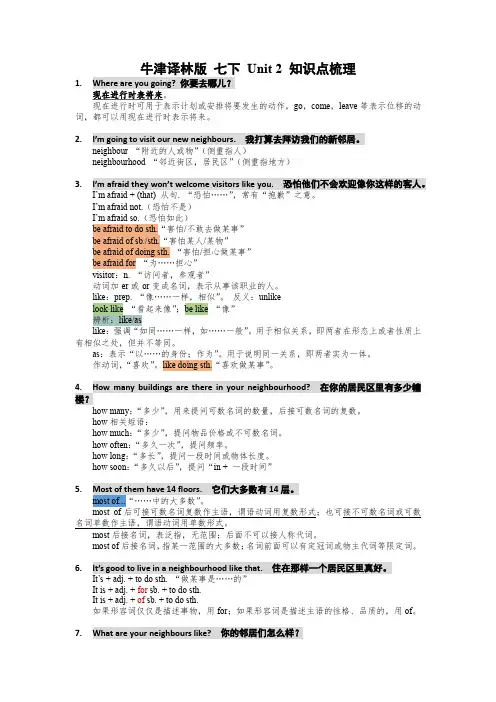
牛津译林版七下Unit 2 知识点梳理1.Where are you going?你要去哪儿?现在进行时表将来。
现在进行时可用于表示计划或安排将要发生的动作,go,come,leave等表示位移的动词,都可以用现在进行时表示将来。
2.I’m going to visit our new neighbours. 我打算去拜访我们的新邻居。
neighbour “附近的人或物”(侧重指人)neighbourhood “邻近街区,居民区”(侧重指地方)3.I’m afraid they won’t welcome visitors like you. 恐怕他们不会欢迎像你这样的客人。
I’m afraid + (that) 从句. “恐怕……”,常有“抱歉”之意。
I’m afraid not.(恐怕不是)I’m afraid so.(恐怕如此)be afraid to do sth.“害怕/不敢去做某事”be afraid of sb./sth.“害怕某人/某物”be afraid of doing sth. “害怕/担心做某事”be afraid for “为……担心”visitor:n. “访问者,参观者”动词加-er或-or变成名词,表示从事该职业的人。
like:prep. “像……一样,相似”。
反义:unlikelook like “看起来像”;be like “像”辨析:like/aslike:强调“如同……一样,如……一般”。
用于相似关系,即两者在形态上或者性质上有相似之处,但并不等同。
as:表示“以……的身份;作为”。
用于说明同一关系,即两者实为一体。
作动词,“喜欢”。
like doing sth.“喜欢做某事”。
4.How many buildings are there in your neighbourhood? 在你的居民区里有多少幢楼?how相关短语:how much:“多少”,提问物品价格或不可数名词。
牛津译林版七年级下英语知识点总结
牛津译林版七年级下英语知识点总结1."Would you like to do something?"Positive answer: "Yes。
I'd/we'd like/love to."Negative answer: "I'd/we'd like/love to。
but。
" or "Sorry。
I'm/We're afraid not."2."Next to" means near or beside.3."One" refers to any one of the same type of thing ned earlier。
"It" refers to the same thing ned earlier.4."Be from" means to come from.5."The capital of" refers to the capital or provincial capital ofa place.6."Around the world," "in the world," and "all over the world" all mean globally.7."Enjoy oneself," "have a good time," and "have fun doing something" all mean to have a good experience doing something.8."In the centre of" means in the middle of.9."Share something with someone" means to use or enjoy something together.10."Look out" means to look outside。
牛津深圳版英语七年级下册Unit1Peoplearoundus知识点梳理课件
8.care:love and concern 照顾和照料 n.(careful adj. carefully adv.)
9.miss:feel sad because you can no longer see sb. / sth. 想念 v. (miss 错过 v.)
萨拉昨天买了一只小猫。这只猫非常可爱。
2.the 用于名词前,用来专指某一或某些特指的人或物。 例如:(1)Look at the boy over there. 看那边的那个男孩。 (2)The girl with glasses is my classmate. 那个戴眼镜的女孩是我的同学。
3.play 后是表示乐器的名词前一般加定冠词 the。 例如:play the guitar/the violin 如果是体育运动的名词,不加定冠词 the。例如:play volleyball/chess
6.give up =not continue 放弃 7.be good at =do well in 擅长于 8.go to work 去上班 9.(be)strict about sth. 对某事要求严格;(be)strict with sb. 对
某人要求严格 10.encourage sb. to do sth. =give support to sb. to do sth. 鼓励某
4.He often Unit 1 People around us says,“Never give up and you’ll be successful.”
他经常说:“永不言弃,你一定会成功的。”
上海牛津英语七年级下册U7知识点总结
上海牛津英语七年级下第七单元知识总结授课内容Word forms1. able adj.有能力的,能够的unable adj.不能的,不会的enable vt. 使能够ability n.能力I am afraid I won't be able to visit you on Saturday.A little baby is unable to walk or talk.The new law has enabled more women to return to work.A person of his ability will have no difficulty getting a job.2. hope n../v.希望,期望hopeful adj. hopeless adj.不抱希望的,不给人希望的You're my only hope. Please help me.I hope that you feel better soon.This is a hopeful news.He is hopeless about his chances of winning the contest.3. secret n.秘密secret adj.秘密的;保密的secretly adv.秘密地secretary n.秘书I can’t tell you where we’re going –it’s a secret.He escaped through a secret door.The boy slipped out of the room and headed for the swimming pool secretly.The secretary must take the minutes of the meetings.4.sign v.签(名);签字*signature n.签名;签字I saw him making signs at us.These two signatures are very similar, can you tell them apart?Phrases1.talk about 谈论2.enter a new century 进入一个新世纪3.in the future 在将来4.be able to do sth. 能够做某事5.live on other planets 住在其他的星球上6.enough food for everybody 供给每个人的足够的食物7.grow vegetables 种蔬菜8.in space stations 在宇宙空间站9.people in different countries 不同国家的人们10.speak the same language 说同一种语言11.understand each other better 彼此更加了解12.live in the cities under the sea 住在海底城市13.learn form computers 通过电脑来学习14.take pills for meals 服药片代替吃饭15.travel to other planets in spacecraft 乘宇宙飞船去别的行星旅行16.in people’s homes 在人们的家中17.terrible air pollution 严重的大气污染18.in ten years’ time = in ten years在十年以后19.keep sth. in a secret place 把某物存放在一个秘密的地方20.write down … on … 在……上写下……21.pieces of paper 一张张的纸22.put … in … 把……放在……里23.seal sth. with tape 用胶带密封某物24.pollute the earth 污染地球25.become an astronaut 成为一个宇航员Sentences1. What do you think will happen in the future? 你们认为将来会发生什么?2.Perhaps people will be able to do sth. 可能人们将能够做某事。
Unit6知识点梳理牛津译林版英语七年级下册

牛津译林版七下Unit 6 知识点梳理1.Hurry up, Eddie. 赶快,埃迪。
hurry up:“快点;赶快”。
hurry:vi. “急忙,匆忙”。
过去式:hurried。
hurry to sp. “匆忙去某地”;hurry off/away “匆匆离去”;hurry to do sth. “匆忙做某事”。
作名词,“匆忙,仓促”。
in a hurry “匆忙地,急于”。
2.I’m tired. 我累了。
tired:adj. “疲劳的,劳累的”(修饰人)。
tiring:adj. “令人困倦的;累人的”(修饰物)。
3.You complain too much. 你真会抱怨。
complain:v.“抱怨”。
complain to sb. of/about sth. “向……抱怨……”。
complain about sth. “抱怨某事”;complain to sb. “向某人抱怨”。
辨析:too much/too many/much tootoo much:“太多”,修饰动词或不可数名词。
too many:“太多的”,修饰可数名词的复数。
much too:“太”,修饰形容词或副词。
4.The bag isn’t that heavy. 这个背包没那么重。
that:adv. “那么,那样”= so。
5.I want to go riding. 我想去骑马。
go riding:“去骑马”。
ride:v. “骑马/自行车,乘”;n. “(乘车或骑车的短途旅程)”。
give sb. a ride “让某人搭便车”。
6.I want to go camping. 我想去野营。
camping:n. “野营,露营”。
go camping “去野营”。
7.One sunny day, Alice sat by a river with her sister. 在一个阳光明媚的日子里,爱丽丝和她的姐姐坐在河边。
牛津译林版英语七年级下册units5-8期末复习重点知识点总结和试卷
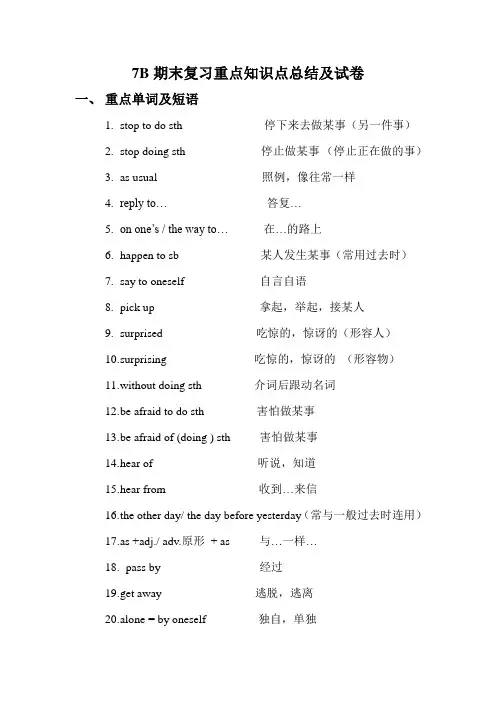
7B期末复习重点知识点总结及试卷一、重点单词及短语1.stop to do sth 停下来去做某事(另一件事)2.stop doing sth 停止做某事(停止正在做的事)3.as usual 照例,像往常一样4.reply to…答复…5.on one’s / the way to…在…的路上6.happen to sb 某人发生某事(常用过去时)7.say to oneself 自言自语8.pick up 拿起,举起,接某人9.surprised 吃惊的,惊讶的(形容人)10.s urprising 吃惊的,惊讶的(形容物)11.w ithout doing sth 介词后跟动名词12.b e afraid to do sth 害怕做某事13.b e afraid of (doing ) sth 害怕做某事14.h ear of 听说,知道15.h ear from 收到…来信16.t he other day/ the day before yesterday(常与一般过去时连用)17.a s +adj./ adv.原形+ as 与…一样…18.pass by 经过19.g et away 逃脱,逃离20.a lone = by oneself 独自,单独21.t hrough 穿过,通过(空间)go through 通过…22.p ut up 搭,竖立23.c entury ----centuries 世纪,百年24.e xcited/exciting 分别形容人和物25.e nough 足够的(放于名词前,形容词后)be enough to do sth26.t oo… to太…而不能…27.d ecide to do sth 决定做某事28.r each sth 伸手(脚)够到29.f ail to do sth 做某事失败30.s end sb sth= send sth to sb 发送…给…31.b e able to do sth= can/could 能/会做某事32.p ay for…为…付款33.r aise sth for sb 为…筹集/募集…34.r aise sth to do sth 募集…做某事35.s ave…from…从…救出…36.b e badly hurt 伤的很重37.p rotect…from doing sth保护…免于….38.p ut it out 把它扑灭(代词放中间)39.i n hospital 住院40.i n the hospital 在医院41.n od—nodded (过去式)点头42.n ews (不可数) 新闻,消息43.b y the way 顺便说说44.n o problem 没问题45.d o/try one’s best to do sth尽某人最大努力做某事46.c areful---careless(反义词)47.d o well in doing=be good at doing sth 擅长做某事48.a t the age of…在…岁的时候49.r ecommend sb for…推荐某人获得…50.t ake part in 参加(节目,游戏,活动)51.l ose one’s way = get lost迷路52.t each sb (代词用宾格)sth 教…(代词用宾格)53.t each sb to do sth 教某人做某事54.b ark at sb 对某人叫/吠55.l ook after…well=take good care of…照顾好…56.h ave trouble doing sth 做某事很困那/麻烦57.a ll the time 一直,总是58.a gree with sb 同意某人的观点agree to do sth 同意做某事59.w eigh up to…重达…60.g row up 成长,长大61.t alk= speech 演讲(可数)62.n oisy---noisily adv. 嘈杂的/地(变y为i加ly)期末复习试卷一、单项选择1. She is 11-year-old girl and enjoys playing chess.A. an; anB. a; theC. an; /D. the; /2. Everybody is too tired. Let's a rest.A. stop havingB. to stop havingC. stop to haveD. stop to have3. He was to hear of the news this morning.A. surprising; surprisedB. surprised; surprisingC. surprised; surprisedD. surprising; surprising4.She met her old friend the other day.A. on her way to homeB. on her way homeC. in my way homeD. in my way to home5.The big fire in Australia was at last.A. put inB. put outC. put upD. put down6.Lots of students couldn’t hear the teacher on Ding ding(钉钉)A. enough clearlyB. clearly enoughC. enough clearD. clear enough7.The sunshine went the window, so the whole room was bright.A. acrossB. overC. throughD. past8.--- I can’t reach the book on the shelf, can you help me?--- .A. Never mindB. No problemC. That's all rightD. That's OK9.He did n’t ___________ his pen-friend and he missed her very much.A. heard fromB. hear ofC. heard ofD. hear from10.Many people have _ to do because of the disease Corona vi(新型冠状病毒).A. everythingB. somethingC. anythingD. nothing11.Doctor Zhong nanshan says it still _______ long time to cure(治愈) the diseaseA. spendB. costC. payD. take12.The Eiffel Tower, a ____________ tower, is 130 years old this year.A. 324 metres tallB. 324-metres-tallC. 324-metre-tallD. 324-metre tall13.She felt very sad because she ___________ in the middle-term exam.A. reachedB. failedC. hitD. entered14.The small giraffe is too short the leaves on the tree.A. to reachingB. to reachC. reachingD. not to reach15. good news! The doctors found the medicine to cure the disease!A. HowB. What aC. WhatD. How a二、完形填空阅读下面短文,掌握其大意,从每题所给的A. B. C. D四个选项中,选出最佳选项。
新牛津译林版七年级英语下册Unit8 知识点复习
Unit 8 Pets知识点复习一、知识点详解1.bring me something to eat =bring something to eat to me给我一些吃的(bring sb sth=bring sth to sb) to 侧重朝着,向着,对着某人;(get sb sth=get sth for sb ) for 侧重强调动作的受益者,为了某人,替某人。
常见此类双宾语动词:①可转换成to 的动词:take / send / lend / give / pass / hand / show / tell / w ish / write / teach feed②可转换成for的动词:buy / get / make / cook / build / draw / choose / prepare / spare / sing / save / order / find2. say “ please” / “ hello ”/ “sorry”(to sb) 对某人说“请”-----①say 说,强调说话内容,及物动词带宾语或句子。
也可作不及物动词,。
Eg.It’s hard to say. say to sb (oneself) 自言自语②speak强调单方的“说”或“讲”,一般用作不及物动词,要表示“对某人说(某事)”,可用speak to [with] sb (about sth)。
可接语言的名词,eg: speak English③tell tell 表示“告诉”,可接双宾语,双宾语易位时用介词to 引出间接宾语。
④talk talk 强调双方“交谈”,一般用作不及物动词,表示“同某人谈论(某事)”,可用talk to [with] sb (about sth)。
如:3.watch them swim around看他们游来游去hear birds singwatch / see / hear / listen to / notice sb do sth” 是指看见某人做过某事”是看着事情的发生全过程,hear someone calling / shouting for helpwatch / see / hear / listen to / notice sb doing doing sth是指”看见某人正在做某事”,表正在进行4. teach parrots to speak 教鹦鹉说话teach sb to do sth 教某人做某事teach sb sth =teach sth to sb 教某人--teach sb how to do sth教某人如何做某事5.the cleverest animal of all 最聪明的动物the biggest restraunt in Tifth Street五大街上最大的餐馆6.wonder n. 奇迹v.想知道wonderful adj 精彩的wonderfully adv 精彩地7.build me camps out of sticks 用树枝造……①常见短语:build ----out of 用---建造---make a bird out of wood make ---out of 用---制作---take a watch out of its pocket take …out of 从-----中取出----helpMrs Sun out (of the fire ) help…out of 帮----从中逃离get …out of②build sb sth = build sth for sb 替某人建造----※※unt with eyes open wide 睁大眼睛寻找do sth with eyes open wide睁大眼睛做某事with复合结构表动作的伴随,通常为:①with +n+adj sleep with eyes closed / open ;②with +n+prep come in with a big smile on one’s facego to school with a big bag on one’s backleave the office with lights on / off8.till the end直到最后eg look after him till the endnot ------till 直到----才eg. do / does / did / will not do homework till 9.pm don’t have to do = don’t need to do 不必做某事9. look around环顾四周常见与look搭配的短语look up/down 朝上/ 下看look after照顾look for寻找look out当心/ 朝外看look out of sth朝------外看look out at sth眺望---look at朝------看look adj 看上去/ 看起来-----look like sth看上去/ 看起来像-----10.be afraid of 害怕be afraid to do害怕做某事be afraid that 恐怕,担心---[来源:学&科&网11.There’s nothing wrong with keeping a snake if you like.如果你喜欢,养蛇并没有错。
译林版牛津英语七年级下册全册Unit3单元知识点及语法归纳
译林版牛津英语七年级下册全册Unit3单元知识点及语法归纳Unit 3 XXXIn this unit。
we learn some XXX。
"An old friend of mine is coming to see me." means that one of my old XXX me。
Another example is "Is it enough for a tin of dog food?" which uses theword "enough" to modify a noun。
"Enough" can modify XXX。
It can also come after an adjective to modify it。
For instance。
"We don't have enough time to do the homework well enough." means that we don't have XXX。
We can also use "be。
enough for。
" to XXX。
For example。
"The room is big enough for three hundred people." shows that the room can XXX。
we can use "be + adj.+ enough to do sth." to express that XXX to do something。
like "Lin Tao was brave enough to save Mrs。
Sun from the fire."In n。
we learn the phrase "a tin of。
七年级英语下册 Unit 5 Amazing things知识点精讲(上)(新版)牛津版
7BUnit 5 知识点梳理(上)知识点梳理一.词汇&短语:WORDS&PHRASES1e on,Eddie.It’s just a plane.I saw one yesterday.①e on是语气词,此处意为“得了吧”,表示责备或不耐烦。
e on 还可以用于催促他人,意为“快点儿;加油”。
如:得了吧,别坐在那儿空想了。
e on,don’t sit there dreaming.加油,莉莉!你可以赶上埃米的!e on,Lily!You can catch up with Amy!②yesterday此处用作副词,意为“昨天”,是一般过去时的时间状语。
所以句中谓语动词see用了过去式saw。
昨天我种了许多树。
__________________________.2.The world is full of amazing things.amazing 形容词,意为“令人惊异的,令人惊奇的”,通常用于修饰事物。
amazes 形容词,意为“吃惊的,惊奇的”,通常用来修饰人。
他对这个令人惊讶的故事感到吃惊。
He is amazed at the amazing story.3.Fish sleep with their eyes open.“With+名词+形容词/介词短语”在句中用作伴随状语。
不要开着窗户睡觉。
Don’t sleep with windows open.他微笑着进了房间。
He came in the room with a smile on his face.4.Our eyes are the same size from birth,but our nose and ears never stop growing.stop growing “停止生长”。
stop doing sth.意为“停止做某事”,指停止正在做的事情。
停止写家庭作业,来喝杯咖啡吧。
Stop doing your homework and have a cup of coffee.【拓展】①stop to do sth.意为“停下来去做某事”我太累了,让我们停下来休息一下吧。
译林版牛津英语七年级下册全册Unit2单元知识点及语法归纳
七年级英语下册知识点总结Unit 2 Neighbours一、重点词组、句型用法一、重点词组、句型用法1. I am afraid they won`t welcome visitors like you.我恐怕他们不会欢迎向你这样的客人。
我恐怕他们不会欢迎向你这样的客人。
be afraid to do sth 害怕去做某事害怕去做某事 be afraid of sth /doing sth.害怕某物/做某事做某事be afraid+(that)从句welcome sb. 欢迎某人迎某人 welcome to sp.欢迎来到某地欢迎来到某地like (prep)像He, _______his elder brother, likes chatting with others. I’m afraid so.恐怕是的。
恐怕是的。
I’m afraid not. 恐怕不是这样的。
恐怕不是这样的。
2.It`s good to live in a neighbourhood like that. 住在那样一个小区很好。
住在那样一个小区很好。
It`s+形容词to do sth3.What are your neighbours like?= How are you neighbours?你的邻居们(性格品质)如何?你的邻居们(性格品质)如何?What be sb/sth like?你认为…怎么样(性格品质)?(用形容词回答)?(用形容词回答)What do/does sb. like?某人喜欢什么?某人喜欢什么?What do/does sb. look like?某人长什么样子(外貌)?4. They often meet at the community centre and share their different skills.different +名词复数名词复数5.Some of them are volunteers.他们中有一些人是志愿者。