
人教版新目标英语九年级第六单元教案设计
人教版新目标英语九年级第六单元教案设计
Unit 6 I like music that I can dance to.
Section A Period 1
一、教学内容分析
本单元的话题主要是谈论个人的喜好,本节课主要是让学生运用定语从句来介绍自己喜欢的音乐类
型。音乐无国界,进而谈论和我们日常生活密切联系的话题。
二、学情分析
大部分学生热爱英语,喜欢用英语来表达自己的观点和想法,本课的话题与生活实际联系较为密切,
能够锻炼学生运用英语进行交际的能力。
三、教学设计说明
本课通过不同种类的音乐,谈论学生自己的喜好,主要是应用定语从句这一语法,可以说,本节新
课是对这一语法的具体操练。本课使用多媒体课件教学,用不同类型的音乐的图片、乐曲来吸引学生,
激发学生学习的积极性。同时,能让音乐这门无国界的语言愉悦学生的心灵。
Topic Unit 6 I like music that I can dance to . (
Section A Period 1)
Time Sep 7. 学校 吉林省洮南市蛟流河中学 教师 魏晓国 Class 1,Grade 3
Teaching aims
Knowledge
objects
1. Key vocabulary :
The students can master the words:prefer ,lyric
2. Target language :
The students can use the sentences in this period to talk about
their likes. Eg:
I like music that I can dance to./sing along with .
I prefer music that has great lyrics.
I like that music that isn’t too loud .
Ability objects 1. Train students to express preferences.
2. Train students’ listening skill. Be able to listen to the languages
about music.
Emotion objects Let’s enjoy music. It always brings us happiness.
Important
points
They can learn:
New words.
Target language.
Difficult points
Express preferences.
The listening practice.
Task activities
Task 1: Make up conversations.
Task 2 : Group work。( Sing or dance accoring to the different kinds of music.)
Teaching
steps
Step 1: Leading-in
Talk about the weather and the music .
T:Good weather, good mood. Listening to music can bring us good mood .Do you
think so ?
Ss: Yes.
T:OK. What kind of music do you like ? Please tell me.
S1:I like Pop music.
S2: I like Rap music.
S3: I like folk music.
….
T: Right.Now, let’s go into today’s study,we can learn more about music.
Step 2: Presentation
1) Look at the screen. It shows some pictures anout famous singers,and they
belong to different kinds of music.
The students are interested in the singers.
They talk about them as much as possible.
When they talk,the teacher explain some words and sentences.
2) 1a .Read the instructions to the class.
3) Learn the new words and target language. Finish 1a.
Step 3: Practice
1) Finish 1c .
2) Make up conversations .(Task 1)
Practice and help the students master the words and expressions.
The students can make the conversations. They can describe the music they
like. Encourage them to speak more.
Step 4: Listening .
Finish 1b.
Step 5 : Task 2.
Practice and group work.. Talk about some topics in our real life .
The teacher give four kinds of music ,and the students in each group help each
other. Some students talk about music they like,some sthdents listen to the music that the
teacher play and act it out or sing it aloud
The students are very happy . They can sing ,they can dance, they can speak.
Step 6 : Make a summary.
Step 7: Homework
1) Remember the new words.
2) Write down sentences about music as many as you can .
Blackboard
design
Unit 6 I like music that I can dance to.
The words and some sentences.
After teaching
实践拓展教案:新目标英语九年级上Unit6教案
实践拓展教案:新目标英语九年级上Unit6教案”教学目标:1.通过学习Unit 6的内容,让学生掌握有关习惯和健康方面的英语词汇和表达方式。
2.通过多种形式的实践活动,让学生学以致用,更好地掌握英语知识点。
教学重难点:1.重点:学习习惯和健康方面的英语词汇和表达方式;2.难点:通过实践活动学以致用。
教学过程:一、导入(8分钟)1.教师播放一段与习惯和健康相关的短视频,提出问题:“你们认为什么是健康的生活习惯?”2.学生自由讨论,并将讨论结果写在黑板上。
二、讲解(15分钟)1.教师通过PPT讲解Unit 6的重点内容。
2.教师带领学生学习词汇和句子结构,并提供相关的练习题目。
3.教师在实践活动之前通过讲解让学生充分掌握相关知识。
三、实践活动(30分钟)1.教师提供多种形式的实践活动,如编写健康饮食计划、组织运动竞赛等等。
2.教师分组让学生进行协作,在实践中培养学生的动手能力和团队合作意识。
四、提案展示(20分钟)1.每组学生通过展示自己的实践结果来证明他们在实践中所学到的英语知识点。
2.每组展示完后,教师对其进行评价,指出其优缺点并给予建议。
五、课堂小结(7分钟)1.教师带领学生通过交流的方式来巩固所学知识点。
2.教师总结本次课堂的重点,并强调学习英语要注重实践。
教学反思:本次教学主要以实践为主,让学生在实践中学以致用,更好地掌握了Unit 6的英语知识点。
同时,实践活动也锻炼了学生的动手能力和团队合作意识。
但需要注意的是,实践活动的组织需要在时间和活动难度上进行科学分配,以保证学生能够在活动中发挥其最大的潜力和能力。
另外,教师评价的过程要客观、公正,不偏不倚地为学生提供具有建设性的评价和建议。
在教学中注重实践,才能更好地提升学生的英语能力和兴趣。
人教版新目标英语九年级 Unit6When was it inventedSectionA3a 3
人教版新目标英语九年级《Unit6.When was it 教学设计SectionA3a---3cinvented?》一、教学设计思路教师首先要让学生明白本节课的学习任务和学习内容,让他们有方向性进行学习。
课堂上首先利用几张图片导入新课,充分调动学生学习兴趣。
通过检查学生的预习情况,让他们找出课文中的新单词,在基本认识新单词的基础上初步了解这篇文章。
然后让学生快读文章,找出每段中心句。
让学生细读文章,初步回答阅读前提出的几个问题。
精读文章,找出被动语态句子,然后完成3c,同时能让学生更能理解这篇文章。
通过这篇文章,让学生之间相互讨论在实际生活中有哪些常用的小发明,同时可以锻炼学生的口语能力。
最后布置家庭作业,根据5个问题写一篇小作文,文中应用被动语态书写。
二、教学背景分析(一)教学内容分析:SectionA3a-3c是九年级第6单元的第三课时,在前2课时中已经详细地分析和应用被动语态,同时对语态也进行了系统复习,为本节课学生理解课文内容奠定了基础。
本节课的短文以茶和神农为背景素材,能激发学生的学习兴趣。
而书中活动3c“groupwork”主要巩固学生刚学的被动语态。
书中3b问题更能理解课文和提高学生阅读能力。
本单元的主要教学内容是让学生会运用一般过去时态的被动语态,本课时的学习对被动语态起了强化巩固作用,同时也提高学生的阅读能力,是本单元的重点之一,所以本课时内容是本单元中必不可少的。
(二)学生情况分析:我所教的这个班学生的基础不是很好,经过摸底发现,通过初中两年的英语学习,部分学生具备一定的听、说、读、写的能力,有了一定的词汇量,学了一些基本句型和两种语态,这些基础知识对本单元学习新词汇、学习过去被动态有着密切的联系。
本班学生英语成绩两极分化较为严重,所以学生的阅读能力和写作能力有待加强。
三、教学目标分析(一)知识与技能1、浏览文章,让学生会读课文中新单词。
2、让学生带着问题自读文章1遍。
、让学生能用文中的新单词复述文中的句子。
人版新目标九年级英语Unit6单元教学案

人教版新目标九年级英语Unit6单元教案第 6 单元教材分析一、单元教材分析本节课的主要话题是谈论历史上的发明物。
二、单元总体目标:1.知识和技能目标:1)谈论历史上的发明物2) 掌握本课单词和短语be made of /be made in;了解一般过去时态被动语态的结构和用法。
2.过程与方法目标:1)能运用所学知识练习被动语态的句式。
2)能用所学句型进行交际练习。
3.情感、态度和价值观目标:培养学生的听说演等能力及合作学习的意识。
三、单元重点:教学重点: 熟练掌握be made of ; be made in 的运用。
四、教学难点:被动语态的运用及构成。
五、单元教学方法:采用Concluding, Role playing 和 Comparing 的学习策略,来展开课堂pairwork 问大师的口语交际活动和讨论活动来谈论名人所采用的学习方法。
词汇教学:情景操练,反复使用。
口语教学;师生互动,生生互动,对话练习,交际活动。
阅读教学:利用词典等工具书,根据上下文查寻词义。
语法教学:总结规律,模仿操练。
六、单元课时分配:6课时Period 1 Section A (1a-1c) Period 2 Section A (2a-2d)Period 3 Section A (3a-3c) Period 4 Section A (Grammar Focus-4c) Period 5 Section B (1a-2e) Period 6 Section B (3a-Self Check)课题Unit 6 When was it invented?课时6课时教学课时第 1 课时总备课数第课时主备人郑海虹其他成员孙仲奎包组领导姜胜基教学目标KnowledgeObject:Talk about the history of inventionsIt was invented in 1876. What was it used for?Itwas used to talk to people in other towns.Master: be + ppAbilityObject. :1)能运用所学知识练习被动语态的句式。
新目标英语九年级教案unit6新人教[全套]
![新目标英语九年级教案unit6新人教[全套]](https://360docs-1393072327.cos.ap-beijing.myqcloud.com/132b9fbc50e2524de5187e9e.webp)
Unit 6 I like music that I can dance toⅠ. Analysis of the Teaching Material1. Status and FunctionIn this unit, students learn to express, preferences with the relative clause.Mostly they will talk about music. Music is a very popular topic among the students. It will arouse the children’s great interest. That will be very helpful to practice using the target language.All the students will make great progress in expressing preferences with the relative clause.(1) The first period mainly provides target language with relative clause to express preferences on music. It gives the students much practice in speaking and listening on the target language.(2) The activities in the second period give students more listening and speaking practice, using more target language. They are helpful to improve students’ listening and speaking skills.(3)In the third period, students learn to get information from a CD review.And they will get much more speaking and writing practice with target language. They will improve their reading, speaking and writing skills.(4) The fourth period provides more listening practice to train the students to understand the target language in spoken conversation.And it provides some writing and speaking practice as well. The children will do more practice on target language with the relative clause.(5)The students will read three different short passages in this period.They do much reading practice on them. And this period is designed to train students’ writing skill. The students will also do some speaking practice.(6) The activities in the sixth period help the students have a self check. The children will be trained to use some verbs and write an e-mail.2. Teaching Aims and Demands(1) Knowledge ObjectIn this unit, students-learn to express preferences using target language with the relative clause. (2)Ability ObjectTo train the students’listening, speaking and writing skills using target language with relative clause.(3)Moral ObjectMusic is a kind of language that can be understood by the people all over the world.3. Teaching Key PointTo help the students learn and grasp the key vocabulary words and target language.4. Teaching Difficult PointsTo train students’ listening, speaking, reading and writing skills.To train students’ communicative competence5. Studying wayArouse the students’ interest in music and get the children to take active part in expressions on music.Ⅱ. Language FunctionExpress preferencesⅢ. Target LanguageWhat kind of music do you like?I like music that I can sing along with. What about you?prefer music that has great lyrics.Ⅳ.structureRelative clauses with that and who.Ⅴ. VocabularyLyric, gentle, remind of, exhibition, prefer, photographer, energyⅥ. Recyclingsinger, music, dance, quiet, clothes, writer, jacket, book, movie, band, CD, sad, love, like, enjoy, favourite, loud, sing along with, musician. clearlyⅦ.Learning Strategies1. Listening for specific information2.Transforming informationⅧ. Teaching TimeSeven periodsNo.25 The First PeriodI. Teaching Aims and Demands(教学目的和要求)1. Knowledge Objects(1) Key Vocabulary prefer, lyric(2) Target LanguageWhat kind of music do you like?I like music that I can sing along with.What about you?I prefer music that has great lyrics.2.Ability Objects(1) Train the students to express preferences.(2) Train the students’ listening skill.3. Moral ObjectLet’s enjoy music. It always brings us happiness.Ⅱ. Teaching Key Points(教学重点)1. Key Vocabulary prefer, lyric2. Target LanguageⅢ. Teaching Difficult Points(教学难点)1. Relative clauses with that2. The listening practiceⅣ. Teaching Methods(教学方法)1. Chain drill2. PairworkⅤ. Teaching Aids(教学手段)1. A tape recorder2. Some tapes of different kinds of musicⅥ. Teaching Procedures(教学过程)Step ⅠRevision(1) Invite different pairs of students to say the conversations learned in preceding classes with books closed.(2)Check the answers to the exercises of the workbook by asking different students to say theiranswers to the Class.(3) Dictate some of the key vocabulary words presented in units 1~5.Step Ⅱ1aThis activity introduces the key vocabulary and trains the students to express preferences with the relative clause.Write…that are red on the blackboard.Point to it and say a sentence with it, I like flowers that are red. Ask who can make another sentence with it. They may say, I like gloves that are red. I like shoes that are red. Write another phrase on the blackboard, …that is big. Help the students to make sentences with it.Play the tapes of different kinds of music for the students, only a short piece of each tape. Say, I like music that makes me relaxed. Write these four groups of words on the blackboard,…that has great lyrics,…that I can sing along with,…that isn’t too loud, …that I can dance to. Tell the students lyrics means the contents of the songs. Ask the students, What kind of music do you like? Say, You can answer with I like music…, I love music…, I prefer music…Explain prefer=like…better to them. Get one of the children to answer the question, then let this child ask the one next to him/her the same question. Set off a chain drill.Ask the students to open their textbooks now. Read the instructions of Activity 1a to the students. Make sure they understand everything.First have them look at the pictures and circle the sentences they agree with. Read each sentence to the class and ask the students to raise their hands to see if they agree. Make a survey to find out how the class feels about each item. Discuss the result of the survey with the class.Get the students to complete the sentence to tell what kind of music they enjoy. Ask some of the students to share their sentences. Write any new words or phrases on the board to help them if necessary.Step Ⅲ1bThis activity gives students practice in understanding the target language in spoken conversation. Say, we will hear Tony and Betty talking about the kinds of music each one likes.Let’s see the instructions first. Read the instructions to the students. Tell them to tick (√) the right statements while they are listening. Read the three headings before playing the tape.Play the tape the first time and the students only listen. Then play it for a second time. The students tick in the right answer boxes.Cheek the answers.TapescriptBetty: Oh, look. There’s the new Cool Dudes CD.Tony: The Cool Dudes? Do you like them?Betty: Oh, yeah. They are my favorite band. I like music that I can dance to.Tony: You’re kidding. I think they’re awful. I prefer music that has great lyrics…music that I can sing along with.Betty: I like songs I can sing along with too. So what’s your favorite band?Tony: The Jitters. Their words are interesting and…。
最新人教新目标九年级英语全册《Unit 6 When was it invented》教案

Unit 6 When was it invented?集体备课内容二次备课内容三维教学目标Knowledge Object: Talk about the history of inventions It was invented in 1876. What was it used for?It was used to talk to people in other towns.Master: be + pp.Ability Object. :1)能运用所学知识练习被动语态的句式。
2)能用所学句型进行交际练习。
Emotion Object:培养学生的听说演等能力及合作学习的意识。
教学重点1.Key Vocabulary2.Target Language.3Train the students to talk about the history of inven tions.教学难点被动语态的运用及构成。
教法情景操练,反复使用,师生互动,生生互动。
学法通过谈论历史上的发明物,充分掌握被动语态的用法.教学准备多媒体课件教科书卡片录音机课前预习学案。
教学过程Step 1. Warm-upShow some pictures and ask students to be familiar with the words below.Telephone ,calculator , car ,personal computer, TV setStep 2. PresentationⅠ.1a Groupwork1. Point to the pictures and ask students to say what they are.2. Discuss in groups and number them 1-5.3. Check the answers.Ⅱ.1b1. Look at the pictures and the dates. Listen to a conversation between a girl and a woman, then match the inventions and the dates.2. Check the answers.Ⅲ.1c Pair work1. Work in pairs. Look at 1b. Student A cover the dates. Student B, ask student A when the things in the picture were invented. Then change roles and practice again.2. Ask students to make similar dialogues using the things around them.Ⅳ.2a1. Show a slide with some inventions on it. Teach the vocabulary words. Read them again and again and try to grasp them.2.2a Showanother slide. Look at the picture. Here are the three inventions. You will hear a conversation between a girl and a boy. Listen and number the inventions in the order that you hear them.3. Listen carefully again and check up their answers.4. Ask a student to say out his / her answer.5. The teacher shows the correct answers.Ⅴ. 2b1. Show another slide. Look at the chart. It shows the people who invented these things and what they are used for. Listen to the recording again and match the items in column A, B and C.2.. Play the tape again, then check the answers.Ⅵ.2c Pair work1. Ask the students to pay attention to the sample conversation and ask two students to read it aloud.2. Role play the conversations using the information in the chart in 2b.Homework:1. Copy grammar twice.2.Ask the students to do the workbook and Recite words.课后反思本节课成功之处:本节课需改进的地方:九年级英语学科全册第 6单元(章)单元(章)名称、课题Unit 6 When was it invented?课时划分4课时教学课时第 2课时总备课数第课时主备人备课组其他成员集体备课内容二次备课内容三维教学目标Knowledge Object:hat are they used for? When was it invented? Who was it invented by?Master: be + pp.Ability Object. :1)能运用所学知识练习被动语态的句式。
新目标九年级Unit6教案
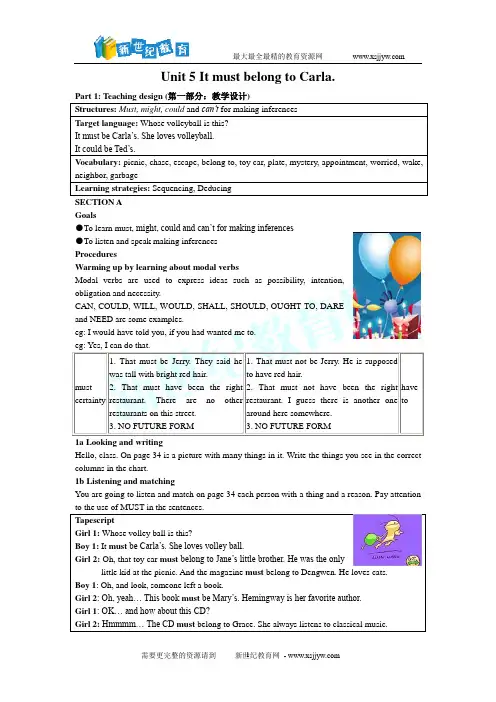
Unit 5 It must belong to Carla.SECTION AGoals●To learn must, might, could and can’t for making inferencesProceduresWarming up by learning about modal verbsModal verbs are used to express ideas such as possibility, intention,obligation and necessity.CAN, COULD, WILL, WOULD, SHALL, SHOULD, OUGHT TO, DAREand NEED are some examples.eg: I would have told you, if you had wanted me to.1a Looking and writingHello, class. On page 34 is a picture with many things in it. Write the things you see in the correct columns in the chart.1b Listening and matchingYou are going to listen and match on page 34 each person with a thing and a reason. Pay attentionbelong to Dengwen. He loves cats.1c Doing pairworkIn pairs practice the conversation in the picture on page 34Bob and Anna found a backpack outside their school gate. Listen to their conversation and write down the things found in the backpack. Pay attention to the uses of modeal verbs making2b Listening and fillingNext you are to listen to the tape once again. Fill in the blanks with modal verbsyou hear used to making inferences.2c Filling and tellingOn page 35 is a chart in which you will see 8 sentences. A word is missing fromOn page 36 you see a box. In it is a thank-you message from Linda to Anna. Read it, number the 53b Doing pairworkIn pairs talk about the words you don’t understand. You can use “can’t”, “must”,” could” or “might”.A:What do you think “anxious” mean?B: We ll, it can’t mean “happy”.A:It might mean “worried”.B:Oh, yes. She’s worried because of her test.A:What do you think “concert” mean?B:Well, it can’t mean “music”.A:It might mean “a performance of music by players or singers”.B: Oh, yes. She was in the symphony hall.4 Doing pairworkIn pairs talk about the things from the backpack on page 37. You are going to make guesses aboutClosing down by looking and sayingLook at the picture below and say what is happening in the classroom.Goals●To learn Must, might, could and can’t for making inferences●To use Must, might, could and can’t for making inferences inlistening, speaking, reading and writingProcedures1 Looking and writingHello, class. Have you ever seen any UFOs or aliens? What are they?How do they look?Now turn to page 37, look at the pictures and write a sentence about each picture. Use Must, might, could and can’t for making inferences.2a Listening and numberingTo know more about the UFO and aliens you shall listen to a recording. While listening pay attention to the uses of Must, might, could and can’t for making inferences and try to number the! They must be making a movie. You are going to listen to the tape again and complete the sentences in the box on page 37. Use In pairs role play the conversations between the man and woman. Use Must, might, could and can’t for making inferences.A: Why do you think the man is running? B: He could be running for exercise.A: No, he’s wearing a suit. He might be running to catch a bus. B: There’s something in the sky. It could be a helicopter. A: No, it cant’ be a helicopter. It must be a UFO.B: And there’s a strange creature getting out. It must be an alien. A: I must be dreaming.B: Look, there’s a woman with a camera. A: She could be from the TV news. B: Oh! They must be making a movie. 3a Reading and underliningThere’s a newspaper article here on page 38. Read it, underline what causes the strange things and3b Writing another paragraphYou have read the newspaper article about strange events in Bell Tower. Nowusing the notes on page 38 to write another paragraph about the events. U se“Late last night, we heard footsteps in the hallway. We thought that they might be the neighbors,”3c Looking and finishingNow please look at the headline in the box on page 38 and finish the article about the strange events in Bell Tower. Use Must, might, could and can’t for making inferences.No more mystery in Bell Tower neighborhoodWe now know what was happening in Bell Tower Neighborhood.The director of the local zoo says that three monkeys escaped from the zoo and ran into the very quiet Bell Tower neighborhood. These days they caused many strange things in the neighborhood and everyone was unhappy.Zhou Gu, the local school teacher was extremely worried. He said that every night they heard strange noises outside their window. His wife thought that it could be an animal, but his friends and he thought it must be teenagers having fun. His parents called the police, but they couldn’t find anything strange. They thought it might be the wind.Zhou’s next door neighbor Qi Hui was unhappy too. At first, he thought it might be a dog, but he couldn’t see a dog and he still heard the noises outside.Everyone in our neighborhood was worried, and everyone had his or her ideas. There must be something visiting the homes in our neighborhood, but what was it?Now everyone knows it was the three monkeys who escaped from the zoo running into the very quiet Bell Tower neighborhood and caused the many strange things.4 Doing groupworkTell your classmates about a recent dream and let them guess what the dream might mean. Use Must, might, could and can’t for making inferences.A: In my dream, I was swimming in an ocean of paper.B:Maybe it means you’re afraid of too much homework.A: In my dream, I was running down the street.B:Maybe it means you’re afraid of something strange.A: In my dream, I was running for exercise.B:Maybe it means you’re afraid of being ill.A: In my dream, I was wearing a suit in the daytime.B:Maybe it means you’re afraid of being late for work.A: In my dream, I was looking kind of scared.B: Maybe it means you saw something strange in the sky yesterday morning.A: In my dream, I saw a UFO was landing.B: Maybe it means you wanted to go to the sky.A: In my dream, I found an alien chasing me!B: Maybe it means you are fond of making a movie!Closing down by writing a newspaper articleHere are some pictures. Look at them and write a newspaper article. Use Must, might, could and c an’t for making inferences.SELF CHECK 1 Filling the blanksOn page 39 you will see 5 sentences. Now read them and fill in each blank with a correct word given. Make necessary changes to the form. Then make your own sentence with each word.(Key: 1. favorite 2. careful 3. worried 4. anxious 5. strange) Your own sentences might be: 1. I’m very anxious about it.2. These days, everyone is extremely worried about the weather.3. We hear strange noises outside our classroom.4. You are not very careful of the aliens swimming in the river. fun.5. My parents are my favorite teachers of English.2 Read the proverbs and tell what they mean. Use Must, might, could and can’t for making3 Circling the odd wordJust for fun!Look at the UFO photos below and write a paragraph for each of them. Use Must, might, could and can’t for making inferences.1967年6月10日罗德岛上空出现的飞碟1951年8月31日美国德克萨斯州出现的飞碟组Part 2: Teaching Resources (第二部分:教学资源)I. What is UFO?A UFO or unidentified flying object in the original, literal sense isany airborne object or optical phenomenon, detected visually or byradar, whose nature is not readily known. Interest in these objectsstems from continued speculation that some of them may be theproducts of extraterrestrial intelligence.A UFO -- fact or fiction?Perhaps the best scientifically accepted definition of a UFO was provided by the late astronomer Dr. J. Allen Hynek: "A UFO is the reported perception of an object or light seen in the sky or upon the land the appearance, trajectory, and general dynamic and luminescent behaviour of which do not suggest a logical, conventional explanation and which is not only mystifying to the original percipients but remains unidentified after close scrutiny of all available evidence by persons who are technically capable of making a common sense identification, if one is possible."II.What is Alien or Extraterrestrial life?Extraterrestrial life is life that may exist and originate outside our planet Earth. Its existence is currently hypothetical: there is as yet no evidence of extraterrestrial life that has been widely accepted by scientists.Speculative forms of extraterrestrial life range from humanoid and monstrous beings seen in works of science fiction to life at the much smaller scale of bacteria and viruses. Extraterrestrial life forms, especially intelligent ones, are often referred to in popular culture as aliens or ETs. The putative study and theorisation of ET life is known as exobiology.III. Exercises on modal verbs1) You____ all those clothes! We have a washing machine to do that sort of thingA) needn't have washed B) shouldn't have washedC) must not have washed D) can not have washed2) John's score on the test is the highest in the class; he____ last night.A) should study B) should have studiedC) must have studied D) must have to study3) The room is in a terrible mess; it ____cleaned. (CET-4, 1996,6)A) can't have been B) shouldn't have beenC) mustn't have been D) wouldn't have been4) Nobody knows how people first came to these islands. They ____ from South America on rafts.A) must have sailed B) can sailC) might have sailed D) should have sailed5) Mary was not in her bedroom yesterday afternoon. She ____ in her classroom.A) should have been B) must have beenC) must be D) should be6) Bob said he was going to join our club but he didn't. He ____ his mind.A) can't have changed B) wouldn't have changedC) must have changed D) shouldn't have changed7) You____ to town to see the film yesterday. It will be on TV tonight.A) needn't go B) had better not goC) should not go D) needn't have gone8) We____ the letter yesterday, but it didn't arrive.A) must receive B) ought to receiveC) must have received D) ought to have received9) With all the work on hand, he____ to the cinema last night.A) mustn't go B) shouldn't have goneC) could not go D) couldn't have gone10) Eve was late for class again. She ____earlier.A) should get up B) must get upC) need to get up D) should have got up11) I am feeling sick. I____ so much chocolate.A) needn't have eaten B) couldn't have eatenC) mustn't have eaten D) shouldn't have eaten12) I didn't send out my application form last week, but I ____.A) had B) would doC) should have D) might have to13) Walking alone in the deserted village, John was scared. He thought he____ Tom to go with him.A) might have asked B) should askedC) must have asked D) should have asked14) When I got to the cinema, the film had already started; I____ there earlier.A) ought to get B) ought to have gotC) must have got D) must get15) The road was muddy. It____ last night.A) must rained B) must have rainedC) must be rained D) could have rained16) She can speak quite fluent English. She____.A) must been in the U.S.A. for some timeB) must have been in the U.S.A. for some timeC) should have been in the U.S.A. for some timeD) May be in the U.S.A. for some time17) You should bear in mind that he is not so strong as he____.A) was used to be B) used to beC) was used to D) use to18)“We didn't see him at the exhibition yesterday.”“He ___it.”A) mustn't visit B) can't have visitedC) should have gone to see D) may see19) Mary ____my letter, otherwise she would have replied before now.A) should have received B) has receivedC) Couldn't have received D) ought to have received20) I ____ you a valuable present for your birthday, but I was short of money.A) would have liked to give B) liked to giveC) have liked to give D) would like to give21)“Where ____ my umbrella?”“Somebody ____ it away by mistake.”A) is, must have taken B) is, must takeC) have been, must take D) is, takes22) What ____ would happen if the director knew you felt that way?A) will you suppose B) you supposeC) do you suppose D) you would suppose23) Two eyes ____see more than one.A) can B) may C) will D) should24) ____ you continue in your efforts and achieve new and greater successes.A) Would B) Will C) May D) Should25) We ought to help each other in our work, ____?A) oughtn't we B) should weC) shouldn't we D) ought to we26) Tom ____ better than to ask Dick for help.A) shall know B) shouldn't knowC) has known D) should have known27) You ____ your tooth pulled out before it rot completely.A) had better got B) had to get betterC) had better to get D) had better get28) When we got to the cinema, the film hasn't started yet, so we ____.最大最全最精的教育资源网 需要更完整的资源请到 新世纪教育网 - 11 A) needn't hurry B) didn't need hurryC) needn't to hurry D) needn't have hurried29) It was really very dangerous; you ____ him seriously.A) might have injured B) could injureC) should have injured D) must injure30) As he had heart attack, he was told that he ____ continue the work.A) needn't B) may not C) mustn't D) can't31) An Englishman who ____not speak Italian was once traveling in Italy.A) must B) could C) may D) might32) I ____like to make a suggestion.A) could B) would C) must D) might33) I know things are hard with you, but you ____try to get over the difficulties.A) can B) may C) must D) ought34) I can't find the recorder in the room. It ______ by somebody.A) m ay have been taken away B) may leaveB) C ) may take away D) must have taken away35) He ____the 9:20 train because he didn't leave home till 9:25.A) can reach B) could catchC) may not catch D) couldn't have caughtKEY:1)A 2)C 3)A 4)C 5)B 6)C 7)D 8)D 9)D 10)D 11)D 12)C 13)D 14)B 15)B 16)B 17)B 18)C 19)C20)A 21)A 22)C 23)A 24)C 25)A 26)D 27)D 28)D 29)A 30)C 31)B 32)B 33)C 34)A 35)D。
人教新目标九年级英语全一册Unit6period1优秀教学案例
3.播放一段关于假期生活的视频,让学生注意视频中人们的行为和动作,激发学生对过去进行时的兴趣。
(二)讲授新知
1.教师通过生动的语言和实例,讲解过去进行时的构成、用法,让学生在真实语境中感知和理解过去进行时。
2.教师给出一些例句,让学生模仿和造句,巩固过去进行时的知识点。
人教新目标九年级英语全一册Unit6period1优秀教学案例
一、案例背景
本案例背景基于人教新目标九年级英语全一册Unit6period1的教学内容,该节课主要围绕“过去进行时”的语法知识点展开。通过本节课的学习,学生需要掌握过去进行时的构成、用法以及如何运用过去进行时描述过去某一时间正在进行的动作。同时,本节课还涉及到一般过去时的复习,帮助学生区分一般过去时和过去进行时的不同。
在教学过程中,我以“我的假期生活”为主题,设计了一系列交际活动,让学生在真实的语境中运用过去进行时进行交流。通过听、说、读、写等多种教学手段,激发学生的学习兴趣,提高他们的语言运用能。
在教学评价方面,我采用了形成性评价和终结性评价相结合的方式,关注学生的学习过程和结果,充分发挥评价的诊断、反馈和激励作用,帮助学生建立自信心,提高自我认知。
1.采用小组合作学习的方式,让学生在小组内共同完成任务,培养他们的团队协作能力和沟通能力。
2.设计各种任务,如讨论、探究、表演等,让学生在完成任务的过程中,运用过去进行时进行交流,提高他们的语言运用能力。
3.鼓励学生发表自己的观点,培养他们独立思考和表达的能力,提高他们的自信心。
(四)反思与评价
1.教师要关注学生的学习过程,及时发现学生的问题,并给予指导和帮助,让学生能够在反思中不断进步。
英语教案人教版新目标九年级英语全册Unit 6第六单元
Unit 6 When was it invented?Grade level: 9th GradeCourse: EnglishTextbook: New Standard English, Book 9, published by People's Education Press.Objectives:To introduce students to the use of the past tense in English languageTo help students improve their reading, writing, listening and speaking skills in English.To encourage students to use their imagination and creativity in discussing technological inventions and their impact on human life.To enhance students' understanding of the significance of technological advances throughout history.Materials:Textbook: New Standard English, Book 9, published by People's Education Press.Whiteboard or blackboard and markers.Handouts with comprehension questions related to the reading.Audio or video materials related to the topic.Pictures or diagrams of some of the most important technological inventions in history. Procedure:I. Warm-up activityThe teacher begins the lesson by asking students about some of the most important technological inventions they use in their daily life, and when they were invented.The teacher then writes some of the students' answers on the board.II. Pre-reading activityThe teacher presents some pictures or diagrams of technological inventions from different time periods and asks students to guess when they were invented.The teacher then divides the class into groups and asks them to discuss the impact of these inventions on human life.III. Reading comprehensionThe teacher asks students to read the text "When Was It Invented?" from their textbook.The teacher then distributes handouts with comprehension questions related to the reading and asks students to answer them individually.The teacher then discusses the answers with the class.IV. Vocabulary buildingThe teacher asks students to find some new words or phrases from the reading, and to write them on the board.The teacher then asks students to work in pairs and use the new vocabulary words in sentences.V. Listening comprehensionThe teacher plays an audio or video clip related to the topic, and asks students to listen carefully. The teacher then distributes handouts with comprehension questions related to the clip and asks students to answer them.VI. Writing activityThe teacher asks students to write a short paragraph about one of the most important technological inventions in history and its impact on human life.The teacher then asks students to exchange their writing with a partner, and to provide feedback on each other's writing.VII. Follow-up activityThe teacher concludes the lesson by asking students to share their opinions about the impact of technological inventions on human life, and how they think technology will continue to shape our future.Assessment:The teacher can assess students' performance through the following:Observing their participation in class discussions and group activities.Reviewing their answers to comprehension questions.Assessing their writing activity and providing feedback.Observing their use of new vocabulary words in sentences.Homework assignment for "When Was It Invented?" lesson:Research and write a brief report about one of the most important technological inventions in history and its impact on human life.Write a dialogue between two people discussing the importance of technological inventions in their lives.Watch a video or read an article about a recent technological invention and write a summary of it.Create a timeline of technological inventions from prehistoric times to the present day, including the approximate date of each invention and its impact on human life.Choose one of the vocabulary words from the lesson and write a short story using that word correctly.Practice reading aloud the text "When Was It Invented?" from your textbook, paying attention to your pronunciation and intonation.Think about how technology has changed your life and write a short paragraph about it.Note: Students should submit their homework assignments in the next class meeting.。
九年级英语全册Unit6SectionA_2教案设计人教新目标版
1. Did you know that tea was invented by accident?
2. It is said that Shen Nong was the first to discover tea as a drink.
3. Tea didn’t appear until aroun years.
Revision.
Let Ss translate some phrases.
Step 2
Free talk.
Ask Ss to talk about the question “how many kinds of drinks do you know?”
Step 3
Discussion.
Show Ss some pictures about the drinks and tell Ss that tea is the most popular drink in the world, and then to discuss about the kinds of tea they know.
4. The Chinese are without doubt the ones who best understand the nature of tea.
Difficulties
How to learn and understand the invention about tea.
Vocabulary
Step 8
Brainstorm.
Introduce to Ss about some brilliant inventions made by accidents.
Step 9
u6 人教新目标九年级英语全套教案[整理14套]
Unit 6 I like music that I can dance to.Part 1: Teaching design (第一部分:教学设计)Structures: Relative clause with that and whoTarget language: I like music that I can sing along with.What about you? I prefer music that has great lyrics.I love singers who write their own music.Vocabulary: lyric, gentle, remind of, exhibition, prefer, photographer, energyLearning strategies: Listening for specific informationTransforming informationSECTION AGoals●To learn to use Relative clause with that and who●To listen to and talk about musicProceduresWarming up by studying “Grammar Focus”Hi, morning. Today we shall take up unit 6 “I like music that I can dance to.” But first we shall studying “Grammar Focus”. Turn to page 45.Relative clause with that and whoWhat kind of music do you like?Rosa likes music that’s quiet and gentle.I love singers who write their own music.We prefer music that has great lyrics.Pay attention to the circle words. What do they serve as?Pay attention to the underline clauses. What do they serve as?1a Looking and circlingTurn to page 44, look at the picture and circle the sentences you agree with. Make your ownsentences like this: I like music that…I like music that is written in China.I like music that sounds sweet.I like music that we can dance to.I like music that isn’t too low.I like music that has good lyrics.I like music that we can easily sing along with.I like music that is made by our music teacher.…1b Listening and checkingListen to the tape and check the music that Tony and Betty like.Music that I can dance to Music that has greatlyricsMusic that I can singalong withTony √√Betty √√TapescriptBetty:Oh, look. There’s the new Cool Kids CD.Tony: The Cool Kids? Do you like them?Betty: Oh, yeah. They’re my favorite band. I like music that I can dance to.Tony:You’re kidding. I think they’re awful. I prefer music that has great lyrics… music that I can sing along with.Betty: I like songs I can sing along with too. So what’s your favorite b and?Tony:The Lions. Their words are interesting and…Underline the Relative clause with that and who in the listening tapescript for 1b on the blackboard.1c Doing pairworkNow in pairs talk about the music you like.A: What kind of music do you like?B: I like music that I can sing along with.A: I prefer music that has great lyrics.A: What kind of music do you like?B: I like music that I can that I can dance to.A: I prefer music that I can sing along with.2a Listening and circlingGo to page 45 a nd listen to circle “T” for true or “F” for false.Underline on the blackboard all the Relative clause with that and who and circle “that” or “who” in the relative sentences.TapescriptBoy: Look, Carmen. These T-shirts are great! Look at this one.Girl: What a great T-shirt, Xu Fei. I really love Dan Dervish. I like musicians who play different kinds of music.Boy:Hmmm… he’s okay…Girl:He’s only okay?! You must be joking.Boy:Well… I like musicians who write their own songs. Dan Dervishdoesn’t write h is own music.Girl:Hmm. Well, I think he’s great.Boy:The Modern’s T-shirt is interesting.Girl: The Modern are really great. I love music that’s really loud and energetic.Boy:I know you do… but I prefer groups that play quiet and gentle songs.2b Listening and pletingListen to the Tapescript in 2a again and plete the sentences in the box on page 45 in 2b.About The modern About Dan DervishXu Fei says 1. I prefer groups that playquiet and gentle songs. 3. I like musicians who write their own songs.Carman says 2. I love music that’s reallyloud and energetic. 4. I like musicians who play different kinds of music.2c Doing pairworkIn pairs make conversations using the information from 2a and 2b.A: Does Xu Fei like The Modern?B:No, he doesn’t. He prefers groups that play quiet and gentle songs.A: Does Carman like groups that play quiet and gentle songs.B: No, she prefers music that’s really loud and energetic.…3aReading and matchingNext you are going to read Jennifer’s CD review. Then ma tch the sentences parts on page 46.1. It’s the kind of music that you can dance to. (d)2. She likes musician who write their own lyrics. (a)3. She doesn’t like songs that are too long. (e)4. She likes singers who sings the words clearly. (c)5. The music is like Brazilian dance music. (b)3b Doing pairworkYou are going to talk with your partner about a CD you listened to recently. Ask and answer the questions as is on page 46 in activity 3a.A: What CD did you listen to recently? B: I listened to one called Heart Strings. A: What do you think of it?B: I enjoy it a lot.A: Why? A: What CD did you listen to recently? B: I listened to one called ChinaChina. A: What do you think of it?B: I enjoy it a lot.A: Why?B:The singer writes her own songs. I prefer singers who write their own lyrics. B:It’s the kind of music that you can dance to. I prefer music that we can dance to.4 Doing pairworkplete the survey on page 46 and then go to find classmates who agree with you. My opinion Classmates who agreesI like groups that dance to their songs. Ju HongxiaI love singers who are tall and beautiful. Li DongmingI can’t stand music that is too long. Zhao HexingI don’t like musicians who look like aliens. Wang BaofengClosing down by singing a clean-up songClean-up,Clean-up,Everybody, Everywhere!Clean-up,Clean-up,Everybody do your share!。