
Unit5 Dinner's ready B.Let's talk
小学英语四年级上册(人教PEP版)Unit 5 Dinner's Ready A Let's learn课件
chicken
beef soup
chicken soup
fish
fish soup
Practice : Let’s learn
_f_i_sh__ soup
_e_g_g__ soup
I’d like some … .
_b_e_e_f_ soup
Practice : Let’s learn I’d like some bread.
想要
I would like some bread. I’d like Oh~ Thin girl.
Practice : Let’s learn I’m hungry, too.
What would you like?
I’d like some…br. ead and soup.
A
B
Practice : Let’s learn
76、人生生命贵太相过知短,暂何,用今金天与放钱弃。了明20天.7.不14一20定.7能.1得42到0.。7.184时。3250分280时年375月分1144日-J星ul期-2二07二.14〇.2二02〇0年七月十四日
花一样美丽,感谢你的阅读。 87、勇放气眼通前往方天,堂只,要怯我懦们通继往续地,狱收。获的20季:35节2就0:3在5前:12方7.。142.02.072.104T2u0e.s7d.1a4y2, 0Ju.7ly.1144。, 2020年7月14日星期二二〇二〇年七月十 四日 8、拥有梦想只是一种智力,实现梦想才是一种能力。20:3520:35:127.14.2020Tuesday, July 14, 2020
unit5 Dinner's ready A Let's learn 课件PPT

Which is missing?
(哪个不见了?) soup chicken beef noodles
fish bread vegetable rice
Let's play
bfwcjrriuaismeeacikhgaectiegedlkr
Part A Let’s learn
主讲:上丰乡中心小学 黄博
dinner: the main meal of the day, eaten in the evening or at midday. (中午或晚上吃的)
正餐
学习目标;
1、能听、说、认、读单词: beef,chicken,noodles,soup以及 vegetable.
教师寄语
Please keep healthy diet. 保持健康饮食。
Modesty is a kind of virtue. 珍惜粮食是一种美德。
Role play
两位同学一组来进行角色扮演
,一位当圣诞老人,另一位则 扮演学生。
What would you like? (你想要什么?) I’d like some …. (我想要一些……)
OK.Here you are(好的,给你)
1.抄写今天学习的单词各三遍。 2.复习Let’s learn的内容。
Chinese Restaurant
Welcome to the Chinese restaurant
Chinese Restaurant's Menu
What would you like? (你想要什么?)
I’d like some ….
新人教版pep四年级英语上册Unit 5 Dinner’s ready第5课时课件
Would you like some rice?
Yes, please.
Pass me the bowl.
Let’s learn
bowl yellow fellow window
Let’s learn
Would you like some noodles?
Yes, please.
I can use chopsticks.
Exercise
( C ) 1. It's
in the evening now.
A. six
B. seven C. eight
( A ) 2. Bob is
.
A. hungry B. happy C. full
( C ) 3. Bob would like some
.
A. water B. bread C. beef
Would you like some vegetables?
Yes, please.
I can use the fork.
Let’s learn
fork or
story
Let’s learn
Would you like some soup?
Yes, please.
I can use the spoon.
● 3、少年易学老难成,一寸光阴不可轻。 07:568.13.202007:568.13.202007:5607:56:148.13.202007:568.13.2020
● 4、敏而好学,不耻下问。8.13.20208.13.202007:5607:5607:56:1407:56:14
● 5、海内存知已,天涯若比邻。Thursday, August 13, 2020August 20Thursday, August 13, 20208/13/2020
【三套试卷】小学四年级英语上册第五单元教材检测题(附答案)(2)

四年级英语上册第五单元达标测试卷(附答案)姓名一、英汉互译(18分)喜欢动物跟我来看一看What about you how nice like horse十三只猴子我的新家那只老虎In the tree these mangoes make a toy panda 试一试过来看多少张桌子Don’t sleep under the desk 打篮球二、按要求写(10分)gilr(对应词)these (对应词)is(复数)bus (复数)too(同义词)they’re(完全形式)is not(缩写形式)do not(缩写形式)can’t (完全形式) thanks(同意词组)三、选择(12分)1、( ) This is mango,that is apple。
A、a aB、an aC、a an2、()that is a tiger,do you like ?A、tiger tigerB、tiger tigersC、tigers tiger3、()I have toy cars, do you have toy cars,either?A、some someB、some anyC、any some4、()would you like cakes? -A、Yes,I amB、Yes,pleaseC、No,I don’t5、()This is a cake grapes 。
A、forB、toC、with6、()It’time bed。
A、forB、toC、with7、()I a student。
A、amB、isC、are8、()I can’t skate ,my brother can’t skate, .A、tooB、toC、either9、()do you have?-I have some pens。
A、WhereB、WhatC、How many10、()is my pencil?—I’s on the table .A、WhereB、WhatC、How many11、()balls do you have?—FourA、WhereB、WhatC、How many12、()are you ?I’m ten。
人教PEP版英语四年级上册Unit5 B.Let's talk教学设计
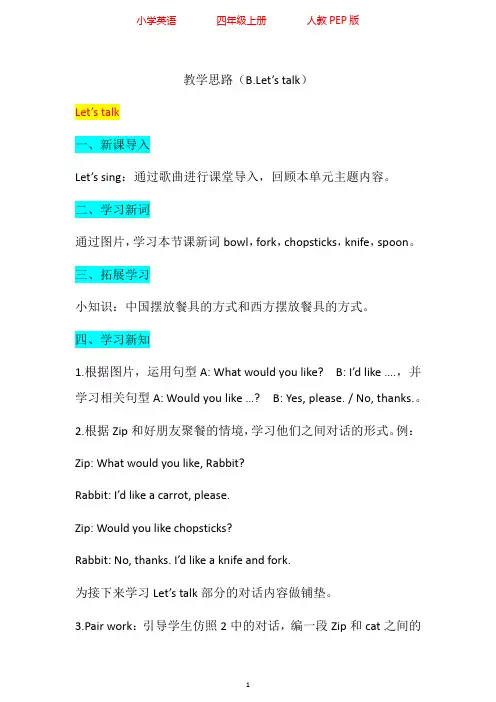
教学思路(B.Let’s talk)Let’s talk一、新课导入Let’s sing:通过歌曲进行课堂导入,回顾本单元主题内容。
二、学习新词通过图片,学习本节课新词bowl,fork,chopsticks,knife,spoon。
三、拓展学习小知识:中国摆放餐具的方式和西方摆放餐具的方式。
四、学习新知1.根据图片,运用句型A: What would you like? B: I’d like ….,并学习相关句型A: Would you like …? B: Yes, please. / No, thanks.。
2.根据Zip和好朋友聚餐的情境,学习他们之间对话的形式。
例:Zip: What would you like, Rabbit?Rabbit: I’d like a carrot, please.Zip: Would you like chopsticks?Rabbit: No, thanks. I’d like a knife and fork.为接下来学习Let’s talk部分的对话内容做铺垫。
3.Pair work:引导学生仿照2中的对话,编一段Zip和cat之间的对话。
4.用陈述句总结Zip和朋友之间的对话。
例:Rabbit would like a carrot. She can use a knife and fork.5.学习本节课重点句型:Dinner’s ready. Help yourself.五、Let’s talk在任务练习中学习Let’s talk部分的对话内容。
六、巩固练习今日特价:根据图片,练习句型。
例:A: Here are today’s specials. Would you like some soup?B: Yes, please. How much is it?A: It’s one yuan.七、Homework课外作业的布置。
让学生回归课本,通过作业的形式,巩固本次课所学内容,并为下次课的学习做准备。
PEP小学英语四年级上册第五单元教案
4. Finish the exercise on workbook.
重点
难点
Spell the words: bread, milk, water, egg. A glass of…
Wow! What a big breakfast. The pronunciation of breakfast.
2. Ss can order food with the sentence pattern:
Can I have some….and…, please?
Sure. Here you are.
重点
难点
Words& sentences
The pronunciation of vegetables
教学
准备
教学
准备
Cards, flash cards, tape, tape recorder
教学过程
一. Warm up
1. Daily greeting.
T: Are you ready for class? If you are ready. Please say:
Everything’s ready.
Bread apples water
… … …
课时计划年月日
课题
名称
Unit5 ALet’s talk
课时
第2课时
教
学
目
标
1. Ss can understand, say and read the sentences:
What would you like for breakfast/ lunch/ dinner?
Unit5 Dinner’s ready教学课件
Find the best actor/actress? 寻找最棒的小演员?
A:Can I help you? B: Yes! A:What would you like for dinner? B:I’d like some… How much is it? A : …yuan. B: Ok! Here you are.
Unit5 Dinner’s ready
Part A Let’s learn & Let’s play
ee → / i: /
b+ee+f=beef (牛肉) m+ee+t=meet(遇见) d+ee+d=deed(行为) f+ee+t=feet(脚)
How much is it? 15 yuan.
Guessing 猜一猜
He is a big chicken. (他是一个十足的胆小鬼)
How much is it? 20 yuan.
Rack your brain
鸡蛋汤 (egg soup) 鸡汤 (chicken soup) 牛肉汤 (beef soup)
动动你的小脑筋
How much is it? 10 yuan.
How much is it? 10yuan.
vegetables
vegetables=ve+ge+table+s
How much is it? 8 yuan.
What's missing? (什么丢了?)
人教版四年级上册英语课文
人教版四年级上册英语课文一、Unit 1 My classroom。
A. Let's talk.- 课文内容:- Chen Jie: We have a new classroom.- John: Really? What's in the classroom?- Chen Jie: Let's go and see!- (They are in the classroom now.)- John: It's so big!- Chen Jie: Look! My picture!- John: Where is it?- Chen Jie: It's near the window.- 重点单词和短语。
- new(新的),classroom(教室),really(真的),big(大的),near (在……附近),window(窗户)- 句型。
- We have a new...(我们有一个新的……)- What's in...?(……里面有什么?)- Let's go and see.(让我们去看看。
)- It's near...(它在……附近。
)B. Let's learn.- 课文内容:- This is my classroom. The door is orange. The desks and chairs are blue. I like my classroom.- 重点单词。
- door(门),desk(书桌),chair(椅子),window(窗户),blackboard (黑板),light(灯)二、Unit 2 My schoolbag。
A. Let's talk.- 课文内容:- Hi, Chen Jie. I have a new schoolbag.- Really? What colour is it?- It's black and white.- Look! It's a panda!- Cool! I like it.- 重点单词和短语。
五上 Unit5 B Let’s talk
PEP五上Unit5 B Let’s talk 同课异构B组张丽第三稿说明:本教案是基于同伴互助下课堂实录后的第三次备课,红色字体部分是在第二稿的基础上改动的部分。
一、教学内容分析:本课时是PEP小学英语五年级上册第五单元B部分的一节对话课。
要求学生能掌握There is a…….near /…the…和The…is near/…the…并能运用所学语言介绍房间摆设。
本部分的对话内容是在A部分和B L et’s learn的基础上展开的对话。
学生已有的知识是:房间内物品名称:trash bin, bed, closet, curtain, mirror, air-conditioner, closet, end table, table, chair, desk等。
介词:in, on, under, near, behind, over, in front of.二、学情分析:1、本节课授课对象五年级十四班学生。
本班学生的特点是活泼好动,思维活跃,纪律不是很好,但集体荣誉感较强。
本课时采用的合作竞争学习方式正适合他们。
另外,借助外籍教师Katy制作的一份学习者类型问卷调查,发现本班约有36%的孩子属于听觉型学习者;约54%的孩子属于视觉型学习者;约30%的孩子属于动型学习者。
2、通过三、四年级两年的学习,大多数学生有一定的英语语言接受和表达能力,词汇量有一定的储备,能进行简单的口语交流,对教师的课堂指令和体态语己有相当好的领悟和反应。
其中,约80%的学生学习兴趣较浓,积极性较高,约15%的学生学生对语言的认知能力不强,缺乏一定的学习能力,约5%的学生反应较迟缓,有待进一步提高。
附:调查问卷:What type of learners you are?Question: 1.When I study I like to…e a highlighter to emphasize pointsB.Explain the information to someone elsee a chanting rhythm to memorizeQuestion: 2.I like to study…A. Alone in a quiet placeB. With one other person using role playing gamesC. In a group so I can listen to othersD. Question: 3.I remember things best if I…A.Make lists and write them over and overB.I write things down and read them backC.Record the information and listenQuestion: 4.I like to learn using…A. Photographs and diagramsB. Labs (experiments) and demonstrationsC. Rhymes and chants that I make upQuestion: 5.Sometimes when nobody is around I will…A. Draw a picture showing a process I need to understandB. Act out informationC. Create songs with my homework informationD. Question: 6.I remember things most when I…A. Read themB. Say themC. Hear themQuestion: 7.I have trouble remembering information if I…A. Can‘t take notesB. Read it and don‘t talk about it in classC. Can‘t discuss it in classQuestion: 8.I remember…A. FacesB. NamesC. Names and faces if I can shake handsQuestion: 9.When I study for a test I like to…A. Make an outlineB. Trace pictures, diagrams, and charts with my fingerC. Read out loudCount how many As, Bs, and Cs you have.If you answered mostly A, you are a visual learnerYou can learn best if you can read the information that you are learning, see pictures, watch movies, look at graphs and diagrams.PPTs, props, and the blackboard are very helpful for you.If you answered mostly B, you are a tactile learner.You can learn the best if you can interact with the material that you are learning. It is helpful for you to talk about the new information, to touch it (if possible) and to perform experiments.Projects, crafts, experiments, and activities are helpful for you.If you answered mostly C, you are an auditory learner.You can learn the best whenever you can listen to new information.It is helpful for you when someone explains information to you. Listening to someone is more helpful than reading books or taking notes.Songs, stories, discussions, and lectures are helpful for you.三、教学目标:新课程强调知识与技能、过程与方法、情感态度与价值观三个角度的有机结合,本着这样的认识,结合以上教材分析和学情分析,我制定如下教学目标:1.知识目标:学生能听、说、认读句子There is a…….near/…the…和The…is near/…the…。
四年级小学英语评课稿:PEP Book3 Unit 5 B Let’s talk
小学英语新课程标准教材英语教案( 2019 — 2020学年度第二学期 )学校:年级:任课教师:英语教案 / 小学英语 / 小学四年级英语教案编订:XX文讯教育机构小学英语评课稿:PEP Book3 Unit 5 B Let’s talk教材简介:本教材主要用途为通过学习英语的内容,提高学生的语言技能,增加一项语言能力,有利于国际化的日常交流、生活、工作等,本教学设计资料适用于小学四年级英语科目, 学习后学生能得到全面的发展和提高。
本内容是按照教材的内容进行的编写,可以放心修改调整或直接进行教学使用。
本节课以就餐时的常用会话来展开教学。
纵观整节课,教师把语言学习与语言运用紧密联系起来,创设了良好的语言环境和充分的语言实践机会,学生在课内学得主动、有趣,达到了较好的效果。
具体看来有以下几个亮点:一、注重知识点的联系,衔接巧妙自然。
新课标倡导要注重学习过程,强调学生的体验和参与。
本节课中教师注意前后知识的衔接,让学生循序渐进地体验成功,使课堂教学不仅激发学生的学习兴趣,而且发展了学生的语言能力。
首先,教师在上课一开始就通过sing a song和chant进行复习,接着用we had a good time. 过渡到let‘s do,有意识地将let’s talk中出现的we had a good time. let me try. i can use chopsticks. 反复呈现,让学生充分接触新知,加大新句型的输入频率,既很好的完成了let‘s do,又做到了大量的输入和输出,为let’s talk做好铺垫。
最后教师再次用we had a good time. 来表达自己的心情,用are you hungry? let‘s have some good food. 作为引子和学生展开就餐时的对话,通过表演、听录音回答问题、朗读、chant等环节教学let’s talk.在这过程中学生的语言和情感都得到了交流,培养了学生听说读的能力,达到了预期的教学目的。