
人教版PEP五年级英语上册Unit 2 My week Part B 教案
课题 Unit 2 My week 课型 新授课 课时
第1课时 教 学 目 标 知识与技能: 掌握字母组合的发音,并能正确读出这些单词 过程与方法:学生通过模仿读、唱歌谣等形式认读单词,引导学生找出相对开音节单词的拼写规律。 情感态度与价值观:让学生在模仿、学习、表演活动中喜欢用英语交流。 重点 难点 重点:音标发音与单词认读。 难点:音标发音与单词认读。 学法 指导 引导自学 教具、学具 磁带、录音机、字母卡、单词卡 通案 个案 一、热身与复习(Warm-up/Revision) 1. 日常口语练习。 2. 学生表演Let`s talk的内容。 二、新课展示(Presentation) 1.出示feet,beaf,meat,tea,read, eat的单词卡,请学生找出它们的共同点(含有ea,ee). 3.两人一组说唱,比比谁说的好。 3.小组活动:找出单词结构上的共同特点。 4.小组交流自己的发现。 5.师生总结,教师点拨:字母组合ea /ee的发音/i:/ 6.学生说说还有哪些含有字母eaee/的单词。 如:see meet beef 三、趣味练习(Practice) 在学生已经熟悉单词的基础上,师生做一些简单的单词记忆游戏以便学生更好得掌握含有ea/ee字母组合的单词。 四、巩固扩展(Add-activities) 1. 说唱本课的歌谣。 2. 完成教材中读一读,听一听,排序。 3. 完成教材中听一听,圈一圈,写一写。 知识点小结: 简单了解字母组合ea/ee在单词中的发音。
课
堂
检
测
一、判断下列单词划线部分发音是否相同,相同的打“ √”,不同的打“ ×”。
1.how mouth ( ) 2. bread teacher ( )
3.thin bike ( ) 4.take apple ( )
5.sheep sleep ( ) 6.put but ( )
7.great seat ( ) 8.now window ( )
9.peach jeans ( )
教
学
反
思
课题 Unit 2 My week 课型 新授课 课时
第2课时 教 学 目 标 知识与技能:: 1.能听懂、会说本课时单词及词组: wash my clothes watch TV do homework read books play football 2.能听懂、会说句型Do you often wash your clothes on the weekend? Yes, I do. 并能在情景中进行运用。 过程与方法: 学生借助实物图片等形象、直观的学习单词,并在实际情景中小组操练、运用句型。 情感态度与价值观: 教育学生学会合理安排自己的周末,养成好习惯。 重点 难点 重点:掌握四会单词。 难点 :能对自己的画进行简单的描述。 学法 指导 情景中学习、活动参与、交流 教具、学具 磁带、录音机 实物教具 通案 个案 一、热身与复习(Warm-up/Revision) (1)教师播放本单元Let’s sing部分的歌曲,复习关于星期的单词等内容。 (2)日常口语练习 二、新课展示(Presentation) (1)教师问学生:What do you have on Saturdays? 学生回答:No.教师说:Then,What do you do on Saturdays? Show me!让学生用动作来演示。教师出示单词卡片,问学生:Look at the boy!What does he do on Saturdays?教师模仿图片上的动作,分别引出短语Watch TV,do homework和 read books。然后问学生:What about Sundays?引导学生表述自己的周末活动。 (2)看挂图或课件,听录音跟读短语,注意在替换句型中操练新词。 (3)教师范写短语,学生在练习本上适量书写或在单词卡片背面仿写。动词词组中的新词homework,watch,read也需引导学生巧记、速记,可在班内开展“谁记得快”的单词拼读竞赛。 三、趣味操练 (Practice) (1)教师播放B部分的歌谣,提问学生歌谣中的周末活动有哪些。对于学生比较难掌握的often,sometimes,可适当解释和范读,帮助学生更好地领会意思。 (2)听录音跟读歌谣,注意理解和体会。可让学生进行适当的动作编排,以更好地把握其中动词词组的意思。 (3)Story time 根据学生情况进行分层次教学,鼓励优秀学生表演故事,要求一般学生能朗读故事,大部分学生能听懂故事。可引导学生通过听录音或观看VCD理解故事含义。 四、巩固扩展(Add-activities) (1)让学生把新学的歌谣吟唱给家长或朋友听。 (2)让学生根据自己的课程表和周末安排对本单元歌谣进行改编。句式可依据原有的歌谣,用词可根据个人喜好酌情改动。 (3)让学生试着把故事讲给家长或朋友听。
课
堂
检
测
二、英汉互译。
1.wait______________ 2.often_____________3.play computer games______________4.play
ping-pong________5.play football_____________ 6do housework_______________
7.看电视____________________8.在星期六早上_____________9.做作业__________________10.读书
_______________11.在周末___________12.在星期三___________________
教
学
反
思
课题 Unit 2 My week 课型 新授课 课时
第3课时
教
学
目
标
知识与技能:1. 能进一步巩固已学单词和词组在对话中的运用。
2. 掌握四会单词、词组及句型: wash my clothes watch TV do homework read books
play football
Do you often wash your clothes on the weekend? Yes, I do.
过程与方法:学生在情景中模仿描述,在交际运用中加以巩固。
情感态度与价值观:教育学生珍爱身边的事物、团结协作,富有爱心。
重点
难点
重点:巩固已学单词和词组在对话中的运用.
难点 :巩固已学单词和词组在对话中的运用.
学法 指导 游戏激趣 教具、学
具
磁带、录音
机、文具
通案 个案
一、热身与复习(Warm-up/Revision)
(1)新编歌谣大比拼。让学生就上一课所学的歌谣,进行改编汇
报演出,评选出最佳创意奖。
(2)使用第二、四课时学过的单词和句型进行日常口语练习
二、新课展示(Presentation)
(1)教师询问学生的周末安排,然后出示本课时Let’s try 部
分的图片,让学生根据图上内容,说一说这些人物的周末活动。
(2)Let’s try 部分在听觉上,感知新句型。在此基础上,教师
让学生观看教学VCD或结合挂图听录音,学习Let’s talk部分的对话。
可多引导他们进行替换关键词组造新句的练习。
(3)听录音,跟读对话。两人一组读对话。
三、趣味操练 (Practice)
(1)Pair work
朗读对话之后,让学生结合自己的实际情况在同桌之间结对交流。
然后完成Pair work部分的问卷调查,交流各自的周末活动。设计更多
的周末活动在小组里进行交流。
(2)Let’s check
播放录音,让学生按照录音内容做练习,对本单元的重要语言进行
阶段性评价。
四、巩固扩展(Add-activities)
让学生做B Let’s talk部分的活动手册配套练习。
知识点小结:
词组: wash my clothes watch TV
do homework read books play football
句型:Do you often wash your clothes on the weekend? Yes, I do.
课
堂
检
测
一、根据答语写问句。
1.A: ___________________________________________________?
B: It’s Tuesday.
A: __________________________________________________?
B: We have math, social studies, English and Chinese on Tuesdays.
A: Do you like Tuesdays?
B: _________________________, because I like English.
A: _________________________________________________________?
B: I often do my homework and read books on weekends.
二.翻译下列句子。
1.今天星期几?星期三。___________________________________________
2.星期四你们上什么课?____________________________________________
3.我们上语文,英语,音乐,计算机和美术。________________________________
教
学
反
思
(PEP)小学五年级英语上册《Unit 2 My week》大单元整体教学设计

(PEP)小学五年级英语上册《Unit 2 My week》大单元整体教学设计一、内容分析与整合(一)教学内容分析人教版英语五年级上册《Unit 2 My week》这一单元,紧密围绕“我的一周”这一主题展开,通过贴近学生日常生活的话题和丰富多彩的教学活动,旨在帮助学生全面掌握与一周日常活动相关的词汇和句型,进而提升他们的语言交际能力和语言运用能力。
在这一单元中,学生们将接触到大量与日常生活息息相关的词汇,如表示一周七天的“Monday”, “Tuesday”, “Wednesday”, “Thursday”, “Friday”, “Saturday”, “Sunday”,以及描述日常活动的“get up”, “have class”, “play sports”, “do homework”等。
这些词汇的学习不仅丰富了学生的词汇量,也为他们日后在生活和学习中更准确地描述和表达自己的一周日常活动打下了坚实的基础。
除了词汇的学习,本单元还重点教授了与日常活动相关的句型结构,如“What do you have on…?”“I have…”等,这些句型的学习使学生能够更加流利、准确地用英语描述自己的一周安排。
通过不断的练习和运用,学生们能够在实际交流中灵活运用这些句型,提高自己的口语表达能力。
在教学活动设计上,本单元同样注重听、说、读、写的全面发展。
听力练习中,学生们将通过听录音、对话等形式,训练自己的听力理解能力,捕捉关键信息;口语练习中,学生们将通过角色扮演、小组讨论等活动,积极参与课堂互动,模拟真实场景进行对话,提高自己的口语表达能力和交际能力;阅读练习中,学生们将通过阅读短文、日记等材料,提升自己的阅读理解能力,同时学习如何在语境中理解和运用新词汇;写作练习中,学生们将通过写日程安排、简短日记等任务,锻炼自己的写作能力,学会如何有条理地描述自己的一周生活。
本单元还特别注重语音练习,通过模仿、朗读等活动,帮助学生掌握正确的发音和语调,提高他们的口语表达能力。
2023年人教版(PEP)五年级英语上册Unit2 My week教案(全单元)
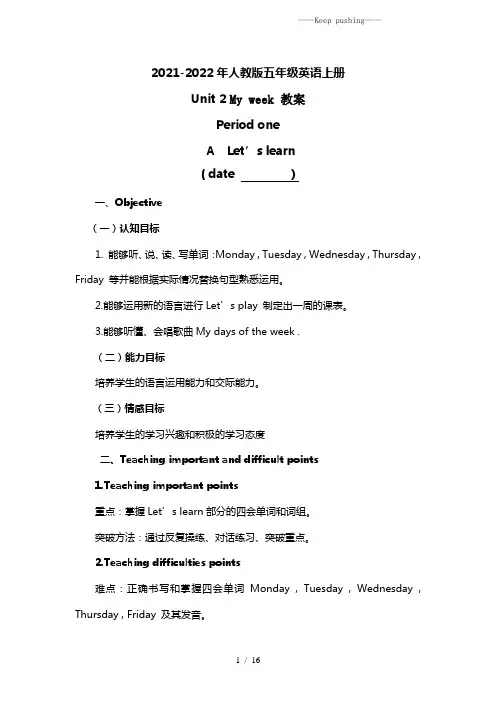
2021-2022年人教版五年级英语上册Unit 2 My week 教案Period oneA Let’s learn(date )一、Objective(一)认知目标1.能够听、说、读、写单词:Monday , Tuesday , Wednesday , Thursday , Friday 等并能根据实际情况替换句型熟悉运用。
2.能够运用新的语言进行Let’s play 制定出一周的课表。
3.能够听懂、会唱歌曲My days of the week .(二)能力目标培养学生的语言运用能力和交际能力。
(三)情感目标培养学生的学习兴趣和积极的学习态度二、Teaching important and difficult points1.Teaching important points重点:掌握Let’s learn部分的四会单词和词组。
突破方法:通过反复操练、对话练习、突破重点。
2.Teaching difficulties points难点:正确书写和掌握四会单词Monday , Tuesday , Wednesday , Thursday , Friday 及其发音。
突破方法:通过练习造句、情景对话,突破难点。
三、Teaching preparation单词卡片四、Teaching procedureStep 1 Warm—up1.播放歌曲,学生看书2.日常口语练习,包括练习时间的问句。
Step 2 PresentationLet’s learn1.问学生哪些会说单词周一到周五。
让学生来当小老师帮助教学。
5分钟后,开展各组学单词的汇报。
并评出学的最好的一个小组。
2.教师结合部分的问句:Let’s start ,引导学生复习有关课程的词汇,再让学生感知本单元的主要语言。
3.运用分解读音的方法让学生理解并书写,如:Sunday。
4.开火车练习句子:What do you have on Mondays? I have Chinese...5.游戏:要求学生利用课表来询问星期几?如:I have PE, music, science and English. Can you guess what day is it today?6.继续利用卡片反复操练句型:What do you have on Mondays? I have Chinese...7.播放Let’s learn部分的录音,要求学生一边跟读一边指出四会单词。
五年级上册英语优质教案-Unit 2 My week B Let’s learn 人教PEP

Unit2 B Let’s learn教案一、Teaching Materials AnalysisThis is a vocabulary lesson of unit 2 which is from English Book 5 of People’s Education Press. This main content is the following phrases about actions, such as wash my clothes, play football, do homework, watch TV and etc. and the key sentence patterns “Do you often wash your clothes/...? Yes, I do. / No, I don’t. What do you often do on the weekend? I often …” The key task of this lesson is to enable students to talk about their weekend life.二、Students AnalysisThe teaching objects of this lesson are students in Grade Five. They have a basic knowledge of the sentence patte rn “Do you…? Yes, I do./ No, I don’t.”, which makes a great contribution to learn this lesson well. However, the sentences “What do you often do on the weekend? I often …” are new to them, so some interesting games and activities about sentence practice are necessary.三、Teaching Aims1. Language Knowledge(1) Teaching AimsPresent and practice the vocabulary about actions (wash my clothes, play football, do homework, watch TV, etc.) in the context of what they often do on the weekend. (2) Students’ outcomeStudents will be able to say these words correctly and get a knowledge of their Chinese meanings.2. Language Ability(1) Teaching Aims:Practice asking and answering about their weekend life.(2) Students’ outcome:Students will be able to present their weekend life and ask about what their partners often do on the weekend.3. Affect Attitude4. Teaching AimsEncourage students to arrange their weekend life reasonably and try to enrich their weekend life.(1) Students’ outcomeStudents will have the awareness of “A ll work and no play makes Jack a dull boy”.5. Learning Strategy:(1) Teaching Aims:Encourage students to cooperate with their partners to complete the learning task. (2) Students’ outcome:Students will have the awareness of cooperating with partners to complete the learning task.四、Teaching Key Points and Difficult Points1. Teaching Key PointsHave a good command of some vocabulary and sentence patterns about actions: wash my clothes, play football, do homework, watch TV and etc. “Do you often wash your clothes/...? Yes, I do. / No, I don’t. What do you often do on the weekend? I often …”2. Teaching Difficult PointsBe able to have a good communication with others about their weekend life with the learnt knowledge.五、Teaching AidsMulti-media; a tape-recorder; pictures; chalkboard, etc.六、教学过程Step 1 Warm-up (2 mins)T-SsSing the song “My week” after the tape.Intensions: Review the vocabulary about days in a relaxing atmosphere, which arouses their enthusiasm.Step 2 Lead-in (4 mins)T-SsS-SsAnswer the questions:Q1: How many days are there in a week?Q2: What are they?Q3: Which day do you like best? Why?Intensions: Guide students to express their own ideas through questions of different levels.Step 3 Presentation (16 mins)T-SsS-SsS-S1. Present the vocabulary with my video about my weekend lifeA: Watch the video and answer the questions.B: Read the vocabulary after the tape.Game TimeA: Let’s dance (Look at the phrases and do the actions)B: Look and say (Look at the actions/pictures and say the phrases)Intensions: Watching my video and guessing will arouse students’ curiosity. The challenge time can stimulate students’ interest in practicing the pronunciation of these words. Guide to watch TV in a correct way and cultivate them the awareness of helping at home.Step 4 Production (15 mins)T-SsS-Ss1. Pair work: Talk about their weekend.A: What do you often do on the weekend?B: I often …2. Group work: Work in groups of four and design a colourful weekend. Then choosea reporter to report.Intensions: Group work will help students learn to cooperate with others to complete the learning task and motivate their enthusiasm in the participation in consolidating the new words and sentence patterns. The mind-map will help students to arrangetheir weekend reasonably.Step 5 Summary (2 mins)T-SsMake a summary of the new words and the sentence pattern by raising questions. Step 6 Homework (1 min)T-SsRead after the tape.Design your dream weekend and write them down.Unit Two My weekPep五上Unit2 My week A let’s learn教学设计。
Unit 2 My week(教案)人教PEP版英语五年级上册
Unit 2 My Week (教案)一、教学目标1.学生能够掌握以下词汇:Monday, Tuesday, Wednesday, Thursday, Friday, Saturday, Sunday, 动词短语如 swim, play basketball, watch TV, read books。
2.学生能够用英语说出一周的每一天,并描述自己的日常活动。
3.学生能够听懂他人描述自己的日常活动,并回答相关问题。
二、教学重点1.学生能够掌握一周的每一天的英语名称。
2.学生能够用英语描述自己的日常活动。
三、教学难点1.学生能够使用英语回答与自己日常活动相关的问题。
四、教学方法1.Task-based learning method.2.Interactive method.五、教学过程Step 1: Daily Routine Review1.Review vocabulary on daily routine learned previously, such as wake up, have breakfast, go to school, have lunch, go home, have dinner, go to bed.2.Ask students to briefly describe what they did yesterday.Step 2: Weekday Introduction1.Display picture of a calendar and ask students to say the English names of each day of the week.2.Introduce the English names of each day of the week and have students repeat after the teacher.3.Have students write the English names of each day of the week in their notebooks.Step 3: Activity Introduction1.Display pictures of people doing different activities, such as swimming, playing basketball, watching TV, and reading books.2.Introduce the English words for these activities and have students repeat after the teacher.3.Ask students if they know any additional activities that they enjoy doing in their free time.Step 4: Weekly Plan Discussion1.Have students share their plans for the upcoming week.2.Ask students what they plan to do on specific days of the week and to describe the activities they will do.3.Encourage students to ask questions about each other’s plans.Step 5: Listening and Speaking Practice1.Have students listen to an audio recording of a person describing their daily routine throughout the week.2.Ask students to take notes on the days of the week and the activities mentioned.3.Have students practice describing their own daily routine for the entire week.4.Encourage students to ask and answer questions about each other’s routines.Step 6: Homework1.Have students practice writing out their daily routine for the upcoming week in English.2.Encourage students to use the vocabulary and phrases learned in class.六、教学评估1.Observe students during class participation and assess theirability to use English when describing their daily routine and making plans for the upcoming week.2.Evaluate student homework for accuracy and use of learned vocabulary.七、教学扩展1.Have students practice writing out the daily routines of their family members or friends.2.Encourage students to create a schedule for their dream week, including their ideal activities for each day.。
人教PEP五年级英语上册《Unit2 my week》教案

《Unit2 my week》教案教学目标1. 掌握A、B部分“Let’s learn”,“Let’s talk”中的词汇和句子。
2. 能听、说、读、写关于星期和日常活动的相关问题并能正确回答。
3. 锻炼学生听、说、读、写单词的能力,初步培养学生快速记词、写词的技能。
4. 学会与同学谈论星期和课程。
5. 能听、说、读、写本单词的四会词语。
6. 能读懂“Story time”部分的趣味故事。
7. 能听懂、会唱歌曲“Days of the week”。
8. 操练和掌握长元音/i:/的发音。
9. 培养学生热爱学习、珍惜时间的良好品质。
10. 教育学生要根据课程表合理安排日常活动。
11. 引导学生积极利用所学的英语知识谈论日常活动的安排情况。
教学重点1. 掌握A、B部分“Let’s learn”,“Let’s talk”中的词汇和句子。
2. 能灵活运用本单元的主要句型谈论星期和课程。
教学难点1. 比较和区分短元音/i/和长元音/i:/,能发准音、发好音。
2. 培养学生热爱学习、珍惜时间的良好品质。
教学安排第一课时:A. Let’s learn A. Let’s play第二课时:A. Let’s try A. Let’s talk第三课时:B. Let’s learn B. Group work第四课时:B. Let’s try B. Let’s talk第五课时:A. Let’s spell B. Let’s wrap it up第六课时:B. Read and write B. Let’s check C. Story timePeriod1课时目标1. 能听、说、读、写单词“Monday”,“Tuesday”,“Wednesday”,“Thursday”,“Friday”,“Saturday”,“Sunday”和“w eekend”。
2. 能在创设的实际情景中灵活运用句型“What do you have on …?”,“I have …”。
五年级上册英语优质教案-Unit2 My week-7-人教(PEP)
Unit Two My weekUnit 2 My week 第三课时教学目标1. 掌握字母组合ea 和ee在重读音节中的发音,并能大声读出所给的单词。
2. 能听懂Listen,write and say.的内容,并完成习题。
3. 能够掌握简单的构词方法。
教学重点1. ee和ea字母组合的发音规则。
2. 会写我们学过的简单的合成词。
教学难点掌握ee 和ea字母组合的发音。
教学准备教师准备:1. 与本课时相关的单词卡片与图片。
2. 与本课时相关的录音和课件。
3. 一些带词缀的单词分解卡片。
学生准备:1. 本课所需单词卡片。
2. 纸和笔;带有相同词缀的单词卡片。
教学方法1. 模仿练习法:教师范读单词,让学生听教师的读音,看教师的口形,认真地进行模仿练习。
引领学生反复训练,鼓励学生大胆张口。
2. 儿歌说唱法:教师播放Read, listen and chant.部分的录音,学生跟唱,教师要反复播放几遍,让学生掌握单词的发音。
3. 合作学习法:教师把班级按前后桌分成四人一组,合作完成Listen, write and say.和Let's wrap it up部分的内容。
教学过程Step 1:Warm-up1. 教师热情地和学生打招呼问好,做简单的Free talk。
2. 教师讲解作业,对学生共同易出错的地方加以讲解,指导学习。
Step 2:PresentationLet's spell1. 教师出示幻灯片(或图片),让学生快速地说出单词。
2. 教师出示单词卡片,让学生再次快速地说出单词:feet,beef,meet,read,tea,eat。
同时,教师纠正发音,并讲解发音规则和口型,然后归纳一些类似的字母或字母组合。
3. 图文配对活动教师边说单词边将图片贴在黑板上,然后让学生将单词卡片贴在相应的图片下。
4. 教师再次朗读以上单词,要求学生仔细听,看看这些单词都含有什么共同音素。
然后归纳并总结元音字母组合ea和ee 发/i:/的一些单词。
Unit 2 My week Part B(课件)人教PEP版英语五年级上册
—Yes, I do.是的,我经常看。 — No, I don’t.不是的,我不经常看。
Let's talk
知识点1 拓展
当句中的主语是第三人称单数(he, she, it)时,该疑问句要 do的第三人称单数形式does开头
肯定回答用 “Yes, 主语 + does.” 否定回答用“No, 主语 + doesnn to music? 他听音乐吗?
Unit 2 My week
Part B
Warming up
Play a game: Minesweepers.
号码牌下面埋着雷,点击号码牌, 读出下面的词组,认读对了加分,遇 到地雷则扣分。
Warming up
watc1h TV homde2owork
3
4
5
read6books
7
wcalos8thhemsy fopol9tabyall
read 指阅读一类的“看”,与纸张类有关,如read books看书。
Let's learn
描述周末活动的动词及词组
play football
踢足球
拓展:play games做游戏 词形变化:play玩→player运动员
Let's learn
易错点 提示
play后跟球类、棋、牌类等名词时,作宾语的名词前不加任何冠词。 如:play basketball打篮球 play chess下棋 表示“演奏(乐器)”时,乐器前通常要定冠词the。 如:play the piano 弹钢琴play the violin 拉小提琴
2020年人教版PEP小学五年级英语上册《Unit2myweek》课件第4课时BLetx27stalk教案
Zhang Peng: Do you often read books in this park?
Sarah: No, I don’t. Do you often play football here? Zhang Peng: Yes, I do. I like this park very much.
1.To role-play the conversation.
2.Listen again and fill in the blanks. (It ’s Saturday afternoon.)
Zhang Peng: Hi, Sarah. What’s that? Sarah: It’s a storybook.
1. 熟练掌握写识词题及写语句型 What do you do on the weekend? I often⋯ ⋯
Do you often ⋯ ⋯ ? Yes, I do. No, I don ’ t. 2. Listen to the tape and read the talk for your parents. 3. Write the talk for 3times and translate it for once.
Yes, I do. No, I don ’t. — Do you often do your homework on the weekend?
Yes, I do. No, I don ’t. — Do you like blue/dogs/ apples/ ⋯ ..?
Yes, I do. No, I don ’t.
TV/ ⋯ A: Do you often play football/ ⋯ on Saturdays/⋯ on the weekend? B: Yes, I do. /No, I don ’t.的掌握写及在真情情景英的运上大
新人教PEP版五上 Unit 2 Part B 说课稿
Unit2 My weekPart B Let’s talk 说课稿教材分析1.教材内容及特点:本课时为PEP 5 Unit2 My week Part B Let’s talk。
这是一堂对话课,是对Unit 2 B Let’s learn 的五个词组及一个句型的巩固,延伸和综合运用。
要求学生能听懂Do you often do…? Yes, I do. No, I don’t.这个句型,并能在真实的情景中运用。
本课教材内容贴近日常生活,创设并呈现给学生生活中真实发生的情景——讲述自己在周末的活动以及学会询问朋友在周末的活动安排,是对他们真实生活的反应。
2.教学目标依据教材的内容和学生的年龄特征及认知水平确定以下目标:知识目标:(1)能听、说、认读单词park。
(2)能听懂、会说:Do you often do…? Yes, I do. No, I don’t。
能力目标:在知识目标的基础上,要求学生在实际生活中会用所学句型来谈论周末的活动安排。
情感目标:让学生通过运用语言来完成学习任务,感受成功,从而引发和培养学生学习英语的内在动机,最终使他们形成英语学习的积极态度。
引导学生学会合理安排周末的活动,培养健康有益的兴趣爱好,养成良好的生活习惯。
3.教学重、难点(1)重点:掌握句型:Do you often do…? Yes, I do. No, I don’t (2)难点:学生能在真实的情景中灵活运用重点句型。
4.教具准备针对本课时的教学目标和教学重难点,我做了以下的教学准备:(1)配套的教学课件。
(2)学生采访活动记录表格。
二.说学情五年级的大多数学生好动、好胜、好新、好奇、思维活跃,对英语充满兴趣,但注意力持久性较差。
我在教学过程中注意创设情景和通过竞赛活动,给学生创设一个轻松愉快的语言学习氛围,让学习过程充满乐趣并同时使他们感受到一定的挑战,满足他们的竞争意识和成功感,从而使他们达到积极思维,创造潜能得以开发。
人教PEP版五年级英语上册《Unit 2 Part B 第三课时》教学课件优秀公开课
Read and write—Story timeUnit 2 My weekPart B & Part C人教P E P版英语五年级上册Play a game.踩地雷play football 是地雷,出现时,不能读出来,而应发出“砰”的爆炸声。
Warm upI do you say.For example:play footballAsk and answer.—What do you have on …?—I have …—What do you often do on …?—I often …—Do you often … on …?—Yes, …/No, …Lead inAsk and answer.—What do you have on …?—I have …—What do you often do on …?—I often …—Do you often … on …?—Yes, …/No, …Ask and answer.—What do you have on …?—I have …—What do you often do on …?—I often …—Do you often … on …?—Yes, …/No, …Pre-reading Who are they?They are Wu Yifan and Robin. What does Wu Yifan look like? He looks tired.Look and answer.PresentationRobin’s adviceRobin: You look tired. What do you have on Fridays?Wu Yifan: I have PE. Robin: Do you often play sports?Wu Yifan: No, I don’t. I don’t like sports.Robin: What do you often do on the weekend?Wu Yifan: I often watch TV. Sometimes I read books. ______ _______While-readingStep 1: Skimming reading: Read it quickly. Underline the day and circle Wu Yifan’s activities.Step 2: Intensive reading Fill in the blanks!Wu Yifan _______.looks tired He has ___.PE Does he often play sports?No, he ______. He doesn’t like sports.doesn’t He ____ watches TV. _______ he reads books.On Fridays On the weekend often Sometimes Robin’s advice:He should ________ every day.play sports Mon.Tues.Wed.Thur.Fri.Sat.Sun.Tick or cross.1. Wu Yifan often watches TV on the weekend. ( )2. Wu Yifan often reads books on the weekend. ( )3. Wu Yifan likes sports. ( )√××Post-readingListen to the tape and read after it.Robin: You look tired. What do you have on Fridays?Wu Yifan: I have PE. Robin: Do you often play sports?Wu Yifan: No, I don’t. I don’t like sports.Robin’s advice Robin: What do you often do on the weekend?Wu Yifan: I often watch TV. Sometimes I read books.Mon.Tues.Wed.Thur.Fri.Sat.Sun.You should play sports every day Here is a new schedule for you.Look at the schedule and complete the dialogue. Sarah: What do you have on Mondays?Wu Yifan: I have a football class.Sarah: What do you have on Tuesdays?Wu Yifan: ___________________. Sarah: __________________________?Wu Yifan: I have a basketball class.Student: Wu Yifan Teacher: Robin Mon.Tues.Wed.Thur.Fri.Sat.Sun.I have a ping-pong classWhat do you have on WednesdaysListen and number.2134Let’s check听力原文:1.Boy: Girl: Boy: Girl Boy:I like Mondays and Thursdays.What do you have on Mondays?I have art.And on Thursdays?I have art, too.2.Girl:Boy:Girl:I like English!Great! Do you have Englishevery day?No, I don’t. I have English onMondays, Wednesdays and Fridays.3.Girl: Boy: Girl: Boys:What do you have onWednesdays?I have maths.Do you like maths?Not really.4.Girl:Boy:Girl:Boys:You’re a good football player!Thank you.Do you often play football onweekends?Yes, I do.Read and circle.1. Do you read books on the weekend? Yes. No.2. Do you watch TV on the weekend? Yes. No3. Do you wash your clothes on the weekend? Yes. NoReviewclass bath bed roomclassroombathroombedroomLet’s wrap it up Mon day bed room Mon + day = Mondaybed + room = bedroom Complete the words.Satur-Saturday bath-bed-Sun-Wednes-class-Thurs-Tues-bedroom Wednesday Thursday Sunday classroom TuesdaybathroomLearn more words.note+ book= note book(笔记本)black+ board= black board(黑板)police+ man= police man(警察)after+ noon= after noon(下午)home+ work= home work(家庭作业)super+ market=supermarket(超市)Story timeWho are they?They are Zip and Zoom.What are they talking about? Zoom: It’s a new school year. I needto do some shopping.zip: I’ll help.Zoom wants to do some shopping.Zoom has _____ in a week.A. English, maths, art and PEB. Chinese, maths and PE.C. Chinese, English and art.ADid they buy all the things they needed?Zip: I’m sorry, Zoom. We don’t have enough money . I’ll put back the football.Zoom: Oh, no!No, they didn’t.Read again and order the pictures.( )( )( )( )( )( )654321Match the pictures and the dialogues.Zip: I’m sorry, Zoom. Wedon’t have enough money . I’ll put back the football.Zoom: Oh, no!Zoom: It’s a new school year . I need to do some shopping . zip: I’ll help.zip: We have English on Mondays and Wednesdays .Zoom: I need some notebooks and pencils .Zip: We have maths on Tuesdays .Zoom: I need a ruler .Zip: We have PE on Fridays .Zoom: I want a new football , please. We can play with it on the weekend.Zip: On Thursdays , we have art .Zoom: I need a box of crayons .Watch, listen and read after it.一、选出不同类的一项。