
外研版七年级上册Module 6 A trip to the zooUnit 1 Does it eat meat
七上M6短语

Module 6 A trip to the zoo Unit 1 Does it eat meat?
1 welcome to 欢迎来到某地
Welcome to Beijing zoo
欢迎来到北京动物园
2 many kinds of 许多种类
The zoo has many kinds of animals
这个动物园有许多种类的动物
3 such as 例如
Such as bear 例如熊
4 come from 来自
They come from many different countries
他们来自许多不同的国家
5 many different countries 许多不同的国家
They come from many different countries
他们来自许多不同的国家
6 other animal 其他的动物
They eat other animal
他们吃其他的动物
7 in front of 在···前面
She’s in front of you!
她在你前面
8 black and white 黑白相间的
She’s the black and white animal 她是黑白相间的动物
9 over there 在那边
She’s the black and white animal over there
在那边它是一只黑白相间的动物
10 a panda called Tony 一只叫托尼的熊猫
Is there a panda called tony
这儿有一只叫托尼的熊猫吗?
Module 6 A trip to the zoo
Unit 2 the tiger lives in Asia
1 live in 生活在...
The elephant lives in Africa and in Asia
外研社七年级上册 Module 6 A trip to the zoo Unit 3教案
Module 6 A trip to the zoo
Unit 3 Language in use
课题 Unit 3 Language in use 课型 New 第 4 课时
教学
目标 1. To summarise and consolidate Present simple questions.
2. To know something about animals in China.
3. To have teamwork and make a poster of one’s favourite animal.
内容
分析 教学重点 Key structures: It doesn’t eat meat. Does it eat meat ?
No, it doesn’t. It eats plants.
教学难点 To improve the Ss’ writing ability.
教法
学法 Interactive approach 教具学具 Multi-Media (or Tape
recorder, OHP)
教
学
过
程 教材处理 二次备课
Step 1 Revision
Show some pictures to review the text of Unit 1 and Unit 2 .
Step 2 Language practice
1. Read through the example sentences in the box with the
whole class.
2. Ask the students to repeat the sentences in the box.
3. Grammar : The present simple
Step 3 Work in pairs
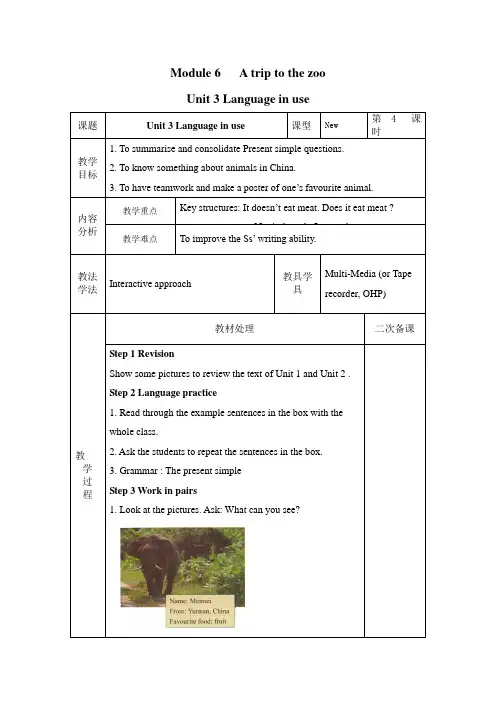
1. Look at the pictures. Ask: What can you see?
外研版英语七上试题module6atriptothezoo综合检测

Common Progress Please Criticize
金戈铁骑制作
外研七年级英语上Module 6 A trip to the zoo 综合检测
第一部分 听力(10分)
Ⅰ.录音中有五个句子, 听一遍后, 选择与之相符的图片。(
A B C D E
1.______ 2.______ 3.______ 4.______ 5.______
Ⅱ.录音中有一篇短文, 听两遍后, 选择最佳答案。
6. Dandan is the name of a ______.
A. tiger B. cat C. dog
7. Who gives the writer the animal?
A. The writer’s father. B. The writer’s uncle. C. The writer’s grandpa.
8. Dandan’s favourite food is ______.
A. meat B. fish C. meat and fish
9. Can Dandan do many things?
A. Yes, it can. B. No, it can’t. C. I don’t know.
10. When the writer comes back home, it can come to meet the writer.
A. at the door B. at home C. at school
第二部分 笔试(90分)
Ⅲ.单项选择(10分)
1.There isn’t ______ American lion in the zoo.
A. a B. an C. the D. /
does it eat meat

Does it eat meat? 教案设计
面向学生: □中学 2,学科:英语
课题:Does it eat meat?
Language goals 语言目标
Key vocabulary 重点词汇
trip, zoo, tiger, camel, elephant, lion, giraffe, kangaroo, monkey, panda, snake, wolf, polar bear
Ability goals 能力目标
Enable students to talk about animals.
Teaching methods 教学方法
Listening, reading and speaking.
Teaching aids 教具准备
A tape recorder, some pictures and a projector.
Teaching procedures and ways 教学过程与方式
Teaching materials analyzing教材分析
本模块以A trip to the zoo为话题,介绍了世界各地的动物以及其栖息地、习性等,通过3个单元的学与练,旨在让学生通过这一学习与体验的过程,唤起学生热爱动物、保护动物的意识。能够就动物进行提问与回答,能够介绍动物的产地和习性。
Unit 1要求学生通过听、读、说的练习,学会谈论动物。
Listening and vocabulary 包括4部分。Part 1要求学生根据图片找出与之相对应的表示动物的单词,通过这一部分的练习,使学生在复习已有知识的基础上,进一步熟悉本单元所要学习的语言知识,为相关语言技能的训练奠定基础;Part 2 要求学生在熟悉图片后,根据一段听力材料,就其所能看到的事物进行判断;Part 3以动物园为背景,通过导游与两个学生的对话,帮助学生学会如何谈论动物的情况(包括产地、习性等);Part 4要求学生在完成Part 3的基础上,正确捕捉和判断对话材料中的信息,判断出符合对话的正确语句。
石狮市第五中学七年级英语上册Module6AtriptothezooUnit1Doesiteatme

1 Unit 1 Does it eat meat
A: Hi, Bob. A new zoo in our city is open. There are different animals from
other countries, such as bears, elephants, tigers, lions, monkeys…
B: Do they have giraffes and zebras?
A: Sure! Do you like them?
B: Yes. They are funny and tall. They are also not dangerous and they eat
plants.
A: Why not go and see them in the zoo?
B: Good idea! Shall we go now?
A: Let’s go.
(Thirty minutes later, they get to the zoo.)
B: Look at the zoo map. Which animals do you want to see first?
A: Pandas. They come from China. They eat bamboo. They only live in China. They
are so cute. Chinese people call them “national treasure(国宝)”.
B: You know so much.
A: Thanks. Ugh! The guide is over there. Let’s go and meet her.
1. bear n. 熊
2. elephant n. 大象
3. giraffe n. 长颈鹿
4. lion n. 狮子
七年级上Module 6 A trip to the zoo重点知识清单(教师版)
七年级上Module 6 A trip to the zoo 重点知识清单(教师版)
一、夯实基础
Ⅰ. 精要词汇
1. n.长颈鹿 giraffe 13. v, aux.....好吗?shall
2. n.狮子 lion 14. pron.哪一个which
3. n.斑马zebra 15. 非洲Africa
4. n.导游guide 16. 亚洲Asia
5. adj.这样的;如此的such 17. 欧洲Europe
6. adj.不同的different 18. adj.非洲的;非洲人African
7. n.国家country 19. n.叶子leaf
8. adj.其他的other 20. adj.大的;巨大的large
9. adj.危险的dangerous 21. adv.通常usually
10. adv.的确;当然sure 22. adv.独自地alone
11. n.竹子bamboo 23. v.抓住catch
12. adj.可爱的cute 24. adv.甚至even
Ⅱ. 精要短语
1. 比如such as 2. 来自come from
3. 看look at 4. 在那边;在那里over there
5. 少量a little 6. 并且;还as well as
7. 全世界all over the world 8. 擅长be good at
9. 许多种类many kinds of 10. 与...不同be different from
外研版七上 module 6 A trip to the zoo 知识点
Module 6 A trip to the zoo 知识点讲解
1. A trip to the zoo 动物园之旅
(1) a trip to…(后接目的地) 意为“去……的旅行”
例如:a trip to China 中国之旅 a trip to Wuhan 武汉之旅
(2) trip作名词 为“旅行”,通常指短途旅行。
例如:He is going to make a day trip to Hong Kong. 他想进行香港一日游。
I’m on a business trip to Japan. 我正在日本出差。
(拓展) trip前面的介词用on, on a trip表示“在旅行期间”。 make/take/have a trip 短语都表示“旅行”
2.Welcome to Beijing Zoo. 欢迎来到北京动物园。
北京动物园是中国开放最早、动物种类最多的动物园,距今已有90 多年的历史。位于北京西城区西直门外,占地面积约90 公顷,饲养展览动物900多种,20000多只,每年接待中外游客六百多万人次。
welcome to… 意为“欢迎来到……”
例如:Welcome to our school. 欢迎来到我们学校。
3. The zoo has many kinds of animals, such as bears, zebras, giraffes and pandas.
动物园里有许多种动物,比如熊、斑马、长颈鹿和熊猫。
a. many为形容词,意为“许多”,后接可数名词的复数形式。
例如:There are many animals in the zoo. 动物园里有许多动物。
辨析many和much
many
意思为“许多的” 修饰或替代可数名词
I have many comic books. 我有许多漫画书。
初中英语《Module6Atriptothezoo》单元教学设计以及思维导图
Module 6 A trip to the zoo 适用年
级 初一年级上
所需时
间 课内共用3课时;课外共用1课时。
主题单元学习概述
简述主题单元在课程中的地位和作用,单元的组成情况:本模块共分
三个单元。从话题上讲,第一单元让学生初步接触了野生动物的名称并浅显地谈论了野生动物的某些习性等内容。第二单元承接了这一话
题并在深度和广度上做了进一步的延伸和扩充。通过课文教学,本课
复习了野生动物的名称并详细地谈论了动物的习性等内容。同时也使第三单元就此话题进行更深一步的探讨顺理成章。从语言功能上讲,
模块训练的是一般现在时态第三人称单数的一般疑问句形式。第一单元已经对该语法功能项目进行了教授,第二单元则进行进一步的训练
和强化,巩固第一单元所学的语法知识,同时为第三单元的综合语言
知识的复习和运用以及综合语言能力的培养作好铺垫。 教学重点
(1)重点句型:一般现在时(主语第三人称单数)的一般疑问句以及肯定和否定形式。
(2)重点话题:Talk about one’s favourite animal.
教学难点 (1)有关动物的名词及它们在句中的正确运用。 (2)掌握一般现在时(主语第三人称单数)的一般疑问句以及肯定
和否定形式。 (3)能用恰当地道的英语问答有关动物的问题以及介绍自己的最喜
爱的动物
依据语言学习 的认知规律,将本单元的学习划分为三个专题。专
题一:如何让学生初步接触了野生动物的名称并浅显地谈论野生动物
的某些习性等内容专题二:如何运用一般现在时态第三人称单数的一般疑问句形式,对专题一进一步的延伸。专题三是综合语言知识的复
习和运用以及综合语言能力的培养。教学中要注意小学到初中的方法
的衔接,即教学是要面向全体学生的教学,必须保证全体学生达到衔接目标;教学是要面向基础的教学,主要教授基础知识、培养基本能
力;结合小学的教学,把形象思维与抽象思维整合的教学方法;养成适合初中的有效学习态度与策略。深度分析学生现状,找到足以建立
外研版七年级英语上册Module 6 知识汇总
Module6知识梳理
【重点短语】
1.a trip to the zoo 到动物园的参观,动物园之旅
2.welcome to... 欢迎到......
3.many kinds of... 许多种......
4.such as... 比如......
5.different countries 不同的国家
6.look at.... 看......
7.lingling the panda 熊猫玲玲
8.the black and white animal 黑白相间的动物
9.live in Africa 生活在非洲
10.a little fruit 一点儿水果
11.30 kilos of bamboo a day 每天30公斤竹子
12.as well as... 还有......
13.the favourite of people 人们最喜欢的
=people’s favourite
14.all over the world 全世界
15.an African animal 一只非洲动物
16.live alone 单独生活
17.be good at swimming 擅长游泳
18.catch other animals for food 抓其他动物为食
19.the world of animals 动物世界
【重点句子】
1.Welcome to Beijing Zoo. 欢迎到北京动物园。
2.The zoo has many kinds of animals.
动物园里有许多种类的动物。
=There are kinds of animals in the zoo.
3.The animals come from different countries and eat different food.
这些动物来自不同的国家,吃不同的食物。
4.They also eat plants. 他们也吃植物。
外研版七年级英语上册Module 6 A trip to the zoo unit1 Does i
第 1 页 共 3 页 外研版七年级英语上册Module 6 A trip to
the zoo unit1 Does it eat meat?教案(表格式)
教案
课题 Module 6 A trip to the zoo. Unit 1 Does it eat meat
课型 Listening and speaking
教材分析 本模块以动物为话题,有利于激发学生的兴趣。让学生检索动物的信息,拓展关于动物的词汇 和知识。
学情分析 多数孩子都喜欢动物,本模块的任务不仅仅是学习语言,还希望通过本模块的学习增强爱护动物,保护自然环境的意识。
教学目标课 时 Key vocabulary—bear, elephant, giraffe, lion,
monkey, panda, tiger, zebra, zoo, guide, animal, such, as, come,
different, country, other, dangerous, ugh, also, plant, look, tall, leaf (pl.
leaves), sure, bamboo, cute, shall, them, which, over, funny, callKey
structures—1.— That’s a giraffe. — Yes, and there are some
giraffes2.—Do lions eat meat —Yes, they do.3.—Does it eat meat
—No, it doesn’t. It eats plants.4.—Do pandas eat plants and leaves
—Sure. They love bamboo.5. Shall we go and… 6. That’s very funny.
教学重难点 The present simple tense The negative form and question