
上海旅游景点(英文版)
上海旅游攻略英文版

上海旅游攻略英文版Shanghai Travel GuideIntroductionShanghai, the largest city in China, is a paradise for enthusiastic travelers. Known for its modern skyline, historical landmarks, vibrant nightlife, and delicious cuisine, Shanghai offers a unique blend of traditional Chinese culture and modern cosmopolitan lifestyle. In this travel guide, we will explore the top attractions, popular neighborhoods, local delicacies, and essential tips for making the most of your trip to Shanghai.Top Attractions1. The Bund: A waterfront promenade along the Huangpu River, featuring iconic historical buildings and offering stunning views of the Pudong skyline.2. Oriental Pearl TV Tower: A famous observation tower in Pudong, offering panoramic views of Shanghai from its observation decks.3. Yu Garden: A classical Chinese garden with beautiful landscapes, pavilions, and traditional architecture, providing a peaceful escape from the bustling city.4. Nanjing Road: One of the world's busiest shopping streets, offering a wide range of shopping opportunities from luxury brands to local products.5. French Concession: A charming neighborhood with tree-lined streets, elegant villas, and trendy boutiques, perfect for leisurely walks and café hopping.6. Shanghai Museum: Home to a vast collection of ancient Chinese art, including ceramics, calligraphy, and paintings, providing a cultural journey through China's history.7. Tianzifang: An artsy district with narrow alleys, art studios, unique shops, and cafes, where you can explore local craftsmanship and creativity.Popular Neighborhoods1. The Bund: A must-visit neighborhood with its iconic architecture, luxurious hotels, and top-notch restaurants, representing the history and glamour of Shanghai.2. Xintiandi: A vibrant and fashionable district, known for its trendy bars, chic restaurants, and high-end shopping,offering a glimpse into modern Shanghai.3. Jing'an: A bustling area with a mix of traditional Shanghai culture and modern development, featuring Jing'an Temple, stylish malls, and vibrant nightlife.4. Tianzifang: A bohemian neighborhood with narrow alleyways, colorful street art, boutique stores, and cozy cafés, perfectfor exploring unique art and culture.5. Zhujiajiao: A water town located on the outskirts of Shanghai, known for its ancient bridges, canals, and well-preserved Ming and Qing Dynasty architecture.Local Delicacies1. Xiaolongbao: Steamed soup dumplings filled with flavorful pork or crab meat, a Shanghai specialty.2. Shengjianbao: Pan-fried dumplings with a crispy bottomand juicy filling, a popular street food in Shanghai.3. Shanghai hairy crab: A seasonal delicacy, famous for its sweet and succulent meat, best enjoyed during autumn.4. Lion's Head Meatballs: Large, tender meatballs made from pork mixed with cabbage, representing traditional Shanghai cuisine.5. Scallion oil noodles: Simple yet tasty, these noodles are seasoned with scallion oil, soy sauce, and topped with fragrant crispy shallots.Essential Tips1. Transportation: Shanghai has a convenient metro system, making it easy to navigate the city. Taxis and ride-hailing apps are also widely available for longer distances.2. Language: English is not widely spoken in Shanghai, soit's helpful to have a few basic Mandarin phrases or a translation app.3. Cash and Cards: While credit cards are widely accepted, it's advisable to carry cash for small local businesses and street vendors.4. Safety: Shanghai is generally a safe city, but it's always wise to keep an eye on your belongings and be cautious in crowded areas.5. Visa: Ensure you have the necessary visa requirements before traveling to China. Check with your local Chinese embassy or consulate for the latest information.ConclusionShanghai is a vibrant city that will captivate you with its mix of traditional and modern attractions, rich cultural heritage, and mouthwatering cuisine. By following this travel guide, you'll be ready to experience all that Shanghai has to offer and create unforgettable memories of your trip to China's most cosmopolitan city.。
上海外滩旅游英文作文初一

上海外滩旅游英文作文初一英文:When it comes to the famous tourist spot in Shanghai, the Bund is definitely on the top of the list. The Bund is a waterfront area in central Shanghai and is known for its stunning views of the city skyline and the Huangpu River. It's a must-visit for anyone traveling to Shanghai, and I had the chance to visit it last summer.As I walked along the Bund, I was amazed by the beautiful colonial architecture and the modern skyscrapers that lined the waterfront. The contrast between the old and the new was truly fascinating. I also enjoyed taking a leisurely stroll along the river and watching the boats pass by. The view of the Oriental Pearl TV Tower and the Shanghai Tower in the distance was simply breathtaking.One of the highlights of my visit to the Bund was taking a river cruise on the Huangpu River. I got to seethe Bund from a different perspective and the city lightsat night were absolutely mesmerizing. It was a great way to relax and take in the beauty of the city.After the cruise, I explored the various shops and restaurants along the Bund. I tried some delicious local snacks and bought some souvenirs to bring back home. The bustling atmosphere and the mix of locals and tourists made the experience even more memorable.Overall, my trip to the Bund was a fantastic experience. The combination of history, culture, and modernity made ita truly unique destination. I can't wait to visit again and explore more of what Shanghai has to offer.中文:提到上海著名的旅游景点,外滩绝对是榜上有名。
英语作文介绍上海名胜古迹
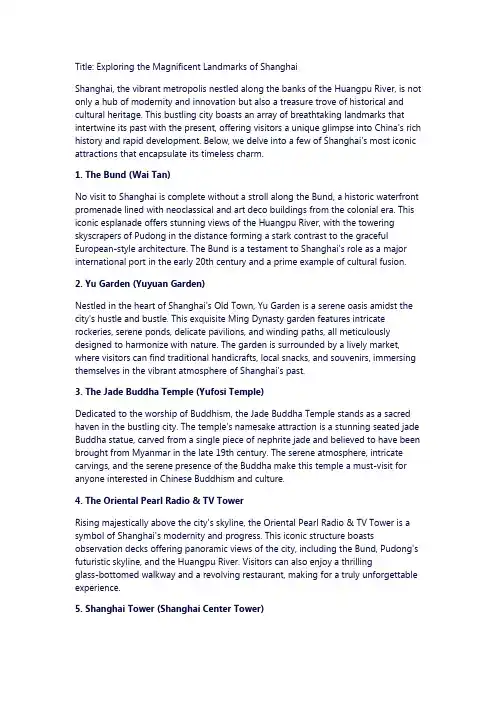
Title: Exploring the Magnificent Landmarks of ShanghaiShanghai, the vibrant metropolis nestled along the banks of the Huangpu River, is not only a hub of modernity and innovation but also a treasure trove of historical and cultural heritage. This bustling city boasts an array of breathtaking landmarks that intertwine its past with the present, offering visitors a unique glimpse into China's rich history and rapid development. Below, we delve into a few of Shanghai's most iconic attractions that encapsulate its timeless charm.1. The Bund (Wai Tan)No visit to Shanghai is complete without a stroll along the Bund, a historic waterfront promenade lined with neoclassical and art deco buildings from the colonial era. This iconic esplanade offers stunning views of the Huangpu River, with the towering skyscrapers of Pudong in the distance forming a stark contrast to the graceful European-style architecture. The Bund is a testament to Shanghai's role as a major international port in the early 20th century and a prime example of cultural fusion. 2. Yu Garden (Yuyuan Garden)Nestled in the heart of Shanghai's Old Town, Yu Garden is a serene oasis amidst the city's hustle and bustle. This exquisite Ming Dynasty garden features intricate rockeries, serene ponds, delicate pavilions, and winding paths, all meticulously designed to harmonize with nature. The garden is surrounded by a lively market, where visitors can find traditional handicrafts, local snacks, and souvenirs, immersing themselves in the vibrant atmosphere of Shanghai's past.3. The Jade Buddha Temple (Yufosi Temple)Dedicated to the worship of Buddhism, the Jade Buddha Temple stands as a sacred haven in the bustling city. The temple's namesake attraction is a stunning seated jade Buddha statue, carved from a single piece of nephrite jade and believed to have been brought from Myanmar in the late 19th century. The serene atmosphere, intricate carvings, and the serene presence of the Buddha make this temple a must-visit for anyone interested in Chinese Buddhism and culture.4. The Oriental Pearl Radio & TV TowerRising majestically above the city's skyline, the Oriental Pearl Radio & TV Tower is a symbol of Shanghai's modernity and progress. This iconic structure boasts observation decks offering panoramic views of the city, including the Bund, Pudong's futuristic skyline, and the Huangpu River. Visitors can also enjoy a thrillingglass-bottomed walkway and a revolving restaurant, making for a truly unforgettable experience.5. Shanghai Tower (Shanghai Center Tower)As the tallest building in China and the second tallest in the world, Shanghai Tower stands as a testament to the city's relentless pursuit of excellence. This modern marvel boasts state-of-the-art technology and design, including high-speed elevators that whisk visitors to the observation deck in mere seconds. From here, one can marvel at the breathtaking views of Shanghai and its endless expanse, feeling a sense of awe at the city's remarkable transformation.In conclusion, Shanghai is a city that seamlessly blends its storied past with a vibrant present, offering visitors a captivating journey through time. Whether exploring the historical landmarks of the Bund or ascending the heights of Shanghai Tower, every corner of this metropolis whispers tales of a city that has embraced change while cherishing its roots.。
上海名胜古迹英语介绍
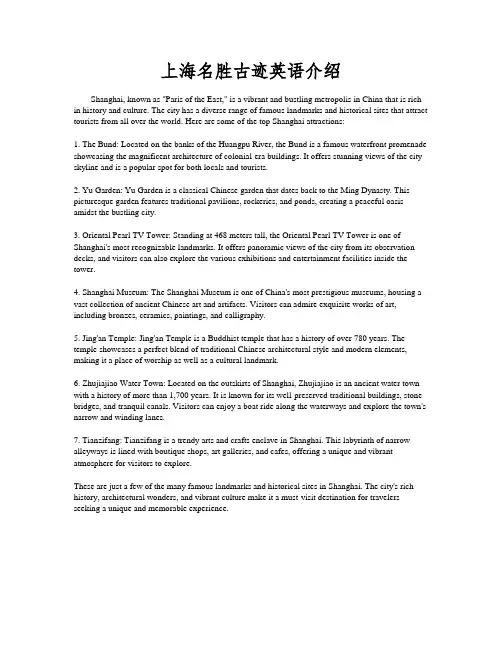
上海名胜古迹英语介绍Shanghai, known as "Paris of the East," is a vibrant and bustling metropolis in China that is rich in history and culture. The city has a diverse range of famous landmarks and historical sites that attract tourists from all over the world. Here are some of the top Shanghai attractions:1. The Bund: Located on the banks of the Huangpu River, the Bund is a famous waterfront promenade showcasing the magnificent architecture of colonial-era buildings. It offers stunning views of the city skyline and is a popular spot for both locals and tourists.2. Yu Garden: Yu Garden is a classical Chinese garden that dates back to the Ming Dynasty. This picturesque garden features traditional pavilions, rockeries, and ponds, creating a peaceful oasis amidst the bustling city.3. Oriental Pearl TV Tower: Standing at 468 meters tall, the Oriental Pearl TV Tower is one of Shanghai's most recognizable landmarks. It offers panoramic views of the city from its observation decks, and visitors can also explore the various exhibitions and entertainment facilities inside the tower.4. Shanghai Museum: The Shanghai Museum is one of China's most prestigious museums, housing a vast collection of ancient Chinese art and artifacts. Visitors can admire exquisite works of art, including bronzes, ceramics, paintings, and calligraphy.5. Jing'an Temple: Jing'an Temple is a Buddhist temple that has a history of over 780 years. The temple showcases a perfect blend of traditional Chinese architectural style and modern elements, making it a place of worship as well as a cultural landmark.6. Zhujiajiao Water Town: Located on the outskirts of Shanghai, Zhujiajiao is an ancient water town with a history of more than 1,700 years. It is known for its well-preserved traditional buildings, stone bridges, and tranquil canals. Visitors can enjoy a boat ride along the waterways and explore the town's narrow and winding lanes.7. Tianzifang: Tianzifang is a trendy arts and crafts enclave in Shanghai. This labyrinth of narrow alleyways is lined with boutique shops, art galleries, and cafes, offering a unique and vibrant atmosphere for visitors to explore.These are just a few of the many famous landmarks and historical sites in Shanghai. The city's rich history, architectural wonders, and vibrant culture make it a must-visit destination for travelers seeking a unique and memorable experience.。
上海旅游景点英语导游词

上海旅游景点英语导游词下面店铺为大家带来上海旅游景点英语导游词,希望大家喜欢!上海旅游景点英语导游词:东方明珠Pudong New Area is located on the east of the Huangpu River, facing the East China Sea and the Pacific Ocean and bordering the Yangtze Delta. It is at the intersection of Chinese golden coast and golden waterway. It is a triangular area, with a size of 522 square kilometers and a population of more than 1.5 million.In the early ‘90s, Comrade Deng Xiaoping, the chief architect of China’s reform and open-up policy, expected that there should be in Shanghai “a change every year and a big change every three years”. As a strategic decision, the Chinese Communist Party Central Committee and the State Council declared the opening and development of Pudong on April 18th, 1990. it is another significant step in China’s policy of reform and opening to the outside world. Since then, Shanghai people have gone all out and worked numerous wonders on this promising piece of land. Up till now there have been set up Lujiazui Financial and Trade Zone, Jinqiao Export Processing Zone, Waigaoqiao Free Trade Zone, Zhangjiang Hi-tech Park, Huaxia Culture & T ourism Development Zone, Sunqiao Moodern Agriculture Development Zone, etc. new municipal infrastructure projects, such as an international airport, a deep-water port and infrastructure for an information highway have been or are being carried out. The opening and development of Pudong Area is a brilliant example, which has become an icon of Shanghai’s sweeping advance to the modern cosmopolis and as economic center, trade center and financial center.Compared with China’s other special economic zones and economic development zones, Pudong New Area has the following characteristics:1. A free trade zone has been established in the area to promote the free entering and leaving of commodities, and capitals, which make Pudong a “free port”.2. Foreign banks have been introduced to enliven the area’s banking services as well as related service industries.3. Means and methods of attracting foreign and domestic investors and tourists are being improved.4. Pudong boasts rich historical heritage and the abundance of cultural resources.5. The whole Pudong New Area is taken as a highly-afforested urban area of the state level. It is a blending of leisure, recreation and entertainment, travel, and shopping, and has become an ideal place for international conferences and business tours.Following its rapid development, the tourism industry of Pudong New Area is making a remarkable progress. Tourism is becoming a new point for economic growth. Besides places of historical interest, a group of new tourist attractions have been added and more tourism projects are under planning and construction. Places of interest in Pudong New Area include:1. A forest of skyscrapers, including Jin Mao Building, Shanghai Stock Exchange Building, etc. the architects from China, Asia and all over the world are contributing their expertise to this area. More than 300 skyscrapers have sprung up, which makes you feel the beating pulse of the new century.2. Places of tourism, entertainment and recreation, including the Oriental Pearl TV Tower, the Riverside Promenade, the CentralGreen, the Century Park, etc. Pudong New Area is where people can relax themselves and enjoy a really good time.3. Historical sites including the Crane Tower in Chuansha Park, the former residence off Huang yanpei and Zhang Wentian, the Qingciyang Palace, etc. The scenic spots and historical sites embody the character of the seashore. An ancient coastline, a sea wall, castle blocks across the south to the north make people recall the evolution of the seacoast and the heroic people who fought against foreign invaders.4. Hotels including some world famous ones such as Jin Mao Grand Hyatt, Pudong Holiday Inn, Shanghai International Convention Center Hotel, Shangri-la Hotel, etc. there are now in Pudong New Area more than 30 deluxe hotels, some of which are built by five-star standard. The excellent facilities can let the guests feel cozy and comfortable.5. Shopper’s Eden: including Shanghai No. 1 Yao-han Nextage Department Store (the biggest in Asia), Pudong Mansion, Zhangyang Commercial Street, Dongfang Commercial Street etc. the comfortable and elegant shopping environment can help you choose freely from the famous brands and exquisite products.6. Kingdom of delicacies, including New Meilongzhen Restaurant, Peninsula Shark’s Fin Chaozhou Restaurant, East Snack Kingdom, etc. The hotels, restaurants, and snack bars are found all over Pudong New Area, offering Chinese and Western food of different standards.A Brief Introduction to LujiazuiThe Lujiazui Financial and Trade Zone is located in the Lujiazui-Huamu Complex District. This zone is in the heart of Pudong and extends within the Inner Ring Road. This is acomparatively busy section where most of Pudong’s finance, trade, information, services, science and technology, education and cultural institutions and facilities are found.Lujiazui Financial and Trade Zone is full of charm and fascinating grace. There are found in this zone the Oriental Pearl TV Tower, the Jin Mao Building, the beautiful Central Green, the Riverside Promenade, the Century Park, and the Oriental Pearl Wharf.The Oriental Pearl TV TowerThe Oriental Pearl TV Tower is unquestionably an icon of Pudong’s renaissance. Looming thro ugh the mist, like a reproduction of a classical Chinese ink painting of landscape, stands Shanghai’s Oriental Pearl TV Tower. Its soaring height of 468 meters boldly characterizes the Lujiazui cityscape. The tower’s jagged reflection in the water mirrors Pudong’s modern development and people’s aspirations, while the new-classical edifices across the Huangpu River staunchly attest to Puxi’s old past. It should be noted that the Oriental Pearl TV Tower ranks the tallest in Asia and the third tallest in the world, only second to Toronto CN Tower (553.3m) and Moscow Ostankino Tower (533.3m).The location of the Oriental Pearl TV Tower is very ideally chosen. It is at the tip of Lujiazui by the side of Huahngpu River, just opposite the world famous Bund of Shanghai.The design scheme of the Oriental Pearl TV Tower was selected from 12 outstanding design schemes by nationwide well-known experts and approved by the Shanghai Municipal Government. The architects, inspired by rich imagination, arranged 13 spheres together with some ground facilities in the order of their sizes high up in the blue sky down to a carpet ofgreen lawn like a string of pearls, while two dazzling ruby-like colossal spheres are propped high up. The harmonious entity of the tower presents at night when lights are on a picture of pearls, big and small, falling into a jade plate (quoted from “The Sontg of Pipa Girl” by Bei Juyi, a great Chinese poet in the Tang Dynasty), a scene full of poetic and artistic conception. It is not only a great attraction to visitors but also an important symbol of Shanghai.The Oriental Pearl TV Tower, with a total floor space of 54,000 square meters, is mainly composed of the base, three gigantic columns (9 meters in diameter), the lower sphere (50 meters in diameter), the upper sphere (45 meters in diameter), and the spherical penthouse. The tower is outstanding and unique in configuration, and has good stability and aseismatic performance. It also represents the state-of-art in TV tower design, reflecting the progress of the modern science and technology. It is an exciting unity of arts and technology as well as architectural conception and structural design, and has contributed a significant effect to the world.The Oriental Pearl TV Tower is equipped with a double deck elevator which travels at 4 meters per second and two high speed elevators at 7 meters per second, which will reach the upper sphee from the ground within 40 seconds. People will get a wonderful thrill being flung from sea level to the zenith in the elevators.The upper sphere (from 250 m to 295 m) covers 9,480 square meters with the maximum capacity of 1,400. It boasts an observation deck, a revolving restaurant, KTV rooms and a discotheque. The sightseeing deck is 263 meters in height, making it th e best place to get a bird’s eye view of WaibaiduBridge flanked by the Monument to the People’s Heroes and the gray Russian Consulate on the north; the famed Bund, together with views from nine main roads, including Beijing Road, Nanjing Road, Yan’an Road, etc, on the west; the Shanghai harbor, with ocean liners passing in and out on the south, and the Pudong New Area, with numerous skyscrapers on the east. Standing on the deck, one gets the feeling that the world is belittled.The revolving restaurant (267m in height), which turns one revolution every one hour, is an ideal place for visitors. Experienced chefs prepare set menus as well as buffets.The spherical penthouse is 350 meters from the ground with an area of 280 square meters. There is a sightseeing terrace and a beautifully decorated meeting hall. The tower ingeniously incorporated the image of the outer space, the space ship, the missile and the atom in its structure, unifying perfectly modern technology with oriental culture.The Oriental Pearl TV Tower hosts 6,000 visitors on a daily average. Up till now, 118 state heads from different countries and regions have visited the tower.Jin Mao TowerJin Mao Tower is situated at the heart of Lujiazui Finance and Trade Zone in Pudong New Area of Shanghai, boasting a height of 420 meters and a total floor space of around 290,000 square meters.Jin Mao T ower, an 88-story skyscraper with 3 stories underground, is, up till now, the tallest building in the Mainland of China and the 3rd tallest in the world. It is an intelligent top-grade building, which combines efficiency of function with elegant aesthetic form. With world-famous architectural design,the structural profile of the building originated in the oriental ancient pagoda, a style which represents the oriental national form of design as well as the occidental modern style of building. Jin Mao T ower, therefore, may well be considered a representative work of post-modern architecture prevalent in recent years in the world.Levels 3-50 of Jin Mao Tower are used for offices, Levels 51-52 for mechanical and electrical equipment, Levels 53-87 for the highest preeminent 5-star deluxe hotel in the world---Grand Hyatt Shanghai. The 6-story podium is a multi-functional building, while its Level 1 is used for a conference hall and an exhibition hall, its Level 2 for ballrooms and Levels 2-6 for shopping and recreation centers.The Observation Deck of Jin Mao Tower is on Level 88, with a height of 340 meters above ground and an area of over 1,400 square meters, boasting its being the highest and the largest top-floor observation deck so far in China. Having a speed of 9.1 meters per second, tow express elevators will take visitors right up to the Observation Deck in 45 seconds. The Observation Deck, 8 meters in height, and surrounded by glass, aluminum and stainless steel walls, secures a bright and comfortable light. As it commands a panoramic view, visitors may look out of the window and see the Huangpu River winding through the city like a snake with shining waves resembling fish scales. When looking down below, they will get a birds’ eye view of the city: high-rise buildings of various styles stand like a forest, presenting a scene of boundless variety; streets busy with traffic crisscross the city, amidst the hustle and bustle of Shanghai; last but not least, there are the Nanpu Bridge and the Yangpu Bridge, with the Oriental Pearl TV Tower standing gracefully in between, offering awonderful picture of “Two Dragons Playing with a Pearl”.Jin Mao T ower also boasts a Grand Hyatt Hotel from the 53rd to the 86th floors, which makes it the loftiest hotel in the world. All hotel rooms (555 in all) are located above the 58th floor, giving guests an unparalleled view of Shanghai. People staying at the hotel will have a unique experience, because the building is so high, they must call downstairs to see if it is raining.Shanghai International Convention CenterShanghai International Convention Center is located to the southwest of the Oriental Pearl TV Tower. It was opened for business in August 1999, and the ’99 Fortune Global Forum was held here. Shanghai International Convention Center covers an area of 45,000 square meters with a total floor space of 110,000 square meters.Shanghai International Convention Center consists of several modernized halls. The 45,000-square-meter multi-function hall, which can serve as an exhibition hall as well, is one of the largest in China. Without a single column, the grand hall embodies great momentum. Provided for the guests are the latest audio-visual equipment, satellite conferencing, simultaneous translation, etc.The 800-seat meeting room is the key meeting room in Shanghai International Convention Center, which includes 800 representative seats in the main hall and a 150 seating press gallery in box. The meeting room is not only equipped with 10 plus 1 simultaneous translation system, speaking and voting systems for representatives and rostrum, and stereo amplifier, but also provided with systems such as video camera, computer interface and objects projection, which are necessary for international conferences.Shanghai International Convention Center Hotel providespresidential and executive suites and standard rooms approaching 260 keys, and it offers restaurants of Chinese and Weste rn cuisine together with a special tea house and café as well. As to the recreational facilities, the hotel is equipped with a night club, a gym, a singing and dancing hall, a health club, etc. the roof garden is the best spot to admire the Bund and to breathe the freshness of the garden flowers.Lujiazui Central GreenLujiazui Central Green is located at the Pudong entrance of the East Yan’an Road Tunnel. It was founded in 1997 with an area of 100,000 square meters. It is now the largest “Urban Green” in S hanghai.At the entrance, eight steel “flowers” show a springing-up vitality. There are a 65,000-square-mete lawn and an 8,600-square-meter man-made lake in the shape of a diminutive Pudong Area in the heart of the green. There is in the green a combination of fountains, which spray water up to 50 meters high. The huge white tent, resembling a white conch, stands by the lake, extending an easy mood of relaxation to the tourists in the spreading green land. Winding orange concrete pavements make up a pattern of white magnolia, the city flower of Shanghai.Dotting on the lawn weeping willows, white magnolias, gingkoes, cedars, pines, camphor trees, and maples. Two hundred-year-old Ju trees are planted just to the north of the green land. T o the south of the green land, the graceful old buildings in Lujiazui Development Exhibition Hall surrounded by about 200 giant camphor trees add much to the vigor and liveliness of the green land.The Riverside PromenadeThe Riverside Promenade is 2,500 meters long. It starts fromTaitongzhan Dock in the north, and ends up at Dongchang Road Dock in the south, nicely incorporating tourism, greenery, transportation and service facilities.The Riverside Promenade is Shanghai’s East Bund in the 21st century, consisting of touching-water platforms, sloping green land, sightseeing routes, and Riverside Garden (former Pudong Park), which has been in existence for 50 years.Standing by the riverside balustrades on the touching-water platform, visitors can enjoy a good view of the historic buildings on the West Bund. Turning to the other side of the platforms, visitors are greeted by a stretch of a gradually rising sloping field, where the flowers and the shrubs are shaded in the emerald green grass. In the park, lakes, kiosks, small bridges, rockeries, flower corridors, paths with giant arboreal and luxuriant flower shrubberies, offer visitors a sense of being away from the hustle and bustle of the city.Installed along the Riverside Promenade are 21 groups of spurting fountains, symbolizing the 21st century, the glass-wall panorama hall, the shipyard’s wharf of 70 years, a colossal iron anchor, a huge stone mushroom with the “Riverside Promenade” engraved on it, and the Oriental Pearl Wharf resembling a flying seagull. These man-made, natural, solemn, and delicate scenes are in harmony, complementing each other with their beauty.The Century ParkThe Century Park is situated in the Huamu Administrative and Cultural Center of Pudong Area. The park is 8 kilometers from the downtown area, and 24 kilometers from Hongqiao International Airport. Covering an area of 140.3 hectares, it is the largest ecological city park rich in natural features in Pudong Area as well as in Shanghai.The overall plan is designed by the British LUC Company. The total investment is one billion RMB. The park highlights a large-area lawn, woods and lake, embodying the integration of oriental and occidental landscape art, and the concept of “human returning to nature”. There are seven scenic areas in the park, including a pastoral area, a scenic area, a beach area, a lawn area, a birds protection area, an international garden area and a small gold course. The park also includes an outdoor musical theater, a meeting plaza, a children’s recreation place, an angli ng place, with such landscaped spots as high post fountains, music pavilion fountains, a century clock of flowers, colossal relief sculptures, streams, a pebble and sand beach, a gingko road and a green pond. Inside the park, there are crisscrossed paths, undulating hills, evergreen trees and limpid water. Walking through the park, one feels in a land of peace and tranquility free from work and worry.The Oriental Pearl WharfTaking shape on the Pudong side of the Huangpu River in 1998, the Oriental Pearl Wharf, a modern yacht wharf, is part of the Oriental Pearl Scenic Area. The wharf, in the shape of a seagull, is made of glass and steel. At night, the whole structure looks like a crystal pavilion. It has a floor space of 6,000 square meters, a waiting room, a VIP room, a restaurant and a bar.The wharf is used for ferries and yachts. After it was put into service in 1998, people can take a yacht to the Riverside Promenade on the east side of the river and enjoy the splendid views of the city’s waterfront.Shanghai Science and Technology MuseumShanghai Science and Technology Museum is an important social and cultural project funded and established by ShanghaiMunicipal Government in implementing China’s basic policy of “revitalizing the nation through science and education”. It is also a base for science popularizing and education with “Nature, Mankind and Technology” as its theme. It integrates exhibition and participation, education and scientific research, cooperation and exchange, collection and manufacture, leisure and tourism into one entity. With the aim off improving the scientific attainments of the public and promoting the scientific advancement of the entire society, it is expected to be the window to advocate scientific knowledge, scientific methods, scientific ideology and scientific spirit for the whole community, especially for youngsters.The museum covers an area of 68,000 square meters with a floor space of 98,000 square meters, built with a total investment of 1.758 billion yuan.The museum consists of seven exhibition areas: the Earth’s Crust Exploration, Wide Spectrum of Life, Light of Wisdom, Children’s Science and Technology Land, Audio Visual Paradise, Cradle of Designers and Museum of Natural Science. It has an IMAS 3-D large screen theater, an IMAX dome theater and an IWERKS theater. For back-up facilities, it has a conference hall, a multi-functional hall and a bank.上海旅游景点英语导游词:玉佛寺Ladies and gentlemen, today we are going to visit a famous Buddhist temple---the Jade Buddha Temple. Before visiting the temple, I’d like to say a few words about the religious situation in Shanghai. Our constitution stipulates that every Chinese citizen is ensured the freedom of religious belief. There are four major religions in practice in Shanghai, namely, Buddhism, Taoism, Islam, and Christianity, which is sub-divided into theCatholic Church and the Protestant Church. When it comes to Buddhist temples in China, they are usually classified into three sects, i.e. temples for meditation, for preaching and for practicing Buddhist disciplines. The Jade Buddha Temple is a temple for meditation, and is well-known both at home and abroad.The temple was first built during the reign of Emperor Guangxu of Qing Dynasty, when a monk named Hui Gen went on a pilgrimage to Burma and brought back five jade statues of Sakyamuni. On his way back to Mount Putuo via Shanghai, he left two jade statues here, one in sitting posture and the other, reclining. He had a temple specially built as a shrine for these two statues in 1882. later the temple was partly destroyed by fire and in 1928 a new temple was completed on the present site.Just opposite the temple gate, there stands a giant screen wall. Various designs, such as dragon, phoenix, elephant, crane and peony are carved on it. In Chinese legend, all these things are considered the symbols of fortune, wealth, longevity and auspiciousness. Chinese people used to set up a wall in front of the house so as to keep the evils away.Now ladies and gentlemen, please turn around. Here we can see the temple gate. It is also called the Sanmen Gate, or say, the Gate of Three Extrications. The door in the middle is called the Door of Emptiness, to its right is the Door of Non-phenomenon, and to its left, the Door of Non-Action. Sanmen Gate is also called the Mountain Gate because most famous temples in China are found deep in mountains. But the Sanmen gate does not open except on the first and the fifteenth of every lunar month. Now this way to the entrance.Ladies and gentlemen, the first hall is the Heavenly King Hall. We will use the rear door, please follow me.(in the Heavenly King Hall next to the southern entrance)Here we can find the statue of a fat and smiling monk with bared belly. He is Bodhisattva Maitreya. His smile is so contagious that you will smile with him and forget all your worries. So he is also called the Laughing Buddha. According to Buddhist scripture, he is now practicing Buddhism in the Tusita Heaven. After 4000 years, which is equal to 5.67 billion years on the earth, he will become successor to Sakyamuni under a Long Hua Tree in Hualin Garden. Hence another name the Future Buddha. But this statue we see here is not the real image of Bodhisattva Maitreya, it is just his incarnation.. it is said that During the Five Dynasties Period, 1000 years ago, there lived in Fenhua in Zhejiang Province a monk named Qi Ci, who always carried a wooden staff with a cloth sack on his shoulder. He often went around towns and in streets to beg alms. Therefore he became known as “the Cloth Sack Monk”. He always smiled and laughed, looking as happy as ever. When he was dying, he left the message saying that he was the incarnation of Bodhisattva Maitreya. So his image is enshrined in the Buddhist Temple as the incarnation of Bodhisattva Maitreya.(on the eastern side of the Heavenly King Hall)On the two sides of the hall are enshrined four statues. They are so-called Four Heavenly Kings. In the Buddhist legend, there is in the center of the world a highest mountain called Mount Sumeru. Halfway on it is a mountain called Mount Ghandara with four peaks. On each peak lives a Heavenly King protecting the Buddhist heaven. The first one is the Southern King---King of Developing Merits. His duty is to educate all living creatures and develop king-heartedness. He is holding a sword in his hand which can emit a ray to chop off the enemies’ heads. The onenext to him is the Eastern King---King of Protection for Buddhism. He is holding in his hand a pipa, which is somewhat like a guitar. With this pipa, he offers music to the Buddha. Meanwhile this pipa is a magic weapon. It can send out a musical rhythm to defeat the enemy by tormenting brain and causing him to lose combatability. Now ladies and gentlemen, please come over to this side.(on the western side of the Heavenly King Hall)The first one on this side is the Northern King---King of Virtue. He is so called because of his virtue. He is holding a parasol-shaped stela in his hand. The parasol can be opened into a canopy in Buddhist processions. It is at the same time a magic umbrella. Once it is opened in the battle field, the sky turns dark and a wind-storm rises, defeating the enemy with a dizzy spell and then it closes up capturing all the enemies. Next to him is the Western King---King of Far Sight. He observes the world with his penetrating eyes. He is holding a dragon-shaped silk rope. The rope is actually a net, with which he converts people to Buddhism just like catching fish with a net. This dragon also has a magic power. It can spurt water from its mouth and drown the enemy in floods.(in the Heavenly King Hall next to the rear door)The Statue facing the rear door is Bodhisattva Skanda. He is always dressed in armour with a worrior’s club in his hand. Originally he was one of the eight heavenly generals under the Southern King of Developing Merits. Later he has been enshrined here because of his bravery. He is also a god of message, a fleet-foot runner, so when visitors come to the temple, he will immediately report to the Buddha in the Grand Hall.Now ladies and gentlemen, that’s all for the Heavenly KingHall. Please follow me and look out the threshold and the steps.Now we can see a giant tripod in the courtyard. It is actually a giant incense burner. It was donated by some Buddhist laymen who believed that by donating something the Buddha they can help purify the souls of their dead relatives from sins and relieve them from purgatory.Now this is the main hall, known as the Grand Hall or Grand Hall of the Great Sage. It is the main structure in every Buddhist temple, where the statue of Sakyamuni, the founder of Buddhism is enshrined.(in the Grand Hall)Ladies and gentlemen, in the middle of the hall is the statue of Sakyamuni, the founder of Buddhism. On his right is Medicine Buddha and on his left is Amitabha Buddha. Each is seated on a lotus blossom and has a back halo. Sakyamuni’s original name was Siddhartha Gautama. He was a contemporary of Confucius. He was born to a warrior’s family in the Himalayan foothill in ancient India, or say, in present-day Nepal. He spent his youth in great luxury. But he renounced the human world at the age of 29 in search of an ultimate solution to the problems of human sufferings. After six years of spiritual discipline he got enlightened at the age of 35. he spent the remaining 45 years of his life teaching his religion and establishing a community for monks to continue his work. He was entitled “Sakyamuni”, which means “the great sage of the Sakya Clan”. He died at the age of 80.On his chest there is a sign that resembles a swastika but it has nothing to do with Hitler’s fascism because it is in an inverted order. It is actually a religious talisman used in ancient orient, symbolizing the concentration of happiness andauspiciousness.The Medicine Buddha is responsible for the Eastern Bright World. Since he can relieve people of all pains and sufferings, he is called the Medicine Buddha. He is holding a wheel, which signifies the unremitting effort of converting people to Buddhism just like turning a wheel.Amitabha Buddha is in charge of the Western Paradise. He is holding a golden lotus blossom stand with which he extradites Buddhist believers to the Western Pure Land, therefore he is also called the Buddha of Guidance.In front of the Medicine Buddha is a hollow wooden fish. It is actually an instrument used by the monks to accompany the chanting of their prayers. But do you happen to know why it is in the pattern of a fish? Now let me tell you about it. The monks think that fish is the most diligent animal in the world because it never closes its eyes, therefore the image of the fish is used to advise people that they should practice Buddhism as diligently as the fish.On both sides of the hall stand 20 Heavenly Gods, all protectors of Buddhist laws. They all bend slightly as if they are listening attentively to Sakyamuni’s preaching.The first one on the right side is Brahma, the chief god of Brahmanism in ancient India. It was believed in ancient India that all living creatures in the world, including gods and men, were created by him and he was thus honored as the Great Creator. Next to him is Yamaraja, the God of Hell, who is in charge of the nether world.The fourth one on this side is Goddess of Loving Children. There is an interesting story about her. It is said that before she became a goddess she was a wicked woman. She herself had。
去上海著名景点旅游四天英语作文

去上海著名景点旅游四天英语作文(中英文版)Title: A Four-Day Tour of Shanghai"s Famous AttractionsDuration: 4 daysDay 1: Arrival and City SightseeingUpon arrival in Shanghai, the first stop is the Bund, a famous waterfront area in the city.Here, you can enjoy the beautiful sunset and take stunning photos of the skyline.Afterward, visit the Yuyuan Garden, a classical Chinese garden located in the heart of Shanghai.Explore the garden"s beautiful pavilions, ponds, and rockeries.In the evening, head to Nanjing Road, the city"s main shopping street, for some shopping and dinner.Day 2: Shanghai DisneylandSpend the entire day at Shanghai Disneyland, the first Disney resort in Mainland China.Enjoy the thrilling rides, magical shows, and meet your favorite Disney characters.Don"t miss the nighttime fireworks show at Cinderella"s Castle.Day 3: Shanghai World Financial Center and Pudong New AreaStart the day by visiting the Shanghai World Financial Center, one of the tallest buildings in the world.Take the observation deck and enjoy panoramic views of the city.Then, explore the Pudong New Area, a modern district known for its skyscrapers and futuristic architecture.Visitthe Shanghai Science and Technology Museum and the Shanghai Art Museum.In the evening, enjoy a Huangpu River Cruise, which offers fantastic views of the city"s skyline.Day 4: Jing"an Temple and French ConcessionBegin the day with a visit to Jing"an Temple, a Buddhist temple located in the heart of Shanghai.Then, explore the French Concession, a former international settlement with a unique blend of French colonial architecture and modern Shanghai style.Here, you can find various trendy cafes, shops, and art galleries.In the afternoon, visit the Shanghai Museum, which houses a collection of over 120,000 art pieces, including ancient Chinese bronzes, calligraphy, and painting.This four-day tour covers the most famous attractions in Shanghai, offering a mix of historical sites, modern architecture, and entertainment options.Whether you"re a history buff, a shopaholic, or a Disney fan, there"s something for everyone in Shanghai.。
上海的红色景点英语作文
上海的红色景点英语作文1. The Bund is a must-see attraction in Shanghai, with its stunning views of the city skyline and historic buildings. You can take a leisurely stroll along the river and admire the architecture, or hop on a boat for a cruise to see the sights from the water.2. Another iconic red landmark in Shanghai is the Oriental Pearl Tower, a futuristic structure that dominates the city's skyline. You can take an elevator to the top for panoramic views of Shanghai, or visit the museum inside to learn more about the tower's history and construction.3. For a taste of Shanghai's revolutionary past, head to the site of the First National Congress of the Communist Party of China. This red building is where the party was founded in 1921, and you can take a tour to learn about the history of the party and its role in shaping modern China.4. If you're interested in traditional Chinese culture,don't miss the Yuyuan Garden in Shanghai. This historic garden is a peaceful oasis in the middle of the bustling city, with traditional architecture, beautiful landscaping, and cultural performances that showcase Shanghai's rich heritage.5. Finally, no visit to Shanghai would be complete without a trip to the Longhua Temple. This ancient Buddhist temple is one of the oldest in the city, with a history dating back over 1,700 years. You can explore the temple grounds, admire the intricate architecture, and participate in traditional Buddhist ceremonies for a truly immersive cultural experience.。
上海旅游介绍英文 ppt课件
• Ticket: free • Open Time: 24hrs
ppt课件
9
Picture—the landmark of Shanghai
ppt课件
10
ppt课件
11
ppt课件
12
ppt课件
13
ppt课件
14
Yu Garden (豫园)
• Intro: The Yu Gardens are a classical landscape in the Southern Chinese style with a history of more than 400 years. Pavilions, halls, rockeries and ponds display the finest in landscaping from the Southern style as seen in the Ming and Qing dynasties. More than 40 landscapes were ingeniously separated by latticed walls, winding corridors, and lattice windows.
• Ticket: ¥150 for sightseeing at 100th floor (474m) • Open Time: 08:00-23:00 (stop selling ticket at 22:00)
ppt课件
28
Picture
ppt课件
29
ppt课件
30
ppt课件
31
Shanghai Metro
ppt课件
2
Oriental Pearl TV Tower(东方明珠)
介绍上海景点的英语作文
介绍上海景点的英语作文英文回答:Shanghai is a city that never sleeps. It is a vibrant metropolis with a rich history and culture. There are many things to see and do in Shanghai, from visiting historical landmarks to exploring modern attractions.One of the most popular tourist attractions in Shanghai is the Bund. The Bund is a waterfront promenade that offers stunning views of the Pudong skyline. It is a great place to take a walk, relax, and enjoy the scenery.Another must-see attraction in Shanghai is the Oriental Pearl Tower. The Oriental Pearl Tower is a 468-meter tall tower that offers panoramic views of the city. It is one of the most iconic buildings in Shanghai and is a popular spot for tourists and locals alike.For those interested in history and culture, Shanghaihas a number of museums and historical sites to visit. The Shanghai Museum is one of the largest museums in China and houses a vast collection of Chinese art and artifacts. The Shanghai History Museum tells the story of Shanghai's development from a small fishing village to a modern metropolis.Shanghai is also a great place to go shopping. The city has a wide variety of shopping malls, department stores,and boutiques. You can find everything from luxury brandsto local handicrafts in Shanghai.If you are looking for a place to relax and unwind, Shanghai has a number of parks and gardens. The Yu Gardenis a beautiful classical Chinese garden that is a popular spot for tourists and locals alike. The Fuxing Park is a large park that is perfect for a picnic or a leisurely walk.Shanghai is a city that has something to offer everyone. Whether you are interested in history, culture, shopping,or nightlife, you are sure to find it in Shanghai.中文回答:上海是一座不夜城。
上海著名景点英文介绍
※ Shanghai Oriental Pearl TowerThe Oriental Pearl Tower is a TV tower in Shanghai, China. The Oriental Pearl Tower is located at the tip of Lujiazui in the Pudong district, by the side of Huangpu River, opposite of The Bund.It was designed by the Shanghai Modern Architectural Design Co. Ltd. Principal designers are Jiang Huan Chen, Lin Benlin and Zhang Xiulin. Construction began in 1990 and the tower was completed in 1994. At 468 m (1,535 feet) high, it was the tallest structure in China (excluding Taiwan; see Taipei 101) from 1994–2007, when it was surpassed by the Shanghai World Financial Center.The spheres in the towerThe tower features 11 spheres, big and small. The two largest spheres, along the length of the tower, have diameters of 50 m (164 ft) for the lower and 45 m (148 ft) for the upper. They are linked by three columns, each 9 m (30 ft) in diameter. The highest sphere is 14 m (46 ft) in diameter. The entire building is supported by three enormous columns that start underground.Observation levelsThe tower has fifteen observatory levels. The highest (known as the Space Module) is at 350 m (1148 ft). The lower levels are at 263 m (863 ft) (Sightseeing Floor) and at 90 m (295 ft) (Space City). There is a revolving containsalso project The level. ft) (876 m 267 the at restaurantexhibition facilities, restaurants and a shopping mall. There is also a 20-room hotel called the Space Hotel between the two large spheres.Antenna spireAn antenna, broadcasting TV and radio programs, extends the construction by another 118 m (387 ft) to a total height of 468 m (1,535 ft).Chinese symbolism in the designThe design of the building is said to be based on a verse of the Tang Dynasty poem Pipa Song by Bai Juyi about the wonderful sprinkling sound of a pipa instrument, like pearls, big and small falling on a jade plate. However, the designer Jiang Huancheng says that he did not have the poem in mind when designing the tower. It was the chief of the jury board who said it reminded him of that poem.※Shanghai World Financial CenterThe Shanghai World Financial Center is a supertall skyscraper located in the Pudong district of Shanghai, China. It was designed by Kohn Pedersen Fox and developed by Mori Building. It is a mixed-use skyscraper, consisting of offices, hotels, conference rooms, observation decks, and ground-floor shopping malls. Park Hyatt Shanghai is the hotel component, containing 174 rooms and suites. Occupying the 79th to the 93rd floors, it is the second-highest hotel in the world, surpassing the Grand Hyatt Shanghai on the 53rd to 87th floors of the neighboring Jin Mao Tower. On 14 September 2007, the skyscraper was topped out, at meters (1, ft) making it the second-tallest building in the world at the time, and the tallest structure in the People's Republic of China prior to the construction of the nearby Shanghai Tower. It also had the highest occupied floor and the highest height to roof, two categories used to determine the title of The World's Tallest Building.On 28 August 2008, the SWFC officially opened for business. Two days later, the world's tallest observation deck opened, offering views from 474 m (1,555 ft) above ground level. The SWFC continues to have the tallest observation deck in the world.The SWFC has been lauded for its design, and in 2008 it was named by architects as the year's best completed skyscraper.HistoryDesigned by Kohn Pedersen Fox, the 101-story tower was originally planned for construction in 1997, but work was temporarily interrupted by the Asian Financial Crisis in the late 1990s and later to accommodate design changes by Mori Building Co. The building of the tower is financed by several multinational firms, including Chinese, Japanese, and Hong Kong banks, as well as by the Japanese developer and as-yet unnamed American and European investors. American investment bank Morgan Stanley is coordinating the financing for Mori Building.ConstructionThe foundation stone was laid on 27 August 1997. In the late 1990s the Pierre de Smet Building Corporation had a fund shortage caused by the Asian financial crisis in 1997 to 1998, which halted the project after the foundations were completed. On 13 February 2003, the Mori Group increased the building's height to 492 m and 101 stories from the initial plans for a 460 m (1,509 ft), 94-story building. The new building would use the foundation of the original design. The building construction resumed on 16 November 2003.The building reached its total height of 492 m on 14 September 2007 after installation of the final steel girder. The final cladding panels were installed in mid June 2008, and elevator installation was finished in mid July 2008. On 17 July 2008 The Shanghai World Financial Center was completed and on 28 August 2008, the SWFC officially opened for business. On 30 August 2008, the observation floors were opened to the public.ArchitectureThe most distinctive feature in the design of the building is an aperture at the peak. The original design specified a circular aperture, 46 m (151 ft) in diameter, to reduce the stresses of wind pressure, as well as serve as a subtext for the design, since Chinese mythology represents the earth with a square and the sky with a circle.It also resembled a Chinese moon gate due to its circular form in Chinese architecture. However, this initial design began facing protests from some Chinese, including the mayor of Shanghai, who considered it too similar to the rising sun design of the Japanese flag. Pedersen then suggested that a bridge be placed at the bottom of the aperture to make it less circular. On 18 October 2005, KPF submitted an alternative design to Mori Building and a trapezoidal hole replaced the circle at the top of the tower, which in addition to changing the controversial design, would also be cheaper and easier to implement according to the architects. In the eyes of some, the building resembles a giant bottle opener. In fact, metal replicas of the building that function as actual bottle openers are sold in the observation deck gift shop.There are 3 observation decks in Shanghai World Financial Center. The height of its lowest observation deck (观光大厅) is 423 m (1,388 ft), on the 94th floor, the second is 439 m (1,440 ft) high, on the 97th floor, named Observatory Bridge (观光天桥), and the highest (观光天阁) is 474 m (1,555 ft) high, on the 100th floor. Admission ranges from 100 RMB USD) for the 94th floor only to 150 RMB (about USD) for all three observation decks.The skyscraper's roof height is set at 492 m, and has temporarily claimed the highest roof in the world. Before construction resumed on the roof, tower height was scheduled to be m (1,671 ft) so the building would hold the title of the world's tallest building (structural top) over the Taipei 101, but a height limit was imposed, allowing the roof to reach a maximum height of 492 m. Architect William Pedersen and developer Minoru Mori have resisted suggestions to add a spire that would surpass that of Taipei 101 and perhaps One World Trade Center, calling the Shanghai WFC a road-shouldered building. The SWFC boasts a gross floor area of more than 377,300 m2 (4,061,200 sq ft) and 31 elevators and 33 escalators.AwardsShanghai World Financial Center was named by architects as the best skyscraper completed in 2008 receiving both the Best Tall Building Overall and Asia & Australasia awards from the Council on Tall Buildings and Urban Habitat (CTBUH). CTBUH's Carol Willis, head of New York's Skyscraper Museum, states: The simplicity of its form as well as its size dramatizes the idea of the skyscraper. Architect Tim Johnson noted its innovative structural design: Steel trusses gird against the forces of wind and earthquake and made the building lighter, made it use less steel, and contributed to its sustainability. Johnson described the SWFC's瑳畲瑣牵?獡尠潮桴湩?桳牯?景朠湥畩?※ Huangpu River cruiseIf you cruise by the river you will see hundreds of cargo and passenger ships. You don't remain indifferent to beauty of four Shanghai bridges: Xupu, Lupu, Nanpu and Yangpu. The splendid array of structures resembles misty ice palaces in a riot of colors-golden yellow, pure white and aquamarine blue. Constantly changing colors mesmerize.It is also a major water source for Shanghai. Huangpu Rver, known as the mother river of Shanghai, which rises in the Tai Lake, Jiangsu Province, flows through the urban area of the city and empties into the mouth of the Yangtze River, with a total length of 112 kilometers. First of all the river is thruway for Shanghai.History and CultureHuangpu River, 97 km long, rising in the lake district of Shanghai Municipality, East China, and flowing northeast past Shanghai into the Chang estuary at Wusong. The Huangpu River can also be called either the Chun Shen River or the Huang Xie River.It is also a major water source for Shanghai, and as the city has grown it has suffered from water shortages and polluted drinking water; in 1996 a project to divert water from the Chang River (Yangtze) to the Huangpu was completed. The cruise boat meanders eastward along the golden waterway to the intriguing hree-layer waters at the Wusong Mouth, confluence of the three and half hours over a distance of 60 kilometers, with beautiful view emerging one after another.Its famous riverside avenue, with its park-like green areas and tall buildings, is Shanghai's landmark. Here, the visitor stands in front of magnificent buildings in the art nouveau style that once housed the clubs,banks, companies and hotels of the foreign rulers.※ Madame Tussauds Gallery in ShanghaiThe second Asian outlet is located in the Chinese city of Shanghai. Attracted by Shanghai's growing reputation and tourism volume in East Asia,the Tussauds Group approached Shanghai authorities to discuss the possibility of opening its second Asian location in early 2004. The Shanghai authorities agreed with the proposal and Madame Tussauds Shanghai was opened on 1 May 2006 on the 10th floor of the New World Department Store at West Nanjing Road.The Shanghai outlet houses nearly 75 wax figures of local andsecondits in more add will and date, to celebrities internationally-known and third phases. The museum opens all year round from 10 am to 10 pm daily and it is divided up into seven themed sections: Glamour, Behind the Scenes,History and Heroes, Music, Film, Speed and Sport. Admission fee is RMB 135 (US$20) for adults and RMB 100 for students. Madame Tussauds Shanghai is the Tussauds Group's sixth waxwork museum after London, Amsterdam, Las Vegas, New York City and Hong Kong※ City God Temple of ShanghaiThe City God Temple or Chenghuang Miao is a temple located in Shanghai, China, within the old walled city. Today the City God Temple not only refers to the large temple complex, but also the traditional district of commerce in the city, surrounding the temple. There are over a hundred stores and shops in this area, and most of these store buildings are nearly a century old. The temple connects to the Yuyuan Garden, another landmark of the old city.The temple's surrounding area and vicinity is a large commercial district that hosts an array of shops, restaurants, teahouses, as well as annual temple fair events.A paifang adjacent to the temple One of the altars of the templePavilions and teahouses in the Chenghuang The streets of Chenghuang Miao Miao areaRegardless of size, many walled cities in ancient China contained a temple dedicated to one or more immortal or god as the spirit(s) or protector(s) of the city.The City God Temple in Shanghai originated as the Jinshan God Temple, dedicated to the spirit of Jinshan, or Gold Mountain, an island off the coast of Shanghai. It was converted into a City God Temple in 1403, during the Yongle era of the Ming dynasty.During the Qing Dynasty, the temple grew popular. Residents of the old city as well as nearby areas visited the temple to pray for good fortune and peace. The temple reached its largest extent in the Daoguang era. The popularity of the temple also led to many businesses being set up in the area, turning the surrounding streets into a busy marketplace.In 1951, the Board of Trustees of the City God Temple was dissolved, and the temple was handed over to the Shanghai Taoist Association and made into a Taoist center. The institution made changes to the temple, removing statues representing folk Underworld personalities such as Yama, the judge of the dead, and placing an emphasis on Taoist spirituality instead. During the Cultural Revolution, the temple was closed down and used for other purposes. For many years, the main hall was used as a jewellery shop. In 1994, the temple was restored to its former use as a temple, with resident Taoist priests. The Temple, together with nearby Yuyuan Garden and the surrounding streets, are now part of a large pedestrian zone dedicated to restaurants and retail.A complete restoration of the City God Temple took place between 2005 and 2006. In October 2006 the place of worship was reopened and reconstructed by Taoist clergymen.※ Yu Yuan GardenYu Yuan GardenYu Yuan Garden located in the center of the Old City next to the Chenghuangmiao area in Shanghai, China, is considered one of the most lavish and finest Chinese gardens in the region. The garden is accessible from the nearby Yuyuan Garden Station on the Shanghai Metro line 10.HistoryThe garden was first established in 1559 as a private garden created by Pan Yunduan, who spent almost 20 years building a garden to please his father Pan En, a high-ranking official in the Ming Dynasty, during his father's old age. Over the years, the gardens fell into disrepair until about 1760 when bought by merchants, before suffering extensive damage in the 19th century. In 1842, during the Opium Wars, the British army occupied the Town God Temple for five days. During the Taiping Rebellion the gardens were occupied by imperial troops, and damaged again by theJapanese in 1942. They were repaired by the Shanghai government from 1956–1961, opened to the public in 1961, and declared a national monument in 1982.DesignYu Yuan GardenToday, Yuyuan Garden occupies an area of 2 hectares (5 acres), and is divided into six general areas laid out in the Suzhou style:Grand Rockery - rockery made of huangshi stone (12 m high), featuring peaks,cliffs, winding caves and gorges. This scenery was possibly created by Zhang Nanyang in the Ming Dynasty. This area also contains the Sansui (Three Corn Ears) Hall.Heralding Spring Hall (Dianchun) - built in 1820, the first year of the Emperor Daoguang's reign. From September 1853 to February 1855, it served as the base of the Small Swords Society.Inner Garden - rockeries, ponds, pavilions, and towers, first laid out in 1709 and more recently recreated in 1956 by combining its east and west gardens.Jade Magnificence Hall (Yuhua) - furnished with rosewood pieces from the Ming Dynasty.Lotus Pool - with a zigzag bridge and mid-lake pavilion.Ten Thousand-Flower Tower (Wanhua)Garden areas are separated by dragon walls with undulating gray tiled ridges, each terminating in a dragon's head.FeaturesSansuiDress HallNine LionYangshan CircleStudyYuhua HallKeyl HallAncientDeyue ChamberWell Pavilion Huge HallJade WaterStone Relic Hall RockeryCorridorCuixui DianchunBoatDepository ofBig Hall HallBooks andRelaxation Acting andStagePaintingsMid-Lake Stone Boat Singing Stage Exquisite JadeKualiou Yule PavilionRockNine PavilionPavilionHuanlong BridgeZigzagDoubleHexu HallInner GardenHuijingLane CorridorBridgeJingguan TowerMaster Wanhua TowerGuantao TowerLao HalToasting ChamberPavilionGingkoTree※ Tian Zi FangHave you ever been to shanghai? If you are going to travel to shanghai, you must have a walk at TianZiFang, which locates at Kangtai Street in shanghai.Comparing with the brand new modern buildings, you can find the special theirin shanghai in lived who Peoples, city. shanghai old of architecture life, still live here. It's such a peaceful and quiet place to live.On the other hand, it's also a good shopping area. There are a lot of beautiful, special and unique goods. The stores are little, but very characteristic with full of art beauty. The whole shopping area is not so large, but you will enjoy walking here and find out a lot of fun. When you're tired, you can go to one of the little cafe or bar to have a drink or cake. What a beautiful day!(End).。