
仁爱版英语七年级上册全部知识点归纳
1111 仁爱版英语七年级上册期末考试知识点归纳 Unit 1 1、 Good morning/ afternoon / evening 早上/下午/晚上好 Good night 晚安(晚上告别) 2、 glad / nice to meet / see you 见到你很高兴 (回答也一样) -Nice to meet you. -Nice to meet you, too. 3、 welcome to + 地点 欢迎来到…… Welcome to Beijing./ Welcome to my home, kids. (回答:Thank you 或者Thanks) 4、 let sb do(动词原形) sth 让某人做某事…… Let me help you. 5、 stand up 起立 sit down 坐下 6、 this is----- 这是…… (用于介绍第三者的用语) Mom, this is my teacher, Mr. Brown. Mr. Brown, this is my mom. 7、 How do you do 你好 (回答也是:How do you do ) 8、 How are you 你好吗 Fine ,thank you .and you 很好;谢谢;你呢 I’m OK / I’m fine , too . 我也很好。 9、 see you = see you later = see you soon = good-bye 再见 10、 excuse me 打扰一下;请问 11、 I’m -----= my name is ---- 我是…… -What’s your name -My name is Michael./ I’m Michael. 12、 be from = come from 来自 ●用be from 时 要注意与前面人称搭配,用不同的be 动词 He/She/It is from China. They/We/You are from China. I’m from China. 2222
●用come from时,要注意与第三人称进行搭配时用comes。 He/She/It comes from Canada. 13、 in English 用英语 What’s this in English It’s an English book. 14、 Can you spell it Yes, I can. / No, Ican’t. 你能拼写它吗 能/不能 15、 That’s OK / That’s all right / You’re welcome / Not at all 不用谢 16、 表达年龄两种方法 ● –How old are you I’m twelve years old. ● –How old are you I’m twelve.
17、 telephone number 电话号码 QQ number QQ号码 ID number 身份证 ● 问号码 What’s your telephone number It’s…….../ My telephone number is…… 18、 the same (相同的) 反义词是 different (不同的) 例: We are in the same grade, but we are in different classes.(different 后面加可数名词的复数形式) 句型: 1. What is your name 你的名字是什么 2. Where +be + 主语 + from 某人来自于哪里(回答:主语+be+地点) -Where are you from -I am from Puyang. 3. What class / grade +be +主语 + in 某人在哪一个班级/年级 例:what class are you in I am in Class Five. (注意:Class 和 Five需要大写) what grade are you in I am in Grade Seven.(注意:Glass 和 Seven需要大写) 4. What’s this/ that (in English) 这是什么 (回答:It’s a/an + 单数名词. 这是……) What’ re these/ those (in English) 这些是什么(回答:They’re + 复数名词 3333
这些是……) 5. How do you spell it 你怎么拼写它 E-R-A-S-E-R, eraser. (注意拼读方法) Unit 2 1、 sb + has/ have ( an /a ) + adj + 五官 === sb’s 五官 is / are + adj (描述长相) 例:Lily has a small nose. = Lily’s nose is small. ●身体器官比如 eyes, arms, hands, ears, legs都是以复数出现的,与be动词搭配。 My eyes are big. 2、 I know = I see 我明白了 3、 That’s right 那是对的 4、 look the same look like 看起来相像 look different 看起来不同 例: Jim and Lilei look the same.= Jim looks like Lilei. We don’t look the same, but we’re good friends,too! . 5、 look at + n 看某物 look for +n 寻找某人/某物 look after +n 照顾某人 6、 both 两者都…… all 三者或者三者以上都…… Both 和 all位于 be动词或情态动词后,位于行为动词前。 例: We are both students. We both have black eyes. We can both speak English. 7、 give sth to sb = give sb sth 把某物给某人;(注意:如果sth是it或them,如果出现代词,只能用前者而且只能用代词的宾格) 请 把那本书给我 -------Please give that book to me.= Please give me that book. ●(如果用it代指that book 只能用give sth to sb) Please give it(人称代词宾格) to me. 4444
8、 have different looks == look different 有着不同的长相 (看起来不相像) have the same look. ==look the same 有着相同的长相 (看起来很相像) 9、 ● in + 颜色 或 in a/an/the +颜色 + 衣服 表示穿着……颜色的衣服 常常接在名词的后面,表示穿----颜色衣服的…… 如 The girl in red is my sister. 10、 too + adj 太…… My pants are too long. 11、 pants 和 shoes 做主语,谓语动词用复数;但a pair of pants/ shoes作主语时,谓语动词用单数形式 例: His shoes are black. A pair of shoes is under the bed. 12、 in the morning/ afternoom/ evening 在早上/下午/晚上 at night 在晚上 13、 help sb. ( to ) do sth == help sb with sth 帮助某人做某事 注意:sb 用代词时必须用宾格 We could help you finish your homework.= We could help you with your homework. (我们可以帮助你完成你的家庭作业) 14、 middle school = junior high school 中学 15、 think of 认为,想 think about 考虑 I think + 从句 我认为…… What do you think of this yellow skirt 你觉得这件黄色的短裙怎么样 I will think about it. 我将会考虑它的。 I think he you are right. 否定式常否定主句,但翻译时要否定后面的从句 例:I don’t think he can come. 我认为他不会来了.(不能说:我不认为他会来) 句型: 1、 What do/does + 主语 + look like 询问人的长相 例: What does your English teacher look like 2、 What’s -----and ------ ……加……是什么(回答:It’s ------) 5555
例: What’s two and five (二加五是多少) It’s seven. (七) 3、 Whose + 东西 + is this/ that Whose + 东西 +are these/ those 这/这些 是谁的…… 例:Whose coat is this (这是谁的外套) It is mine. ( 它是我的 ) Whose shoes are these (这些鞋是谁的) They are hers. (她的) 4、 Who is the letter from 这封信来自于谁 It’s from Lily. 它来自于莉莉。 5、 What color be + 东西 (回答:It’s +颜色 或者 They’re + 颜色) 例:What color is your dress It’s black. What color are your pants They’re blue. Unit 3 1、 Could you (please)+ V(动词原形) 你愿意做某事吗 ● Could you please tell me your name Sure, my name is Jane. May I + V(动词原形) 我能做某事吗 ● May I help you Yes, please./ No,thanks. 2、 live in + 地点 住在某地 live with + 人 和某人住在一起 ● I live in Puyang. My grandparents are old. They live with us. 我住在濮阳,我的爷爷奶奶岁数大了,他们和我们一起住。 3、 a lot = very much 放在句末,修饰动词,非常…… 例: I like the boy a lot/ very much. not at all 一点也不…… 例: I don’t like the boy at all.. 4、 each other 相互,彼此 We often help each other. 我们经常互帮互助。 5、 No problem 没问题 6、 speak + 语言 说某种语言 speak English speak
仁爱版七年级英语(上册)语法归纳及练习
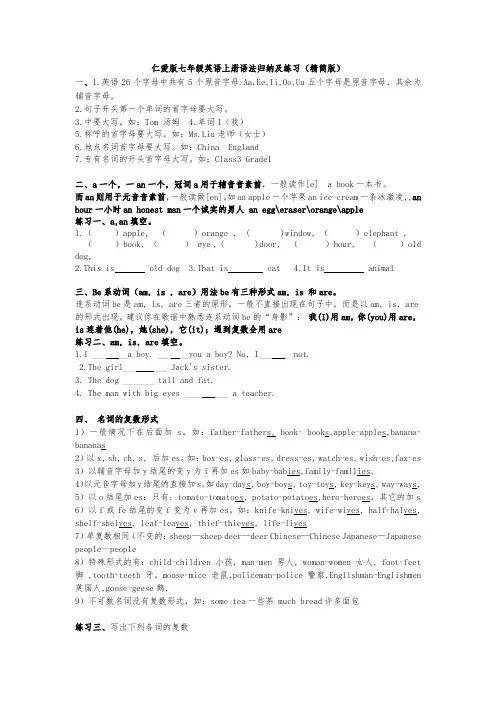
仁爱版七年级英语上册语法归纳及练习(精简版)一、1.英语26个字母中共有5个原音字母.Aa,Ee,Ii,Oo,Uu五个字母是原音字母,其余为辅音字母。
2.句子开头第一个单词的首字母要大写。
3.中要大写。
如:Tom 汤姆4.单词I(我)5.称呼的首字母要大写。
如:Ms.Liu老师(女士)6.地点名词首字母要大写。
如:China England7.专有名词的开头首字母大写。
如:Class3 Grade1二、a一个,一an一个,冠词a用于辅音音素前,一般读作[e] a book一本书。
而an则用于元音音素前,一般读做[en]。
如an apple一个苹果an ice-cream一条冰激凌,,an hour一小时an honest man一个诚实的男人 an egg\eraser\orange\apple练习一、a,an填空。
1.()apple, ()orange , ( )window, ()elephant , ()book, () eye , ( )door, ()hour, ()old dog,2.This is old dog3.That is cat4.It is animal三、Be系动词(am, is , are)用法be有三种形式am, is 和are。
连系动词be是am, is, are三者的原形,一般不直接出现在句子中,而是以am, is, are的形式出现。
建议你在歌谣中熟悉连系动词be的“身影”:我(I)用am,你(you)用are,is连着他(he),她(she),它(it);遇到复数全用are练习二、am, is, are填空。
1.I ___ __a boy. ___ __you a boy? No, I___ _ not.2.The girl___ ___ Jack's sister.3. The dog _______ tall and fat.4. The man with big eyes ____ ___ a teacher.四、名词的复数形式1)一般情况下在后面加s。
仁爱英语七年级上册知识点归纳
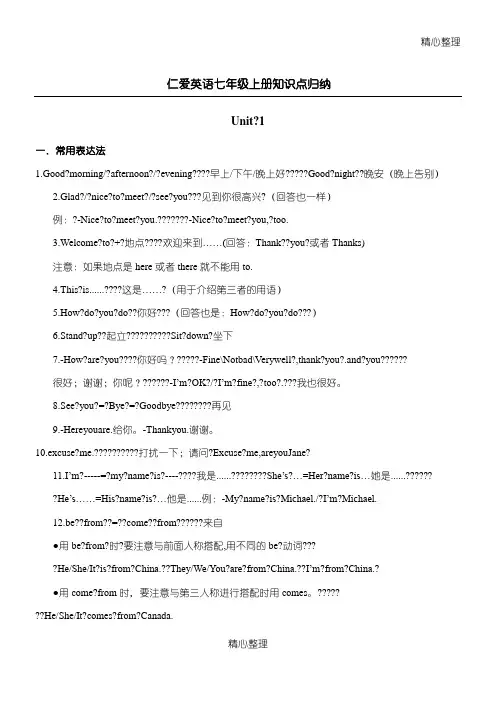
精心整理仁爱英语七年级上册知识点归纳Unit?1一.常用表达法1.Good?morning/?afternoon?/?evening????早上/下午/晚上好?????Good?night??晚安(晚上告别)2.Glad?/?nice?to?meet?/?see?you???见到你很高兴?(回答也一样)例:3.Welcome?to?+?地点????欢迎来到……(注意:如果地点是here或者there就不能用4.This?is......????这是……?5.How?do?you?do??你好???(回答也是:6.Stand?up??起立??????????Sit?down?坐下7.-How?are?you????你好吗?很好;谢谢;你呢???????-too?.???我也很好。
谢谢。
?Excuse?me,areyouJane?11.I’m?我是......????????She’s?…=Her?name?is…她是......???????He’s……=His?name?is?…他是......例:-My?nam e?is?Michael./?I’m?Michael.12.be??from??=??come??from??????来自●用be?from?时?要注意与前面人称搭配,用不同的be?动词????He/She/It?is?from?China.??They/We/You?are?from?China.??I’m?from?China.?●用come?from时,要注意与第三人称进行搭配时用comes。
???????He/She/It?comes?from?Canada.13.fullname全名familyname\lastname姓givenname\firstname名14.telephone?number?????电话号码?????QQ?number??QQ号码???ID?number??身份证?15.-Thankyouverymuch.\Thanksalot.\Manythanks.非常感谢你。
仁爱版英语七年级上册知识点归纳总结
仁爱版英语七年级上册知识点归纳总结英语是一门国际性的语言,对于学生来说,学好英语对他们的学习和未来的发展都有着重要的意义。
而对于在仁爱版英语七年级上册中学习的内容,我们可以将其中的知识点进行归纳总结,帮助学生更好地掌握和应用这些知识。
一、基础语法1. 介词在句子中起连接其他词或短语的作用,如in、on、under等。
介词的正确使用对句子的意思和语法结构都有很大的影响。
2. 冠词冠词分为不定冠词(a、an)和定冠词(the)。
不同的冠词在句子中的使用要根据具体的情况来确定。
3. 代词代词可以作为名词的替代,分为人称代词、物主代词、指示代词等。
正确使用代词可以使语言表达更加简洁清晰。
二、日常用语1. 问候语日常生活中的问候语是英语交流中的重要部分,如“Hello!”、“How are you?”等。
学会使用这些问候语可以使沟通更加顺畅。
2. 询问和回答在交流中,询问和回答是我们经常使用的句子,比如询问“Where is the library?”、“What's your name?”等。
熟练掌握这些句子结构和表达方式对于学生的口语能力的提升非常重要。
三、常用词汇1. 数字词汇数字在英语中十分常见且具有重要的意义,比如表示年龄、时间、信息等。
学生需要掌握基本的数字词汇,如one、two、three等。
2. 季节和月份季节和月份也是我们日常经常使用的词汇,如spring、summer、January、February等。
熟悉并正确运用这些词汇可以帮助学生更好地描述时间和事件。
四、阅读技巧1. 阅读理解在学生学习英语的过程中,阅读理解是非常重要的一项技能。
通过阅读文章并回答问题可以帮助学生提升对英语文本的理解和运用能力。
2. 关键词阅读文章时,学生可以通过寻找关键词来辅助理解文章的意思。
这些关键词可能是与文章主题相关的名词、动词或形容词等。
五、写作技巧1. 句型结构学生在写作时需要注意句型结构的正确运用。
七年级上册英语仁爱版知识点归纳
七年级上册英语仁爱版知识点归纳全文共3篇示例,供读者参考篇1Knowledge Summary of Grade 7 English Kindness Edition (上册)In the first semester of Grade 7, students are introduced to a variety of topics in English. Here is a summary of the key knowledge points covered in the Kindness Edition textbook.1. Grammar:- Present simple tense: Used to talk about habits, routines, facts, and general truths.- Present continuous tense: Used to talk about actions happening at the moment of speaking or around the current time.- Past simple tense: Used to talk about completed actions in the past.- Future simple tense: Used to talk about future plans and intentions.- Modal verbs (can, could, will, would, may, might, shall, should): Used to express permission, possibility, probability, ability, advice, obligation, and requests.2. Vocabulary:- Daily routines: Words and phrases related to daily activities such as waking up, brushing teeth, having breakfast, going to school, and doing homework.- Emotions: Words to describe feelings and emotions such as happy, sad, angry, excited, and nervous.- Relationships: Vocabulary related to family members (parents, siblings), friends, classmates, and teachers.- Education: Words and phrases related to school subjects, classroom objects, and school activities.- Food and drink: Vocabulary related to different kinds of food, drinks, meals, and tableware.- Places: Words to describe locations such as home, school, park, library, store, and restaurant.3. Reading and Writing Skills:- Reading comprehension: Students are required to read and understand various texts, including narratives, dialogues, descriptions, and instructions.- Writing skills: Students learn to write simple sentences, paragraphs, letters, and short compositions on familiar topics.- Sentence construction: Students practice forming grammatically correct sentences using different tenses, vocabulary, and structures.4. Listening and Speaking Skills:- Listening comprehension: Students listen to and understand spoken English in various contexts such as conversations, interviews, announcements, and instructions.- Speaking skills: Students practice speaking in English through role plays, presentations, discussions, and conversations with classmates and teachers.5. Cultural Knowledge:- English-speaking countries: Students learn about the geography, culture, customs, traditions, and famous landmarks of English-speaking countries such as the United States, the United Kingdom, Canada, Australia, and New Zealand.- Festivals and celebrations: Students learn about the major festivals and celebrations in English-speaking countries, such as Christmas, Halloween, Easter, Thanksgiving, and Independence Day.- Famous personalities: Students read about and discuss famous personalities from English-speaking countries in various fields such as literature, music, sports, science, and politics.Overall, the Grade 7 English Kindness Edition textbook provides a comprehensive introduction to the English language and culture, helping students improve their communication skills and broaden their knowledge of the world. By mastering the key knowledge points covered in this textbook, students will be well-prepared to continue their English language learning journey in the future.篇2Knowledge Summary of Grade 7 English Textbook - Ren'ai EditionIn the Grade 7 English textbook, students will learn a wide range of topics that will help them develop their language skills and cultural awareness. Here is a summary of the key knowledge points covered in the textbook:1. Grammar: The textbook covers a variety of grammar topics, including simple present tense, simple past tense, present continuous tense, past continuous tense, present perfect tense, future tense, modal verbs, articles, prepositions, conjunctions, and relative clauses. Students will learn how to use these grammar points correctly in different contexts.2. Vocabulary: The textbook introduces a wide range of vocabulary related to various topics such as family, school, hobbies, food, sports, travel, and shopping. Students will learn new words and phrases through reading, listening, and speaking activities.3. Reading comprehension: The textbook includes a variety of reading passages, such as short stories, dialogues, poems, articles, and letters. These reading materials help students improve their reading skills, comprehension, and analytical abilities.4. Writing: Students will learn how to write different types of texts, including emails, diary entries, descriptions, narratives, and reports. They will practice writing skills such as organization, coherence, and creativity.5. Listening and speaking: The textbook includes listening exercises that help students improve their listening skills andcomprehension. Speaking activities encourage students to practice their speaking skills, pronunciation, and fluency.6. Cultural awareness: The textbook introduces students to different cultures, traditions, customs, and lifestyles from English-speaking countries around the world. Students will learn to appreciate and respect cultural diversity.7. Language skills: The textbook focuses on developing students' four language skills: listening, speaking, reading, and writing. Students will practice these skills through a variety of activities designed to enhance their overall language proficiency.Overall, the Grade 7 English textbook provides a comprehensive and engaging learning experience for students, helping them develop their English language skills and cultural awareness. By mastering the knowledge points covered in the textbook, students will be well-prepared to communicate effectively in English and engage with the global community.篇3Seventh Grade English Kindness Book SummaryIn the first semester of seventh grade English Kindness book, students will learn a variety of interesting topics and knowledgepoints. Here is a summary of the key knowledge points covered in the textbook:Unit 1: Introduction to English- Basic greetings and introductions- The alphabet and pronunciation- Numbers and colors- Common classroom expressionsUnit 2: Personal Information- Talking about oneself (name, age, nationality)- Asking and responding to questions about personal information- Describing physical appearance and personality traits- Family members and relationshipsUnit 3: School Life- School subjects and schedules- School facilities and locations- Classroom objects and supplies- Talking about after-school activities and hobbiesUnit 4: Daily Routine- Telling time and discussing daily schedules- Actions and activities in the morning, afternoon, and evening- Talking about household chores and responsibilitiesUnit 5: Food and Drink- Common food and drink vocabulary- Ordering food in a restaurant- Talking about likes and dislikes- Healthy eating habits and nutritionUnit 6: Shopping- Shopping vocabulary and phrases- Money and currency- Bargaining and negotiating prices- Describing clothing and accessoriesUnit 7: My Hobbies- Talking about hobbies and interests- Leisure activities and pastimes- Music, sports, and other hobbies- Planning and scheduling activitiesUnit 8: Holidays and Festivals- Major holidays and festivals around the world- Traditions and customs for various celebrations- Talking about holiday plans and experiences- Sending greetings and best wishesOverall, the first semester of seventh grade English Kindness book covers a wide range of topics that are relevant and engaging for students. By mastering these knowledge points, students will be able to communicate effectively in English and expand their vocabulary and language skills.。
(精校版)仁爱英语七年级上册知识点归纳完整版
(直打版)仁爱英语七年级上册知识点归纳完整版(word版可编辑修改) (直打版)仁爱英语七年级上册知识点归纳完整版(word版可编辑修改)编辑整理:尊敬的读者朋友们:这里是精品文档编辑中心,本文档内容是由我和我的同事精心编辑整理后发布的,发布之前我们对文中内容进行仔细校对,但是难免会有疏漏的地方,但是任然希望((直打版)仁爱英语七年级上册知识点归纳完整版(word版可编辑修改))的内容能够给您的工作和学习带来便利。
同时也真诚的希望收到您的建议和反馈,这将是我们进步的源泉,前进的动力。
本文可编辑可修改,如果觉得对您有帮助请收藏以便随时查阅,最后祝您生活愉快业绩进步,以下为(直打版)仁爱英语七年级上册知识点归纳完整版(word版可编辑修改)的全部内容。
仁爱英语七年级上册知识点归纳完整版一、短语:come from 出生(于);来自 in English 用英语(表达)look like 看起来像 give sth. to sb. 把(某物)给(某人)look at 看着 help sb. with sth. 帮助(某人)做(某事)a little 一点点 each other 互相a lot 非常,更加,很 very much 非常,更加,很have a seat 坐下,就座 look after 照顾,照看next time 下一次 try on 试穿good idea 好主意 such as 比如,例如wait a moment 稍候,等一会儿 family tree 家谱look the same 看起来一样 have a picnic 去野餐go fishing 去钓鱼 go shopping 去购物do some shopping 购物take one's order 记下顾客点的菜fly a kite 放风筝 different looks 不同的相貌have breakfast 吃早餐 have lunch 吃午饭have supper 吃晚饭 have dinner 吃饭all right 好的 on one’s way home 在某人回家的路上find one’s way home 找到回家的路 a glass of 一玻璃杯a bottle of 一瓶 a pair of 一双have fun 玩得开心 think of 认为speak to sb. 对某人说 call sb. back 回拨电话给某人get up 起床 eat out 下馆子,出去吃饭go home 回家 go to school 去上学help oneself to sth. 随便吃(喝)些什么be free 有空have no time 没时间 over there 在那儿think about 考虑 on a farm 在农场help sb. with sth. 帮助某人某事 at night 在夜晚on Sunday 在星期天 go out 出去go for a picnic 去野餐 on Sunday morning 在星期天早晨at six o’clock 在六点钟 be from 出生(于);来自go to the zoo 去动物园 Welcome to China! 欢迎到中国来!Don't worry!别担忧! in the same grade 在同一个年级in different classes 在不同的班级telephonenumber 电话号码junior high school 初中You're welcome!别客气!Thank you!谢谢你! Can I help you? 我能帮你什么忙吗?Here you are! 给你! Here it is!它在这Here we are! 我们到了! be afraid 恐怕,害怕in different clothes 不同的衣服 be in blue 蓝色衣服be in a red T-shirt 红色T恤 be in black pants 黑色裤子help sb. do sth。
仁爱版七年级上册英语全册复习笔记
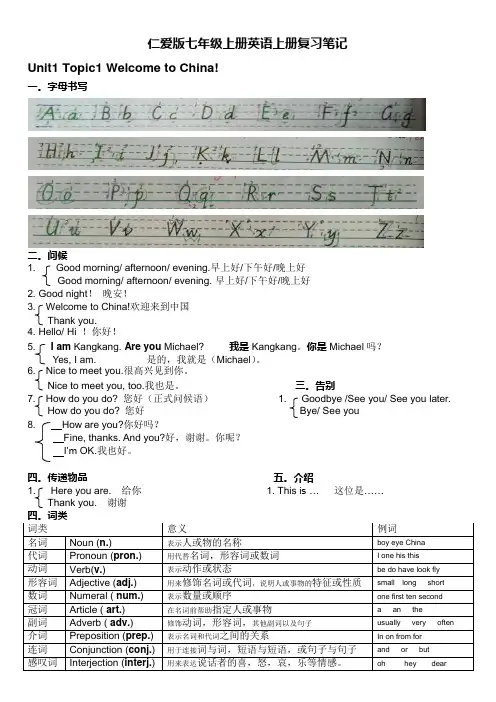
仁爱版七年级上册英语上册复习笔记Unit1 Topic1 Welcome to China!一。
字母书写二。
问候1. Good morning/ afternoon/ evening.早上好/下午好/晚上好Good morning/ afternoon/ evening. 早上好/下午好/晚上好2. Good night!晚安!3. Welcome to China!欢迎来到中国Thank you.4. Hello/ Hi !你好!5. I am Kangkang. Are you Michael? 我是Kangkang。
你是Michael 吗?Y e s, I am. 是的,我就是(M ichael)。
6. Nice to meet you.很高兴见到你。
Nice to meet you, too.我也是。
三。
告别7. How do you do? 您好(正式问候语) 1. Goodbye /See you/ See you later.How do you do? 您好Bye/ See you8. How are you?你好吗?Fine, thanks. And you?好,谢谢。
你呢?I’m OK.我也好。
四。
传递物品五。
介绍1. Here you are. 给你 1. This is …这位是……Thank you. 谢谢四。
词类词类意义例词名词Noun (n.) 表示人或物的名称boy eye China代词Pronoun (pron.) 用代替名词,形容词或数词I one his this动词Verb(v.) 表示动作或状态be do have look fly形容词Adjective (adj.) 用来修饰名词或代词,说明人或事物的特征或性质small long short 数词Numeral ( num.) 表示数量或顺序one first ten second冠词Article ( art.) 在名词前帮助指定人或事物 a an the副词Adverb ( adv.) 修饰动词,形容词,其他副词以及句子usually very often 介词Preposition (prep.) 表示名词和代词之间的关系In on from for连词Conjunction (conj.) 用于连接词与词,短语与短语,或句子与句子and or but感叹词Interjection (interj.) 用来表达说话者的喜,怒,哀,乐等情感。
仁爱版七年级英语上册知识点总结
仁爱版七年级英语上册知识点总结英语七年级上册知识点归纳Unit 1 Making New Friends. 一.重点短语1.Good morning/ afternoon / evening! 早上/下午/晚上好!Good night: 晚安(晚上告别)!2.Glad / Nice to meet / see you ! 见到你很高兴(回答也一样)3.Welcome to + 地点: 欢迎来到…… (回答:Thank you 或者Thanks)4.let’s + do(动词原形):让我们做……5.stand up: 起立sit down: 坐下6.单数: this is----- 这是…… (用于介绍第三者的用语)复数:these are----- 这些是7.How do you do ?你好(回答也是:How do you do ? )8.How are you ? 你好吗?Fine ,thank you/thanks .And you ? 很好,谢谢;你呢?I’m OK / I’m fine , too .我也很好。
9.See you = See you later = See you soon = good-bye 再见10.excuse me 打扰一下;请问11.做自我介绍:I’m -----= my name is ---- 我是……12. be from = come from: 来自13. in English: 用英语表示14.Can you spell it ? Yes / No. 你能拼写它吗?能/不能How do you spell it? M-A-P, map.你怎样拼写它?15.That’s OK / That’s all right / You’re welcome / Not at all!不用谢16.……years old:……岁如:I’m twelve years old.17. telephone number:电话号码QQ number:QQ号码ID number:身份证18.the same: 相同的反义词是different: 不同的例: We are in the same grade, but we are in different classes.二.重点句型:1. What is your name ? 你的名字是什么?2. Where +be +主语+ from? 某人来自于哪里?(回答:主语+be+地点)eg:Where are you from? I am from China.3. How old + be + 主语?某人几岁?(回答:主语+ be + 数字)例:How old are you ? I’m twelve.4.What is your telephone number? 你的电话号码是多少?回答:My telephone number is--或者It’s -- 注意:读出号码的时候要逐个读出。
七年级仁爱版英语全册知识点
七年级仁爱版英语全册知识点七年级是初中的起点,也是英语学习的重要阶段。
为了帮助同学们更好地掌握仁爱版七年级英语知识点,本篇文章将为大家介绍全册的重点内容。
第一单元-初识英语第一单元是英语学习的起点,主要介绍英语语音、字母、数字、问候语等基础知识。
同学们在学习这些基础知识的同时,需要掌握正确的发音方式,建立正确的语音基础。
第二单元-初识语法第二单元介绍英语语法中的be动词和不定冠词,这是英语语法中的两个基础知识点。
同时,同学们需要通过大量的阅读和听力来巩固语感,提高语言理解能力。
第三单元-我的家庭第三单元是以介绍家庭为主题的单元,同学们需要掌握相关的词汇、句子以及表达方式。
同时,要求同学们能够用英语描述自己的家庭、家庭成员等信息。
第四单元-我的学校第四单元介绍学校相关的词汇、句子和表达方式。
同学们需要学会用英语描述学校、校园、老师、同学等信息。
除此之外,还需要掌握一些描述课程、学习习惯等方面的词汇。
第五单元-我的朋友第五单元的主题是朋友,同学们需要掌握得体、真实的交流方式,并学习一些介绍自己和朋友的句型。
同时,要求同学们掌握部分形容词和副词的用法,以便用英语描述人物或事物。
第六单元-我的兴趣第六单元主要介绍兴趣爱好和活动,同学们需要学会表达自己的兴趣和参加的活动,并掌握一些议论文的表达方式。
同时,还需要加强词汇的积累和使用,以便更好地表达自己。
第七单元-我喜欢阅读第七单元主要介绍阅读的技巧和方法,同学们需要学会一些阅读理解的技巧,并掌握一些高频词汇和常见的语法结构。
此外,要求同学们阅读一些简单的英语文章,加强语言听说能力。
第八单元-我喜欢运动第八单元介绍了运动和健康的相关知识,同学们需要掌握一些基本的运动场馆和器材的词汇,并学会用英语介绍运动的好处和运动的方式。
同时,还需要加强听力训练,提高语言理解能力。
结语以上就是七年级仁爱版英语全册的知识点介绍,希望同学们在学习过程中能够认真理解,逐步提高语言能力,更好地掌握英语。
仁爱版英语七年级(上册)各单元知识点归纳
惠安县仁爱英语七年级上册知识点归纳作者:骆鸿勇Un it 11、Good morning/ after noon / eve ning 早上/下午/晚上好Good ni ght 晚安(晚上告别)2、glad / nice to meet / see you 见到你很高兴(回答也一样)3、welcome to + 地点欢迎来到…•…(回答:Thank you或者Thanks)4、let 's + V (原)让我们做•…5、sta nd up 起立sit dow n 坐下6、this is——这是……(用于介绍第三者的用语)7、How do you do ?你好(回答也是How do you do ? )8、How are you ? 你好吗?Fine ,tha nk you .and you ? 很好;谢谢;你呢?I ' m OK / I ' m fine , too .我也很好。
9、see you = see you later =see you soon = good-bye 再见10、excuse me 打扰一下;请问11、I m ——=my n ame is —我疋...12、be from = come from 来自13、in En glish 用英语14、 Can you spell it ?Yes / No 你能拼写它吗?能/不能 15、 That ' s OK / That 's all right / You're welcome/ Not atall 不用谢16、 ..... years old……岁17、teleph one nu mber电话号码QQ number QQ 号码 IDnu mber 身份证18、 the same (相同的) 反义词是 differe nt (不同的)例:We are in the same grade, but we are in differe nt classes.句型:地点)+数字)号码的时候要逐个读出。
仁爱版七年级上册英语语法知识点总结
课时一教学任务一、重点语法1.动词be(am,is,are)的用法:be动词包括“am”, “is”, “are”三种形式。
①第一人称单数(I)配合am来用。
句型解析析:I am+…②第二人称(You)配合are使用。
句型解析:You are+…③第三人称单数(He or She or It)配合is使用。
句型解析:She(He, It) is +……④人称复数(we /you/they)配合are使用。
句型解析:We (You, They) are +……例句We are in Class 5,Grade 7.They are my friends.You are good students.用法口诀:我(I)用am, 你(you)用are,is跟着他(he),她(she),它(it)。
单数名词用is,复数名词全用are。
变否定,更容易,be后not加上去。
变疑问,往前提,句末问号莫丢弃。
还有一条须注意,句首大写莫忘记。
1.用括号中适当的词填空。
1. I ________(am, are, is) from Australia.2. She _______ (am, are, is) a student.3. Jane and Tom _________(am, is, are) my friends.4. My parents _______ (am, is, are) very busy every day.5. _______ (Are, Is, Do, Does) there a Chinese school in New York?6. _______ (Be, Are, Were, Was) they excited when he heard the news?7. There _____ (be) some glasses on it.8. If he _____ (be) free tomorrow, he will go with us.2.用be 动词的适当形式填空1. I ______ a boy. ______ you a boy? No, I _____ not.2. The girl______ Jack's sister.3. The dog _______ tall and fat.4. The man with big eyes _______ a teacher.5. ______ your brother in the classroom?6. Where _____ your mother? She ______ at home.7. How _______ your father?8. Mike and Liu Tao ______ at school.9. Whose dress ______ this?10. Whose socks ______ they?11. That ______ my red skirt.12. Who ______ I?13.The jeans ______ on the desk.14.Here ______ a scarf for you.15. Here ______ some sweaters for you.16. The black gloves ______ for Su Yang.17. This pair of gloves ______ for Yang Ling.18. The two cups of milk _____ for me.19. Some tea ______ in the glass.20. Gao shan's shirt _______ over there.第二课时(1)英语人称代词和物主代词一、人称代词表示“我”、“你”、“他”、“她”、“它”、“我们”、“你们”、“他们”的词,叫做人称代词。