
【新教材】9.3 The Secrets of Your Memory 课件-北师大版高中英语必修第三册(共13张PPT)
Activity 11. Express yourself Group work
Read the tips for improving your memory. Which tips seem most/least useful? Which, if any, would be useful for English learning?
Activity 2
If you were going to meet a memory expert, what questions would you ask him/her?
Read and explore Activity 3
Read the text quickly. Does the text answer any of your questions in Activity 2?
Activity5 Pair work
What suggestions would you provide for each of the four questions discussed? Discuss with your partner
Activity 6:Match the following suggestions with the four questions and put them back in the text.
learning materials, we simply need to focus on the important ideas and be curious about what we learn. Asking questions about what we learn also helps with memorisation Another effective technique to remember things is to group similar ideas or information together so that they can be easily connected to things that are already known
A What can we learn from all this? When remembering something new, try to connect it to our emotions. It is important to connect it with what we already know. Also, we can try to retell what we have learnt to a few others
Activity 7:What truths about memory does Jemima Gryaznov discuss in the text? What advice does she give to improve one's memory?
Truth and advice 1:__________________________________________________ Truth and advice 2:__________________________________________________ Truth and advice 3 :__________________________________________________ Truth and adivice 4:__________________________________________________
1.Jemima Gryaznov thinks people remember things that have strong sentimental attachment. 2 When we do things with enthusiasm, we tend to remember them well. 3 When we try to remember detailed materials, we should focus on the important ideas. 4 Jemima Gryaznov suggested another effective method to remember things: grouping similar ideas or informatiose memory is to review the material you are trying to remember often.
Activity 8:Think and share
1. How has the expert tried to make her statements to each question convincing? What methods has she used and what signal words can you find?
Activity 10. Focus on language:Subject-verb agreement
Circle the subjects of the setences in the Sentence builder. Then use the correct form of
the verbs to complete the sentences.
Activity 11. Choose the correct options.
1. If anybody has/have any tips for memorising information, I would like to hear them. 2. Many experts says/ say that you should review information periodically after you learn it. 3. Each of the students is/are trying one of these memorising techniques this week. 4. Both of my English teachers tells/tell me to ask questions to identify the most important information I need to remember. 5. Writing information down clearly makes/make it easier for you to review it later.
2 Are there any answers given by Jemima gryaznov that are not convincing to you? What are your doubts?
Activity 9. Replace the underlined words and phrases with the words from the text.
Sentence Builder
Subject-Verb Agreement Retelling events ________(help) fix experiences in our memories. There _______(be) some people who do have amazing memories. They ________(be) both good at remembering paticular things for a limited time. One of the golden rules to increase how much we remember ______(be ) to review the material periodically.
Activity 4 Read the text again. Write T or F. Correct the false statements.
( )1 We remember certain events in our childhood, because we experienced many of them for the first time and we felt strongly about them at the time. ( )2 When we tell a story many times, we forget important details. ( )3 Stephen Wiltshire has a photographic memory because he can draw a detailed picture of a city from memory after flying over it. ( )4 It has been proved that some people have a photographic memory. ( )5 The sharpest loss of memory occurs during the first five days. ( )6 Our memory starts to get worse in middle age.
Unit9Lesson3TheSecretsofYourMemory说课稿高中英语北师大版
Now, I will introduce the teaching design of lesson three The Secrets of Your Memory.So this title itself has some mysterious color. I believe it can stimulate the students' subsequent exploration and the desire for knowledge. Moreover, in this text, we not only involve the mystery of memory, but also give suggestions for ways to improve memory. In fact, these methods to improve memory are also a manifestation of a learning strategy, so we can see that it is very relevant to our unit theme.Let's take a specific look at the article below. So the story is mainly about the four mysteries of memory and some targeted answers, and there are corresponding suggestions to improve the memory. Then these four mysteries are that the strong event will make the memory deeper. Human beings are used for picture memory, the existence of forgetting law and Ebbinghaus forgetting curve. And the capacity of the human brain declines with age. The first of some suggestions for improving memory, accordingly, is to connect new memory events, emotions and known constructs, and try to repeat it. Second, keep focused and curious, ask more questions, and try to classify new memory events. Point 3 is to review what you learn regularly. The fourth point is to relax, and grasp the golden period of memory.By learning this story, students can have a deeper understanding of their own memory and apply what they have learned so as to better improve their memory. We can see that the structure of this article is very clear, and the four mysteries of memory are developed by asking questions, answers and providing suggestions. In addition, in this article, we also use the relevant supporting details of the reference list of numbers to make our argument more convincing and credible. So in the second paragraph, we use the example method to say that Daniel can remember more than 20,000 decimal places of PI, and Stefan can draw a detailed map of the city to show their strong memory after a helicopter flies over the city. Then, in thethird paragraph, we use the reference method. We quote the memory forgetting curve model to show that the forgetting of human memory is a rule. In the fourth paragraph, the list of numbers is mainly used. Take age of five and two hundred pieces of information, for example, suggests that the human brain grows and declines with age.Then based on the above text interpretation, we determined the teaching objectives of this lesson. First, through reading, b and summarize the four secrets about memory and the corresponding answers.2. Introduce others to memory based on structured knowledge.3. Get and talk about ways to improve memory through reading and thinking.4. bing out the examples used in the text, quote the constraints and other relevant explanatory means, and use them, so as to express their views on the way of improving themselves. Then we can achieve the unit goal through the study of this lesson.5. Discuss the mystery based on memory and use methods to improve memory. Then based on the text interpretation, we determined the teaching focus of undergraduate course, based on the analysis of learning situation, we determined the teaching difficulties of this course.Then, let's take a look at the specific teaching process. In the introduction section, the teacher will first share one of his own experiences. When I took a bus, my mobile phone was almost stolen. So thanks to the bus driver pretending to know me well and then greeting me from the tragic experience of having my cell phone stolen. And then the teacher will ask the students, do you have the similar experience and can you explain why? The sharing of this experience and these two questions can help students to better activate their background knowledge about their memory. The second question of the students is what do you want to know about memory which is to activate the information difference between students and the text. Next, we will let the students read the text for the first time to have a quick browse, one is to see if the text of these questions have been answered. At the same time, also let thestudents quickly browse the text to grasp the general idea of the article, and can grasp the overall structure of the article. Then we will ask the students to mainly read the first paragraph and the first mystery of memory.The main question iswhat are the experts answers and underline the expressions in the test. And record the obtained information in the illustrated table. Then we will ask the students to go through the first paragraph again quickly. Because the focus of the grammar teaching in this text is about the consistency of subject and predicate, in fact, the phenomenon of the students have learned. So in this lesson, we will review the grammar of subjectpredicate consistency. Then the teacher will present the students with the same subject and verb in the sentence, and then ask the students to circle the subject and the words. Next, teachers and students will work together to summarize the relevant rules of the subject and verb consistency. So with the first paragraph of the demonstration, we will let the students to read the rest of their own paragraphs, and record the relevant information.So far, we have achieved the goal of the lesson. First, we will ask the students to form their own mind map of the information just recorded. First, retell your mind map to yourself. After that, we will have a pair work, two people to introduce each other, and further supplement and then class presentation in the class. Which will help students to better internalize the relevant language and content. So we achieved the secondobjective.There are two main items of homework at the end of this class. The first item is that the student himself is a memory expert, so you want to choose two questions from the test to prepare a report and share it with the whole class in the next class. Then the second assignment is mainly to make a foundation for the next period of learning. So what can you think of about the four mysteries of memory just mentioned? For the mystery of each memory, the students gave them one or two suggestions.So now let's look at the second class of study again. At the very beginning of the course, we will ask the students to e to share your report with the whole class. In this way, you can check the pletion of the students' homework, and you can also help you to review what you learned in the last class. Next, we will ask the students to share some suggestion they think of about the four mysteries of memory. The teacher will record their suggestion on the blackboard. Next, we will ask the students to read the text, and then match the suggestions of the experts mentioned in the exercise 6 behind the text. So now, we will ask students to think about which suggestion works best for you? So this is mainly to enable students to express their views on improving memory methods according to themselves, so as to promote students' positive thinking. So now, we have achieved the third objective. Then we will ask the students to read the text again, and this time we will mainly focus on these two issues. Question 1, how had the experts try to make her statements to each questionconvincing? what signal words can you find?I believe that students can outline some of the relevant techniques used in the text, such as examples. The second question is are there any answers given by the expert that are not convincing to you?what are your doubts?So for some of the experts' answers, the students may not feel so persuasive. So we mainly want the students to know that the expert's answer may not be absolutely correct so that we can promote the students' awareness of critical thinking. Then we will ask the students to discuss the exercises in the textbook. There are five suggestions for improving your memory, so students will think about which tips seem the most/least useful and why? Try to make your answers convincing. It mainly requires the students to express their views on improving their memory and remind them to try to use your answers, apply your answer to the relevant details we have just outlined as some examples of the numbers. So we say that these examples of the details of these numbers, both for English learning, is very important for Chinese learning.Can make our argument more persuasive. So now, we have achieved the goal of the class hour. Four, the following came to the class of the homework. There are two assignments. The first item you can choose, is the question you want to know at the beginning about memory that has not been answered, or you may just think that the answer given by the er expert is not so convincing to you. Then you can further go to the Internet to consult information, and then to give your answer. But your answers should be logic and convincing. The second question, how will you make use of what you have learned from this text? Through learning this lesson, I believe that they must have mastered some methods to improve their memory. So how do you apply these methods to your actual study and life? In this area, we mainly urge students to make a detailed plan, and really implement it, so as to help students to make progress step by step, and continue to improve. So much about the introduction of lesson three.。
Unit9LearningLesson3TheSecretsofYourMemory教学设计高一英语
普通高中新课程新教材优质课评选暨优秀课例汇集[What]北师大版高中英语教材必修三第九单元的主题为学习与发展。
学生在学完本单元后能够认识学习的原理,了解影响学习的因素,从而树立积极主动的学习观,践行相应的学习策略,寻找高效学习的规律,选择合适自己的学习方法,倡导善学乐学的学习态度。
本课是本单元的第三课,为了让学生在本课学习中形成大单元的观念,本课关注记忆中存在误区的解答和记忆有效策略的分享,最终为学生发现适合自己的记忆策略提供参考和指导,同时形成本课课时所期达到的学习成果:探讨并分享有效的记忆策略,成为一名积极的学习者。
本课属于三大主题语境之一“人与自我”下主题群“生活与学习”中“记忆的规律与策略”子话题,学生通过获取有效的记忆策略,思考自己在记忆中存在的误区并同时加以探讨和反思,寻找记忆规律,获取适合自己的记忆策略。
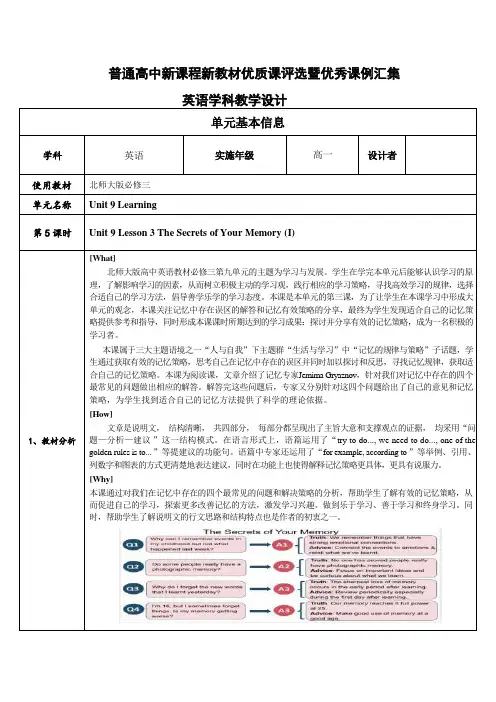
本课为阅读课,文章介绍了记忆专家Jemima Gryaznov,针对我们对记忆中存在的四个最常见的问题做出相应的解答。
解答完这些问题后,专家又分别针对这四个问题给出了自己的意见和记忆策略,为学生找到适合自己的记忆方法提供了科学的理论依据。
[How]文章是说明文,结构清晰,共四部分,每部分都呈现出了主旨大意和支撑观点的证据,均采用“问题—分析—建议”这一结构模式。
在语言形式上,语篇运用了“try to do..., we need to do..., one of the golden rules is to... ”等提建议的功能句。
语篇中专家还运用了“for example, according to ”等举例、引用、列数字和图表的方式更清楚地表达建议,同时在功能上也使得解释记忆策略更具体,更具有说服力。
[Why]本课通过对我们在记忆中存在的四个最常见的问题和解决策略的分析,帮助学生了解有效的记忆策略,从而促进自己的学习,探索更多改善记忆的方法,激发学习兴趣。
做到乐于学习、善于学习和终身学习。
新教材北师大版高中英语必修第三册Unit9 Learning 精品教学课件
1.Your inner voice expresses your personal opinions,while the outer voice tells you about opinions from what you hear or read.
你内心的声音表达你的个人观点,而 _外__在__的__声____来__告__诉__你__观__点_。
⑭argue vi.争论,争吵 argue with 争吵 ⑮flexible adj.灵活的,可变通的 ⑯end up 以……结束 ⑰promote vt.促进,增进 ⑱achieve vt.实现;完成 ⑲in short 简而言之
⑳curious adj.好奇的;有好奇心的 be curious about 对……感到好奇 ○21 attempt vt.尝试;试图 n.努力,尝试 attempt to 尝试 ○22 entirely adv.全部地;完整地;完全地 ○23 unlikely adj.不大可能的 ○24 aspect n.方面
答案将引导你进一步学习,而 问__题__的__解__决__将__帮__助__你__对__这__个__话__题__有__更__高__层__次__的__理__解__。
4.If you try to find out the source of an idea,no matter how crazy it seems,you will increase your chance of learning something.
搭档,同伴 内部的 促进,增进 不大可能的 恐龙 资料;数据 仔细思考;表达(意见);反映 争论,争吵
Ⅰ.语境填词 promote;partner;ignore;automatic;inner;flexible; data;approach;attempt;unlikely 1.They have built hotels in most _u_n_li_k_e_ly__ places. 2.These _d_a_ta_ have been collected from various sources. 3 . We will be exploring different _a_p_p_ro_a_c_h_e_s_ to gathering information.
高中英语Unit9gLesson3TheSecretsofYourMemory教案北师大版必修第三册
Unit 9 LearningLesson 3 The Secrets of Your Memory【教学目标】Students will be able to1. read a text about memory2. read for detail and correct false statements3. understand the main theme of each paragraph in an extended text4. correct mistakes in a summary of the reading text5. study and understand the subject–verb agreement rules in sentences6. discuss tips on memory improvement【教学重难点】1.reading for detail and understanding the main themes2. Talking about ways to improve memory【教学过程】1. Talk about memory by identifying things that are easy to remember.1)In small groups, volunteer students discuss their first memory.2) Volunteers can share their answers with the class.3) Explain to students that the human brain remembers information roughly categorised into broader groups.4) Read the bulleted list.5) Conduct a survey to find out which things are the easiest and the hardest to remember. Each student shares the category they remember best and the one they struggle to remember.2. What do you want to know about memory?1)Give an example of one or two questions you would like to ask a memory expert,e.g., Does age play a role in the human’s brain ability to store and recall information? Is there any special food that helps memory?2) In pairs, students note down 4–5questions that they would like to ask a memory expert.3) If possible, students can find the answers online.4) Each student shares at least one question they would like to ask.3. Read the text and find out.1) Ask students to quickly skim through the text and find out if any of the questions they noted down in Activity 2 are answered by the memory expert.2) Students share the questions and answers that were addressed.4. Read again, write T or F, and correct false statements.1)Read the statements. Ask volunteer students to read the text. Explain any difficult words.2) Read each statement again. Students answer if they are true or false from memory. Do not confirm their answers at this point.3) Independently, students read through the text to check their answers and correct the false statements.4) To help struggling students, give them the paragraph number where the information for each statement is included.5) Read out loud each statement and pause after each one for students to call out “true” or “false” in chorus. If the answer is “false”, invite a volunteer to come to the board and write the corrected statement.5. Pair Work: Offer suggestions.1) In pairs, students read each paragraph in the text and discuss further advice that they would suggest. Revise empathy with the students. What do you do when you can’t remember something? What memory tricks do you suggest?2) If possible, students can research online some advice for each question.3) Review the answers as a class. Write the useful advice on the board.6. Match suggestions and questions.1) Read through each suggestion. Explain any difficult words.2) Students need to connect each comment to one of the four paragraphs in the readingtext on pages 58 and 59. Then, students write the suggestions on the lines provided in the text.3) Review the answers as a class.4) Compare the suggestions students gave in Activity 5 with the suggestions in Activity 6.Which suggestions are more helpful? Which suggestion works best for you? Why?Which suggestion was surprising?7. Find out truths and advice.1) Point out to students that each of Jemima Gryaznov’s answers can be divided into two sections: the truth and the advice section. Go through the first answer with the class and have volunteers identify the two parts to illustrate what students need to do.2) Students note the four truths and advice that Jemima Gryaznov gives in the text.3) Review the answers as a class. Which truth is the most significant to you? Why?8. Group Work: Think and share.1) Students underline the most and least convincing words in the text that Jemima Gryaznov puts forward using two different colours.2) Students discuss what methods she uses to convince others and share their answers in small groups.3) Challenge students in each group to convince one another of each answer that is being questioned.Conduct a class survey to find the most and least convincing answer shared by the majority of students.4) Assign groups of students to search online for additional information that could beer support or deny this answer.9. Find words and phrases to replace underlined words.1) Revise synonyms with students. In pairs, students replace the underlined words and phrase with the words from the text.Remind students that the meaning must be similar.2) Help students who are struggling by giving the first letter of the word or theparagraph number where the word can be found.3) Read aloud the sentences and pause before each item for students to call out the answer in chorus.4) Encourage students to provide their own words or expressions for the underlined part in the sentences.10. Find subjects and use the correct verbs to complete sentences.1) Write this example on the board: “We remembers things that have strong connections in our mind.” Ask students to think whether there’s anything wrong with the sentence (the verb “remembers” should be plural to match the subject “we”.) Ask students to correct the mistake, i.e., change the verb to “remember”.2) Explain to students that in English the verb always needs to match the subject in terms of singular/plural form and that this is called “subject–verb agreement”. Find out whether this is the case in the students’ first language.3) Point out that the -ing form of verbs, when used as a subject, is considered as singular.4) Revise subjects of the sentence with students; the subject of a sentence is the person, place, thing, or idea that is doing or being something.5) Read the sentence frames in the Sentence Builder. Independently, students complete the task. Remind students to first circle the subject in each sentence.6) In pairs, students read their answers and listen if they sound correct.7) Review the answers as a class.11. Group Work: Read the tips and discuss the most/least useful ones.1) In small groups, students read and discuss the tips.2) Each student explains, with reasoning, which is the most and least useful tips for learning English.3) Conduct a class survey to find out the most and least popular tips of all.。
高中英语外北师大版(2019)必修第三册-Unit 9 Learning Lesson 3 The
Unit 9 LearningLesson 3 The Secrets of Your Memory【教学目标】Students will be able to1. read a text about memory2. read for detail and correct false statements3. understand the main theme of each paragraph in an extended text4. correct mistakes in a summary of the reading text5. study and understand the subject–verb agreement rules in sentences6. discuss tips on memory improvement【教学重难点】1. reading for detail and understanding the main themes2. Talking about ways to improve memory【教学过程】1. Talk about memory by identifying things that are easy to remember.1) In small groups, volunteer students discuss their first memory.2) V olunteers can share their answers with the class.3) Explain to students that the human brain remembers information roughly categorised into broader groups.4) Read the bulleted list.5) Conduct a survey to find out which things are the easiest and the hardest to remember. Each student shares the category they remember best and the one they struggle to remember.2. What do you want to know about memory?1) Give an example of one or two questions you would like to ask a memory expert, e.g., Does age play a role in the human’s brain ability to store and recall information? Is there any special food that helps memory?2) In pairs, students note down 4–5 questions that they would like to ask a memory expert.3) If possible, students can find the answers online.4) Each student shares at least one question they would like to ask.3. Read the text and find out.1) Ask students to quickly skim through the text and find out if any of the questions they noted down in Activity 2 are answered by the memory expert.2) Students share the questions and answers that were addressed.4. Read again, write T or F, and correct false statements.1) Read the statements. Ask volunteer students to read the text. Explain any difficult words.2) Read each statement again. Students answer if they are true or false from memory. Do not confirm their answers at this point.3) Independently, students read through the text to check their answers and correct the false statements.4) To help struggling students, give them the paragraph number where the information for each statement is included.5) Read out loud each statement and pause after each one for students to call out “true” or “false” in chorus. If the answer is “false”, invite a volunteer to come to the board and write the corrected statement.5. Pair Work: Offer suggestions.1) In pairs, students read each paragraph in the text and discuss further advice that they would suggest. Revise empathy with the students. What do you do when you can’t remember something? What memory tricks do you suggest?2) If possible, students can research online some advice for each question.3) Review the answers as a class. Write the useful advice on the board.6. Match suggestions and questions.1) Read through each suggestion. Explain any difficult words.2) Students need to connect each comment to one of the four paragraphs in the reading text on pages 58 and 59. Then, students write the suggestions on the lines provided in the text.3) Review the answers as a class.4) Compare the suggestions students gave in Activity 5 with the suggestions in Activity 6.Which suggestions are more helpful? Which suggestion works best for you? Why? Which suggestion was surprising?7. Find out truths and advice.1) Point out to students that each of Jemima Gryaznov’s answers can be divided into two sections: the truth and the advice section. Go through the first answer with the class and have volunteers identify the two parts to illustrate what students need to do.2) Students note the four truths and advice that Jemima Gryaznov gives in the text.3) Review the answers as a class. Which truth is the most significant to you? Why?8. Group Work: Think and share.1) Students underline the most and least convincing words in the text that Jemima Gryaznov puts forward using two different colours.2) Students discuss what methods she uses to convince others and share their answers in small groups.3) Challenge students in each group to convince one another of each answer that is being questioned.Conduct a class survey to find the most and least convincing answer shared by the majority of students.4) Assign groups of students to search online for additional information that could beer support or deny this answer.9. Find words and phrases to replace underlined words.1) Revise synonyms with students. In pairs, students replace the underlined words and phrase with the words from the text. Remind students that the meaning must be similar.2) Help students who are struggling by giving the first letter of the word or the paragraph number where the word can be found.3) Read aloud the sentences and pause before each item for students to call out the answer in chorus.4) Encourage students to provide their own words or expressions for the underlined part in the sentences.10. Find subjects and use the correct verbs to complete sentences.1) Write this example on the board: “We remembers things that have strong connections in our mind.” Ask students to think whether there’s anything wrong with the sentence (the verb “remembers” should be plural to match the subject “we”.) Ask students to correct the mistake, i.e., change the verb to “remember”.2) Explain to students that in English the verb always needs to match the subject in terms of singular/plural form and that this is called “subject–verb agreement”. Find out whether this is the case in the students’ first language.3) Point out that the -ing form of verbs, when used as a subject, is considered as singular.4) Revise subjects of the sentence with students; the subject of a sentence is the person, place, thing, or idea that is doing or being something.5) Read the sentence frames in the Sentence Builder. Independently, students complete the task. Remind students to first circle the subject in each sentence.6) In pairs, students read their answers and listen if they sound correct.7) Review the answers as a class.11. Group Work: Read the tips and discuss the most/least useful ones.1) In small groups, students read and discuss the tips.2) Each student explains, with reasoning, which is the most and least useful tips for learning English.3) Conduct a class survey to find out the most and least popular tips of all.。
高中英语Unit9课件北师大版必修第三册

As a result,daily output has doubled.
in from
of
He is very sharp,a quick thinker and swift with repartee.
sharply
sharpen
But they performed significantly better in all other tests.
is was
was
was
are
were has
were
is keeps
Thank you for watching !
UNIT 9ꢀLEARNING
Section ⅡꢀLesson 2 & Lesson 3
预习 新知 早知 道
strategy beyond
sufficient input context memorisation
sharp arrangement odd novel
childhood
classic
smaller than
突破 语法 大冲 关
is
are are
is regarded
was offered was
is is covered
is
are
is has
are
are is
is
am has
makes
has like
is were
is are is
seriously
be curious about was honoured to
take it easy As a result
in one way or another
Unit+9+Learning+Lesson+3+高中英语北师大版(2019)必修第三册
The Secrets of Your Memory
Game Time
• Observe the pictures or numbers
carefully! • Try to memorise
them within 10s!
0:100987654321
Q:How many bears are there?
The Secrets of Your Memory
I’m 16, but I sometimes forget things. Is my memory getting worse?
Choose the main idea according to the title and questions mentioned.
111 22 33333 4444
0:100987654321
Q:How many 3 are there?
111 22 33333 4444
a. 3 b. 4 c. 5 d. 6
a. 2579 b. 9725 c. 5972 d. 7952
0:100987654321
Q:Which one is 5972?
Group work: Assess(评估) your memory and give your approaches to improving memory.
CCoommbbininininggppaarrtststotommaakkeeaa nneewwwwhhoolele
Judging the value of information or ideas
Thank you!
Q1 to connect things with your emotion
北师大版高中英语同步测控必修第三册精品课件 UNIt 9 Section Ⅱ Lesson 2
阅读理解
阅读短文“THE SECRETS OF YOUR MEMORY”,选择正确 答案
1.We can learn from the first paragraph that D .
A.we can remember exciting things better B.we can remember new things better C.we can remember things happening in our childhood better D.we can remember things having strong connections in our mind better
2.Why did the writer give the examples of Daniel Tammet and Stephen Wiltshire? B A.To prove some people have photographic memories. B.To prove that some people have amazing memories. C.To show they are both good at remembering particular things for a limited time. D.To show us Daniel Tammet and Stephen Wiltshire are good at memorising figures.
【即学即用】 单句语法填空 ①You’d better buy your child the simplified (simplify) novels. ②I can buy something simply (simple) with a tap of my mobile phone. ③It is said that the palace was beautiful beyond description.
Unit 9 Lesson 1 Active Learning 课件高中英语北师大版必修第三册
2. What is active learning?
Active learning is training ourselves to be better learners, to actively take part in the learning process.
Para.3
1.If you find your inner voice difficult to control, you can argue _w_i_t_h__ it __as___(正如;像) most active learners do. 2._W__h_e_n__ your inner voice tells you a speaker / writer is wrong, think about _w__h_y__ the speaker / writer may be right. 3.Be flexible in your opinions and you might end up __a_g_re_e_i_n_g_w__it_h__(同意) the speaker / writer ____________( 最a终fte;r a终ll 究;毕竟). 4.If not, at least you have “listened to” _a_n_o_t_h_e_r___(另一个) point of view.
பைடு நூலகம் Para.2-1
1. Your inner voice expresses your __p_e_r_s_o_n_a_l__(person) opinions, __w_h__il_e__(当……) the outer voice tells you about
【新教材】9.1 Active Learning 课件-北师大版高中英语必修第三册
Activity 8:Use the phrases below to replace the underlined parts.
In short based on at the heart of attempt to argue with achieve a higher level of understanding get in the way of learning
learning
Reasons_____
actions___
_____l_e_a_rning
Reaso_n_s___________
Activity 6:Are the following ways of learning correct according to Kevin Daum?Write T(ture) or F(false) .
Activity 11. Express yourself Group work
What other ways of active learning do you know? How will you learn actively in the future? Make a list and explain them. Compare and discuss your list with your group members.
3. ________
________
Reasons_____ ________
1. Listen to the outer voice
learning actions___ ________
Reasons_____ ________
Active Learning
2. ________