
小学英语新外研版(一起)四年级上册Module4U1教案
小学英语新外研版(一起)四年级上册
新标准英语5册M4U1 These ducks are very naughty.
学习指导卡
学习目标:
1. 询问别人的技能,说说自己的技能。
2. 会运用句式I can … Can ….you …? Yes, I can./No, I can’t。
3.朗读、表演课文。
I预习关
1.听录音,自读生词并写下来。
2.跟读课文,圈出还没有掌握的短语、句型。
II语篇初读词汇关
1.小组内讨论有哪些生词和短语,同桌互读,纠正发音。
2.全班齐读生词并检查。
3.检测:
(1)根据汉语意思写单词。
跑_______ 快_________ 跳远_____________
水坑、泥坑_________能、会_________ 胜利者_________
(2)读一读,看一看,勾一勾。
1). Sam can run fast. A. 跳得远 B. 跑得快
2). Amy can jump far. A. 跳得远 B. 跑得快
3). Daming can play football. A.踢足球 B.打篮球
4). Lingling can play the flute. A.打鼓 B.吹笛子
5). Lily can sing. A. 跳舞 B.唱歌
6). Sam can play ping-pong. A.打乒乓球 B. 打网球
Ⅲ 语篇再读音准关
1. 跟读录音,模仿语音语调
2. 自读课文,小组内互相纠错。
3. 检测:小组内展示,其他小组和老师负责纠错。
Ⅳ 语篇再读解析关
1. 小组讨论,找出重点句型并翻译:
2. 同桌互相问答以上句型。
3. 检测:回答下列问题。(小组内讨论,找答案,然后找代表发言,全班同学一起
订正答案。)
(1). Can Amy run fast?_________________________________.
(2).Can Sam jump far?_________________________________.
V 语篇熟读朗诵关
1. 自己有感情地朗读课文
2. 小组内按喜欢的方式练习有感情地读课文。
3. 小组展示: 用喜欢的方式朗读或背诵课文。
VI语篇熟读应用关
1.询问互相问答能做或不能做什么。(至少问5句)
Can you…? Yes, I can./No, I can’t.
2.小组内交流,推荐一对同学表演对话,小组间互相打分。
VII学生收获关
1. 自己总结本节课所学的单词、词组、句型或其他收获。全班交流。
2. 测试:连词成句。
1). far can jump he
_______________________________________
2). dog this run can ?
____________________________________
3). this swim in Sam puddle can.
_________________________________________
4). can’t bird fly the
____________________________________________
5). eat apple you can an ?
_________________________________________
6). not can I no
____________________________________
小学英语新外研版(一起)四年级上册M4U1教案
小学英语新外研版(一起)四年级上册课题:《英语》(新标准)(一年级起点)四年级上册
Module 4 Unit 1 Chinese people invented paper.
设计者:辽宁省大连市沙河口区中心小学金昀昀
2.(拓展训练)这些发明你知道吗?
教师出示“电话、收音机和篮球”这些贴近学生生活的
图片,并提问“你知道是谁(哪国人)发明的吗?”
PPT第27页
小结
与
布置作业(2分钟)1.小结
T: Now let’s look at the blackboard, what did we learn
today?
教师引导学生总结本课所学目标语句、词语及用法。
2. 布置分层作业,学生自主选做。
套餐A:抄写词汇、语句各4个;跟读课文2遍;
收集外国人的发明。
套餐B:抄写词汇、语句各2个;自读课文2遍;
收集外国人的发明。
套餐C:在本上写出你所喜欢的两种中国发明;
背诵课文;收集外国人的发明。
PPT第28页。
四年级英语上册 Module 4 Unit 1(4)教案 外研版
外研版英语四年级上册Module 4 Unit 1What are they doing?I. Learning aims and demands(学习目标与要求):1. Knowledge aims(知识目标):①Function: Talking about the activities that people are doing in the park.②Words: Let’s, get on, lots of, interesting, thing, look at, people, park, lake, row, boat, men, chess, drink, hungry.③Sentences: Look at the people/men …….What are they doing? They are doing…….2.Ability aims (能力目标): To develop “listening, speaking, reading, writing” skills.3.Feeling aims(情感目标): Arouse the Ss to know about “Dragon boat festival”and “taijiquan”.II.Important points(重点):Look at the people/men …….What are they doing? They are doing…….III.Difficult points(难点):Read the sentence “We can see lots of interesting things.”IV. Aids preparation(学具准备):CD-ROM, word cards, multimedia.V.Lead learning process(辅导训练):Step 1 Warming-up(热身)Greetings.T: Class begins!M: Stand up!T: Hello, boys and girls.Ss: Hello, Miss Liu.T:Nice to see you.Ss: Nice to see you, too.Sing a song: “I am listening to music.”Listen and do the actions. Take a picture/ read a book/write a letter/listen to music……. Step 2 Pre-task(任务呈现)Ppt shows some single person pictures and ask: What’s he\she doing? (Help them to say) He /She is doing taijiquan, playing chess, rowing a dragon boat, drinking soybean milk. Get the Ss to practice several times.T: Today ,I’d like to ask you to talk about these pictures. Look, in these pictures, there are many people. What are they doing? (Ppt shows the pictures, and helps them to say) S: They are doing taijiquan/rowing a dragon boat/playing chess /drinking soybean milk. Get them to practice in pairs.Step 3 While-task(任务实施)Ppt shows a picture of a bus. And ask: What are the people doing? (Help them to say)They are getting on the bus. Teach “get on the bus, let’s get on the bus.”T: Daming asks Amy to get on the bus. What do they see? Let’s listen.Finish Part1.Listen and ask the Ss to find “look at”.Listen again and find the questions: “What are they doing? What are they drinking?”Listen again and answer the questions: What are they doing? What are they drinking? Some people are dong Taijiquan,where are they? Some people are rowing boat, where are they? 引导学生得出答案in the park\on the lake\under the tree.Listen and repeat.Practice.Drill.Step 4 Post-task(完成运用任务)Finish 3.Get the Ss to work in groups. Ask several to act, and then ask and answer like:A: What are they doing?B: They are doing taijiquan.Step 5 Summary(巩固生成)Today we have learned how to ask what they are doing. We can read them together. What are they doing?They are doing taijiquan.They are rowing a dragon boat.They are playing chess.They are drinking soybean milk.Step 6 Homework(拓展与延伸)Read the text directly.Copy the words 3 times.Blackboard writing:。
小学英语外研新标准四年级上册(2022年新编)Module4(四上)M4U1
Module 4 Unit 1 Do you want some rice?城南小学李荣华教学目标:1、能听懂并会读Chinese, want, some, make, / juice, ice, tomato, potato, egg, noodles, food, fast food2、能听懂,会读,会说:(1) Do you want some rice? Yes, please. / No, thank you. (2) What do you want? Noodles with tomato and egg.并能在情景中恰当运用。
3、能在韵诗中发现字母组合ice在单词中的相同发音。
4、能说出部分中西方饮食的名称及其不同。
教学重难点:同上教学过程:Step 1 Warm-up1、课件呈现学过的食物单词,教读一遍。
2、猜猜看游戏T: It's long. We Chinese people like it very much.What food?S:NoodlesIt's red. We usually eat it in summer. What food?S:Apple/watermelon/ tomato.T:It's brown. Children like it very much. What food?S:Potato.3、以“两只老虎”的曲调唱歌Ss:Do you like noodles?Do you like noodles?Yes, I do. Yes, I do.Do you like meat?Do you like meat?No, I don't. No, I don't.Step 2 Presentation and practice1、教师拿着食物卡片询问学生:T/ Ss: Do you like rice/ meat/ milk?SI: Yes, IdoDo you want some rice/ meat/ milk?51:Yes, please.(教师引导说出)T: Here you are.T/ Ss: Do you like rice/ meat/ milk?52:No, I don't.T: Do you want some rice/ meat/ milk?S2:No, thank you.(教师引导说出)2、教师出示制作面条的课本插图。
四年级英语上册教案Module 4 Unit 1 外研版一起

Module 4 Unit 1Chinese people invented paper.教学设计教材分析:本模块的学习主要依然围绕着过去式的应用,复习了动词过去式的用法,以及过去式的否定形式。
在Unit 1里,老师通过讲述中国人发明了哪些东西,学习了invent这个动词的过去式用法,以及invent过去式的否定形式,同时也培养孩子们对民族文化的自信心和自豪感。
教学目标:1.Students learn some words, the past tense and its negative form.Words: important, paper, newspaper, invented, printing, printedSentences:Chinese people invented …….Chinese people didn’t invent …….2.Help the students use these words and sentences in activities and daily life.3.Inspire the students’ interest, and Inspire the students to love our homeland .教学重难点:1.To master the basic sentence “Chinese people invented…….”2.To master the past indefinite tense “invent-invented , print-printed”3.To talk about what Chinese people invented.4.To talk about what Chinese people didn’t invent.5.To use these words and sentences in the past indefinite tense correctly.教学准备:Multimedia, cards, ppt, and CD-ROM.教学过程:1.Warm-up1) Sing a song: Children from China are Chinese.2) Free talk:T: Which country is it? (point to the Chinese national flag)Ss: It’s China.T: The people from China are (Chinese).T: Are the Chinese people very clever?Ss: Yes. Chinese people are very clever.T: There is a clever cat. He invented something. Let’s go and see.3) Activity1:listen, point and sayPlay the CD-ROM.T: what did the cat invent?Ss: the cat invented a boat.T: is it like a bike?Ss: yes, it is. It’s a bike boat.【设计意图】The song will draw students’ attention, make them ready for the class, and have a review on some verbal phrases. Especially, the word “invented”. The activity1 will let students have a primary knowledge of the word “invent”.2.Presentation1)Activity2. Listen and say.T: boys and girls, the cat invented many things. Chinese people are also very clever.T: Chinese people invented many things.T: what did Chinese people invent?S1: …S2: …S3: …T: the teacher is talking about this with students. Let’s listen and find the answer.Play the CD-ROM.T: boys and girls, what did Chinese people invent?Ss: paper and printing.T: great! But what did we do with these important inventions? Let’s listen to the tape again.2)Listen again for detailed information.Play the CD-ROM again.Discuss and check the answer.Chinese people invented important things.Chinese people invented paper.Chinese people invented printing.Sam printed his newspaper.Learn “important”, ”paper”, ”printing”, “printing” and the sentence pattern.3)Listen again and read.Play the CD-ROM again, and read after it.T: boys and girls, now we will listen to the tape again. This time, please try to imitate the pronunciation and intonation.【设计意图】This procedure is to learn the new text. The Task-based method is used to lead students to read the letter carefully and get information from the text. Imitation and repeat will improve students’ pronunciation.3.Practice1)Role-play.Students will read the letter by group, or by role.2) Practice activity3 on page22.3) Practice activity4 on page22.4) Play a game: quick response (ppt)【设计意图】The new knowledge they have learned will be consolidated, and they will practice their skill of communication and expression.4.SummaryStudents sum up the knowledge they have learned.【设计意图】The summary is another kind of consolidation.5.Homework1) Listen to the text and try to recite.2) Copy the sentences and words3 times:Words: important, paper, newspaper, invented, printing, printedSentences:Chinese people invented paper.Chinese pe ople didn’t invent bicycle.【设计意图】Let students do some exercises after class to consolidate the knowledge they have learned. 教学反思:。
四年级英语上册 Module 4 Unit 1(4)教案 外研版
Blackboard writing:
Listen again and answer the questions: What are they doing? What are they drinking? Some people are dong Taijiquan,where are they? Some people are rowing boat, where are they?引导学生得出答案in the park\on the lake\under the tree.
Ss: Hello, Miss Liu.
T:Nice to see you.
Ss: Nice to see you, too.
Sing a song:“I am listening to music.”
Listen and do the actions. Take a picture/ read a book/write a letter/listen to music…….
2.Ability aims(能力目标): To develop“listening, speaking, reading, writing”skills.
3.Feeling aims(情感目标): Arouse the Ss to know about“Dragon boat festival”and“taijiquan”.
外研版小学英语四年级上册Module4 《Unit 1 Do you want some rice》教学设计
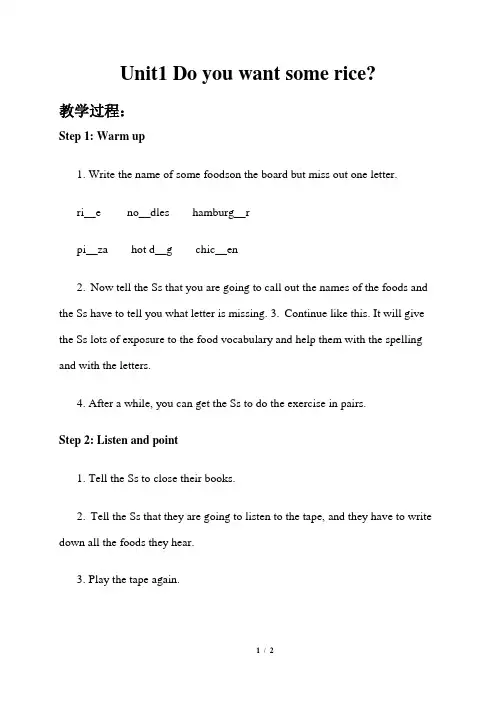
Unit1 Do you want some rice?教学过程:Step 1: Warm up1. Write the name of some foodson the board but miss out one letter.ri__e no__dles hamburg__rpi__za hot d__g chic__en2.Now tell the Ss that you are going to call out the names of the foods and the Ss have to tell you what letter is missing.3.Continue like this. It will give the Ss lots of exposure to the food vocabulary and help them with the spelling and with the letters.4. After a while, you can get the Ss to do the exercise in pairs.Step 2: Listen and point1. Tell the Ss to close their books.2.Tell the Ss that they are going to listen to the tape, and they have to write down all the foods they hear.3. Play the tape again.4. Ask the Ss to tell you all the foods they heard and write them down on the board.5.Now tell the ss to open their books and play the story again.This time ge t them to follow in their books.Step 3: Point, ask and answer.1. Use the pictures to do some extra work on vocabulary.2. Tell the Ss that you are going to call out the names of the foods and they have to point at them in their books.3. After a while you can get the Ss to do the same in pairs. One calls out a food and the other points at it.Step 3: Teaching tip.Tell the ss to draw a picture of a food they like. It can be a simple picture but they must know the word in English.Now call out two names or point to two ss. The ss stand up and hold up their pictures.Student A says what Student B is hold ing and s B says what sA is holding,The two ss sit down and the teacher calls ou t another two names.。
新外研版四年级英语上册Module4《In the Park》第1课时 Unit1教案.doc
Module4《In the Park》第1课时Unit1教案一、教学目的1.学习询问他人正在做什么事情。
2.描述他人正在做的事情。
3.学生能够听、说、认boat chess row soybean milk drink hungry 。
4.通过创设和谐的氛围,让孩子们轻松愉快地学习英语,并形成良好的英语语感。
二、教学重难点1.教学重点:学说问句What are they doing?掌握句型They're 动词+ing [+宾语]2.教学难点:能清晰准确地发出本课所教的单词的音,并自如地应用。
三、教学准备:卡片、象棋、豆奶。
四、教学过程:(一)Warming up师生齐唱M2 中的小诗,并配以动作。
(二)Revision1.教师快速向学生出示几组词,每组包含一个动词,请学生说出这个动词。
师板书:read , write ,listen ,play , talk …2.请学生说这些动词的-ing形式。
3.齐读黑板上的动词及其-ing形式。
(三)Presentation1、学习新句型(1)请一学生挑选黑板上所提供的任一动词,做出相应的动作。
(2)教师通过提问:What is he/ she doing ?复习He's/ She's 动词+ing [+宾语]。
(3)请该生所在组的成员模仿该生的动作,并做动作边说:I'm动词+ing[+宾语]。
(4)教师故作不解状问:What are they doing ? 后又释然说:Oh. They're动词+ing [+宾语],并板书。
(5)教师指着黑板上的句子,请学生跟说多遍。
(6)再请一组学生挑选黑板上所提供的任一动词(不能重复),做出相应的动作,教师请其他学生回答问题:What are they doing ? 然后教师把正确答案写在黑板上。
(7)请学生一起认读黑板上的句子。
2、学习新动词(1)告诉学生,教师将要模仿一个动作,他们要猜猜教师正在做什么。
新外研版四年级英语上册《Module4 Unit1》精品教案
《Module4 Unit1》精品教案一.教学目标1. 知识目标1)掌握并运用单词:Chinese fast food want some make nice chopsticks difficult2) 熟练运用句型:“Do you want some ……?”“Yes, please. / No, thank you”、“Have you got……?”“Yes, I have. / No, I haven’t.”2. 能力目标能运用所学的语言知识在创设的情境中进行熟练的交际,并在此基础上能将其应用于日常生活之中。
3. 情感目标通过学习和了解中国和西方的食物和饮食文化差异,激发学生学习英语的兴趣,帮助学生树立学好英语的信心,增强学生的参与意识,引导学生积极与他人合作,共同完成学习任务,并在成功中体会英语学习中的乐趣和跨文化交际的能力。
二、教学重难点:1.教学重点:掌握句型Do you want some...?Yes, please. No, thank you.并能就食物的选择向他人提问或回答他人。
2.教学难点:chopsticks、difficult的发音及新句型的运用。
三、教学准备实物图片、磁带、单词卡四、教学过程step1、Warming up1 、Greetings2、RevisionT: Today we will learn the new lesson. First, let's review some words of food.( 复习以前学过的食物的单词,全体学生齐读一次。
)3、Free talkT: Can you tell me what your favorite food is? My favorite food is noodles, what is yours?S:My favorite foot is chicken.T: Chicken is very nice. (教学nice)句型:Have you got _____ in these days? Yes, I have. / No, I haven’t.(此处的教授要迅速,简明,以免时间不足)step2、presentation and practice1、T:I have got some nice food.Look.(Show the food cards and ask)T:Noodles、rice、dumplings、hamburgers and hot dogs are fast food.(Show the card and read “fast food”)And noodles、rice、dumplings are Chinese fast food.(explain “Chinese fast food”)Yes,hamburgers,hot dogs and sandwiches are Western fast food.2、T: dumplings、noodles and rice are Chinese fast food . Do you like Chinese fast food?Ss:...教学Chinese / fast food(小火车读)3、T: Boys and girls, look at me please, what foot I is this?Ss: Noodles.T: Yes, you are right. I like noodles. Do you know how to making noodles? Ss:...T:(出示图片)Look, what is he doing? X k B 1 . c o mSs:…..T: He's making noodles.(随机教学making noodles)4、T: I want some noodles. What do I need? (用体态语帮助学生理解句意,同时拿出筷子)S:T: Yep, chopsticks.教学chopsticks (把单词为两个部分chops / ticks)告诉学生这个词语用复数5、T: Chopsticks are difficult. 教学difficult (个人读,小组读,齐读)6、教授句型Do you want some...?Yes, please. No, thank you.T: Do you want some...?1)板书Do you want some...?2)引导学生回答Yes, please. No, thank you并板书7、practice /先个别后整体/1)老师轮流指着实物图片提问Do you want some...?2)全班开火车操练8、听课文录音Listen to the text and answer the questions:1. Does Amy want some rice?2. What is the man doing?3. Are chopsticks difficult for Amy?全班跟读3遍,分角色跟读并表演。
外研版小学英语四年级上册Module4Unit1教案(教学设计)
外研版小学英语四年级上册Module4Unit1教案(教学设计)Unit1 参考教案一、学情分析:四年级学生对英语的学习已有一定的基础,在学习的过程中尽可能多地创造较好的语言环境,给学生充足的语言“习得机会”,让学生大胆实践,积极参与,形成积极的情感态度和自主学习的能力。
二、教学准备与分析:1.教学内容学生用书:第五模块第一单元2.教学目标技能与知识目标(1)基本能听懂会说Chinese、fast food、want、some、make、chopsticks等词汇。
基本能听懂会说Do you want…?Yes ,please . /No, t hank you .What is he doing ?He's making noodles .句型。
(2)谈论中国和西方的食物。
素质教育目标(1)通过学习,使学生逐渐培养学习英语的兴趣和爱好,在真实环境中使用英语进行交际的积极性。
(2)通过学习,使学生能运用英语在日常生活和课堂情景中与老师和同学进行初步的口语交际。
3.教学重点能听懂并说出Do you want…?Yes ,please . /No, thank you.句型。
4.教学难点(1)教授多音节词(2)能运用所学句型进行扩展性的情景会话。
5.教学任务(1)学习Chinese、fast food、want、some、make、chopsticks等词汇。
(2)学习Do you want…?Yes ,please . /No, thank you .What is he doing ?He's making noodles .How much is it?句型。
(3)运用“Do you want…?Yes ,please . /No, thank you .What is he doing ?He's making noodles .How much is it?It’s…句型”。
Module4Unit1教案4-新标准(一起)小学英语四年级上册
Chinese people didn’t invent…
五、Sum-up
Make the students to sum up the main part of this class.
Let the students get ready for the
作业设计与拓展
1.Listen to the tape p14-15 and repeat the sentences
2.Copy the new words 5 times
教学反思
1.The students can compare the two tense and use them correctly( v-ed v)
Explain: important重要的
invention发明
T: So today we’ll learn something about the invention of ancient China. Watch TV, answer:
T: You know paper and printing are inventions. So, who invented paper and printing?
2.Be able to listen and repeat the dialog and understand the meaning.
3.Be able to use the past tense correctly.
课前准备
vcd powerpoint flash cards tape recorder
2.The students can use the words“didn’t”correctly.