
(完整版)人教版七年级英语下册unit3知识点
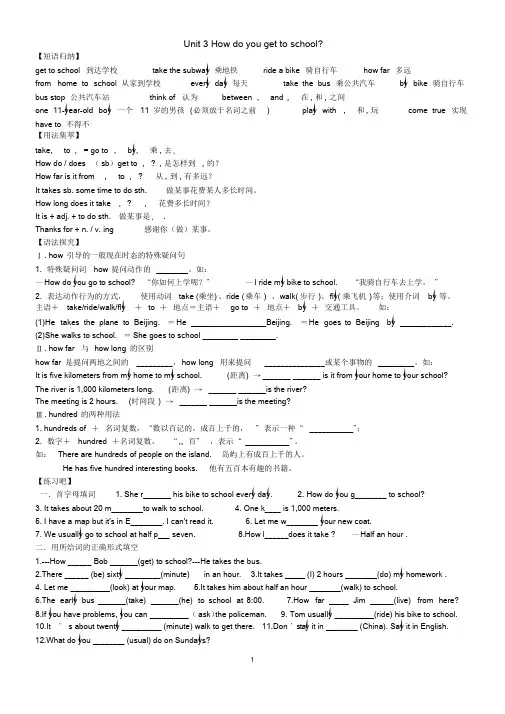
1 Unit 3 How do you get to school? 【短语归纳】 get to school 到达学校 take the subway 乘地铁 ride a bike 骑自行车 how far 多远 from home to school 从家到学校 every day 每天 take the bus 乘公共汽车 by bike 骑自行车 bus stop 公共汽车站 think of 认为 between … and … 在…和…之间 one 11-year-old boy 一个11岁的男孩(必须放于名词之前) play with … 和…玩 come true 实现 have to 不得不 【用法集萃】 take… to …= go to … by… 乘…去… How do / does (sb)get to …? …是怎样到…的? How far is it from … to …? 从…到…有多远? It takes sb. some time to do sth. 做某事花费某人多长时间。 How long does it take …? … 花费多长时间? It is + adj. + to do sth. 做某事是…. Thanks for + n. / v. ing 感谢你(做)某事。 【语法探究】 Ⅰ. how引导的一般现在时态的特殊疑问句 1. 特殊疑问词how提问动作的________。如: —How do you go to school? “你如何上学呢?” —I ride my bike to school. “我骑自行车去上学。” 2. 表达动作行为的方式, 使用动词take (乘坐)、ride (乘车) 、walk(步行)、fly(乘飞机)等;使用介词by等。 主语+ take/ride/walk/fly + to + 地点=主语+ go to + 地点+ by + 交通工具。 如: (1)He takes the plane to Beijing. =He ___________________Beijing. =He goes to Beijing by _____________. (2)She walks to school. =She goes to school _________ _________. Ⅱ. how far 与 how long的区别 how far是提问两地之间的_________,how long 用来提问 _______________或某个事物的_________。如: It is five kilometers from my home to my school. (距离) →_______ _______ is it from your home to your school? The river is 1,000 kilometers long. (距离) → _______ _______is the river? The meeting is 2 hours. (时间段) → _______ _______is the meeting? Ⅲ. hundred的两种用法 1. hundreds of + 名词复数,“数以百记的,成百上千的,”表示一种“___________”; 2. 数字+ hundred +名词复数, “……百”,表示“___________”。 如: There are hundreds of people on the island. 岛屿上有成百上千的人。 He has five hundred interesting books. 他有五百本有趣的书籍。 【练习吧】 一.首字母填词 1. She r_______ his bike to school every day. 2. How do you g________ to school? 3. It takes about 20 m________to walk to school. 4. One k____ is 1,000 meters. 5. I have a map but it's in E________. I can't read it. 6. Let me w________ your new coat. 7. We usually go to school at half p___ seven. 8.How l______does it take ? —Half an hour . 二.用所给词的正确形式填空 1.---How ______ Bob _______(get) to school?---He takes the bus. 2.There ______ (be) sixty _________(minute) in an hour. 3.It takes _____ (I) 2 hours ________(do) my homework . 4. Let me __________(look) at your map. 5.It takes him about half an hour ________(walk) to school. 6.The early bus _______(take) _______(he) to school at 8:00. 7.How far _____ Jim ______(live) from here? 8.If you have problems, you can __________(ask)the policeman. 9. Tom usually __________(ride) his bike to school. 10.It’s about twenty __________ (minute) walk to get there. 11.Don’t say it in ________ (China). Say it in English. 12.What do you ________ (usual) do on Sundays? 2
一、单项选择 1. does it take to get to school? Twenty minutes. A. How B. How far C. How long D. How many 2. 一 it from the radio station? 一It’s about 5 kilometers. A. How long B. How far C. How much D. How many 3.一How do you school?一I take the train. A. get B.get to C. arrive D.arrive to 4.I walk to school every day.____? A. What about you do B. What do you C. How about you D. What about your 5. How do the students get to school Monday morning? A. on B.in C. at D.for 6一 your teacher____home? 一Yes, she does. A. Do; drive B.Does; drive C. Do; drives D. Does; drives 7. He has to take a boat to work. A. get B.to get C. got D. gets 8. 一How does your father go to work? 一He a bus there every day. A.takes B.ride C. walks D. goes 9.一How many Chinese players (运动员) are there in the 2012 London Olympics (奥运会) ? 一About . A.three hundred B.three hundreds C.three hundred of D.three hundreds of 10.How do you get____from the bridge? 一On a ropeway. A. to home B. to school C.to here D. the room 11. Nancy loves stories for children. A. write B. writes C. to write D. wrote 12. How long it to get to his home? A.do; take B. do; takes C. does; take D. does takes 13. Mr Han has a son and he is happy. A. 3 year old B. 3-year-old C. 3-years-old D. 3 years old 14. What do you this new club,? It’s nice and big. A. get to B. think of C. live to D. go to 15.It usually takes about ten minutes ____to school. A. by bike B. on a bike C.to ride D. ride 二、句型转换,每空一词 1. They go to school by train.(就画线部分提问) do they to school? 2.It takes about 20 minutes to go there by bus.(就画线部分提问) does it to go there by bus? 3.It’s 5 kilometers from my home to school.( 就画线部分提问) is it from home to school? 4. The boy often rides bike to school. (改为一般疑问句) 5.1 need to see my friend.(就划线部分提问) do you need ? 三、根据句意填写疑问词组,完成下列句子,每空一词。 1. 一 people are there in the picture? 一Six. 2. 一 does she read every day? 一Three hours. 3. 一 does he have music class? 一Twice a week. 4. 一 is it from our school to here? - About 1,000 kilometers. 5. 一 money does Linda want 一 1,000yuan. 四、根据汉语提示完成句子。 1. The boy is only six (岁)old,but he can play the guitar. 2. You can take the bus to the train ( 车站). 3. How many (小船) can you see? 4. My (梦想)is to go to France in 20l3. 5. My sister doesn’t go on a ropeway, she is very (害怕)。 五、用所给单词的正确形式填空。 1. Can you tell me how (get) your home. 2 .The two (bridge.) are too old. The villagers want two new ones. 3. Larry and Dick are waiting for you at the bus ( stop). 4. Lin Yue wants to know where David (live). 5. The boy (cross) the river. 6.It is easy (write) a story in English. 7. The Brown likes (see) a film on the weekend. 8. (thank)for your help and I know how to do it.
人教版七年级下册英语Unit 3 知识点语法归纳总结

人教版七年级下册英语Unit 3 知识点语法归纳总结Unit 3 How do you get to school?In this unit。
we will learn how to talk about n and how to describe our daily commute to school.1.Phrases to remember:Get to school: Arrive at schoolTake the subway: Use the subway as nRide a bike: Use a bicycle as nHow far: The distance een two placesFrom home to school: The distance een home and schoolEvery day: DailyTake the bus: Use the bus as nLeave Beijing for Shanghai: Depart from Beijing to Shanghaieful sentences:How do you get to school。
I ride my bike to school.How far is it from your home to school?How long does it take you to get to school?For many students。
it is easy to get to school.age:1) How to express n:How do you get to school?When describing n。
we usually use ns such as "by" (without "a/the").BusThink ofeen。
人教版七年级英语下册Unit 3 重点知识点总结

人教版七年级英语下册Unit 3 重点知识点总结人教版七年级英语下册Unit 3 重点知识点总结Unit 3 Why do you like koalas?一、词组want to do sth .想要做某事want sb to do sth 想要某做某事want sth 想要某物Let sb do sth 让某人做某事d of 有几分种类a kind of 一种……years old …年龄如:ten years old 十岁like to do sth 喜欢做某事like doinglay with … 与...一起玩be quiet 安静during the day 在白天at night 在夜间have a look at.. 看…一个...另一个二、句型(1)、-why do you like pandas?-Because they’re very cu(2)、-Why dose he like koalas?-Becauare kindg.(3)、-Where are l?-Lions auth Africa.(4)、-What animals do you like?-I like elepha三、日常交际用语(1)、-Let’l(2)-Why do you walions?-Becaare very cu(3)-Do you like giraffes?I do./ No,I don’t(4)-Whaanimal do you like?_I like dog+ 名词的复数.表示没有特定的数量范围+名词的复数表示有特定的数量范围.(5)-Why are you looking at me?-Because you are very cu(6)-Let us play games. –Great!L。
人教版七年级英语下册unit3知识点
Unit 3 How do you get to school?【短语归纳】get to school 到达学校take the subway 乘地铁ride a bike 骑自行车how far 多远from home to school 从家到学校every day 每天take the bus 乘公共汽车by bike 骑自行车bus stop 公共汽车站think of 认为between , and , 在, 和, 之间one 11-year-old boy 一个11 岁的男孩(必须放于名词之前) play with , 和, 玩come true 实现have to 不得不【用法集萃】take, to , = go to , by, 乘, 去,How do / does (sb)get to , ? , 是怎样到, 的?How far is it from , to , ? 从, 到, 有多远?It takes sb. some time to do sth. 做某事花费某人多长时间。
How long does it take , ? , 花费多长时间?It is + adj. + to do sth. 做某事是, .Thanks for + n. / v. ing 感谢你(做)某事。
【语法探究】Ⅰ. how 引导的一般现在时态的特殊疑问句1. 特殊疑问词how 提问动作的________。
如:—How do you go to school? “你如何上学呢?”—I ride my bike to school. “我骑自行车去上学。
”2. 表达动作行为的方式,使用动词take (乘坐)、ride (乘车) 、walk( 步行)、fly( 乘飞机)等;使用介词by 等。
主语+take/ride/walk/fly +to +地点=主语+go to +地点+by +交通工具。
如:(1)He takes the plane to Beijing. =He ___________________Beijing. =He goes to Beijing by _____________.(2)She walks to school. =She goes to school _________ _________.Ⅱ. how far 与how long 的区别how far 是提问两地之间的_________,how long 用来提问_______________或某个事物的_________。
人教版英语七年级下册单元Unit 3 知识点+测试卷+思维导图
Unit 3 How do you get to school?1.重点词汇:new, every, drive, live, stop, cross, many, like, leave, true, dream2. 短语归纳:1.get to school 到达学校2.take the subway 乘地铁3.ride a bike 骑自行车4.how far 多远5.from home to school 从家到学校6.every day 每天7.take the bus 乘公共汽车8.by bike 骑自行车9.bus stop 公共汽车站10.think of 认为11.between … and … 在……和……之间12.one 11-year-old boy 一个11岁的男孩13.play with … 和……玩e true 实现15.have to 不得不3. 必背典句:1. How do you get to school? I ride my bike.2. How far is it from your home to school?3. How long does it take you to get to school?4. For many students, it is easy to get to school.5. There is a very big river between their school and the village.6. how about 征求意见7. how many /how much/how old/how far/how long/how often/how soon 4.语法知识:How开头的特殊疑问句1.询问动作执行的方式手段,“怎样”2.询问动作执行的程度“怎样”3.询问身体How are you?4.第一次见面How do you do?5.how组成的特殊疑问词:How long问时间How far问距离How much问价格及不可数名词数量How many问可数名词数量,多少How old问年龄How often 问频率How soon问快慢人教版英语七下Unit 3 How do you get to school?单元测试卷(时间:90分钟分值:100分)一.单项填空(每小题1分,共10分)1.— do you like your new bike?—It’s cool.A.HowB.WhatC.WhereD.Why2.—Our class wins the English speaking contest.—Congratulations! You be very proud of it.A.canB.needC.wouldD.must3.He usually goes to school bike,but sometimes he goes to school foot.A.with;onB.on;byC.on;withD.by;on4.It them about half an hour to get to school every day.A.spendsB.costsC.paysD.takes5.—How do you go to the park?—I my bike there.A.driveB.rideC.getD.stand6.—I have to get to the airport at 10:00 but it’s 9:40 now.— ! I can send you there by car.A.Thank youB.Hurry upC.Don’t worryD.Try your best7.When it rains, I a taxi to the post office.A.makeB.takeC.bringD.want8.— is it from your home to the bank?—Three miles.A.How farB.How muchC.How soonD.How long9.—How far is your teacher’s home from here?—It’s about two drive.A.hour’sB.hoursC.hours’D.hour10.How does she Shanghai?A.reachesB.arrive atC.get toD.gets二.完形填空(每小题2分,满分20分)Tom 1 near the sea. Their house is not very high, but it is beautiful. There 2 big trees and a small garden in front 3 their house.They plant flowers in the garden. Some are red, some are white 4 some are blue. Tom and his family love 5 garden very much.6 Tom and his sister go to school7 bus. The bus is comfortable. There are air conditioners in the bus. And it is a double decker bus. After school,they sometimes help their mum8 some shopping at the Shopping Centre, and sometimes help their dad in the garden. At weekends, they often take some photos by the sea.9 summer, they often go swimming 10 their parents.1.A.lives B.lived C.living D.liveing2.A.are B.is C.was D.be3.A.to B.for C.at D.of4.A.but B.or C.at D.and5.A.they B.them C.their D.theirs6.A.All B.Both C.Some D.Two7.A.on B.by C.take D.sit8.A.do B.doing C.does D.did9.A.In B.On C.At D.To10.A.and B.for C.of D.with三.阅读理解(每小题2分,满分30分)AHello, everyone! I’m Kathy. I live in Washington, D.C. I’m in Grade 8. I spend about half an hour on my homework every day. My homework this week is to find out how much homework students have now. Please tell me about your homework on the website.1. Why does Kathy want others to tell her about their homework?A. Because she wants to know about her classmates.B. Because she wants to make friends on the Internet.C. Because she wants to finish her homework.D. Because she wants to find someone to do her homework.2. What will Linda do if she has problems with her homework?A. Ask her brother for help.B. Ask her teacher for help.C. Use the Internet for help.D. Discuss them with her friends.3. ____ spends the most time on homework.A. KathyB. BenC. LindaD. Jack4. Which two students are in the same grade?A. Kathy and Linda.B. Linda and Jack.C. Ben and Jack.D. Kathy and Jack.5. How many of the four students use the Internet for homework?A. OneB. TwoC. ThreeD. FourBSome children are flying kites near the river. They are very high and Peter can see them fromthe classroom. After lunch his aunt comes to see his mother and brings a kite to him. It looks like a bird. He wants to fly it but his mother doesn’t let him do that.“It’s time to go to school,” says his mother, “You can fly it after dinner.”The boy is unhappy, and says goodbye to his aunt and leaves. Now he is in the classroom but he doesn’t listen to Miss Black. He only thinks how to fly the kite. Miss Black writes something on the blackboard and then turns to the class.“Name(说出……的名字) nine things with milk in them, Peter.” she says.The boy doesn’t hear her and still sits there. A boy in Row 4 beats(敲打)his back and he knows it. He stands up and Miss Black asks him the question again. He thinks for some time and then says, “Yes, madam, tea, coffee, cake and…er… six cows(奶牛).”1. There is ____ near Peter’s school.A. a bankB. a riverC. a lakeD. a park2. In the classroom, Peter can see ____.A. some children swimming in the parkB. his aunt buy a kite for himC. some students reading beside the lakeD. some children flying kites near the river3. ____ comes to visit his mother after lunch.A. Peter’s teacherB. Peter’s friendC. Peter’s cousinD. Peter’s aunt4. Peter’s mother tells him to fly the kite ____.A. at breakfastB. in the classroomC. after dinnerD. in school5. In class, Peter only thinks ____.A. his teacher’s wordsB. what the kite looks likeC. how to fly the kiteD. how to answer the teacher’s questionCIf you go to Hong Kong by air, you will arrive at Hong Kong International Airport.Because there was not enough land, this was built (被建造)out into the sea.It is in the part of Hong Kong called Kowloon.Kowloon is one of the two big cities in Hong Kong.The other city is Hong Kong itself.It is on an island.You can get there by ship or through a tunnel(隧道)under the sea.Much of Hong Kon g is farmland and mountains.The population of Hong Kong is over six million.Chinese and English are spoken by many people.Clothes,computers,radios and TVs are made in Hong Kong.You can buy all kinds of things,such as watches and computers there.People from all over the world travel to Hong Kong every year.You can watch dog racing or motor racing.Some places are quiet and beautiful.When you are hot and tired,there are small cool gardens to rest in.There are also a lot of hotels to live in.Hong Kong is also a good place for wonderful Chinese food.You can enjoy many kinds of food,for example,fish,vegetables and the famous Beijing Duck.There is certainly a lot to see and to do in Hong Kong.1.The airport was built out into the sea because .A.it is near the seaB.there was not enough landC.planes arrive safelyD.it would be good2.Kowloon is .A.the name of a countryB.the name of an airportC.one of the two big cities in Hong KongD.a big city under the sea3.Most people in Hong Kong speak .A.neither Chinese nor EnglishB.Chinese onlyC.English onlyD.Chinese and English4.There are travelers in Hong Kong every year.A.a lot ofB.fewC.severalD.some5.The main idea(大意)of the fourth paragraph is “ ”.A.Dog racing is interestingB.Beijing Duck is famousC.Chinese food is famousD.Hong Kong is a good place for traveling四.任务型阅读(每题2分,共10分)The new school term is coming. Now the school clerks are planning a new timetable for Class 5,Grade 7.There are six classes every day,four in the morning and two in the afternoon. The students have a math class every day. And they have seven English classes in a week. Two of them are given by a foreign teacher and should be arranged(安排)together on Thursday morning.There are five Chinese classes in a week. Two of them should also be arranged one after the other for the students to write their compositions.They have two physics classes in a week but on different days. Besides these,there is an art class every Wednesday afternoon.It’s necessary and important for students to take enough exercise. So they have two PE classes every week. And they can do outdoor activities after school every afternoon.阅读短文内容后,将下面的课程表补充完整。
人教版七年级下册英语知识点复习(完整版)
人教版七年级下册英语知识点复习(完整版) Unit 1 Can you play the guitar?1,情态动词+V原can do= be able to do2,Play+ the+ 乐器+球类,棋类3,join 参加社团、组织、团体4,4个说的区别:say+内容Speak+语言Talk 谈论talk about sth talk with sb talk to sbTell 告诉,讲述tell sb (not)to do sthTell stories/ jokes5,want= would like +(sb)to do sth6,4个也的区别:too 肯定句末(前面加逗号)Either否定句末(前面加逗号)Also 行前be 后As well 口语中(前面不加逗号)7,be good at+ V-ing=do well in 擅长于be good for 对…有益(be bad for对…有害)be good to 对…友好(good 可用friendly,nice,kind替换)be good with和…相处好=get on/ along well with8,特殊疑问句的构成:疑问词+一般疑问句9,How/ what about+V-ing …怎么样?(表建议)10,感官动词(look, sound, taste, smell, feel)+adj/ like11,选择疑问句:回答不能直接用Yes或者No,要从中选择一个回答12,students wanted for school show(wanted表示招募,含有被动意义)13,show sth to sb=show sb sth give sth to sb=give sb sth14,help sb (to)do sthHelp sb with sthWith sb’s help= with the help of sbHelp oneself to 随便享用15,be busy doing sth/ be busy with sth16,need to do sth17,be free= have time18,have friends= make friends19,call sb at +电话号码20,on the weekend= on weekends21,English-speaking students 说英语的学生(带有连词符,有形容词性质)22,do kung fu表演功夫Unit 2 What time do you go to school?1,问时间用what time或者whenAt+钟点at 7 o’clock at noon/ at night(during/ in the day)On+ 具体某天、星期、特指的一天on April 1st on Sunday on a cold winter morningIn +年、月、上午、下午、晚上2,时间读法:顺读法逆读法:分钟≤30用past five past eight(8:05)half past eight(8:30)分钟>30用to a quarter to ten(9:45)整点用…o’clock 7 o’clock(7:00)3,3个穿的区别:wear 表状态,接服装、手套、眼镜、香水等Put on 表动作,接服装Dress 表动作,接sb/ oneself get dressed穿衣3,感叹句:How+adj+主谓!How+adj+a/an +n单+主谓!What+ a/an +adj+ n单+主谓!What+ adj+ n复/ 不可数+主谓!4,from…to…5,be/ arrive late for6,频度副词(行前be 后)Always usually often sometimes seldom hardly never7,一段时间前面要用介词for for half an hour for five minutes8,eat/ have…for breakfast/ lunch/ dinner/ supper9,either…or10,a lot of=lots of11,it is +adj+for sb +to do sth (adj修饰to do sth)It is important for me to learn English.it is +adj+of sb +to do sth (adj修饰sb)It is kind/ friendly/ nice of you to help me.Unit 3 How do you get to school?1,疑问词How 如何(方式)how long 多长(时间)答语常用“(For/ about +)时间段”how far多远(距离)答语常用“(It’s +)数词 +miles/ meters/ kilometers”how often多久一次(频率)答语常用“Always/ often/ every day/…”或“次数+时间”等表频率的状语How soon多快,多久以后,常用在将来时中。
期末复习人教版七年级英语下册unit3解析词汇、句型解析及练习(有参考解析)
期末复习人教版七年级英语下册unit3解析词汇、句型解析及练习Unit3 How do you get to school?01词汇讲解1. subway1)subway 在美式英语中意为“地铁”。
更常用“take the subway”或者“go by subway”表示“乘坐地铁”,而一般不用“take a subway”或者“go by a/the subway”。
例如:Let’s go by subway. 让我们乘地铁去吧。
You can take the subway to come to my house.你可以坐地铁来我家。
2)subway在英式英语中意为“地下通道”。
英式英语的“地铁”是“the underground”。
例如:We travelled across London on the underground.我们乘地铁穿过伦敦。
3)subway train 指“地铁列车”; subway station指“地铁站”。
例如:I’m on a subway train. I can’t hear you clearly.我在地铁上呢,听不清楚你说话。
It takes me 15munites to walk to the nearest subway station from my home.从我家步行到最近的地铁站需要15分钟。
2. ride1)ride 做名词时,意为“(乘坐汽车等的)旅行;乘骑;(乘车或骑车的)短途旅程”等。
常用于词组:go for a ride (去兜风) give sb. a ride (让……搭车)。
例如:Can you give me a ride to the market?你能让我搭车去市场吗?I’d like to go for a ride.我想出去兜兜风。
How much is a ride? 乘一次多少钱?2)ride做动词,意为“乘车,乘坐,搭乘”。
人教版英语七年级下册Unit 3 - Section B教材全解知识点课件
课中讲解 二 Passage
“I love to play with my classmates. And I love my teacher. He’s like a father to me.” • love to do sth. 喜爱做某事/ love doing sth. • play with 玩,与…玩耍 • like 像 be like 多指在性格、品质方面像,也可指外貌上像 look like 看起来像,指外观或外貌上像
Unit 3 - Section B
上时间: 老师:
课中讲解 一 Words
stop n. 车站 station 在公共汽车站 at the bus stop v. 停止 stop to do sth stop doing sth
cross v.越过,横过 = go across n. crossing 十字路口 cross n. 十字形,叉形记号
课中讲解 二 Passage
One 11-year-old boy, Liangliang, crosses the river every school day. But he is not afraid because he loves school. • afraid 害怕,畏惧 be afraid of sth. 害怕某事/某物 be afraid to do sth. 害怕做某事 be afraid of doing sth害怕做某事 be afraid + that 从句 I’m afraid that he can’t come.
课中讲解 二 Passage
One 11-year-old boy, Liangliang, crosses the river every school day. But he is not afraid because he loves school. • 复合形容词 11-year-old “数词 + 连字符 + 名词” I have a two-month holiday. • school day 上学日 holiday vacation weekend I must do my homework on school days.
七年级下册英语人教版unit3知识点
七年级下册英语人教版unit3知识点Unit3是七年级下册英语人教版中的一篇文章,学习这篇文章需要了解以下知识点:一、单词和短语1. wake up:醒来2. get dressed:穿衣3. brush teeth:刷牙4. have breakfast:吃早餐5. go to school:去上学6. a glass of:一杯7. some milk:一些牛奶8. a bowl of:一碗9. cereal:谷物类食品10. toast:烤面包11. bacon:熏肉12. egg:鸡蛋13. porridge:粥14. apple:苹果15. banana:香蕉16. grape:葡萄17. orange:橙子18. pear:梨19. strawberry:草莓20. watermelon:西瓜21. Where is / are…?:……在哪里?22. It’s on / under / in / behind…:它在……上面 / 下面 / 里面 / 后面。
23. Let’s…:让我们……二、句型1. What would you like for breakfast?:早餐你想吃什么?2. I’d like / love…:我想要 / 喜欢……3. What do you have for breakfast?:你早餐吃什么?4. I have / don’t have…:我有 / 没有……5. What time do you get up?:你什么时间起床?6. I get up at…:我在……起床。
7. What time do you start school?:你几点开始上学?8. I start school at…:我在……开始上学。
9. Where are my socks?:我的袜子在哪里?10. They’re under the bed.:它们在床底下。
11. Let’s brush our teeth.:让我们刷牙吧。
人教版七年级下册英语Unit 3单元知识点讲义(学生版)
七年级下册英语Unit 3知识点与语法精讲精练词汇梳理(一)完成单词梳理:名词:1. 火车 2. 公共汽车 3. 地铁4. 自行车5. 分钟6. 千米;公里7. 小汽车;轿车8. 车站;停止9. 河;江10. 村庄;村镇11. 桥12. 小船13. 索道14. 年;岁15. 村民动词:1. 开车 2. 居住;生活 3. 横过;越过4. 离开;留下数词:1. 六十 2. 七十 3. 八十4. 九十5. 一百介词:1. (表示方式)乘(交通工具) 2. 介于……之间3. 像;怎么样形容词:1. 新的;刚出现的 2. 每一;每个3. 害怕;畏惧4. 真的;符合事实的兼类词:1. (v)骑(n)旅程 2. (adv/adj)远;远的3. (adj/pron)许多4. (n)梦想;睡梦(v)做梦(二)词汇变形小结:1.bus公共汽车(n.) → ____________ (复数)2.drive 开车(v.) → ____________ (n.)驾驶员→ ____________ (现在分词)3.live 居居居居居(v.)→ ____________(n.)生活;生命→ ____________ (现在分词)4.cross 居居居居居(v.) →____________(n.)居居居居→____________(prep.)居居居居居5.village 居居居居居(n.) → ____________ (n.)居居6.leave 离开(v.) → ____________ (第三人称单数) → ____________ (现在分词)7.true 居居居居居居居居(adj.) → ____________ (adv.)居居居 → ____________ (n.)居居居居居8.dream 居居(n/v.) → ____________ (n.)居居居【练一练】用所给词的适当形式填空1.It's about five ____________ (kilometer) from Alice's home to school.2.Jim ____________ (live) in Beijing with his parents.3.Does he need ____________ ( clean ) the classroom now?4.—How about ____________ (play) soccer this afternoon?—Good idea.5.There are five school ____________ (bus) in our school.6.There are about 2,000 ____________ (village) in the village.7.Do you know the ____________ ( different ) between these two transportation?8.He ____________ (leave) home at 8:00 every day.9.I need three ____________ (hundred) dollars to buy the bike.10.My brother’s dream is to be a ____________ (drive).(三)短语攻关:乘火车/公共汽车/地铁到达骑自行车到学校多长时间多远每天骑自行车过得愉快公共汽车站点公共汽车车站需要做某事认为;想起在……和……之间乘索道实现;成为现实1. How do you get to school? 你是怎样到达学校的?【用法详解】知识点1: 重点:本句是how 引导的特殊疑问句,用来询问交通方式。
七年级下册英语unit3知识点人教版
七年级下册英语unit3知识点人教版本文将为大家介绍七年级下册英语unit3的知识点。
unit3主要涵盖了一些基础的英语语法和词汇。
下面我们将分别从以下五个方面来介绍这些内容:班级活动的用语、时间指示法、英文书信格式、形容词的用法及比较级和动词的时态。
接下来我们将逐一解释这些知识点。
班级活动的用语班级活动用语主要包括口语表达和书面表达两种形式。
口语表达主要应用在班级讨论、会议和通知等场合。
书面表达则主要应用在班级通知和邀请函等场合。
在班级活动表达中,需要使用到以下词汇:1. organize(组织)2. attend(参加)3. schedule(计划)4. postpone(推迟)5. cancel(取消)6. remind(提醒)除了这些常用词汇之外,还需要注意词语的用法和句式的结构。
例如:1. We need to organize a meeting to discuss the arrangement of the class party.2. I am unable to attend the meeting due to my illness.3. We have scheduled the meeting to take place on Friday afternoon.4. The meeting has been postponed until next Monday.5. We are sorry to inform you that the class party has been cancelled.6. Just a friendly reminder that the meeting will be held at 2pm on Friday.时间指示法时间指示法是英语语法中非常重要的部分。
在日常生活中,我们需要了解时间的具体表达方法。
以下是一些常用的时间指示法:1. at(表示具体时间点)2. on(表示具体日期或星期几)3. in(表示一段时间)4. ago(表示多长时间之前)5. later(表示多长时间之后)6. before(表示在某个具体时间之前)7. after(表示在某个具体时间之后)需要注意的是,这些时间指示法在具体应用时需要结合具体的语境和句子结构。